CLARK, Anthony <http://orcid.org/0000-0003-3167-0739>, SAMMUT, Paul
and WILLANS, James
Available from Sheffield Hallam University Research Archive (SHURA) at:
http://shura.shu.ac.uk/11884/
This document is the author deposited version. You are advised to consult the publisher's version if you wish to cite from it.
Published version
CLARK, Anthony, SAMMUT, Paul and WILLANS, James (2015). Applied metamodelling : a foundation for language driven development. arXiv.org.
Copyright and re-use policy
A F
OUNDATION FOR
L
ANGUAGE
D
RIVEN
D
EVELOPMENT
T
HIRD
E
DITION
Tony Clark, Paul Sammut, James Willans
Preface (Third Edition) ix
Preface (Second Edition) xi
Preface (First Edition) xiii
1 Language-Driven Development 1
1.1 Challenges Facing Developers Today . . . 1
1.1.1 Coping with Complexity . . . 2
1.1.2 The Challenge of Diversity . . . 3
1.1.3 The Only Constant is Change . . . 4
1.2 Language-Driven Development - Providing the Solution . . . 5
1.2.1 Languages are the Future . . . 5
1.2.2 Rich Organised Abstraction . . . 6
1.2.3 Appropriate Abstraction Through Multiple Languages . . . 6
1.2.4 Integration - Weaving the Rich Tapestry of Languages . . . 8
1.2.5 Evolvability - The Key to Managing Change . . . 9
1.2.6 Language-Driven Development - The Complete Solution . . . 9
1.3 From Model-Driven to Language-Driven Development . . . 10
1.3.1 The Unified Modelling Language . . . 10
1.3.2 MDA . . . 12
1.4 Language Engineering and Metamodelling . . . 13
1.5 Conclusion . . . 14
2 Metamodelling 15 2.1 Introduction . . . 15
2.2 Features of Languages . . . 15
2.2.2 Abstract Syntax . . . 16
2.2.3 Semantics . . . 17
2.2.4 Mappings . . . 18
2.2.5 Extensibility . . . 18
2.3 Modelling Languages vs. Programming Languages . . . 18
2.4 What is a Metamodel? . . . 19
2.5 Why Metamodel? . . . 20
2.5.1 Metamodels and Tools . . . 20
2.6 Where do you find Metamodels? . . . 21
2.7 Metamodelling Languages . . . 21
2.8 Metamodel Architectures . . . 22
2.8.1 Traditional Metamodel Architecture . . . 22
2.8.2 Golden Braid Metamodel Architecture . . . 23
2.9 The Metamodelling Process . . . 24
2.10 Five levels of Metamodelling . . . 25
2.11 Conclusion . . . 26
3 A Metamodelling Facility 27 3.1 Introduction . . . 27
3.2 Requirements of a Metamodelling Facility . . . 27
3.2.1 XMF . . . 28
3.3 XMF Features . . . 29
3.3.1 Core OO Modelling Concepts . . . 29
3.3.2 Imports . . . 30
3.3.3 Constraints . . . 31
3.3.4 Queries . . . 31
3.3.5 Actions and XOCL . . . 32
3.3.6 Instantiation . . . 34
3.3.7 Concrete Syntax . . . 34
3.3.8 Mappings . . . 36
3.4 XMF Architecture . . . 39
3.4.1 XCore Metamodel . . . 40
3.5 Relationship to Existing Metamodelling Languages . . . 41
3.6 Conclusion . . . 42
4 Abstract Syntax 45 4.1 Introduction . . . 45
4.2 Modelling Abstract Syntax . . . 45
4.3 The Process . . . 46
4.3.1 Concept Identification . . . 46
4.3.2 Use Cases . . . 48
4.3.3 Concept Modelling . . . 48
4.3.5 Operations and Queries . . . 49
4.3.6 Validation and Testing . . . 49
4.4 Case Study . . . 49
4.4.1 Identification of Concepts . . . 51
4.4.2 The Model . . . 52
4.4.3 Metamodel Reuse . . . 53
4.4.4 Well-formedness Rules . . . 54
4.4.5 Operations . . . 55
4.4.6 Validating the StateMachine Metamodel . . . 56
4.5 Conclusion . . . 57
5 Concrete syntax 59 5.1 Introduction . . . 59
5.2 Textual Syntax . . . 60
5.2.1 Parsing text using EBNF . . . 60
5.2.2 Parsing text using XBNF . . . 61
5.2.3 Building Abstract Syntax . . . 63
5.3 Diagrammatic Syntax . . . 67
5.3.1 Parsing Diagrams . . . 67
5.3.2 Building Abstract Syntax . . . 68
5.3.3 Building Diagrams from Abstract Syntax . . . 71
5.4 Conclusion . . . 72
6 Semantics 75 6.1 Introduction . . . 75
6.2 What is Semantics? . . . 75
6.3 Why Semantics? . . . 76
6.4 Semantics and Metamodels . . . 77
6.5 Approaches . . . 78
6.6 Translational Semantics . . . 78
6.6.1 Approaches . . . 79
6.6.2 Example . . . 80
6.7 Operational Semantics . . . 83
6.7.1 Example . . . 83
6.8 Extensional Semantics . . . 85
6.8.1 Example . . . 86
6.9 Denotational Semantics . . . 86
6.9.1 Example . . . 87
6.10 Process . . . 89
6.11 Conclusion . . . 90
7.2 Why Executable Metamodelling? . . . 91
7.2.1 Executability and XMF . . . 92
7.2.2 Executable Metamodelling and Programming . . . 92
7.3 Adding Executability . . . 93
7.3.1 XOCL Extensions . . . 94
7.4 Examples . . . 95
7.4.1 Example 1: Model Merge . . . 95
7.4.2 Example 2: Find and Replace . . . 96
7.4.3 Example 3: Walker . . . 97
7.4.4 Example 4: Meta-Patterns . . . 100
7.5 Conclusion . . . 101
8 Mappings 103 8.1 Introduction . . . 103
8.2 Applications Of Mappings . . . 104
8.2.1 Vertical Mappings . . . 104
8.2.2 Horizontal Mappings . . . 105
8.2.3 Variant Dimensions . . . 105
8.3 Types of Mappings . . . 106
8.3.1 Unidirectional Mappings . . . 106
8.3.2 Synchronised Mappings . . . 106
8.4 Requirements of a Mapping Language . . . 107
8.5 XMap . . . 108
8.6 XMap Syntax . . . 109
8.7 XMap Examples . . . 111
8.7.1 StateMachines to Java . . . 112
8.7.2 Mapping to XML . . . 116
8.8 Mapping Specifications . . . 120
8.9 Mapping Issues . . . 121
8.9.1 Merging . . . 121
8.9.2 Traceability . . . 122
8.10 XSync . . . 122
8.10.1 Examples . . . 123
8.11 Conclusion . . . 125
9 Reuse 127 9.1 Introduction . . . 127
9.2 Extension Based Approaches . . . 127
9.2.1 Specialisation . . . 128
9.2.2 Stereotyping, Tags and Profiles . . . 129
9.2.3 Package specialisation and Meta-Packages . . . 130
9.3 Translation Based Approaches . . . 133
9.4 Family of Languages . . . 134
9.5 The XCore Framework . . . 134
9.6 Conclusion . . . 136
10 Case Study 1: An Aspect-Oriented Language 139 10.1 Introduction . . . 139
10.2 AOL . . . 139
10.3 Language Definition Strategy . . . 140
10.4 Abstract Syntax . . . 140
10.4.1 Identification of Concepts . . . 140
10.4.2 Abstract Syntax Model . . . 141
10.5 Semantics . . . 141
10.6 Concrete Syntax . . . 143
10.7 Conclusion . . . 144
11 Case Study 2: A Telecoms Language 145 11.1 Introduction . . . 145
11.2 The Case Study: OSS/J Inventory . . . 145
11.3 Abstract Syntax Model . . . 147
11.3.1 Well-formedness Rules . . . 148
11.4 Concrete Syntax . . . 149
11.5 Semantics . . . 149
11.6 Instantiation . . . 150
11.7 Transformations . . . 152
11.8 Tool Mapping . . . 153
11.9 Conclusion . . . 154
12 Case Study 3: A Simple Programming Language 157 12.1 Introduction . . . 157
12.2 XAction . . . 157
12.2.1 XAction Values . . . 158
12.2.2 XAction Expressions . . . 160
12.2.3 XAction Statements . . . 162
12.3 An Evaluator for XAction . . . 165
12.3.1 Evaluating Expressions . . . 165
12.3.2 Evaluating Statements . . . 167
12.4 A Translator for XAction with Run-Time Types . . . 169
12.4.1 Translating Expressions . . . 169
12.4.2 Translating Statements . . . 171
12.5 A Translator for XAction without Run-Time Types . . . 173
12.5.1 Translating Expressions . . . 174
12.6 Compiling XAction . . . 178
12.6.1 Compiling Expressions . . . 178
12.6.2 Compiling Statements . . . 180
12.7 Abstract Syntax to Concrete Syntax . . . 182
12.8 Conclusion . . . 185
13 Case Study 4: Interactive TV 187 13.1 Introduction . . . 187
13.2 Interactive Application Architecture . . . 188
13.3 A DSL for Interactive Applications . . . 190
13.4 Implementation . . . 194
13.4.1 Syntax . . . 194
13.4.2 Semantics . . . 202
13.4.3 Handling Events . . . 209
13.5 Simulation . . . 210
13.6 XML Representation for Applications . . . 212
13.7 Conclusion . . . 214
14 Case Study 5: Graphs 217 14.1 Introduction . . . 217
14.2 A Model of Graphs . . . 217
(Third Edition)
The Third Edition of Applied Metamodelling represents a small increment since the Second Edition was produced in 2008. The book continues to be referenced in schol-arly articles with 212 citations on Google Scholar including neschol-arly 150 since 2008. The open-source release of the accompanying technologies XMF and XMF-Mosaic did not generate the same level of interest, partly due to a lack of exposure and associated tuto-rial matetuto-rials. Recently, interest in the field of multi-level modelling has increased and has led to publications [CGPHS14, Cla13, CB13, HSCGP13, CW12] and a Dagstuhl Sem-inar [CFG+
13] based on the ideas of meta-languages and tool-modelling. An overview of the historical development of XMF, the ideas in this book, and the the birth and death of an associated startup company has been published in [CM12] as part of the10th
(Second Edition)
Since publishing the first edition in 2004 we were pleasantly surprised by how much momentum Applied Metamodelling created. The fundamental tenets of the book have been cited in a large number of papers and books, and key ideas have been influential in a number of technology initiatives including the Eclipse Modeling Project [EMP08].
A recurring response that we commonly receive is a frustration that although the book gives readers the knowledge to apply metamodelling, they cannot easily do this using the XMF technology which was used to construct the examples in the book. This is about to change with the release of XMF as an open source technology in the first quarter of 2008.
(First Edition)
Modern day system developers have some serious problems to contend with. The systems they develop are becoming increasingly complex as customers demand richer functionality delivered in ever shorter timescales. They have to manage a huge di-versity of implementation technologies, design techniques and development processes: everything from scripting languages to web-services to the latest ’silver bullet’ design abstraction. To add to that, nothing stays still: today’s ’must have’ technology rapidly becomes tomorrow’s legacy problem that must be managed along with everything else. How can these problems be dealt with? In this book we propose that there is a com-mon foundation to their resolution:languages. Languages are the primary way in which system developers communicate, design and implement systems. Languages provide abstractions that can encapsulate complexity, embrace the diversity of technologies and design abstractions, and unite modern and legacy systems.
Language-Driven Development
mod-els that are rich enough to permit analysis and simulation of system properties before completely generating the code for the system. They can manipulate their models and programs in significantly more sophisticated ways than they can code. Moreover, pro-vided the language definitions are flexible, they can adapt their languages to meet their development needs with relative ease.
Metamodelling
In order to realise Language-Driven Development, we need the ability to rapidly design and integrate semantically rich languages in a unified way. Metamodellingis the way to achieve this. A metamodel is a model of a language that captures its essential proper-ties and features. These include the language concepts it supports, its textual and/or graphical syntax and its semantics (what the models and programs written in the lan-guage mean and how they behave). Metamodels unify lanlan-guages because the same metamodelling language is used in each case. Significant advantage can be made of this unification to construct powerful and flexible design environments for languages. These enable the rapid assembly of Language-Driven Development tools that give developers the power they need to design their systems faster, cheaper and more flexibly.
Purpose of this Book
The aim of this book is to advance the state of the art in metamodelling to the point at which it can realise the Language-Driven Development vision. Traditionally, metamod-elling has focused on the design of data centric models of language concepts. In this book, we go way beyond that, showing how they can capture all aspects of languages, including concrete syntax, abstract syntax and semantics in a sound and pragmatic way. This book also aims to fill a large gap in the metamodelling literature, providing a technically rich book on an a subject that is mentioned often, but for which there is little concrete material available. Metamodels are increasingly being used across wider application domains, and it is the intention that this book will provide good advice to metamodellers irrespective of the languages and tools they are using.
Scope of this Book
Intended Audience
This book should be useful to anyone who has an interest in the design of languages, language and model-driven development, and metamodelling. Our intention is that the book has an industrial focus, and we have tried hard to ensure that it is relevant to real practitioners. In particular, everything in this book has been implemented, therefore ensuring that it is has been tried and tested.
Relationship to Other Approaches
We do not claim that the ideas presented in this book are new. Approaches to rapidly designing languages in flexible ways have been around since the early days of LISP, ObjVLisp and Smalltalk. Meta-case tools have been widely touted as a means of design-ing tailored tools and languages. Efforts by the Object Management Group (OMG) to standardise facilities for capturing language meta-data are already influencing the way vendors build tools. More recently, work on domain specific languages has highlighted the benefits of rapidly designing languages targeted at specific application domains.
In this book we have combined many of these approaches on top of existing standards to facilitate the definition of languages in a general and complete way. An important emphasis has been on raising the level of abstraction at which complex aspects of lan-guage design such as the definition of concrete syntax and semantics are expressed. Thus wemodel languages, but in sufficient detail that these models can be turned into semantically rich development environments and tools. This capability has not been achieved in such a complete way before.
Organisation of this Book
This book is organised into three parts. The first and shortest part gives an overview of challenges facing the system development industry and proposes Language-Driven Development as a way forward to addressing those challenges.
The middle part provides a detailed treatment of metamodelling. It contains the fol-lowing chapters:
Metamodelling : introduces the key features of languages and describes what meta-models are and how they can capture those features.
A Metamodelling Facility : presents an overview of an executable metamodelling fa-cility that provides a number of powerful languages for capturing the syntax and semantics of languages.
Concrete Syntax : describes how the textual and diagrammatical syntaxes of language can be modelled.
Semantics : introduces semantics and the motivation for having them in language definitions. The chapter goes on to describe four different approach to describing semantics.
Executable Metamodelling : discusses how the addition of a small number of action primitives to a metamodelling language turn it into a powerful metaprogramming environment for Language-Driven Development.
Mappings : motivates and presents two languages for transforming and relating meta-models.
Reuse : this chapter describes a number of different approaches to reusing existing language metamodels.
The final part provides a number of indepth case studies each describing a specific example of metamodelling. These examples range from the design of a small general purpose language to a domain specific language for modelling interactive television based applications. The case studies are a significant resource for demonstrating meta-modelling best practice.
Acknowledgements
LANGUAGE-DRIVEN DEVELOPMENT
This chapter provides an introduction to Language-Driven Development. It outlines current problems facing software and systems developers today, and explains how an integrated architecture of semantically rich, evolvable languages can provide huge pro-ductivity benefits to industry.
Language-driven development is fundamentally based on the ability to rapidly de-sign new languages and tools in a unified and interoperable manner. We argue that ex-isting technologies do not provide this capability, but a language engineering approach based onmetamodellingcan. The detailed study of metamodelling and how it can realise the Language-Driven Development vision will form the focus for the remainder of this book.
1.1 Challenges Facing Developers Today
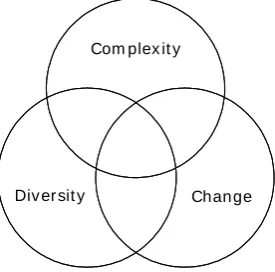
When discussing software and systems engineering, it is only a matter of time before the topic of managing complexity arises. The desire to manage complexity was the driv-ing force behind the emergence of the aforementioned disciplines, and despite many valiant attempts to master it, the problem is still with us today. However, we believe that the nature of today’s systems are quite different to those developed when those disciplines emerged, and in turn the developers of today’s systems face different chal-lenges to those in previous decades. In particular, it is no longer sufficient to manage complexity alone. Instead, we believe that most of today’s development challenges boil down to a combination of three important factors: complexity, diversity and change.
Com plex it y
[image:19.595.232.370.114.250.2]Change Div er sit y
Figure 1.1: Challenges Facing Developers Today
1.1.1 Coping with Complexity
As hardware costs have plummeted and development and manufacture techniques have improved, the demands for more sophisticated systems have been relentless. Of course, the more sophisticated the requirements of a system are, the larger and more complex the deployed system is likely to be. Increased system complexity typically brings with it the following problems:
• longer development times;
• more complex assembly due to number of components and number of people involved;
• increased cost and time for testing;
• increased maintenance costs.
Overall, this results in an increased time to market for any system, and increased development and maintenance costs in order for there to be any confidence that the quality of the system is not compromised.
For software systems, as well as the problems outlined above which relate to the fundamental increase in lines of code, there is an additional qualitative difference to the systems being developed today compared to those of decades past. Modern systems are increasingly distributed in nature, as demonstrated by the ubiquity of enterprise applications. This adds another dimension to software complexity, and brings added challenges of communication and security to those listed above.
1.1.2 The Challenge of Diversity
The challenge of diversity reflects how developers have to manage in a non-homogenous environment. Life would be much easier if there was only one programming language and one deployment platform, but of course this is not the case, and for very good rea-sons. Diversity is not really a single challenge, but a category of challenges, outlined below. Section 1.2.4 describes how diversity as a whole can be managed.
Diverse Domains
The requirements of large systems often relate to a variety of domains that need to be reconciled by different stakeholders. These requirements may range far and wide, including functional, safety, security and performance considerations. Each domain often has its own specialist approach for dealing with appropriate requirements, but their specialist nature inevitably precludes them from being applied in other domains.
Diverse Customer Requirements
The ’one size fits all’ approach to software and systems is increasingly inappropriate in today’s market. Vendors who offer products that can be tailored to the specific needs of a customer have a strong commercial advantage, but developing products that are truly customisable such that they can meet the demands of a broad customer base is a far from trivial matter. Despite the fact that two products being offered to different customers may share significant functionality, large rewrites and redesign are often re-quired because the functional components of a system are too tightly coupled to allow large scale reuse. In addition, many systems are designed at too lower a level of abstrac-tion to yield optimum flexibility.
Diverse Implementation Technologies
Diverse Tools and Artefact Types
During the development of a system, a large number of artefacts are created, including requirements specifications, design documentation, design and analysis models, anal-ysis and simulation data and of course the code (for software systems). Unfortunately, these artefacts are often prevented from being truly valuable assets because:
• they are often created by different incompatible tools or using different languages, some of which may no longer be supported, such that the artefacts become un-maintainable;
• the forms of artefacts are incompatible, and many are written in informal lan-guages, such that there is no clear way to integrate the information they contain;
• artefacts such as design models are rarely kept in step with changes to the im-plementation artefacts such as code, because there is no automatic way to do so, vastly reducing their value as assets;
• the artefacts that are kept up to date, such as code, are often tightly coupled to the integration technology, reducing their value as reusable assets;
• many artefacts only exist on paper rather than electronic form, so any maintenance or integration tasks has to be manually.
This may be fine for one-off systems, but systems are rarely built from scratch - they are often based on existing systems, and as such would ideally reuse as much as possible from the baseline system.
1.1.3 The Only Constant is Change
Nearly all systems evolve over time. Typical reasons for this are:
• change in customers requirements or market trends;
• change in implementation technologies or deployment platforms;
• support for additional functionality and features;
• availability of more effective implementation solutions;
• bug fixes.
Once again the problem of managing change is intertwined with the problem of com-plexity. Traditionally systems have been developed at too lower level of abstraction, and code is not always the ideal starting point for managing change.
Ultimately, managing change is costly and timely - system maintenance is well known to be an expensive activity, and that is only part of the bigger challenge of managing change. Problems are compounded when a tool, platform or other technology involved in the design, development and deployment of the system becomes obsolete. It can either become even more expensive or in some cases impossible to continue to maintain a system. It is clear then that any technique or technology that can aid in managing change will have a direct beneficial effect on the bottom line and shorter lead times for delivery. This is the topic of section 1.2.5.
1.2 Language-Driven Development - Providing the
Solution
1.2.1 Languages are the Future
One of the distinguishing features of being human is our use of language. Languages are fundamental to the way we communicate with others and understand the meaning of the world around us.
Languages are also an essential part of systems development (albeit in a more for-malised form than natural languages). Developers use a surprisingly varied collection of languages. This includes high-level modelling languages that abstract away from implementation specific details, to languages that are based on specific implementation technologies. Many of these are general-purpose languages, which provide abstractions that are applicable across a wide variety of domains. In other situations, they will be domain specific languages that provide a highly specialised set of domain concepts.
In addition to using languages to design and implement systems, languages typically support many different capabilities that are an essential part of the development pro-cess. These include:
• Execution:allows the model or program to be tested, run and deployed;
• Analysis: provides information of the properties of models and programs;
• Testing: support for both generating test cases and validating them must be pro-vided;
• Visualisation: many languages have a graphical syntax, and support must be pro-vided for this via the user interface to the language;
• Translation: languages don’t exist in isolation. They are typically connected to-gether whether it is done informally or automatically through code generation or compilation;
• Integration: it is often useful to be able to integrate features from one model or program into another, e.g. through the use of configuration management.
Languages are the true universal abstractions, and hold the key to managing the chal-lenges described in section 1.1. This section describes how particular facets of languages can help to solve the individual problems described above, and how they can combine to from the holistic solution of Language-Driven Development.
1.2.2 Rich Organised Abstraction
Abstraction has long been used as a means to allow humans to cope with complexity. Abstraction concerns distilling the essential characteristics of something relative to a particular perspective of the viewer. The two key ideas here are that some non-essential details are ignored, and that a particular context needs to be defined in order for the abstraction to make sense. Often abstraction involves the ‘chunking’ and organisation of information in a particular problem domain in order to allow the viewer to better comprehend the problem, by separating concerns. It is this information chunking that is the fundamental means for overcoming the limited human capacity for complexity, and languages are the means for capturing abstractions.
Organised abstraction is the key tool that formed the basis of the disciplines of soft-ware and systems engineering from the outset right through to recent trends in model-driven development. However, there has been a backlash against modelling and con-cerns that high-level abstraction doesn’t work for complex large scale systems. This has come from a recognition that current model-driven technologies have failed to deliver the increased productivity that was promised. However, we argue that it abstraction is still a crucial tool - it’s just that the wrong abstractions have been used in the past.
This is partly because there has been a tendency for inappropriate languages to be used for capturing abstractions - this is covered in section 1.2.3. More significantly, modelling languages often use ’high-level’ as an excuse to suggest that their abstractions need not be unambiguous, complete, meaningful or executable. This simply does not work. Abstraction is a means ofhidingdetail appropriately from various stakeholders, but that detail must still be there. Also, if such abstractions have no meaning or its meaning is ambiguous, then the potential applications on that abstraction are severely limited - validation, verification, translation, integration, execution and simulation rely heavily on semantically precise abstractions.
1.2.3 Appropriate Abstraction Through Multiple Languages
languages:
• specialists require languages to address the particular facets of the problem that lie within their domain - often within each specialist domain there are numerous languages, with new languages being developed all the time;
• there are countless implementation languages - some differences are due to the continuing trend of increasing abstraction, some are due to the fact that differ-ent paradigms or individual languages are better suited to a particular problem-solution pair than others, and some are simply down to competitive commercial interests;
• the languages and syntax that capture the artefacts created during the develop-ment lifecycle.
We propose that rather than trying to subdue this diversity by forcing everyone to talk (or model) using the same language, we should embrace it and allow everyone to use whatever language best suits their needs. In many cases, this may be a general-purpose modelling or programming language, as these will be widely supported by tools and techniques, but in some cases more specialised languages may be more ap-propriate. An example of this might be an inventory-based system, where developers consistently have to express their models in terms of inventory type concepts such as resources, services and products. By allowing engineers and domain experts to express themselves in the languages that they are both most comfortable with and that will give them the most expressive power, productivity can increase with corresponding gains for industry.
The argument against this is that by having a single standard language, there is only one language for developers to learn, so everyone can communicate more easily, and interoperability between tools will be much simpler. Whilst this is undoubtedly true, in order to make a modelling language that suits the needs of everybody (not just software engineers), it will suffer from the following problems:
• it will necessarily be a very large, bloated language;
• there are often contradictory needs of a language from different domains that can-not be reconciled in a single language;
• any gain made in widening the applicability of a language to different domains will be at the expense of the richness of the language that makes it so suitable for a particular domain.
efficient machine instructions to keep the computer happy. The trend of increasing ab-straction that has resulted in Object-Oriented Programming has resulted in more usable languages, but at the expense of performance. Thus a single language is not enough.
1.2.4 Integration - Weaving the Rich Tapestry of Languages
In section 1.2.3, we suggested that large productivity gains could be achieved by open-ing up the full spectrum of languages. However, this vision will not work with isolated language islands - we need to find a way for all the models and other artefacts for a system written in these disparate languages to make sense as a meaningful whole. In order for that to happen, the languages themselves must be integrated.
Language integration between two languages means that some or all of the language constructs of each language are in some way mapped to corresponding constructs of the other language. Some common applications of language integration are outlined below:
Transformation
The most publicised application of language integration is that of transformation, where an artefact in one language is transformed into an artefact of another. This type of ac-tivity is of prime importance in MDA (see section 1.3.2), as reflected by dominance of the concept of transforming Platform Independent Models (PIMs) to Platform Specific Models (PSMs). Language-Driven Development goes a step further by enabling high-level models to be transformed directly into fully compiled executable systems, so long as the appropriate languages that capture such views of a system are integrated appro-priately. Transformation activities also include reverse engineering, and generation of any secondary artefacts such as documentation or even full test beds for systems.
Artefact Integration
If a system is comprised of a number of subsystems from different domains, and these different system aspects are described in different languages, then by integrating the languages, those aspects can themselves be weaved together to form a unified view of the system. This is typically used to integrate language artefacts that are at a similar level of abstraction.
Equivalence Verification
Synchronisation
Language integration can also enable language artefacts to be synchronised. For exam-ple, whilst in some cases it might be appropriate to generate code for a system from a high-level model as a one-shot activity, in many cases it is desirable to keep the model and code in step. Similarly, if you have a diagramming language that allows graphical representation of a modelling languages, it is important to keep the graphical entities in step with any changes to the model.
1.2.5 Evolvability - The Key to Managing Change
Languages evolve in the same way as systems, and the best way to protect systems against change and obsolescence is to protect the languages that describe them. They should be flexible and extensible to cope with changing requirements, and when a new version of a language is developed, mappings (as described in section 1.2.4 should be provided to provide full traceability between versions. In this way, an artefact written in an earlier version should able to be transformed into the new version. With some legacy systems, the language is no longer well-supported. In these cases, the language should be described and integrated within the Language-Driven Development frame-work, such that corresponding artefacts can be transformed into artefacts in a new more current and appropriate language. In summary, good language design (see Chapter 9) together with language integration enables both languages and systems to evolve in a controlled fashion.
1.2.6 Language-Driven Development - The Complete Solution
This section has described how languages can provide the overall solution to the chal-lenges described in section 1.1 - more specifically an integrated framework of semanti-cally rich, flexible and evolvable languages appropriate to their needs. This Language-Driven Development framework will:
• allow the contruction of agile abstractions that are resistant to change;
• enable those abstractions to be transformed into, integrated with, validated against or synchronised with abstractions written in other languages;
• support powerful applications (editors, analysis and simulation tools, the afore-mentioned transformers and integrators) to be written and applied on those ab-stractions.
support their development processes. They can create models that are rich enough to permit analysis and simulation of system properties before completely generating the code for the system, and are more reusable and agile. They can manipulate their models and programs in significantly more sophisticated ways than they can code. Moreover, provided the language definitions are flexible, they can adapt their languages to meet their development needs with relative ease.
Language-Driven Development is the next generation development paradigm which can provide a step gain in productivity through the recognition that languages, rather than objects or models, are the abstractions needed for today’s development environ-ment.
1.3 From Model-Driven to Language-Driven
Development
Much of what has been described in this chapter has a lot in common with model-driven development approaches such as the OMG’s Model Driven Architecture (MDA). However, there are two prime motivations for distinguishing Language-Driven Devel-opment from model-driven approaches:
• the termmodelsuggests a focus on high-level abstractions andmodellinglanguages, with other artefacts seen as of lesser value. We feel that languages itself are the truly central abstractions, and that modelling languages form an undoubtedly use-ful yet partial subset of the spectrum of useuse-ful languages in system development. Consequently, all language artefacts, not just models, have a crucial role to play in the process;
• the prominent model-driven approach, MDA, is limited in its scope of application, compared to the full potential of Language-Driven Development (see section 1.3.2.
The remainder of this section examines two key model-driven technologies from the Object Management Group, UML and MDA, and assesses their suitability for the basis of Language-Driven Development.1
1.3.1 The Unified Modelling Language
The Unified Modelling Language (UML) came out of a desire to consolidate all the no-tations in the various object-oriented methodologies that had arisen in the eighties and nineties, such as Schlaer-Mellor [SM88] and OMT [RBP+
91]. UML consists of a number of different notations that allow different views of a software system to be modelled at
1Two other key technologies underpinning MDA are the Meta-Object Facility (MOF) and the
different stages of the development lifecycle. Both static and dynamic aspects of a sys-tem can be captured, and facilities are also provided to enable model management and limited extensibility. A textual constraint language (OCL) is included to allow the state space represented by a model to be further constrained in ways that are too complex to be captured by the graphical notations alone.
As highlighted earlier, there are certainly advantages of having a common language such as UML, particularly with regard to communication. In line with this, UML has been well-received and is now the de facto software modelling language. However, it has some major shortcomings:
Imprecise semantics
The UML 1.x specification [uml01] falls some way short of providing a precise seman-tics. Whilst its syntax is mostly well specified, the semantics of those syntactic elements is either missing or provided informally using English. This has led to a situation where, as of version 1.3, no tool could claim to be UML compliant [CEF+
99]. This in turn has inhibited model interchange between tools, leading back to the situation of vendor lock-in. In addition, as explained earlier, models written in such an informally specified language are open to misinterpretation, a potentially dangerous or expensive problem. Whilst a major revision of UML will be released soon, draft versions of the UML 2.0 standard do not indicate major improvements with regard to semantics.
Limited scope and flexibility
UML has been successfully applied across the software development community, and it is increasingly being applied to non-software domains such as systems engineering[uml02], and specialised software domains such as real time and high integrity systems. The di-verse modelling requirements that this widespread use brings makes defining what a unified modelling language should be a considerable problem. Early attempts to en-hance UML to support new requirements adopted a ’mud-packing’ approach[Kob99], which involved making direct amendments to the monolithic definition of UML itself. This resulted in a language that became increasingly large, unwieldy to use, incompre-hensible, and difficult to maintain and test for consistency.
Non-executability
UML is not in itself executable - it was designed to be a declarative language. In other words you cannot run a UML model as defined in the specification, merely define a specification to which any executable program must conform. This is certainly useful, but does not (in the general case) allow executable code to be generated automatically from the model. This was deemed to be a desirable application of models, so an Action Semantics extension was provided. Whilst this was a step in the right direction, like much of UML, the semantics of this extension is weakly defined.
These shortcomings are constantly being addressed by revisions of the language. At the time of writing, UML 2.0 is due to be released in the near future. This addresses some of the problems of imprecise semantics, and improves the profile mechanism of UML 1.4, but it is still limited by the fundamental flaw of trying to have a one-size-fits-all language. UML started out as general purpose object-oriented modelling lan-guage, and was good at describing high level object-oriented software models. But as a consequence of its popularity, attempts were made to tailor for more and more highly specialised uses for which it was not originally intended. Developing it as an extensi-ble language was a major step forward, but the core that the profiles are built upon is still an object-oriented core, which does not suit the needs of all languages. We are not proposing that UML should be scrapped, simply that it used where it makes sense to use it - and use other languages where the abstractions provided by UML do not fit.
1.3.2 MDA
The Model Driven Architecture is framework for unifying a number of technologies based around OMG standards such as UML, MOF, CWM and CORBA. It is founded on the metamodelling language MOF, which is used to define other languages such as UML and CWM.
Primarily MDA concerns models and mappings between those models. The most widely recognised application of MDA is the mapping or transformation between Plat-form Independent Models (PIMs) and PlatPlat-form Specific Models (PSMs). A key idea is that system models are constructed that realise all the functional requirements, but are completely independent of platform, programming language and other implemen-tation issues (PIMs). Instead of producing code for a system manually, a model that contains all the constructs and details needed for the system to operate on the intended implementation technology (the PSM) is generated from the appropriate PIM using a mapping. Because the core functionality of a system is captured in the PIM, if that sys-tem needs to be deployed on to a new platform, a new PSM can be generated simply by changing the PIM to PSM mapping. Thus faster platform migration and platform independence are achieved through the large scale reuse that PIMs provide [mda01].
future. However, as with UML, it has some problems:
• whilst the MDA vision is grand, the technology for implementing it is very vaguely specified. So weak in fact that any modelling tool which has some simple code generation facility can (and in most cases does) claim to implement MDA. MDA is more useful as a marketing tool than anything else;
• MDA is too fixed on the notion ofplatform. What constitutes aplatformis unclear at best - the transition from the most abstract model of a system to the most re-fined model may include several stages of models, each which could considered Platform Specific when compared to the previous stage, or Platform Independent when compared to the following stage. In any case, PIM to PSM mappings are just one of a whole spectrum of potential applications of Language-Driven Devel-opment;
• MDA is built on a weak inflexible architecture. This will be discussed in the con-text of metamodelling in section 2.8.
Language-Driven Development is not just about PIM to PSM mappings - it is about being able to capture all aspects of the software and systems development process in a unified way, through the rich tapestry of languages described in section 1.2.
1.4 Language Engineering and Metamodelling
In order for a development process to be truly adaptable, it is not simply a case of en-abling it to support a number of pre-defined languages. If a development process limits itself to the application of a fixed set of languages, it will still necessarily limit the range of problems that it can address as well as the potential solutions it can provide. Instead, a development process should incorporate the ability to adopt and construct whatever languages provide the best fit. In other words, on top of the disciplines of Software and System Engineering, there needs to be a new discipline for Language Engineering.
Language engineering is required whenever the integrated language framework does not support the problem-solution pair. For example, if Language-Driven Development is required on a problem domain that has its own specialist language or if a new pro-gramming language is developed, then that language must be captured in an appropri-ate form to support Language-Driven Development technologies. However language engineering involves not just the construction of semantically rich languages for cap-turing appropriate abstractions (section 1.2.2). It also involves the integration of such languages within the language framework (section 1.2.4) and the evolution of such lan-guages (section 1.2.5). Thus language engineering provides the foundation for all we have described in this chapter.
be sufficient to know that languages need not be static entities, and that languages can be customised, extended and created as needed. Some of these language engineering tasks they may be able to carry out themselves, and some (particularly the creating of new languages entirely) will have to be carried out by language specialists.
In order to be able to engineer languages, we need a language for capturing, describ-ing and manipulatdescrib-ing all aspects of languages in a unified and semantically rich way. This language is called a metamodelling language. Metamodels (models of languages) are the primary means by which language engineering artefacts are expressed, and are therefore the foundation for Language-Driven Development. While we have motivated Language-Driven Development in this chapter, the rest of the book will explore how metamodelling (the process of creating metamodels) can realise the Language-Driven Development vision.
1.5 Conclusion
This chapter has outlined some of that the key challenges facing developers today are complexity, diversity and change. It has proposed that Language-Driven Development can help developers to manage these challenges by utilising the following tools:
• abstraction through rich languages helps to manage complexity;
• integration of multiple appropriate languages help to manage diversity;
• flexible, evolvable languages help manage change.
An outline as to how Language-Driven Development differs from model-driven de-velopment was then given, along with an overview of existing model-driven technolo-gies and their limitations. The chapter closed with an introduction to the discipline of Language Engineering, which this book is fundamentally about, and is described in more detail in the following chapter.
METAMODELLING
2.1 Introduction
The previous chapter described the benefits of using semantically rich languages to pre-cisely capture, relate and manipulate different aspects of a problem domain. These languages may be general purpose languages, domain specific languages, modelling languages or programming languages. In order to realise these benefits, a way must be found of defining languages in a unified and semantically rich way. In this chapter we begin exploring a means of achieving this usingmetamodels.
This chapter sets out to explain a number of key aspects of metamodelling that lay the foundation for the rest of this book. An important starting point is to understand the features of languages that a metamodel must be capable of describing. A definition of a metamodel is then given, and the type of language necessary to construct metamodels with is explored. This language, a metamodelling language, is just another example of a language. As we will shall see later in the book, all language metamodels can be described in this language: thus facilitating the unified definition of the languages that underpins Language-Driven Development.
2.2 Features of Languages
2.2.1 Concrete Syntax
All languages provide a notation that facilitates the presentation and construction of models or programs in the language. This notation is known as itsconcrete syntax. There are two main types of concrete syntax typically used by languages: textual syntax and visual syntax.
A textual syntax enables models or programs to be described in a structured textual form. A textual syntax can take many forms, but typically consists of a mixture of dec-larations, which declare specific objects and variables to be available, and expressions, which state properties relating to the declared objects and variables. The following Java code illustrates a textual syntax that includes a class with a local attribute declaration and a method with a return expression:
public abstract class Thing
{
private String nameOfThing;
public String getName()
{return nameOfThing;} }
An important advantage of textual syntaxes is their ability to capture complex expres-sions. However, beyond a certain number of lines, they become difficult to comprehend and manage.
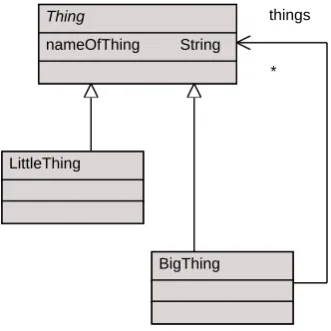
A visual syntax presents a model or program in a diagrammatical form. A visual syntax consists of a number of graphical icons that represent views on an underlying model. A good example of a visual syntax is a class diagram, which provides graphical icons for class models. As shown in Figure 2.1 it is particularly good at presenting an overview of the relationships and concepts in a model:
The main benefit of a visual syntax is its ability to express large amounts of detail in an intuitive and understandable form. Its obvious weakness is that only certain levels of detail can be expressed beyond which it becomes overly complex and incomprehen-sible.
In practice, utilising a mixture of diagrammatical and textual syntaxes gains the ben-efits of both forms of representation. Thus, a language will often use visual notations to present a higher level view of the model, whilst textual syntax will be used to capture detailed properties.
2.2.2 Abstract Syntax
BigThing Thing
String nameOfThing
LittleThing
[image:34.595.219.385.113.279.2]* things
Figure 2.1: Visualising concepts and relationships
that state how the concepts may be legally combined.
Consider a simple state machine language. An abstract syntax model of this language may include concepts such as State, Transition and Event. In addition, there will be relationships between concepts, such as a Transition being related to a source and target State. Finally, well-formedness rules will be defined that ensure, for example, that no two transitions may be triggered by the same event.
It is important to emphasise that a language’s abstract syntax is independent of its concrete syntax and semantics. Abstract syntax deals solely with the form and struc-ture of concepts in a language without any consideration given to their presentation or meaning.
2.2.3 Semantics
An abstract syntax conveys little information about what the concepts in a language actually mean. Therefore, additional information is needed in order to capture the se-mantics of a language. Defining a sese-mantics for a language is important in order to be clear about what the language represents and means. Otherwise, assumptions may be made about the language that lead to its incorrect use. For instance, although we may have an intuitive understanding of what is meant by a state machine, it is likely that the detailed semantics of the language will be open to misinterpretation if they are not defined precisely. What exactly is a state? What does it mean for transition to occur? What happens if two transitions leave the same state. Which will be chosen? All these questions should be captured by the semantics of the language.
language should have an operational semantics that allows it be run; A language which contains type concepts, such as classes, should permit the creation of objects according to the rules of instantiation, and so on.
2.2.4 Mappings
In the real world, languages do not exist in isolation. They will have a relationships to other languages. This may be via translation (concepts in one language are trans-lated into concepts in another language); semantic equivalence (a language may have concepts whose meaning overlaps with concepts in another language) or abstraction (a language may be related to another language that is at a different level of abstraction). Capturing these relationships is an important part of a language’s definition as it serves to place the language in the context of the world around it. Furthermore, mappings exist between the internal components of languages, such as between a concrete and abstract syntax, and are an important part of a language’s architecture (see section 9.4).
2.2.5 Extensibility
Languages are not static entities: they change and evolve over time. For instance, new concepts may be added that enable common patterns of model or code to be expressed more succinctly, whilst unused elements of the language will eventually die out. The ability to extend a language in a precise and well-managed way is vital in order to be able to support adaptability. It allows the language to adapt to new application domains and to evolve to meet new requirements. Furthermore, extensibility enables the commonality and differences between languages to be precisely captured.
2.3 Modelling Languages vs. Programming Languages
A strong distinction has traditionally been made between modelling languages and pro-gramming languages (a fact reflected by the two distinct modelling and propro-gramming communities!). One reason for this is that modelling languages have been traditionally viewed as having an informal and abstract semantics whereas programming languages are significantly more concrete due to their need to be executable.
This is not the case in this book. Here, we view modelling languages and program-ming languages as being one and the same. Both have a concrete syntax, abstract syntax and semantics. If there is a difference, it is the level of abstraction that the languages are targeted at. For instance, UML tends to focus on specification whilst Java empha-sises implementation. However, even this distinction is blurred: Java has been widely extended with declarative features, such as assertions, whilst significant inroads have been made towards developing executable versions of UML.
whilst programming languages are textual. However, the representational choice of a language should not enforce this distinction. There is nothing to say that a modelling language cannot have a textual syntax or that programming language cannot have a visual syntax: it is purely a matter of representational choice. Indeed there is already a human readable textual form of UML and tools that provide visual front ends to pro-gramming languages like Java are commonplace.
If modelling languages and programming languages are essentially the same, why can’t the mature techniques used to define programming languages be used to design modelling languages? The answer is that they can - indeed many of the techniques pre-sented here have their foundation in programming language design. However, there is one important element that is missing from many approaches to defining program-ming languages, and that is unification. It is the ability to define multiple languages that co-exist in a unified meta-architecture that make metamodelling such a powerful technology.
Thus, the techniques that are developed in this book are equally as applicable to pro-gramming languages as they are to modelling languages. A critical failing of modelling languages is that they have not, until now, been given the precise, executable definitions that programming languages enjoy.
2.4 What is a Metamodel?
In its broadest sense, a metamodel is a model of a modelling language. The term ”meta” means transcending or above, emphasising the fact that a metamodel describes a mod-elling language at a higher level of abstraction than the modmod-elling language itself.
In order to understand what a metamodel is, it is useful to understand the difference between a metamodel and a model. Whilst a metamodel is also a model (as defined in chapter 1), a metamodel has two main distinguishing characteristics. Firstly, it must capture the essential features and properties of the language that is being modelled. Thus, a metamodel should be capable of describing a language’s concrete syntax, ab-stract syntax and semantics. Note, how we do this is the major topic of the rest of this book!
Secondly, a metamodel must be part of a metamodel architecture. Just as we can use metamodels to describe the valid models or programs permitted by a language, a meta-model architecture enables a metameta-model to be viewed as a meta-model, which itself is de-scribed by another metamodel. This allows all metamodels to be dede-scribed by a single metamodel. This single metamodel, sometimes known as a meta-metamodel, is the key to metamodelling as it enables all modelling languages to be described in a unified way. How metamodels can bedescribed by a meta-metamodel is discussed in more detail in section 2.8.
focus on the abstract syntax of the languages. They should really be viewed partial metamodels (or even just models) as they do not provide a complete language defini-tion.
2.5 Why Metamodel?
As discussed in chapter 1, system development is fundamentally based on the use of languages to capture and relate different aspects of the problem domain.
The benefit of metamodelling is its ability to describe these languages in a unified way. This means that the languages can be uniformly managed and manipulated thus tackling the problem of language diversity. For instance, mappings can be constructed between any number of languages provided that they are described in the same meta-modelling language.
Another benefit is the ability to define semantically rich languages that abstract from implementation specific technologies and focus on the problem domain at hand. Using metamodels, many different abstractions can be defined and combined to create new languages that are specifically tailored for a particular application domain. Productivity is greatly improved as a result.
2.5.1 Metamodels and Tools
The ability to describe all aspects of a language in a metamodel is particularly important to tool developers.
Imagine the benefits of loading a metamodel of a language into a tool that defined all aspects of the language. The tool would immediately understand everything relating to the presentation and storage of models or programs in the language, the users’ inter-action with and creation of models or programs, and how to perform semantically rich activities, such as execution, analysis and testing. Furthermore, any number of other languages could also be loaded in the same way, enabling the construction of seman-tically rich development environments. Because all the languages are defined in the same way, interoperability between the tools would be straightforward. This flexibility would not just be restricted to user level languages. Another example might be loading an extension to the meta-metamodel, such as a new kind of mapping language. This language would then be immediately available to capture mappings between different languages.
Secondly, rich metamodels will have a significant benefit to the standards community. As we have argued, there is currently no means of capturing complete language defini-tions in existing metamodelling languages. As a result, standards that use metamodels to describe the languages they define suffer because their informal definitions can be interpreted in many ways. Complete metamodels of standards such as UML would greatly enhance the rigour by which the standard is implemented and understood -something that all stakeholders will benefit from.
2.6 Where do you find Metamodels?
Metamodels have been around for many years in a wide variety of different application domains and under various pseudonyms: ”data model”, ”language schema”, ”data schema” are all terms we have seen. Wherever there is a need to define a language, it is common to find a metamodel. This is particularly the case for standards, which by virtue of being a standard must have a precise definition. Examples include AP233 and SysML (systems engineering), SPEM (process modelling), OSS (telecoms) and CWM (data warehousing). The Object Management Group (OMG) has been particularly in-volved in their use in the standards arena. One of the largest metamodels (about 200 pages long) is contained in the UML specification [uml01]. With the advent of MDA [mda] and the increasing need for standardisation across the systems development com-munity, the number of applications of metamodels is set to grow significantly.
Finally, although many developers may view metamodels as being un-connected with their daily work, it is interesting to note that many are already using metamodels without knowing it! Many developers have already experienced the benefits of design-ing frameworks containdesign-ing a vocabulary of language concepts. For example, developers of financial systems will use concepts such as financial transactions, accounts, and so on. In reality, they are defining a language for their domain.
2.7 Metamodelling Languages
A metamodel is written in a metamodelling language, which is described by a meta-metamodel. As described above, the aim is that the same metamodelling language (and meta-metamodel) is used to describe any number of different languages. Thus, provided that the modelling languages have been defined in the same metamodelling language, it is possible to treat their definitions in a unified manner. For example, they can be stored and manipulated in the same way, or related by mappings.
The next chapter will examine in detail the required components of a metamodelling language.
2.8 Metamodel Architectures
A metamodelling language places requirements on there being a specific metamod-elling archictecture. This architecture provides a framework within which some key features of a metamodel can be realised. An important property of a metamodel ar-chitecture is that it describes a classification hierarchy. Models written in the language areinstancesof the concepts that are defined in the metamodel - the structure of the in-stances is classified by the metamodel. Furthermore, many languages have their own notion of classification (although they need not), and the pattern is repeated until a point is reached at which further classification does not occur. This repeating pattern of classification/instantiation contributes to what is commonly known as a meta-level architecture - a concept that will be described in more detail in the next sections.
2.8.1 Traditional Metamodel Architecture
The traditional metamodel architecture, proposed by the original OMG MOF 1.X stan-dards is based on 4 distinct meta-levels. These are as follows:
M0 contains the data of the application (for example, the instances populating an object-oriented system at run time, or rows in relational database tables).
M1 contains the application: the classes of an object-oriented system, or the table def-initions of a relational database. This is the level at which application modeling takes place (the type or model level).
M2 contains the metamodel that captures the language: for example, UML elements such as Class, Attribute, and Operation. This is the level at which tools operate (the metamodel or architectural level).
M3 The meta-metamodel that describes the properties of all metamodels can exhibit. This is the level at which modeling languages and operate, providing for inter-change between tools.
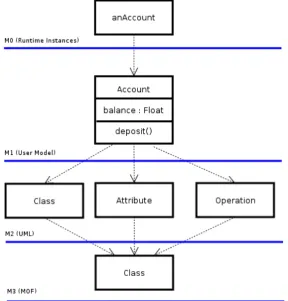
Each level in this hierarchy represents an instance of a classifier relationship. As shown in figure 2.2, elements at M0 are instances of classes at M1, which themselves can be viewed as instances of metamodel classes, which can be viewed as instances of meta-metamodel classes.
Figure 2.2: Example of the 4 Layer Meta Architecture
2.8.2 Golden Braid Metamodel Architecture
Although the 4-layer metamodel is widely cited, its use of numbering can be confusing. An alterative architecture is the golden braid architecture [Hof79]. This architecture emphasises the fact that metamodels, models and instances are all relative concepts based on the fundamental property of instantiation.
The idea was first developed in LOOPS (the early Lisp Object Oriented Programming System, and then became a feature of both ObjVLisp [Coi87] and also CLOS (the Com-mon Lisp Object System).
Underpinning the golden braid architecture is the relationship between a Class and an Object. A Class can be instantiated to create an Object. An Object is said to be an instance of a Class. This fact can be determined through a distinct operation, of(), that returns the Class that the Object was created from.
In addition, a Class is also a subclass of Object. This means that a Class can also be instantiated by another Class: its meta Class. This relationship is key to the meta-architecture, as it enables an arbitrary number of meta-levels to be described through the instantiation relationship.
instances of. This is the meta-metaclass, which is effectively used to bootstrap the entire metamodel architecture. This class will be defined as part of the meta-metamodel (the model of the metamodelling language used to model all languages).
In terms of the 4-layer metamodel, it is clear that it can be viewed as the result of stamping out the golden braid architecture over a number of different levels. Thus, there is no notion of a meta-metamodel: it is just a metamodel that describes models, which themselves may be metamodels.
The golden braid architecture offers a great deal of flexibility. Thus it forms the foun-dation of the XMF metamodelling language, which will be presented in chapter 3.
Meta Object Protocol
A related aspect of the golden braid architecture is its use of a meta-object protocol (MOP). A meta-object protocol is a set of classes and methods that allow a program to inspect the state of, and alter the behaviour of its meta-metamodel at run-time. These make it possible to easily adapt the metamodelling language to support different types of behaviours. For instance, changing the way that inheritance works, or modifying how the compiler works without having to change the code for the compiler. This adds further flexibility to the metamodelling process.
2.9 The Metamodelling Process
The task of creating a metamodel for a language is not a trivial one. It will closely match the complexity of the language being defined, so for example, a language containing rich executable capabilities will be much more complex to define than a simple static language.
However, thereisa clearly defined process to constructing metamodels, which does at least make the task a well-defined, if iterative, process. The process has the following basic steps:
• defining abstract syntax
• defining well-formedness rules and meta-operations
• defining concrete syntax
• defining semantics
• constructing mappings to other languages
2.10 Five levels of Metamodelling
We are often asked by clients how they can assess the quality of a metamodel. To help them, we have found the following five levels to be useful:
Level 1 This is the lowest level. A simple abstract syntax model must be defined, which has not been checked in a tool. The semantics of the language it defines will be informal and incomplete and there will be few, if any, well-formed rules.
Level 2 At this level, the abstract syntax model will be relatively complete. A signifi-cant number of well-formedness rules will have been defined, and some or all of the model will have been checked in a tool. Snapshots of the abstract syntax model will have been constructed and used to validate its correctness. The semantics will still be informally defined. However, there may be more in the way of analysis of the language semantics.
Level 3 The abstract syntax model will be completely tried and tested. Concrete syn-tax will have been defined for the language, but will only have been partially formalised. Typically, the concrete syntax will be described in terms of informal examples of the concrete syntax, as opposed to a precise concrete syntax model. Some consideration will have been given to the extensibility of the language ar-chitecture, but it will not be formalised or tested.
Level 4 At level 4, the concrete syntax of the language will have been formalised and tested. Users will be able to create models either visually and textually and check that they result in a valid instance of the abstract syntax model. The language architecture will have been refactored to facilitate reuse and extensibility. Models of semantics will have begun to appear.
Level 5 This is the topmost level. All aspects of the language will have been modelled, including its semantics. The semantic model will be executable, enabling users of the language to perform semantically rich operations on models written in the lan-guage, such as simulation, evaluation and execution. The language architecture will support good levels of reuse, it will have been proven to do so through real examples. Critically, the completed metamodel will not be reliant on any external technology - it will be a fully platform independent and self contained definition of the language that can be used ‘as is’ to generate or instantiate tools.
2.11 Conclusion
A METAMODELLING FACILITY
3.1 Introduction
In order to be able to construct semantically rich models of languages, a facility that fully supports language definition is required. This is known as ametamodelling facility. A metamodelling facility should provide the ability to capture the key features of a lan-guage, including its syntax and semantics in a unified and platform independent way, along with support for other important language design requirements such as extensi-bility and executaextensi-bility.
This chapter gives a brief introduction to a metamodelling facility called XMF (eX-ecutable Metamodelling Facility). XMF extends existing standards such as MOF, OCL and QVT with rich executable metamodelling capabilities. It provides a number of lan-guages for metamodelling, all based around a core executable meta-architecture and metamodelling framework.
XMF will form the foundation for exploring metamodelling throughout the rest of this book.
3.2 Requirements of a Metamodelling Facility
Before introducing XMF, it is important to understand some of the key requirements of a metamodelling facility.
Secondly, it should provide a meta-architecture in which the metamodelling lan-guages (including their semantics) are themselves described in terms of a core meta-modelling language. This ensures that the languages are self defined and complete, and enables their definitions to be readily reused to create new language definitions.
Finally, to gain maximum flexibility, a metamodelling facility must be platform in-dependent. In other words, its metamodels should be self sufficient and independent of implementation specific descriptions of the language being modelled. Thus, reliance on the implementation of the language’s behaviour in a programming language or the assumption that there will be an external database that manages object creation and persistence is completely avoided.
3.2.1 XMF
XMF aims to provide a rich environment for language design that supports the key requirements of a metamodelling facility. It combines and extends a number of stan-dard object-oriented modelling facilities to provide a minimal, but expressive, platform independent language for metamodelling. It includes the following features: