When you're outlining the requirements of · your new computer or system, pause a mo-'ment and consider · what our new RG core me m'o ry offe rs: 350 nsec access; 900 nsec full cycle time; inte-grated ci rcuitry; and expansion from a' 4K
· memory all the way to 64K by addition of modules.
We think you'll want to design these features into your next sys-tem. The RG is low in cost, too. You pay less for the RG; your cus-tomers pay less for your system.
He.re's what your
computer can do with the
NEW AMPEX RG MEMORY
1. Access data in 350 nanoseconds
2. Expand in modules to 5 million bits
3. Sell for less
ALSO NEW FOR 512-TO-4096 WORD TASKS
-THE RF-4 CORE
MEMORY
This new, high-speed core memory, similar to our RF-1 memory, is built on one large PC board and is capable of word lengths to 20 bits. It uses integrated circuitry and gives you high speed (1 microsecond cycle time) at low cost.
Check the specs. If they serve your purpose, please drop us a line, or circle the Reader Card number~ We would like to send
you our literature about these new workhorse memories. We'll even tell you how little they cost.
IMPORTANT SPECS
RG RF·4
Access time 350 nsec 400 nsec 1000 nsec Full cycle 900 nsec (half cycle:
650 nsec) 51/4 x 19 x 21 51/4 x 19 x 21 Size (inches) (per memory (including
module) power supply)
Capacity: 4096; 8192; 512 to 12,228; or 16,384 4096 words words, expandable
in modules to 65,536 words
Word length: 24 to 80 bits 4 to 20 bits
For more informatio':!, write AMPEX COMPUTER PRODUCTS, 9937 West Jefferson, Culver City, California 90231 or call: (213) 836-5000; San FrancIsco: (415) 367-2011; Cocoa Beach: (305) 783-1811; Boston: (617) TW9-1040; Chicago: (312) 439-4600; Minneapolis: (612) 941-2430; New York: (201) 489-7400; Dayton: (513) 254-6101; Philadelphia: (215) TU7-7650; Dallas: (214) 637-5100; Washington. D. C.: (703) 671-4000
I
AMPEX
I
CIRCLE 1 ON READER CARD
Buy a Sigma 5
Get
a Sigma
5
general purpose
computer free.
Sigma 5 is two of our best computers.
In the foreground it's a real-time computer. It has all
the hardware and software features that are important
to a systems computer. Built-in, not added-on. Very fast
reaction time; an 850ns memory with multiple ports
and buses; and up to 224 priority interrupts. A variety
of System Interface Units make it easy to adapt Sigma 5
to just about
~nysystem, and Sigma 5 uses the same
basic Sigma 7 software that's been working in the field
for a year.
In the background Sigma 5 is a general purpose
com-puter. Use it for batch processing, for data reduction,
for FORTRAN computation, to run your payroll, keep
track of your inventory, or do any other computing
tasks you need done. Sigma 5 will do its general
pur-pose computing whenever it has microseconds to spare.
It will operate with complete protection for your
real-time memory areas and registers, even if the GP
pro-grams run unchecked. And when it's interrupted, Sigma
5 will save the registers and its place in the program,
and switch to real-time in 4.8 microseconds flat. (It only
takes one instruction.)
Sigma 5 is completely modular. You can start with
the basic $108,000 system and add memory modules
(up to 131,072 words of 32 bits, in 4 K modules) 'and
peripheral units to suit your needs. Sigma 5 uses the
same powerful peripherals developed for Sigma 7,
including I/O Processors that operate independently of
the CPU at rates up to 32 Megabits per second, and
Rapid Access Data Files that take most of the waiting
out of accessing data. You can add these units whenever
you need them, now or in the future. And when you're
ready for time sharing, all you'll need is a Sigma 7 CPU.
, The software and the peripherals are all compatible.
If
you place your order for a Sigma 5 now, you'll get
it in about six months. That's
C 5
almost the best del, ivery time you
5
can get on a computer.
Especially when it's the best
computer you can get.
Scientific Data Systems,How to
make any
PDP* PLUS!
COMPATIBLE -
produces fully IBM-compatible tape on both the 7-track and 9-track versions.COMPACT -
completely self-contained. Each unit con-sists of a tape transport mechanism and all electronics, ready for rack-mounting, or packaged in a compact cabinet.SUPPORTED -
software supplied with the TS-8 fully support all magnetic tape I/O and include error-checking and recovery procedures. Hardware maintenance and sup-port are available through Infotec service personnel.ECONOMICAL -
this IBM-compatible tape system, de-signed specifically for DEC computers, is also the least expensive IBM-compatible tape system available anywhere - an Infotec cost breakthrough!1
1130, TOO! TS-1130, a companion product of TS-8, offers all the same features to users of the IBM-1130, significantly extending this computer's capabilities in commercial and industrial applications. Full software support is provided through 1130 FORTRAN and the Disk Monitor System.For literature: Infotec, Inc., Dept. D
22 Purchase Street, Rye, N. Y. 10580 914/967-1325
*PDP is a registered trade mark of Digital Equipment Corp.
INFORMATION TECHNOLOGY
CIRCLE 6 ON READER CARD
4
volume 14
Publisher Editor
may
1968
number 5
GARDNER F. LANDON ROBERT B. FQREST
Managing Editor & Art Director CLEVE MARIE BOUTEa:L
Associate Editors WILLIAM J. ROLPH
AUBREY DAHL Assistant Editors
Eastern Editors
Midwestern Editor European Editor Contributing Editors
Washington Reporter Editorial Adviser Technical Consultant Production Manager Director of Circulation Circulation Fulfillment
WENDY REID JANET EYLER ANGELINE PANTAGES PHIL HIRSCH EDITH GOODMAN PEARCE WRIGHT HOWARD BROMBERG ROBERT V. HEAD PHIL HIRSCH ROBERT L. PATRICK LOWELL AMDAHL MARILEE PITMAN FRANK DeCARLO ALGENE TRAINA
ADVERTISING OFFICES
Eastern District Managers JAMES M. MORRIS
WARREN A. TIBBETTS 35 Mason Street, Greenwich, Conn. 06830 (203) 661-5400 New England District Manager WARREN A. TIBBETTS
& Vice President 112 West Haven Rd.,
Manchester, N.H., 03104 (603) NAtional 5-9498
Midwest District Manager JOHN BRENNAN
205 West Wacker Drive, Chicago, III. 60606 . (312) Financial 6-1026 Western District Manager HAMILTON S. STYRON
& Senior Vice President 94 So. Los Robles Ava.,
1mB
Pasadena, Cal., 91101 (213) 795-9721 (213) 681-8486-from Los Angeles
EDITORIAL OFFICES
94 So. Los Robles Ave.
Pasadena, Calif. 91101
Circulation audited by
Business Publications Audit American Business Press, Inc. Member,
DATAMATION is published monthly on or about the tenth day of every month by F. D. Thompson Publications, Inc., Frank D. Thompson, Chairman; Gardner F. landon, Pres-ident; Gilbert Thayer, Senior Vice President. Executive, Circulation and AdvertiSing offices, 35 Mason Street, Greenwich, Conn. 06830 (203) 661-5400. Editorial offices, 94 So. Los Robles Ave., Pasadena, California 91101. Published at Chicago, III. DATAMATION is circulated without charge by name and title to certain qualified individualS who are employed by companies involved with automatic information han-dling equipment. Available to others by subscription at the rate of $15.00 annually; Single issues (when available) $1.50. Reduced rate for qualified students. Foreign sub-scriptions are on a paid basis only at a rate of $25.00 annually. No subscription agency is authorized by us to solicit or take orders for subscriptions. Controlled circulation paid at Columbus, O. and Form 3579 to be sent to F. D.Thompson Publica· tions, Inc., P.O. Box 2000, Greenwich, Conn 06830. Copyright 1968, F. D. Thompson Publications, Inc. Microfilm copi!!s of DATAMATION may be obtained from UniverSity Microfilms, Inc., 313 No. First St., Ann Arbor, Michigan.
Printed by Beslow Associates, Inc.
This issue 72,837 copies
Lack of continuous and
i.,....,,,+"" ... +;,, ... , ... A,,"',·:i','i·i I-<'"',...,~" ... ,~capacity,
altitude information has gone the
way of the biplane.
An electronic Alpha-Numeric
Generator system, developed by the
Hazeltine Corporation and built
around a Bryant Magnetic Memory
Drum, enables air traffic control to
"visually" pinpoint the altitude of
every aircraft in their sector.
"Personalized'
ttransponders in the
aircraft continuously transmit a
stream of vital information to the
airport electronic control center.
As it's processed, synchronization
pulses in the drum release it in the
form of a luminous block of
reports-updated every 1
Y2
seconds on
the radar screen.
screens, in many
different locations, can be served
simultaneously. Which means that a
controller can literally "pass the
airplane" to other controllers as the
flight continues across country.
Hazeltine Corporation chose the
Bryant drum for its reliability,
dependable interfacing capqbility
and low cost per bit. To find out how
Bryant solves tough jobs in other
fields write to 850 Ladd Rd.,
Walled Lake, Michigan 48088.
BRYANT
COMPUTER PRODUCTS
"'XLO"
ht
d4
EX-CELL-O CORPORATION
6
the
~
worlds
W
largest
independent producer of
data modems at ..
2400-3600-4800
bps.
For information, call or write for Collins Data Modem portfolio. Collins Radio Company,
Data Equipment Marketing, Newport Beach, California 92663. Telephone (714) 833-0600
CIRCLE B ON READER CARD
volume 14
may
1968
number 5automatic
information
prQcesslng
for b.usiness
industry &science
I
®
22
LOGICAL DESIGN OF DIGITAL COMPUTERS, by
Peter
L.
Lindley.
Some basic concepts illustrated by minimaps and a beauty contest.
33
SELECTING A PRIVATE EDP SCHOOL, by
Edward
W.
Markham.
Suggestions and warnings for a prospective student.
43
SOME PROBLEMS WITH TIME-SHARING, by
Bryan Wilkinson.
A technological tale of woe.
46 CONGRESS SEEKS A SYSTEMS APPROACH, by
Robert
L.
Chartrand.
The trend in Congress is toward using the systems approach in grappling with the public problems that now demand the scale of action once reserved for defense and space.
pO
MODULAR PROGRAMMING IN COBOL, by
Harry T. Hicks, Jr.
The program intercommunication facility recently added to the official version of COBOL, and available in several manufacturers' compilers, allows modular programming.
60 THE ARMY'S NEW UNIT RECORD CONCEPT, by
Donald D.
Curry.
Dissatisfied with the punched card and· the machine for handling it, the Army has proposed a new type of unit record and assigned two development contracts to explore its possibilities.
65
THE MT
1ST
TAPE READER.
A new alternative to the keypunch.
69 INSURANCE AUTOMATION FORUM:
A Conference Report.
116 CURRICULUM '68:
A Report from the ACM Committee on Computer Science.
datamation departments
9 Calendar
11 Letters to the Editor
17 Look Ahead 21 The Editor's Readout 77 News Briefs
135 New Products 147 New Literature
153
159
169
171
175
179
182
World Report Books
Washington Report People
Datamart
Index to Advertisers
The Forum
the
$188,000
graphics· terminal
It used to be you had to spend that kind of money to do meaningful work in computer graphics. Now you can buy a complete interactive terminal from AdFlge for $60,000 - and get a lot better performance. That's our model AGT /10.
You can display more than 4500 vectors at 40 frames per second with resolution better than 100 lines per inch. "Straight" lines are really straight. They meet where they're supposed to, and they are uniformly
on-line signal analysis
8
printed circuit layout
that costs $GOk
bright regardless of length. And only with the Adage AGT /10 do you get built-in scaling and translation.
Every AGT /10 comes with its own powerful 30-bit word length processor with basic 4K of core memory and teletype I/O. A complete line of I/O peripherals is available as well as core memory expansion to 32K. Soft-ware furnished includes a resident monitor, a FORTRAN compiler (for systems with at least 8K memory), an assembler, and a set of graphics operators. The standard package also includes a library of utility and service routines with full provision for com-municating with the central computer
business, management systems
CIRCLE 9 ON READER CARD
facility via dataphone interface or direct data channel access.
The terminal console houses the large-screen CRT with light pen, and comes equipped with function switches and controls. Graphics hardware options include joystick controls, an input data tablet, a character gen-erator, and photographic hard-copy output.
machine-aided drafting
If you'd like more information about our under-priced AGT /10, or a 16 mm movie showing the 'Adage Graphics Terminal in action, write D. Sud kin, Marketing Services Manager, Adage, Inc., 1079 Commonwealth Ave., Boston, Massachusetts 02215.
• •
calendar
DATE TITLE LOCATION
June 10 Seminars on File New York
June 11 Structures for On- Chicago
June 13 Line Systems Los Angeles
June 14 San Francisc,o
June 12-14 Annual Meeting- New York
Service Center Operations
June 25-27 2nd Annual Com- Los Angeles puter Group Conf.,
Impact of LSI
June 25-28 International DP Washington, Conf. & Business D.C. Exposition'
June 26-28 9th Annual Joint Univ. of Mich-Automatic Control igan, Ann
Conference Arbor
July 15-18 5th Annual Design Washington, Automation Work- D.C. shop
\
\
July 23-24 Nat'l. Symposium on Boston Modular
Program-ming
Aug. 20-23 Western Electronic Los Angeles Show & Convention
Oct. 18 Symposium on the New York
Application of Computers to the Problems of Urban Society
Oct. 20-23 International St. Louis Systems Meeting
Oct. 28-31 Annual Meeting- San Francisco Users of Automatic
Information Display Equipment
Dec. 2-3 2nd Conf. on New York
Applications of Simulation
Dec. 9-11 Fall Joint Computer San Francisco Conference
May 1968,
SPONSORI CONTACT ACM,211 E. 43 St., N.Y., N.Y. 10017
ADAPSO, 420 Lexing-ton Ave., N.Y., N.Y. 10017
IEEE, 3600 Wilshire Blvd., Los Angeles 90005
DPMA, 505 Busse Hwy., Park Ridge, III. 60068 IEEE, 345 E~ 47 St., N.Y., N.Y. 10017
SHARE-ACM-IEEE Computer Group, 345 E. 47 St., N.Y., N.Y. 10017 Information & Sys-terns Inst., 14 Concord L~., Cam-bridge, Mass. 02138 WESCON, 3600 WiI-shire Blvd., Los Angeles 90005
ACM/J.M. Spring, Computer Methods Corp., 866 Third Ave., N.Y., N.Y. 10022
Systems & Procedures Assn., 24587 Bagley Rd., Cleveland, Ohio 44138
UAIDE/Elien Williams, Marshall Space Flight Ctr., R-COMP-S, Hunts-ville, Ala. 35812 SHARE-ACM-IEEE-SCII ACM,211 E. 43 St., N.Y., N.Y. 10017 AFIPS, 211 E. 43 St., N.Y., N.Y. 10017
r
r
.J
j
• Customer Satisfaction • Reliability
• Speed
That's what Datacraft Corporation engineers into each memory, whether it's an off·the·shelf 512 x 8 unit or a custom designed 65536 x 32 system.
The model DC·31 for example, is a high speed, linear select, coincident· current, magnetic core memory especi· ally suited for systems requiring small high speed units. It comes with a full complement of field proven options that enable the customer to select a custom system at minimum expense.
The basic DC·31 features include: less than one microsecond full cycle time; 450 nanosecond access time; capacities up to 1024 x 12 in one bit per word increments; 30 days delivery. Prices start at $1210.
For detailed specifications on the DC·31 and information on other models, call (305) 565·9441 now, or write
Datacraft Corporation, 776 N.E. 40th. Court, Fort lauderdale, Florida 33307.
1~..dI1
DA T A C RA
fT
17~
CORPORATION
CIRCLE 10 ON READER CARD
,
TAPE EDGE COMPARISON
,
y
EXCLUSIVE PRECISION SLiITING
•
BRANDA
,
BRANDB
y
TYPICAL INDUSTRY SLITTING
BRAND,C
,
pIC
your computer tape
10
HOW THESE PHOTOGRAPHS WERE MADE 1. The two ends of the tape were inserted into a plexi-glass tube.
2. The tube was then filled with epoxy and allowed to cure.
3. When completely cured, the cylinder was put on a lathe. 4. The ends of the cylinder were then polished in several stages until the required smoothness was achieved. 5. The edges were then pho-tographed under a microscope _,using a parallel light source, eliminating shadows which might result in undefined tape edges.
D
You have probably never worried about how your computer tape looks in cross-section, but believe it or not, it's an angle worth considering.D
The unretouched photos above are representative cross-section views (at approx-imately 500X) of three leading "premium" tape brands, together with Computron's new TVP2.D
You can see ata glance that, of the four specimens, only TVP2 displays a clean, rectangular edge. Why is this important? Primarily because in this way TVP2 greatly reduces the possibility of error-producing edge debris.o
When oxide overhang is present, small fragments are almost certain to break off in use. With a non-rectangular cut there is uneven edge wear between the oxide and backing, weak spots develop and the edges fracture and chip. This means an in-creased probability of dropouts, both transient and permanent.D
In addition to solving the debris problem TVP2's clean, uniform edges result in skew characteristics which rival those of master skew tapes.o
TVP2's exceptional edges are the result of an exclusive new Computron slitting technique .' .. another important factor in the Total Value Performance of this ex-ceptional new tape.D
Consider it the next time you select computer tape.lIffi
CCMPUTRON INC
8-
G ENE R ALE LEe T RIC / lID f}l~
f G R a U p CROSBY DRIVE, BEDFORD, MASSACHUSETTS 01730CIRCLE 11 ON READER CARD
4
letters
an apology
Sir:
Over the years, Control Data has been the subject of editorial comment in vir-tually all trade and general business publications. On the whole, most of these comments have been favorable, but there have been some of the other kind as well. We here at Control Data have become used to both kinds. What we will never get used to, however, is bad taste, which we feel your article (Feb., p .. 21) exhibited. For a bunch of "Conmen,j (your word) with "a weak coaching staff and lousy bench," (also your words), our track record has been pretty good.
NORBERT R. BERG
Vice President, Administration and Personnel
Control Data Corporation Minneapolis, Minnesota
Editor's Note: The choice of "Conmen" was
hasty and ill-advised, and we apologize. Con-trol D'ata's representatives are no more "con-men" than those of any other computer
manu-facturer.
refuting calculations
Sir:
The article by Professor Knight, "Evolving Computer Performance 1963-1967" (Jan., p. 31) exhibits some very serious deficiencies. The de-.ficiencies are, primarily, fundamental . inadequacies in the data base and
over-simplifications or gross assumptions in the performance calculations. This ar-ticle is a sequel to an arar-ticle published in your September 1966 issue; and the first article is based on pre-1963 data collected for a doctoral dissertation. Quite obviously, major changes in dp concepts, system architecture, and ap-plications or market structure have oc-curred since that time. Yet, the calcu-lations of performance (P) in these two articles are based on these pre-1963 data.
In addition to this outdated data base, there are specific questions on fundamental statistical validity affect-ing the adequacy, the representative-ness of the sample, and the assump-tions made in calculating System Performance. These include:
1. The scientific mix has only five
ca-tegories and is based on pre-1963
data from IBM 704 and 7090
sys-tems. It is not stated, but it appears that traCing to establish frequency weightings was static rather than dynamic.
2. The same five instruction
catego-ries selected from scientific data
were used for the commercial mix.
The frequency weightings are based on counts from nine pre-1963 705 programs. Obviously, no floating point instructions were found so the commercial mix has three categories - fixed add/sub-tract (25% or 45% weighting), multiply (1% weighting) and all others (54% or 74% weighting) . 3. I/O estimates are based on IBM
650, 704, 705, 1401, 7070, 7090, Philco 211, Bendix C-15 with only those from the 7090 "accurately obtained."
4. A memory factor, rated as very sig-nificant, is based on the opinions of
43 engineers, programmers, and other knowledgeable people
(pre-1963) .
5. The equations used in the second article are identical to those used in the first, even though it is noted in the first article that: "The equa-tions derived are therefore appli-cable only within the range of computers studied."
The following anomalies illustrate the deficiencies and the limitations of the approach:
1. The commercial performance rate of IBM 709 (a binary, fixed word system designed for scientific pro-cessing) is shown as about five times its scientific rate. By contrast, the IBM 7090, which is essentially the same system logic and design with faster hardware (transistors vs. tubes) shows a scientific perfor-mance rate more than twice its commercial rate.
2. Similar anomalies occur in the case of the 705 II and 7080. . 3. On current systems, the
commer-cial performance rate of the IBM 1130 (a small binary system) is shown as over four times the com-mercial performance rate. On the IBM 360/44, which has no deci-mal instruction set, the commercial performance rate is shown to be greater than that of the IBM 360/65, which not only has deci-mal instructions, but also faster cir-cuitry.
The treatment of cost or price, which is the other factor in Professor Knight's analysis, is also unrealistic since only one configuration-the one available when the computer was in-troduced-is used. Taking System 360 as an example: when it was first intro-duced in 1964, it included 19 combi-nations of processing speed and mem-ory capacity and 44 peripheral units. Today the system offers 43
combina-tions of memory and processing units and 90 peripheral units.
Such growth illustrates, among other things: (1) increasing diversity in and structuring of user needs; (2) increasing importance of I/O devices both in terms of effect on performance and in proportionate share of system cost. To ignore this and equate such systems as a 360/30, where a maxi-mum of 64K memory is available to a
360/75 where a minimum of 262K is
offered is to force statistics beyond the realm of reality. '
Although dp technology and mar-kets are far from static, there is suffici-ent experience and structure to estab-lish the fact that any meaningful comparison of system performance re-quires (1) a reasonable balance in sys-tem configuration that avoids in-creasing cost without increasing performance, and (2) a selection of an appropriate environment for the sys-tems being compared.
It seems apparent from the anoma-lies and other data cited above, that Professor Knight's analyses do not meet these minimum requirements. His analyses point to economies of scale in a very gross sense over a wide range of systems; but beyond that, they are not meaningful in assessing current systems performance in to day's com-plex, competitive and diverse markets. C.B.BRANNEN
Wappingers Falls, New York
Dr. Knight replies: Mr. Brannen's very thought-ful letter discusses many of the limitations of my article. My research has made me well aware of a general model that attempts to compare
ACTUAL INSTALLATION
Oblique suspended fil-ing permits easier, quicker EDP referencing through smaller bindings. Makes your EDP filing area attrac-tive in appearance, effi-cient in operation. Write for free illustrated ma-terial.
DBLII1\\~
Suspended Fifing Compartments
R. P. GILLOTIE & co., INC. ~
929 Holland Ave., Cayce, S. C. 29033 (803) 254·8452 CIRCLE 12 ON READER CARD
12
letters
lems between today's different computing sys-tems. The very complexity and rapid rate of, change Mr. Brannen refers to demands that we attempt to analyze this important industry rather than bury our heads in the sand. It is my hope that Mr. Brannen's letter and my article will stimulate further effprts to explore the relation-ship between equipment development and com-puting power.
proiect control
Sir:
Max Gray and Herbert B. Lassiter have made a valuable contribution to successful systems implementation with their "Project Control for Data Processing" (Feb., p. 33). It will work. We have a substantIal effort going into the design and implementation of an integrated information system and are about three years into a seven-year program. The first implementation phase ,was approached in the tradi-' tional one-step-at-a-time and our time-table bombed. Oh, did it bomb.
Mean-while, we were putting the second implementation phase together and during one of our task group critiques, we began to focus on the need for bet-ter planning and decided that we ought to find out about our critical path. Our tentative timetable for this phase reflected 10 months of elapsed time to implementation. We spent about a month working out a PERT
chart and it showed 18 months to im-plementation. Now we have reorga-nized the second phase into four small implementation steps and are targeting the· first one-which will obtain con-siderable improvement for some 30 shops-for seven months to implemen-tation. Incidentally, all of these time intervals are measured from the same beginning point so the improvements are real.
Because systems are what they are, we may not hit the keyhole but we have considerably improved project control because we no longer operate behind that veil of mystery Gray and Lassiter spoke of in their article. Any-one who has ever slid a target ought to try their ideas. It will hurt for only a little while-mostly from embarrass-ment.
TRUMAN EVANS
Director, Systems Planning American Airlines
Tulsa, Oklahoma
p.s. to a eulogy
Sir:
Sam Alexander, who led various Na-tional Bureau of Standards' electronic data processing efforts for many years, was indeed the. interesting and
imagi-native pioneer that your eulogy (Feb., p. 65) suggests. For these pioneering efforts he had my respect and admira-tion even before I joined "The Sam Alexander Post-Graduate School" in early 1962.
However, the bad taste you ex-pressed by your critical aside refer-ences to Representative Jack Brooks and to Norm Ream was not character-istic of the sense of honor of the man you have attempted'to eulogize. Sam especially would not have appreciated your placing these references in the same context as references to his "ene-mies," to his questionable testimony at a Congressional hearing, and to criti-cism of his "pilot project," even if you had been correct.
In fact you were not. The events of
1964-65 culmina ted in Alexander's In-formation Technology Division becom-ing the core around which the NBS Center for Computer Sciences and Technology was built. It was Alexan-der, not Brooks, who played a strong role in recommending the selection of Ream as the Center's first director. Fol-lowing this, Ream had the responsibil-. ity of becoming acquainted with the
spirit and intent of the Center's enabl-ing legislation, i.e. Public Law 89-306, by opening a line of communication with the Law's sponsor, Rep. Brooks. , Only in this way could the Center play its most meaningful and contributory role in the development of computer and related information system usage by the Federal Government.
The second point on which you erred was in the cursory mention of Alexander's "pilot project." Recom-mendations, in which neither Brooks nor Ream had a part, had already been made to NBS concerning the "pilot project." Ream, as director, and Alexander, as technical director, each commissioned an independent survey in order to confirm and clarify these recommendations. The two studies were approached from different points
[image:14.615.400.556.362.519.2]of view , Alexander's being a, solely technical one. The results of both sur-veys led to the same conclusion, con-firming the earlier recommendation that the project be discontinued. How-ever unhappy a conclusion this was, Alexander's role in it was a characteris-tically professional one as was Ream's resulting decision.
Both men (Alexander and Ream) have enjoyed the respect and admira-tion of the informaadmira-tion systems com-munity. The one you attempted to honor you have instead dishonored. The other, you seriously disserved by leaving his motives open to doubt-doubt which has no basis in fact in a man whose professional honesty is un-questioned, and whose public service is an example to .others.
F. CLAYTON ROSE
Gaithersburg, Maryland
taxing users
Sir:
In "Brandon Panel Discuss Data Pro-cessing Management Problems" (Feb., p. 72) I noticed that someone is work-ing on definwork-ing "systems analysis" and "programming."
If and when this is finished, who or what should be contacted to receive these great documents? Also, onfe specified how is "management" to be coerced to implement ideas that are not of their own choosing?
As to the suggestion of taxing com-puter users, I hope you realize to what extent "government" is involved and, therefore, not taxable. A better idea might be to sell the manufacturers on bearing the full cost of such a worth-while venture.
R. L. BROWN
Sacramento, California
t-s considerations
Sir:
Your report (Feb., p. 121) on large corporations losing interest in time-sharing indicated the popular concept of time-sharing as the on-line conver-sational mode of operation with im-mediate processing response to user inquiry. Unfortunately, too much at-tention has often been placed on de-signing immediate response time-shar-ing systems which operate mainly at the "high end of the processing re-sponse curve." This has caused exces-sive programming overhead and sys-tem costs when compared to the value received.
Too frequently, the user has no di-rect access to the computer and then is provided complete on-line control with immediate processing of all requests,
May 1968
Do
quire
•
a non-Impact,
silent printer
that's mil-spec?
The
Me
3434 DATALOG® printer.
to MIL-Q-985
8A.
Completely solid state,
silent in operation with
inter-nal paper takeup, the
Me-3434 has been designed and
tested to military
environ-mental conditions, including
airborne. For information,
contact DA T ALOG Division
of Litton Industries, 343
Sansome Street, San
Fran-cisco 94104. Area code (415)
397-2813.
For military applications
tha t. require extraordinary
speed with reliability,
noth-ing even approaches this
lightweight, non-impact
printer that pours out 6000
lines a mi'nute, 32 columns
per line. MTBF is in excess of
4000 hours, based on
MIL-STD-785 and
MIL-HDBK-21 7 A. RFI qualified, the
MC3434 DATALOG uses
QPL components to the
full-est extent according to
MIL-E-5400 and MIL-T-21200.
Quality assurance is apprpved
rn
2~r~~~~INDUSTRIES
DATALOG is a registered trademark of Litton Industries.
14
It isn't real time when you wait days to access a computer. But it is with the new Model VDT-2 DATAPORTTM Terminal. Com-pletely portable, DATAPORT sets up on a desk and gives immediate access to a time-sharing com-puter. DATAPORT offers a tele-printer with all TTY-33 features, data set, magnetic/acoustic coup-ler for any telephone, two luggage-type cases, and 58-pound porta-bility. DATAPQRT - for real real time!
New Model
TC-1
Coupler
Couples any data terminal to any telephone for computer time sharing. Combines magnetic and acoustic coupling for clear I/O ,transmission. Full / half duplex
modes.
Cia
Write for Brochure VERNITRON CORPORATION'Farmingdale, N.Y.
50
Gazza Blvd.
Call (East Coast) 516-694-5002 (West Coast) 213-328-2504
CIRCLE 14 ON READER CARD
letters
even when this is neither required nor desired. This is a "rags to riches" ap-proach and often provides exceptional service to a restricted number of users.
It will become increasingly valuable to provide on-line direct access sup-port for computer system users. How-ever, the processing response time is a second consideration and should be controlled by criteria established by the corporation. An executive should be able to use the same time-sharing on-line terminal for immediate process-ing of an inquiry and then for request-ing future processrequest-ing for a report on a low priority basis.
The large corporation will not lose interest in time-sharing if systems ar~ properly designed to provide more us-ers time-sharing with more levels of processing response. Several commer-cial time-sharing companies are now selling computer time at different rates based on the user's required processing response. This is accomplished mainly on two levels (immediate and batch), but this should expand to more levels in the future; i.e., perhaps charges in accordance \Yith core partition time-sharing priority levels when using IBM 360 systems.
JAMES W. GRAY M cLean, Virginia
design and selection
Sir:
Re Dr. Ruskin's article "The Potential Savings Yardstick" (March, p. 59), I
offer the, following summary: The name of the game is "smart."
ROBERT M. GORDON
Irvine, California
stump the machine
Sir:
The problem with simple models of machine learning ability is that we can always see through them and beyond \ them. We are not convinced and our fears are not allayed. In the case of a stacked deck and a very naive pro-gram, such as our friend the Hexa-pawn player (March, p. 67), the na-ture of the game changes.
In Hexapawn, the second player can always win. But if the machine is
really as simple-minded as the article
by Hughes and Engvold tells us, we can prevent it from learning to beat us
every time.
Aside from symmetry, there are two possible first moves for the player, to
which the machine has a total of five responses. If the machine response is either of these positions (X for play-er):
00-x-a
-xx
00--xo
x-x
don't clobber it immediately, or you'll never get another chance. Instead (in either case) leave it with:
00-XXO--x
After it finds out it loses whatever it
does beyond this point, it will probab-ly blow a fuse or even push its own "function" button.
MILLARD H. PERSTEIN
Santa Monica, California
edp for the blind
Sir:
As a member of the Braille Services of New Mexico, Inc., I am in the process of getting permission from IBM to re-produce in Braille their IBM System/ 360 Reference Data card X 20-1703-4 (12 pages, foldout). If approved, our organization will be able to supply to interested parties'thermoform copies of this card (fur the cost of materials) by writing directly to me.
DA VID E. MICK
Chairman, Special Projects
Braille Services of New Mexico, Inc. 3101 Betts St., N.E.
Albuquerque, New Mexico 87111
Sir:
In response to my letter (March, p. 14), many' readers have provided us with sources fo'r programming infor-, mation for the blind. Perhaps if you published the attached list, it would be of service.
E. A. RACICOT
Rexdale, Ontario, Canada
Editor's note: The following list was compiled with the help of Dr. Racicot, Mr. Mick and Mr. Lagrone. Comments or descriptions are based on their information.
Recordings for the Blind, Inc. 215 E. 58th Street
New York, N.Y. 10022
Tape recordings on IBM/360 systems; a catalog listing will be sent on re-quest.
Braille Services of New Mexico, Inc. P. O. Box 3455
Albuquerque, New Mexico 87110 In addition to other services, a re-corded instruction course on System/ 360 assembler language coding in two parts.
Science for the Blind 221 Rock Hill Road
Bala-Cynwyd, Pennsylvania '19004
This organization has a special tape offer for $10 with readings from issues of Computing Reviews and Comnwni-cations of the AC M.
Jewish Guild for the Blind 1880 Broadway
New York, N.Y. 10023
General information on computers and data processing in Braille.
International Academy 4010 Volta Ave.
Brentwood, Maryland 20722 Braille Book Bank
Attn: Mrs. Richard Bent 85 Godwin Ave.
Midland Park, New Jersey 07432 National Braille Press
88 St. Stephen Street Boston, Massachusetts
Royal National Institute for the Blind 224 Great Portland Street
London WI, England
Volunteer Services for the Blind 332 S. 13th Street
Philadelphia, Pennsylvania 19107 Mr. Karl Lappin
Textbook Consultant
American Printing House for the Blind Louisville, Kentucky 40206
Science for the Blind Haverford College
Haverford, Pennsylvania 19041 Volunteer Braille Services 1229 Taylor St., N.W. Washington, D.C.
Two individuals willing to give further information and assistance: ' Dr. Theodor D. Sterling
Chairman, ACM Committee on Profes-sional Activities for the Blind
Dept. of Applied Math & Computer Sciences
Campus Box 1102 Washington U niv. Skinker & Forsyth St. Louis, Missouri 63130 Mr. Robert Lagrone IBM Corporation System Support Group 18,100 Frederick Pike Dept. PC4, Room 2P25 Gaithersburg, Marylan.d 20760
DATAMATION welcomes corre-spondence about the computer in-dustry and its effects on society, as well as comments on the contents of this publication. Letters should be typed, double-spaced, and brief. Only those reaching the edi-tors by the 5th can be considered for the next month's issue. We re-serve the right to edit or select ex-cerpts from letters submitted to us.
Have you noticed which disc
memories your competitors
use now?
Five computer manufacturers and
six data systems builders have
adopted Data Disc memories as a
standard rapid-access peripheral
storage.
They've discovered that Data Disc
memories cost about 35% less
than any other head-per-track disc
memory of equal storage capacity.
Complete machines, including
electronics, sell for 1/10¢ per bit
in quantities of ten.
Perhaps you wonder how a
top-quality machine can cost so little.
Well, 'cost per disc, per track, per
head or per drive is no less than
any other reliable memory. But
cost per bit stored is far
less~simply because our "in-contact"
re-cording technique stores twice as
many bits per inch as older
"float-ing head" techniques.
"In-contact" recording - in which
heads ride in gentle contact with
-a highly polished disc-is five years
old now. It has proven its
long-term reliability in hundreds of
Da-ta Disc memories now operating
across the nation. We guarantee an
error rate less
than 1 part in
10
10,and tests
our customers
show typical
er-ror rates 1000 '
AnF-Seriestimes better.
head-per-track systemOur F-Series head-per-track
sys-tem comes with storage capacities
of 0.8, 1.6, 3.2 and 6.4 million bits.
It has an average access time of
16.7 ms, and stores 100,000 bits on
each track - enough to fill the core
memory of a small computer. And
the whole system fits in 8 %"
of
rack space.
For complete information contact
Data Disc, Inc., 1275 California
Avenue, Palo Alto, California
94304, Phone (415) 326-7602.
DATA DISC
~~
BALANCED SYSTEM-B 500
Concerned with getting a lot of work done? Need a system that can handle
on·line data communications and regular production work at the same time?
Like to take advantage of COBOL, operating system control, or multiprograming?
Does the prospect of almost unlimited high speed disk file memory appeal to you?
Like to have all this at a very modest investment?
{3.
Ask your Burroughs man about the B 500!
Burroughs
Or see it in action at DPMA, June 25·28!
CIRCLE 16 ON READER CARD
DATAMATION
e mp
-ility
the
---,
CI.)
E
co
z:
Co
N
~-I
I
look~ahead
SDC MAY GO
PUBLIC--AND,~PEFULLY,
PROFIT
Rumors of System Development Corp. giving up its
nonprofit status have persisted for two or three years
--dying out each time as too many obstacles came up
to warrant a final decision.
But now, we hear,
they're about to jump, probably by the end of June.
There are a number of reasons why this might seem
a sensible move to the management.
The market for
programming services appears headed toward
proprietary-packages--and a company needs to be able to raise
money to develop them.
Nonprofit organizations have
trouble keeping key employees, since they can't offer
those delicious stock options.
And, now that SDC is
competing with other software houses for some kinds of
contracts, there has been criticism of their special
status as giving them an edge in bids--since there
are no stockholders to be kept happy.
Initial emphaSis is expected to be on
general-purpose proprietary program packages; marketing has
already begun for the LUCID and TDMS time-sharing
systems (the latter at a hefty $5K/month) as well as
a JOVIAL compiler for the 360.
The plan for making the change-over from nonprofit
status is said to involve setting up a profit-making
subsidiary and transferring SDC's assets for payment
of $5.5 million in notes and a block of stock.
There
would be an initial offering of stock to a large group
of individuals as a transition step.
Then, over a
period of some five years, the stock would be
distributed about one-third to employees and the
other two-thirds to the public by the parent company.
Rumor has it that maybe a third of the employees
will qualify for stock options but with strings
attached, such as gradual accrual of the right to
exercise options and sell the stock according to the
number of years employed by the company.
FROM CRISIS TO CRISIS
WITH 1HE DISC PACKS
Now that the disc pack shortage for 2311 drives is
being overcome--with the independents offering fast,
fast, fast delivery and IBM countering with
get-them-from-us ads--along comes a new shortage of packs
to fit the 2314.
Since the new 25-megabit"packs offer nearly four
times the storage, the drives are an increasingly
big seller for IBM.
But a check of users turns up
some sad stories.
One got his drives but no packs and
can't get even a promise of a delivery date.
Now he
learns that IBM is not liable for any damage to the
heads on their equipment if he has trouble with packs
from an independent.
A couple of big, cool
cus~omershave no problem; they ordered the packs a year ahead
of time for a set quantity to be delivered
every month.
Meanwhile, the independents are scrambling to
fill the gap.
But most of them are talking about
delivery in September
~rOctober.
And one report sets
18
UPSIDE
DO\NN
CAKE
We agree.· .. this is no way to handle computer tape. But,
it is an easy way to get the reel out of the canister . . . especially if you don't care too much aboutdrop-outs and edge pinching, An easier way, and one that helps to promote proper tape handlingisto use the TAPE·SEAL® System by Wright . Line. With TAPE·SEAL, all you have to handle is the reel hub and the TAPE·SEAL belt. The belt comes off with a "flick of yOlJr finger" while you hold the reel by its hub as recommended by tape suppliers. We orig· inally inventedTAPE·SEAL to save space and money ... our many customers now tell us it also saves tape by promoting better and safer handling. We'llbernost happy to send you further information. . Circle the
readers' service number or write Wright Line, A Division of Barry Wright Corporation, 160 Gold Star Boulevard, Worcester, Massachu· setts 01606.
CIRCLE 17 ON READER CARD
DATAMATION
We know you want Datamation to follow you. If you're changing your business address, please use the card at the right and mall It to us now. We need your old address label, too. Paste it on the card (see Instructions) to facilitate handling.
NEWA[J
Name-Title_
City _ _
Your Sigr
DATAMl
INFORMA'l
I
Whatever your work in infol'J ADP Glossary. It gives you c daily EDP use. It covers the
1
tronics, communications, sys1 This glossary has provided students as a reference to SI
familiarity with the speciali2 venience for customer, prosp preparing or evaluating prop<
P lease use the attached coup
62
pages cross-referenced
$1
00
each
75c
of
10
to
49copies ,
50c
50
or
~()r~copies,.~
---·1
D
I
1
35M
11
I
Pieaslq
'I
NamEI
:1 Addn
'I
City_ 1:1
'I
'I
look ahead
May 1968
IBM DOES A 180
ON 360 LEASING
the interim blackmarket price at $40/month--double
the list price.
One exception turned up is Thin Film Inc. of
Los Angeles.
They're quoting 30-to-60-day delivery
but their production capacity now is only about 10
packs (110 discs) per day.
Thin Film's packs,
incidentally, are plated--as are the discs made by
most of the computer manufacturers--but IBM is
apparently sticking with oxide coating for a while.
Maybe it's the inevitable result of the proliferation
of small computer-oriented firms, but there seems to
be a trend now to start out with just money and
acquire a complete operation.
Two new Los Angeles
based outfits have surfaced this month--both
following that route.
A broad cross section of computer-related firms
,will be grouped into "the first computer
conglom-erate," being organized by Dr. Mel Salveson, formerly
a group vice president at Control Data.
The company will be called Computer General Corp.
Capitalization, to be underwritten by the investment
banking firm of D. H. Blair & Co., is in the $100-150'
million bracket.
Francis H. Hoge of Blair will be
chairman of the board; Salveson'is president, although
he says that "this will be the first company that
really has a computer for a president."
Negotiations are now under way with the firms
that will be acquired to form Computer General and
their identity can't be let out until the deals are
set since "most of our vice presidents will be
their ex-presidents."
The companies to be acquired range in size from
a half million to $50 million volume.
They cover
software, operations research, systems analysis,
service bureaus, computer training schools, and
manufacturing.
The other one, also with plenty of dollars
available, is U. S. Systems & Software.
It's headed
by Homer Rhoads, former president of Electrada.
Executive vp is Dr. William Kirk from Planning
Research.Gorp.
They have already picked up Medical Data
Research, supplying programming services for medical
and community applications, and Management Computer
Services.
The latter is a service bureau but will
gradually change direction to software and
pro-gramming support.
And the hunt is on for both
commercial and scientific software houses.
USS&S
has a board of
d~rectorsfeaturing major executives
from North American, Douglas,
Martin~Marietta~and
Union Bank.
Their goal, says Dr. Kirk, is to "find
companies that are making money and leave them aloqe."
Although recent reports have shown IBM hardening its
corporate heart toward third-party leasing companies,
it now looks as though a turnaround is under way.
Whatever the cause--heat from the lessors, '
interest of the Justice Dept., etc.--the company has
now set up a liaison group called the Leasing Company
Relations Dept.
This organization will represent IBM
to the third-party leasing companies for both sales
and maintenance.
Arrangements between this group
LOOKING INTO AUTOMATIC DRAFTING MACHINES?
/\
I
I
\,
\
\
, ....
Look to GERBER for higher speeds and greater accuracy.
More time for the urgent projects ... more drawings ... finer drawings ... consistent accuracy: this is what the MODEL 622 can deliver to you for your com-puter-aided drafting requirements. ' Here's why:
SPEED-draws up to 800 IPM-more drawings per hour ... requires less computer time to prepare tape ..• fully buffered input. One command can move the pen any distance from .001 inch to 75 inches.
! .
ACCURACY-proven accuracy to ± .007 inch over entire 50" by 60" area.
LINE QUAliTY-crisp, uniform lines ... even the most complex curves will be exceptionally smooth. PATENTED· DRIVE-All digital ... rugged, smooth, precise. Rack and pinion drive for X carriage; helical lead screw for Y carriage. it's mechanically trouble-free-durable components ensure· a cdnstant accuracy.
INPUT-keyboard, paper tape, magnetic tape, AVAILABIliTY-Economically priced, quick delivery.
THE GERBER SCIENTIFIC INSTRUMENT COMPANY
P. O. BOX 305 • HARTFORD, CONNECTICUT 06101 • TEL: 203-644-1551 • TWX: 710-427-2218
May 1968
editor's
read ...
i~ut
MAKING THE CONNECTION
It's been over two months now since 57 varieties and thousands of pages of opinions were dropped on the Federal Communications Commission (Apr. 1968,
pp~ 32-34), which by now is probably wondering why it ever decided to look into the sticky business of "regulatory and policy problems presented by the interdependence of computer and communications services and facilities."
As Kemo Sabe would say, it will be many more moons undoubtedly before the FCC comes up with any decisions or policies. Just trying to figure out how to draw the line between communications and data processing services ought to keep them busy for a while.
While the FCC is pondering the big, abstract ponderables, we hope they don't overlook what some feel is the strongest issue reflected in nearly every brief filed by non-carriers: the foreign attachment. .
In essence FCC foreign attachment policies allow the carriers the right to determine what equipment will be attached to the ends of their lines. So far the carriers have limited equipment connecting the edp user to their dial-up net-works to that of their own make. (Private lines have been able to take advantage of "foreign" modems with higher transfer rates.)
The carriers' arguments for the right to control the attachments to their lines revolve around their duty to protect the integrity of their lines and their service. So far, they claim, only equipment made, rented and serviced by them can be guaranteed to preserve that integrity.
But the users and their spokesmen-including edp equipI'nent and independent commuqications gear manufacturers-seek greater flexibility and lower costs over dial-up networks. They want standard interface specifications which would per-- mit the use of foreign attachments which could be bought, no~ rented at a rate
arbitrarily set by the carriers under FCC mumbo-jumbo accounting formulas. We'd bet that the communications technology does permit the establishment of such interface standards. And we believe that the importance of extending information processing services makes their establishment an absolute necessity. The question of who should develop such interface standards remains. Tnterest-ingly, the biggest voice (500-plus pages of testimony representing 43 firms) of the edp community in the FCC hearings-the Business Equipment Manufactur-ers' Association-wants to leave that job up to the carriers.
Says the BEMA brief (p. 131): 'There is every reason to believe that appropri-ate standards can be devised, and the carriers should be required to announce standards which should be subject to review, under Commission auspices, by groups representing the common carriers as well as the equipment manufacturers and other interested parties, in order that a detailed set of standards for equip-ment to be attached to -the public switched communications networks may be adopted as promptly as possible."
The only problem with the BEMA proposal is that "as promptly as possible" may be a long, fong time. The carriers cannot be expected to move swiftly toward the adoption of standards which would strip them of sizeable modem and terminal revenues.
Instead, we feel that the industry-through BEMA as a start-'should establish its own interface standards blueprint along with a detailed description of the orga-nization needed to carry it out. An edp industry-wide approach could do much to harmonize internal squabbles over foreign attachment requirements and force the carriers to come up with suitable alternatives. •
If the information processing community waits for the carriers to move first, the foreign attachment disagreements could become critical ... not only delaying and weakening. the industry's response to eventual carrier proposals, but giving the carriers a chance to play one side against the other. It's a tactic they've used before.
There's a lot at stake. Let's go, BEMA.
LOGICAL
DESIGNOF
some basics
DIGITAL COMPUTERS
by
PETER
L.
LINDLEY
0
__
< Logical design is generally considered to havebegun with the work of the nineteenth cen-tury English mathematician and philosopher George Boole (1815-1864). His classic book,
An Investigation of the Laws of Thought on Which are Founded the Mathematical Theories of Logic and Proba-bilities, was published in 1854. Boole's intention was to
perform a mathematical analysis of logic. He succeeded in constructing a "logical algebra" which now, in his honor, is generally called Boolean algebra.
Boolean algebra forms the basis of modern logical design of digital computers as well as of other digital or switching devices such as those employed in the telephone industry. The term "logical design," then, identifies that phase of computer design which is based on the mathe-matical aspects of philosophical logic. Some other phases of computer design are electronic or relay circuit design, design of mechanisms, and the structural aspects _ of
product manufacture. .
Twenty years ago, most individuals working on the development of a digital computer made some contribu-tion to its mechanical, electrical, and logical design. Today's computer engineers have found it necessary to speCialize in one phase of computer design or another.
Computer logical design has thus become a discipline in its own right. Undergraduate and graduate courses in the subject are now offered by most universities and technical institutes. Until quite recently, however, logical design, and indeed Boolean a1gebra itself, were familiar to only a comparatively small group of specialists with degrees in electrical engineering, mathematics, or philosophy.
Now, in the mid-sixties, we find that there are thou-sands of computer engineers, field servicemen, operators, maintenance and repairmen, and technicians who need, want, or ought to know something of logical design. A basic knowledge of mechanical design and circuit design
has been expected of them for many years. Helpful books and articles on those subjects have been available to them at all technical and academic levels. Excellent books on logical desig~ are also available. These, however, invaria-bly are aimed at the graduate engineer, the specialist. Their mathematical rigor, their technical completeness,
22
their very size and language prove frustrating to any but the highly trained or the deeply interested.
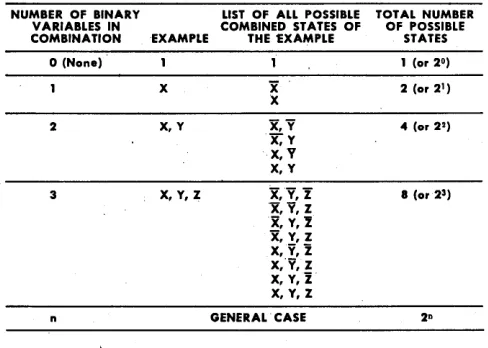
Here, I shall present some basics of Boolean algebra and logical design. Obviously we cannot expect to cover the field completely, to go into a lot of special aspects, or to be mathematically or logically rigorous. As the title implies, I intend to give you "some basics." A fair amount of interest and a minimum of technical background should enable you to read and understand. Having understood and practiced for a little while, you should be able to solve many of the simpler problems in design and trouble shooting-and to go on to deeper and broader literature if and when you are faced with more complex problems.
binary numbers & elements
Computing devices deal with numbers, and also with operations such as addition, subtraction, multiplication, division, shifting, storing, reading, printing, etc. Numbers are made up of digits, of which there are ten in the decimal number system. Their numeric symbols are the familiar 0, 1, 2, 3, 4, 5, 6, 7, 8, and 9. To represent any of
Mr. Lindley is a senior engineer
in the digital systems develop-ment section, Jet Propulsion
Laboratory, where he Is em-ployed in the development of digital ground communications equipment for tracking
space-craft. He has a SA from Ohio
Wesleyan Univ., and an MS
from Purdue.