February, 1966
7
t
CD
•
Programming, Software, and Future Developments: Special Feature
o ••• ! \i<'r.d.~n.1WCbl-rtn ~
Bell System Data-Phone service clears blizzards
of bits for Standard Oil of Ohio
Bell System Dataspeed* data communications service at SOHIO'S Cleveland headquarters use regular telephone lines to transmit some 14,000 heating oil orders a day to 16 truck terminals in Ohio.
During the peak cold weather season, nearly one billion bits of data a month are interchanged between Cleveland and the terminals.
At the terminals, teletypewriter machines print out delivery tickets from the tape. The tickets
give the drivers complete information, even telling them how to locate fill pipes.
After delivery, the exact amount of oil received by the customer is stamped on the tickets. A punched tape of the day's deliveries is made and this tape is fed into the terminal's Dataspeed unit. The data is
automatically sent back to Cleveland, where computers process the information for billing and inventory control. SOHIO installed its data system primarily to
improve profit margins on heating oil sales. The system achieved this goal as it centralized operations, reduced paperwork, speeded cash flow and improved customer service.
Consider the advantages of Bell System Data-Phone* service for your data system. One of our
Communications Consultants will be happy to go over them with you in detail. Just call your
Bell Telephone Business Office and ·ask for his services.
*
Service mark of the Bell SystemIiff:\
~
!?r~!n ~r.~~~~
Telegraph and Associated Compani"
Designate No. 1 on Readers Service Card
j
Some businesses are too small
to use electronic data processing.
But not very many. Small busi-nesses right down to little neighbor-hood grocery or hardware stores can now reap the fruits of elec-tronic data processing. Because you don't have to buy, or even rent, your own computer system any
more. You can use ours. By mail. Just send us the tape from your
NCR cash register or adding ma-chine equipped with "Optical Font" printing. (That's so our computer can read the printing as easily as you can.) NCR does the rest. Process
THE NATIONAL CASH REGISTER COMPANY ® Designate No. 4 on Readers Service Card
COMPUTERS and AUTOMATION for February, 1966
your tapes at a nearby NCR Data Processing Center. Mail back re-ports on every phase of your busi-ness ... accounts receivable, accounts payable, or whatever. At low cost. If you use a cash register, you're big enough for EDP.
DAYTON, OHIO 45409
Mayday!
Ever have days when you get this sinking feeling? Tape problems -
trans-port problems- dropout problems?
Next time maybe we can help. Before you go down for the third time,
call your nearest Computron Regional Office and shout "Mayday". Your
Computron customer engineer will be on his way in a trice. He is fully qualified
in all phases of EDP. He is not a salesman. He knows tapes -
he knows
com-puters -
and he has had a great deal of experience in getting them to talk
to each other.
Of course, many people have solved their data recording problems simply
by switching to Computape.
In any case,
w~are at your service. For advice, application
assistance~problem solving, or justa reel of tape, call. your nearest Computron office.
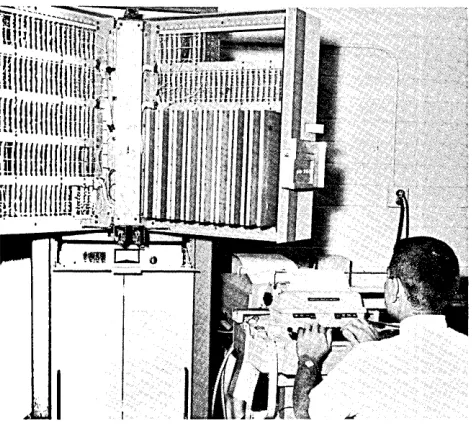
The front cover, alluding to the special feature in this issue, shows some software documentation produced systematically - by people, not computers! For more information, see page 42.
©(Q)Dln)~(1jJ~~~§
~
[fi)@
CE)11lJ'lr;@U1TIlCEJlGfuQuru
FEBRUARY, 1966 Vol. 15, No.2
editor and publisher
EDMUND C. BERKELEY
associate publisher
PATRICK J. MCGOVERN
assistant editors
MOSES M. BERLIN LINDA LADD LOVETT NEIL D. MACDONALD
contributing editors
JOHN BENNETT ANDREW D. BOOTH DICK H. BRANDON JOHN W. CARR, III NED CHAPIN ALSTON S. HOUSEHOLDER PETER KUGEL
advisory committee
T. E. CHEATHAM, JR. JAMES J. CRYAN RICHARD W. HAMMING ALSTON S. HOUSEHOLDER HERBERT F. MITCHELL, JR. VICTOR PASCHKIS
art director
RAY W. HASS
fulfilment manager
WILLIAM J. MCMILLAN, 815 Washington St. Newtonville, Mass. 02160, 617-DEcatur 2-5453
advertising representatives
New York 10018, BERNARD LANE 37 West 39 St., 212-BRyant 9-7281 Chicago 60611, COLE, MASON AND DEMING 737 N. Michigan Ave., 312-SU 7-6558 Los Angeles 90005, WENTWORTH F. GREEN 300 S. Kenmore Ave., 213-DUnkirk 7-8135 San Francisco 94105, A. S. BABCOCK 605 Market St., 415-YUkon 2-3954 Elsewhere, THE PUBLISHER 815 Washington St., 617-D Ecatur 2-5453 Newtonville, Mass. 02160
111 This Issue
Special Feature:
Sofftvare, Progral1zming, and Future Developments
12
14
22
42
44
48
49
In
25
7
10
41
47
8 8 8 8 8 18
62
56 61
62
NEW DEMANDS ON SOFTWARE by Thomas E. Kurtz
What is needed is a new language for expressing software systems: com-pilers, assemblers, file maintenance programs, and supervisors.
THE INTERACTION OF HARDWARE, SOFTWARE, AND FUTURE DEVELOPMENTS AT TRW SYSTEMS
by H. D. Greif
Combining the "best of two worlds" in a single state-of-the-art computing system - large batch-processing problems handled efficiently, and small amounts of a time-sharing environment for quick handling of a host of small problems
LOGICAL DESIGN TO IMPROVE SOFTWARE DEBUGGING - A PROPOSAL by Ned Chapin
Hardware for a "snap-shot dump" command, and an "auto-monitor" com-mand - to make trouble-shooting of programs easier
THE PROJECT WORKBOOK FOR SOFTWARE DOCUMENTATION by Dave De Pinto
A. continuously updated project history including everything from rough notes to final memos - for every project member.
TOWARDS GREATER GENERALITY OF SOFTWARE: EXECUTIVE SYSTEMS IN THE SIXTIES
by Herbert S. Bright
The trends of development of programs used by programmers BASIC RESEARCH IN SOFTWARE
by Ivan Flores
Towards a unified theory of software design, and the responsibilities of computer people to work for it
AUTOMATED WAREHOUSING AND INVENTORY CONTROL by Renzo Dallimonti
Many different approaches are possible, since removing one bottleneck can be equivalent to an expansion in warehouse capacity.
Every Issue
across the editor's desk
COMPUTING AND DATA PROCESSING NEWSLETTER
editorial
Software, Programming, and Future Developments
market report
More Computers = More Profits, New Research Study Indicates
throughput
by Dick H. Brandon
capital report
by James Titus
readers' and editor's forum
The Journal of Computer and Systems Sciences AIAA Technical Subcommittee on Computers
Data Processing Management Association Announces Research Grants The Digital Mona Lisa - Acknowledgement
Formation of the Australian Computer Society
Social Responsibilities of Computer People - More Comments Calendar of Coming Events
reference information
Computer CensusNew Patents, by Raymond R. Skolnick
index of notices
Advertising Index
.~. COMPUTERS AND AUTOMATION IS PUBLISHED MONTHLY AT 815 WASHINGTON ST., NEWTONVILLE, MASS. 02160, BY BERKELEY ENTERPRISES, INC. PRINTED IN U.S.A. SUBSCRIPTION RATES: UNITED ~Y!!J[.' STATES, $15.00 FOR 1 YEAR, $29.00 FOR 2 YEARS, INCLUDING THE JUNE DIRECTORY ISSUE; CANADA, ADD SOc A YEAR FOR POSTAGE; FOREIGN, ADD $3.50 A YEAR FOR POSTAGE. ADDRESS ALL
... EDITORIAL AND SUBSCRIPTION MAIL TO BERKELEY ENTERPRISES, INC., 815 WASHINGTON ST., NEWTONVILLE, MASS., 02160. SECOND CLASS POSTAGE PAID AT BOSTON, MASS.
POSTMASTER: PLEASE SEND ALL FORMS 3579 TO BERKELEY ENTERPRISES, INC., 815 WASHINGTON ST., NEWTONVillE, MASS. 02160. © COPYRIGHT, 1966, BY BERKELEY ENTERPRISES, INC. CHANGE OF ADDRESS: IF YOUR ADDRESS CHANGES, PLEASE SEND US BOTH YOUR NEW ADDRESS AND YOUR OLD ADDRESS (AS IT APPEARS ON THE MAGAZINE ADDRESS IMPRINT), AND ALLOW THREE WEEKS FOR THE CHANGE TO BE MADE.
BRANDON
APPLIED SYSTEMS, INC.
and
CDrn~uters
and automation
are pleased to announce the fifth series (Spring, 1966) of sevenTECHNICAL COURSES
IN DATA PROCESSING
conducted by Brandon Applied Systems, Inc.
sponsored by Computers and Automation
"Management Standards for Data Processing"
a 2-day course for managers and senior person-nel. on management control and standards. This course is based in part on the book of the same name, by Dick H. Brandon. (D. Van Nostrand Company, Inc., Princeton, N.J. 1963.)
Washington, D.C. - March 23, 24
New York, N.Y. - April 6, 7
London, England - May 17, 18
"Operations Control"
a l-day course to provide operations managers
and supervisors with a body of techniques and discipline for operations control.
Washington, D.C. - March 22
New York, N.Y. - April 5
London, England - April 25
"Computer Systems Analysis Techniques"
a 2-day technical course on the techniques of systems analysis and computer feasibility study. This course is designed for experienced analysts and supervisory personnel.
Washington, D.C. - April 20, 21
London, England - April 27, 28
New York, N.Y. - May 11, 12
oqa
"Management Audit of Data Processing" a l-day course for data processing management, senior management responsible for the data processing function, management analysts, and organizational specialists.
Washington, D.C. - April 19
London, England - April 29
New, York, N.Y. - May 10
"Appreciation Course in Data Processing" a 2-day course for top executive and depart-mental management covering the basic princi-ples of data processing.
London, England - May 19, 20
Washington, D.C. - June 1 r 2
New York, N.Y. - June 15, 16
"Introduction to Data Communication and Time Sharing"
a l-day course intended for data processing managers, departmental managers, and others using data communication equipment or time-sharing techniques.
Washington, D.C. - May 4
New York, N.Y. - May 25
"Computer Selection"
a l-day course for management and technical personnel contemplating acquisition or replace-ment of a compl;.lter system.
London, England - May 16
For the Spring, 1966 course catalog write or phone or mail coupon:
BRANDON APPLIED SYSTEMS, INC.
30 East 42nd Street, New York, N.Y. 10017 212-YUkon 6-1518
TO: Brandon Applied Systems
30 East
42
St.,New York, N.Y. 10017
Programming, Software,
As a special feature in this issue of "Computers and Auto-mation," we have chosen the subject of programming, soft-ware, and future developments. Why?
A central proposition in this field nowadays, it seems to me, is this:
The hardware of computers, as machines for handling information, has gone a long way - but, the software, the techniques for easily and flexibly instructing machines to handle information as we desire, is becoming the crit-ical area for further progress, and many advances need to be found and worked out.
In "SDC Magazine" for August 1965, published by System Development Corporation, Santa Monica, California, appear some interesting remarks:
At SDC a family of user-oriented programs and sys-tems is being developed that will make possible a valuable dialogue between the computer and its users. These pro-grams and systems aim at bringing the user . . . into communication with the computer without the need for a translation by a programmer. The goal is to make it possible for him to:
- question the computer;
- get responses in a language resembling English; - build his program as he goes along;
- permit him to do this while other users are sharing the same machine; and
- receive the responding information in any format that seems best.
Clearly, it is desirable for the computer also to recognize natural English. Steps in this direction have also been taken. In his Ph.D. thesis "Natural Language Input for a Com-puter Problem-Solving System" which Dr. Daniel G. Bobrow submitted to Mass. Inst. of Technology in September 1964, a computer program called STUDENT is defined, which is able to accept for example a problem like the follow-ing:
Bill is one half his father's age 4 years ago. In 20 years he will be 2 years older than his father is now. How old are Bill and his father?
The problem in this very form is accepted by the program STUDENT, and the answer produced by STUDENT is:
BILL S AGE IS 14. BILL S FATHER S AGE IS 32.
COMPUTERS and AUTOMATION for f:::bruary, 1966
and Future
c&a
EDITORIAL
Developments
This is of course the correct answer, and expressed in satis-factory English as well. Only the grammatical apostrophes for the possessive case are missing, a trivial defect which would not have occurred if an expanded set of characters had been available in the computer system in which STU-DENT was run.
Along with the development of direct personal questions and answers in a dialogue with a computer, is increased interaction of computer programming with mathematics and logic.
For example, problem-oriented computer programming languages enlarge our conception of mathematical objects. In prior centuries men became accustomed to noticing as in-teresting mathematical objects: numbers; points and lines; the magnitudes and direc~ions of forces; sequences of num-bers, usually infinite and usually constructed with fairly simple rules, such as 1, 1/2, 1/4, 1/8, 1/16 . . . ; and so on. Now with the development of problem-oriented program-ming languages, we take into mathematics a great variety of new structures (such as lists), and a mathematical expres-sion of processes of effectively computing· with them (such as recursion). For example, a, recursive definition of the function FACTORIAL (for whole numbers) is that the factorial of zero is one, and that the factorial of any number N is equal to N times the preceding factorial. This is not a circular definition because the recursion stops at the initial case, and so the function can be computed from this defini-tion. The expansion of the nature of mathematical objects because of problem-oriented computer programming lan-guages is important and exciting.
We can safely predict that the next 20 years will show remarkable developments in computer programming lan-guages, to such an extent that the barriers between user and computer nowadays will seem like prehistoric times to those of us still working in the computer field.
By then in fact it is very likely that computers will con-verse and discuss with human beings, using ordinary lan-guage and handling ideas appropriately, - as well as being able to draw within seconds on vast quantities of recorded knowledge, and perform within seconds reasoning and cal-culation far beyond human powers.
c.~
EDITOR
THE JOURNAL OF COMPUTER AND SYSTEMS SCIENCES
Academic Press
New York, N. Y.
We should like to inform your readers that we will soon be publishing the JOURNAL OF COMPUTER AND SYS-TEMS SCIENCES. A new journal, to be issued quarterly, it will be devoted to the newly emerging interdisciplinary area of Computer and Systems Sciences. It will feature papers on computers and computer-like information process-ing systems; on the general theory of systems whether they be discrete (such as automata) or continuous, whether deter-ministic or stochastic, and including biological systems; and on optimization theory of such systems, whether for informa-tion systems or control systems, in which the emphasis is on computational methods and algorithms. The papers, largely theoretical in character with no compromise in mathematical rigor, will deal with problems that may arise in diverse disciplines but will involve the computer or computer-based technology in an essential way.
The editors of JOURNAL OF COMPUTER AND SYS-TEMS SCIENCES will be Professor A. V. Balakrishnan, University of California, Los Angeles; Professor E. K. Blum, Wesleyan University; Dr. R. W. Hamming, Bell Telephone Laboratories; Professor P. D. Lax, New York University; and Professor L. A. Zadeh, University of California, Berkeley. They will be assisted by an international editorial board representing the U.S.S.R., Israel, England, France, and Japan.
AIAA TECHNICAL SUBCOMMITTEE ON COMPUTERS
Barry Boehm
Chairman, AIAA TSC Computer Sciences Department
The Rand Corp. 1700 Main St. Santa Monica, Calif. 90406
The American Institute of Aeronautics and Astronautics -the nation's primary aerospace professional organization, with about 40,000 members - has recently established a Technical Subcommittee on Computers.
The purpose of the subcommittee is to facilitate technical advances and reduce duplication of effort by stimulating information transfer in the interface area between the aero-space sciences and the computer sciences. Some of the pro-posed means of doing this include compiling a catalogue of aerospace computer programs, sponsoring sessions of technical papers on computer applications at AIAA meetings, coordi-nating with relevant professional organizations in the computer sciences, and disseminating information on problems and progress in the computer sciences to aerospace scientists and vice versa.
Any suggestions on these or other possible useful activities will be welcomed by the subcommittee.
c&a
READERS'
&
EDITOR'S FORUM
DATA PROCESSING MANAGEMENT ASSOCIATION ANNOUNCES RESEARCH GRANTS
The Data Pro:-essing Management Association will sponsor a program to 2ssist and promote Ph.D. level university re-search in data processing. Beginning in September, 1966, a number of individual grants of $2,000 each will be made to selected doctoral candidates who will perform the necessary research and prepare dissertations in the field of data process-ing systems and management. The research should be directed toward methods of management planning, control, organiza-tion, and decision-making with regard to automatic data processing technology.
The grant funds will be disbursed in 1\vo parts: (a) the first $1,000 at the rate of $125 per month for eight months during which time the candidate pursues his research, and (b) the final payment of $1,000 upon completion of the study and its acceptance by the university 2S a dissertation that
partially fulfills the requirements for a doctoral degree. A copy of th(' accepted manuscript" suitable for publication, will be provided the Association which will have first option
to publish.
Applicants must be doctoral candidates at accredited grad-uate schools. The doctoral committee must have already be('n appointed by the university and th(' proposed research, including content and methodology, must have been approved. Applications for 1966-1967 grants must be received at DPMA Internatiqnal Headquarters no later than March 15. Additional information and application forms arc available from DPMA International Headquarters, 505 Busse Highway, Park Ridge, Illinois.
THE DIGITAL MONA LISA - ACKNOWLEDGEMENT
The front cover of our December 1965 issue was a copy of "the digital Mona Lisa/' made by a computer and a plotter. Our account of it (on page 13) mentioned the maker of the computer, but did not mention the maker of the plotter - information which we did not have at that time. The maker of the plotter was California Computer Prod-ucts, of Anaheim, California. Certainly, the remarkable ac-complishment of the device that plotted the information produced by the computer should have been acknowledged in our December issue. We regret this omission.
FORMATION OF THE AUSTRALIAN COMPUTER SOCIETY
The five existing computer societies in Australia, namely, the Canberra Computer Society, the N.S.W. Computer So-ciety, the Queensland Computer SoSo-ciety, the South Austra-lian Computer Society, and the Victorian Computer Society, have agreed to join together to form a single society, to be called "The Australian Computer Society." This Society came into existence on January 1, 1966.
A 20-million-bit mass core memory
can be economical, reliable, and fast!
Here's how:
Coincident-current versatility with only two wires!
(Cross-section of Fabri-Tek's simple and reliable orthogonal mass core memory plane.)
V-Top Selection Bit 1 Bit 20 Bit 21 Bit 40 Bit 41 Bit 60
X-Selection [1216] [12.81J ~~96J [25.61J [37.76] X-Selection
~ INPUTS 256 X 1280 (1-64) 1280 1345 560 2625 3840 OUTPUTS MATRIX
1 Lines 1-256 Lines 1-256
2 257-512 257-512
3 513-768 513-768
4 769-1024 769-1024
5 1025-1280 1025-1280
6 1281-1536 1281-1536
7 1537-1792 1537-1792
8 1793-2048 1793-2048
9 2049-2304 2049-2304
10 2305-2560 2305-2560
11 2561-2816 2561-2816
12 2817-3072 2817-3072
13 3073-3328 3073-3328
14 3329-3584 3329-3584
15 3585-3840 3585-3840
16 3841-4096 3841-4096
Note: This block diagram Bits 1 to 20 Bits 21 to 40 Bits 41 to 60 Bits 61 to 80 presents an "edge-on"
V-Bottom Selection view of stack.
Here is the road-map to reliability!
(Core-selection block diagram for Fabri-Tek's mass core memory stack.)
In extremely large capacity core memory systems such as Fabri-Tek's new Series MT mass core memory, the stack and core selection circuit costs become the major system cost consideration. The illustrations above show the key factors which make the Series MT a truly practical mass core memory.
If conventional 128 X 128 matrices were used, a total of 1,280 frames would be required instead of 64. This would mean a total of 655,360 X and Y·line to frame connections compared to the 196,608 connections used in this Fabri·Tek memory.
A simple and reliable orthogonal array uses only X and Y wires to reduce the stack stringing cost and to reduce X and Y drive line soldered connections by a ratio of more than 4:1.
The core·selection block diagram shows how a 20·million·bit array is divided into 4,096 X lines and 5,120 Y lines. A total of 327,6aO cores is wired into each frame.
Special Fabri·Tek circuit techniques, using all·silicon semi-conductors, give reliable memory speeds of 4 to 8 microseconds. Interface is compatible with discrete or integrated circuitry.
If you'd like more interesting facts about the Fabri-Tek mass core memory, write, call, or wire Fabri-Tek Incorporated, Amery, Wisconsin. Phone: 715·268·7155. TWX: 510·376·1710.
FABRI-TEK
INCORPORATED
Designate No. 1 on Readers Service Card
MORE COMPUTERS
=
MORE PROFITS, NEW RESEARCH STUDY INDICA TESThe profitability of major sectors of busi-ness enterprise shows a close relationship to the size of their investment in computer use. This is one of the key findings of an extensive market research study of computer use in the United States, recently conducted by the International Data Corporation (IDC).
The table below summarizes the results of the study.
Finance. insurance, and real estate firms, which as a group rank first in business profit-ability (their profit equaled over 18% of gross receipts). also rank first in computer investment per firm. They show an overall investment of $27 in computer hardware per thousand dollars of business receipts. Transportation, communications and public utilities come next in industry profit-ability with profit at 14.1% of gross receipts and they were also second in computer investment with $9 in computers for every thousand dollars of business receipts.
MARKET
REPORT
Following these economic sectors were manu-facturing firms with profit equal to 6.4% of gross receipts and an investment in computers of $6.38 per thousand dollars of business receipts. Trail-ing were the construction and minTrail-ing firms, whole-sale and retail trades, and agricultural, forestry and fishery firms with profits less than 4% of gross receipts and investments in computers of less than $3 per thousand dollars of business receipts.
The IDC research project included a study of computer use in firms with annual sales in excess of $100,000, whether sole proprietorships, partner-ships or corporations.
"The density of computers in the industries studied is still very light," a spokesman for !DC
commented. "It ranges from one computer per 18 organizations for financial firms to one computer per 975 organizations for agricultural, forestry and fishery firms." He pointed to these high ratios as indications of the massive potential market still available in the computer industry in the United States. He also said that at the current time, the benefits of direct computer use are being received by less than 1% of the business enterprises in the United States with annual sales of over $100,000.
COMPUTER USE BY SOLE PROPRIETORSHIPS, PARTNERSHIPS, AND CORPORATIONS IN THE UNITED STATES WITH ANNUAL SALES OVER $100,000
Number of Total Percent Value of Computers
Organizations/ Business Net Net Profit/ Installed/
Number of Installed Receipts Profit Business Business Receipts
Industry GrouQ Organizations ComQuters (millions) (millions) ReceiI!ts x 1000
Agriculture, Forestry, 39,000 975 $ 12,534 $ 478 3.8 .87
and Fisheries
Mining and Contract 105,000 233 64,430 2,362 3.7 2.73
Construction
Durable and Non-Durable 153,000 20 407,061 26,150 6.4 6.38
Products Manufacturing
Transportation, Communi- 29,000 16 71,872 8,125 14.1 9.25
cation, and Other Public Utilities
Wholesale and Retail 545,000 361 365,012 8,814 2.4 1.11
Trades
Finance, Insurance, and 64,000 18 46,715 8,535 18.3 27.22
Real Estate
Prepared by: International Data Corporation, Newton, Massachusetts 02160, December 1, 1965.
WHERE CAN MAN GO ... IN P
.
.
.
GRAMMING?
F"'rol11
~ll)(lCllS
t()
C(}111l-)ll
ter,
1111111::1!1
l)rogress
C~ln l)c~
.111etlSllred
ill
illcrel11ellts
of
.111~111'
s
s
](ill
ill
l)ro(~essillg
ti~lta. ()rigill(lll~(
110 .1ll()re C().111111ex
tl1~lIl tllt~
.fi
g(~rs
of 01le
hall(1,
C()111.ptItc:r systC:t11S (lre
t()(l~l~T
trIll
re\70Il1ti()nizil1g
tIlt:
\:rer)!
til11t:S
ill
vv'11ic11
,,7e
1
&as
ci
\7iliz(lti()ll gr()"lS
c:\7{~r
111()re
(l\\l~lre
of
t
e s l(il1s
of
tlleSt~ 1111C(11111~T
Ser\l(1Il
ts,
Sf)
t()()
gr()\\!
ill
illlJ)
()rt ..
a n c e
t
11
e
1)
r () g r
(1111111 e r
s\\r
]1 ()
i
11
i
t
i
(1
t
t:
~lll
(1
t
11
e 11
in
terl-)rc~t
(111
tl1
(It
tIl
es(~
i
llstrtllllellts
(Ire
,lblc:
to
aCC()ll1.P
1
is
11.
I)r()gr~lI11:
l\
tr~lj C~(~t()r~T
f()r
()I)till1U.ll1
1)al1istic
fligIlt
f~lr
alIt
ill
SJ)(l(~(~. Pr()gr~llll:
SitllI11il
ti()!l
stucl
ies.
Pr()grll111:
l\.cl\/a
11
(~ec1
S().ft,,7(lre.
lZe~ll-
t
inl
(~
111~lt1.(lgelllc~11
t,
(lncl
1)"[1
si
11(~SS s)rstc~ln,s..
III
l)riei,
\'l11t~r
ever t}lere
exists tlle
.lleecl to
(l()
tl1illgS
l)t~tter:
Pr()-gr~1111.
I ..
.f()
C ]{
11
e
t:
(1 ()
ff
(~r
s
~111
111111 S
11
~111
j!"
\\T
i
(1
c~
r£l
11 g
(~
0
f
a.d\lancecl
1)r()gr~1Illrlling t~lSJ.CS ~lt
OIle
of
-tllt~
'\T()rlci's
1
(1
r g est
c
(~
11
t
r
(11
i
Z e
c1
i
11
clu.
s
t
r
i
~ll (~(?
111
I)
11
t
r i l l s
t
£11-lations .. ,;\Trite ]VIr.
·K .. It. ](.ici(loo,
Ilrc)fessic)Il(lI
l~lce
l11cn t
1\1
(111(lge
r,
SlIll
Ily\7~11
e,
(,~
,II
i
i()
rl1 i<l ..
IJo
(~
cl
is
an
equal
opportunity employer.
!::!!!?~!:!If!IJ!!!?V
A GROUP DIVISION OF LOCKHEED AIRCRAFT CORPORATION
NEW DEMANDS ON
SOFTWARE
Dr. Thomas E. Kurtz, Director
Computation Center
Dartmouth College
Hanover, N.H.
Computers are getting bigger and better, and at a faster rate. In the short space of 15 years computation has pro-gressed from the c2rd programmed calculator (CPC) stage, with its two or three operations per second, to the place where submicrosecond mach:nes (lfe no longer status symbols. While it would be heresy within the computing world to suggest that this is a bad thing, I would contend that the tremendous advance in hardware has been a mixed bless-ing. So much re-programming effort has been needed for these frequent, easily justified, equipment changes that little energy was left to improve the software situation on existing (now obsolete) computers. As computers get bigger and faster and ap~roach the speed of light, it is becoming clear that the development of software to match has not proceeded as well as it should.
The appearance of several time-sharing computer systems has caused us to take a closer look at software. This closer look, besides leading us to conclude that the software situa-tion is not as good as it ought to be, has suggested some remedies. We can obtain some perspective by reviewing the present controversy about the value of time-sharing. The perspective becomes clearer if we look at the past history of software development.
A Brief Historical Trace
The first computers following the CPC were relatively fast compared with their input-output. In those days most com-puter programming was done directly in machine language.
A person labeled as a computer programmer was indeed a highly skilled expert in conversing with the computer in this mysterious and exotic tongue.
As more efficient means of input and output were de-veloped, we noted the increased use of special languages, though it is not being claimed that there is any correlation between these two trends. In any case, symbolic assemblers..
made it more convenient for programmers to program. Then came the revolutionary development of algebraic, user-ori-ented languages of which FORTRAN was one of the pio-neers. ~he job of programming now suddenly became
some-what simpler; it is obviously simpler to teach an algebraic language than it is to teach a machine language if your purpose is to perform numerical calculations.
About this time there entered on the scene a new type of software, the so-called monitor. It permitted the user to specify what was to be done with his problems in a special code language punched on "control cards." Thus ~as born the batch pro~essing system now in extremely heavy use the country over. In a batch processing system each submitted problem is run to completion. Usually each such run will require several different components in the software system to be retrieved and used consecutively. (Actually, the term batch processing is now a misnomer. Originally, when input and output were slow, it was convenient to batch together all jobs requiring, say, an assembler. After the batched as-semblies, 'each of these jobs would then be continued at a later time. A more appropriate term for the present mode of operation might be sequential processing.)
The conventional batch-processing monitor initiates and performs such tasks as reading and writing tapes, searching for and reading in compilers, and printing or punching ac-counting information. Human operators still perform the tasks of scheduling the work load, handling the accounting information, overseeing the running of the problem including adherence to time limits, and carrying boxes of cards and magnetic tapes from point to point within the computing center.
Time-Sharing vs. Batch Processing
is costly. This is of course true. The standard counter-argument, with which I agree, is that time-sharing provides a completely different, much more valuable service, well worth the additional cost. But a crucial point is often overlooked: namely, that batch processing software systems also require a considerable amount of overhead. Some might require up to twenty per cent of the central processor operating time for tape operations, including a search for the proper software systems, and in some cases for manual operations such as tape mounting or operator intervention for debugging pur-poses. The conclusion we can draw is that conventional batch processing software must still be considered primi-tive. While present time-sharing systems represent only the beginning, experience with them has served to identify areas for considerable software improvement in batch-processing systems as well.
There are, of course, good batch-processing monitors. Many installations are making improvements to better utilize exist-ing hardware without droppexist-ing the basic concepts of batch processing. But in the fast-moving computer world today it is usually easier for an organization to convince its man-agement that it needs a more powerful set of hardware. (Indeed, it may even be true that a newer, faster computer can often do the same job at a lower cost.) The net result is that not nearly enough thought and effort is being put into the improvement of software systems. If the improve-ment in hardware were to suddenly cease (perish the thought), we would undoubtedly find the computer world working harder to improve present software, reduce over-head, and improve service.
It should be pointed out that the emphasis on improved hardware over improved software is probably economically justified. When you can get it, good software is expensive. More often than not, you can't get it. Then> just aren't enough systems programmers to go around, especially ones that can be assigned the job of going after that additional 10 or 20 per cent of saving.
The Time-Sharing Legacy
The principal side effect of the introduction of time-shar-ing systems has been the necessity to re-examine the whole question of software: its design, construction, growth, and maintenance. Since poor service in a time-sharing system is something that every customer is immediately aware of, there is much more direct pressure to come up with better super-visory systems and compilers. The computer center staff can no longer hide behind the jargon of unfamiliar words that has kept the computer-using public docile.
To be truly effective, a time-sharing system must be de-signed for the load and job mix that it actually receives. In an educational or engineering environment, for instance, the multitude of small, quick jobs dictates the availability of small, quick compiler systems. Where file maintenance and interrog:1tion are importC'nt, special attention must be given to the software that performs the file functions. Poor service is easily recognized by the user and complaints just as easily initiated. But all too often, in conventional batch process-ing systems servprocess-ing predominantly a load of small problems the clumsy, memory-filling compiler is unlimbered and dragged in for every such problem. (What user knows enough to complain?) All too few installations now an' using small resident compilers for their many short problems.
Another side effect, traceable to considerations of multi-programming as well as time-sharing, suggests quite strongly that most of the bookkeeping and manual operations
pre-COMPUTERS and AUTOMATION for February, 1966
viously performed by human beings ought to be managed by the computer itself. The most obvious example is that the computer should schedule its own work. Even if we retain the fundamental batch-processing concept of a single input-output channel, it is still common sense that the com-puter should be able to interrupt its own work when a very short, quick job is submitted to it. In a commercial situation, if a customer is willing to pay more for a quicker turn-around, the software ought to be able to serve his request, whether it be oriented more towards batch-processing or towards time-sharing.
Like the term batch-processing, the term time-sharing is also a slight misnomer. All but the smallest computers are time-shared, that is, their users share their time. But what is usually meant by the term "time-sharing" today is a sys-tem whereby many small input-output consoles operate si-multaneously. Perhaps a better term would be a multiple-console system. In any case, the fundamental characteris-tics of what we usually call a time-sharing system are these:
1. Multiple input-output consoles.
2. A software system that lets the consoles operate si-multaneously, schedules the use of the computer so that all console users receive equally good service, and main-tains the user files.
\V'e argue that a batch-processing software system ought to supply the functions under item 2, with the exception that there may be only one input-output channel, or that multiple channels if they exist receive only delayed service. We admit that many applications are better servrd by a system that employs the philosophy of a batch-processing run to com-pletion, but we insist that this is no reason not to have sophisticated software.
The Problem of the Evolution of Software
The main problem therefore is that the development of computer hardware has outstripped the evolution of soft-ware. If our utilization of computers is to keep pace with the development of hardware, then new efforts must be in-vested in software. Software must be engineered with the applications in mind. The relatively infrequent application requiring special treatment need not receive the same ser-vice as the frequent applications.
As an example, in an educational trnvironment, the many small problems from students should receive super-fast ser-vice from a software system especially designed for them. The relatively less frequent problem requiring a longer run or more sophisticated use of memories would require a dif-ferent software system. This more elabor2te system would be brought into play only when needed. As a result, the overhead associated with the more elaborate software sys-tem would be generated much less frequently. It does not make sense to have the more elaborate software system on hand at all times.
Another reason why more effort must be put into the development of software is that software must assume more of the bookkeeping and data-transfer functions now per-formed by human beings. Whether in a time-sharing or batch-processing environment, we can no longer permit a computer system used by many, many persons to be slowed down to the speed of human operators in changing prob-lems.
In a time-sharing or a multi-programming system the more widely used software components must be reentrant: that is, they must be able to be used in common by several differ-ent users, and be interruptible.
(Please
turn topage 54 )
THE IN'TERACTION OF HARDWARE, SOFTWARE,
AND FUTURE DEVELOPMENTS
AT TRW SYSTEMS
H. D. Greif, Manager Data Systems Department TRW Systems
Redondo Beach, Calif·
In the summer of 1965 TRW Systems decided to replace their existing computers with GE 600's. This replacement is scheduled to take place in the latter half of 1966. Why did we decide to take this step?
Basically, there are two prime reasons. One is economic: the computers to be replaced lease for about $3.5 million per year, compared to the equivalent capability on the new configuration renting for approximately $1.1 million an-nually. The other reason for replacement is technical capa-bility: the new computers will permit rendering new or im-proved services in many areas. It is the purpose of this paper to outline the ·new and improved capabilities of the new configuration compared to our existing computer complex and how we expect to take advantage of them.
Present Computing Facilities
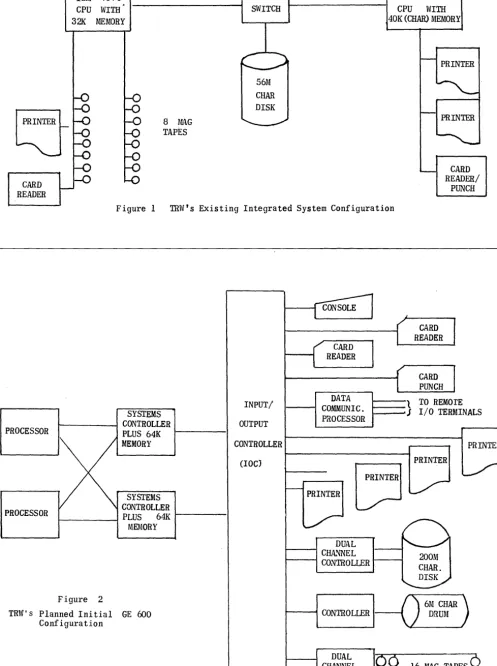
Since the spring of 1963 our computer complex has con-sisted primarily of two integrated1 (or shared file) IBM 7094/1301/1410 systems configured as shown in Fig. 1. In contrast to most other large computer installations of that time period, our "integrated system" has permitted input/ output functions to be performed on-line to the main com-puter (7094) by direct tie-in of a peripheral processor (1410) via a large, shared disk file (1301). In addition, we have also employed small RCA and Honeywell computers for ac-counting, etc.; furthermore, a third IBM 7094 computer was added in 1965 to cope with the increased computing load.
What Is Faulty With the Existing System
Other than its relatively high cost compared to newer computer offerings, what is wrong with TRW's existing com-puter complex? It is certainly a relatively efficient installa-tion and gives excellent turn-around time (as long as the load does not exceed system capacity); set-up time is very
low compared to industry standards because of the sophisti-cated scheduling that is handled by the computer itself; furthermore, many of the tape and file-service problems of other batch-processing installations have been eliminated.
In discussing the shortcomings of our existing computer complex, we may talk about two areas: those that are pri-marily of concern to the professional computer programmer or analyst; and those that primarily concern the man with a problem to be solved, e.g., the engineer, physicist, or ac-countant. Some of the shortcomings of concern to the former include
• limited core space (32K* words on the 7094)
• no common data base between the various computers • lack of memory protection
• competition between 7094 and 1410 for disk accesses
*K
=
210=
1024Hence, in summary, what is wrong with the present system is that on the one hand there are certain limitations in terms of core space, etc., that primarily handicap the solution of the ever-more-complex large problems, e.g. space mission analysis; on the other hand there are different limitations in terms of access that prevent the optimum employment of a computer for the myriad of small problems that crop up daily. It is our goal to alleviat~ these shortcomings with the new computing complex which will be described next.
What Will the New Hardware Offer?
The new hardware equipment2 selected to meet our
re-quirements is shown in Fig. 2. Note first of all that it is a memory-centered system, with initially 128K words (36-bit) of 1 microsecond core storage and provisions for expansion up to 256K words. This large memory will allow the efficient solution of complex problems, and yet provide for multi-programming, i.e., the ability to accommodate several pro-grams, both large and small, in core simultaneously. Multi-programming permits switching a processor from one program to another whenever a processor encounters a condition where it would become idle due to having to wait on some input-output, and hence multiprogramming is an important feature from the point-of-view of keeping the computer resources usefully occupied a large percentage of the time. Further-more, multiprogramming as well as a powerful interrupt sys-tem are essential if large programs requiring minutes of computer time are to be frequently interrupted by small programs requiring of the order of a second of computing with essentially instantaneous response. To make multipro-gramming practical, the new memory includes the following features:
• Memory Protection - Hardware provisions to prevent any program from accessing memory outside of its assigned boundaries. This is achieved by a register holding the upper program limit and a comparator checking every memory access to see that the address is less than this upper limit, and if greater, to cause a fault trap.
• Relative Addressing - Hardware provisions to allow all programs to be written as though they would be loaded into core starting at location zero. This is achieved by a register holding the address of the first memory location assigned to the program, and adding the contents of this register to the address specified in the program to obtain the absolute address to be accessed.
Any part of the core memory is accessible from either one of the two independent processor units, as well as from any of the devices connected to the input-output-controller (IOC). Secondary memory connected to the system via the IOC will initially consist of a hierarchy of 6 million characters of drum memory, 200 million characters of disk memory, and 16 magnetic tape drives; plans call for considerable expan-sion of the disk capacity in the future. The accessibility of all memory from either processor results in the highly de-sirable common data base which we currently lack.
All the traditional unit record devices, e.g. card readers, card punch, and printers, are on-line as in our present con-figuration to give fast turn-around. Furthermore, we plan to add plotting capability on-line in the future.
A data~communication processor rounds out the new com-puting complex; this is a small-scale computer with 16K word (18-bit) core memory, primarily designed to facilitate servicing a large number of remote terminals via communi-cation lines. It is capable of accommodating a variety of
COMPUTERS and AUTOMATION for February, 1966
can you
prevent your
computer from
multiprocessing?
Burroughs B 5500
users can't.
Most computers can't multiprocess
anyway-but the B 5500 is always multiprocessing,
even with only one production run on the
system. The reason: the Burroughs B 5500's
Master Control Program is always active, always
multiprocessed with the job or jobs it controls,
often multiprocessed upon itself. For example,
the
MCProutine that processes operator
con-sole messages can run simultaneously not only
with the job, but also with the
MCProutine
that interrogates peripheral units, or the
por-tion of the
MCPthat selects and brings a user
program into the system.
For more information about the Master Control
Progrrun for the Burroughs B 5500, write us
at Detroit, Michigan
48232.
BurrOUghS~
THE MARK OF EXCELLENCE IN EDP
Designate No. 9 on Readers Service Card
[image:15.621.318.564.151.483.2]CARD
READER
IBM 7094
CPU WITH
32K
MEMORY
a
MAG
TAPES
SWITCH
IBM 1410
CPU
WITH
40K (CHAR) MEMORY
PRINTER
CARD
READER/
PUNCH
Figure 1
TRW's Existing Integrated System Configuration
~
CARD
I
I
READER
CARD
READER
CARD
1
I
PUNCH
INPUT/
COMMUNIC.
DATA
1
TO REMOTE
SYSTEMS
J I/O TERMINALS
CONTROLLER
OUTPUT
PROCESSOR
PROCESSOR
PLUS 64K
MEMORY
CONTROLLER
PRINTER
(IOC)
CTERI
PRINTER
~
' -
V-SYSTEMS
PRINTER
PROCESSOR
CONTROLLER
PLUS
64K
V-MEMORY
DUAL
~
CHA.~EL
200M
CONTROLLER
CHAR.
DISK
Figure 2
mNTIlOWlR
-0
6~Rg~
)
TRW's Planned Initial GE 600
Configuration
DUAL
199
16 MAG TAPES9
CHANNEL
[image:16.623.46.544.54.721.2]terminals via either direct lines or telephone switching cir-cuits. The number and types of terminals to be installed at our various facilities is still unsettled; however, it appears likely that by 1967 there will be a total of about 30 Teletype or equivalent devices, plus about 15 CRT/Keyboard stations, plus a small number of satellite computers, test data collection and display terminals, etc.
Now that we have outlined the most pertinent features of the hardware TRW expects to install, and indicated how both large "batch-processing" programs and small, real-time on-line programs can live side-by-side, let us next look at the required software.
What About Software?
Hardware without software is rather like a man without a woman, of little use. To employ today's complex hardware at all efficiently requires equally complex software.
The following discussion on software is confined to the basic operating system, and the extensions to give the remote user the tools to solve his small problems; compilers, as-semblers, applications programs, etc. will not be described.
The manufacturer has developed a comprehensive Oper-ating Supervisor called GECOS II for the GE 600.3 This
software package is primarily intended for efficiently han-dling the traditional batch processing of jobs, with no pro-visions for real-time, conversational on-line facilities. We are! developing fairly extensive additions to GECOS II to provide\ the required real-time, conversational on-line facilities.
Let us first give a brief description of the functions GECOS II performs:
• Input Media Conversion - Entering jobs into a job stack from the card reader or other input device; intercepting and interpreting certain control cards, and generating input control tables; and recording the in-put data on the drum or disk memory.
• Allocation - As jobs are completed, looking at the input control tables and selecting the job to be pro-cessed next on the basis of available resources, pri-orities, etc.; compacting the programs in core, if neces-sary, to allow the new program to be fitted into the memory; issuing instructions to the operator, if re-quired, for tape mounting, etc.; updating the input control tables and initiating the new program.
• Execution - Overseeing the execution of each activ-ity; interpreting fault conditions; supervising all input/ output requests; collecting accounting data; etc. • Termination - Generating the accounting record;
closing systems output file; producing a post mortem dump if the termination was not normal; communi-cating with the operator, if required; reallocommuni-cating memory and peripherals; etc.
• Output Media Conversion - Initiating and control-ling the movement of data to output devices, e.g., card punch, printers, etc.
Thus, it can be seen that GECOS II completely performs the control functions required to process the traditional batch processing jobs. We shall next describe how we intend to extend by additional software the capability so that remote-terminal, real-time users can also be accommodated on the new computer complex.
Remote Operations Supervisor
First, we are currently developing a Remote Operations Supervisor (ROS) which, for simplicity, can be considered
COMPUTERS and AUTOMATION for February, 1966
do you
get maximum
machine efficiency
from your
compiled programs?
Burroughs B 5500
users do.
With most computers, you face this choice:
use compiled programs without modification
despite slower-than-optimum run times, or try
to improve the object programs through hand
coding. The Burroughs B 5500 is different.
The excellence of its advanced compilers, plus
the B 5500's unusual internal organization,
results in machine compilations that are every
bit as efficient as the very best hand coded
programs. Programing is less costly, takes less
time. The B 5500 is always used optimally.
Documentation is always complete, standard,
and current.
For more information about advanced
com-pilers for the Burroughs B 5500, write us at
Detroit, Michigan
48232.
BurrOUghS~
THE MARK OF EXCELLENCE IN EDP
Designate No. 9 on Readers Servico Card
the highest priority applications program which may obtain up to 25% of the processor time. Parts of ROS, like GECOS II, are always resident in the core memory. ROS is essentially a second-level control program that performs many of the functions of GECOS, i.e., scheduling, accounting, re-locations, etc., but only for the numerous remote terminal jobs. ROS is being structured "open-ended," so as to be able to accommodate a variety of specialized software pack-ages as required to provide different services for the remote llsers.
Other Software
Initially, two specialized software packages are being de-veloped to run under ROS, one a "small problem service" for solving fairly simple mathematical equations, the other for an on-line information update-and-retrieval system. A num-ber of other software packages are in various planning stages. The following is a brief description of these remote-terminal, real-time packages.
• Small Problem Service - This package is essentially a copy of Dartmouth's BASIC,4 but structured for operation under ROS. It will give the user at his terminal a powerful tool for finding numerical solu-tions to fairly sophisticated mathematical equasolu-tions. Included are facilities for most of the common mathe-matical functions, capability for looping and branch-ing, storage of the program for future recall, etc. This facility is expected to be heavily used, primarily by engineers, physicists, etc., for solving a host of day-to-day problems in the various scientific dis-ciplines.
• Information Update-and-Retrieval System - This package is intended to give the administrative and management personnel ready access to the latest pos-sible information, without having to search through voluminous reports. The initial system will be pri-marily used for purchasing, receiving, inventory con-trol, quality assurance, etc.; however, plans call for other data bases to similarly allow on-line information update-and-retrieval in other fields.
In addition to the above packages currently under devel-opment, other packages currently under consideration for future implementation include:
• Text Editing - This package would permit the sub-mission of textual material for storage on disk or tape. Once stored, additions, deletions, or corrections could readily be accomplished and clean copy prepared at any time. As such it is of prime value in the prepara-tion of proposals, technical manuals, etc.
• Program Debugging - This package would allow a computer programmer to correct errors on-line to help speed up the development and checkout of software.
• Culler-Fried System - This package would make the Culler-Fried capability5 available on the GE 600. This
would be a powerful tool for solving problems which do not have a known or well-formulated solution, primarily as found in the field of classical mathe-matics.
• Computer-Aided Design - This package would per-mit the on-line, computer-aided design of mechanical parts, electrical circuits, structures, etc.
• Other - Computer-aided training, computer-aided testing of spacecraft and other devices, etc., are among many possible future extensions.
Thus, by extensions to the software supplied with the equip-ment, we expect to bring a host of new services to the users at remote terminals.
Conclusion
Our plans, in other words, are to combine the "best of two worlds" on a single state-of-the-art computing system. On the one hand, we expect to service large batch-processing problems, i.e., trajectory, matrix, APT, etc., in a very efficient and economical way. At the same time, we expect tq "steal" small amounts of time in a multiprogrammed or time-sharing environment for solving a host of problems that are most effectively handled using remote terminals and man-machine interaction.
vVe fully expect that as time goes on, further improvements in computer hardware and software will bring about systems that together will approach a true computer utility, and which will once again make obsolete the computing system described here.
REFERENCES
1. M. Kory and P. Berning, "The STL Integrated Computer Operating System," ACM Proceedings, August, 1964 2. GE 635 Systems Manual, G.E. Computer Dept., July
1964
3. GE 625/635 Comprehensive Operating Supervisor, G.E. Computer Dept., July 1964
4. BASIC Manual, Dartmouth College, Hanover, N.H., Oct. 1964
5. On-Line User's Manual, TRW Publication 3851-62, April 1964
READERS' AND EDITOR'S FORUM
(Continued from page 8 )
The Society will have objects similar to those of the state computer societies, these being described in the constitu-tion as:
1. To extend among members the knowledge and appreciation of digital and analog computers, automatic data processing systems, and computer-based automatic control systems, and of theory related thereto;
2. To establish and maintain the professional standing of members by developing a code of ethics and defining stan-dards of knowledge in the fields referred to above; and 3. To foster an informed public opinion regarding computa-tion and computing machinery and techniques related thereto.
Its initial membership will be approximately 1,300.
SOCIAL RESPONSIBILITIES OF COMPUTER PEOPLE - MORE COMMENTS
I. From Stanley W. Mechlin
Data Systems Consultant Pet Milk Co. St. Louis, Mo.
I read your October editorial on social responsibilities of computer people, and I enjoyed it very much. I agree with the responsibilities and areas you have set forth.
Nevertheless, I believe you omitted several non-economic areas of responsibility. Perhaps the difference in our thinking results from the fact that I equate "Computer People" with "Systems Designers" . . . and this equating may not be ac-ceptable to you.
t·
Nevertheless, I believe you omitted several non-economic areas of responsibility. Perhaps the difference in our thinking results from the fact that I equate "Computer People" with "Systems Designers" . . . and this equating may not be ac-ceptable to you.
Perhaps my forecasts are biased because of my business position, but I see computer-related systems design as being used primarily for optimization of economic systems. This optimizing is coming at a fantastic, accelerating pace.
But economic needs are only one part of human needs, and the economic sub-system is only a part of the total social system. As all systems designers have painfully discovered, optimizing a sub-system out of context can play the devil with the overall system. In fact, the new sub-system thus designed can easily make a smaller contribution to overall system performance than the "old" sub-system being replaced. We already have seen examples of the danger of optimizing economic sub-systems. Partial optimizing of Production pro-duced non-economic stresses that resulted in communism, trade-unionism, and strikes. Our economically abundant so-ciety has produced pollution of air and water, urban and highway blight, the television wasteland, etc., etc.
And the degree of optimization that has been achieved so far is just a tiny part of what is possible, through the use of computer-based systems, in the very near future.
Although it is difficult to predict the specific, non-economic results of this economic optimization, I think it is likely that dire consequences will follow. One possibility is a form of non-material communism, where the government is forced to take over the economic sub-system in order to relegate it to its place within Man's total needs.
None of this is meant to imply that using computers for economic optimization is bad. Nor could we slow down this progress even if we wanted to. Therefore, there seem to me to be two general areas of social responsibility for the sys-tems designer.
First is the general area covered by the six items in your editorial, which I would sum up by saying, "Promote the use of computers for optimizing non-economic systems" . . . health, education, public welfare, law enforcement, etc.
The second area of responsibility covers providing for non-economic needs in the design of non-economic systems. In addi-tion to the needs menaddi-tioned above (health, educaaddi-tion, etc.), some of these non-economic needs might be described as fol-lows: the need for freedom, the need for human companion-ship, the need for challenge and sense of accomplishment, and the need to feel needed.
I see quite a challenge to systems designers in both of these areas of responsibility. In general, the areas covered in your editorial imply public, avocational activities on the part of computer people.
The second set of responsibilities often produce on-the-job conflicts for the systems designer. How is he to meet the basic economic requirements for which he receives a salary, and still take into consideration in systems design the human need for freedom, sociability, etc.? It is much easier to turn one's back on such responsibilities.
Thanks for a provoking..editorial and a good publication.
-'; • - ~j;'
II. From William Eastman
Mass. Inst.of Technology Instrumentat.ion Laboratory Cambrjdge( Mass. 02139
It would be as preposterous,to oppose your "position paper" (C&A, October 1965) as
to
oppose motherhood or Christmas.No doubt .
All men should be responsible citizens.
(Please
turn to page 54 )
COMPUTERS and AUTOMATION for February, 1966
can you mix
on-line and
batch processing
simultaneously with
your computer?
Burroughs B 5500
users can.
Compilations and batch throughput are not
affected during the handling of inquiries and
transactions from the data communications
networks. Yet on-line demands are met
promptly-given the high priority they require.
The Burroughs B 5500 has the multiprocessing
capabilities others strive for to meet the
requirements of on-line processing and time
sharing.
For more information about multiprocessing
with the Burroughs' B 5500, write us at Detroit,
Michigan
48232.
BurrOUghSm
THE MARK OF EXCELLENCE IN EDP
Designate No. 9 on Readers Service Card
/
/
/
,I
/
I
t
1
1
"
J
t
}
.f
f
t
l
i
I