§
0D
r
,
22.-R
LiS
21 SiL
CD
.
Computer-Coded Filter Reveals "Hidden" Patterns
-SCIENCE
&
TECHNOLOG
February, 1970
Low cost solutions to your
1/0
and display problems
1. Foto-Vision Alphanumeric
Display Terminal. From $39.50
per month.
* This is designed for
rapid entry, correction, verification,
retrieval and display. It solves the
man-machine interface problems
of third and fourth generation
com-puters. Rapid and quiet, it.features
a large, legible viewing
ar'ea,.cur-sor control for editing, special
key-board configuration for operator
efficiency, control of characters
and roll. Design advantages
include flicker-free operation,
tele-type compatibility, and Foto-Mem
reliability.
2. Foto-Print 30 Electrostatic
Data Printing Terminal. From
$35.00 per month.
* Its smooth,
silent, and dependable operation
is as modern as your computer.
It features switch selectable
speeds of 10, 15, and 30
charac-ters per second. Teletype
com-patible. Foto-Print 30 can be used
as a keyboard, keyboard-reader,
or keyboard-reader-printer. It
inputs to computer, magnetic
tape, disc pack, core memory,
punch tape, and punch cards.
Foto-Mem also offers impact
print-ers. Write or call for specifications.
3. Foto-View Micro-fiche Viewer.
As low as $185.00.
Featuring
brighter, higher quality operation
at a significantly lower cost. High
intensity anti-reflective screen,
single knob focusing, indexing
guide with dual scales and simple'
fiche insertion are standard features.
Send for brochures, or phone. Other products include: Foto-Mem CENTAUR Computer Photo-optical Random AccessMemories Information Storage/ Retrieval Systems
"Minimum lease arrangement.
, .
~
~
6 Strathmore Road~
II
Natick, Mass. 01760FDTD.MEM. INC. (617) 655-4600
You owe it to yourself
. to see Compso,
the first
Computer Software
and Peripherals Show
ever held in Chicago.
If you're a management man who's concerned with the efficient . operation of your company's data processing installations, COMPSO will prOVide the latest information on equipmE'''' -- ... ---~
---If you're part of the management of a cor '
a way to put computers to work, CC developments on software, time sharin computers and
Partial List of Exhibitors in COMPSO-MI
Computerworld
Business Press International Viatron Computer Systems Talcott Computer Leasing Time Share Peripherals Datamation Magazine Daedalus Computer Products Xerox Corp.
Kimball Systems Div., Litton Ind. Conisec, Inc.
Information Displays, Inc. United Computing Corp. Computers & Automation
Coml Infor Data Syne Atlan PDA, Coml Patel Mohc
Decit
Digiti DMC Pion«
If ~ou're a data processing professional, COMPSO will give you a convenient way to check on a broad range of new products and services
- . . ---~ L. . . - . - - - - -. .
_0..--
~f companies, many of which have neverexhibited before. 1's no charge for admission to the
r. Avoid delay. Send in the handy badge will be waiting at the door.
Logic Corp.
Cummins-Chicago Corp. DPA Service Corp. MAl Equipment Corp. Adpac
Computer Industries, Inc. National Blank Book Co. Data Processing Magazine
GIONAL COMPUTER SOFTWARE AND
~IPHERALS SHOWS & CONFERENCES
WEST: CHICAGO
(PALMER HOUSE-FEB. 17-19, 1970)
(Checl First Name _ _ _ _ _ _ Title _ _ _ _ _ _ _ _ -' Firm _ _ _ _ _ _ _ _ Address - - - . , ; City _ _ _ _ _ _ _ Occupation or Function (Circle One
m
Admin. Exec.lID
Other (SpeCify)Principal type of business (Circle 0
@D
Manufacturing ~ Ban~ Insurance
§]
PrirOur firm: (Check all that apply)
o
Owns a computero
Uses time sharing serviceSHOW WORLD, INC.
m
DP or Systems Mgt.@)
Wholesale~ Institution/Service
ISing a timesharing service Ising a service bureau
I
Letters To The Editor
For Minicomputers
After reading "Brainiac's" and en-during five years in the U.S. Navy (dur-ing which time I learned a Control Data computer), I am now a Customer Engi-neer for I.B.M. and a subscriber to Computers and Automation. I find it a small world to see you're the editor. Count me among those who experiment with and build mini-computers and anxiously await the day that not only the processor but also the I/O gear will cost less than $2000.00 for a reader, punch, and printer and half a meg of memory (bytes).
Please consider this letter a fond "Hello" and a goad to continue your efforts in the field of lower cost, higher efficiency computers. My fondest re-gards.
RIX E. DOBBS 4300 S.W. 95th Ave. Miami, Fla. 33165
Needed: New Short Words
As you would be the first to recog-nize, I'm sure, there is no reason why computers should not help us in the tasks of devising the new words we need - not just for new drugs as is already done - but also for the new
•••••••
•••••••
••
••
•••••••
species of evolving artifacts which pro-liferate rapidly.
We need some new short words for such mouthfuls as: "automatic pattern recognition" and "artificially intelligent devices".
I have been working for years on an acronym for the first, but such horrors as "autoparec" or "autopar" result. For the second, may I suggest a good old Anglo-Saxon sounding term: a "feign-brain". (As we begin exporting these, senators can point to the unpatriotic feignbrain drain.) Or, if one insists on brevity, use the term "itwit".
In social conversation it's much quicker to say, "Oh, I do the itwit bit", than to go into a lot of details.
On second thought, maybe we should simply call an automatic recognition device simply a "spotwhat", which would undoubtedly be corrupted to "spotwot".
Hopefully, this may inspire your readers to invent some more useful and efficient terms. I will gladly collect and publicize them.
OTIS N. MINOT Lexington Research 10 Muzzey St.
Lexingt011, Mass: 02173
...
...
·
.
...
..
·
.
.
·
·
...
·
.
· .
.. .
e· • •..
.
·
·
..
.
·
Systems programming is in three areas of application: 1) Develop on-line systems for hospital data management. Must have IBM 360/DOS and assembly language back-ground; 2) Perform test data programming on advanced aerospace projects. Must have CDC 6000 experience; 3) Coordinate between programming and manufacturing organizations. Must have A.P.T. systems experience. BS in math or engineering is required for all above positions. Business programming: Develop COBOL programs for hospital business offices. Must have degree and two years' experience.
For further information please write H. W. Bissell, Professional Placement Manager, P. O. Box 504, Sunnyvale, California 94088. An equal opportunity employer.
LOCKHEED
MISSILES & SPACE COMPANY A GROUP DIVISION O~ L.OCKHEED AIRCRAFT CORPORATION
Designate No. 25 on Reader Service Card
Editor Edmund C. Berkeley
Associate Editor Sharry Langdale
Assistant Editors Moses M. Berlin Linda Ladd Lovett Neil D. Macdonald
Software Editor Stewart B. Nelson
Advertising Director Bernard Lane
Art Directors Ray W. Hass Daniel T. Langdale
Contributing Editors John Bennett
Advisory Committee
Andrew D. Booth John W. Carr III Ned Chapin Alston S. Householder Peter Kugel Leslie Mezei Rod E. Packer Ted Schoeters
T. E. Cheatham, Jr. James J. Cryan Richard W. Hamming Alston S. Householder Victor Paschkis
Fulfillment Manager William J. McMillan
Advertising Representatives
BOSTON 02116, Philip E. Nutting
1127 Statler Office Bldg., 617-542-7720
CHICAGO 60611, Cole, Mason, and Deming
221 N. LaSalle St., Room 856, 312·641-1253
'NEW YORK 10018, Bernard Lane
37 West 39 St., 212-279-7281
PASADENA, CALIF. 91105, Douglas C. Lance
562 Bellefontaine St., 213-682-1464
ELSEWHERE, The Publisher Berkeley Enterprises, Inc.
815 Washington St., 617-332-5453 Newtonville, Mass. 02160
Editorial Offices
\ , . 0 I> BERKELEY ENTERPRISES, INC.
~ 815 WASHINGTON STREET,
;~o:
NEWTONVILLE, MASS. 02160""/1
L ,,'\' CIRCULATION AUDITED BYAUDIT BUREAU OF CIRCULATIONS
computers and Automation is published .13 tlm~s a year (12 monthly issues plus an annual directory. I~sue
published in June) at 815 Washington St., Newtonville, Mass. 02160, by Berkeley Enterprises, Inc. Printed in U.S.A. Subscription rates: United States, $18.50 for 1 year, $36.00 for 2 years, including annual di-rectory issue - $9.50 for 1 year, $18.00 for two years without annual directory; Canada, add 50¢ a year for postage; Foreign, add $3.50 a year for postage. Address all U.S. subscription mail to: Berke-ley Enterprises, Inc., 815 Washington St., Newtonville, Mass. 02160. Second Class Postage paid at Louisville,
~~~tmaster:
Please send all forms 3579 to Berkeley Enterprises, Inc., 815 Washington St., Newtonville, Mass. 02160. © Copyright, 1970, by Berkeley Enter-prises, Inc.Change of address: If your address changes, please send us both your new address and your old address (as it appears on the magazine address imprint), and allow three weeks for the change to be made.
Vol. 19 No.2 - february, 1970 The magazine of the design, applications, and implications of information processing systems.
Speciq,l Feature
Software. and Programming
14 IBM, THE PATENT OFFICE, AND THE SMALL SOFTWARE COMPANY: The
Emergence of an Industry
by Howard A. Silber ana John Ambrose
-14 I.
The Tale of Crazy Fredc:lie
by John Ambrose
An apocryphal view of the emerging computer programming industry, with a glimpse at a day when hardware will be supplied free as part of 'a total-service software package.
16
II.
A Hypothetical Interview Between the President of a Computer Soft.
ware Company and a Patent Attorney Specializing in Protection of
Computer Programs
by Howard A. Silber
Specific answers to specific questions about how to protect software secrets.
20 THE INTERNAL REVENUE SERVICE LOOKS AT COMPUTER SOFTWARE
by Mark E., Battersby
A careful interpretation of the IRS Directive regarding the development, purchase, or lease .of computer software.
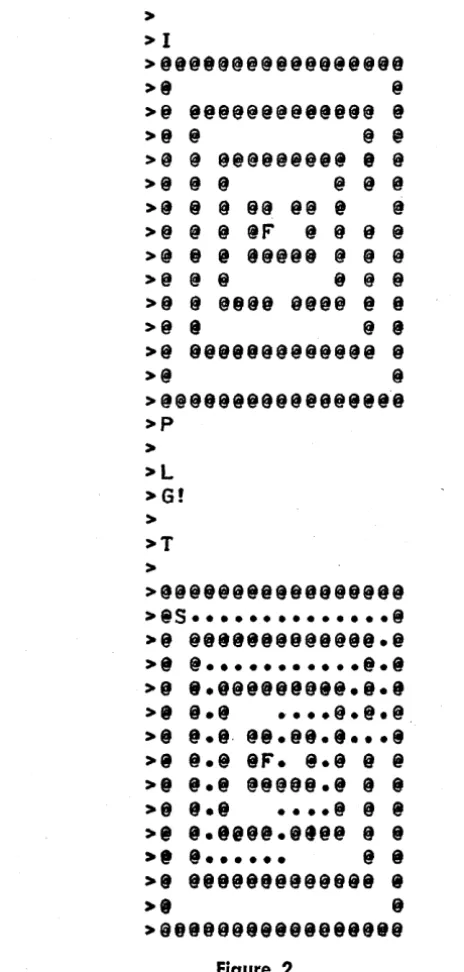
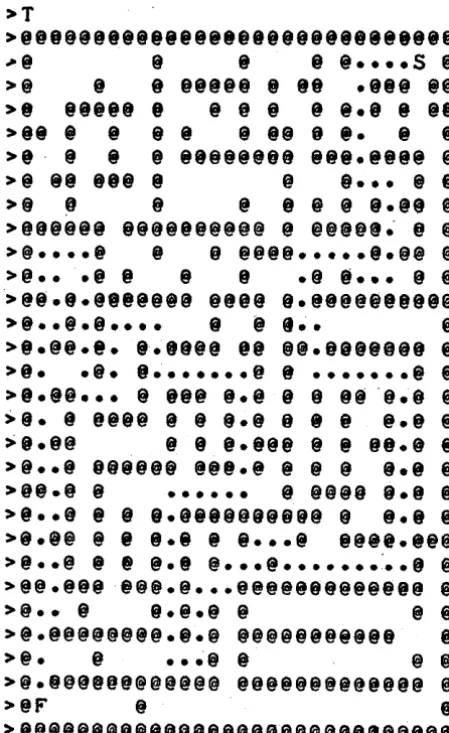
22 MAZE SEARCH: A PROGRAM THAT SOLVES N DIMENSIONAL MAZES
by Michael F. Tighe
The algorith~ and applications of a maze-solving program.
25 COMPANY CONTROL SYSTEMS
by Andrew Muir
How big businesses can retain the high levels of management efficiency possible in smaller concerns.
33 THE SYMBOLS OF THE KHAN
Anonymous
How an empire of a million square miles was controlled with a universal written language.
Regular Features
Editorial
6 "The House is on Fire", by Edmund C. Berkeley
The Profession of Information Engineer and His Bridges to Society
30 The "Invo!untary Campus" and the "Manipulated Society", by Kingman Brewster, Jr.
C&A Worldwide
~6 Report from Great Britain, by Ted Schoeters
Tobs and Careers in Data Processing
37 ,Computers Offer New Op~ortunities for the Blind
Ideas: Spotlight'
37 Programs that "Understand" the Nature of III-Defined Problems, by Bertram Raphael
Multi-Access Forum
7 Who's Who in Computers and Data Processing - Entries 8 "People and Computers" - Comment, by V. J. Maruska
9 Counter Conference to ACM 1971 Meeting is Scheduled, by Daniel D. McCracken and the Editor 9 "Motion Pictu"re Animation by Computer" - Comments, by Charles A. Vaughn and Stephen A.
Kallis, Jr.
10 Another Approach to Social Responsibility in the Computer Field, by T. D. C. Kuch and the Editor
10 IIA Proposes FCC Study of the Potential of Low Cost Delivery of Information via Community Television Antenna Systems, by Paul G. Zurkowski
10 "International Association of Computer Programmers" Becomes Active, by Richard T. Lynch 11 Martin Luther King Memorial Prize Contest - Second Year
11 New Association of Business Forms Manufacturers is Organized 19 Announcement: Computer Directory and Buyers' Guide, 1970
The front cover picture
shows an experimental,
com-puter-produced filter placed
over a street map of
Hous-ton, Texas. The filter reveals
hidden patterns in photos,
charts, and other graphic
ma-terial; and could be used by
aerial photo analysts,
seis-mologists, medical
research-ers, and quality control
engi-neers to recognize graphic
patterns that might not
other-wise be detected. For more
information, see page 50.
NOTICE
Who's Who in Computers and Data Processing is to be typeset by computer. As a result, it should be possible to include new entries (and to modify previous entries) CONTINUOUSLY -especially since Who's Who will be published periodically.
Consequently, if you have not yet sent us your up-to-date filled-in Who's Who entry form, PLEASE SEND IT TO US QUICKLY - the chance is good that your entry can be promptly included. Use the entry form on page 7 of this issue, or a copy of it.
Departments
40 Across the Editor's Desk -Computing and Data Processing Newsletter
54 Advertising Index
7 As We Go to Press 39 Calendar of Coming Events
4 letters to the Editor
51 Monthly Computer Census
52 New Contracts
53 New Installations
38 Numbles
by Neil Macdonald
54 Problem Corner by Walter Penney, COP
38 Punch Lines • • •
C:·
a
EDITORIAL
"Th·e House is on Fire"
In the computer field, there are basically two kinds of attitudes about the applications of computers and data processing-information handling-to the .. solving of prob-lems.
On the one hand there is the attitude:
Computers are tools like matches-and we are just mechanics. We take the data as given (the kindling). Our responsibility is the processlng-swift, economical, correct (making a fire with matches). The answers be-long to our employer (he uses the fire as he sees fit). The group who holds this attitude-let's call it Group 1-takes the data and the problem as given-given by the corporation or the government, the employer or the client, who has the problem.
This group works on payrolls, etc.-and on the targeting of nuclear mis'siles and on calculations of the dissemina-tion of nerve gases. And they work on the latter with the same "I'm just doing my job" attitude that they work on the former. In Nazi Germany Group I would have worked "under orders" on the design of ovens for efficient mass incineration of thousands of corpses from the gas chambers. (The Nazis put to death in concentration camps over 11 million Jews, Russians, Poles, Czechs, French, etc., in pursuit of the "final solution".) If you read "Treblinka" by Jean-Francois Steiner (Simon & Schuster, New York, 1967) you find out how one Nazi scientist graded corpses from fat to thin so the fires would burn better.
On the other hand there is the attitude:
Computers are tools like bridges-and we are profes-sional engineers. We take the data as given (the materials and the site) but we check the data indepen-dently. Our responsibility is not only processing-swift, economical, correct (building a bridge with girders)-but also worthwhile answers (brldges that work). The bridges we build must carry people, and we don't want them to crash.
The group who holds this attitude-let's call it Group " -works on payrolls, etc.-but they will refuse to work on calculations for the dissemination of nerve gases, or on calculations for targeting of nuclear weapons, or on calcu-lations for the design of crematoria for thousands of human corpses. They see a responsibility greater than that to their government or employer-they see a primary responsibility to their fellowman.
A recent vote of members of the Association for Com-puting Machinery indicated that the proportion of Group I to Group " is about two to one. In other words, two-thirds of the computer people who replied to the survey on the "questions of importance", voted that the ACM should not "take a stand on deeply political questions."
The attitude of Group I is a characteristically conserva-tive attitude: "The world is going along pretty well"-"Let us not rock the boat"-"The existing system should be tolerated"-"Things will eventually work out all right"-"Professional people have their major allegiance to the persons who pay them"-"A computer professional has no social responsibility different from that of the nonpro-fessional man" ....
The attitude of Group " is a characteristically liberal attitude: "The world can be a much better place than it is now"-"It is important to try to improve the world"-"Such a vast number of sad and evil things happen in the
6
world that everybody must do something significant to help prevent them"-"The fact that thousands of human beings have been killed by both sides in the Viet Nam conflict requires people everywhere to see~ withdrawal of foreign armed forces from that unhappy civil war."
Scientifically it is easy to show that the attitude of Group I will lead to the destruction and ex.tinction of the human race, just as the dinosaurs became extinct. Scien-tifically it is not possible to show that the attitude of Group " will lead to the survival of human beings on the earth: it is only possible to show that the attitude of Group " offers human beings some hope of survival in the increasingly more difficult environment on earth, the "house" for all of us.
For "the house' is on fire": the earth as an environment for human beings has changed enormously in the last 25 years and is deteriorating fairly rapidly. Before 1945, the factor of sufficient distance from a danger could almost always save human beings alive. Now, distance is not enough. Now, because of interlocking planet-wide systems of consequences, the environment of the earth is no longer safe for human beings. For example:
Large-scale nuclear war (and its radioactivity) be-tween two countries in the Northern hemisphere can kill all the inhabitants of that hemisphere. Inter-national anarchy allows this to break' out at the choice of one government.
The explosive increase in the number of human beings alive-the so-called population explosion-seriously threatens the power of the earth to sup-port them. Worldwide anarchy allows any man and woman to bear children unrestrictedly.
Pollution of the air, the water, and the land by man's activities is becoming world-wide. Again, interna-tional anarchy allows this to happen everywhere. Etc.
"The house is on fire". So it is necessary for all persons living in the "house" to take some time away from their play rooms, their work rooms, and their bedrooms, their computer rooms, their laboratories, and their ivory towers-and to try to help put out the fire. The fire is licking at the edges of the roof and the walls and the floors-and time is pressing and will not wait.
Accordingly, Computers and Automation with this issue is starting a department in the magazine which for the present will bear the subtitle "The House is on Fire" and the title "The Profession of Information Engineer." Here we plan to publish information from time to time which will help focus the attention of computer professionals in the direction of becoming information engineers, "bridge" en-gineers,-not mechanics, not artisans. For we are, first of all, human beings with professional training, and second-ly, we are computer professionals. We need to shed light on major urgent problems of the earth today. These are the great problems w~ich cause our children to be "a generation in search of a future," to use the phrase of Professor George Wald, Nobel prizewinner in biochemistry. These are the great problems which raise the great question:
Will there be any future at all for our children?
AS WE GO TO PRESS
CLOSE TO 10,000 PERSONS ATTENDED COMPSO-EAST, the first regional Computer Software and Peripherals Show which was held at the New York Hilton, Jan. 19-21. The Show attracted about 95 exhibitors and util ized 150 booths. Lines of visitors were still waiting to get into the exhibits Just an hour be-fore the Show closed. More than 1000 registrants attended one or more of the six seminars conducted under the direction of Dr. Ned Chapin, a pioneer data processing consultant with InfoSci, Inc., Menlo Park, Calif. The seminars were aimed at man-agement applications of data processing, rather than the technical aspects, but included a session on buying computer stocks. The Show was designed for, and largely attended by, business managers.
One unique feature of the Show was the use of computer technology to enable exhibitors to better identify their prospective customers among the many persons who visited their booths, and to
faci-litate visitor fol low-up.
COMPSO-East for 197Q was an experiment with a new idea -- to hold a regional show for the growing number of management men concerned with data proc-essing operations. It seems clear that this first COMPSO Show should be regarded as significantly success fu 1 .
COMPSO-East for 1971 has been scheduled for Feb. 8-11, and will be held at the New York Co 1 i seum.
SCIENTIFIC CONTROL CORPORATION (SCC) MAY BE ABLE TO RESUME OPERATIONS, if a proposal by the Great South-west Corp. (a subsidiary of Penn Central Co.) is accepted by the bankruptcy court and SCC's credi-tors. SCC filed for bankruptcy in December. Early in January the Great Southwest Corp. offered to pro-vide $2 mill iOh for working control of the company, and to guarantee $580,000 of SCC's $11 mil lion debt.
SCC was founded in 1964; by the end of 1968 the company had 500 employees. But although sales fig-ures for the firm showed steady increases, a repor-ted lack of manufacturing know-how and cost control caused losses to increase faster. In apdition, since last summer, SCC had undergone several changes
in top management. .
THE NATIONAL CASH REGISTER COMPANY (NCR) HAS AN-NOUNCED A NEW PRICING PLAN FOR EDUCATIONAL SERVICES offered to users of the company's Century Series of computers. Under the new plan, all educational courses are priced separately. Each user will, however, receive a basic educational allowance as part of the rental or purchase price of his system, and wi 11 pay extra only for educational services above that allowance.
This announcement is the second NCR in regard to computer pricing. ate pricing approach was announced port last fall, and is expected to software in the near future.
made recently by The same sepa r-for systems sup-be appl ied to
Who's Who in Computers
and'Data Processing
Who's Who in Computers and Data Processing will be published jointly (as an annual publication) by The New York Times Book and Educational Division and Computers and Automation. The fifth edition is scheduled to be published in three volumes in hard cover in early 1970, and will include upwards of 8000 capsule biographies.
Who's Who in Computers and Data Processing is to be typeset by computer. As a result, it should be possible to include new entries (and to modify previous entries) CONTINUOUSLY -- especially since Who's Who will be published periodically.
Consequently, if you have not yet sent us your up-to-date filled-in Who's Who entry form, PLEASE SEND IT TO US QUICKLY -- the chance is good that your entry can be promptly included. Use the entry form below, or a copy of it.
1.
2. 3. 4. 5. 6.
WHO'S WHO ENTRY FORM
(may be copied on any piece of paper)
Name? (Please print).~~ ______________________ _ Home Address (with zip)? ____________________ ___ Organiza ti on?
Its Address
(-w7i-th~Z~i~p~)7.(~---Your Title? ______ ~---Your Main Interest?
Applications ( )
Business ( )
Construction ( )
Design ( )
Logic ( )
Management ( )
Mathematics Programming Sales Sys terns Other
(Please
) )
)
)
) specify)
7. Yea r of B i rt h?:::-____
-=-_____________________ __
8. Education and
Degrees?~~~----~---9. Year Entered Computer Field? __________________ _
10. Your Present
Occupation?~--~~---~---11. Publications, Honors, Memberships, and other Distinctions?
(attach paper if needed)
12. Do you have access to a computer? ( )Yes ( )No a. If yes, what kind of computer?
Manufacturer?
Model?
---b. Where is it installed: Manufacturer?
Address?
---c. Is your access: Batch? ( ) Time-Shared? (
Other? ( ) Pleaseexplain: ________________ ~_
d. Any rema rks? ________________ ~ __________ _ 13. In which volume or volumes of Who's Who do you
think you should be included?
Vol 1. Systems Analysts and Programmers Vol 2. Data Processing Managers and Directors Vol 3. Other Computer Professionals
14. Associates or friends who should be sent Who's Who entry forms?
Name and Address
(attach paper if needed)
When completed, please send to:
MULTI-ACCESS F'ORUM·
IIPEOPLE AND COMPUTERSII - COMMENT
v.
J.
Maruska12467 Pine Rock Lane Houston, Tex. 77024
Your regular dissertations on "truth" combined with Lord Robens' article in your November, 1969 issue ("People and Computers", page 53) aroused my interest and this response. There are many reasons for unem-ployment but very little evidence that computers and/or automation have made any significant contribution. How-. ever, I have observed that two major causes of unemploy-ment receive little if any publicity. Since you are in-terested in "reliable factual data, not false, misleading, nonrepresentative, or lying data", I think the comments stated herein are pertinent.
Americans have historically been hard working people with much initiative. A "20 hour week" would have been foreign to their religious convictions and ethics such as: "For ~ven when we were with you, this we commanded you', that If any would not work, neither should he eat." (II Thess. 3:10) Jesus taught many parables on the virtues of hard work and dedication to noble purposes.
Somewhere along the way our ancestors abandoned these principles and started feeding those who "were not of the faith" and who absolutely refused to contribute. Today we are reaping a whirlwind where hundreds of thousands of individuals intentionally refuse to work be-cause they know the rest of us will provide them their basic necessities. Until we own up to this truth and take effective measures to reverse. its trend, we wi II experience an ever increasing number of individuals becoming pro-fessional freeloaders.
Still; there are millions of people who want to work but cannot find or have not found employment that provides
sufficient compensation for them to adequately provide for their families. Why? Is there a true shortage of employ-ment for which these people are qualified? I think not, but it will take some serious and honest soul searching to arrive at the solution. Computers can certainly be of as-sistance in such an investigation.
I believe Lord Robens may have brought to light a characteristic of the American people which is generally ignored: our selfish greed to acquire things! As an example, consider the family breadwinner (generally the father) who has sufficient income to support several families with regard to the. basic necessities but whose spouse is also employed so that'they "can afford" those little extras. The extras include Items listed by Lord Robens plus, in addi-tion, the third automobile, the second home, and other wasteful extravagances.
My computations indicate that such a second income of several hundred .dollars per month tends to look rather small when expressed on an hourly basis after FICA and FIT. Meanwhile, neither spouse is able to care for and properly supervise their children, be as effective in better-ing their community, etc. Most people agree with these points but they indulge anyway. This is why I choose to call it selfish greed.
Not only does this selfish greed feed inflation, but I believe it is responsible for much if not most of our unemployment as described in my fourth paragraph. As a rule, the second job is a category· which is notorously underpaid. A breadwinner must pass it by because he
There certainly are other causes of unemployment and I have no single solution which would please all people. The problem truly is people and people are complex. I responded with this letter because I have observed so many
COUNTER CONFERENCE TO ACM 1971
I. From Daniel D. McCracken
7 Justamere Drive
Ossining, N.Y. 10562
A group within the Association for Computing Machinery (ACM), unhappy with the ACM's decision to hold its 1971 conference in Chicago, will hold a simultaneous "Counter-Conference" Aug. 3-5, 1971, at the Harvest House Motel, Boulder, Colorado.
The Counter-Conference wi II be in the standard profes-sional format, and technical referees are already being re-cruited, according to Professor Joseph Weizenbaum of M.I.T., a spokesman for the Counter-Conference group.
Attendance at the Counter-Conference will be limited to four hundred. Organizers include Professors Jerome Feld-man, Edward Feigenbaum, and R. W. Floyd of Stanford;
computer professionals joining this greedy rat race. Upon final analysis, I see America's unemployment problem be-ing akin to our gobe-ing to the moon-once we decided that we really wanted to go, we quickly found a way! D
MEETING IS SCHEDULED
Dr. John C. Reynolds of Argonne National Laboratory; Professor William C. Dorn of the University of Denver; and Professors Robert R. Fenichel, Robert M. Graham, J.C. R. Licklider, Marvin L. Minsky, and Joseph Weizenbaum of M.I.T.
II. Letter from the Editor to Daniel D. McCracken
Please put my name on the mailing list to receive in-formation about the Counter-Conference. I plan to go. I think it is unfortunate that attendance is to be limited to 400; I would like to see all those ACM members who protest a conference in Chicago able to go to the Counter-Conference. Perhaps some compromise can be worked out.
It may be time to split the ACM, into conservatives and
liberalS'. D
IIMOTION PICTURE ANIMATION BY COMPUTERII - COMMENTS
I.
Letter from Charles A. Vaughn, Executive Vice Pres., Storer Studios Inc., 3700 Oakcliff Rd., N.E., Atlanta, Ga.
30040, to Stephen A. Kallis, Jr., Public Relations, Digital Equipment Corp., 146 Main St., Maynard, Mass. 01754
I was very interested in your article on computerized animation published in the November issue of Computers and Automation ("Motion Picture Animation by Computer", page 30); however, Storer Studios was not in your list of computer systems available on the market today.
I am enclosing a copy of an article that appeared in CLIO Magazine last March which describes our system in somewhat broad form. Since you are familiar with the other systems available, I think that probably the best way to describe our system would be to say that it is an on-line system which encompasses many of the advan-tages of the off-line system and at the same time avoids most of the disadvantages of both systems.
We at Storer Studios are critically interested in com-puter animation, as you might suspect, and I would be happy to let you examine our system if you are ever in
II. Letter from Mr. Kallis to Mr. Vaughn
Thank you very much for your letter calling attention to your computer animation system. Actually, I do not con-sider your comments a "barb," but rather, additional in-formation in a' field that is still in its infancy and conse-quently not very well documented.
With regards to my article in Computers and Automa-tion, please note that I refrained from naming any actual installation and only alluded to those I mentioned. This was due expressly to the magazine schedule. I had in-sufficient time to contact facilities for clearance before the article deadline from the time I was, able to start writing the article.
For your information, I am enclosing a copy of my previous article on this subject which features an off-line system that has been in commercial operation for over three years. This system has been used primarily for the
this neck of the woods. We hope to marKet it beginning next year.
I hope you wi II excuse the barb but those of us who have worked on the system here at Storer Studios feel that we are entitled to be considered pioneers in the field and we think that perhaps we've been able to bring computer animation up to what the animator really needs. For ex-ample, our system controls all four peg tracks, rotation, north, south, east, west, zoom, as well as all camera controls, capping and automatic stepping routines. It does all these simultaneously or any of the combinations or sequence.
You might also be interested in knowing that we are currently adapting our program on a proportional feedback, arrangement to be used on optical printing devices.
We did enjoy your article and we feel that any system avaifable to aid the animator is very definitely welcome.
production of animated commercials.
Another system, which is fully on-line and uses a PDP-B, has been used for more than two years by the National Film Board of Canada for animating their films. The system recently won an award for technical innovation
in Canada.
The thrust of my article in Computers and Automation was to explain true film animation by computer to the computer person, not to describe a specific computer sys-tem. Quite obviously, any computer system capable of numerical control functions can be used for animation functions, if properly programmed. Previously, most com-puter people considered a CRT trace recorded by a slaved camera as all there was to computer-animated motion pictures, and I wanted to introduce them to the real
ANOTHER APPROACH TO SOCIAL RESPONSIBILITY IN THE COMPUTER FIELD
I. From T. D. C. Kuch ADP Management ~taff
National Cancer Institute 7554 Spring Lake Drive Bethesda, Md. 20034
I see on the back cover of the November issue of C&A that Industrial Computer Systems, Inc., advertises that its implementation of APL is "not for sale for unethical or destructive purposes".
As this firm's Boston address is the same as yours, 'I assume that this is, at least in part, your firm, and it was your decision to restrict the sale of the implementation.
This is, I believe, a new approach to the problem of the social responsibility of computer people, and a potentially quite valuable one. I expected to see an editorial on it, but didn't.
I'm sure your readers would appreciate your views on this step, what you expect to accomplish, how the idea came about, etc., including an explanation of what consti-tutes an "unethical" purpose (we all know, all too well, what a "destructive" purpose is).
II. From the Editor
The persons who have organized APL Manhattan, APL Boston, APL Philadelphia, APL Washington, etc., under the general aegis of I ndustrial Computer Systems, are Karl Korn and James Lamb, who are authors of articles published in
Computers and Automation
in the past. I t was their choice to put into their notices of doing business and their advertisements "not for sale for unethical or destructive purposes". I like this business policy very much. They asked me in August to become a Director of Industrial Computer Systems, and I have become one.When ICS was looking for office space for APL Boston, I
notice~ suitable space available in the same office building where we are located; and so it was natural' to locate APL Boston in the same building.
The policy "not for sale for unethical or destructive purposes", together with its actual implications in specific' real situations, is being worked out. When the appropriate time comes, i.e., when enough factual information is at hand. to make some worthwhile and interesting statements of experience, I hope we shall have a letter in Multi-Access Forum or an article in the magazine describing and
eval-uating this policy. 0
IIA PROPOSES FCC STUDY OF THE POTENTIAL OF LOW' COST DELIVERY OF
INFORMATION VIA COMMUNITY TELEVISION ANTENNA SYSTEMS
Paul G. Zurkowski, Executive Director Information Industry Association 1025 15th St. N.W.
Washington, D.C. 20005
The Information Industry Association (lIA) recently asked the Federal Communications Commission (FCC) to create a separate study of the potential community antenna sys-tems (CATV) and related broadband communications tech-nologies for low cost delivery of information products and services.
These technologies offer the prospect that within the decade, the cost of delivering information at the rate of a page per second, tailored to the particular needs of in-dividuals using low cost terminals in their homes, schools, or offices, will be competitive with current postal rates. The IIA feels that the economic and social implications of such modern information services involve issues signifi-cantly different from those involved in other current FCC proceed i ngs.
The'liA filing included the following subjects: distinc-tions between computer switching services in communica-tions networks, and applicacommunica-tions of computer technologies in pre-processing,searching and retrieving information products from' automated storage systems; information products and services which will be pro.foundly affected by broadband delivery capabilities; requirements for com-patibility of television display and facsimile recording sys-tems; traffic and marketing problems in broadband com-munications; needs for privacy; and, the nature of the regulatory environment and the need for proprietary rights concepts suited to these technologies.
Members of the Information Industry Association are commercial firms enga'ged in, the application of advanced information technologies to the creation and marketing of information products and services for particular audiences. Copies of the IIA filing can be obtained for a $5.00 fee
from the address above. , - 0
"INTERNATIONAL ASSOCIATION OF COMPUTER PROGRAMMERS" BECOMES
ACTIVE
Richard
T.
Lynch, Executive Vice Pres.International Association of Computer Prograinmers, Inc. '
P.O.
Box 57Sycamore, III. 60178
Th International Association of Computer Programmers (lACP) was incorporated on Oct. 27, 1969 as a non-profit professional organization for computer programmers and personnel. The Association is designed for, and depends upon, the personal involvement and participation of the,
professional programmer in local, national, and international activities.
Plans of IACP for 1970 include: publication of a monthly magazine containing articles and departments of interest to the computer programmer; formation of local chapters; development of scholarships, loans and work-study programs for continuing education in the program--ming profession; and sponsorship of educational semi-nars, lectures, and exhibits.
MARTIN LUTHER KING MEMORIAL PRIZE CONTEST
- SECOND YEAR
(Please post this notice)
Computers and Automation
has received an anon-ymous gift and announces the annual Martin LutherKing Memorial Prize, of
$300,
to be awarded each year for the best article on an important subject in the general field of:The application of information sciences and engineering to the problems of improvement in human society.
The judges in
1970
will be:Dr. Franz L. Alt of the American I nstitute of Physics; Prof. John W. Carr III of the Univ. of Pennsylvania; Dr. William H. Churchill of How-ard Ulliv.; and Edmund C. Berkeley, Editor of
Computers and Automation.
The closing date for the receipt of manuscripts this year is April
30, 1970,
in the office ofComputers and
Automation, 815
Washington St., Newtonville, Mass.02160.
The winni!lg article, if any, will be published in the July issue of
Computers and Automation.
The deci-sion of the judges will be conclusive. The prize will not be awarded if, in the opinion of the judges, no sufficiently good article is received.Following are the details: The article should be approximately
2500
to3500
words in length. The article should be factual, useful, and understandable. The subject chosen should be treated practically and realistically with examples and evidence - but also with imagination, and broad vision of possible future developments, not necessarily restricted to one nation or culture. The writings of Martin Luther King should be included among the references used by the author, but it is not necessary that any quotations be in-cluded in the article.Articles should be typed with double line spacing and should meet reasonable standards for publication. Four copies should be submitted. All entries will
become the property of
Computers and Automation.
The article should bear a title and a date, but not the name of the author. The author's name and address and four or five sentences of biographical information about him, should be included in an accompanying letter - which also specifies the title of the article and the date."Many people fear nothing more terribly than to take a position which stands out sharply and clearly from the prevailing opinion. The tendency of most is to adopt a view that is so ambiguous that it wi II include everything and so popular that it will include everybody .... Not a few men who cherish noble ideals hide them under a bushel for fear of being called different."
"Wherever unjust laws exist, people on the basis of conscience have a right to disobey those laws."
"There is nothing that expressed massive civil disobedience any more than the Boston Tea Party, and yet we give th is to our young people and our students as a part of the great tradition of our nation. So I think we are in good company when we break unjust laws, and I think that those who are willing to do it and accept the penalty are those who are a part of the saving of the nation."
- From "/
Have a Dream" - The
Quota-tions of Martin Luther King, Jr.,
compiled and edited by Lotte Haskins, Grosset and Dunlap, New York,1968.
Reverend Martin Luther King, Jr., was awarded the Nobel Peace Prize in
1964,
when he was age
35.
He was in jail in the United States more than
60
ti mesoHe was assassinated in Memphis, Tennessee, April
4, 1968.
NEW ASSOCIATION OF BUSINESS FORMS MANUFACTURERS IS ORGANIZED
Association of Business Forms Manufacturers 4344 East-West Highway
Washington, D.C. 20014
A new and completely independent association of busi-ness forms manufacturers has been organized. Under the leadership of John Randall, President of Specialized Printed Forms, I nc., the group has adopted the interim name of Association of Business Forms Manufacturers.
The pri mary objective of the association, accord ing to Randall, is to do the types of things that will help the
industry member in his efforts to grow and prosper. Other officers of the association include: Vice President - John E. Pfeiffer, President of Pfeiffer Business Forms; Secretary - Richard A. Sch ilffarth, President of Dataforms, I nc.; and Treasurer - Roger Trunkett, Director of Marketing, Unit Printing Corp.
The first annual meeting of the association will be held February
12-14, 1970
at the Monteleone Hotel in New Orleans. Mr. Richard O'Brien, Vice President and Director of Research for Moore Business Forms, will be a featuredspeaker at the meeting. 0
IBM,THE PATENT OFFICE, AND
THE SMALL SOFTWARE COMPANY
The Emergence of an Industry
Perhaps the most secretive commercial business in the world is that of computer programming. The lack of mean-ingful patent or copyright protection for computer pro-grams, and the inability to compete effectively with IBM and other computer manufacturers for the general
pur-pose program market, has forced most software companies to emphasize development of complex, special purpose programs. These programs, often prepared for only one, two or at most a handful of users, typically are protected by keeping them under lock and key. This atmosphere has stifled growth of the software industry, limited competi-tion, caused unnecessary duplication of programming ef-fort, and increased cost to computer user and the public.
The recent "unbundling" announcement by IBM that it would no longer sell programs together with their com-puters, but would license programs independently, and recent indications that the Patent Office and the courts wi II a II ow patent protection for computer programs, com-bine to present the beginning of a new era for the small software company.
The following two articles offer: (1) an. apocryphal view of the emerging computer programming industry; and (2) a hypothetical interview between the president of a small software company and a patent attorney specializing in protection of computer programs.
THE TALE OF CRAZY FREDDIE
John Ambrose, President
Scientific Experiments, Inc.
3707 Bagley Ave.
Los Angeles, Calif. 90034
((The dramatic economic question in
1984 is: Will the Federal
Gov-ernment force Crazy Freddie to charge a separate price for the
com-puters it now supplies free as a part of its total service software
package?"
Once upon a time in 1960 there was a company that made shoes and it was called the Shoe Company In-corporated. It had a president by the name of Mr. Shoe and 100 happy employees.
Shoe and Socks
One day Mr. Shoe was having lunch with his old friend, Mr. Socks, who owned the Socks Company Incorporated. Mr. Socks told Mr. Shoe that Socks Co. was so up to date that it held a computer. Mr. Shoe felt envious of Mr. Socks but Mr. Shoe was not the type of man to waste money just to· keep up with the Joneses; so Mr. Shoe called in a salesman from the computer company, KM Co.
"Wi II a computer save me money?" asked Mr. Shoe. "Oh, my, yes!" said the salesman. "You won't have to
After graduating from Loyola University first in his class in mathematics in 1960, John Ambrose went to work as a scientific systems engineer for IBM. During this period he published a number of papers on specialized aspects of computer program-ming. Beginning in 1963, Mr. Ambrose worked as a patent ex-aminer in the computer division of the U.S. Patent Office and attended the Georgetown University Law Center. He was ad-mitted to the California Bar in 1967, and served as a deputy Los Angeles District Attorney until 1969 when he formed and became president of Scientific Experiments, Inc., a computer software company. He is also presently serving as a special con-sultant on computer applications in the field of criminology for the Los Angeles District Attorney's Office.
have all those people doing clerical work any more!"
"Is KM
CO.
the only computer company?" asked -Mr. Shoe."I've never heard of any others," answered the salesman. "Do we need any special personnel?" asked Mr. Shoe. The salesman smiled and patted Mr. Shoe on the head. "Don't worry," he said, "KM Co. takes care of everything." So began the empire _ called the Shoe Company's Data Proce£sing Department. It was small at first but then it . grew and grew. By 1965 it was so big it had 15 employees. . It was led by Sam, Supervisor of Data Processing, who used to be the chief accountant. Sam made $15,000 a year. Second in command was Herbert, the chief pro-grammer and ex-chief file clerk. Herbert made $10,000 a year and had been with the company 10 years. Also in the Data Processing Department was Jack Smart who made $9,000 a year.
"What! $9,000 a year for a kid one year out of high schoo!!" screamed Mr. Shoe, when Sam told him he wanted to hire Jack. "We have to pay that much to get someone with experience", stated Sam.
Crazy Freddie Gets Turned Down
Around the corner under a garage lived another com-pany called the Crazy Freddie Service Bureau Comcom-pany Inc. It had a president by the name of Crazy Freddie and he was the only employee and he wasn't very happy.
One day Crazy Freddie came to see Mr. Shoe but Mr. Shoe wasn't in to Crazy Freddie; so Crazy Freddie talked to Sam, the Supervisor of Data Processing. "I will do all your programming for your new KM Co. computer you have on order, for $30,000," said Crazy Freddie. "$30,000! No wonder they call you Crazy Freddie," screamed Sam. "Why should I hire you when I have programmers of my own?" "You're a shoe company, I'm a computer com-pany!" screamed back Crazy Freddie, and walked out.
One day Crazy Freddie got an idea; why not write a program that everyone can use, and sell it at a discount? It was a good idea, and Freddie sold the program to 4 users who agreed to keep the program secret. The other users in his area that needed a program like that but didn't have the right computer were sold time on Freddie's computer. One manufacturer paid Freddie to write the program for his machine. Some manufacturers wrote their own. Freddie made $10,000 on his program.
In July of 1968 the United States Patent Office issued a patent on a computer program.
Jack Smart came into Sam's office. "I want a raise," said Jack.
"But you make $13,000 a year." exclaimed Sam, "You make as much as Herbert, who has been here almost 15 years." "I'm five times as good as Herbert!" demanded Jack; but he knew he could never make five times what
Herbert made and so he began to look for a job.
On June 29, 1969, KM Co. announced that it would charge monthly fees for all of its programs and would protect its programs with patents.
Crazy Freddie sat in the bar at the top of the building his main branch was in. Crazy Freddie was now doing pretty well: 3 branches each having a computer in house, 12 employees, 4 programmers, 6 keypunchers, and 2 sales-men. Still Freddie felt unfulfilled. Sure, he had gotten a lot of new business from the unbundling announcement, but he wasn't called Crazy Freddie for nothing.
It was 1970 now. "Send in Sam!" demanded Mr. Shoe. The Shoe Company was doing very well in gross sales and had over 200 employees. Jack Smart had left, none knew to where. The cost of the Data Processing installation was at an all time high and seemed to be working more poorly than ever. "Sam, when will you finish that Sales Analysis Program I wanted?"
"We're only slightly behind schedule, Mr. Shoe," said Sam, "about 4 more months."
Mr. Shoe Gets Smart
Mr. Shoe didn't ask Sam how much that programming would cost; he could figure it for himself. His eyes fell back to an ,ad in the Wall Street Journal:
Choose from
18 Sales Analysis Packages 37 Payroll and Labor Distributions
14 Inventory Control Packages, plus many more One to fit anyone's need
$50.00 per month each - Pat. Pending
CRAZY FREDDIE INTERNATIONAL
Mr. Shoe called tlie telephone number listed in the ad. Jack Smart wouldn't normally take a sales telephone call, but he felt a certain pride in going back to his alma mater. He could still remember telling Sam that he was worth five times what Herbert was making; now at last he was making five times Herbert's salary and more.
COMPUTERS and AUTOMATION for February, 1970
"You see, Mr. Shoe," Jack began, "the reason we can of-fer you such value is that the cost of our programs is al-most nothing. We hire the best programmers there are; we pay them a salary higher than a doctor or lawyer and watch them produce. We have found this to be the most economical way to operate. A program which requires a man months to produce at a cost of $5,000 is leased to over a 1,000 customers. This brings our total programming cost down to less than 10% of the first month's royalty."
Mr. Shoe learned a lesson from Jack Smart; and soon things were happier at The Shoe Company. Mr. Shoe still had his computer but the headaches were gone. Sam was still in charge of the Data Processing installation but he spent most of his time in accounting. Herbert took over an administrative job which made use of the knowledge he had gained about the company.
Every time Mr .. Shoe would see a Crazy Freddie com-mercial on TV, he would thank his stars that he had bought Crazy Freddie stock in the 1970's, now that it was the largest industry in the nation.
KM Co. Loses Its Head
KM Co. didn't seem so big any more. That might have satisfied the stockholders but it made the President, Mr. Townsend, rather jealous. "I'm sick of the tail wagging the dog," fumed Mr. Townsend. "I'm going to challenge Crazy Freddie."
Somehow KM Co. had never been the same, since they couldn't get a decent share of the packaged program market. It seemed that good programmers were more the bearded, pot-smoking, colored-sweater type than the ivy-league, white-shirted, no-smoke, no-drink type. In any case KM Co. lost its head.
KM Co. put all of its resources into an attempt to smash Crazy Freddie. KM Co. knew that it did not have to announce its machine language until it announced a new machine. So Mr. Townsend put all of KM Co.'s program-mers on programming applications for its to-be-announced Series 27 computer. At last came the announcement of hardware and software together. It would be a real coup. KM Co. knew that it would take months for Crazy Freddie to duplicate KM Co.'s packages, even though KM Co.'s programs were twice the price of Freddie's current price. It. would surely take Freddie a long time to effectively compete.
But that proved the end of an epoch. What KM Co. had overlooked was that hardware was so cheap anyway that hardware improvements weren't as dramatic as they were in the old days. Since software cost more than hardware anyway, a new computer with a software tag of twice the old price just wouldn't make it. And so KM Co. went into reorganization under Chapter 987654321B, and its stock price slipped down and down and down ....
And that's the background behind the dramatic economic question of the year, now 1984. Question: Will the Fed-eral Government force Crazy Freddie to charge a separate price for the computers it now supplies free from its subsidiary, KM Co., as a part of its total service software package?
Suits have been filed by other software firms claiming that giving away free computers in one package with the software is unfair competition. Informed observers muse, however, that it will be hardware manufacturers that will really benefit if Crazy Freddie is forced to unbundle since they have a very difficult time selling hardware when Crazy Freddie gives it away.
And so they all lived happily ever after.
(P.S. This ending is only for those who really think this
A HYPOTHETICAL INTERVIEW BETWEEN
THE PRESIDENT OF A COMPUTER SOFTWARE
COMPANY ANDA PATENT ATTORNEY SPECIALIZING
IN PROTECTION OF COMPUTER PROGRAMS
Howard A. Silber
Hinderstein
&Silber
Suite 700, Newport National Bank Bldg.
2555 E. Chapman Ave.
Fullerton, Calif. 92631
((Some kind of patent coverage for computer programs is imperative
if we are to maintain some sanity in the software industry."
Q. In the past, the need for protecting our com-puter programs by patent has been minimal for two rea-sons. First, we have stayed out of the utility and general purpose computer program market, because such wide usage programs generally were supplied by the computer manufacturer, and we felt unable to compete effectively in this market. Secondly, the complex, special-purpose pro-grams which we had the capability to provide, and which formed the bulwark of our business, often were designed for individual users or very small groups of users. These programs were well protected by keeping them under lock and key as a trade secret. .
Now, since IBM has announced that computer programs will not be supplied with their computers, but will be offered separately at an individual charge under a license agreement from IBM, the picture has changed drastically. Computer users now will shop around to find out where they can get a utility or general-purpose program at the lowest cost. Suddenly a, new market has been opened, to us. But for such general-purpose programs we feel that trade-secret protection is inadequate, and other protection appears necessary to help us establish a foothold in this new market.
A. I think this is a very significant consequence of the IBM unbundling announcement. Not only is such patent protection necessary to maintain your position in the new market, but indeed if such protection should not be available, it would both take the teeth out of the IBM license agreement, and as you imply, result in chaos in the software industry.
IIUnfairl l
Competition
Q. If I'm now going to be able to sell general pur-pose computer programs, which may be purchased by many computer users, what kind of protection is available for
16
Howard Silber received an A.B. in physics from Princeton University,' and was employed for six years by National Scien-tific laboratories, Inc.; Washington, D.C., as a senior proiect engineer specializing in electro-magnetic interference studies of large-scale computer and digital communication systems. Mr. Silber obtained his J.D. degree in 1964 'and was a'~mitted to practice before the California, District of Columbia, and U.S. Patent Office bars. From 1966 to 1968 he was the assistant Patent Counsel at the Autonetics Div. of North American Rock-well Corp., and since 1968 has been a partner in the patent law firm of Hinderstein & Silber.
these programs which might limit potential competition, and prevent a free-for-all market?
A. Well, the better question is not how can you prevent a free-for-all market, since there you are asking me how you can restrain trade,' but rather, how can you pre-vent your competitors from unjustly taking advantage of 'the time, money and effort you have put into developing your programs and establishing a commercial market for them. You are already familiar with trade secrets. This is a branch of the law of unfair competition, which law has long been available to protect a businessman's reputation and product development effort from being unjustly appropri-ated by another. The established laws of unfair competi-tion are available for proteccompeti-tion of your software business. Moreover, you can copyright your programs, although the protection afforded by copyright is not very meaningful, and there is increasing evidence that computer program patents also will be available.
Q. You speak of unfair competition; perhaps you can describe what my competitor would have to do for me to take legal action against him.
A. In general, you can get injunctive relief and damages against a competitor who fraudulently or unfairly attempts to capitalize on your business reputation, or who attempts to palm-off his own programs as being ones you developed. For example, if you call your company "Crazy Freddie," and Crazy Freddie programs have a reputation for being well written, efficient and cheap, and a competitor tries to sell his own program as a Crazy Freddie program, you can bring suit to enjoin him.
Q. But suppose my compa~ develops a particular program, perhaps at substantial cost, and builds up a market to sell this program and like programs. Then some-one else comes along and copies our programs and tries to sell them to others; can I prevent him from doing this?