Matrix-2000 Architecture
ABSTRACT
This paper presents the design and implementation of an Open Computing Language (OpenCL) framework for the Matrix-2000 many-core architecture. This architecture is designed to replace the Intel XeonPhi accelerators of the TianHe-2 supercomputer. We share our experience and insights on how to design an effective OpenCL system for this new hardware accelerator. We propose a set of new analysis and optimizations to unlock the potential of the hardware. We extensively evaluate our approach using a wide range of OpenCL benchmarks on a single and multiple computing nodes. We present our design choices and provide guidance how to optimize code on the new Matrix-2000 architecture.
KEYWORDS
Heterogeneous Computing; OpenCL; Runtime and Compiler Opti-mization
ACM Reference format:
. 2018. MOCL: An Efficient OpenCL Implementation for the Matrix-2000 Architecture. InProceedings of CF’18, Ischia, Italy, May 8-10 2018,10 pages.
DOI: http://dx.doi.org/10.1145/xxx.yyy
1
INTRODUCTION
TianHe-2A (TH-2A) is an upgrade of the leading TOP500 high-performance-computing (HPC) system TianHe-2 (TH-2) [11]. The most significant enhancement of TH-2A over its predecessor is replacing the Intel Xeon Phi (Knights Corner) accelerators with a proprietary accelerator called Matrix-2000. The fully upgraded sys-tem has a total of 4,981,760 cores (with 92% of the cores are provided by Matrix-2000) and 3.4 PB primary memory, and reaches a theo-retical peak performance of 94.97 Pflops/s, doubling the theotheo-retical peak performance of the former TianHe-2 system1.
While the Matrix-2000 accelerator provides the potential for higher performance, its potential can only be realized if the software can make effective use of it. To unlock the hardware potential, we need to provide an efficient programming model. We believe that OpenCL is a good candidate for this purpose. This is because it is emerging as a standard for heterogeneous computing, and allows the same code to be executed across a variety of processors.
1As of January 2018, TianHe-2 is ranked as the second faster HPC system with a peak
performance of 54.9 petaflops in the fiftieth TOP500 list: https://www.top500.org/
Permission to make digital or hard copies of all or part of this work for personal or classroom use is granted without fee provided that copies are not made or distributed for profit or commercial advantage and that copies bear this notice and the full citation on the first page. Copyrights for components of this work owned by others than the author(s) must be honored. Abstracting with credit is permitted. To copy otherwise, or republish, to post on servers or to redistribute to lists, requires prior specific permission and/or a fee. Request permissions from [email protected].
CF’18, Ischia, Italy
© 2018 Copyright held by the owner/author(s). Publication rights licensed to ACM. 978-1-4503-4487-6/17/05...$15.00
DOI: http://dx.doi.org/10.1145/xxx.yyy
Since existing OpenCL frameworks mainly target CPUs and GPUs, they are not directly applicable to Matrix-2000 [1, 2, 7, 14, 15, 18, 20]. Providing an efficient OpenCL implementation for Matrix-2000 is unique in that the hardware architecture differs from a many-core GPU with a smaller number of cores and runs a light-weight operating system. To exploit the hardware, we have to develop a compiler to translate kernels into target-specific bina-ries and provide a runtime to manage task dispatching and data communication between the host and the accelerator.
This paper presents the design and implementation ofMOCL, an
OpenCLprogramming interface forMatrix-2000.MOCLconsists of
two main components: a kernel compiler and a runtime. The kernel compiler is built upon the LLVM compiler infrastructure [19]. It translates each OpenCL kernel to an executable binary to run on Matrix-2000. At the core of the compiler is a set of compiling passes to translate an OpenCL work-group2into awork-item loop. We
map distinct work-item loops to different hardware threads where the work-items in the same group are executed by a single thread to run in a serial manner. We present apush-based task dispatching
strategy to distribute work-item loops to hardware threads. Our mapping strategy is different from many OpenCL implementations which execute work-items within a group in parallel. Given that each supernode of an Matrix-2000 has 32 cores instead of hundreds of cores provided by modern GPUs, by mapping a work-group to run on a hardware core (so that we can have up to 32 work-group running in parallel), our strategy avoids the overhead of scheduling thousands of work-items. As we will show later in the paper, this strategy leads to better performance compared to the conventional OpenCL mapping strategies. On top of this, we propose a set of optimization techniques includinglock-freeatomics to exploit the
hardware design.
We evaluate our approach by applying it to 70 OpenCL bench-marks from five well-established benchmark suits. We test the performance of our OpenCL implementation on both a single and multiple Xeon-Matrix2000 nodes of the upgraded TH-2A system. We compare various design choices and show that the chosen ones lead to good performance. We show that our approach, in combina-tion of MPI for cross-node communicacombina-tion, provides good scalability across multiple computing nodes. We provide extensive discussions on how to optimize OpenCL programs on the Matrix-2000 archi-tecture, offering useful insights on how to write efficient code for this unique accelerator.
The main contribution of this paper is on sharing the experience and insights of designing an effective OpenCL framework for the Matrix-2000 architecture. Our OpenCL implementation has now been deployed to the upgraded TH-2A supercomputer and is ready to be made available to the public.
2An OpenCL work-group is a collection of work-items that can execute on a single
2
BACKGROUND
In this section, we provide an overview of the OpenCL program-ming interface and the Matrix-2000 architecture.
2.1
Open Computing Language
Open Computing Language(OpenCL) is a standardized
program-ming model for heterogeneous computing [17]. OpenCL uses a generic platform model comprising a host and one or several de-vices, which are seen as the computation engines. They might be central processing units (CPUs) or “accelerators” such as Matrix-2000, attached to a host processor (a CPU). Devices have multiple
processing elements(PEs), further grouped into severalcompute units(CUs), aglobal memoryandlocal memories.
An OpenCL program has two parts:kernelsthat execute on one
or more devices, and ahost programthat executes on the host
(typ-ically a traditional CPU). The host program defines thecontextsfor
the kernels and manages their execution, while the computational task is coded into kernel functions. When a kernel is submitted to a device for execution, an index space ofwork-items(instances
of the kernel) is defined. Work-items, grouped inwork-groups, are
executed on the processing elements of the device in a lock-step fashion. Each work-item has its ownprivate memoryspace, and can
share data via thelocal memorywith the other work-items in the
same work-group. All work-items can access theglobal memory,
and/or theconstant memory.
2.2
Matrix-2000
Figure 1(a) gives a high-level view of Matrix-2000. A Matrix-2000 processor has 128 computing cores running at 1.2 GHz, offering a peak performance of 2.4576 Tflop/s. Computing cores are grouped into four supernodes (SNs), 32 cores perSN. ASNis further broken
down into clusters with four cores per cluster, and cores within a cluster share a coherent data cache. TheSNsare connected through
a scalable on-chip communication network. Each computing core is an in-order RISC core with a 12-stage pipeline. The core is a 256-bit vector instruction set architecture with two 256-bit vector functional units.
The topology of the network on chip (NoC) within aSNis a 4×2
mesh. Figure 1(b) shows the basic network structure with a total of eight routers in theNoC. A cluster and a directory control unit
(DCU) are pinned to a router. Two DDR4-2400 memory control units
(MCUs) are integrated into eachSNandSNscommunicate through a
Fast Interconnect Transport (FIT) port.
At the system’s level, each node of TH-2A has two Intel Ivy Bridge CPUs with 64GB of DDR3 RAM, and two Matrix-2000 accel-erators with 128GB of DDR4 RAM. The CPU uses a 16×PCI Express
3.0 connection to communicate with the accelerator. Furthermore, a host operating system (OS) runs on the CPUs and a light-weight Linux runs on each of the Matrix-2000 processors. The host and the accelerator can communicate through the Unix socket via the PCIe.
3
MOCL DESIGN AND IMPLEMENTATION
In this section, we describe the overall design and implementation of OpenCL on Matrix-2000. We focus on the OpenCL kernel compiler and the runtime system.
(a) Conceptual structure of Matrix-2000.
[image:2.612.322.567.90.321.2](b) The SuperNode topology.
Figure 1: An overview of the Matrix-2000 accelerator.
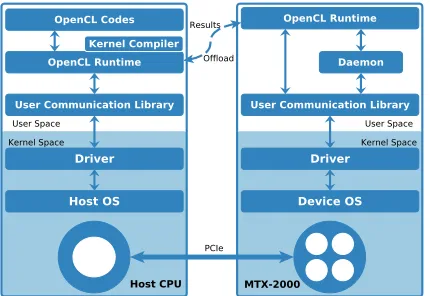
Figure 2: An overview of the software stack and the OpenCL components. The left part shows the Xeon CPU and its soft-ware stack and the right part shows the Matrix-2000 and its software stack. The Xeon CPU and the Matrix-2000 are phys-ically connected withPCIe. Both the host side and the device side have an OS running on the hardware.
3.1
Overall Design
Figure 2 shows an overview of the software stack and the OpenCL components for the Matrix-2000 accelerator. At the hardware level, the host CPU and the Matrix-2000 accelerators are connected via
PCIe; at the software level, both sides run an operating system.
The driver work as the communication backbone between host and accelerators. In the user space, a user communication library is provided to enable the host-device communication.
Our OpenCL framework for Matrix-2000 (MOCL) is built on top
[image:2.612.331.546.354.502.2](a) Overview (b) The internal structure of our compiler
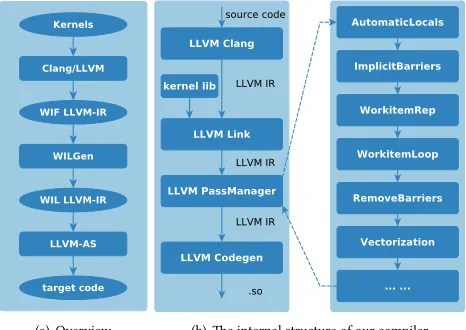
Figure 3: The compiling infrastructure on Matrix-2000: (a) shows the overall framework, and (b) shows the implemen-tation flow and compiler passes based on LLVMv5.0.
runtime system (Section 3.2 and 3.3). The kernel compiler translates the OpenCL kernels into device-specific binaries (mtx) to run on
the Matrix-2000, whereas the runtime implements the OpenCL host APIs and manages the runtime context [12]. Furthermore, we use a resident process asdaemonon Matrix-2000 to detect requests (e.g.,
process creation/destroy) from the host CPU.
As we note in Section 2.1, an OpenCL program has two parts: kernels and a host program. Kernel compilation is triggered when the host program invoked the OpenCLclBuildProgramAPI. The
host program is first compiled by a host compiler (e.g. gcc), which is then linked with the runtime library (i.e.,libOpenCL.so).
Dur-ing runtime, the compiled kernels and the required data are first offloaded onto Matrix-2000. Then the offloaded tasks are scheduled to run on the idle hardware threads. The results are transferred back to the host side. Finally, the runtime contexts on the host and the device will be cleaned up after execution.
3.2
Kernel Compiler
3.2.1 Compiler Description.Our compiler translates OpenCL C
kernel codes into themtxbinaries. This cross-compilation process is
taken place on thex64host CPU to generate target codes for
Matrix-2000. Our kernel compiler is built based on the LLVM infrastructure
v5.0and conforms to the OpenCLv1.2specification.
Different from GPUs, Matrix-2000 runs a lightweight OS and supportsPOSIX Threads. Thus, the design of the kernel compiler
resembles the traditional multi-core compilers. Optimizing OpenCL on multi-core CPUs is a heavily studied area and there is much research to draw upon. Our implementation follows the approaches used in prior work. We found that these strategies give good re-sults on Matrix-2000. Specially, we schedule OpenCL work-groups to run on distinct hardware threads [12, 14, 16, 18, 24, 25]. Fur-ther, scheduling work-items within a work-group to execute on a hardware thread is done either by wrapping a code region with a
work-item loop[14, 16, 18, 25], or by usinguser-level threads[12].
In this context, we use thework-item-loopscheduling approach for
reduced overheads. Forming work-item loops is achieved by using nested loops around the kernel body to replace the execution of work-items within a work-group.
Figure 3(a) shows how an OpenCL kernel is translated into a device binary on Matrix-2000. Our compiler takes in an OpenCL kernel and translates it into LLVM intermediate representation (IR) for a single work-item (WIF LLVM-IR). This IR kernel is transformed
into work-item loops (WIL LLVM-IR, which is then optimized by
using exisiting LLVM optimization passes [12]. Finally, the target binary is generated withLLVM-ASand linked with libraries.
When looking into the internal structure of the kernel compiler (Figure 3(b)), we see that it relies heavily on the LLVM compiling framework. At the front end,clangis used to translate OpenCL C
kernel codes into the LLVM intermediate format. Then we need to link thebuilt-inlibrary into the kernel. At the core of our compiler
are a set of compiling passes used to transformWIFintoWIL. Once
it is done, we assemble the intermediate code intomtxbinaries,
which is submitted to the target device for execution.
After generating work-item loops, we package them into a dy-namic library (i.e.,kernel.soin Figure 3(b)), which is then
trans-ferred to the device. Thereafter, the device-side runtime system will open the library and get the handle of this work-group function. During runtime, the work-group functions will work as the entry function of worker threads on the device.
3.2.2 Dealing with Barriers.OpenCL C usesbarriersto
synchro-nize work-items within a work-group. When producingWIL, we
need to respect the synchronization semantics of the work-group
barriersinside the kernel source code [14]. In this work, we
parti-tion the code with barriers into separatecode regions, each of which
is transformed into awork-item loop. To deal with barriers, we
classify them into three categories.
Category 1:Unconditional barrieris the barrier that occurs on
all code execution paths and separates the whole function body into two or more code regions. Thus, we create a work-item loop for each code region, and the content of each loop body is the code located in the corresponding code region. Figure 4 shows that the kernel has an unconditional barrier, which partitions theDCTkernel
into two parts, each enclosed by a work-item loop.
Category 2: Conditional barrier is the barrier that the
items from some groups follow one branch, while the work-items from other work-groups follow another. According to the OpenCL specification, the work-items from the same work-group must reach the same barriers [17]. That is, if one branch of if-statementhas a barrier, then all the work-items from the same
work-group will execute the same branch. Therefore, evaluating the conditional variables must yield the same results among the work-items of a work-group. To handle such conditional barriers, we create a work-item loop for the code regions before and after the barrier within a branch, and place the branch statement outside of the work-item loops. We also generate work-item loops for the code regions before and after theif-statement. Figure 5 demonstrates a
kernel with a conditional barrier, and its transformed format with a total of three work-item loops.
Category 3:Loop barrieris the barrier that is located in a loop-statement. Loop barrier is a special case of conditional barrier:
[image:3.612.58.291.88.253.2]_ _ k e r n e l void DCT (_ _ g l o b a l float* output ,
_ _ g l o b a l float* input , _ _ g l o b a l float* dct8x8 ,
_ _ l o c a l float* inter , const uintwidth ,
const uintbl ock Wid th , const uinti n v e r s e ) {
/* ... */
for(uint k =0; k < b l o c k W i d t h ; k ++) {
uint i n d e x 1 = ( i n v e r s e ) ? i * b l o c k W i d t h + k : k * b l o c k W i d t h + i ;
uint i n d e x 2 = g e t I d x ( groupIdx , groupIdy , j , k , bl ock Wid th , wi dth ) ; acc += d c t 8 x 8 [ i n d e x 1 ] * inp ut [ i n d e x 2 ];
}
in ter [ j * b l o c k W i d t h + i ] = acc ;
b a r r i e r( C L K _ L O C A L _ M E M _ F E N C E ) ;
acc = 0.0 f ;
for(uint k =0; k < b l o c k W i d t h ; k ++) {
uint i n d e x 1 = i * b l o c k W i d t h + k ;
uint i n d e x 2 = ( i n v e r s e ) ? j * b l o c k W i d t h + k : k * b l o c k W i d t h + j ; acc += i nte r [ i n d e x 1 ] * d c t 8 x 8 [ i n d e x 2 ];
}
o u t p u t [ idx ] = acc ; }
(a) Unconditional barriers
_ _ k e r n e l void DCT (_ _ g l o b a l float* output ,
_ _ g l o b a l float* input ,_ _ g l o b a l float* dct8x8 ,
_ _ l o c a l float* inter ,const uint width ,
const uint bl ock Wid th , const uint i n v e r s e ) {
/* W I _ l o o p _ 1 { */ /* ... */
for(uintk =0; k < b l o c k W i d t h ; k ++) {
uinti n d e x 1 = ( i n v e r s e ) ? i * b l o c k W i d t h + k : k * b l o c k W i d t h + i ;
uinti n d e x 2 = g e t I d x ( groupIdx , groupIdy , j , k , bl ock Wid th , wi dt h ) ; acc += d c t 8 x 8 [ i n d e x 1 ] * inp ut [ i n d e x 2 ];
}
in ter [ j * b l o c k W i d t h + i ] = acc ;
/* } */ /* W I _ l o o p _ 2 { */
acc = 0.0 f ;
for(uintk =0; k < b l o c k W i d t h ; k ++) {
uinti n d e x 1 = i * b l o c k W i d t h + k ;
uinti n d e x 2 = ( i n v e r s e ) ? j * b l o c k W i d t h + k : k * b l o c k W i d t h + j ; acc += i nte r [ i n d e x 1 ] * d c t 8 x 8 [ i n d e x 2 ];
}
o u t p u t [ idx ] = acc ;
/* } */
}
[image:4.612.94.514.85.220.2](b) After WI-loop generation
Figure 4: WI-loop generation forDCTwhich have an unconditionalbarrier.
_ _ k e r n e l void r e d u c e 6 (_ _ g l o b a lT * g_idata ,
_ _ g l o b a lT * g_odata ,u n s i g n e d int n ,
_ _ l o c a l v o l a t i l eT * s dat a ) {
/* pre - p r o c e s s */
// do r e d u c t i o n in s h a r e d mem
if( b l o c k S i z e >= 512) {
if( tid < 256) { s dat a [ tid ] += sda ta [ tid + 256 ]; }
b a r r i e r( C L K _ L O C A L _ M E M _ F E N C E ) ;
}
/* post - p r e c e s s */
}
(a) Barriers in if-statement
_ _ k e r n e l void r e d u c e 6 (_ _ g l o b a lT * g_idata ,
_ _ g l o b a lT * g_odata ,u n s i g n e d intn ,
_ _ l o c a l v o l a t i l eT * s dat a ) {
/* W I _ l o o p _ 1 { */ /* pre - p r o c e s s */ /* } */
// do r e d u c t i o n in s h a r e d mem
if ( b l o c k S i z e >= 512) {
/* W I _ l o o p _ 2 { */
if( tid < 256) { sda ta [ tid ] += sda ta [ tid + 256 ]; }
/* } */
}
/* W I _ l o o p _ 3 { */ /* post - p r o c e s s */ /* } */
}
(b) After WI-loop generation
Figure 5: WI-loop generation forreductionwhich has a conditionalbarrier.
each iteration, the loop index must be the same among all the work-items of a work-group. To handle such barriers, we create work-item loops for the code regions before and after the barrier within the loop body, and place the loop statement outside them.
3.2.3 Lock-free Atomic Functions. The OpenCL C programming
language provides a rich set of built-in functions for scalar and vector operations [17]. Among them, atomic functions can provide atomic operations on 32-bit signed, unsigned integers and single precision floating-point to locations in globalor local
mem-ory. The atomic functions are typically implemented with a set of
atomiclibrary calls that are generated by LLVM. For example, the
atomic addfunction can be implemented based on the external
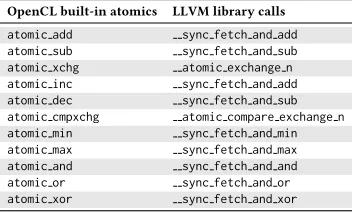
library call sync fetch and add. The specific mappings between
the OpenCL atomic functions and the LLVM library calls are shown in Table 1. Note that this is the case when the atomic variables are located in globalmemory.
When atomic variables are located in localmemory, the
afore-mentioned mapping approach is equally applicable. But we note that, the synchronization overhead from concurrent work-items can be avoided in this case. InMOCL, a work-group is transformed
into a work-item loop by our kernel compiler, which is scheduled to a hardware thread. And the loop iterations are serially enumer-ated, i.e., the SEO (sequential execution order) constraint. Thus, the work-items within a work-group are executed one by one and in a sequential fasion. In terms of memory access, the work-items of this work-group will access local variables sequentially, and there is
Table 1: The mapping between OpenCL built-in atomics and the LLVM library calls.
OpenCL built-in atomics LLVM library calls
atomic add sync fetch and add
atomic sub sync fetch and sub
atomic xchg atomic exchange n
atomic inc sync fetch and add
atomic dec sync fetch and sub
atomic cmpxchg atomic compare exchange n
atomic min sync fetch and min
atomic max sync fetch and max
atomic and sync fetch and and
atomic or sync fetch and or
atomic xor sync fetch and xor
no chance of running these operations concurrently within a work-group. Therefore, the atomic operations on local memory can be replaced by equivalent functional operations without synchroniza-tion. Figure 6 shows the implemetation of theatomic addfunction
with a regular addition statement. We see that the statements run sequentially to update the atomic variablep. This lock-free
atom-ics can significantly improve kernel performance (see results in Section 5.3) by avoiding the synchronization overheads.
3.3
Runtime System
The runtime system implements the OpenCL APIs and generates the OpenCL library (libOpenCL.so). As shown in Figure 2, the
[image:4.612.351.528.432.538.2]// read , add , sto re _ _ a t t r i b u t e _ _ (( o v e r l o a d a b l e ) ) T a t o m i c _ a d d (v o l a t i l e Q T *p , T val ) {
T r e t v a l = * p ; * p = r e t v a l + val ;
r e t u r n r e t v a l ; }
Figure 6: The implementation of atomic addwhen atomic variables are located in localmemory. Qdenotes the ad-dress space,Tdenotes the type of atomic variables, and the atomic function returns the old value in the end.
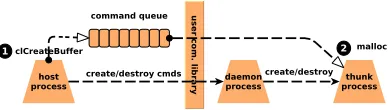
Figure 7: The interaction between host and device.
3.3.1 Host Runtime.The runtime system needs to implement
the OpenCL APIs. The host-device interaction is performed in terms ofcommands, which are broadly categorized into buffer allocation
and deallocation, kernel compilation and execution commands, data movement commands, and synchronization commands. Figure 7 shows the workflow of a command from host to device. The host issues commands to devices, and the commands are put into com-mand queues. Then, devices fetch comcom-mands at the queue and perform the corresponding actions to finish the offloading work. The interaction between host and device relies on the user commu-nication library.
As an example shown in Figure 7, the buffer allocation command (i.e.,clCreateBuffer) is pushed into the command queue (¶) and
executed on the device using themalloc()function to allocate
a buffer space (·). When executingkernel commands, the host
launches the kernel function and dispatch the predefined work-groups onto the hardware threads. The runtime system calls the kernel compiler when building kernel code. Also, Figure 7 illustrates that thedaemonprocess is used to detect requests from the host. To
manage the device-side runtime and run the offloading tasks, we use
athunkprocess, which is created during the OpenCL initialization
stage and released when finalizing the program.
3.3.2 Device Runtime. Figure 7 shows that thethunkprocess
manages the device-side runtime and runs the offloading tasks. This process is created and started to run at the very beginning of an OpenCL program, and is destroyed when the program exits.
We create a thread pool with a total of 32 threads on aSNof
Matrix-2000 when initializing thethunkprocess. Figure 8 shows
that each thread has 4 states:idle,ready,done, andexit. Once
threads are created, they will switch to be idle immediately. A
condition variableis used to signal the idle threads to be ready. By
doing so, we aim to avoid continually polling and save cycles. Note that, when the number of tasks (i.e., #work-groups) is less than the number of idle threads, we will use only a portion of them. Once the threads done with tasks, they switch to be idle and they are pushed back into the thread pool again. We will clean up the thread context and the related data when the thunk process exits.
Figure 8: Thread states and their transitions.
Distributing pending tasks to idle threads is at the core of the device runtime. In this context, a work-group is regarded as the basic unit of task distribution. When starting an OpenCL kernel, our runtime queries the number of idle threads and evenly dispatches the tasks to idles threads in one time. If the number of idle threads is greater than that of tasks, only a portion of the threads are signaled. Different from the task dispatching strategy used inPocl[14], we
call our approach as apush-based strategy. Our runtime pushes
tasks to available threads while inPocl, all the available threads
are pulling tasks once they finish the dispatched tasks. In contrast, our task dispatching approach can mitigate the overhead of thread polling and synchronization.
3.4
Implementation Details
3.4.1 Handling Kernel Variables.For global, constantand
localvariables, they are not private to a single work-item. When
generating work-item loops, we leave such variables intact. For
privatevariables, things become complicated. When a private
variable is used in only one work-item loop, we make no change of it. When the private variable is used in more than one work-item loops, but its value is the same for different work-items, we also make no change. At the same time, we need move the statements which update the content of the variables outside of the work-item loop. For other type of private variables, we have to allocate an array for them, which is located by the local index of work-items.
3.4.2 Runtime Profiling.To facilitate the performance analysis
of the runtime system, we provide a profiling module to the device runtime. When we submit a kernel function, the device runtime will assemble kernel arguments, fetch idle threads from the thread pool, dipatch tasks to the fetched threads, execute tasks on each thread, and return threads back. We record the time consumed by each stage during runtime. With this module, we can analyze and measure the performance metrics such as load balancing and scheduling cost, so as to help improveMOCL’s efficiency.
3.4.3 Optimization for Scalability.When our OpenCL
frame-work frame-works collaboratively with MPI on multiple devices or com-pute nodes, we meet with two issues. The first one is that, when creating multiple processes on a node, our framework would fail to run. Each node of TH-2A has eight compute devices out of two Matrix-2000s, and it is natural to use one process to control a device. But our OpenCL framework caches kernel binaries in the local file system, and they would be stored to the same location when using multiple processes. This results in the write conflicts from differ-ent processes. To address this issue, we provide an environmdiffer-ent variableMOCL ENV CACHEto indicate where to savemtxbinaries.
[image:5.612.68.279.82.138.2] [image:5.612.389.494.87.148.2] [image:5.612.76.270.205.260.2]cannot be found. This is because when our framework initializes
devices, it will create athunkprocess on all devices. As a
conse-quence, each process would contend to interact with all the devices simultaneously. To this end, we delay thethunkcreation from
device initialization to context creation. ThenMOCLwill only create
thethunkprocess on the device that it really used.
4
EXPERIMENTAL SETUP
Hardware Platform.We evaluate our approach on both a single
and multiple compute nodes of the TH-2A supercomputer. Each compute node of TH-2A is equipped with two Intel Ivy Bridge CPUs and two proprietary Matrix-2000 accelerators. Each node has 192 GB memory. The host CPUs and the Matrix-2000 are connected throughPCIe. More details of the Matrix-2000 architecture can be
found in Section 2.2.
Systems Software.Both the CPU and the accelerator runs an
op-erating system (OS). The host CPU runs Redhat Linux v7.0 (with kernel v.3.10). The Matrix-2000 runs a lightweight OS with Linux kernel 3.14. We use an in-house driver to enable data communica-tions between the host and Matrix-2000.
Benchmarks.To validate and evaluate our OpenCL
implemen-tation, we use 70 benchmarks from theNVIDIA SDK,AMD SDK,
SNU NPB,ShocandParboil suites. To evaluate our approach
across computing nodes, we useClover, a mini-app that solves
the compressible Euler equations on a Cartesian grid, using an explicit, second-order accurate method3. It uses OpenCL for kernel
execution and MPI for cross-node execution. We analyze these benchmarks and collect information from them to guide the imple-mentation ofMOCL.
Performance Report.For each test case, we report the
geomet-ric mean performance across all benchmarks. We run each test case multiple times, until the difference between the upper and lower confidence bounds under a 95% confidence interval setting is smaller than 5%. We compare our approach toPOCL[3], an
open-sourced OpenCL implementation based on LLVM, in terms of kernel compilation policies and scheduling cost.
5
EXPERIMENTAL RESULTS
In this section, we first evaluate the efficiency ofMOCL, then we give
some optimization tips for users who want to write efficient OpenCL programs on Matrix-2000. At last, we evaluate the scalability of
MOCLon the TianHe-2A system.
5.1
Kernel Compilation Policies
InMOCL, an OpenCL kernel is compiled when the OpenCL API
clEnqueueNDRangeis invoked by the host program. At this point,
the work-group size is known to the compiler. Thus, we can pass this work-group size as either a constant parameter or a variable parameter to the compiler. We refer the first strategy as constant parameter compilation (CPC) and the latter as variable parameter
compilation (VPC). These two policies differ in thatCPChas to
re-compile the kernel when using a different work-group size. This occurs when an OpenCL kernel is called in an iterative manner and
3CloverLeaf: http://uk-mac.github.io/CloverLeaf/.
the work-group size changes between iterations. In contrast, using a variable parameter (VPC) can avoid the overhead of recompilation.
Figure 9 shows speedup of kernel compilation and execution time forCPCoverVPC. A speedup of over 1 means thatCPCyields
better performance. Overall, we see that using a constant work-group can often achieve a better performance than using a variable work-group. This is because the work-group size is fixed in such a case and we only have to compile kernels once. In addition, using a constant upper bound for a work-item loop brings more optimiza-tion opportunities such as vectorizaoptimiza-tion. This is why using theCPC
policy performs better even though the kernel compilation takes more time. Nontheless, we note a different performance behav-ior forBT,LU,NvBlsh,ScReduc,ScScan, andPbBFS. A common
observation of these benchmarks can noted that the kernels are invoked iteratively and the work-group size changes between iter-ations. As a result, the overhead of recompiling kernels becomes nonneglectable, and usingVPCruns faster. InMOCL, we provide
programmers with bothCPCandVPC. In default, theCPCpolicy is
enabled. But programmers can switch to theVPCpolicy by setting
the environment variableMOCL ENV KCP=2.
5.2
Device Runtime Scheduling
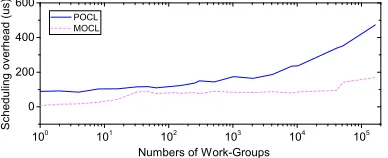
Figure 10 shows the scheduling cost betweenMOCLandPOCL. For
this, we synthesize a microbenchmark with an aim to measuring the overhead of the scheduling strategies used inMOCLandPOCL. This
microbenchmark is an OpenCL program that has a host part for managing contexts and a kernel part with an empty body. Therefore, the scheduling overhead can be roughly estimated by measuring the running time from the start of task dispatching to the moment when all the work-groups have been done.
InPOCL, each worker threadpullsa fixed amount of work-groups
from the task pool in each round. Every time a thread is pulling, it will have to synchronize with the other threads. This synchro-nization overhead becomes nonnegligible in particular when we have a large number of work-groups. This is due to the fact that the worker threads need to make pulling again and again. InMOCL,
how-ever, we use a master thread topushtasks (i.e., the work-groups)
to worker theads in one time. This often holds because the number of work-groups is determined at the time of starting anNDRange.
Therefore, the worker threads do not have to synchronize with each other thereafter. This exlains the observation in Figure 10 that, when the number of work-groups grows, the scheduling cost of
MOCLbecomes significantly smaller than that ofPOCL.
When we only have a very few work-groups, the scheduling overhead ofMOCLis also much smaller than that ofPOCL. This is
because thatMOCLonly activates a necessary number of worker
threads which are not more than the number of tasks and leaves others idle. By contrast,POCLwill activate all the idle threads and
dispatch tasks to each of them. Therefore, our scheduling strategy can avoid the unnecessary scheduling cost. This is particularly true when an OpenCL program starts its kernel(s) iteratively.
A natural extention to our scheduling approach is to leverage the work-stealing technique. That is, we firstpushtasks to the worker
b in s c h b in o mo
b tn c
s
b ls h DPb ls hb ox f d c
t
d whf wt ff ws h is t
o A h is t
o
L Uc o
m
MM M Tp re f
s
QR
S
r ad s Re c u G Re d
u c SL A Sm
p Co n
v
So b
F
St r S UR
NG BTCG E P F T I S L U S P Nv B
l sh Nv C
o nv S Nv D CT Nv D o tP Nv D XT C Nv F
DT D 3 d Nv H
i dM k v Nv H i st o Nv M
M
Nv M VM Nv M
e rT w Nv Q RG Nv R
e du c Nv S c an Nv S
o rt N e t Nv T r i d Nv V
e cA d d
Sc B F S Sc F F T Sc G
EM
M
Sc M a xF l
o ps Sc M
D5 H a sh
Sc M
D
Sc R e du c
Sc S 3 D Sc S c an Sc S o rt Sc S
p m
v
Sc S t en c
i l 2D Sc T r i ad
Pb B F S Pb C
UT C
P
Pb H i st o Pb L BM Pb M r i -q Pb S
g em
m
Pb S t en c
i l Pb T
PAC
F
g eo . Me a
n
0 . 0 0 . 5 1 . 0 1 . 5 2 . 0 2 . 5 3 . 0 3 . 5
S p e e d u p o v e r V P
C E x e c u t i o n C o m p i l a t i o n T o t a l
[image:7.612.75.535.85.168.2]A M D S D K S N U N P B N V I D I A S D K S h o c P a r b o i l
Figure 9: Speedup of kernel compilation strategyCPCoverVPC.
1 00 1 01 1 02 1 03 1 04 1 05
0
2 0 0 4 0 0 6 0 0
Sc he du lin g ov er he ad (u s)
N u m b e r s o f W o r k - G r o u p s
[image:7.612.79.273.207.286.2]P O C L M O C L
Figure 10: Comparing the scheduling overhead between
POCLandMOCL. The x-axis represents the number of work-groups, each having only one work-item and the y-axis de-notes the scheduling time from dispatching tasks to their completion. 5 1 0 1 5 2 0 2 5 3 0
0 2 4 6 8 1 0 1 2 1 4 1 6 1 8 2 0 E x e c u t e t i m e ( s )
T h re a d I D
(a) Load distribution of EP
5 1 0 1 5 2 0 2 5 3 0
0 2 4 6 8 1 01 2 1 41 6 1 82 0 2 22 4 2 62 8 3 03 2 3 4 E x e c u t e t i m e ( s )
T h re a d I D
(b) Load distribution of PbTPACF
Figure 11: The workload per thread ofEPandPbTPACF
have a rather even workload distribution among work-groups. As shown in Figure 11(a), the one-time workload distribution can garuantee a good load balancing. Thus, applying work-stealing on these programs is not a must. Meanwhile, programs such as
PbTPACFhave branches and thus distinct work-items may run
dif-ferent amouts of workloads (Figure 11(b)). For such programs, it is still necessary to implement the work-stealing technique. Provided that there are very few such programs among the 70 benchmarks, we will leave this extension for the future work. To summarize, we calculate that the average ratio (between the fastest worker thread and the slowest one) of load balancing is around 90.5%, which is considered to be well load balanced.
5.3
Evaluating Atomic Operations
We evaluate the performance of our atomic functions over several programs, which are from theParboiland AMD benchmark suites.
We implement two versions of the atomic functions: one is built on the LLVMsynclibrary calls, and the other uses our lock-free
im-plementation. We measure their kernel execution time to compare the performance of our optimized atomic functions. From Table 2, we see that our optimized atomic functions can achieve a speedup of up to 4.32x, when compared to the baseline implementation. Most atomic functions inPbBFSandPbHistowork on updating
Table 2: The performance evaluation of the optimized atomic functions when atomic variables are located in
localmemory. The speedup is the performance of our im-plementation versus the one based on external library calls.
Programs Atomics Locations Speed up
StrS atomic{inc, dec} local 1.11
rads atomic inc local 1.08
histoA atomic inc local 4.32
PbBFS atomic{add, min, xchg} {local, global} 1.00
PbHisto atomic{add, min, max} {local, global} 1.00
PbTPACF atomic inc local 1.28
variables in globalmemory. As we perform no optimizations on
such atomic functions, these benchmarks can gain a slight perfor-mance improvement. Other programs such ashistoAandPbTPACF,
work on updating atomic variables in localmemory. We note
that such benchmarks can yield significant speedups, which comes from the usage of our lock-free atomics.
5.4
Programming and Code Optimization on
Matrix-2000: A Programmer’s Perspective
With the help of our OpenCL framework, programmers can take Xeon-Matrix2000 as a conventional heterogeneous platform. But we argue that the following optimization guidelines are required to achieve high performance on this platform.
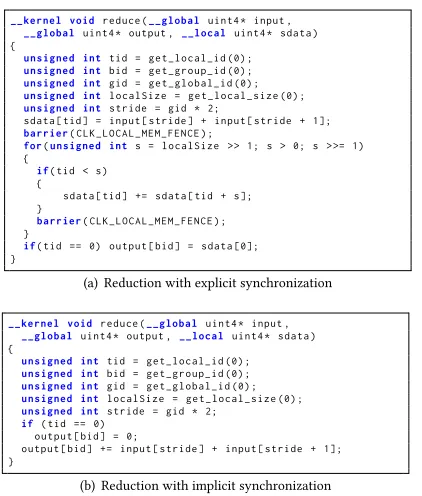
5.4.1 On Reduction Operations.InMOCL, the work-items in a
work-group are executed in a sequential way, i.e., the sequential execution order (SEO). By leveraging this implicit constraint, we
can remove the usage of local memory and barrier. We analyze the benchmarks and find that the reduction operation can be reim-plemented with SEO in a straightforward manner. In Figure 12, we show how we use SEO to implement reduction operations for
Reducin the AMD-SDK benchmark suite. In the original kernel,
it uses a loop and barrier to implement reduction. When taking the SEO constraint into account, we can simply implement the reduction operation in an equivalent way that we sum the private result for the first work-item to the last one.
We rewrite the benchmarks with reductions and implement the reduction operation without local memory or barrier. The speedup can be up to 1.5x, when compared to the original kernel. Specif-ically,Reduc,IS,PbTPACF,PbBFScan achieve a speedup of 1.42x,
[image:7.612.61.286.371.423.2]_ _ k e r n e l void r e d u c e (_ _ g l o b a l ui nt4 * input ,
_ _ g l o b a l ui nt4 * output , _ _ l o c a l ui nt4 * sd ata ) {
u n s i g n e d int tid = g e t _ l o c a l _ i d (0) ;
u n s i g n e d int bid = g e t _ g r o u p _ i d (0) ;
u n s i g n e d int gid = g e t _ g l o b a l _ i d (0) ;
u n s i g n e d int l o c a l S i z e = g e t _ l o c a l _ s i z e (0) ;
u n s i g n e d int s t r i d e = gid * 2;
sd ata [ tid ] = in put [ s t r i d e ] + i npu t [ s t r i d e + 1];
b a r r i e r( C L K _ L O C A L _ M E M _ F E N C E ) ;
for(u n s i g n e d ints = l o c a l S i z e >> 1; s > 0; s > >= 1) {
if( tid < s ) {
sd ata [ tid ] += sd ata [ tid + s ]; }
b a r r i e r( C L K _ L O C A L _ M E M _ F E N C E ) ; }
if( tid == 0) o u t p u t [ bid ] = sda ta [0]; }
(a) Reduction with explicit synchronization
_ _ k e r n e l void r e d u c e (_ _ g l o b a l ui nt4 * input ,
_ _ g l o b a l ui nt4 * output , _ _ l o c a l ui nt4 * sd ata ) {
u n s i g n e d int tid = g e t _ l o c a l _ i d (0) ;
u n s i g n e d int bid = g e t _ g r o u p _ i d (0) ;
u n s i g n e d int gid = g e t _ g l o b a l _ i d (0) ;
u n s i g n e d int l o c a l S i z e = g e t _ l o c a l _ s i z e (0) ;
u n s i g n e d int s t r i d e = gid * 2;
if ( tid == 0) o u t p u t [ bid ] = 0;
o u t p u t [ bid ] += inp ut [ s t r i d e ] + in put [ s t r i d e + 1]; }
[image:8.612.70.281.83.331.2](b) Reduction with implicit synchronization
Figure 12: Reduction operation optimization forReduction.
1 28 2 56 5 121 02 4 1 02 42 56 05 12 0 1 02 4
0
3 20 4 80 6 40 8 00 1 28 02 56 05 12 0 1 02 0
0
g eo . Me a
n
0
1
2
3
I n p u t s i z e
S
p
e
e
d
u
p
[image:8.612.329.545.171.245.2]L U c o m M T N v M M Q R S
Figure 13: The performance without local memory com-pared to with local memory. The kernels without using local memory run up to 2.4x faster.
5.4.2 On Local Memory Usage. The local memory in OpenCL
can be used to stage the data from global memory, or used to cache the result produced by other work-items. Using local memory can enable faster memory accesses, because local memory is located on-chip and has a much smaller access latency on GPUs. But it is not the same for Matrix-2000, where the architecture has no physical on-chip buffers. In such a case, local memory is implemented as a buffer in the global memory space. Therefore, accessing local memory is same as accessing global memory on Matrix-2000.
Among all the benchmarks, we note several of them are using local memory to stage data:LUcom,MT,NvMM, andQRS. We rewrite
these programs by removing the usage of local memory. Figure 13 shows that we obtain an up to 2.4x speedup, compared to the original kernel. We demonstrate the speedup of the optimized version compared to the version with local memory. Overall, the kernels without local memory achieve an average speedup of 1.3x over the original kernels. To summarize, it is not recommended that local memory be used in OpenCL kernels on Matrix-2000. As doing so, we will introduce extra memory accesses and synchronizations.
(a) Pattern 1. (b) Pattern 2.
Figure 14: Memory access patterns. This is the memory foot-print of one work group. WI0 means the memory that work item 0 will access.
N v H
id M
k v
N v T
r id
N v
T r id
N v
Q R
G
N v Q
R G
N v M
e r T
w
N v M
V M
b in
o m
o
0 1 2 3 4 5 6 7 8
S
p
e
e
d
u
p
1 device 4 devices 8 devices
Figure 15: Evaluate the performance of multiple devices
5.4.3 On Memory Access Patterns.There are two typical
mem-ory access patterns: (1) a work-item accesses memmem-ory contiguously (Figure 14(a)), and (2) the access distance between two neighbouring work-items is 1 and the data elements accessed by a work-item may be far from each other (Figure 14(b)). InMOCL, the work-items in
one work-group are scheduled for exeuction in a sequential fashion. Thus, pattern 1 can bring a much larger memory bandwidth than pattern 2. As a result, pattern 1 is preferred by programmers to implement OpenCL kernels. We compare the performance of these patterns withDCTandQRS, and see that using pattern 1 can yeild a
speedup of 1.03x and 1.01x, respectively.
5.5
Evaluating the Scalability of
MOCL
We evaluate the scalbility ofMOCLon either multiple Matrix-2000s
or multiple compute nodes, each with multiple devices.
On Multiple Matrix-2000s.In order to evaluateMOCL’s
perfor-mance on multiple devices, we select the benchmarks which use multiple devices from Nvidia and AMD benchmark suites. We run these programs in three cases: using 1 device, 4 devices and 8 de-vices. From Figure 15, we see how the performance increases when using increasingly more devices.
On Multiple Nodes with Multiple Matrix-2000s.We run the
mini-appCloveron 256 nodes of TH-2A to evaluate the scalability of
MOCL.Cloveris implemented with MPI and OpenCL, where each
MPI process is used to control a device. To fully utilize the TH-2A system, we run 8 processes per compute node, which corresponds to 8 devices. We first runCloverwith a fixed input size, and change
the number of nodes and devices. The execution time ofClover
is shown in Figure 16(a). We see that the execution time decrease when increasing the number of MPI processes. But when the num-ber of MPI processes is large than 8, the change of execution time is very slight. Then we keep the task size of each MPI process con-stant, and vary the number of nodes and input size. The execution time is shown in Figure 16(b). When the input dataset increases, we see that the execution time increase slowly. It means thatMOCL
[image:8.612.60.289.364.451.2]1 N 2 N 3 N 4 N
0 2 0 0 4 0 0 6 0 0
E x e c u t i o n t i m e ( s )
N
o
d
e
s
a
n
d
d
e
v
ic
e
s 8 D 4 D
7 D 3 D 6 D 2 D 5 D 1 D
(a) Strong scalability
4 0 0 0 * 2 0 0 0 4 0 0 0 * 4 0 0 0 8 0 0 0 * 4 0 0 0 8 0 0 0 * 8 0 0 0 1 6 0 0 0 * 8 0 0 0
0
1 0 2 0 3 0 4 0 5 0
E
x
e
c
u
ti
o
n
t
im
e
(
s
)
P r o b l e m s i z e
[image:9.612.64.282.87.279.2](b) Weak scalability
Figure 16: Evaluate the scalability ofCloveracross comput-ing nodes.
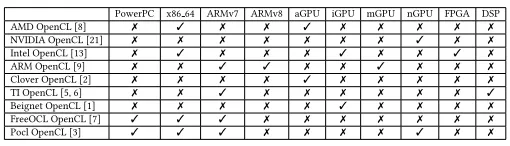
Table 3: Existing OpenCL Implementations on various plat-forms (aGPU– AMD GPU, iGPU– Intel GPU, mGPU– Mali GPU, nGPU– NVIDIA GPU; [3] denotesAVAILABLEwhile [7] denotesUNAVAILABLE).
PowerPC x86 64 ARMv7 ARMv8 aGPU iGPU mGPU nGPU FPGA DSP
AMD OpenCL [8] 7 3 7 7 3 7 7 7 7 7
NVIDIA OpenCL [21] 7 7 7 7 7 7 7 3 7 7
Intel OpenCL [13] 7 3 7 7 7 3 7 7 3 7
ARM OpenCL [9] 7 7 3 3 7 7 3 7 7 7
Clover OpenCL [2] 7 7 7 7 3 7 7 7 7 7
TI OpenCL [5, 6] 7 7 3 7 7 7 7 7 7 3
Beignet OpenCL [1] 7 7 7 7 7 3 7 7 7 7
FreeOCL OpenCL [7] 3 3 3 7 7 7 7 7 7 7
Pocl OpenCL [3] 3 3 3 7 7 7 7 3 7 7
6
RELATED WORK
There exist various OpenCL implementations, which are shown in Table 3. On the one hand, we notice that most vendor imple-mentations are close-source, except the one from AMD. This open source Linux Compute project is Radeon Open Compute ROCm for Radeon Graphics GCN 3 and 4 (Hawaii, Fiji, Polaris) and Intel Xeon E5v3 and Corev3 CPU (Haswell and newer) or new AMD Ryzen with PCIe Gen3 atomics capability [4]. Meanwhile, the OpenCL implementation from TI is customized to TI SoCs (an ARM CPU + a TI DSP) [6]. On the other hand, the open-source implementations are typically developed and maintained by academia. The Gallium Compute Project maintains an implementation of OpenCL mainly for AMD Radeon GCN (formerly known as CLOVER), and it builds on the work of the Mesa project to support multiple platforms [2]. BEIGNET is an implementation released by Intel in 2013 for its in-tegrated GPUs (Ivy Bridge and newer) [1]. POCL is a CPU-oriented OpenCL implementation built on Clang and LLVM. In addition, POCL supports the TTA and HSA architecture [14, 15]. As of April 2017, POCL has an experimental support for NVIDIA GPU devices via a new backend which makes use of the LLVM NVPTX backend and the CUDA driver API. Similar to POCL, FreeOCL also supports a large range of multi-core CPUs with the help of the generic C++
compilers [7]. But this framework is purely CPU-oriented and can-not be extended to accelerators in a straightforward way. Although these frameworks provide us with valuable building blocks, none of them can be directly applicable to the Xeon-Matrix2000 platform. In [12], Gummaraju et al. presentTwin Peaks, a software
plat-form for heterogeneous computing. This allows codes originally targeted for GPUs execute efficiently on CPUs as well. In particular, they propose several techniques in the runtime system to efficiently utilize the caches and functional units present in CPUs. The ex-perimental results show that the techniques enable GPGPU-style code to run efficiently on multicore CPUs with minimal runtime overheads. In [20], Lee et al. present the design and implementa-tion of an OpenCL framework for architectures which consist of a general-purpose processor core and multiple accelerator cores without caches but a small internal local memory. Their OpenCL C kernel translator contains three source-code transformation tech-niques to boost performance. In [25], Stratton et al. describe a framework (MCUDA), which allows CUDA programs to be executed
efficiently on shared memory, multi-core CPUs. The framework consists of a set of source-level compiler transformations and a runtime system for parallel execution. This approach can achieve a better performance than the OpenMP version on multicore CPUs. These OpenCL implementations are targeted for multicore CPUs. Our kernel compiler resembles theirs by using thework-item loop
strategy. Different from these work, our kernel compiler further op-timizes kernel performance by fully leveraging the SEO constraint. To compare and contrast architectural designs and programming systems, Danalis et al. have designed the Scalable HeterOgeneous Computing benchmark suite (SHOC) [10], which is a spectrum of programs that test the performance and stability of these scalable heterogeneous computing systems. In this context, we use these benchmarks to evaluate the performance of our design. In [22, 23], Shen et al. compare the performance of OpenCL and OpenMP on threex86 64multicores. They identify the factors that significantly
impact the overall performance of the OpenCL code. By taking a reasonable OpenMP implementation as a performance reference, they optimize the OpenCL code to reach or exceed this thresh-old. The authors find that the performance of OpenCL codes is affected by hard-coded GPU optimizations which are unsuitable for multi-core CPUs, the fine-grained parallelism of the model, and the immature OpenCL compilers. On the Matrix-2000 architecture, we have similar observations that the GPU-customized OpenCL codes perform even worse than the serial code. This motivates us to generates efficient codes for Matrix-2000 from the OpenCL codes with GPU-specific optimizations in the future.
7
CONCLUSION
[image:9.612.53.308.374.447.2]with a state-of-the-art open-sourced OpenCL implementation. We share our experience on code optimization on Matrix-2000, pro-viding useful insights on how to effectively program this unique architecture.
REFERENCES
[1] 2017. Beignet OpenCL. https://www.freedesktop.org/wiki/Software/Beignet/. (2017).
[2] 2017. GalliumCompute OpenCL. https://dri.freedesktop.org/wiki/
GalliumCompute/. (2017).
[3] 2017. Pocl OpenCL. http://pocl.sourceforge.net/. (2017).
[4] 2017. ROCm OpenCL. https://radeonopencompute.github.io/index.html. (2017). [5] 2017. Shamrock OpenCL. https://git.linaro.org/gpgpu/shamrock.git/about/.
(2017).
[6] 2017. TI OpenCL. http://git.ti.com/opencl. (2017).
[7] February, 2017. FreeOCL OpenCL. http://www.zuzuf.net/FreeOCL/. (February, 2017).
[8] AMD. 2017. OpenCL Zone - Accelerate Your Applications. http://developer.amd. com/tools-and-sdks/opencl-zone/. (2017).
[9] ARM. 2017. Mali OpenCL SDK. https://developer.arm.com/products/software/ mali-sdks/opencl. (2017).
[10] Anthony Danalis and others. The Scalable Heterogeneous Computing (SHOC)
benchmark suite. InGPGPU ’10.
[11] Jack Dongarra. 2017.Report on the TianHe-2A System. Technical Report
ICL-UT-17-04.
[12] Jayanth Gummaraju and others. Twin peaks: a software platform for
heteroge-neous computing on general-purpose and graphics processors. InPACT ’10.
[13] Intel. 2017. Intel SDK for OpenCL Applications. https://software.intel.com/en-us/ intel-opencl. (2017).
[14] Pekka J¨a¨askel¨ainen and others. 2015. pocl: A Performance-Portable OpenCL
Implementation.International Journal of Parallel Programming(2015).
[15] Pekka J¨a¨askel¨ainen and others. 2016. pocl: A Performance-Portable OpenCL
Implementation.CoRR(2016).
[16] Ralf Karrenberg and Sebastian Hack. Improving Performance of OpenCL on
CPUs. InCC ’12.
[17] Khronos OpenCL Working Group 2012.The OpenCL Specification V1.2. Khronos
OpenCL Working Group.
[18] Jungwon Kim and others. SnuCL: an OpenCL framework for heterogeneous
CPU/GPU clusters. InICS’12.
[19] Chris Lattner and Vikram Adve. LLVM: A Compilation Framework for Lifelong
Program Analysis & Transformation. InCGO ’04.
[20] Jaejin Lee and others. An OpenCL framework for heterogeneous multicores
with local memory. InPACT ’10.
[21] NVIDIA. 2017. OpenCL. https://developer.nvidia.com/opencl. (2017). [22] Jie Shen and others. Performance Gaps between OpenMP and OpenCL for
Multi-core CPUs. InICPPW ’12.
[23] Jie Shen and others. 2013. An application-centric evaluation of OpenCL on
multi-core CPUs.Parallel Comput.(2013).
[24] John A. Stratton and others. Efficient compilation of fine-grained SPMD-threaded
programs for multicore CPUs. InCGO ’10.
[25] John A. Stratton, Sam S. Stone, and Wen-mei W. Hwu. MCUDA: An Efficient