© 2019, IRJET | Impact Factor value: 7.211 | ISO 9001:2008 Certified Journal
| Page
5249
EasyKey - Multipurpose RFID Card based IoT System
Abhinav
1, Abhinav Kumar
2, Akshari Nidugala
3, Mridul Ganga
41,2,3,4
B.E., Department of Information Science and Engineering, The National Institute of Engineering, Mysuru, India
---***---Abstract - We often find our wallets overloaded with manydifferent cards that serve various purposes. The handling and monitoring of all these cards becomes a very cumbersome task. We end up misplacing one or the other card, or we end up forgetting a particular card at home. Our project aims to solve this issue that we face. This project proposes the use of a single card that will perform the operations of some of the cards that we possess. Basically, we are promoting the use of a single card in place of some cards. This way, we can easily keep track of a single multipurpose card instead of keeping tab of multiple cards. This project proposes a system called EasyKey that uses RFID (Radio Frequency Identification Reader) cards, which can be used along with a wide range of applications. The project provides Two Factor Authentication using a mobile device and allows the user to list all the authentication requests on a mobile application.
Key Words: EasyKey, multipurpose card, RFID, Two Factor Authentication
1. INTRODUCTION
Our project EasyKey proposes the use of a single RFID (Radio Frequency Identification Reader) card to perform the operations of Authentication and Payment cards. This is how the EasyKey card can be used- when the user visits a store he/she can make payments using the card, when the user visits a hospital he/she can register using the same RFID card all the operations must go through the mobile device for authentication. The authentication will be two factor authentication for privacy and security purposes.
Radio-frequency identification (RFID) uses electromagnetic fields to identify and track tags attached to objects automatically. Electronically stored information is maintained in the tags. Passive tags collect energy from a nearby RFID reader's interrogating radio waves. Active tags have a local power source and may operate from several meters from the RFID reader. The tag need not be within the line of sight of the reader unlike a barcode, so it may be embedded in the tracked object. RFID is one method of automatic identification and data capture.
Two-factor authentication is an authentication method in which a computer user is granted access only after successfully presenting two pieces of factors to complete and authentication. It is a method of confirming identities claimed by users by using a mixture of two different factors: 1) something they know, 2) something they have, or 3) something they are. An example of two-factor authentication is withdrawing of money from an ATM machine; only the
correct combination of a bank card (something the user has) and a PIN (something the user knows) allows the transaction to be carried out.
2. SYSTEM DESCRIPTION
The system comprises of the following components-
Application at user end
A device on the vendor’s end
Vendor database
API Server
EasyKey database
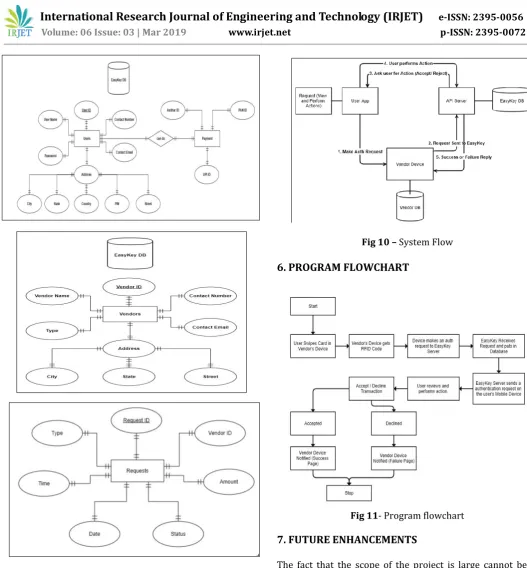
The user swipes his/her card at a vendor’s machine device. The vendor’s device receives a RFID code. The system uses a Two Factor Authentication for confirmation. The first factor of authentication is met when the vendor device makes an authentication request to EasyKey server. The EasyKey receives the request and puts it into its database. The EasyKey server then sends a authentication request to the user’s mobile device. This satisfies the second authentication factor. The user then reviews and performs action accordingly. The user either accepts or declines the transaction. If the transaction is accepted, the vendor device is notified of a “Successful transaction”. If the transaction is declined, the vendor device is notified of an “Unsuccessful transaction”.
3. EXISTING SYSTEM
There have been numerous systems designed that make use of RFID cards.
RFID technology has been used to simulate smart
trolleys that can be used in supermarkets, in order to alleviate the time consuming process of a bar code scanner at the cash counter.
RFID technology has also been used in development
of a smart library management system in order to allow fast transactions like issue and return of books by reducing manual intervention as far as possible.
RFID tags have also been used alongwith ZigBee and
© 2019, IRJET | Impact Factor value: 7.211 | ISO 9001:2008 Certified Journal
| Page
5250
selecting shopping items according to popularity and demand.
4. PROPOSED APPROACH
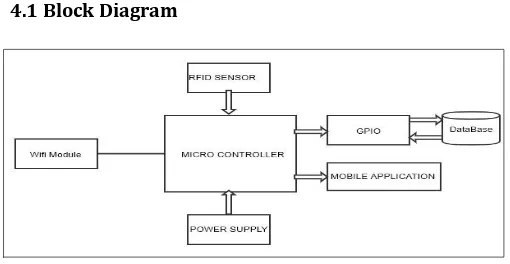
[image:2.595.31.286.153.285.2]4.1 Block Diagram
Fig 1- Block diagram of system
4.2 Hardware design
The Hardware Design contains Raspberry pi, RFID reading sensor and few RFID cards. With this system, the user will be able to authenticate himself/herself to places like hospitals. Users can also make payments to vendors at shops. At first, the user will have to register himself/herself by filling all the necessary details.
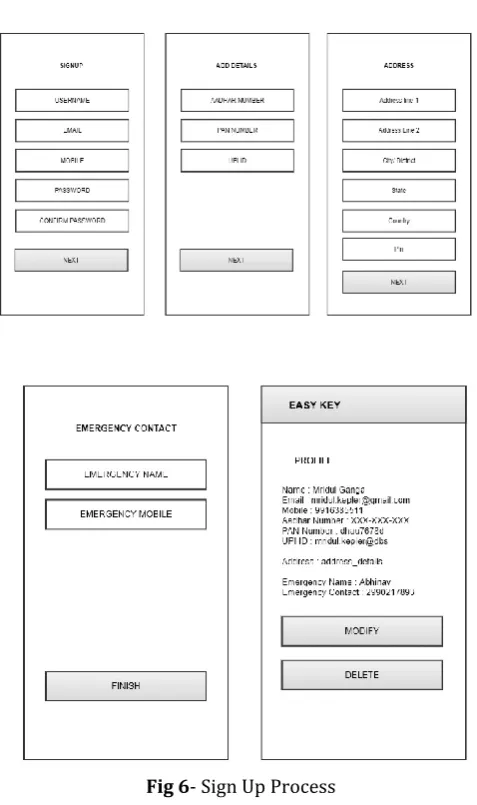
The raspberry pi is connected to the RFID sensor and wifi. The RFID card is scanned through the sensor. The unique ID of the card will be stored in the database and the user will be asked to fill in personal credentials like Name, Email, Phone number, Aadhar number, PAN number and billing and communication address. The user will also be asked to enter payment details like UPI ID.
Now, when the user scans the RFID card at any vendor,’s device the ID will be matched to the database and the user will get a notification on his/her registered mobile number to authenticate the request. The request will then be authenticated. For payments, the user will get a notification on mobile for either accepting or declining the payment.
The Raspberry pi is connected to the web server via the wireless network. The web server is connected to the database as shown in the block diagram.
Fig 2- Raspberry pi setup
Fig 3- Raspberry pi setup
Fig 4-RFID Sensor
4.3 Software design
The mobile application will have the following design-
THE HOME PAGE:
[image:2.595.42.547.511.794.2]© 2019, IRJET | Impact Factor value: 7.211 | ISO 9001:2008 Certified Journal
| Page
5251
[image:3.595.36.570.75.779.2]THE SIGN UP PROCESS
Fig 6- Sign Up Process
AFTER LOGIN
Fig 7- Login and payment
[image:3.595.46.285.110.513.2]AFTER TRANSACTION
Fig 8- Transaction success or failure
CODE SNIPPET FOR SERVER THAT CONNECTS TO DATABASE
4.4 Database
[image:3.595.317.555.124.279.2]© 2019, IRJET | Impact Factor value: 7.211 | ISO 9001:2008 Certified Journal
| Page
5252
Fig 9- Entity relationship
5. SYSTEM FLOW
[image:4.595.31.559.39.608.2]The system flow is shown below in Fig. 10
Fig 10 – System Flow
6. PROGRAM FLOWCHART
Fig 11- Program flowchart
7. FUTURE ENHANCEMENTS
[image:4.595.318.556.318.549.2]© 2019, IRJET | Impact Factor value: 7.211 | ISO 9001:2008 Certified Journal
| Page
5253
become easy with further improvisations which will credit the user to access data and services more easily.
CONCLUSION
In this paper, we have shown the implementation of a single multipurpose RFID card that can be used to make payments and for authentication purposes. This multipurpose card eliminates the need of carrying various cards that are used for authentication and payment usages. We have kept in mind the privacy and security aspects of the users, and hence have instilled a Two Factor authentication. This two factor authentication reduces the risk of transactions being performed when the card falls into wrong hands. Decisively, this application may reduce the number of cards that a person carries in his/her wallet. Also, the many number of cards may be replaced by this single multipurpose RFID card.
REFERENCES
[1] J. C. Michael Melton, Theodore Arnold "Managing RFID
tags using an RFID-enabled cart," 2005.
Available:https://patents.google.com/patent/US200601 63350A1/fr#patentCitations.
[2] A. X. Liu and L. A. Bailey, "PAP: A privacy and authentication protocol for passive RFID tags," Comput. Commun., vol. 32, pp. 1194-1199, 2009.
[3] Cheng Feng, Research for Application of RFID in
Library, 978-1-4244-6947-5/10 ©20l0 IEEE
[4] Paul Golding and Vanesa Tennant, Performance and
Reliability of Radio Frequency Identification (RFID) Library System, 0-7695-2777-9/07 © 2007 IEEE.
[5] Tim Good · Mohammed Benaissa, “A holistic approach
examining RFID design for security and privacy,” JSupercomput 64, pp. 664–684, 2013.
[6] Mirza, Zainab Rasheed Fahad and M.N. Brohi,
“Integrating radio frequency identification technology in academic management system,” J. Comput. Sci., vol. 10, issue 2, pp. 361-365, 2014.
[7] Dawes A.T. (2004),”Is RFID Right for Your