SHOULD BRITAIN LEAVE THE EU? AN EXPLORATION OF ONLINE ARGUMENT
THROUGH A TOULMIN PERSPECTIVELA
GRAN
BRETAGNA DOVREBBE LASCIARE L’UE?
L’ESPLORAZIONE DI UNA
ARGOMENTAZIONE ONLINE ATTRAVERSO LA PROSPETTIVA DI TOULMIN
Michael Hammond* and Marina Charalampidi
Centre for Education Studies, University of Warwick, UK, [email protected], [email protected]
* Corresponding author
Abstract The paper shows how a framework adapted from Toulmin (1958) was valuable in exploring the force of online argument in an educational setting. In past research of online discussions there has been a focus on interaction patterns at the expense of exploring questions of content. In seeking to address this imbalance, we used Toulmin’s key terms of claim, data, warrant, rebuttal and backing in an analysis of an educational network for young learners (13-18) in which a debate on whether Britain should leave the EU was carried out. Drawing on these key terms, a framework was constructed in order to categorise messages as: claims with no force; insufficient argument; constructed argument; forceful argument. This framework was used to unpack the claims and warrants put forward in the course of the debate. The paper shows that Toulmin’s approach can be adapted to provide a feasible and useful framework for assessing the force of argument within forums. However, it is
recognised that there are also challenges and limitations in using such an approach.
KEYWORDS Argument; Online Forums; Toulmin.
squilibrio, abbiamo utilizzato i termini chiave di tesi (claim), dati (data), garanzia (warrant), riserva (rebuttal) e fondamento (backing) di Toulmin nell’analisi di una rete educativa per giovani studenti (13-18) in cui è stato condotto un dibattito sull'eventualità che la Gran Bretagna abbandonasse l'UE. Attingendo a questi termini chiave, è stato costruito un framework per classificare i messaggi come: tesi senza forza (claims with no force);
argomentazione insufficiente (insufficient argument); argomentazione articolata (constructed argument); argomentazione forte (forceful argument). Il framework è stato utilizzato per analizzare le tesi e le garanzie presentati nel corso del dibattito. L’articolo mostra come l'approccio di Toulmin possa essere adattato per fornire un framework utile per valutare la forza di un’argomentazione all'interno di un forum. Tuttavia, viene anche evidenziato che esistono sfide e limitazioni nell'utilizzo di tale approccio.
PAROLE CHIAVE Argomentazione; Forum online; Toulmin.
1. INTRODUCTION
The introduction of online environments, including online forums, blogs and other social networking, was once heralded as offering opportunities for inclusive debate in which members had the time and space to read and offer views undistracted by visual clues. These opportunities applied to not just teaching and learning contexts (Austin, 2006; Boyd, 1996; McConnell, 2000), but also to community networks and civil society more generally (Boshier, 1990; Rheingold, 1993; 2008). Such opportunities continue to exist but early enthusiasm has been dampened by awareness of the sometimes chaotic nature of participation in formal learning (Eve & Brabazon, 2008) and the tendency for social networking to reinforce existing beliefs, as in the phenomenon of 'echo chambers' (Boutyline & Willer,2017; Del Vicario et al., 2016), rather than support reflexivity and the exploration of counter argument. These difficulties have led to questions over the quality of online activity in general and concern over online argument in particular (Paglieri & Reed, 2017). However, if we are to criticise the conduct of online argument then we need to have some criteria for helping to identify what a good argument looks like. This paper suggests Toulmin’s framework can help. In particular, it shows how Toulmin’s key work (Toulmin, 1958) can be adapted to provide a feasible and useful tool for understanding the force of argument in online discussion.
of claim, data, warrant and backing in an argument. We then move on to showing how the Toulmin framework was adapted to analyse a discussion about leaving the EU, one which took place in an educational network for young learners (13-18). Finally, the strength of the Toulmin approach are discussed along with its limitations.
2. THEORETICAL BACKGROUND
2.1 Analysis of online knowledge building: The educational technology tradition
In seeking to deepen our understanding of online discussion one well-trodden path is to present frameworks for analysing the messages themselves, in other words: what are these messages designed to do? Here much of the work in the field of educational technology research has focused on knowledge building communities and communities of practice (Anderson, 2004; Cacciamani, Perrucci, & Khanlari, 2018; Garrison, Anderson, & Archer, 2010; Gunawardena, Lowe, & Anderson, 1997; Henri & Pudelko, 2003; Lee, Son, & Lee, 2005; Salmon, Nie, & Edirisingha, 2010; Scardamalia & Bereiter, 2014; Zhang, Scardamalia, Reeve, & Messina, 2009). Early work in this tradition made recurring reference to Henri (1992) in which an analytical model based around participation, interaction, social, cognitive and metacognitive dimensions of messages was proposed. Later, Gunawardena, Lowe and Anderson (1997) put forward an ‘interaction analysis’ model in order to show the social construction of knowledge around five phases starting with the sharing and comparing of information, through to noticing inconsistency and negotiation of meaning, and finishing with agreement or application of newly constructed meaning. Meanwhile, Garrison, Anderson and Archer's (2010) Community of Inquiry model contained three elements, namely social, cognitive and teaching presence, and Salmon, Nie and Edirisingha (2010) proposed a five-stage model, which categorised participation from access and motivation, through information exchange leading to knowledge construction development. Many researchers have used these schema creatively to come up with new models, for example Ke and Xie (2009) categorise interactions into three dimensions (socializing, knowledge construction and regulation of learning), while Pezzotti and Gambini (2012) draw creatively on knowledge construction literature and extend it in important ways.
suggests a robust process of debate. Indeed, a stimulus to pioneer researchers in the field of online text analysis was the possibility of being able to quite literally chart the construction of new knowledge as message archives seemed to provide a complete account of interaction within a group. However, if such a goal was to be achieved then researchers needed to get the categorisation of messages right. In particular, they needed to explain not only how new knowledge was created but why this new knowledge was worth paying attention to. However here was a gap. After all members of a group may construct knowledge by articulating claims and addressing counter claims, but do any of the agreements which participants arrive at carry any force? Of course validity criteria are not entirely absent from many of the schema used to analyse online texts. For example, Gunawardena, Lowe, and Anderson (1997) suggested that any new knowledge co-constructed by members should be tested against cultural assumptions; experience; cognitive schema; testimony and data. Garrison, Anderson, and Archer (2001) saw a kind of pragmatic claim to new knowledge as its usefulness in practice. Scardamalia and Bereiter (2014) drew attention to processes, e.g. offering insightful interpretation or providing supportive/disconfirming findings, which needed to be present in creating authentic knowledge. And Pezzotti and Gambini (2012) put forward content indicators ('Indicatori di contenuto') in respect to the source of knowledge on which participants draw. However, we argue that these fall short of offering the kind of forensic analysis needed to establish the quality of an argument. This leads to the wider question, 'Can the quality of argument really be evaluated?'. One place to look for an answer is the educational literature.
2.2 The education literature on argument
how to learn); the second is 'metastrategic processes' (knowing which strategies to deploy); and the third is 'epistemological framework' (an understanding of how we know).
Given what has been said about its value, the teaching of argument should be a priority across all sectors. However, there is one overriding conclusion to be drawn from the literature: there have been, and continue to be, considerable weaknesses in the conduct of argument (Kuhn, 1992; Nussbaum, Hartley, Sinatra, Reynolds, & Bendixen, 2004; Stegmann et al., 2004). Kuhn and Pearsall (2000) forensically examine some of these weaknesses. For example, in many cases concerning young people’s scientific understanding argument stopped with covariation (X rises with Y hence X must be the cause of Y). Other weaknesses include engaging in counterfactual reasoning (presenting alternative accounts of what actually happened), discounting (ignoring more comprehensive explanations for preferred ones) and analogy (a tendency to think about objects of inquiry in terms of what was already familiar). A key feature of weak argument is its failure to engage with alternative explanations and its reliance on ‘pseudoevidence’ (Nussbaum & Schraw, 2007). Nussbaum et al. (2004) further suggest that a good argument successfully integrates argument and counterargument. Indeed, students often do not realise that considering and rebutting a counterclaim often increases the persuasiveness of their argument.
Conducting an argument is not straightforward. At the individual level, argument is seen as carrying a high cognitive load (Coirier, Andriessen, & Chanquoy, 1999), allied to which many students seek to maintain ‘cognitive consistency’ rather than consider new explanations (see the review by Simon & Holyoak, 2002). Underlying resistance to argument at both individual teacher and student levels are: beliefs about epistemology (for example, difficulty in accepting the fallible nature of knowledge and hence the need for argument at all); personality type (for example, the difficulty some experience in accepting uncertainty); and preferred learning style or a preference for surface rather than deep learning (Oh & Jonassen, 2007). At a macro level, there are further constraints, for example the prevailing emphasis on testing recall of knowledge, and gaps in teacher training (Simon, 2008). Not surprisingly, many researchers, including Anderson, Guerreiro, and Smith (2016), Littleton & Whitelock (2005) and Mercer (1995) have seen the need to assist young people in developing argument skills and for supporting teachers in leading and modelling argument.
2.3 Toulmin and what makes a good argument
recurring point of reference has been, and remains, Stephen Toulmin. Toulmin’s Use of Argument (1958) has been adopted in many areas including linguistics, psychology, philosophy, law and politics. More crucially, for this paper, Toulmin has also been influential in education. For example, Bacha (2010) and Qin & Karabacak (2010), along with many others, have used the Toulmin framework for analysing and supporting academic writing in higher education. In school contexts, Toulmin has been influential in science education (Erduran et al., 2004; Jimenez-Aleixandre, Rodriguez, & Duschl, 2000) and is a point of reference for many other disciplines (Lee, 2017; Pontecorvo & Girardet, 1993). Toulmin has, however, only rarely been applied in an online context (Blake & Scanlon, 2014).
there was a structure to argument (including elements of claim, data, warrant, backing, rebuttal) which was common across all argument (i.e. field independent), but there was discipline knowledge that needed to be brought to an argument which was field dependent. This put Toulmin at odds with logicians, in that he argued there was much more to consider about a text than its formal structure, but later he was also at odds with post-structuralism by arguing that there was an identifiable structure to a text. Post-structuralists emphasised the multiple meanings which a text afforded and the instability of language, for all meaning was nested within other meaning (Elliot, 2014). By contrast, Toulmin had found a way of moving against the logical positivist tradition, while maintaining an interest, drawing on Aristotle, in how logical reasoning can play out in practical contexts. His stance was a largely pragmatic one which aimed to integrate objectivist and subjectivist ways of thinking and this position remained broadly consistent throughout his career (Toulmin, 1977).
There were other frameworks both within the educational technology and classroom talk literature which appeared easier to apply (for example, the categories of disputational, cumulative and exploratory talk in Littleton & Whitelock, 2005), but there were three things which attracted us to Toulmin as an approach to understanding online argument. First, his schema did not solely focus on the form an argument took (as was the case in much of the knowledge building literature), it had to consider knowledge of the field. In fact, Toulmin tended to equate field with discipline knowledge, but in this paper content knowledge is used to better reflect that backing for arguments often cuts across discipline or subject boundaries. Second, his broadly pragmatic stance on knowledge made Toulmin seemed to fit well with the anti-foundational ontology often associated with those proposing online discussion (McConnell, 2000). Third, there was a great deal of literature on the use of Toulmin in physical classrooms on which to draw when examining online settings.
3. METHODS
3.1 Context for the research
the network was open to any young person in that age group whose parents, carers or teachers vouched that it would be of value to them.
IGGY was a distinctive example of an online network as it offered members social interaction with people that in many cases they had not physically met. In addition, it offered a good deal of structured, optional, learning content covering areas such as history, politics, science, languages and so on (see Charalampidi, Hammond, & Boddison, 2014). According to IGGY’s database, the network had around 7,000 active members. These members came from all over the world, though most lived in the UK. The majority of the members were female but data on gender were not routinely collected. An important feature of IGGY was the high level of participation safety so that the network was closed to non-members, members used anonymised avatars and participation was monitored carefully by organisers for inappropriate activity.
We had already carried out a great deal of work aimed at understanding members’ perspectives on participation in IGGY (Charalampidi & Hammond, 2016). For example, active members tended to use the network for a number of reasons: to address lack of challenge at school, to access learning resources, to meet new people, to communicate with other members, and to learn about other cultures. IGGY was an educational community within which those who actively participated felt trust, empathy and respect. The main constraints in using IGGY was lack of time and learning to navigate the network which meant that some members were not active, or only active in particular areas - for example some accessed the learning materials but did not take part in discussion, and some accessed the discussions but not the learning material.
Before carrying out the analysis of the EU debate reported here we had already carried out quantitative analysis of several debates (including data on the number of contributions and the pattern of contributions) and a functional analysis of large units of meaning using the key codes Triggering a discussion (T), Inviting a response (R) and Stating (S) (Charalampidi & Hammond, 2016). This work was helpful in understanding the flow of argument but it was of limited value in helping to understand the force of argument. This is what led back to Toulmin.
3.2 The framework of analysis
Toulmin needed adapting if it was to be used as a way of understanding the comparative merits of arguments. We drew heavily on a framework constructed by Erduran, Simon, and Osborne (2004) and Simon (2008) in which five different levels of argument were identified. They range from Level 1, a simple claim without supporting data, to level 5, a claim with data, warrant, and backing with a recognition as to how the claim may be qualified or rebutted. This framework, however, needed further adaption. First, numerical labels (1, 2, 3, 4, 5) were replaced with something more descriptive. Second, each level was broadened, for example our category insufficient argument could capture different types of weakness including absence of W but also lack of clarity in respect to W. Third, Erduran et al.’s level 5 (‘displays an extended argument with more than one rebuttal’) set the bar too high. Indeed, Toulmin’s own work on argument seemed driven by an interest in jurisprudence and how legal arguments were constructed in order to integrate different claims within quite long and detailed texts. In contrast, in this study the texts were shorter and were made by young learners, rather than practising lawyers.
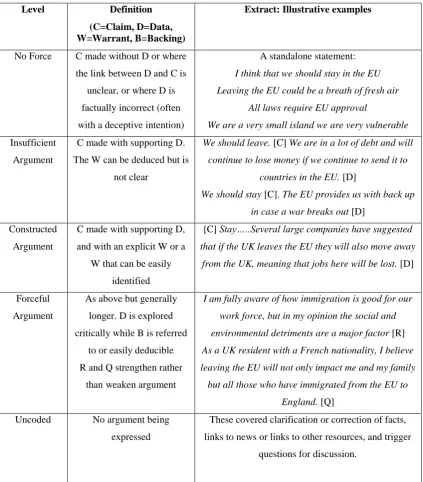
was considered a good or bad thing. Table 1 illustrates extracts from posts to give an idea as to the application of the framework.
Level Definition (C=Claim, D=Data, W=Warrant, B=Backing)
Extract: Illustrative examples
No Force C made without D or where the link between D and C is
unclear, or where D is factually incorrect (often with a deceptive intention)
A standalone statement:
I think that we should stay in the EU Leaving the EU could be a breath of fresh air
All laws require EU approval
We are a very small island we are very vulnerable
Insufficient Argument
C made with supporting D. The W can be deduced but is
not clear
We should leave. [C] We are in a lot of debt and will continue to lose money if we continue to send it to
countries in the EU. [D]
We should stay [C]. The EU provides us with back up in case a war breaks out [D]
Constructed Argument
C made with supporting D, and with an explicit W or a
W that can be easily identified
[C] Stay…..Several large companies have suggested
that if the UK leaves the EU they will also move away from the UK, meaning that jobs here will be lost. [D]
Forceful Argument
As above but generally longer. D is explored critically while B is referred
to or easily deducible R and Q strengthen rather
than weaken argument
I am fully aware of how immigration is good for our work force, but in my opinion the social and environmental detriments are a major factor [R]
As a UK resident with a French nationality, I believe leaving the EU will not only impact me and my family
but all those who have immigrated from the EU to England. [Q]
Uncoded No argument being expressed
These covered clarification or correction of facts, links to news or links to other resources, and trigger
[image:10.595.67.491.116.599.2]questions for discussion.
Table 1: Level descriptors used for categorisation of messages
important than economic output. Moreover, claims rested in part on counterfactuals: what would happen to the economy if UK left the EU or what would have happened if UK had not had joined in the first place. We were challenged throughout to reach agreement as what counted as relevant data and we were further challenged to background our own feelings about EU membership, for example by recognising a tendency to over-compensate when analysing positions with which we disagreed. Finally, we had decided to categorise at a whole text level but this required best-fit judgments in the case of longer messages containing different types of claim.
On our first run with the coding framework we, the two authors of this paper, reached agreement in 55 out of the 103 messages. There was a high level of consistency in applying the codes uncoded, no force and insufficient but less consistency in applying the categories of constructed argument and forceful. At this point we engaged in a prolonged discussion as what was reasonable in the terms of content knowledge for this group of participants. In a second round we found consistency in 27 out of the 58 disputed codes, and reached agreement over the remaining 31 after further conversation. We refer back to the issues this search for agreement raises in the discussion.
4. FINDINGS
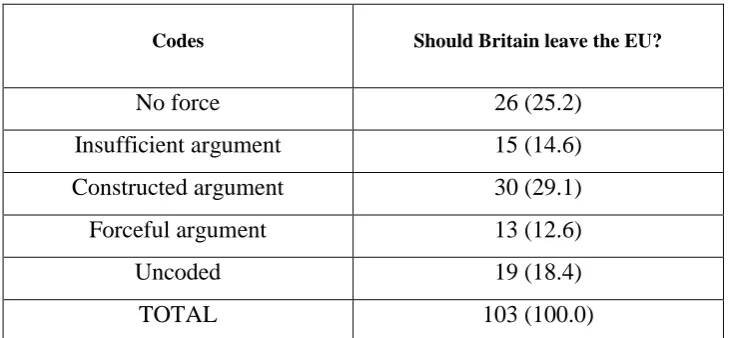
The messages (n=103) were categorised across the full range of levels (Table 2) with constructed argument the modal category. After taking away the uncoded category, the number of constructed and forceful arguments just outweighed the combined total of no force or insufficient arguments. This suggests that the quality of argument was varied but did at times reach an impressive level for this age group.
Codes Should Britain leave the EU?
No force 26 (25.2)
Insufficient argument 15 (14.6)
Constructed argument 30 (29.1)
Forceful argument 13 (12.6)
Uncoded 19 (18.4)
[image:11.595.100.465.561.730.2]TOTAL 103 (100.0)
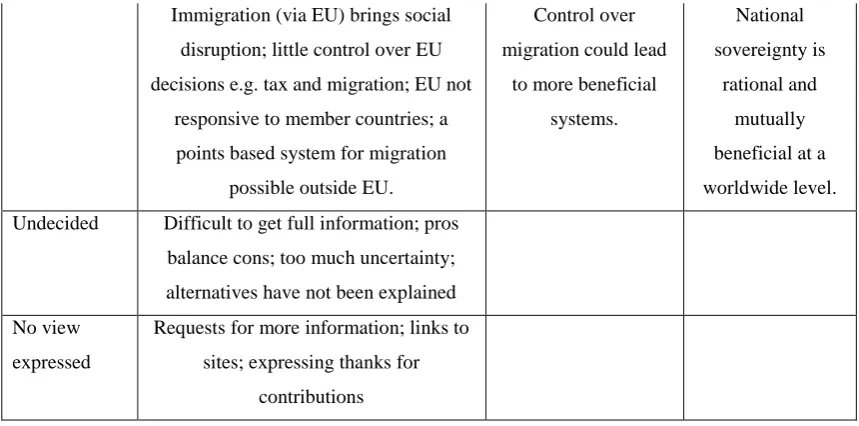
Having constructed the framework for analysis, the nature of the claims put forward about the EU could be unpacked by breaking down the D, W and B that underlay claims. There was agreement by both ‘Remainers’ and ‘Leavers’ that the issues at stake covered the economic, political and social consequences, including migration and security (Table 3).
Claims Data Warrant Backing
UK should stay in the EU (n=42 messages)
Economic
Manufacturing has an EU wide supply chain; trade easier with EU as it is tariff free; data on costs offered by leave side is misleading; migrants don't steal jobs. Alternatives to EU are unsatisfactory: new trade and political relationships are
unlikely / will bring risks / too much is unknown; freer trade with rest of the world is unlikely; freer trade if possible
may result in flooding of cheap goods.
EU provides economic and political security.
Free movement within the EU brings
economic advantages.
Economic prosperity is based
on secure relationships.
Trade is a principle concern in political decision making; free movement balances demand and supply.
Political and social
Political security stronger within EU; EU protects and rebalances resources; third country migration needs to be tackled at an EU level; disruption and
loss to those who have moved to UK from EU and to EU from UK; travel in EU is now straightforward; crises need
to be tackled at EU level.
Disruption is damaging.
EU is an effective political organisation.
Secure political alliances depend
on trade blocks.
Problems are international/ global not
national. UK should
leave the EU (n=42 messages)
Economic
EU is a declining trade block; financial cost of membership is too high;
countries of EU are unevenly developed; trade outside EU is subject
to tariffs; leaving will give more freedom to trade with other countries outside EU; free movement threatens
jobs.
More freedom over trade deals will bring
economic advantages. Countries require bespoke economic policies. Migration controls will result in more jobs for UK people.
A protected labour market has predictable consequences for
employment. Political decisions
at the EU level can interfere with
sound economic policies.
Immigration (via EU) brings social disruption; little control over EU decisions e.g. tax and migration; EU not
responsive to member countries; a points based system for migration
possible outside EU.
Control over migration could lead
to more beneficial systems.
National sovereignty is
rational and mutually beneficial at a worldwide level. Undecided Difficult to get full information; pros
balance cons; too much uncertainty; alternatives have not been explained
No view expressed
Requests for more information; links to sites; expressing thanks for
[image:13.595.83.513.55.268.2]contributions
Table 3: The architecture of the debate.
There was an exact balance between messages supporting Remain and Leave in the discussion though among participants there were slightly more Remainers than Leavers. These data seem to run counter to the general idea that young people were overwhelmingly positive towards the EU (in regards to the UK, see Sloam, 2016).
5. DISCUSSION
The study began by suggesting there was a problem with how we considered online message analysis and by asking whether it was both feasible and useful to adapt a Toulmin framework to assess the quality of an argument. We found that it was.
categorisation will always be influenced by the positionality of those carrying out the analysis and decisions arrived at will be based on best fit. In this respect the concept of inter-rater reliability, with its focus on the search for consistency, comes with positivist associations (Anderson, Guerreiro, & Smith, 2016) which distort the process of reaching agreement. In our study we found a lack of consistency was not only inevitable but also valuable in reaching a critical shared understanding of how the codes should be applied.
Toulmin's interest in content knowledge is then a source of difficulty for the coder but also a source of strength for analysis. Toulmin does not provide a checklist against which claims can be considered true or false, but by adapting his approach we could offer explicit grounds for saying why one argument appeared better than another. Furthermore, while Toulmin is largely used to assess the force of argument at a micro level (the claims put forward in a particular text) we were able to use a Toulmin framework to show the architecture of a debate, i.e. the nature of the particular claims, the types of data considered relevant, and the warrants and backings that were being offered. Our results show that it is possible to make a forceful argument both for leaving and remaining in the EU. Forceful arguments engaged with a broader set of issues (for example, levels of migration from outside the EU in debates about border control) and indicated how interpretations were distorted by experience and position (for example, some participants from EU countries recognised they had a special interest if living in the UK). It is often assumed by those debating EU membership that there must be predictable outcomes from leaving the EU in relation to issues such as migration, economic prosperity and security. Those arguing more forcefully showed it was more complicated than that.
not incompatible but Toulmin leads us to focus more on the former at the expense of the latter. Different categories are needed to go down the responsibilist route and here, as an example, Schwarz and De Groot (2007) argue that developing autonomy, collaboration, commitment to reasoning, ethical communication and procedural mediation are important foci for analysis.
Second, a particular gap in the Toulmin approach is that, unlike the Habermasian perspective with which it shares a broadly pragmatic orientation, it does not engage with a wider sociological tradition (Hammond, 2015). This means Toulmin has little to say about how power is exercised, implicitly or explicitly, within groups or how our reading of a text takes place in a wider context – compare here with externalisation and socialisation as issues in van Eemeren and Houtlosser's (2015) pragma-dialetics.
Third, a shortcoming in Toulmin is that he is focused on content rather than voice and register. In fact, our interest in this debate was triggered by an appreciation that contributions in IGGY lacked the vitriol that seemed ever present in public forums on EU membership at the time. For example, disagreements among these younger participants were often tempered by recognition that others might see the same facts in a different way and disagreement was focused on the argument not on the person. This civility pointed again to the educational purpose of the forum but to understand how and why such civility was maintained we would need, again, to go beyond message analysis and explore intentions of those involved.
Finally, not all educational networks created for young people need have the same commitment to argumentation. They may, for example, seek to support the development of social capital (Tomai et al., 2010), the negotiation of adolescence (Subrahmanyam & Greenfield, 2008), or offer less formal learning in affinity groups (Gee, 2005). Networks which support argument are of special interest due to their avowedly educational nature but we should not see all activity as argument.
6. CONCLUSIONS
broadly pragmatic epistemology; and draw on an established research tradition. A Toulmin framework was then adapted to enable analysis of a discussion on whether should leave the EU. We concluded that this framework was feasible in that researchers were able to reach agreement on coding messages. However, such coding was necessarily challenging as it needed to consider content knowledge - both researcher and participant content knowledge. We further concluded that the framework was particularly useful for providing a focus on content and for allowing judgements on the quality of the debate. We see considerable value in a Toulmin approach though note that any framework needs to be adapted to the particular context of a study. We also argue for a range of approaches to online message analysis to reflect the spread of research questions which researchers ask and note there are other foci for research than the force of argument.
REFERENCES
Anderson, B. (2004). Dimensions of learning and support in an online community. Open Learning: The Journal of Open, Distance and e-Learning, 19(2), 183-190.
Anderson, R. C., Guerreiro, M., & Smith, J. (2016). Are all biases bad? Collaborative grounded theory in developmental evaluation of education policy. Journal of Multidisciplinary Evaluation, 12(27), 44-57.
Austin, R. (2006). The role of ICT in bridge-building and social inclusion: theory, policy and practice issues.
European Journal of Teacher Education, 29(2), 145-161.
Bacha, N. N. (2010). Teaching the academic argument in a university EFL environment. Journal of English for
Academic Purposes, 9(3), 229-241.
Blake, C., & Scanlon, E. (2014) Analysing online discussions in educational and work based settings. In S. Bayne, C. Jones, M. de Laat, T. Ryberg & C. Sinclair (Eds.), Proceedings of the 9th International Conference on
Networked Learning 2014, 7-9 April, Edinburgh UK: University of Edinburgh.
Boshier, R. (1990). Sociopsychological factors in electronic networking. International Journal of Lifelong Education, 9(1), 49-64.
Boutyline, A., & Willer, R. (2017). The social structure of political echo chambers: Variation in ideological homophily in online networks. Political Psychology, 38(3), 551-569.
Bowell, T., & Kingsbury, J. (2013). Virtue and argument: Taking character into account. Informal Logic, 33(1), 22-32.
Cacciamani, S., Perrucci, V., & Khanlari, A. (2018). Conversational functions for knowledge building: a study of an online course at university. Journal of e-Learning and Knowledge Society, 14(1) 98-109.
Charalampidi, M., & Hammond, M. (2016) How do we know what is happening online?: a triangulated approach to data analysis. In Proceedings of the 10th International Conference on e-Learning. Madeira, Portugal, 1-3 July 2016. Retrieved from https://eric.ed.gov/?id=ED571478
Charalampidi, M., Hammond, M., & Boddison, A. (2014) Exploring the use of an international online network for “gifted” students – a research in progress. In Proceedings ofEdulearn14. The 6th International Conference
on Education and New Learning Technologies, Barcelona, Spain, 7-9 July, 2014. Retrieved from
http://library.iated.org/publications/EDULEARN14
Cohen, D. (2017). The virtuous troll: argumentative virtues in the age of (technologically enhanced) argumentative pluralism. Philosophy & Technology, 30(2), 179-189.
Coirier, P., Andriessen, J., & Chanquoy, L. (1999). From planning to translating: The specificity of
argumentative writing. In J. Andriessen, & P. Coirier (Eds.), Foundation of argumentative text processing (pp. 1–28). Amsterdam: Amsterdam University Press.
Del Vicario, M., Vivaldo, G., Bessi, A., Zollo, F., Scala, A., Caldarelli, G., & Quattrociocchi, W. (2016). Echo chambers: Emotional contagion and group polarization on Facebook. Nature, Scientific Reports, 6, 37825.
Duschl, R. A., & Osborne, J. (2002). Supporting and promoting argumentation discourse in science education.
Studies in Science Education, 38(1), 39-72.
Elliott, A. (2014) Contemporary social theory: An introduction (pp. 75-110). London, UK: Routledge.
Erduran, S., Simon, S., & Osborne, J. (2004). TAPping into argumentation: Developments in the application of Toulmin's argument pattern for studying science discourse. Science Education, 88(6), 915-933.
Eve, J., & Brabazon, T. (2008). Learning to leisure? Failure, flame, blame, shame, homophobia and other everyday practices in online education. Journal of Literacy and Technology, 9(1), 36-61.
Garrison, D. R., Anderson, T., & Archer, W. (2001). Critical thinking, cognitive presence, and computer conferencing in distance education. American Journal of Distance Education, 15(1), 7-23.
Garrison, D., Anderson, T., & Archer, W. (2010). The first decade of the community of inquiry framework: A retrospective. The Internet and Higher Education, 13(1), 5-9.
Gee, J. (2005). Semiotic social spaces and affinity spaces. In D. Barton & K. Tusting (Eds.), Beyond
Communities of Practice: Language power and social context (pp. 214-232). Cambridge, UK: Cambridge
Gunawardena, C., Lowe, C., & Anderson, T. (1997). Analysis of a global online debate and the development of an interaction analysis model for examining social construction of knowledge in computer conferencing. Journal
of Educational Computing Research, 17(4), 397-431.
Hammond, M. (2015). A Habermasian perspective on joint meaning making online: What does it offer and what are the difficulties? International Journal of Computer-Supported Collaborative Learning, 10(3), 223-237.
Hammond, M., & Charalampidi, M. (2019). Supplementary File: 'Who believes in evolution?', 'Is giftedness genetic?'. Coventry, UK: University of Warwick. Retrieved from http://wrap.warwick.ac.uk/115827
Henri, F. (1992). Computer conferencing and content analysis. In A. Kaye (Ed.), Collaborative learning through computer conferencing (pp. 117-136). Berlin: Springer.
Henri, F., & Pudelko, B. (2003). Understanding and analysing activity and learning in virtual communities.
Journal of Computer Assisted Learning, 19(4), 474-487.
Jimenez-Aleixandre, M. P., Rodriguez, A. B., & Duschl, R. A. (2000). 'Doing the lesson' or ‘doing science’: Argument in high school genetics. Science Education, 84(6), 757-792.
Ke, F., & Xie, K. (2009). Toward deep learning for adult students in online courses. The Internet and Higher Education, 12(3), 136-145.
Kuhn, D. (1992). Thinking as argument. Harvard Educational Review, 62(2), 155-179.
Kuhn, D., & Pearsall, S. (2000). Developmental origins of scientific thinking. Journal of Cognition and Development, 1(1), 113-129.
Lee, B.-W., Son, J.-W., & Lee, S.-M. (2005). Science-gifted students' scientific inquiry change in online argumentative discussion. Journal of The Korean Association For Science Education, 25(6), 642-649.
Lee, O. (2017). Common core state standards for ELA / literacy and next generation science standards: convergences and discrepancies using argument as an example. Educational Researcher, 46(2), 90-102.
Littleton, K., & Whitelock, D. (2005). The negotiation and co‐ construction of meaning and understanding within a postgraduate online learning community. Learning, Media and Technology, 30(2), 147-164.
McConnell, D. (2000). Implementing computer supported cooperative learning. London, UK: Kogan Page.
Mercer, N. (1995). The Guided construction of knowledge: Talk amongst teachers and learners. Clevedon, UK: Multilingual Matters.
Nussbaum, E. M., & Schraw, G. (2007). Promoting argument-counterargument integration in students' writing.
Nussbaum, E. M., Hartley, K., Sinatra, G. M., Reynolds, R. E., & Bendixen, L. D. (2004). Personality interactions and scaffolding in on-line discussions. Journal of Educational Computing Research, 30(1-2), 113-137.
Oh, S., & Jonassen, D. H. (2007). Scaffolding online argumentation during problem solving. Journal of Computer Assisted Learning, 23(2), 95-110.
Paglieri, F., & Reed, C. (2017). Introduction: Theoretical and technological perspectives on online arguments.
Philosophy & Technology, 30(2), 131-135.
Pezzotti, A., & Gambini, A. (2012). Indicatori di qualità per l’analisi della comunicazione di un corso online. TD
Tecnologie Didattiche, 20(2), 90-98.
Pontecorvo, C. (1987). Discussing and reasoning: The role of argument in knowledge construction. In E. De Corte, H. Lodewıjks, R. Parmentier, & P. Span (Eds.), Learning and instruction: European research in an
international context (pp. 239–250). Oxford, UK: Pergamon Press.
Pontecorvo, C., & Girardet, H. (1993). Arguing and reasoning in understanding historical topics. Cognition and Instruction, 11(3-4), 365-395.
Qin, J., & Karabacak, E. (2010). The analysis of Toulmin elements in Chinese EFL university argumentative writing. System, 38(3), 444-456.
Rheingold, H. (1993). The Virtual community: homesteading on the electronic frontier. Perseus Books, MA: The MIT Press.
Rheingold, H. (2008). Using participatory media and public voice to encourage civic engagement. In W. Bennett (Ed.), Civic life online: Learning how digital media can engage youth (pp. 97-118). Cambridge, MA: The MIT Press.
Salmon, G., Nie, M., & Edirisingha, P. (2010). Developing a five-stage model of learning in Second Life.
Educational Research, 52(2), 169-182.
Scardamalia, M., & Bereiter, C. (2014). Knowledge building: Theory, pedagogy, and technology. In K. Sawyer (Ed.), Cambridge handbook of the learning sciences (pp. 397–417). New York, NY: Cambridge University Press.
Schwarz, B. & De Groot, R. (2007). Argumentation in a changing world. International Journal of Computer-Supported Collaborative Learning,2(2-3), 297-313.
Schwarz, B., Neuman, Y., Gil, J., & Ilya, M. (2003). Construction of collective and individual knowledge in argumentative activity. The Journal of the Learning Sciences, 12(2), 219-256.
Simon, S. (2008). Using Toulmin’s argument pattern in the evaluation of argumentation in school science.
International Journal of Research & Method in Education, 31(3), 277-289.
Sloam, J. (2016). Young voters: most are for remaining in the EU, yet many will not vote. Blog post retrieved from http://blogs.lse.ac.uk/brexit/2016/04/18/the-generation-gap-how-young-voters-view-the-uks-referendum/
Stegmann, K., Weinberger, A., Fischer, F., & Mandl, H. (2004). Scripting argumentation in computer-supported learning environments. In P. Gerjets, P. A. Kirschner, J. Elen & R. Joiner (Eds.), Instructional design for
effective and enjoyable computer-supported learning (pp. 320-330). Tübingen, Germany: Knowledge Media
Research Center.
Subrahmanyam, K., & Greenfield, P. (2008). Online communication and adolescent relationships. The Future of Children, 18(1), 119-146.
Tomai, M., Rosa, V., Mebane, M. E., D'Acunti, A., Benedetti, M., & Francescato, D. (2010). Virtual
communities in schools as tools to promote social capital with high schools students. Computers & Education, 54(1), 265-274.
Toulmin, S. (1958). The Uses of Argument, Cambridge, UK: Cambridge University Press.
Toulmin, S. (1977). From form to function: Philosophy and history of science in the 1950s and now. Daedalus, 106(3), 143-162.
van Eemeren, F., & Houtlosser, P. (2015). The case of Pragma-Dialectics. In F. van Emmeren (Ed.),
Reasonableness and effectiveness in argumentative discourse (pp. 149-179). Cham, Switzerland: Springer.
Walton, D. (2015). Argument evaluation and evidence. Cham, Switzerland: Springer.