1National Physical Laboratory, UK. 2Aalto University, Finland. 3Lancaster University, UK. 4VTT, Finland.
Controlling single
microwave photons
-A new frontier in microwave engineering
Tobias Lindström1, Russell Lake2, Yuri A. Pahskin3 and Antti Manninen4
In microwave engineering we are used to thinking of the electromagnetic
energy in our circuits as transmitted by waves. Now new technologies are being
developed that deal with signals at the level of single photons where this is no
longer valid. Here we describe some of the challenges and opportunities in this
rapidly developing field.
While Maxwell’s equations are valid at all frequencies, in practice, we still think of the electromagnetic spectrum as being “segmented” because of the vastly different tools used to manipulate for example laser light, versus microwaves. In this review we consider microwave “single-photons”, which are single energy quanta of radiation, with 4 to 5 orders of magnitude smaller energy than their optical counterparts: a 1 GHz photon has an energy of 0.66 yoctojoule (0.66 *10-24 J); 1/200 000th of the energy of an optical photon at 1.55 m or, equivalently, about 1/6000th of the thermal energy at room temperature. This explains why until recently single photon sources were only available for optical frequencies. As we discuss below, manipulating the particle nature of microwave signals, is extremely challenging but offers exciting scientific and technological prospects.
Over the past couple of decades, enormous progress has been made in the research field now known as solid-state quantum engineering. The origin of this field can be traced back to the mid-eighties when the scientific community started to wonder if it would be possible to observe exotic quantum effects such as entanglement and superposition in man-made electronic circuits [1]. The invention of quantum computing algorithms, promising to solve hard computational problems, lead to an explosion of experimental activity in the field. However, it wasn’t until the late nineties and the creation of the first solid state quantum bits (qubits) that the field really took off [2]. The past few years have seen the complexity of these quantum circuits go up enormously; and some circuits now contain hundreds of elements [3]; all operated at microwave frequencies, typically in the range 1-12 GHz.
The headline-grabbing long-term goal of all of this effort is to build a quantum computer; a type of a computing device that uses quantum algorithms to solve certain problems, most notably factoring large integers for e.g. code breaking, much faster than a classical computer. However, in the pursuit of this goal researchers have also developed a toolbox containing novel microwave components and devices that might turn out to be useful in a much wider range of applications.
This is a very active research field and there are many ongoing research projects around the world. The authors are involved in one such international project called MICROPHOTON which is funded by Euramet [4]. In this brief review, we will describe some of the latest developments in this rapidly advancing area.
Quantum circuitry
dealing with single photons. This means that a single microwave photon systems can —from an engineer’s point of view— be largely treated as any other microwave circuit and we can use many of the same familiar tools. The systems need detectors, sources, and ways to manipulate and guide the photons.
Looking at a chip containing a quantum circuit it would be difficult to distinguish from a conventional electronic circuit. A typical chip made using e.g. superconducting device technology –one of the leading contenders in this field- contains
50-ohm transmission lines (usually coplanar waveguides, CPW), planar inductors (spirals or meanders) and capacitors (interdigital, planar or parallel-plate type) fabricated on a low-loss substrate (usually sapphire or silicon). Other common elements include resonators, either lumped or transmission line /2 and /4. The key elements of quantum circuits are qubits that are used as ‘artificial atoms’. For superconducting circuitry these are typically based on so-called Josephson junctions; although these are also fabricated using standard
microfabrication techniques and are therefore —from a design point of view— just another type of circuit element. As the complexity of these circuits continues to grow so does the importance of precision microwave engineering.
A cool technology
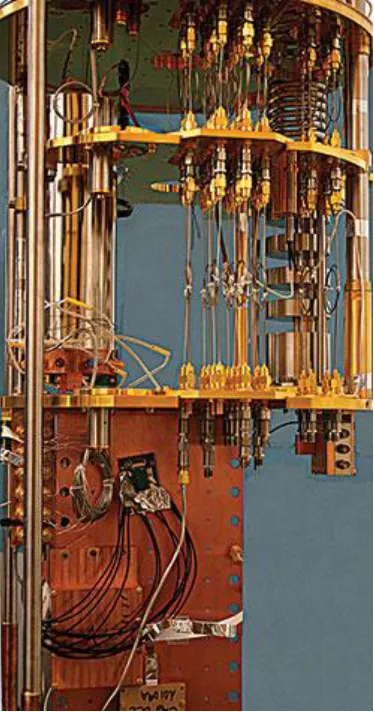
The energy of a single microwave photon is very small compared to the thermal background at room temperature. This dictates that any device we want to use with single microwave photons must be cooled to cryogenic temperatures. In practice, most of the single-photon devices that are currently being developed need to be operated at temperatures below 0.1K. [5-8]. Not long ago this would have meant using cryostats that used liquid helium for cooling which is generally unsuitable for use outside of research labs. However, rapid progress in the field of cryogenics has already seen the development of much more user friendly dry (cryogen free) mechanical systems (see figure 1) that only require a source of electricity to run [9]. Currently available systems are still too bulky and expensive for widespread use but smaller and cheaper systems are under development.
Figure 1 The sample stages of a dilution refrigerator equipped with microwave lines. The different levels get progressively colder. The device under test is mounted at the bottom where T≈10mK.
Detecting single microwave photons
Detecting a single microwave photon is extremely challenging. Several companies now produce low-noise amplifiers (LNAs) with noise temperatures as low as 2.1 K for the c-band (4-8 GHz) [10]. However, even this impressively low figure is still too high to detect a single microwave photon. Moreover, there are intrinsic issues – such as self-heating- with amplifiers based on conventional III-V semiconductors meaning that it is unlikely that they ever will be useful as practical single photon detectors. In order to overcome this problem, new types of advanced instrumentation, parametric amplifiers (paramps) and bifurcation amplifiers, have been developed over the past few years. Parametric amplification is not a new idea, but paramps based on superconducting circuits have literally pushed the technology to its physical limits: several research groups have demonstrated designs that are truly quantum limited; i.e. their noise is only limited by quantum fluctuations [11]. The typical gain of these amplifiers is 20-30 dB which brings the signal up to a level where conventional LNAs can be used for further amplification.
An approach, which has already demonstrated single-photon sensitivity in special circumstances, utilizes phenomena that directly exploit the quantum-particle nature of photons. The photons can be trapped in a resonator —the microwave equivalent of having a photon bouncing between two mirrors— and then detect their presence indirectly using a qubit [5]. This method is extremely sensitive but not very practical and is —— unless additional circuitry is used— inherently slow and inefficient.
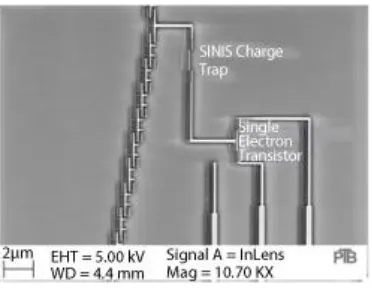
Figure 2 shows an example of a threshold detector that sends out an electrical signal when a single photon with high enough energy is absorbed. The implementation in Figure 2 is a nanofabricated circuit which detects absorbed photons by sensing when electrons are knocked out from a charge trap using a single electron transistor which is essentially a very sensitive electrometer [6]. Absorption events of single microwave photons can be detected clearly, but the quantum efficiency of such a detector is very low: only a tiny fraction of incoming photons are actually absorbed in the detector.
A very sensitive thermal power sensor can also — at least in principle— be used for sensing microwave photons. This would detect a single photon bolometrically or calorimetrically by measuring the increase in temperature as the photon hits a 50-ohm absorber that terminates a waveguide. Recently demonstrated state-of-the-art for this approach is a detector capable of sensing pulses containing about 200 photons at 8.4 GHz[12]. Other
approaches include using so-called bifurcation amplifiers —essentially bistable threshold amplifiers— that can already be made sensitive enough to detect pulses containing a few photons [13]. Unfortunately, both thermal and bifurcation amplifier detectors realized so far have to integrate the signal for a long time to get anywhere near single photon sensitivity meaning this is an area with a lot of scope and potential for improvement.
An efficient single microwave photon detector would be useful not only for fundamental physics experiment or quantum information processing, but also because it would, in principle, allow us to count the number of
incoming photons per second, as long as we know the frequency this then would give us the absolute microwave power without any need for calibration.
Figure 2Scanning electron microscopy of a photon detector based on conversion of a single photon into charge. Incoming photons knock off electrons from the charge trap and these events can then be detected by the single electron transistor. The device is fabricated by MICROPHOTON partner PTB (Germany) [6].
Generating microwave photons
be used to make a true single photon source since the photons are uncorrelated, in a true single photon source the spacing between photons will be very regular which is what gives the radiation its non-classical nature.
So how do you generate a single photon? The solution is once again to use quantum technology originally developed for quantum computing. The quantum bit, or qubit, is the quantum mechanical version of the digital bit, albeit with some very special properties. This can be exploited to make a single-photon source since a qubit switching from its ‘1’ state to ‘0’ will emit a single photon; this is similar to how an atom emits light when an
electron moves from an excited state to a lower energy state. The engineering challenge is to create circuits that can reliably prepare a qubit in its ‘1’ state and also guide the resulting photon. Doing this at optical frequencies is extremely difficult due to the low collection efficiency of emitted photons in three dimensional space. However, in the microwave regime where transmission lines are one dimensional, and circuit elements are “point-like” with respect to the wavelength of the radiation, quantum output efficiencies are already above 50 % in the first candidate devices. Work on devices for single photon generation in the microwave regime was pioneered by research groups at Yale University in the USA and ETH in Switzerland [7,14].
An implementation of the microwave single-photon source is shown in figure 3. This circuit is based on a qubit embedded in a 50-ohm CPW. The trick here is that the qubit is much more strongly coupled to the ‘out’ port than the ‘in’ port. A large amplitude trigger pulse generated by a conventional microwave pulse generator in the ‘in’ port excites the qubit which then a few tens of nanoseconds later decays into the ‘out’ port meaning a photon is emitted. The coupling capacitances are chosen in such a way that the stray coupling between the ports is minimized. Hence, this circuit functions a bit like the quantum equivalent of a monostable multivibrator —a circuit familiar from conventional electronics— in that it is an on-demand source.
There has been remarkable progress in this area over the past few years but making large-scale quantum circuits still presents numerous challenges [15]. Fortunately, whereas you would need hundreds or thousands of qubits to build a practical quantum computer, you only need one to make a source. Hence, practical single microwave photon sources are likely to become available for real-world applications much sooner than quantum computers.
Controlling photons
Emitting and detecting single microwave photons remains challenging and is much more difficult than in the optical regime. However, microwave photons have one very important advantage over optical photons: they are much easier to control.
Figure 3A single photon source based on a superconducting qubit (an “artificial atom”). The qubit is asymmetrically coupled to two 50 Ohm coplanar waveguides via coupling capacitances Cc=0.5 fF and Ce=5 fF. MICROPHOTON partners RHUL and NPL (U.K.) have with Japanese collaborators recently demonstrated on-demand generation of single microwave photons with such a source [16].
Applications
The technology discussed in this article was primarily developed for fundamental research and designed to meet the needs of researchers working in the field of solid-state quantum engineering. Widespread usage of quantum computers is still decades away. An obvious question is therefore whether there are any current real-world applications of single-microwave-photon technology? As with any new technology, it is difficult to predict the impact. The first users will likely be scientists working in e.g. radio astronomy and other areas where the extra overhead in terms of cost and equipment can be tolerated if it leads to significantly higher performance. Technologies such as the paramp —which is essentially just a very good microwave amplifier— are also likely to find applications in demanding areas such as space communications. Another area that will benefit from this technology is precision metrology. The quantum nature of this technology being an advantage since it gives direct connection to the primary standards of the international system of units; this would be especially true if sources and detectors become available with efficiencies high enough to allow for direct microwave photon detection.
Conclusions
Microwave photonics is a new field and contains elements that one would not normally encounter in microwave engineering. However, most of the fundamentals are still the same as for any other microwave circuit; and as the complexity of quantum circuitry continue to grow the importance of good microwave engineering will grow with it.
References
[1] Feynman, R. P. , "Simulating physics with computers."
International journal of theoretical physics 21.6 (1982): 467-488.
[2] Nakamura, Y. , Pashkin, Yu. A. and Tsai. J. S. "Coherent control of macroscopic quantum states in a single-Cooper-pair box." Nature 398.6730 (1999): 786-788.
[3] D-Wave 2000Q Technology Overview Available from http://www.dwavesys.com
[4] Manninen, A. J., et al. "Measurement and control of single-photon microwave radiation on chip." Precision Electromagnetic Measurements (CPEM 2014), 2014 Conference on. IEEE, 2014.
[6] Lotkhov, S.V. et al., “Photon-activated electron hopping in a single-electron trap enhanced by Josephson radiation”, Appl. Phys. Lett. 108, 172603 (2016)
[7] Houck, A. A., et al. "Generating single microwave photons in a circuit." Nature 449.7160 (2007): 328-331.
[8] Inomata, K., et al. "Single microwave-photon detector using an artificial [Lambda]-type three-level system." Nature Communications 7 (2016).
[9] Radebaugh, R., "Cryocoolers: the state of the art and recent developments." Journal of Physics: Condensed Matter 21.16 (2009): 164219.
See also e.g. http://www.oxinst,com or http://www.bluefors.com
[10] See e.g. http://www.lownoisefactory.com/ or http://cosmicmicrowavetechnology.com/
[11] Devoret, M. and Roy. A. ”Introduction to Quantum-limited Parametric Amplification of Quantum Signals with Josephson Circuits”, arXiv:1605.00539 [cond-mat.mes-hall] (2016)
[12] Govenius, J., et al. "Detection of zeptojoule microwave pulses using electrothermal feedback in proximity-induced Josephson junctions." Physical Review Letters 117.3 (2016): 030802.
[13] Vijay, R., Devoret, M. H. and Siddiqi I. "Invited review article: The Josephson bifurcation amplifier." Review of Scientific Instruments 80.11 (2009): 111101.
[14] Bozyigit, D., et al. "Antibunching of microwave-frequency photons observed in correlation measurements using linear detectors." Nature Physics 7.2 (2011): 154-158.
[15] Mohseni, M., et al. "Commercialize quantum technologies in five years." Nature 543.7644 (2017): 171.