A Note on Representations of Linear Inequalities in
Non-Convex Mixed-Integer Quadratic Programs
Adam N. Letchford∗ Daniel J. Grainger†
To appear in Operations Research Letters
Abstract
In the literature on the quadratic 0-1 knapsack problem, several alternative ways have been given to represent the knapsack constraint in the quadratic space. We extend this work by constructing analo-gous representations for arbitrary linear inequalities for arbitrary non-convex mixed-integer quadratic programs with bounded variables.
1
Introduction
It has long been known that one can obtain useful reformulations of N P
-hard optimisation problems by introducing additional variables representing products or squares of original variables. This idea has been applied to, e.g., 0-1 linear programs [18, 22], 0-1 quadratic programs [1, 11, 19], non-convex quadratic programs [7, 23], non-convex quadratically constrained quadratic programs [12, 21], and many other problems.
The presence of additional variables leads to some flexibility in the choice of representing linear constraints. In their paper on semidefinite program-ming relaxations of the 0-1 quadratic knapsack problem (QKP), Helmberg et al.[16] consider three different representations of the knapsack constraint. In his thesis, Helmberg [14], considers also a fourth representation. The pur-pose of this note is to extend this work, by constructing analogous represen-tations for arbitrary linear inequalities for arbitrary mixed-integer quadratic programs (MIQPs). The only restriction is that all variables involved in the inequality must be explicitly bounded.
The paper has a very simple structure. The literature is reviewed in Section 2, and the new results are in Section 3.
∗
Corresponding author. Department of Management Science, Lancaster University, Lancaster LA1 4YW, UK. E-mail: [email protected]
†
2
Literature Review
We now give a brief overview of the relevant literature. We cover general quadratic 0-1 programs in Subsection 2.1, the QKP in Subsection 2.2, and bounded MIQP in Subsection 2.3.
2.1 Quadratic 0-1 programming
A quadratic 0-1 program (0-1 QP) with n variables and m constraints is a problem of the form
maxxTQx: Ax≤b, x∈ {0,1}n ,
where Q = {qij} ∈ Qn×n, A ∈ Qm×n and b ∈ Qm. It is well known that
0-1 QPs are stronglyN P-hard, yet have many important applications (see,
e.g., [4, 10]).
One can convert 0-1 QPs into 0-1 linear programs using a standard
linearisation trick, due to Fortet [11]. We introduce for all 1≤i < j≤nthe
binary variablexij, representing the productxixj. To simplify notation, we
identifyxji withxij. The 0-1 QP is then formulated as:
max P
1≤i≤nqiixi+P1≤i<j≤n(qij+qji)xij
s.t. Ax≤b
xij ≤xi (1≤i≤n, j6=i)
xi+xj ≤xij + 1 (1≤i < j≤n)
xi∈ {0,1}n (1≤i≤n)
xij ∈ {0,1}n (1≤i < j≤n).
Unfortunately, the LP relaxation of this formulation typically gives a very weak upper bound. To strengthen it, one can use various families of cutting planes, such as those presented in [1, 10, 19].
An alternative way to construct a non-trivial relaxation is to use
semidef-inite programming (SDP); see, e.g., [15, 20]. The basic idea is as follows.
Define the matrixX=xxT, along with the augmented matrix
X+ =
1
x
1
x
T
=
1 xT
x X
.
Clearly, X+ will be real, symmetric and positive semidefinite in a feasible
0-1 QP solution. Moreover, for binaryxi we havexi=x2i, meaning that the
main diagonal ofX should be equal to x. This leads to the SDP relaxation
maxQ•X: Ax≤b, diag(X) =x, X+∈ Sn+1+ ,
where ‘•’ denotes inner product and ‘Sn+1+ ’ denotes the cone of psd matrices
Finally, one can instead use Lagrangian relaxations (e.g., Caprara [8]) or convex QP relaxations (e.g., Billionnet et al. [3]). We omit details, for brevity.
2.2 The quadratic knapsack problem
Thequadratic knapsack problem(QKP) is a special kind of 0-1 QP in which there is a single linear constraint with non-negative coefficients. A QKP instance takes the form:
max
xTQx: wTx≤c, x∈ {0,1}n ,
where w ∈ Zn
+ is the vector of item weights and c ∈ Z+ is the knapsack
capacity. We refer the reader to [9, 17] for excellent surveys on the QKP.
Helmberget al.[16] explored three natural SDP relaxations of the QKP.
The simplest, called ‘SQK1’, is:
maxQ•X: wTx≤c, diag(X) =x, X+∈ Sn+1+ .
The second, called ‘SQK2’, is obtained by replacing the knapsack constraint
wTx≤cwith the constraint wTXw≤c2. The third, ‘SQK3’, is obtained by
adding the following valid inequalities toSQK1:
X
i6=j
wixij ≤(c−wj)xj (j= 1, . . . , n).
These latter inequalities can be derived from the original knapsack constraint
by applying the well-knownreformulation-linearization technique (RLT) of
Adams & Sherali [1, 22].
Helmberg et al.prove that SQK3 dominates SQK2, which in turns
domi-nates SQK1. In his thesis [14], Helmberg mentions a fourth SDP relaxation,
which he attributes to Bauvin and Goemans. It is obtained by replacing
the original knapsack constraint with wTXw ≤ c(wTx). We will call this
relaxation ‘SQK2+’. Helmberg shows thatSQK2+is intermediate in strength
betweenSQK2 and SQK3.
A comprehensive computational study of all four SDP relaxations is
given in [17]. It turns out that SQK2+ gives the best compromise between
upper bound strength and computing time, since it typically gives a bound
of similar quality to that ofSQK3, but with much less computing effort, due
to the smaller number of linear constraints.
2.3 Mixed-integer quadratic programs
Now we turn our attention to bounded MIQPs, which include 0-1 QPs as a special case. A bounded MIQP takes the form:
max
xTQx+cTx: Ax≤b, 0≤x≤u, x∈Rn
whereI ⊂ {1, . . . , n} and u∈Qn
+. (Of course, one can assume w.l.o.g. that
ui ∈ Z+ for all i∈ I.) Bounded MIQPs are N P-hard in general, and are
especially challenging when Q is not psd (i.e., when the objective function
is non-convex).
A natural SDP relaxation of the MIQP is:
max
Q•X+cTx: Ax≤b, 0≤x≤u, X+∈ Sn+1+ . (2) Note that this relaxation does not exploit integrality. Moreover, it is
un-bounded in general, since the entriesXiican be increased without limit. To
make it bounded, one can add the upper boundsXii≤u2i. Or, even better,
as pointed out by Anstreicher [2], one can add the constraints
Xii≤uixi (i= 1, . . . , n). (3)
The relaxation can be strengthened further by adding various valid inequal-ities, some of which exploit integrality; see, e.g., [5, 6, 13].
3
Main Results
Consider a non-convex MIQP of the form (1), and let αTx ≤ β be one of
the linear constraints in the systemAx≤b. We define the sets
N ={1, . . . , n}
N+={i∈N : αi>0}
N−={i∈N : αi<0}
and the quantities
U = X i∈N+
αiui, L=
X
i∈N−
αiui.
We assume thatL < β < U, since otherwise the linear constraint would be
implied by the bounds 0≤x≤u.
Now, by definition, if a pair (x, X) represents a feasible MIQP solution,
we must haveL≤αTx≤β and
(αTx)2 = (αTx)(xTα) =αT(xxT)α=αTXα.
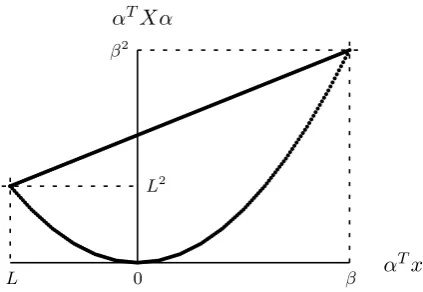
Thus, if we project the set of feasible MIQP solutions in (x, X)-space onto a
2-dimensional subspace havingαTxandαTXαas axes, it must be contained
inside the convex region represented in Figure 1. One can check that this region is defined by the convex quadratic inequality
αTXα≥(αTx)2 (4)
and the linear inequality
αTXα≤(β+L)αTx−βL. (5)
αTXα
αTx
L 0 β
β2
L2 qqqqqqqqqqqqqqqqqqqqqqqqqqqqqqqq
qqqqqqqqqqqqqqqqqqqqqqqqqqqqqqqq
qqqqqqqqqqqqqqqqqqqqqqqqqqqqqqqq
qqqqqqqqqqqqqqqqqqqqqqqqqqqqqqqq
qqqqqqqqqqqqqqqqqqqqqqqqqqqqqqqq q
qqqqqqqqqqqqqqqqqqqqqqqqqqqqqqqqqqqq qqqqqqqqqqqqqqq
qqqqqqqqqqqq qqqqqqqqqq
qqqqqqqqq qqqqqqqq
qqqqqqqq qq
[image:5.595.207.419.123.269.2]qqqqqqqqqq qqqqqqqqqq qqqqqqqqqq qqqqqqqqqq qqqqqqqqqq qqqqqqqqqq
Figure 1: Projection of feasible region onto two-dimensional subspace.
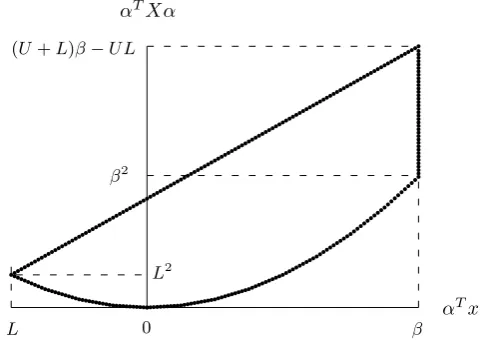
Theorem 1 Consider the SDP relaxation of the MIQP obtained by adding the constraints (3) to (2). This relaxation satisfies (4). It does not in general satisfy (5), but it does satisfy the weaker inequality
αTXα≤(U+L)αTx−U L (6)
(see Figure 2).
Proof. From the well-known concept of Schur complement,X+∈ Sn+1+ if
and only if X−xxT ∈ S+
n. This implies that αT(X−xxT)α≥0, i.e., that
the SDP relaxation satisfies (4).
We now define vectors xL, xU ∈Qn
+, as follows. We letxLi =ui for all
i ∈ N− and xLi = 0 for all i ∈ N \N−. Similarly, we let xUi = ui for all
i∈ N+ and xUi = 0 for all i∈ N \N+. We also define the corresponding
matrices XL = xL(xL)T and XU = xU(xU)T. (Note that αTxL = L and
αTxU =U > β. As a result, the pair (xL, XL) is feasible for the relaxation,
but the pair (xU, XU) is not.) Now, consider the convex combination
(˜x,X˜) = U−β
U −L(x
L, XL) + β−L
U −L(x
U, XU).
One can check thatαTx˜=β and αTXα˜ =βL+U(β−L). Thus, (˜x,X˜) is
feasible for the relaxation, but violates the inequality (5).
All that remains is to show that the relaxation satisfies (6). We will do
this in three steps. First, for any{i, j} ⊂N, consider the following principle
submatrix ofX+:
Xii Xij
Xij Xjj
Since this submatrix must be psd, it follows that the relaxation satisfies
uj −ui
Xii Xij
Xij Xjj
uj −ui
or, equivalently, 2uiujXij ≤uj2Xii+u2iXjj. Together with (3), this implies
2uiujXij ≤uiuj2xi+u2iujxj, or, equivalently,
2Xij ≤ujxi+uixj. (7)
Second, consider the following principle submatrix:
1 xi xj
xi Xii Xij
xj Xij Xjj
We have
−uiuj uj ui
1 xi xj
xi Xii Xij
xj Xij Xjj
−uiuj
uj
ui
≥0,
or, equivalently,
2uiujXij ≥2uiu2jxi+ 2u2iujxj −u2jXii−u2iXjj−(uiuj)2.
Together with (3), this implies:
2uiujXij ≥uiu2jxi+u2iujxj−(uiuj)2,
or, equivalently,
2Xij ≥ujxi+uixj−uiuj. (8)
Finally, the inequalities (7) imply
αiαjXij ≤αiαj(ujxi+uixj)/2 (9)
whenαiαj >0, and the inequalities (8) imply
αiαjXij ≤αiαj(ujxi+uixj)/2−(αiui)(αjuj) (10)
when αiαj < 0. Summing the inequalities (9) for all (not necessarily
dis-tinct) pairs i, j with αiαj > 0, together with the inequalities (10) for all
pairs{i, j}with αiαj <0, yields (6).
We are now in a position to define our analogues of SQK1,SQK2, SQK2+
andSKQ3 for bounded MIQPs. The analogue ofSQK1 is obtained simply by
taking the SDP (2) and adding the constraints (3). The analogue of SQK2
is obtained from SQK1 by taking each constraint αTx ≤ β in the system
Ax≤b and replacing it with the constraintαTXα≤β2. This relaxation
is however valid only if (i)b >0 and (ii) all feasible MIQP solutions satisfy
Ax≥ −b.
The analogue of SQK2+ is obtained by replacing each constraint
αTx≤β with the stronger constraint (5). As for the analogue ofSQK3, this
is obtained by replacing each constraint αTx ≤ β with the 2n constraints
αTXα
αTx
L 0 β
L2
β2
(U+L)β−U L
qqq qqq qqq q
qqq qqq qqq q
qqq qqq qqq
q qqqqqqqqqqqqqqqqqqqqqqqqqqqqqqqqqqqqqqqqqqqqqqqqqqqqqq qqqqqqqqqqqqq
qqqqqqqqqqq qqqqqqqqqq
qqqqqqqqq qqqq qqqq qqqq qqqq qqqq qqqq qqqq qqq
qqqqqqqqqqqqqq qqqqqqqqqqqqqq
qqqqqqqqqqqqqq qqqqqqqqqqqqqq
qqqqqqqqqqqqqq qqqqqqqqqqqqqq
qqqqqqqqqqqqqq qqqqqqqqqqqqqq
[image:7.595.181.424.121.293.2]qqqqqqqqq
Figure 2: Projection of SDP relaxation onto same subspace.
Proposition 1 Let αTx≤β be one of the constraints in the system Ax≤
b. The following 2n linear inequalities are valid for all pairs (x, X) that represent feasible MIQP solutions:
P
j∈NαjXij ≤ βxi (i∈N) (11)
uiαTx−Pj∈NαjXij ≤ β(ui−xi) (i∈N). (12)
Collectively, they dominate the inequality (5).
Proof. Given that αTx ≤β and x ≥0, we have the quadratic inequality
(β −αTx)xi ≥ 0 for all i ∈ N, which implies (11). Similarly, given that
x≤u, we have the quadratic inequality (β−αTx)(ui−xi)≥0 for alli∈N,
which implies (12).
Now, if we take the inequality (11) for somei∈N+ and multiply it by
αi, we obtain
αi
X
j∈N
αjXij ≤ β αixi. (13)
On the other hand, if we take the inequality (12) for some i ∈ N− and
multiply it byαi, we obtain
αi
X
j∈N
αjXij ≤ βαixi+ (αiui)αTx−β(αiui). (14)
Summing up (13) over alli∈N+ and (14) over all i∈N−, we obtain (5).
Note that the proof of Proposition 1 actually implies that it suffices to
We end the paper with a final remark. The linear inequality (5) remains
valid if we replaceLwith:
min
αTx: Ax≤b,0≤x≤u, xi∈Z(i∈I) ,
or indeed any lower bound on the value taken by αTx in a feasible
solu-tion. In this way, one can strengthen our analogue ofSQK2+. It is not clear
whether one could strengthen our analogue of SQK3 using a similar
argu-ment, since the coefficient L does not appear explicitly in the constraints
(11) and (12).
Acknowledgement: The research of the first author was partially sup-ported by the Engineering and Physical Sciences Research Council under grant EP/D072662/1.
References
[1] W.P. Adams & H.D. Sherali (1986) A tight linearization and an
algo-rithm for zero-one quadratic programming problems. Mgmt. Sci., 32,
1274–1290.
[2] K. Anstreicher (2009) Semidefinite programming versus the
reformulation-linearization technique for nonconvex quadratically
constrained quadratic programming. J. Glob. Optim., 43, 471–484.
[3] A. Billionnet, S. Elloumi & M.-C. Plateau (2009) Improving the perfor-mance of standard solvers for quadratic 0-1 programs by a tight convex
reformulation: the QCR method. Discr. Appl. Math., 157, 1185–1197.
[4] E. Boros & P. Hammer (2002) Pseudo-boolean optimization. Discr.
Appl. Math., 123, 155–225.
[5] S. Burer & A.N. Letchford (2014) Unbounded convex sets for
non-convex mixed-integer quadratic programming. Math. Program., 143,
231–256.
[6] S. Burer & A. Saxena (2011) The MILP road to MIQCP. In J. Lee &
S. Leyffer (eds.) Mixed Integer Nonlinear Programming, pp. 373–406.
New York: Springer US.
[7] S. Burer & D. Vandenbussche (2008) A finite branch-and-bound al-gorithm for nonconvex quadratic programming via semidefinite
relax-ations. Math. Program., 113, 259–282.
[8] A. Caprara (2008) Constrained 0–1 quadratic programming: basic
[9] A. Caprara, D. Pisinger & P. Toth (1999) Exact solution of the
quadratic knapsack problem.INFORMS J. Comput. 11, 125–137.
[10] M.M. Deza & M. Laurent (1997)Geometry of Cuts and Metrics. Berlin:
Springer-Verlag.
[11] R. Fortet (1959) L’Alg`ebre de Boole et ses applications en recherche
op´erationnelle.Cahiers Centre Etudes Rech. Oper., 1, 5–36.
[12] T. Fujie & M. Kojima (1997) Semidefinite programming relaxation for
nonconvex quadratic programs. J. Glob. Optim., 10, 367–380.
[13] L. Galli, K. Kaparis & A.N. Letchford (2011) Gap inequalities for
non-convex mixed-integer quadratic programs. Oper. Res. Lett., 39, 297–
300.
[14] C. Helmberg (2000)Semidefinite Programming for Combinatorial
Op-timization. Habilitationsschrift, Technical University of Berlin.
[15] C. Helmberg & F. Rendl (1998) Solving quadratic (0,1)-programs by
semidefinite programs and cutting planes.Math. Program., 82, 291–315.
[16] C. Helmberg, F. Rendl & R. Weismental (2000) A semidefinite
pro-gramming approach to the quadratic knapsack problem. J. Combin.
Optim., 4, 197–215.
[17] H. Kellerer, U. Pferschy & D. Pisinger (2004) Knapsack Problems.
Berlin: Springer-Verlag.
[18] L. Lov´asz & A.J. Schrijver (1991) Cones of matrices and set-functions
and 0-1 optimization.SIAM J. Optim., 1, 166–190.
[19] M.W. Padberg (1989) The Boolean quadric polytope: some
character-istics, facets and relatives. Math. Program., 45, 139–172.
[20] S. Poljak, F. Rendl & H. Wolkowicz (1995) A recipe for semidefinite
relaxation for (0,1)-quadratic programming.J. Glob. Optim., 7, 51–73.
[21] M. Ramana (1993) An Algorithmic Analysis of Multiquadratic and
Semidefinite Programming Problems. PhD Thesis, Johns Hopkins Uni-versity, Baltimore, MD.
[22] H.D. Sherali & W.P. Adams (1990) A hierarchy of relaxations between the continuous and convex hull representations for zero-one
program-ming problems. SIAM J. Discr. Math., 3, 411–430.
[23] H.D. Sherali & C.H. Tuncbilek (1995) A reformulation-convexification
approach for solving nonconvex quadratic programming problems. J.