© 2019, IRJET | Impact Factor value: 7.211 | ISO 9001:2008 Certified Journal
| Page 1316
Tool Design for Injection Moulding With Basic Parameters
Kavin Kumar S
1, Ravi kumar M
21
Student, Mechanical Engineering, BIT, Sathyamangalam, Tamil Nadu
2
Professor and Head, Mechanical Engineering, BIT, Sathyamangalam, Tamil Nadu
---***---Abstract -Injection molding is one of the most versatile and important manufacturing processes, capable of mass-producing complicated plastic parts in a variety of complex shapes with high dimensional precision. It is a major processing technique for converting thermoplastic and thermosetting materials with the aid of heat and pressure into complicated parts, consuming worldwide approximately 32% of all plastics. Tool design will be on basic parameters of machine. Generally, Mould/die are made up of En31, p20 steel, Aluminium
Key Words: Mass Production, Variety of Complex Shapes, Precision, Complicated Parts, Basic Parameter.
1. INTRODUCTION
Injection machine is used for manufacturing plastic product such as; bottle caps, comb, mug, etc. It is essential to make Mould/die for moulding the component. Using machine details. Consider the design and collect the machine details, there are two types of feeding, horizontal feeding and vertical feeding it will be selected based on production. In spite of the relatively expensive tooling cost, injection molding remains the most popular manufacturing process for plastic materials in mass production, thanks to its low operational cost, high throughput, and the flexibility to make parts with complex shapes.
1.1 BASIC PARAMETER
Basic parameter to be considered for making Mould/die is,
a. Product design b. Machine parameter c. Software model
d. Mould/die material selection
a. Product design
Refer the product 2d design very clearly note down the values
b. Machine parameter
There are some machine parameters such as,
1. Shot capacity-it refers to weight of the component can take from the single shot
2. Clamping force-the force used for closing Mould/die
3. Mould size-it refers to size, where the Mould/die fits for moulding
4. Mould opening-it refers to how the Mould/die clamp can open
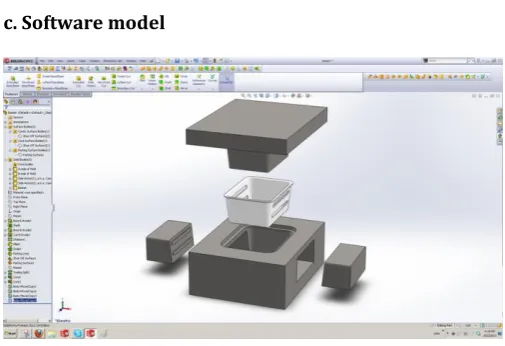
c. Software model
Fig 1: Mould/die model
This describes the example for the cad design for a Mould/die
d. Mould/die material selection
Based on usage of Mould/die the material will be selected En 31, p20 steel, aluminium, etc.
En 31-using of this metal no need of heat treatment is no needed foe small Mould/die P20 steel-hardness, good polishing ability. good corrosion resistance. good wear and wear resistance, good thermal stability.
Aluminium- it has 5x better heat transfer rate. Heat treatment process for aluminium much better than steel.
2. MODELLING PRINCIPLES
OPTIMIZATION-The search is for the best compromise between the conflicting criteria.
SIMPLIFICATION-In order to model a situation, it is first necessary to make some simplifying assumptions.
SCALING-full scale models are rarely possible and reduced size testing must be carried out carefully.
[image:1.595.314.567.279.452.2]© 2019, IRJET | Impact Factor value: 7.211 | ISO 9001:2008 Certified Journal
| Page 1317
Synthesis-A solution is often arrived at by a combination of techniques and elements.
Iteration-At all stages the models will need to be used iteratively as knowledge of the important factors grows.
3. Moulding parts
Molding parts refer to those in direct contact with plastics to form the shape of plastic parts, where in those constituting the contour of the plastics parts are called cavities and those constituting the internal shape of the plastic parts are called cores. Since the cavity and core directly contact the plastics of high temperature and pressure and rub with the plastic parts when protruding, it is thus required that they are provided with sufficient intensity, rigidity, hardness, abrasion resistance, corrosion resistance as well as low enough surface roughness.
3.1Structural Design
3.1.1 Cavity Structural Design
1) Integral Cavity
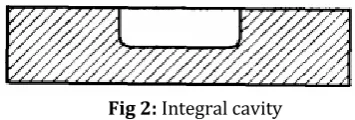
Directly cut cavity in the die set plate as indicated in Fig. 2. The advantage thereof is that the processing cost is relatively low. Yet the molding board material for making the die set is usually common medium carbon steel which is short in-service life if used as cavity parts, whereas selecting materials with high performance shall result in high production cost.
Usually, for the mold and precision of plastic parts which are less than 10000 times of molding, relatively low requirements are made; therefore, for molds of simple shape, integral structure can be adopted Usually, for the mold and precision of plastic parts which are less than 10000 times of molding, relatively low requirements are made; therefore, for molds of simple shape, integral structure can be adopted
Fig 2: Integral cavity 2) Integral Embedded Cavity
Use high quality materials (high-carbon steel or alloy tool steel) which are slightly larger than the external shape of the plastic parts (wall thickness of sufficient intensity must be ensured) to make the cavity parts and embed them into the molding plate thereafter, as indicated in Fig. 3. The advantage is that the service life of the cavity parts can be ensured and meanwhile the material cost is reduced. Furthermore, it is easy and convenient to repair and replace the cavity parts if they are damaged.
Fig 3: integral embedded cavity 3) Insertion and Splice Cavity
For cavities which are of complicated shapes or are damageable in certain parts, design the parts hard to be processed or easily damaged into insert form and embed them into the basal body of the cavity, as indicated in fig 4.
Fig 4: local insertion and splice cavity
For large and complicated cavity mold, the four walls of the cavity can be separately processed and inlaid into the mold sleeve and finally fitted with the soleplate, as indicated in Fig.5
[image:2.595.300.560.53.301.2] [image:2.595.318.546.393.551.2] [image:2.595.60.238.563.623.2]© 2019, IRJET | Impact Factor value: 7.211 | ISO 9001:2008 Certified Journal
| Page 1318
4) Threaded Ring Cavity
Threaded ring cavity is a kind of active insert used to mold the outer thread of the plastic parts, which shall be protruded together with the parts after molding and dismounted outside the mold. Fig.6 shows an integral threaded ring cavity whose length of fit is 5mm~8mm. To make it easy for assembly, the remaining parts are made into 3°~ 5° obliquity, and a four-sided plane is modified at the lower extreme so that it will be convenient to screw it from the plastic parts with tools
Fig 6: threaded ring cavity
3.1.2 Core Structural Design
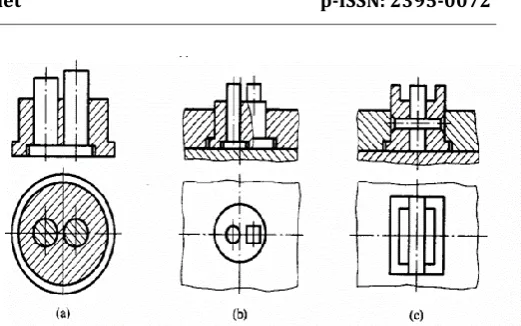
Integral punch costs too many materials and the working load for cutting and processing amounts too high. Therefore, hardly any such structure exists in modern mold structures which is instead preoccupied with integral embedded punch and inlaying modular punch, as indicated in Fig.7 and 8
Fig 7: Core structure
Fig 8: inlaying modular core
4. Side Core-pulling Mechanism
The flanks of plastic parts are usually provided with holes or flutes, as indicated in Fig.2-9. Under such cases, side-direction forming cores must be employed to form plastic parts. However, such forming cores must be fabricated into active parts so that they can be pulled out prior to the stripping of plastic parts. The mechanism for pulling out and restoring such active forming cores is called core-pulling mechanism.
Fig 9: plastic parts with side holes and side flutes
5. Classification of Core-pulling Mechanism
Core-pulling mechanism usually comprises the following types:
1. Manual Pulling
[image:3.595.313.574.71.234.2]Manual pulling refers to the pulling of side-direction cores with hand or hand tools. Such mechanism is simple in structure yet low in productivity and large in labor intensity. See Fig 9
[image:3.595.50.265.239.384.2] [image:3.595.358.557.397.470.2] [image:3.595.37.279.521.675.2] [image:3.595.321.565.647.730.2]© 2019, IRJET | Impact Factor value: 7.211 | ISO 9001:2008 Certified Journal
| Page 1319
2. Hydraulic or Pneumatic Core-pulling
[image:4.595.368.546.105.205.2]Use pressure oil or compressed air as power, equipped the molds with special hydraulic or pneumatic tank, and achieve core-pulling through the to-and-fro movements of piston. The pulling force under such structure is large yet the cost is relatively higher. See Fig.11, 12 and 13
Fig 11: hydraulic (pneumatic) side core-pulling mechanism for fixed half mold
[image:4.595.70.247.193.293.2]Fig 12: hydraulic (pneumatic) side core-pulling mechanism for moving half mold
Fig 13: hydraulic long-core-pulling mechanism 1- fixed plate; 2- long core; 3- moving plate
3. Side Core-pulling Mechanism Driven by Spring
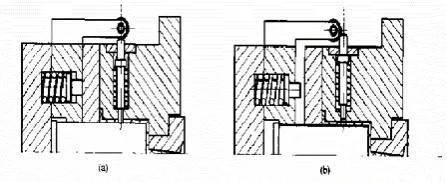
[image:4.595.374.536.256.356.2]When the side concave of plastic parts is shallow and requires relatively smaller pulling force, spring or ebonite can be used to achieve core-pulling. See Fig 14, 15 and 16.
[image:4.595.61.254.340.445.2]Fig 14: ebonite core-pulling (a) close mold; (b) open mold core-pulling
Fig 15: spring core-pulling (a) close mold; (b) open mold core-pulling
Fig 16: spring core-pulling fixed mold (a) close mold; (b) open mold core-pulling
6. Simple Ejector Unit
Apply an ejection force in a side direction to one side of the moving mold and the stripping of the plastic parts can be achieved. Such mechanism is called the simple ejector unit, which usually includes mandrils ejector unit, sleeve ejector unit, plate ejector unit and block ejector unit etc,.
1) Ejector Pin Unit
[image:4.595.353.577.405.496.2] [image:4.595.54.266.488.611.2]© 2019, IRJET | Impact Factor value: 7.211 | ISO 9001:2008 Certified Journal
| Page 1320
[image:5.595.93.262.160.304.2]forming a fitting of H8/f8 with the mandril hole. Mandrils are standard parts for molds and those of various diameters, lengths and sectional forms can be found in many cities’ marketplace for standard parts of molds.
[image:5.595.91.260.165.442.2]Fig 17: Ejector pin unit
Fig 18: commonly-used ejector pin forms Return by spring mechanism
Fig 19: return by spring
2) Sleeve Ejector Unit
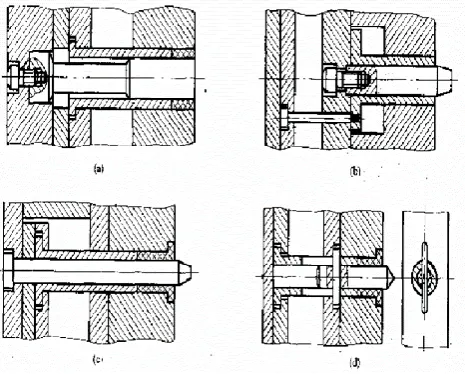
The device is suitable for cylindrical or partially cylindrical plastic parts with thin walls as indicated in Fig 20. The movement of its ejection is similar to the ejection of plastic parts by mandrils, except that a fixed core is provided at the center of the sleeve. Therefore, it is required that the retaining form of the sleeve must adapt to the retaining method of the core.
To shorten the length of fit between the sleeve and the core so as to reduce friction, diameter of the latter half of the
sleeve fitting hole can be diminished. To protect cavity and core from being scratched on the surface, outer diameter of the sleeve should be smaller than that of the plastic parts, whereas the inner diameter should be slightly larger than that of the corresponding hole in the plastic parts, as indicated in Fig 21, wherein H is the ejecting distance.
[image:5.595.322.555.218.405.2]The sleeve and core are usually fitted as per H7/e7, and H7/f7 is usually adopted for the sleeve and mold plate.
Fig 20: sleeve ejector unit
Fig 21: shape of sleeve
3)Ejector Plate Unit
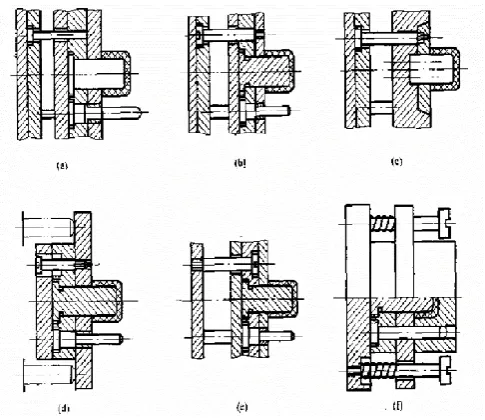
The ejector plate unit as indicated in Fig 22, an ejector plate is assembled at the root of the protruding mold, forming close assortment therewith. When protruding, the ejector plate moves along the margin of the protruding mold and ejects plastic parts away from the mold. The mechanism is mainly applied to the ejection of large cylindrical plastic parts, containers with thin walls as well as shell plastic parts of various liners. Plate ejection is endowed with such features as balanced ejection, strong force, calm movement, simple structure, no distortion on the plastic parts, and no mark is left. Above all, it is unnecessary to attach a return pin.
[image:5.595.82.271.503.597.2]© 2019, IRJET | Impact Factor value: 7.211 | ISO 9001:2008 Certified Journal
| Page 1321
the forming part of the mold. Furthermore, the fitting surface of the protruding mold and the ejector plate should be made into conical surface to prevent flash caused by the deviation of ejector plate. The pitch on a single side should be preferably around 10°.
As indicated in Fig 22 are various forms of plate ejector unit.
As indicated in Fig 22 (b) and (c), the ejector plate is drawn by the pitch bolt to avoid falling off. The form as indicated in Fig 22 (e) is applied to large-sized container-like plastic parts with deep cavity. An air-inlet unit is added on the core to avoid vacuum forming between the plastic parts and core during ejection, which can baffle the ejection of plastic parts.
Fig 22: various forms of ejector plate unit
7. Conclusion
Thus, the design of mould/die for injection moulding has been described. Structural design has been listed in the paper. This type of structural design is used now a days. This type of design will be implemented in further researches.
8. REFERENCES:
[1]. Engineering design principles, ken Hurst, Elsevier Ltd, ISBN: 978-93-80501-35-2.
[image:6.595.39.282.295.505.2]