82"
71
r
'
IIFS
'
'
H
October,
1
Flow Chart'Via Computer:
Helping
the User Understand
his
Problem
SENTC
•
...
-DC ..
.. Al·
••
•
X A 1 ..
iI-•
•
•
01 A2 • 26
•
•
•
OUTPUT•
•
•
A3 • 27
•
•
NC
•
•
.
...
I I
.. A4 .. I I
•
•••
SOPHDAB ;
A4 • I 28
.
"
~C 'FILE SERIAL"
-A5 • 29
•
•
YES
-
-"
FILE TYPE • . . . x· EXIT 3 USED * .•••••.• x. LABEL CHECK • •••••••• X" TO EOUAL -TAPE SERIAL."
.
• ...•...• x. CH.lRACTER CHECK
-
,
"
"
"
•
•
•
.INPUT
•
•
•
"
"
"
-
"
• YES
•
•
•
•
.YES•
"
.x •••••..••••••.•••.•.•.•••••.••••.••••••••.•.•••.•
ENTCR X 02
NO
.····81···
.SREADRU DGel..-~-*-.-*-*-*-.-.
..
. ~• READ LABEL •
•
•
•••••••••••••••••
X
CI • • 03
·
-•
•
..
-
LABEL CHECK-••
•
~.•
•
SCNTD•
•
•
•
-•
• YES01 • • O~
•
•
'IDENTIFIERS' YES
YES
....
x
•••••
*08 • ..
.
C4*-•
-C2 - 06
• DO • · 'SPECIFIED •
FIELDS • MATCH •
• LABEL •
•
•
•
X
TO SENTD .INPT
•
1)2 • 05
•
•
•
-~C
•...
X 07
···03···
'MOVE 1-0 IDENT •
• MATCH (IHDRI • ...•.. x. FILE TYPE
•
• "30122 FIL ' AND TO' • 'SNOTE MSG AREA •NHL
•
•
•
•
•
•
-
.NOX 23
···EI···
-MOVE 10 IDENT
-.. AND ..
.'30133 NIH' TO.
.SNOTE MSG AREA •
•
•
••
•••••••••••••••
X
F 1 . . . . 24
•
•
•
FILE TYPE•
..
•
•
-
-
•
•
-•
..
.
•
•
•
.CUPT
-SOPHD X 14
NO
···E2···
SET WORD MARKS-"IN LABEL AREA • •
• ADD RETENTION
-• CYCLE TO • • CREATION DATE.
•
••••••••••••••••·
X
F2 . . . IS
•
•
•
•
...
SUMG 166
•
•
I ••
-
•
•
•
•
...
·
X 08
···E3···
-SNOTE DHA2'*-*-*-*-*-*-*-*-* I TYPE MESSAGE
-.ON THE CONSOLE I
- PRINTER •
•••••••••••••••••
X 09
• ·.··F3···
• MOVE • • LABEL AREA •
- FIELDS TO • .SNOTE MSG AREA •
•
•
•••••••••••••••••
I
•
I
.NO
·
X 41
···c.···
I MOVE USERS -IEXIT 3 ADDRESS' - TO SSWBX EXIT I
~ (BLOCK DC421 I
•
•
•••••••••••••••••
·
~ 42···04.····
•• ···
ISSWBX
DFBS-*-.-.-.-.-.-.-.-.
- SET IWIS FOR ~
• ~SER. SBR INTO • I RE-ENTRY EXIT.
•••••••••••••••••
·
X 43
··.··E4···.··
I I*-.-.-*-*-.-.-.-.
.SBR IN RE-ENTRY-• EXIT, RESET I
• XIS FOR USER •
•
••••••••••••••••
x ••
• • • • • F4·4 • • • • • • • •
.SRE~~T DFGS.
. -*-*-.-.-.-.-.-.
-RES' "~E ~ IS FORI
"IO:~. RETURN AS-• SET B~ DC42 I
•
••••••••••••••••
•
I-
-
.ND-·
-•
X 30
···ss···
·
• MAKE INTERNAL -- FILE SERI.lL
=
-I TAPE SERIAL II •
•••••••••••••••••
X 31
····.es···
• ~OVE I
• I lODAY'S DATE I
• •• X. TO INTERNAL •• • CREATION DATE • - DATE I
•••••••••••••••••
·
X 32 •• ••• os •••• • •••• • - BLANK OUT I• FIRST 40
-• POSITIONS IN -• LABEL AREA •
-
-•
••••••••••••••••
·
x 33
···ES·· •• ••• •• •
• MOVE
-'I~TERNAL FIELDS-.INTO 10CS
LABEL-I AREA
-·
•
••••••••••••••••
-·
X 3..····F5···
• MOVE USER'S --EXIT. ADDRESS • • TO SS.BX E~ll • • (BLOCK DC36)
-• EXIT
Orders filled in 36 hours, instead of 14 days.
Paper-work time and expense reduced by two-thirds.
That's how
Bell System DATA-PHONE service has helped Whirlpool Corporation speed
parts order processing-from receipt to ship-out. Used with data equipment,
DATA-PHONE service enables Whirlpool to receive card-punched data sent
over regular telephone lines to its La Porte, Indiana, service center from
120 supply points across the country.
'"
At left, above, orders from Whirlpool distribution outlets are received by phone via
DATA-PHONE '"-'J
service, then punched on cards for fast checking, clearing and processing for shipment.
Are you transmitting your business data as quickly and profitably as you
might be? Talk with one of our Communications Consultants and find out.
Just ask your Bell Telephone Business Office to have him contact you.
Bell Telephone System
The front cover ShOll'S a /low chart produced by an IBM computer programmed
to control a high-speed printer. :.:::·:::i!!1t:·,,·
..
":';~~~';~;:;:' ... :.:~.~:'~ ::~,.::,~ :",... :.: ....
•••• • • tc. .... • • ..:"!.: .'~:. :.
:,,:
...
:
~:~~~;~;~~~~ll
t··~:~~~!l~~~;}··l
©CQJomCQ)(10f0~[f=J~
~O-u~ m(U]\1~(Q)U--Lrua\~~D@o-u
OCTOBER, 1963 Vol. X II, No.10
editor and publisher
EDMUND C. BERKELEY
assistant editors
MOSES M. BERLIN NEIL D. MACDONALD LINDA lADD LOVETT
contributing editors
ANDREW D. BOOTH NED CHAPIN JOHN W. CARR, III ALSTON S. HOUSEHOLDER PETER KUGEL
advisory committee
T. E. CHEATHAM, JR. GEORGE E. FORSYTHE RICHARD W. HAMMING ALSTON S. HOUSEHOLDER HERBERT F. MITCHELL, JR.
associate publisher
PATRICK J. MCGOVERN
production manager
ANN B. BAKER
art director
N. DORF
circulation manager
VIRGINIA A. NELSON, 815 Washington St. Uewtonville, Mass. 02160, DEcatur 2-5453
advertising representatives
New York 18, BERNARD LANE 37 West 39 St., BRyant 9-7281 Chicago 11, COLE, MASON AND DEMING 737 N. Michigan Ave., SU 7-6558 Los Angeles 5, WENTWORTH F. GREEN 300 S. Kenmore Ave., DUnkirk 7-8135 San Francisco 5, A. S. BABCOCK 605 Market St., YUkon 2-3954 Elsewhere, THE PUBLISHER 815 Washington St., DEcatur 2-5453 Newtonville, Mass. 02160
computers and data processors: the design, applications, and implications
0/
in/ormation pf-ocessing systems.
In This Issue
10 HYBRID COMPUTATION: WHAT AND WHY?
by Alan E. Rogers
18 THE DEVElOPMENT OF THE COMPUTER MARKET IN EUROPE (Part 2 Conclusion)
by W. i< dp. Bruijn, A. B. Frelink, and B. Scheepmaker
27 A SURVEY OF NEW WEST·EUROPEAN DIGITAL COMPUTERS (PART 2)
by Joseph L. F. De Kerf
30 THE CONTROL DATA 6600 COMPUTER - A BIG MOVE TOWARD COMPUTING CONCURRENCY
by Patrick J. McGovern, Jr.
In Every Issue
33
5
7
7
7 7 8 8 8
4 32
46
26
across the editor's desk
COMPUTING AND DATA PROCESSING NEWSLETTER
editorial
Computers and War Safety Control - II
ed itor's scratcb
INul
Norris Offers Formula for Computer Builder Survival A Super-6600?
Vendors Couple to Couple Gear
Bryant Disc File Deliveries Near $5 Million Mark Fortran Advances Toward Standards Goal EAI in Analog Education Set-Up Bump of Curiosity
readers' and editor's forum
The Printing of Advertising as Publicity Releases Calendar of Coming Eventsreference information
Monthly Computer Censusindex of notices
Advertising IndexCOMPUTERS AND AUTOMATION IS PUBLISHED MONTHLY AT 815 WASHINGTON ST., NEWTONVILLE 60, MASS., BY BERKELEY ENTERPRISES, INC. PRINTED IN U.S.A. SUBSCRIPTION RATES. UNITED STATES, $15.00 FOR 1 YEAR, $29.00 FOR 2 YEARS, INCLUDING THE JUNE DIRECTORY ISSUE; CANADA, ADD SOc A YEAR FOR POSTAGE; FOREIGN, ADD $1.50 A YEAR FOR POSTAGE. ADDR[SS ALL rDlTORIAL AND SUBSCRIPTION MAIL TO BERKELEY ENTERPRISES, INC., 815 WASHINGTON ST., NEWTONVILLE, MASS., 02160. SECOND CLASS POSTAGE PAID AT BOSTON, MASS.
POSTMASTER: PLEASE SEND ALL FORMS 3579 TO BERKELEY ENTERPRISES, INC., 815 WASHINGTON ST., NEWTONVillE, MASS., 02160. (<.) COPYRIGUT, 1963, BY B[RKrllY [NHRPRIS[S, INC. CUANGE OF ADDRESS: IF YOUR ADDRESS CHANGES, PLEASE SEND US BOTH YOUR NEW ADDRESS AND YOUR OLD ADDRESS (AS IT APPEARS ON THE MAGAZINE ADDR[SS IMPRINT), AND AllOW T1IRU W[[J(S FOR THE CHANGE TO BE MADE.
THE PRINTING OF ADVERTISING
AS PUBLICITY RELEASES
I. From Joseph M. Ludka
Vice President Sales Systems Sales Co. Binghamton, N. Y.
A letter written by Mr. Savage, our Advertising Man-ager, to your company on August 13th, which was re-turned with appropriate comments by yourself, has reached my.desk, and I felt that some comment was mandated by your attitude.
In his letter, Mr. Savage asked whether you had planned to use a news release pre.viously sent you, and then thanked you in advance for your "cooperation." The letter came back with a "NO" in the margin to the left of the question about use, and with a "NONE" next to the thanks for co-operation line.
An attitude of this type is certainly hard to understand.
It leads us to believe that you are not interested in garner-ing any part of our forthcomgarner-ing advertisgarner-ing budge,t, which will be the biggest in our history. Some samples of what we have been doing with competitive magazines are enclosed for your vilification [sic].
I am pleased to be able to report that your desires will be honored. We definitely WILL NOT give Computers and Automation any consideration in our budget delibera-tions in the future.
At least it is interesting to find a Publisher who is no longer interested in money; one who feels he has all the adverHsing he requires. Congratulations!
II. From the Editor to
Joseph M. Ludka
I am delighted to have your letter. I hope I will have the privilege of talking with you the next time I am in New York. We are always delighted to have people argue with us.
The letter which I replied to seemed to me one of the most impolite and presumptuous letters which I had read in a long time. It asked us why we had not printed certain releases, and it clearly implied that we, were derelict in not having done so.
The field we try to cover is computers and data processors, and their design, construction, applications, and implica-tions including automation. In addition, we try to cover components intimately related to this field, such as mag-netic drums and logic circuits. Racks for holding magmag-netic tape definitely would be in this category, and I was wrong in not realizing that some of your products were not "office furniture" but "computer-related equipment."
Because we have a $15 paid subscription rate for our magazine, we arc independent of advertising, and we can establish and maintain an editorial standard for our maga-zine that we are proud of.
Any advertising that you may consider for Computers and Automation it seems to me should be decided strictly
4
c&a
READERS'
&
EDITOR'S FORUM
on the merits, on whether or not in your opinion Compu-ters and Automation will give, you certain coverage that you really want to have. It should not have anything to do with whether you like me or my attitude, or whether or not we play the release-printing game as suppliants to attract advertising.
I certainly reacted too hastily to that letter. I am sorry. I am very glad that you have sent me additional informa-tion. Will you please keep us on your mailing list of re-leases related to the computer and data processing field?
By the way, in your letter did you mean "vilification" or "edification"?
In.
From Joseph M. Ludka
[Mr. Ludka's responses were written here and there on our le,tter, and then our letter was sent back to us. In or-der to express his responses adequately, we show them pho-tographically below.]
BERKELEY ENTERPRISES, INC.
publishers: "Computers and Automation", &c - Consultants - Manufacturers
!!::~!.~
PrtuiJSfJl81' WASHINGTON STREET
NI!WTONVILLB 60, MAss. ~2160
DEcarur 2·,4H
",\lc, ~ ~ \~r,1 August 23, 1963 Mr. Joseph M. Ludka
Systems Sales Co. 13 Broad St. Binghamton, N. Y.
Dear Mr. Ludka: ;ltl,r iJrilll£ I am delighted to have your letter.
you the next time I am in New York.
I hope I will have the privilege 'of talki~ith
We are always delighted to have peopl,yarg;iejwi th
~
i~~t!:!t:~i~~i~h h;/:~~~e~n t~ ~~~:;'~i:. me I~n:S~!d t~~ ~!m~~~i ~~t a~~i~~:~u~~;~~r~ if Ht;
releases. and it clearly implied that we were derelict lnli'Ot haVIng done so. f,(.I'I,.;1
----'i..,("ttll. .. ?'
The field we try to cover is computers and data processors, and their design. construc-tion. applications. and implications including automaconstruc-tion. In addition. we try to cover components intimately related to this field, such as magnetic drums and logiC circuits. Racks for holding magnetic tape definitely would be in this category, and I was wrong in not realizing that some of your prOducts were not "office f~~n.i ture" but "computer-related equ!J~t". _
E,{IPi/,'rJ+
4-cccttIJ.f Jth-6l:;{,af".~Because we have a $15 paid subscription rate for our magazine. we are independent of
:~:~r~~s~~~, P:~~dw~f~an establish and maintain an editorial standard for our magaZicri}..(o\<'";: Any advertising that you may consider for "Computers and Automation" it seems to me
(~
should be decided strictly on the meri ts. on whether or not in your opinion "Computers Jand Automation" will give you certain coverage that you really want to have. It. should not have anything to do wi t~.~:~~r.-10!! ll.~ m.l....!!!i!.1:l4e, or whether or notwe play the release-prIntIn:~t:m~"'A~/s~€~liants to attract
adve~~c~:(\'+..e:--I certainly reacted too 'hastily to that letter. adve~~c~:(\'+..e:--I am sorry. adve~~c~:(\'+..e:--I am very ~lad that you have sent me additional information. Will you please k~e...Q us on your mailing list of releases related to the computer and data processing field?
By the way. in your letter did you mean "vilification" or "edification"? With warmest greetings to you, and hoping to see you,
ECB:bb
~.~w,~
Yours sincerely,E'~-L=_~
Edmund C. Berkeley, Editor Computers and Automation
IV. From the Editor
/Vt''{' " / ; Cft:
''''k~' ';'.-cI
9'l"r-As many of our subscribers know, but perhaps not all, there are basically two kinds of magazines in the United States today:
-"paid" magazines, which are basically paid for by subscribers buying subscriptions, and which are dis-tributed only to them; and
-"free" or "controlled circulation" magazines, which are paid for by advertisers buying advertising, and
Computers and
"Among airmen flying blind in a cloud, all the things that men used to disagree about, to hate about, to
fi.ght about, to kill each other about, begin to melt away.
If you are flying one airplane in this cloud, and I am fly-ing another, it no longer makes any difference what church you or I go to ... , what your nationality is or
War
mine ... , we shall both be dead if collision is allowed to occur. . ... On the verge of final extermination through accident, it is no longer possible to make any important distinction between my own selfish concern for my own safety and my equal concern for your safety. . .. . What-ever I do to assure your safety, I simultaneously do to
assure my own." ( - Howard Kurtz)
This is the concept that led to Air Traffic Control and that is now being expanded (by a group of concerned persons led by Howard Kurtz) into "War Safety Control".
"War Safety Control" is essentially a proposed, multi-national, technological control system (making use of computers, other devices, and people), to secure safety from war on behalf of all nations jointly, and regardless of the governments that they have. It is a multi-nation system to find out and give alarm about dangers of military collision. Our January, 1962 issue presented the first report in "Computers and Automation" on this subject, a report in some 14 sections over a dozen pages.
There has now been published "War Safety Control Report", 103 pages long, by War Control Planners, Inc., Box 35, Chappaqua, N. Y., at $3. This publication puts together another large instalment of information, discus-sion, and argument (some of it reasonable, and some of it not), on this interesting and particularly important subject. The group of some 20 authors includes Elmo Roper, Louis B. Sohn, and other persons who have studied or reflected on arms control and disarmament. But War Safety Control <lues not assume nor require disarmament as a first step.
Harold Rapaport, a Vice President of International Electric Co., contributes in it an important 45-page
pa-which are distributed free to the group of persons they want to influence.
In the computer field, the magazine with the largest circula-tion at present is a controlled-circulacircula-tion magazine.
Computers and Automation has been from the beginning a paid magazine, and as stated in our October, 1952 issue: "Our purpose is to help provide information in the field of computing machinery . . . . We hope, particularly to gather and publish information which is factual, use-ful, and understandable . . . . "
Because we are a magazine that is NOT FREE, we 'can carry out that purpose and try to serve the interests of our readers FIRST-the persons who pay us to receive our magazine. We can' refuse to publish advertising puffs in the form of publicity releases UNLESS they are "factual,
useful, and understandable." If we should find out
ad-verse reports about some big company which advertises, reports which computer people should know, we can pub-lish them-without going out of business. We do not have to look for our bread and butter to advertising managers who talk about their "advertising budget which is the
big-COMPUTERS and AUTOMATION for October, 1963
Safety Control
II
c&a
EDITORIAL
per on the nature of large-scale information-handling systems, such as BMEWS and TIROS, and the technology for them. A t the end of his paper he says, "Based upon an analysis of these systems and described areas of the supporting technology, it is felt that supported by a rea-sonable degree of development effort, a War Safety Con-trol System is quite feasible and supportable from the technical point of view. "
This point is in fact confirmed by a remark in the letter of Arthur Barber, Deputy Assistant Secretary of Defense, U. S. A., which appears in facsimile at the end of the publication: "Military technology does not repre-sent the principal block to disarmament negotiations. The fundamental problems are political. "
However, 1963 has brought new and surprising poli-tical developments. The nuclear-test-ban treaty has now been signed by 80 nations; and at present writing the votes for ratification in the U. S. Senate are counted at 81. The political obstacles in the way of something like War Safety Control may be reducing. In fact, the Soviet Union has recently alluded to the possibility of making a treaty to guard against surprise attack, thus picking up an idea put forward by the United States in previous years.
These new political conditions may permit progress towards the application of computers and large-scale in-formation-handling systems to warn of preparations or possibilities for war. War Safety Control is not to be considered fanciful and not worth attention. On the con-trary, we are livingin an era where in many different ways the "im" is coming off "impossible". As the sound ideas in War Safety Control are sifted out from the chaff, we are likely to see in years to come, an immense expan-sion of information-handling systems to strengthen the security of.!!:Q.. nations from war.
gest in our history" and inquire with astonishment why we have not printed their rele,ases,.
Of course, we pUblish many publicity releases. But we take out many puff words, and we hope what is left is "factual, useful, and understandable."
We found out a year and a half ago that we were off
the advertising schedule for several years of a big, new manufacturer of computers who had given us much adver-tising in the preceding couple of years. But did that af-fect the way in which we printed publicity releases about what they were accomplishing? Not one particle. One of their publicity releases is in this issue, because it is inter-esting.
Besides the area of free magazines, there are many more areas of American life-such as television programs-where, if the consumers and the public paid directly for what they received, instead of the advertisers, the fare would be enormously better than what it is.
There is a deep-seated danger in receiving one's infoI" .mation without paying an appropriate price for the cost
of it. That is one of the places where tyranny hegins.
At a recent NABAC Convention held in Minneapolis, NCR demonstrated its On-line Bank System and Software to hun-dreds of bankers.
Typical bank saving transactions were entered on a Class 42 Window Machine located on the convention floor and transmitted to a 315 CRAM Computer System at NCR's Data Processing Center in Los Angeles, California.
The 315, operating under control of the On-Line Package Program
devel-oped by NCR, processed each trans-action by selecting the proper account ... verifying the old balance ... updat-ing the central record . . . establishupdat-ing the required controls . . . and returning the updated transaction to the Class 42 for printing in the customer's passbook. A transaction such as the above
traveled nearly 4,000 miles and yet was processed in approximately thirteen sec-onds. This demonstration convinced many bankers of the feasibility of plac-ing a computer at the "fplac-inger tips" of each teller.
For more information regarding the On-Line processing capabilities of the 315 CRAM Computer System, call your nearby NCR Office.
NCR PROVIDES TOTAL SYSTEMS - FROM ORIGINAL ENTRY TO FINAL
REPORT-THROUGH ACCOUNTING MACHINES, CASH REGISTERS OR ADDING MACHINES, AND DATA PROCESSING
The National Cash Register Co .• 1,133 offices In 120 countries· 79 years of helping business save money
NORRIS OFFEr{S FOR~IULA FOr{ COMPUTER BUI LDER SURVI VAL
EDITOR'S
SCRATCHPAD
Idlliam Norris, president of Control Data, delivered some straight-from-,the-shoulder estimates in his keynote talk to the recent ACM National Meeting. lIe quoted predictions that,·there would. be at least $20 to $30 billion worth of standard computer systems at work in the U.S. by 1970 ••• and that by the same year the foreign market would approach that of the U.S.
Norris also offered some carefully sketched clues as to who he thought would be around to share this lucrative market in the 70's. Outlining his recipe for survival in the computer market during the current decade, Norris said the ingredients "not necessarily in order" were (1) singleness of purpose, (2) dedi-cation and depth of understanding of top management, (3) technical strength, (4) market strength on a world-wide basis, and (5) manufacturing competence. Applying this recipe to the 12 or so U.S. firms cur-rently competing in the computer market, Norris personally estimated that there would be about 6 survivors at the end of the decade.
CDC's president did mention a sometimes neglected basic discipline to which he said his company re-ligious ly adheres: "Thou shalt operate at a profit."
A SUPER-6600?
••• Speaking of CDC, engineers at the firm's computer development laboratory at Chippewa Falls, Wisc., are not willing to let their laurels wilt following the announcement of specifications for the CDC 6600 computer (see elsewhere in this issue). They are already at work on the design of a super-66Q.O. The de-sign principles behind this new giant computer, according to CDC engineers, will be: the use of minia-ture circuits with inter-module wire lengths under one inch; the use of transistors with improved switch-ing times, e.g., optical transistors; and the use of 18/12 mil magnetic cores in the central memory. CDC does not expect that thin films will be of practical use in large computer memories for some time. The company also ruled out integrated circuitry for the time being.
An announcement is expected concurrent with the distribution of this issue of Computers and Automation on the new Control Data 3200 computer, a medium-to-large-scale system fitting between the 924A and the l604A in the product line. Also expected shortly from CDC is a new computer designed to upgrade the in-formation-processing capability of the family of G-1S and l60A users, and also to serve as a satellite for the 3600 computers.
Other information-processing products expected from CDC in the next six months include units to ex-pand their line of data collection and data communication 1!ear· ••• both considered essential to the wide-spread use of the company's larger computers.
VENDORS COUPLE TO COUPLE GEAR
The IncreasIng Interest in, and economic importance of, hybrid computation systems are factors get-ting considerable attention in the compuget-ting industry (see the article on page 10). One of the byproducts of this expansion of the market for such computing capability, is the contractual coupling of makers of analog and of digital computers. For example, Electronic Associates Inc. has announced an arrangement with Computer Control to use their DDP-24 in an EAI Hybrid System.
Also, Packard Bell Computer, showing bright sights of 'vitality with twelve orders registered on the new PB440 and a very black income statement for the first nine months of 1963, has just signed an agree-ment with Computer Products Inc. to undertake a joint marketing and systems engineering effort on large hybrid systems. The P13440 and Computer Products Mark III analog unit are . likely to be the machines in the proposed hybrid systems. Packard Bell will supply the A-D linkages for the new systems. Proposals for such hybrid systems are already in the works, PB officials report.
HRYANT DISC FI LE DELIVERIES ~EAR $5 MI LLION ~·IAI~K
Bryant Computer Products, the.dIvlsion of Ex-Cell-O Corp. producing computer drum and disc files, ap-pears to have fina lly out\'Ji tted their engineering difficulties in making a re liable, large capacity. disc file. Their Series 400U Disc File, with an expandable capacity from 31 to 1625 megabits, was first an-nounced in late Fall, 1960. The first installation, at Sylvania, was made in December 1960. However a number of engineering problems plagued the first and subsequent units. Vibration in the hydraulic position-ing unit \'Jas pronounced. The head positionposition-ing time was above the announced average of 65 milliseconds. Costly coating problems developed in creating a satisfactory magnetic disc.
Between December, 1960, and June, 1962, Bryant withdrew numerous uisc files from the fielu for fac-tory aujustments. By June, 1962, however, Bryant's engineers hau overcome the major problems with the Series 4000 units. An average access time of 133 milliseconds for a selected track was set up as the new capability of the series.
Since that time Bryant has shipped over 75 disc files to system builuers neeuing large ranuom access memories. \'Ii th nearly $5 mi Ilion worth of files shipped, Bryant is easily the largest independent manu-facturer of disc files in the worlu. The combineu disc file installations of Data Prouucts, Burroughs, and Anelex are under twenty ••• all three having introduced uisc files wi thin the past year. RCA, Collins
Radio, and Honeywell are Bryant's three largest disc file customers.
Brya~t has a number of new units expecteu to be introduced to the disc file market in the corning months. One is a 6-disc unit with uisc module, electronics and power supply all within the same cabinet. Another is a reuesigned unit which eliminates the massive rocker arm assembly which currently carries the reau/write into position over a selected track. The new unit will use a lightweight positioning arm to move the heaus across the face of the uisc. It is expecteu early in 1964.
FORTRAN ADVANCES TOlvARD STANDARDS GOAL
FORTRAN has moveu a gIant step forwaru towaru becoming a standaru language for scientific and engin-eering programming. At a recent meeting, the American Standards Assoc. 's X3.4 committee (the group work-ing on the standardization of programmwork-ing languages) auopted an important FORTRAN resolution. The resolution, drafted by Bill Heising, chairman of X3.4.2, the subcommittee working on FORTRAN, specifi-cally declares X3.4's intention to give full support to FORTRAN standard proposals ••• subject to conditions which include satisfaction by X3.4 that there is reasonable agreement among those who would be affected by the standardization of FORTRAN that its adoption would serve a useful purpose. The latter condition leaves latitude for considerable hedging by non-enthusiasts of the IBM-originated computer prose.
Correspondingly, ALGOL standards work unuer X3.4 has cooled off considerably. A recent survey of U.S. computer manufacturers by the ALGOL subcommittee produced only two positive indications that ALGOL compi lers were being implemented. IH th only a couple of subsets of ALGOL in operation, standardization proposals for ALGOL in this country would almost certainly be judged as premature.
EAI IN ANALOG EDUCATION SET-UP
One of the fundamental principles of successful business ventures is often stated as: "Find a need and fill it." A variation on this principle, and one used more consistently in the computer field, is "Create a need and fill it." To generate a need for computer assistance wi thin a potential user's orga-nization, the process is a kind of awakening, cajoling, and persuading usually termed "education." The process has not been neglected in the digital computer field, since the main frame manufacturers have taken steps to insure that their machines are at the disposal of college and technical school students. These students later will be carrying their familiarity of, and desire for, automatic computation to in-dustries across the country. Other steps include setting up training courses for customers (and pros-pective customers) in EDP methods, and issuing manuals, films, and other instruction devices by the carload.
The analog computer field has not, until recently, placed a similar stress on education of the po-tential user in the capabilities and uses of analog computation. Electronic Associates, Inc., however, have recognized that newly developed computational techniques in engineering design have overtaken the training of the engineer in nearly every discipline. So they have set up a series of courses on methods and applications of analog and hybrid computation. Among the courses being offered is ~10dern Methods in Analog Computation, a two-week program designeu to give the participant a working knowledge of the analog computer, its efficient programming, scaling, and application to problems in engineering and science. Titles of other EAI courses include Introduction to lIybrid Computation, Bio-Medical Applications of Ana-log Computation, and Chemical and Petroleum Applications of AnaAna-log Computation. These courses are given periodically at EAI' s Computation Centers at Princeton and Los Angeles. EAI also has a five-day course entitled Introduction to Analog Computation "on tour." During past weeks it has been given at such col-leges and universities as Illinois, Santa Clara, Syracuse, Missouri, and Southern California.
BUMP OF CURIOSITY
Ever wonder how a computer gets its name? In the past, memory, size, cost, and word length have often played a role in determining the name for a computer. However, the new CDC 6600 may be one of the few computers named for aesthetic reasons. It seems that Control Data called in a prominent industrial designer to give the skins of CDC's largest computers a professional look. The designer was appalled with the irregular look of such numbers as 924 and 1604 on the computer's console and main frame; he suggested that future computers be named with some nice "roundish," attractive number. Hence the 3600 and the 6600. \~hat next? •• the 8800, the 9900?
Conuucted by Leichtlicht Schreibfeder
The NAVY's new civilian/military/computer team streamlines
strategic COMMAND, CONTROL and INFORMATION flow
through application of advanced edp technology
NAVCOSSACT
Operating directly under the Chief of NavalOpera-tions, NAVCOSSACT -the Naval Command Systems Support Activity-has one of the most significant and far-reaching missions ever assigned a fledgling scientific organization:
evaluation, integration, testing and continuing. pro-gramming; to provide such support in direct response to requirements determined by the Chief of Naval Operations or higher authority."
". . . support the Chief of Naval Operations,
Secretary of the Navy, Secretary of Defense, Joint Chiefs of Staff and Commanders of major com-mands in the development and implementation of Navy-sponsored command systems, including sys· terns applications, techniques, standardization,
The hard core of this provocative mission-the development and implementation of Navy-spon-sored Command systems-concerns the most ad· vanced-and meaningful-applications of edp tech-nology. In essence, the NAVCOSSACT civilian/mili-tary /computer team develops command and control packages fOJ on-the-spot use by Navy or Navy supported commands throughout the world .
.
Ji~fh~:
':,)A
Thus, NAVCOSSACT scientists and analysts may: 1/ Help CNO and other strategic commanders make best use of computer programming and analysis in their strategic command and control centers.
2/ Explore and exploit new edp developments -including advanced hardware capabilities and analytical techniques-which will make such command control centers more effective.
3/ Making use of operations research, work with operational commanders in developing edp functional requirements and systems concepts . . . and determine operational parameters of edp systems for INTELLI-GENCE, OPERATIONS, LOGISTICS, GAMING, COMMUNICATIONS, WEATHER, MANAGEMENT, and ADMINISTRATION.
4/ Design, develop, produce, install, de-bug,
test, evaluate and document operational computer programs.
5/ Prepare edp hardware design criteria for future computer centers.
6/ Work in a liaison and advisory capacity for CNO and other commanders both here and abroad to standardize command and control data codes, messages, languages and tech· niques.
7/ Operate the Navy Information Center (NAVIC) edp facility.
To carry out these and future tasks, NAVCOS· SACT needs experienced DIGITAL COMPUTER SYSTEMS ANALYSTS and PROGRAMMERS . . . OPERATIONS RESEARCH ANALYSTS . . . ELEC-TRONICS ENGINEERS ... and MATHEMATICIANS mainly here in Washington, but also in military command areas the world over. Not under any one Navy Bureau but reporting only to the Ch ief
COMPUTERS and AUTOMATION for October, 1963
of Naval Operations, or "higher authority," means that these positions offer unusual lati-tude for individual work and coordination with civilians of other services, research groups, and institutions the world over.
Starting salaries range from $8,045 to $14,-565 ($8,410 to $15,665 as of January 1st), and offer the exclusive benefits of Career Civil Serv-ice. If you qualify, and want continuing as-signments of national importance, send your qualifications to Miss D. Burks, Personnel Ad-ministrator. Full consideration will be given to all qualified applicants without regard for their race, creed, color, or national origin.
NAVCOSSACT
Naval Command Systems Support Activity
Navy Yard Annex Washington, D.C. 20390
Circle No. 3 on Readers Service Card
HYBRID COMPUTATION:
WHAT AND
WHY?
A
ian E. Rogers
Director Systems Analysis
Research and Computation Division
Electronic Associates) Inc.
Long Branch)
N. ].
The potential use of hybrid computers in the solution of scientific and engineering problems not conveniently in-vestigated in other ways has been accepted over the last few years. There are many possible machine organizations and we shall discuss here the influence on this organization of the typical expected application, its mathematical pro-gramming, and the machine cost. The discussion is pre-sented from the viewpoint of system design through simula-tion. Thus, although there are probably many worthwhile applications of a good computer to other needs, the major consideration here is a capability ih simulation.
A Few Possibilities
For many years now analog and digital computers have provided' the applied scientist with their individual capa-bilities which he has applied skillfully to solve his prob-lems. For example, the speed with which aerospace sys-tems are engineered today is in part valid testament both to their contribution and to his finesse in their application. This is not to imply that all problems are readily resolved by the use of any available computer. One frequently finds that a problem has features leading to computing demands, some of which are not matched by the capabilities of the analog computer, others are not matched by the structure of the digital computer, and still others are not satisfied presently by either. It appears that a combination of the two computers in a manner in which they complement each other would provide a computer more adequate and
ef-fectively applicable than either alone. The desirable in-tegration of analog and digital computer techniques, and a consideration of potential applications in aerospace sys-tems design, is the main subject to be discussed here.
The suggested combination of analog and digital com-puters is not new. As long ago as 1955 the problem of in-vestigating guidance and control of intercontinental bal-listic missile trajectories led to the specification of a linkage system for signal conversion between a Sperry Rand Il03A digital computer and an EAI analog computer. It was the intention in this system to solve the trajectory equations on the digital computer and simulate on-board control sys-tems on the higher speed an.alog computer. Such an ar-rangement takes advantage of the resolution available from a digital computer to compute in a discretely sampled
I
10
form the trajectory of the vehicle which is controlled by mechanisms simulated continuously on the analog com-puter. (See Figure 1) Difficulties and delays in the comple-tion of the linkage defeated the intended applicacomple-tion of this first combined system. But more recently many com-bined anal9g-digital facilities have been placed in opera-tion for similar uses which demand the resoluopera-tion of the digital computer and the parallel speed of the analog com-puter.
A second reason that has been proposed for a combined operation makes use of the readily available data storage of the digital computer. Where large quantities of point data have to be stored for use in a simulation or computer solution of a' problem, there is little doubt that econom-icallyand practically storage in binary number form within one of the possible digital data storage devices is desirable. Such is the case in the storage of aerodynamic and engine functions for the study of aircraft flight with many degrees of freedom. Although analog function generators have proven valuable and economical in storing such data, when the resolution 'of the digital computer is necessary for com-puting precision its storage capacity can also be used to advantage for function generation (table look-up). How-ever, it might be difficult to justify the use of a general purpose digital computer solely for function generation in situations where its resolution is not otherwise required.
The question of data storage is entirely different when the data to be stored is generated within the computer during the computation. A few points can be stored on analog storage devices (capacitors charged to hold voltage levels proportional to the ,data points), but when a sam-pling operation within the computer's operation produces many values to be stored and re-used, it appears desirable to turn to the more efficient and economical digital storage devices even though a data conversion operation is called for.
ANALOG-DIGITAL CONVERSION ANALOG
COMPUTER
DIGITAL COMPUTER 1. Vehicle
Rotational Motion
1. Vehicle Translational
Motion
Figure 1. COMBINED ANALOG-DIGITAL COMPUTATION 2. Vehicle
Control Systems
2. Coordinate Conversion 3. Vehicle
Sensors
3. Guidance Computations 4. Coordinate
Conversion
DIGITAL-ANALOG CONVERSION
ILink, the components would have a digital processing
section and an analog section treating each variable as the sum of two parts, x
=
X D+
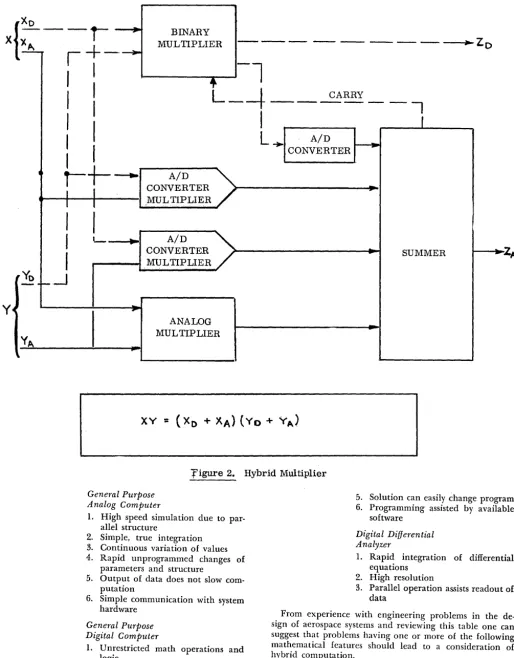
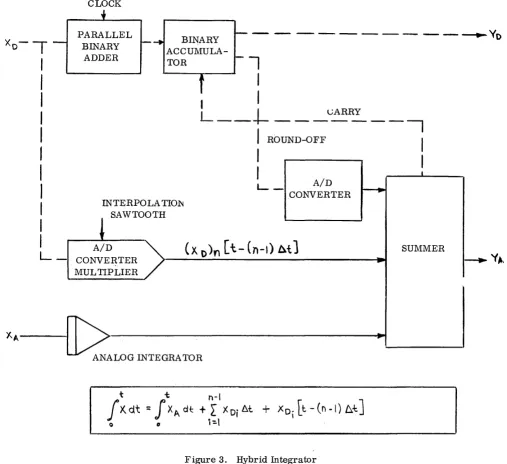
xA • The more significantdigital part xD might have 5 bits of slowly changing digital data, whil~ the analog section would contain 3 decimal places of voltage data. A 5 bit digital section could be made relatively fast at low cost, and would have no dif-ficulty in this association ke,eping up with the speeds of the analog section for high speed computation. Of course, there is interaction between the analog and digital sections requiring the generation of carry pulses. As the analog sec-tion exceeds a threshold value corresponding to I binary unit, a carry pulse must be generated to add one unit to the digital section and clear the analog section. With all de-sign problems solved, components to perform the standard analog computer operations would have a considerably im-proved resolution. (See Figures 2 and 3)
In contrast to this addition of digital components to a machine organization along analog lines, persons at the MIT Electronic Systems Lab. have proposed the addition of pulsed analog components to be used as a very fast multiplexed analog arithmetic unit in a digital computer. Additional analog integrators would also be included to perform high-speed integration. The concept of this sys-tem essentially is to produce a set of analog arithmetic units each programmable to perform specific multiple op-erations which can then be used in a sequentially sampled manner to satisfy many equation requirements. The data as they are updated are placed in digital memory.
Neither of these latter suggestions have had wide ac-ceptance but they demonstrate the ingenuity of some of the persons working to increase the high speed computing capabilities available to solve demanding aerospace prob-lems.
Another suggested solution is the Digital Differential Analyzer, which although not a hybrid computer does have a parallel, multiple-component, analog computer structure made from digital binary circuits which process numbers. The modern DDA is a powerful tool in solving certain lim-ited kinds of problems. Being a digital computer by circuit . design, it has the possibility of relatively unlimited
reso-lutiqn. Having parallel component operation, one would expect a high speed solution capability and this is true, at
COMPUTERS and AUTOMATION for October, 1963
.1
least in small problems. The interaction between speed of solution and resolution sometimes slows the operation of the DDA disappointingly. However, in the solution of differential equations it is faster than a general purpose digital computer and is more accurate than the analog computer. By itself it does not possess all of the qualities typically required in most dynamic design problems.
A completely separate and different philosophy in the development of a hybrid computer is represented by EAI's HYDAC system. It accepts the desirable features of the modern analog computer and adds to them computing capability organized along the lines of an analog computer but fashioned with digital devices. In one integrated com-puter the resolution, storage, logic, and program control of the digital computer is added in many individual com-ponents which are interconnectable in parallel. The com, bination of high speed analog components under direct program control from digital logic, with the resolution and storage capacity of digital devices provides an unusually flexible arrangement.
To consider the advantages of one form of hybrid com-puter system over another requires attention to its poten-tial applications, the resulting mathematical forms ta be computed, the possible questions related to component operation, and the necessary computer operation and con-trols. Once one has established the capability of a num-ber of different computers to solve. effectively problems of interest in a field of application, the question of perform-ance efficiency (capability' per dollar) in some acceptably defined terms is the deciding factor.
Where Are Hybrid C,om'pute'rs Desirable?
The different qualities of analog computers and digital computers or components (the one using voltage values to represent variables in a solution, the other using binary numbers) offer separate advantages in the solution of prob-lems. The possibility of employing a hybrid computer presents itself whenever a problem has features some of which are best satisfied by the qualities of one computa-tional form and others arc best satisfied by the qualities of the other .
Some of the advantageous qualities of different compu-ters arc tabulated below:
[image:11.624.61.372.38.317.2]BINARY
{~--I
x
~
I
t _.--
MULTIPLIER
=-l-- -- -- -- - - - -...
Zo
I I
f.---~+
- - - J .y
12
I
I
L_--t
CARRY
-,
J
I
I
I
: I
L ..
CON~~~TER
r---It-
I
--"1
CONVERTER
AID
>
r---~~~I-{
I
.
.MULTIPLIER .
, I
I
I
YO
r-.--1
I_~
AID
CONVERTER
MULTIPLIER
ANALOG
MULTIPLIER
...
SUMMER
-figure 2. Hybrid Multiplier
General Purpose Analog Computer
1. High speed simulation due to par-allel structure
2. Simple, true integration 3. Continuous variation of values 4. Rapid unprogrammed changes of
parameters and structure
5. Output of data does not slow com-putation
6. Simple communication with system hardware
General Purpose Digital Computer
1. Unrestricted math operations and
logic
2. High resolution which can be in-creased a t will
3. Large, easily reproducible data stor-age
4. Floating point operations eliminate scaling
5. Solution can easily change program 6. Programming assisted by available
software
Digital Differential Analyzer
1. Rapid integration of differential equations
2. High resolution
3. Parallel operation assists readout of data
From experience with engineering problems in the de-sign of aerospace systems and reviewing this table one can suggest that problems having one or more of the following mathematical features should lead to a consideration of hybrid computation.
1. Simultaneous differential equations with widely
dif-ferent parameters which produce both low and high fre-quencies in the solution.
2. Differential equations to be solved at high speed, their solutions for different initial conditions or parameters being used in a prediction, iteration or optimization process.
[image:12.627.41.556.44.702.2]3. Combinations of continuous and discrete variables as in the description of a sample data system or a computer control system.
4. Perturbation analysis about slowly changing, precisely
established solutions.
5. Statistical analysis requiring repeated solution of
dif-ferential equations, including Monte Carlo methods for deterministic problems. This is essentially a data storage and simple evaluation task around the solution of differen-tial equations.
6. Filtering and processing continuous and sampled data
for evaluation purposes.
7. Partial differential equations to be solved by serial integration procedures.
8. Ordinary differential equations accompanied by trans-port delays.
A few examples of practical applications of hybrid
compu-tation in aerospace system design help to clarify the situa-tions in which these mathematical features occur. Consider the problem of designing the guidance and attitude control system for a space vehicle attempting to dock with a target
CLOCK
PARALLEL BINARY
ADDER
BINARY
ACCUMULA-TOR
vehicle. This docking maneuver might be manually con-trolled by the pilot in which case the design of the control mechanisms must take due consideration of the problems of a man-machine system. A close-range maneuver control system design suggests immediately the use of an analog computer to simulate the intended system. The choice of the analog computer .is particularly emphasized by the de-sirability of checking the design with a man "in the loop" in real time. Also the selection of control system parameter values, and the possible re-arrangement of any use of sen-sors for feedback purposes is particularly easy when they are mechanized on such a computer. The later inclusion of real hardware is more readily accomplished using the analog computer. However, there are features of such a control system which are discrete or sampled and,.there-fore, suggest the use of digital circuitry. The reaction jets which adjust the attitude of the vehicle are "on-off" rather than continuously adjustable. The manual 3-axis control stick used by the pilot energises in a number of pre-select-able ways some, but rarely all of, say, 16 jets. Between the control stick and the jets there is a logic unit whose operation is modified by other manual inputs. These two·
-
-
-
-
-
-
-
-
-
-
---.. YO
l
I
XO-I
I
I
I
I
I
I
I
L---I---i
CARRYI
I
I
I
I
I
L-INTERPOLATIO~
~
SAWTOOTHAID
CONVERTER MULTIPLIERI
ROUND-DFFI
I
I
I
IL _
AID
r----CONVERTER
(X
o)n
[t-
(n-\)
btl
..
SUMMER..
..
,.
XA-[?
ANALOG INTEGRATOR
t
-t
n-I
f
X dt
=
f
X
Adt
+
r
X
Djb.t
o 0 i:.\Figure 3. Hybrid Integrator
~
[image:13.613.64.571.287.751.2]features of the system could be mechanized with difficulty on a conventional analog computer. They are readily established with the logic capability of digital equipment.
(See Figure 4)
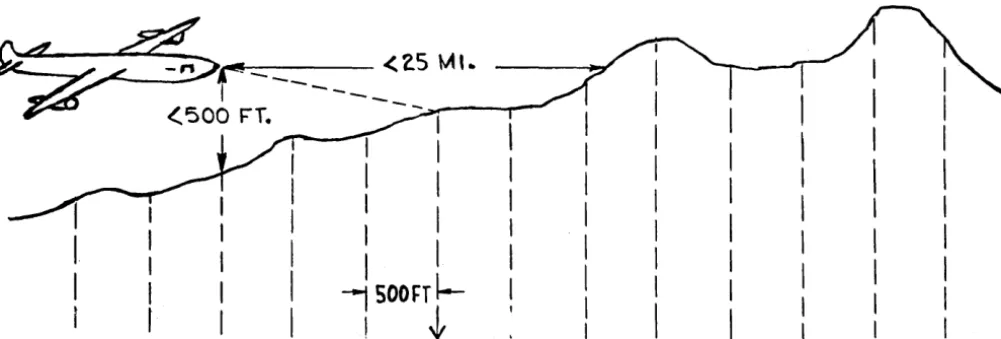
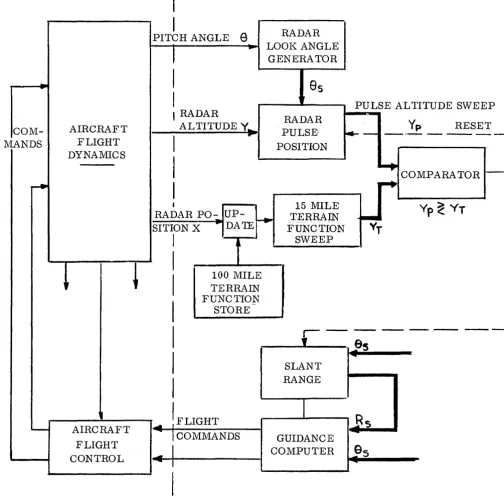
The same maneuver control system could be completely automatic with a beacon·homing device replacing the pilot's decisions, but in either case, the system is most likely to have rpany parts which are discrete in their operation and thus call for digital equipment in th~ir representation. Consider the problem of designing a terrain avoidance guidance system for loW flying high-performance aircraft. A radar dish in the nose of the aircraft scans through pitch angles of +5 degrees to -25 degrees to obtain slant range data. This data is sampled and stored to determine flight control commands which allow the aircraft to fly at high speed below an altitude of 500 feet. The range of the radar is 15 miles. Simulation techniques would play an invalu-able role in the efficient design of such a system. An analog computer could simulate the flight path and attitude of the aircraft. It could also simulate the on-board control mech-anisms and the generation of aerodynamic forces. How-ever, the representation of the radar beam and its reflection from typically rough terrain with re.asonable fidelity is not readily achieved with analog function generators. It is well to store the features of many miles of terrain in a digital memory and compute the values of slant range for use in the on-board guidance computer digitally. For real-time simulation and high values of radar PRF (400 pulses/sec), a high speed digital computer would be required. How-ever, this particular problem is very well suited to simula-tion using parallel interconnectable items of digital hard-ware. It will be discussed later. (See Figure 5)
A third example of the desirable use of a hybrid computer is in the analysis of rocket parameters and staging times for maximum efficiency in orbit injection. A multi-stage rocket's flight into orbit with the necessary considerations of aerodynamic forces, on-board control system, and staging with its consequent sudden changes in mass, inertia and thrust, is a complicated problem in simulation. To achieve any efficiency in considering many possible system parame-ters and flight path designs, a high speed simulation of a typical six minute flight to injection is essential. Thus, the speed of parallel computation of an analog computer is de-sirable. The automatic control and evaluation of the many different sets of parameters with their effect on the selected criterion of efficiency is most appropriately achieved using a digital computer. Such an arrangement would save con-siderably on the time presently required by an analog computer and even more so on that of an IBM 7090. This ,kind of problem, a search for an optimum set of parameters
I
I
I
I
I
I
I
I
500FT\-!
*
for a dynamic physical system, is one having many varied application. Its implications in computation-the solution of differential equations plus the need for up-dating stored values and making of logical decisions according to a criterion-suggest strongly the use of a hybrid computer. There are many other examples of problem types which place a mixture of demands on computers. They should be most readily solved by the use of a hybrid computer. In choosing such a computer there is good reason to consider both the technical features essential in the computer, and the economic comparison between the different possible organizations.
The Organization of a Hybrid Compute·r
From a consideration of problem types-particularly those whose solutions are best obtained by a simulation procedure-one can establish the features and organization desirable in a hybrid computer. Taking advantage of exist-ing circuit techniques and hardware a number of equip-ment combinations is possible. A choice between them rests on their appropriateness to the group of applications envisaged and secondly on their "performance per dollar" according to some measure-usually quite difficult to ob-tain agreement upon.
Before discussing the different possible arrangements it is well to define the nature of the system that is required. To be of value beyond analog, digital or DDA computers the hybrid computer must combine effectively the qualities of these different computers. Thus, we would expect it to have the following components:
1. An analog section with a parallel array of high speed integrators, summers, multipliers and function generators. 2. A digital section with logic and arithmetic ability, and volatile data storage.
3. An analog-digital data communication system to trans-late analog voltages to binary numbers and vice versa.
4. A program control capability to maintain the timing of events in the computer.
5. Input-output display and equipment monitoring for program checkout.
A typical use of such a. system would find the analog section performing high-speed integration of non-linear differential equations with the digital section providing precise low speed computation of slowly changing vari-ables. These variables might require the numerical inte-gration of differential equations or might be the result of an algebraic function generation. Any other function gen-eration or algebraic transformation might fit on the analog equipment or be performed digitally. Samples of computed __
Figure 4. Terrain Avoidance Guidance
[image:14.620.45.546.555.724.2]...
-
COM-MANDS·
AIRCRAFT
FLIGHT
DYNAMICS
PITCH ANGLE
a
I
I
I
I
RADAR
-ALTITUDEY~
I
RADAR
LOOK ANGLE
GENERATOR
9s
RADAR
PULSE·
POSITION
PULSE ALTITUDE SWEEP
Yp
RESET
.... - -.-
.... - - - - l
;:: COMPARATOR
M
RADAR PO:.. UP-
-.-SITION X
-
D~IE
15 MILE
TERRAIN
- - - --
~-I
I
I
-
AIRCRAFT
~FLIGHT
CONTROL
.---I
I
I
I
I
I
I
t
100 MILE
TERRAIN
FUNCTION
STORE
!FLIGHT
I
COMMANDS
I
I
FUNCTION
SWEEP
I
I
r-~----J
SLANT
RANGE
I
GUIDANCE
COMPUTER
..
~5
~---
..
Figure 5. Block Diagram
data would be stored digitally and logical'data evaluation would also be performed digitally. The program timing and control would be a responsibility of the digital equip-ment. However consistent with their normal separate op-eration, typical usage would require all operations on the digital computer to be completed cyclically, whilst the analog computer might have two modes of operation, one a high speed iterative mode, the other a continuous compu-tation mode.
As has been reported by more than one user, the kind of operation envisaged for such a'system, docs not demand an· expensive digital computer. As might be expected in the combined use of analog and digital computers, the 3-4
decimal place accuracy of the analog computer (,--I 12 bits)
is well matched by a 16-32 bit range in word length on the digital computer. This requirement appears to follow through no matter the type of digital section considered,
COMPUTERS and AUTOMATION for October, 1963
be
it
gpdc, DDA, special purpose or multi componentdigi-tal computer. The digidigi-tal section does need to be fast, for the parallel, high-speed nature of the general purpose analog section is otherwise frequently wasted. Other fea-tures of the digital section are the subject of considerable discussion.
The choice of linkage equipment is rather easily made. The accuracy of the analog seuion detcrlllines the word length required in the converters. Typically it is 12-13 bits plus sign.
A number of A-D channels are required. Signals can be simultaneously scanned, stored in analog track-and-store units, and converted sequentially by one converter to binary number form for storage in the digital section. Other-wise they can be sequentially scanned, without the need for analog storage, and converted to binary number form. The D-A channels are either separate, each channel accept·
[image:15.615.60.565.45.546.2]