EUROPEAN EXPERIENCE
Wild cherry (Prunus avium L.) is one of noble hard-voods. Great attention has been paid to this tree species in Europe recently (TUROK et al. 1996, 1998, 1999). This attention is aroused by importance of increasing the for-est ecosystem biodiversity and obtaining valuable wood, which is also connected with efforts to reduce wood im-port from tropical regions of the world and with efforts to maintain the gene resources of these forest trees. At-tention is paid to wild cherry and other noble hardwoods in Europe mainly within the EUFORGEN program. The greatest wild cherry programs are realized in France and Germany.
France
DEMESURE (in TUROK et al. 1996) stated that the gene resources of wild cherry in France were endangered mainly by seed transfer without control. This species was planted on a large scale in France during 15 years but the reproductive material originated from a small number of mother trees. Research institutions of France (INRA and CEMAGREF) try to recognize the diversity of this species. Aims are better recognition of gene resources by genetic markers, conservation of gene resources in situ (natural stands in the northeast, artifi cially established stands in other regions of France), conservation of gene resources ex situ including seed orchards.
HÉOIS et al. (in TUROK et al. 1996) informed about this situation. Domestication of wild cherry caused genetic modifi cations within the species. Much later, the diversity and genetic variability of its resources in France changed
by forest management practices. A trend directed at es-tablishment of homogeneous forest stands made wild cherry rare. CAZET (in TUROK et al. 1996) stated that 1.3 million individuals were planted by 1993. Problems are a frequently unknown origin and rather narrow basis of the used plant material. Conservation strategy of wild cherry gene resources in France is based on:
1. Regionalized conservation of gene resources in situ – large and variety natural stands in the northeast of France (10 localities), artifi cially established stands – stands were established in 3 regions with the mate-rial suitable for the given region and originating from localities of wild cherry occurrence.
2. Establishment of national program of forest tree breed-ing and establishment of seed orchards ex situ. Increasing costs of wild cherry wood caused cutting
of many valuable individuals in the sixties. During 15 years this situation contributed to extinction of wild cherry in stands. Cherry plantations were established on agricultural lands by use of planting machines. It led to a great extension of artifi cial plantations of this type. At the beginning the quality of the used material was very low. Sometimes plantations were established by distilling sorts. 102 stands for seed collection were se-lected in the northeast of France and only 10 stands in other regions by 1996. During 20 years INRA selected about 400 plus trees. These trees were tested by clonal tests at many sites. 20 clones were selected and they were grafted to slowly growing rootstocks in 1995 in order to reach early fl owering of grafted trees. In spite of this information a recent supply of wild cherry reproduc-tive material has been unsatisfactory. Only 21–35 stands
Wild cherry (
Prunus avium
Wild cherry (
Prunus avium
Wild cherry (
L.) breeding program aimed at the use
of this tree in the Czech forestry
J. K
OBLIHACzech University of Agriculture, Faculty of Forestry, Prague, Czech Republic
ABSTRACT: The paper widely introduces European experience in wild cherry breeding because it is the fi rst one from a prepared series of articles aimed at wild cherry breeding in the Czech Republic. Beginnings of wild cherry breeding program for the Czech forestry are described. Plus trees were certifi ed, seed orchards, clone archives, progeny and clonal tests were established. Clones were tested for fl owering of grafts in reproductive plantations. Progenies and clones were tested for growth parameters in progeny and clonal tests. Progenies and clones in every breeding plantation were tested for damage by aphids.
Keywords: seed orchard; clone archives; half-sib progeny test; clonal test; flowering; growth; damage by aphids; Prunus avium L.
are used for seed collection. Recently, 66% of seed have originated from 5 or 6 stands.
FERNANDEZ et al. (in TUROK et al. 1996) stated that the quality of selected stands was low and their genetic basis was probably narrow (FRASCARIA et al. in TUROK et al. 1996). One of the cause can be vegetative sprouting of mother trees. This process can lead to a very small number of genotypes inside stands. It is known that such “clonal swarm” can occupy the area of 20–5,000 m2.
MARIETTEet al. (1997) investigated genetic variability in wild cherry populations in France by help of isoen-zymes. Genetic diversity and differentiation between 6 populations were studied by SANTI and LEMOINE (1990) on 286 trees from France (186 trees), especially from Nor-mandy (61 trees), from Ardenes (19 trees), from Germany (14 trees) and from Belgium (6 trees). They distinguished products of 41 loci, 13 of them were polymorphic. Genet-ics of 7 isoenzymatic loci for 8 full-sib progenies was investigated. Relations were found only between the isoenzymatic loci lap l and got l, lap 1 and me l.
MURANTY et al. (1998) measured height and diameter and studied sensitivity to Phloesporella padi in 3 planta-tions of 14 wild cherry half-sib progenies periodically to 7 years. Height growth during 5 growing seasons, diameter growth during 2 seasons and sensitivity to Phloesporella padi showed high heritability. The ratio of additive vari-ance to general varivari-ance for these traits was higher than 0.60. Genotype × environment interaction was rather high for height growth but low or null for diameter growth and sensitivity. Height and diameter growth reached high ge-netic correlation similarly like the sensitivity. According to this study relative genetic gain is from 8% to 37% in dependence on trait and site.
SANTI et al. (1998) evaluated genetic parameters and potential selection gain in wild cherry clones in a 7-year clonal test with 33 clones in France for the fi rst time. Studied traits were height increments from 0 to 2 years and from 2 to 7 years after planting, diameter, stem form, number, angle and diameter of branches, leaf param-eters and glandule number, sensitivity to aphids (Myrus cerasi) and Bluemeriella jaapii. Height increment in the second period, diameter, branching angle and sensitivity to Bluemeriella were the traits with highest heritability (0.56; 0.70; 0.57; 0.83). Branch number and diameter were also heritable but not at agricultural sites (0.66 and 0.22). Height increment in the second period, diameter and branching angle showed good reciprocal genetic correla-tions and also correlation with sensitivity to Bluemeriella. Ecovalence analysis of “site × clone” interaction showed a high proportion of clones and sites that were slightly interactive for each trait. Genetic gain 11% was reached for height increment in the second period and 13% for diameter with low selection intensity (1/4). Currently, 6 clones are in the certifi cation list. They are the fi rst clonal varieties of wild cherry that were offi cially certi-fi ed in EU.
MURANTY et al. (1996) mentioned that many forest tree breeding programs are based on clonal tests for
purposes of genotype selection for clonal forestry now. But the working capacity, fi nances and space for tests are limited and in spite of this it is necessary to obtain the test selection results. The authors also tried to fi nd an optimum number of ramets per clone in 2 clonal tests. They obtained data in a test of 32 wild cherry clones in 3 replications at the age of 7 years and in a test of 96 hybrid larch clones without replication at the age of 8 years. The studied characteristics were height increments, diameter, branching parameters and wood quality. They found that 6 ramets per clone is enough for clonal forestry pur-poses.
Germany
Great attention is paid to wild cherry in Germany (KLEINSCHMIT et al. in TUROK et al. 1996). Only Acer pseudoplatanus and Fraxinus excelsior arouse greater interest. Wild cherry occurrence is connected with fertile, warm sites and stand edges. Only several stands and seed orchards are able to produce quality seed. Wild cherry is not mentioned in the German Forest Seed and Plant Material Act. There is no guarantee for supplying suitable seed. The danger of crossing with cultural sorts is high but German colleagues made a lot of work to conserve gene resources in situ. In 1996, 34 selected stands were registered on a total area of 19.6 ha and 1,164 plus trees. Their activities were probably the most extensive among the member countries of EUFORGEN program. They established 48 stands on an area of 39 ha, 17 seed orchards with 700 clones on an area of 25 ha and orchards with 120 clones. Seed (200 kg) and also pollen are stored in Germany.
In 1957 a seed orchard was established in Baden-Würt-temberg when 150 grafts from 13 clones were primarily used on an area of 1.65 ha by FRANKEet al. (1988). It was extended to 3.3 ha by 1983. Grafts were used on Prunus avium or Prunus mahaleb rootstocks. In 1988, 275 grafted trees of 42 clones from the whole Germany were there. The seed orchard was established at spacings 6 × 6 m to 10 × 10 m. After the fi rst years of orchard fructifi ca-tion the clones whose fruits showed a great relaca-tionship with consume cherry fruits were removed. In the years 1974–1987, 4–529 kg of seed per year were obtained. There were approximately 4,000 seeds per 1 kg. Cherry fructifi cation is endangered by late frosts and rainfall in fl owering time in this locality.
Spain
Wild cherry occurs in the whole territory of Spain ac-cording to MIRANDA (in TUROK et al. 1996) but only as individual trees. It occurs mainly in the north where a program of small mixed stand plantations at agricultural sites is realized. The main danger is great tree cutting for fi nancial profi t. 93 trees were selected within the breeding program by 1996. Selection criterion was the quality of wood production, mainly growth and stem straightness. Research on quality individuals in the whole territory has not been fi nished yet. Clonal material from 51 trees was collected and clone archives were established. Part of this material is grown in vitro.
Italy
Italian research intensively investigates wild cherry genetic variability by help of morphological and phe-nological traits and biochemical and molecular markers (isoenzymes, RFLP, RAPD) to obtain the basis for selec-tion (DUCCI in TUROKet al. 1996). In 1996 Italian col-leagues had 350 wild cherry clones from the whole Italy, 10 clones from France and 10 clones from Great Britain. They also had clones modifi ed by radiation. 150 clones are tested in plantations. DUCCIet al. (1990) reported that 225 plus trees had been collected in 10 regions of Italy since 1980. AMPRIMO (1997) mentioned the establish-ment of a clonal wild cherry plantation originating from 8 trees valuable in phenotype propagated in vitro, 4 from Piedmont and 4 from other regions of Italy. Clones in this plantation were tested for growth.
Hungary, Austria, Slovakia, Switzerland
BARNA (in TUROK et al. 1996) stated that 180 trees were selected and 1 seed orchard was established in Hungary by 1996. 3 seed orchards with 152 clones were established in Austria by MÜLLER (in TUROK et al. 1996). LONGAUER and HOFFMAN (in TUROK et al. 1996) criticize practices in the trade in cherry wood and its regeneration in Slo-vakia. In 1996 a clonal seed orchard of wild cherry was established here. A low quantity of quality gene resources of wild cherry is available in Swiss forestry according to ROTACH (in TUROK et al. 1996). Great populations of satisfactory quality are extremely rare according to this author. A bad result of this situation is imports of more than 50% of seed. The breeding aim is to obtain seed or-chards producing seed not only with high genetic quality but also with higher genetic diversity.
Belgium, Netherlands
CUYPER and JACQUES (in TUROK et al. 1996) reported 2 wild cherry stands for seed collection and 121 plus trees in situ, 2 seed orchards, 1 clone archives, 16 clonal tests or progeny tests ex situ in Belgium. The risk of the negative infl uence of wild cherry original gene resources exists in cultural (distilling and preserved fruit) sorts. Relatively high is the import of seed from other countries, often from different ecological conditions. Cherry wood is very much valued in the Netherlands according to VRIESE(in TUROK
et al. 1996). But cherry is very rare in this country. Greater occurrence of cherry is in national parks in the south and in the eastern part of country. The identifi cation of stand origin is not easy. A seed orchard of this tree species was established there.
Latvia, Sweden, Great Britain
Wild cherry is mentioned as an introduced tree in bo-real countries. BAUMANIS et al. (in TUROK et al. 1996) reported that cherry came to Latvia as a fruit tree and it oc-curs secondarily in this country. It ococ-curs in mixed stands in the west of the country. It is resistant to cold there. It is a potential species for agroforestry for its relatively fast growth. Wild cherry occurs to 60 degrees of northern latitude according to ERIKSSON(in TUROK et al. 1996). 10 subpopulations were distinguished within the conser-vation of gene resources in situ by 1996. LAGERSTRÖM and ERIKSSON (1997) mentioned the problems of stands for seed collection and seed orchards of various forest tree species including the wild cherry. NICOLL(1993) and HAMMATTet al. (1996) solved the problems of wild cherry breeding for wood production on agricultural land in Great Britain.
Some breeding activities were realized with wild cherry in the Czech Republic but the most important work in this fi eld is done by the Faculty of Forestry of Czech University of Agriculture in Prague. This wild cherry breeding program started within the research project of National Agency for Agricultural Research Breeding and silviculture of wild cherry (Prunus avium L.) in the Czech Republic in 1997–2000 (KOBLIHA, PODRÁZSKÝ 2001). This research continued by the research project of Ministry of Agriculture of the Czech Republic Results of several-year breeding and silviculture aimed at the use of this tree species in the forestry of Czech Republic in 2001 (KOBLIHA 2002). A general aim of these projects was wild cherry breeding for high production and quality of wood for purposes of forest regeneration and affor-estation of lands outside forests. This aim is realized by establishment of breeding program based on reproductive plantations and evaluating tests. Other aims were to ac-quire the knowledge of wild cherry breeding, propagation, silviculture and ecological functions.
MATERIAL AND METHODS Tree selection
height, diameter and crown length, they were classifi ed into tree classes according to Kraft. Phenotypic traits of the trees were also evaluated: crown width, form, regu-larity, density and condition, branching angle, stem taper, form and natural pruning, branching, branch diameter and rough bark character. These characteristics were already published by KOBLIHA and JANEČEK(2001).
Seed orchard and clone archives establishment In February 1999 grafts were collected from 63 plus trees in FD FCR Křivoklát and Nižbor and used for graft-ing at Tree Breedgraft-ing Station Truba. Collection of grafts was repeated in December 1999 and grafting in February 2000. 350 grafted trees survived until control inventory in autumn 2001. This material is to be used for establish-ment of seed orchard in FD FCR Lužná on a prepared plot in the former forest nursery in spring 2002. During January 2000 grafts were collected from 30 plus trees in MF Velichov. In autumn 2001 250 grafted trees survived until control inventory. This material will also be used for establishment of seed orchard on the prepared plot in MF Velichov in spring 2002.
In 1995 grafts of 30 clones were obtained from Ger-many (Lower Saxony Forestry Research Institute, Depart-ment in Escherode). These clones originate from elite trees – evaluated by progeny tests. Grafts of this origin were
used on rootstocks of Prunus mahaleb at Tree Breeding Station Truba in February 1995. In spring 1998 this mate-rial was used for establishment of the second generation seed orchard in the School Forest Enterprise (SFE) in Kos-telec nad Černými lesy. 155 grafted trees were planted at a spacing 6 × 6 m there.
In February 1997 the same clones originating from Germany were grafted with secondary grafts on wild cherry rootstocks at Tree Breeding Station Truba. In spring 1999 the 2nd seed orchard of the second generation was established with the above-mentioned material from 30 elite clones in Forests of the Town of Prostějov. The seed orchard was established on an area of 0.86 ha. 228 grafted trees were planted at a spacing of 6 × 6 m there.
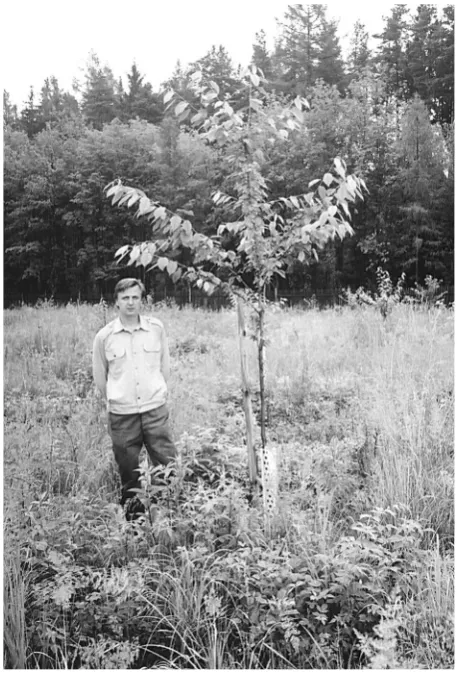
[image:4.595.298.524.54.218.2]In February 1998 elite clones from Germany were also propagated by secondary grafts on wild cherry rootstocks. This material was intended for improvement of seed or-chards in SFE Kostelec nad Černými lesy and in Forests of the Town of Prostějov. This material was used for this purpose but mortality was very low in these seed orchards. Then this material was used for establishment of reserve clone archives in SFE Kostelec nad Černými lesy in spring 2000. 141 grafted trees of 26 elite clones from Germany were planted at a spacing of 3 × 3 m there.
Fig. 1. Seed orchard of German origin – Forests of the Town
[image:4.595.55.284.389.726.2] [image:4.595.298.524.566.725.2]In February 1998 a material of Moravian origin was grafted at Tree Breeding Station Truba. This material originates from plus trees from FD FCR Luhačovice, Strážnice and Brumov and Communal Forests Suchá Loz. It was obtained in the form of secondary grafts from Forest Nursery Budišov. In spring 1999 research clone archives was established by this material in SFE Kostelec nad Černými lesy. 118 grafted trees of 55 clones were planted at a spacing of 3 × 3 m.
Half-sib progeny test and clonal test establishment In summer 1997 fruits were collected from 14 wild cherry trees in SFE Kostelec nad Černými lesy. Seeds (5.76 kg) were obtained from these fruits. Seed was strati-fi ed at a tree breeding station. Seeding was realized in the tree breeding station nursery at the end of April 1998. Seed did not germinate because of extremely dry spring 1998. It germinated in spring 1999. In autumn 2000 the prog-enies were planted in a comparative plantation at a spacing of 1.5 × 1.5 m in SFE Kostelec nad Černými lesy. About 25 seedlings per progeny were planted here.
In September 1998, 140 wild cherry plants propagated in vitro were obtained from the Laboratory of Biotech-nologies at Olešná. These 140 plants represent 28 clones (5 ramets per clone). Clones originate from plus trees, 10 clones from FD FCR Křivoklát (Central Bohemia) and 18 clones from FD FCR Nové Hrady and Prachatice (Southern Bohemia). In spring 2000 this material was used for establishment of comparative plantation at a spacing of 3 × 3 m in SFE Kostelec nad Černými lesy.
Clonal testing in seed orchard and 2 clone archives (SFE Kostelec nad Černými lesy)
Control of fl owering was realized in these 3 reproduc-tive plantations in May 2001. The fl owering of grafted trees was evaluated according to this classifi cation: no fl owering, poor fl owering, strong fl owering. Control of damage by aphids was realized in June 2001. Damage to grafted trees by aphids was classifi ed as follows: no dam-age, low damdam-age, strong damage.
Progeny and clonal testing in comparative plantations (SFE Kostelec nad Černými lesy) Plants in half-sib progeny test and clonal test were measured in spring 2001 before bud fl ushing and then in autumn 2001 after growth end. Analysis of variance (level 95%) was used to evaluate statistical signifi cance of the infl uence of progeny on plant height. Duncan’s test was used. Control of damage by aphids was also realized with the same classifi cation as in grafted trees in June 2001.
RESULTS
FLOWERING OF GRAFTED TREES IN SEED ORCHARD AND 2 CLONE ARCHIVES
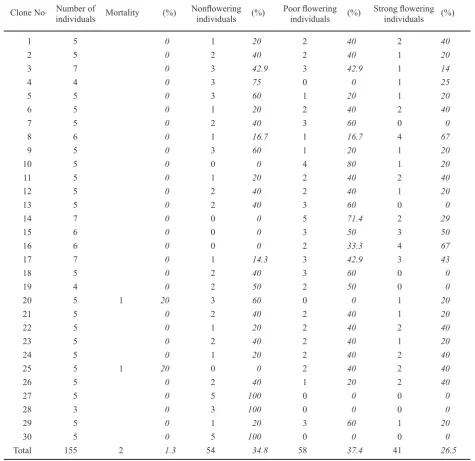
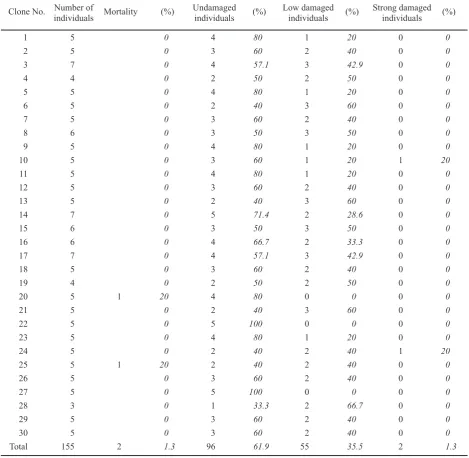
2 grafted trees (1.3%) died until May 2001, 54 individu-als did not fl ower (34.8%), fl owering of 58 individuindividu-als was poor (37.4%), fl owering of 41 individuals was strong (26.5%) out of 155 grafted trees in the investigated seed orchard. No grafted tree fl owered in the case of 3 clones (No. 27, 28, 30) out of 30. Every grafted tree fl owered in 5 clones (No. 10, 14, 15, 16, 25). Grafted trees of clone No. 16 fl owered mostly (Table 1).
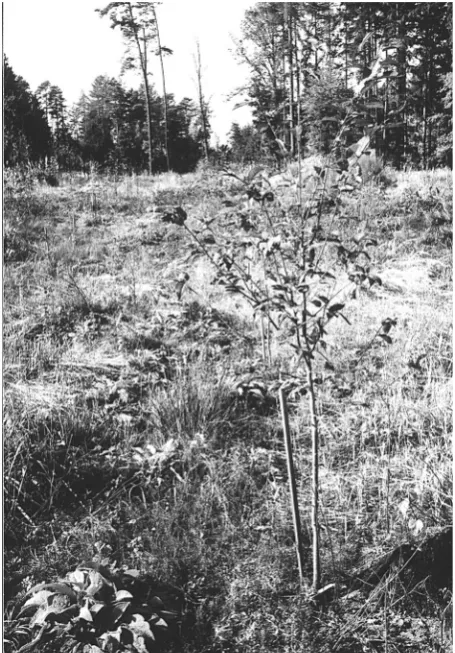
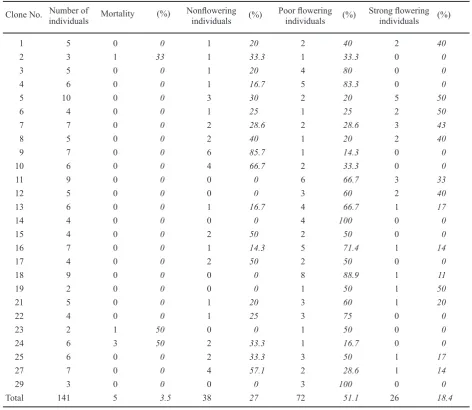
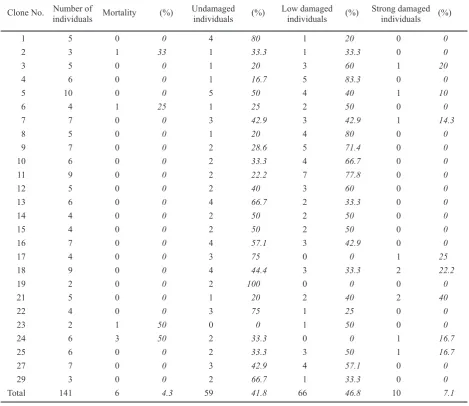
[image:5.595.71.297.53.232.2]5 individuals died (3.5%) until May 2001, 38 individuals did not fl ower (27%), fl owering of 72 individuals was poor (51.1%) and fl owering of 26 individuals was strong (18.4%) out of 141 grafted trees in the reserve clone archives with Fig. 4. Flowers of grafted tree – School Forest Enterprise
Kos-telec nad Černými lesy
[image:5.595.70.298.402.729.2]the same origin of clones as in the seed orchard. No clone was without any fl owering individual. Every grafted tree out of 7 clones fl owered (No. 11, 12, 14, 18, 19, 23, 29). Clone No. 14 had the same result in the seed orchard (Table 2).
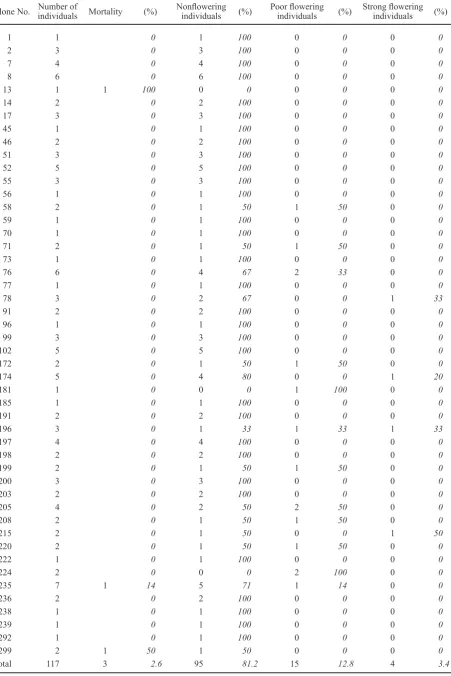
3 individuals died (2.6%) until May 2001, 95 individu-als did not fl ower (81.2%), fl owering of 15 individuindividu-als was poor (12.8%) and fl owering of 4 individuals was strong (3.4%) out of 117 grafted trees in the clone archives of Moravian origin. No grafted tree fl owered in 31 clones. Some grafted trees of 16 clones fl owered. Strong fl ower-ing occurred in 4 clones (Table 3).
DAMAGE OF GRAFTED PLANTS BY APHIDS IN SEED ORCHARD AND 2 CLONE ARCHIVES
2 individuals died (1.3%) until June 2001, 96 individu-als were not damaged (61.9%), damage of 55 individuindividu-als
was low (35.5%) and damage of 2 individuals was strong (1.3%) out of 155 grafted trees in the seed orchard. No grafted tree was damaged in 2 clones (No. 22 and 27) (Table 4).
6 individuals died (4.3%) until June 2001, 59 individu-als were not damaged (41.8%), damage of 66 individuindividu-als was low (46.8%) and damage of 10 individuals was strong (7.1%) out of 141 grafted trees in the reserve clone archives. No grafted tree was damaged in clone No. 19. Clone No. 4 had the highest number of damaged individuals (83.3%). Strong damage occurred in 8 out of 26 clones (Table 5).
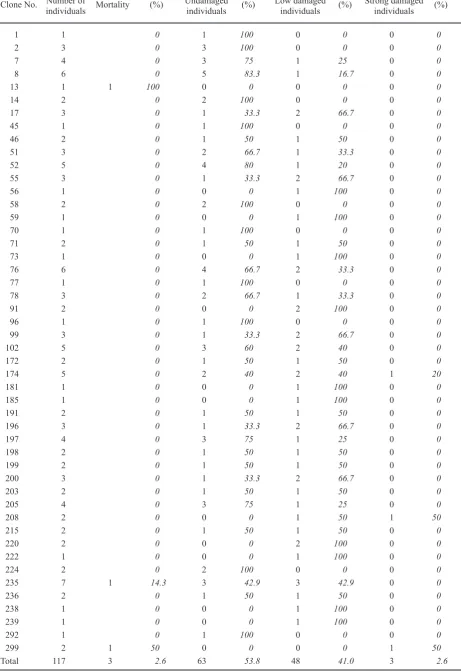
[image:6.595.53.529.71.532.2]3 individuals died (2.6%) until June 2001, 63 individu-als were not damaged (53.8%), damage of 48 individuindividu-als was low (41%) and damage of 3 individuals was strong (2.6%) out of 117 grafted trees in the clone archives of Moravian origin. No grafted tree was damaged in 10 out of 47 clones. Every grafted tree was damaged in 12 clones. Table 1. Flowering in seed orchard
Clone No. Number of Mortality (%) Nonfl owering (%) Poor fl owering (%) Strong fl owering (%)
individuals individuals individuals individuals
1 5 0 1 20 2 40 2 40
2 5 0 2 40 2 40 1 20
3 7 0 3 42.9 3 42.9 1 14
4 4 0 3 75 0 0 1 25
5 5 0 3 60 1 20 1 20
6 5 0 1 20 2 40 2 40
7 5 0 2 40 3 60 0 0
8 6 0 1 16.7 1 16.7 4 67
9 5 0 3 60 1 20 1 20
10 5 0 0 0 4 80 1 20
11 5 0 1 20 2 40 2 40
12 5 0 2 40 2 40 1 20
13 5 0 2 40 3 60 0 0
14 7 0 0 0 5 71.4 2 29
15 6 0 0 0 3 50 3 50
16 6 0 0 0 2 33.3 4 67
17 7 0 1 14.3 3 42.9 3 43
18 5 0 2 40 3 60 0 0
19 4 0 2 50 2 50 0 0
20 5 1 20 3 60 0 0 1 20
21 5 0 2 40 2 40 1 20
22 5 0 1 20 2 40 2 40
23 5 0 2 40 2 40 1 20
24 5 0 1 20 2 40 2 40
25 5 1 20 0 0 2 40 2 40
26 5 0 2 40 1 20 2 40
27 5 0 5 100 0 0 0 0
28 3 0 3 100 0 0 0 0
29 5 0 1 20 3 60 1 20
30 5 0 5 100 0 0 0 0
PLANT GROWTH AND DAMAGE BY APHIDS IN PROGENY TEST
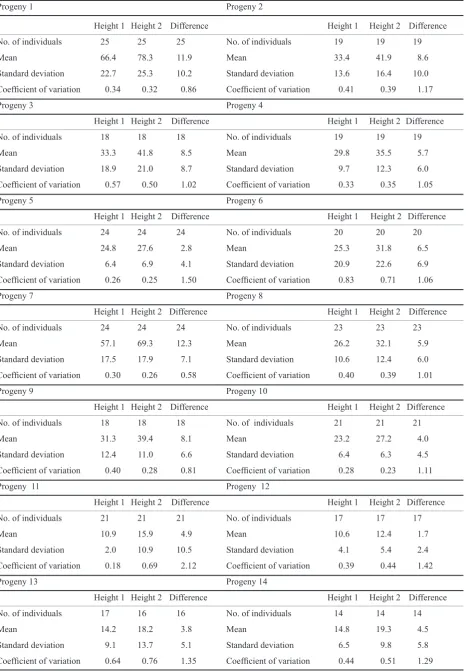
Mean height of progenies was from 10.6 cm (progeny No. 12) to 66.4 cm (progeny No. 1) in spring 2001. In autumn mean height was from 12.4 cm (progeny No. 12) to 78.3 cm (progeny No. 1) (Table 7). Analysis of vari-ance showed a statistically highly signifi cant infl uence of progeny on plant height in spring and also in autumn 2001. Duncan’s test divided the progenies into 6 homogeneous subgroups according to spring height and also according to autumn height:
Spring height:
1. progenies No. 12, 11, 13, 14 (common mean: 12.4 cm)
2. progenies No. 13, 14, 10 (common mean: 18 cm) 3. progenies No. 10, 5, 6, 8, 4, 9 (common mean:
26.6 cm)
4. progenies No. 5, 6, 8, 4, 9, 3, 2 (common mean: 28.9 cm)
5. progeny No. 7 (mean: 57 cm)
6. progeny No. 1 (mean: 66.4 cm). Autumn height:
1. progenies No. 12, 11, 13, 14 (common mean: 16.2 cm)
2. progenies No. 13, 14, 10, 5 (common mean: 23.9 cm) 3. progenies No. 10, 5, 6, 8, 4 (common mean: 30.7 cm) 4. progenies No. 6, 8, 4, 9, 3, 2 (common mean:
36.8 cm)
5. progeny No. 7 (mean: 69.3 cm) 6. progeny No. 1 (mean: 72.3 cm).
2 individuals died (0.6%) until June 2001, 330 indi-viduals were not damaged by aphids (98.5%), damage of 3 individuals was low (0.9%) and damage of no indi-vidual was strong out of 335 plants in the progeny test (Table 8).
PLANT GROWTH AND DAMAGE BY APHIDS IN CLONAL TEST
[image:7.595.68.541.69.479.2]Mean height of clones was from 23.8 cm (clone No. 12) to 128 cm (clone No. 19) in spring 2001. In Table 2. Flowering in reserve clone archives
Clone No. Number of Mortality (%) Nonfl owering (%) Poor fl owering (%) Strong fl owering (%)
individuals individuals individuals individuals
1 5 0 0 1 20 2 40 2 40
2 3 1 33 1 33.3 1 33.3 0 0
3 5 0 0 1 20 4 80 0 0
4 6 0 0 1 16.7 5 83.3 0 0
5 10 0 0 3 30 2 20 5 50
6 4 0 0 1 25 1 25 2 50
7 7 0 0 2 28.6 2 28.6 3 43
8 5 0 0 2 40 1 20 2 40
9 7 0 0 6 85.7 1 14.3 0 0
10 6 0 0 4 66.7 2 33.3 0 0
11 9 0 0 0 0 6 66.7 3 33
12 5 0 0 0 0 3 60 2 40
13 6 0 0 1 16.7 4 66.7 1 17
14 4 0 0 0 0 4 100 0 0
15 4 0 0 2 50 2 50 0 0
16 7 0 0 1 14.3 5 71.4 1 14
17 4 0 0 2 50 2 50 0 0
18 9 0 0 0 0 8 88.9 1 11
19 2 0 0 0 0 1 50 1 50
21 5 0 0 1 20 3 60 1 20
22 4 0 0 1 25 3 75 0 0
23 2 1 50 0 0 1 50 0 0
24 6 3 50 2 33.3 1 16.7 0 0
25 6 0 0 2 33.3 3 50 1 17
27 7 0 0 4 57.1 2 28.6 1 14
29 3 0 0 0 0 3 100 0 0
Table 3. Flowering in clone archives of Moravian origin
Clone No. Number of Mortalityindividuals (%) Nonfl owering (%)individuals Poor fl owering individuals (%) Strong fl owering (%)individuals
1 1 0 1 100 0 0 0 0
2 3 0 3 100 0 0 0 0
7 4 0 4 100 0 0 0 0
8 6 0 6 100 0 0 0 0
13 1 1 100 0 0 0 0 0 0
14 2 0 2 100 0 0 0 0
17 3 0 3 100 0 0 0 0
45 1 0 1 100 0 0 0 0
46 2 0 2 100 0 0 0 0
51 3 0 3 100 0 0 0 0
52 5 0 5 100 0 0 0 0
55 3 0 3 100 0 0 0 0
56 1 0 1 100 0 0 0 0
58 2 0 1 50 1 50 0 0
59 1 0 1 100 0 0 0 0
70 1 0 1 100 0 0 0 0
71 2 0 1 50 1 50 0 0
73 1 0 1 100 0 0 0 0
76 6 0 4 67 2 33 0 0
77 1 0 1 100 0 0 0 0
78 3 0 2 67 0 0 1 33
91 2 0 2 100 0 0 0 0
96 1 0 1 100 0 0 0 0
99 3 0 3 100 0 0 0 0
102 5 0 5 100 0 0 0 0
172 2 0 1 50 1 50 0 0
174 5 0 4 80 0 0 1 20
181 1 0 0 0 1 100 0 0
185 1 0 1 100 0 0 0 0
191 2 0 2 100 0 0 0 0
196 3 0 1 33 1 33 1 33
197 4 0 4 100 0 0 0 0
198 2 0 2 100 0 0 0 0
199 2 0 1 50 1 50 0 0
200 3 0 3 100 0 0 0 0
203 2 0 2 100 0 0 0 0
205 4 0 2 50 2 50 0 0
208 2 0 1 50 1 50 0 0
215 2 0 1 50 0 0 1 50
220 2 0 1 50 1 50 0 0
222 1 0 1 100 0 0 0 0
224 2 0 0 0 2 100 0 0
235 7 1 14 5 71 1 14 0 0
236 2 0 2 100 0 0 0 0
238 1 0 1 100 0 0 0 0
239 1 0 1 100 0 0 0 0
292 1 0 1 100 0 0 0 0
299 2 1 50 1 50 0 0 0 0
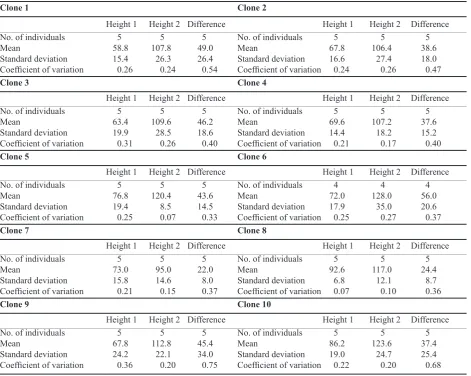
autumn mean height was from 51 cm (clone No. 12) to 153.8 cm (clone No. 19 – Table 9). Analysis of variance showed a statistically highly signifi cant infl uence of clone on spring and also autumn plant height. Duncan’s test divided clones into 11 homogeneous subgroups according to spring height and into 10 subgroups according to autumn height:
Spring height:
1. clone No. 12 (mean: 23.8 cm)
2. clones No. 16, 1, 41, 3, 2, 9, 4, 6, 7, 11, 5, 13, 150, 21 (common mean: 69.8 cm)
3. clones No. 1, 41, 3, 2, 9, 4, 6, 7, 11, 5, 13, 150, 21, 18, 10 (common mean: 73.1 cm)
4. clones No. 3, 2, 9, 4, 6, 7, 11, 5, 13, 150, 21, 18, 10, 14 (common mean: 76.4 cm)
5. clones No. 2, 9, 4, 6, 7, 11, 5, 13, 150, 21, 18, 10, 14, 8 (common mean: 78.6 cm)
6. clones No. 6, 7, 11, 5, 13, 150, 21, 18, 10, 14, 8, 28, 20, 29 (common mean: 85.8 cm)
7. clones No. 11, 5, 13, 150, 21, 18, 10, 14, 8, 28, 20, 29, 27 (common mean: 89.1 cm)
8. clones No. 150, 21, 18, 10, 14, 8, 28, 20, 29, 27, 23, 26 (common mean: 95.8 cm)
9. clones No. 21, 18, 10, 14, 8, 28, 20, 29, 27, 23, 26, 25 (common mean: 98.2 cm)
10. clones No. 14, 8, 28, 20, 29, 27, 23, 26, 25, 24 (com-mon mean: 103.8 cm)
11. clones No. 28, 20, 29, 27, 23, 26, 25, 24, 19 (common mean: 109.3 cm).
Autumn height:
1. clones No. 12, 16 (common mean: 59.4 cm)
[image:9.595.70.540.72.530.2]2. clones No. 16, 41, 13, 7, 150, 18 (common mean: 89.8 cm)
Table 4. Damage by aphids in seed orchard
Clone No. Number of Mortality (%) Undamaged (%) Low damaged (%) Strong damaged (%)
individuals individuals individuals individuals
1 5 0 4 80 1 20 0 0
2 5 0 3 60 2 40 0 0
3 7 0 4 57.1 3 42.9 0 0
4 4 0 2 50 2 50 0 0
5 5 0 4 80 1 20 0 0
6 5 0 2 40 3 60 0 0
7 5 0 3 60 2 40 0 0
8 6 0 3 50 3 50 0 0
9 5 0 4 80 1 20 0 0
10 5 0 3 60 1 20 1 20
11 5 0 4 80 1 20 0 0
12 5 0 3 60 2 40 0 0
13 5 0 2 40 3 60 0 0
14 7 0 5 71.4 2 28.6 0 0
15 6 0 3 50 3 50 0 0
16 6 0 4 66.7 2 33.3 0 0
17 7 0 4 57.1 3 42.9 0 0
18 5 0 3 60 2 40 0 0
19 4 0 2 50 2 50 0 0
20 5 1 20 4 80 0 0 0 0
21 5 0 2 40 3 60 0 0
22 5 0 5 100 0 0 0 0
23 5 0 4 80 1 20 0 0
24 5 0 2 40 2 40 1 20
25 5 1 20 2 40 2 40 0 0
26 5 0 3 60 2 40 0 0
27 5 0 5 100 0 0 0 0
28 3 0 1 33.3 2 66.7 0 0
29 5 0 3 60 2 40 0 0
30 5 0 3 60 2 40 0 0
3. clones No. 41, 13, 7, 150, 18, 2, 27, 4, 21, 1, 28, 3, 9, 14, 8, 5 (common mean: 105.9 cm)
4. clones No. 13, 7, 150, 18, 2, 27, 4, 21, 1, 28, 3, 9, 14, 8, 5, 10, 26, 6 (common mean: 110.3 cm)
5. clones No. 7, 150, 18, 2, 27, 4, 21, 1, 28, 3, 9, 14, 8, 5, 10, 26, 6, 11 (common mean: 112.7 cm)
6. clones No. 150, 18, 2, 27, 4, 21, 1, 28, 3, 9, 14, 8, 5, 10, 26, 6, 11, 23, 24 (common mean: 116.2 cm)
7. clones No. 2, 27, 4, 21, 1, 28, 3, 9, 14, 8, 5, 10, 26, 6, 11, 23, 24, 25 (common mean: 119.2 cm)
8. clones No. 21, 1, 28, 3, 9, 14, 8, 5, 10, 26, 6, 11, 23, 24, 25, 29 (common mean: 123.2 cm)
9. clones No. 14, 8, 5, 10, 26, 6, 11, 23, 24, 25, 29, 20 (common mean: 130.8 cm)
10. clones No. 5, 10, 26, 6, 11, 23, 24, 25, 29, 20, 19 (com-mon mean: 135.6 cm).
No individual died until June 2001, 118 individuals were not damaged by aphids (84.3%), damage of 22 in-dividuals was low (15.7%) and damage of no individual was strong out of 140 plants in the clonal test. No plant of 11 clones (out ot 28) was damaged (Table 10).
DISCUSSION
FLOWERING IN REPRODUCTIVE PLANTATIONS
A higher number of grafted trees fl owered in both repro-ductive plantations with German clones. A small part of grafted trees fl owered in the clone archives of Moravian origin. Although grafted trees in the seed orchard are 3 years older than grafted trees of Moravian clones, grafted trees of German clonal origin in the reserve clone archives have the same age. Grafted trees are only 4–7 years old and plantations were established 2–3 years ago, so it is necessary to continue investigations of their fl owering and also fructifi cation.
DAMAGE BY APHIDS IN BREEDING PLANTATIONS
[image:10.595.56.526.71.477.2]Damage by aphids was observed in 5 breeding planta-tions. Comparison of this type of damage between individ-ual plantations showed that older and higher plantations Table 5. Damage by aphids in reserve clone archives
Clone No. Number of Mortality (%) Undamaged (%) Low damaged (%) Strong damaged (%)
individuals individuals individuals individuals
1 5 0 0 4 80 1 20 0 0
2 3 1 33 1 33.3 1 33.3 0 0
3 5 0 0 1 20 3 60 1 20
4 6 0 0 1 16.7 5 83.3 0 0
5 10 0 0 5 50 4 40 1 10
6 4 1 25 1 25 2 50 0 0
7 7 0 0 3 42.9 3 42.9 1 14.3
8 5 0 0 1 20 4 80 0 0
9 7 0 0 2 28.6 5 71.4 0 0
10 6 0 0 2 33.3 4 66.7 0 0
11 9 0 0 2 22.2 7 77.8 0 0
12 5 0 0 2 40 3 60 0 0
13 6 0 0 4 66.7 2 33.3 0 0
14 4 0 0 2 50 2 50 0 0
15 4 0 0 2 50 2 50 0 0
16 7 0 0 4 57.1 3 42.9 0 0
17 4 0 0 3 75 0 0 1 25
18 9 0 0 4 44.4 3 33.3 2 22.2
19 2 0 0 2 100 0 0 0 0
21 5 0 0 1 20 2 40 2 40
22 4 0 0 3 75 1 25 0 0
23 2 1 50 0 0 1 50 0 0
24 6 3 50 2 33.3 0 0 1 16.7
25 6 0 0 2 33.3 3 50 1 16.7
27 7 0 0 3 42.9 4 57.1 0 0
29 3 0 0 2 66.7 1 33.3 0 0
Table 6. Damage by aphids in clone archives of Moravian origin
Clone No. Number of Mortality (%) Undamaged (%) Low damaged (%) Strong damaged (%)
individuals individuals individuals individuals
1 1 0 1 100 0 0 0 0
2 3 0 3 100 0 0 0 0
7 4 0 3 75 1 25 0 0
8 6 0 5 83.3 1 16.7 0 0
13 1 1 100 0 0 0 0 0 0
14 2 0 2 100 0 0 0 0
17 3 0 1 33.3 2 66.7 0 0
45 1 0 1 100 0 0 0 0
46 2 0 1 50 1 50 0 0
51 3 0 2 66.7 1 33.3 0 0
52 5 0 4 80 1 20 0 0
55 3 0 1 33.3 2 66.7 0 0
56 1 0 0 0 1 100 0 0
58 2 0 2 100 0 0 0 0
59 1 0 0 0 1 100 0 0
70 1 0 1 100 0 0 0 0
71 2 0 1 50 1 50 0 0
73 1 0 0 0 1 100 0 0
76 6 0 4 66.7 2 33.3 0 0
77 1 0 1 100 0 0 0 0
78 3 0 2 66.7 1 33.3 0 0
91 2 0 0 0 2 100 0 0
96 1 0 1 100 0 0 0 0
99 3 0 1 33.3 2 66.7 0 0
102 5 0 3 60 2 40 0 0
172 2 0 1 50 1 50 0 0
174 5 0 2 40 2 40 1 20
181 1 0 0 0 1 100 0 0
185 1 0 0 0 1 100 0 0
191 2 0 1 50 1 50 0 0
196 3 0 1 33.3 2 66.7 0 0
197 4 0 3 75 1 25 0 0
198 2 0 1 50 1 50 0 0
199 2 0 1 50 1 50 0 0
200 3 0 1 33.3 2 66.7 0 0
203 2 0 1 50 1 50 0 0
205 4 0 3 75 1 25 0 0
208 2 0 0 0 1 50 1 50
215 2 0 1 50 1 50 0 0
220 2 0 0 0 2 100 0 0
222 1 0 0 0 1 100 0 0
224 2 0 2 100 0 0 0 0
235 7 1 14.3 3 42.9 3 42.9 0 0
236 2 0 1 50 1 50 0 0
238 1 0 0 0 1 100 0 0
239 1 0 0 0 1 100 0 0
292 1 0 1 100 0 0 0 0
299 2 1 50 0 0 0 0 1 50
Table 7. Growth of half-sib progenies
Progeny 1 Progeny 2
Height 1 Height 2 Difference Height 1 Height 2 Difference
No. of individuals 25 25 25 No. of individuals 19 19 19
Mean 66.4 78.3 11.9 Mean 33.4 41.9 8.6
Standard deviation 22.7 25.3 10.2 Standard deviation 13.6 16.4 10.0
Coeffi cient of variation 0.34 0.32 0.86 Coeffi cient of variation 0.41 0.39 1.17
Progeny 3 Progeny 4
Height 1 Height 2 Difference Height 1 Height 2 Difference
No. of individuals 18 18 18 No. of individuals 19 19 19
Mean 33.3 41.8 8.5 Mean 29.8 35.5 5.7
Standard deviation 18.9 21.0 8.7 Standard deviation 9.7 12.3 6.0
Coeffi cient of variation 0.57 0.50 1.02 Coeffi cient of variation 0.33 0.35 1.05
Progeny 5 Progeny 6
Height 1 Height 2 Difference Height 1 Height 2 Difference
No. of individuals 24 24 24 No. of individuals 20 20 20
Mean 24.8 27.6 2.8 Mean 25.3 31.8 6.5
Standard deviation 6.4 6.9 4.1 Standard deviation 20.9 22.6 6.9
Coeffi cient of variation 0.26 0.25 1.50 Coeffi cient of variation 0.83 0.71 1.06
Progeny 7 Progeny 8
Height 1 Height 2 Difference Height 1 Height 2 Difference
No. of individuals 24 24 24 No. of individuals 23 23 23
Mean 57.1 69.3 12.3 Mean 26.2 32.1 5.9
Standard deviation 17.5 17.9 7.1 Standard deviation 10.6 12.4 6.0
Coeffi cient of variation 0.30 0.26 0.58 Coeffi cient of variation 0.40 0.39 1.01
Progeny 9 Progeny 10
Height 1 Height 2 Difference Height 1 Height 2 Difference
No. of individuals 18 18 18 No. of individuals 21 21 21
Mean 31.3 39.4 8.1 Mean 23.2 27.2 4.0
Standard deviation 12.4 11.0 6.6 Standard deviation 6.4 6.3 4.5
Coeffi cient of variation 0.40 0.28 0.81 Coeffi cient of variation 0.28 0.23 1.11
Progeny 11 Progeny 12
Height 1 Height 2 Difference Height 1 Height 2 Difference
No. of individuals 21 21 21 No. of individuals 17 17 17
Mean 10.9 15.9 4.9 Mean 10.6 12.4 1.7
Standard deviation 2.0 10.9 10.5 Standard deviation 4.1 5.4 2.4
Coeffi cient of variation 0.18 0.69 2.12 Coeffi cient of variation 0.39 0.44 1.42
Progeny 13 Progeny 14
Height 1 Height 2 Difference Height 1 Height 2 Difference
No. of individuals 17 16 16 No. of individuals 14 14 14
Mean 14.2 18.2 3.8 Mean 14.8 19.3 4.5
Standard deviation 9.1 13.7 5.1 Standard deviation 6.5 9.8 5.8
Coeffi cient of variation 0.64 0.76 1.35 Coeffi cient of variation 0.44 0.51 1.29
Table 8. Damage by aphids in half-sib progeny test
Progeny No. Number of Mortality (%) Undamaged (%) Low damaged (%) Strong damaged (%)
individuals individuals individuals individuals
1 25 1 4 24 96 0 0 0 0
2 25 0 25 100 0 0 0 0
3 25 0 25 100 0 0 0 0
4 24 0 24 100 0 0 0 0
5 25 0 24 96 1 4 0 0
6 25 0 25 100 0 0 0 0
7 25 0 24 96 1 4 0 0
8 25 0 25 100 0 0 0 0
9 25 0 25 100 0 0 0 0
10 25 0 24 96 1 4 0 0
11 24 0 24 100 0 0 0 0
12 23 1 4 22 95.7 0 0 0 0
13 21 0 21 100 0 0 0 0
14 18 0 18 100 0 0 0 0
Total 335 2 0.6 330 98.5 3 0.9 0 0
Table 9. Plant growth in clonal test
Clone 1 Clone 2
Height 1 Height 2 Difference Height 1 Height 2 Difference
No. of individuals 5 5 5 No. of individuals 5 5 5
Mean 58.8 107.8 49.0 Mean 67.8 106.4 38.6
Standard deviation 15.4 26.3 26.4 Standard deviation 16.6 27.4 18.0
Coeffi cient of variation 0.26 0.24 0.54 Coeffi cient of variation 0.24 0.26 0.47
Clone 3 Clone 4
Height 1 Height 2 Difference Height 1 Height 2 Difference
No. of individuals 5 5 5 No. of individuals 5 5 5
Mean 63.4 109.6 46.2 Mean 69.6 107.2 37.6
Standard deviation 19.9 28.5 18.6 Standard deviation 14.4 18.2 15.2
Coeffi cient of variation 0.31 0.26 0.40 Coeffi cient of variation 0.21 0.17 0.40
Clone 5 Clone 6
Height 1 Height 2 Difference Height 1 Height 2 Difference
No. of individuals 5 5 5 No. of individuals 4 4 4
Mean 76.8 120.4 43.6 Mean 72.0 128.0 56.0
Standard deviation 19.4 8.5 14.5 Standard deviation 17.9 35.0 20.6
Coeffi cient of variation 0.25 0.07 0.33 Coeffi cient of variation 0.25 0.27 0.37
Clone 7 Clone 8
Height 1 Height 2 Difference Height 1 Height 2 Difference
No. of individuals 5 5 5 No. of individuals 5 5 5
Mean 73.0 95.0 22.0 Mean 92.6 117.0 24.4
Standard deviation 15.8 14.6 8.0 Standard deviation 6.8 12.1 8.7
Coeffi cient of variation 0.21 0.15 0.37 Coeffi cient of variation 0.07 0.10 0.36
Clone 9 Clone 10
Height 1 Height 2 Difference Height 1 Height 2 Difference
No. of individuals 5 5 5 No. of individuals 5 5 5
Mean 67.8 112.8 45.4 Mean 86.2 123.6 37.4
Standard deviation 24.2 22.1 34.0 Standard deviation 19.0 24.7 25.4
[image:13.595.71.543.372.748.2]Clone 11 Clone 12
Height 1 Height 2 Difference Height 1 Height 2 Difference
No. of individuals 5 5 5 No. of individuals 5 5 5
Mean 76.2 132.0 55.8 Mean 23.8 51.0 27.2
Standard deviation 30.1 32.6 11.2 Standard deviation 17.0 20.0 14.2
Coeffi cient of variation 0.39 0.25 0.20 Coeffi cient of variation 0.71 0.39 0.52
Clone 13 Clone 14
Height 1 Height 2 Difference Height 1 Height 2 Difference
No. of individuals 5 5 5 No. of individuals 5 5 5
Mean 78.8 91.2 12.4 Mean 90.4 116.0 25.6
Standard deviation 26.1 16.8 14.6 Standard deviation 26.5 39.3 14.1
Coeffi cient of variation 0.33 0.18 1.18 Coeffi cient of variation 0.29 0.34 0.55
Clone 16 Clone 18
Height 1 Height 2 Difference Height 1 Height 2 Difference
No. of individuals 5 5 5 No. of individuals 5 5 5
Mean 53.8 67.8 14.0 Mean 84.0 102.0 18.0
Standard deviation 10.6 15.8 7.2 Standard deviation 18.7 17.5 12.5
Coeffi cient of variation 0.20 0.23 0.51 Coeffi cient of variation 0.22 0.17 0.70
Clone 19 Clone 20
Height 1 Height 2 Difference Height 1 Height 2 Difference
No. of individuals 5 5 5 No. of individuals 5 5 5
Mean 128.0 153.8 25.8 Mean 102.0 149.6 47.6
Standard deviation 19.8 37.6 24.5 Standard deviation 19.3 26.1 24.8
Coeffi cient of variation 0.16 0.24 0.95 Coeffi cient of variation 0.19 0.17 0.52
Clone 21 Clone 23
Height 1 Height 2 Difference Height 1 Height 2 Difference
No. of individuals 4 4 4 No. of individuals 5 5 5
Mean 83.5 107.3 23.8 Mean 108.6 134.0 25.4
Standard deviation 18.1 26.1 10.1 Standard deviation 7.4 23.1 25.3
Coeffi cient of variation 0.22 0.24 0.43 Coeffi cient of variation 0.07 0.17 1.00
Clone 24 Clone 25
Height 1 Height 2 Difference Height 1 Height 2 Difference
No. of individuals 5 5 5 No. of individuals 5 5 5
Mean 115.4 136.6 21.2 Mean 112.2 140.0 27.8
Standard deviation 12.9 19.4 12.8 Standard deviation 21.0 32.1 16.0
Coeffi cient of variation 0.11 0.14 0.60 Coeffi cient of variation 0.19 0.23 0.58
Clone 26 Clone 27
Height 1 Height 2 Difference Height 1 Height 2 Difference
No. of individuals 5 5 5 No. of individuals 5 5 5
Mean 109.8 127.8 18.0 Mean 103.2 106.6 3.4
Standard deviation 19.3 25.3 16.3 Standard deviation 12.8 10.6 3.2
Coeffi cient of variation 0.18 0.20 0.91 Coeffi cient of variation 0.12 0.10 0.94
Clone 28 Clone 29
Height 1 Height 2 Difference Height 1 Height 2 Difference
No. of individuals 4 4 4 No. of individuals 5 5 5
Mean 101.0 109.5 8.5 Mean 102.2 144.2 42.0
Standard deviation 18.7 19.6 7.9 Standard deviation 15.1 11.8 17.0
Coeffi cient of variation 0.18 0.18 0.93 Coeffi cient of variation 0.15 0.08 0.40
Clone 41 Clone 150
Height 1 Height 2 Difference Height 1 Height 2 Difference
No. of individuals 5 5 5 No. of individuals 4 4 4
Mean 60.0 86.4 26.4 Mean 81.5 98.0 16.5
Standard deviation 26.8 24.1 16.1 Standard deviation 23.7 25.6 10.6
Coeffi cient of variation 0.45 0.28 0.61 Coeffi cient of variation 0.29 0.26 0.64
[image:14.595.57.530.76.743.2]Height l – height in spring 2001, Height 2 – height in autumn 2001
were damaged more. The lowest damage was observed in plants of the progeny test where only 3 plants were dam-aged (0.9%) and no strong damage was observed. A higher number of damaged plants was observed in the clonal test where 22 individuals were damaged (15.7%) but this damage was only low. The highest number of damaged individuals was observed in 3 reproductive plantations of grafted trees which are also highest: seed orchard with German clones ... low damage of 55 individuals (35.5%) and strong damage of 2 individuals (1.3%), reserve clone archives with the same clones ... low damage of 66 in-dividuals (46.8%) and strong damage of 10 inin-dividuals (7.1%), clone archives with Moravian clones ... low damage of 48 individuals (41%) and strong damage of 3 individuals (2.6%). It is not possible to fi nd the infl uence of genetic differences in this phase yet but investigations of this problem have to continue because for example SANTIel al. (1998) found high heritability of sensitivity to aphids in 7 years old wild cherry clonal test.
PLANT GROWTH IN PROGENY AND CLONAL TESTS
A difference was 55.8 cm between the mean height of the lowest and highest progenies at the age of 2 years, 65.9 cm after the next season. This difference increased between the same progenies (No. 12 and 1). KOBLIHA(in KOBLIHA, PODRÁZSKÝ 2001) also mentioned that prog-eny No. 12 was the lowest (6.4 cm) and progprog-eny No. 1 was the highest (35.1 cm) in the nursery in autumn 1999. Increment was low ... 1.7–11.9 cm in 2001. In spring 2001 the difference was 104.2 cm between the mean height of the lowest and highest clones, then 102.8 cm after the next season (clones No. 12 and 19).
[image:15.595.72.537.321.754.2]Analyses of variance showed a statistically signifi cant infl uence of the progeny and clone on plant height growth in this stage. This fact is important because it shows a great selection potential. Plants propagated by cultures in vitro grow more rapidly than seedlings. Mean height of
Table 10. Damage by aphids in clonal test
Clone No. Number of Mortalityindividuals (%) Undamaged individuals (%) Low damaged individuals (%) Strong damaged (%)individuals
1 5 0 3 60 2 40 0 0
2 5 0 3 60 2 40 0 0
3 5 0 3 60 2 40 0 0
4 5 0 5 100 0 0 0 0
5 5 0 4 80 1 20 0 0
6 5 0 5 100 0 0 0 0
7 5 0 4 80 1 20 0 0
8 5 0 5 100 0 0 0 0
9 5 0 4 80 1 20 0 0
10 5 0 3 60 2 40 0 0
11 5 0 4 80 1 20 0 0
12 5 0 5 100 0 0 0 0
13 5 0 4 80 1 20 0 0
14 5 0 5 100 0 0 0 0
16 5 0 5 100 0 0 0 0
18 5 0 4 80 1 20 0 0
19 5 0 3 60 2 40 0 0
20 5 0 5 100 0 0 0 0
21 5 0 4 80 1 20 0 0
23 5 0 5 100 0 0 0 0
24 5 0 4 80 1 20 0 0
25 5 0 5 100 0 0 0 0
26 5 0 5 100 0 0 0 0
27 5 0 4 80 1 20 0 0
28 5 0 4 80 1 20 0 0
29 5 0 5 100 0 0 0 0
41 5 0 4 80 1 20 0 0
150 5 0 4 80 1 20 0 0
2 years old progenies was 10.6–66.4 cm and at the same age mean height of clones was 23.8–128 cm (one year later 51–153.8 cm).
References
AMPRIMO G., 1997. Primi rilevamenti in collezioni di fenotipi superiori di Prunus avium e Juglans regia. Annali Inst. Sper. Silvic., 1994–1995, 25–26: 71–79.
DUCCI F., TOCCI A., VERACINI A., 1990. Sintesi del registro del materiale di base di Prunus avium L. in Italia centro settentrionale, Basilicita e Calabria. Annali Inst. Sper. Silvic., 1988, 19: 263–303.
FRANKE A., HAUFF U., DAGENBACH H., 1988. Samenplantage “Waldkirsche Liliental” produziert Vermehrungsgut der Kirsche. Allg. Forstz., 20: 558–559. HAMMATT N., HIPPS N.A., BURGESS C.M., 1996. Genetic
and physiological research to improve farm woodland management. In: Vegetation management in forestry, amenity and conservation areas: managing for multiple objectives, 19 and 20 March 1996, University of York, York, UK. Aspects of Applied Biology, 44:101–107.
HYNEK V., BURIÁNEK V., BENEDÍKOVÁ M., FRÝDL J., KAŇÁK J., 1997. Výběrové stromy a porosty uznané pro sběr osiva – Základní kritéria. VÚLHM, Jíloviště-Strnady: 51. KOBLIHA J., JANEČEK V., 2001. Selekce stromů třešně ptačí.
In: Sbor. z celost. konf. Krajina, les a lesní hospodářství.Praha, ČZU, Kostelec n. Č. l., 22.–23. 1. 2001: 58–66.
KOBLIHA J., PODRÁZSKÝ V., 2001. Šlechtění a pěstování třešně ptačí (Prunus avium L.) v ČR. [Závěrečná zpráva výzkumného projektu NAZV EP 7138.] Praha, ČZU, LF: 150.
KOBLIHA J., 2002. Výsledky několikaletého šlechtění a pěs-tování třešně ptačí se zaměřením na rozšíření této dřeviny v lesním hospodářství ČR. [Závěrečná zpráva výzkumného projektu MZe ČR.] Praha, ČZU, LF: 51.
LAGERSTRÖM T., ERIKSSON G., 1997. Improvement of trees and shrubs by phenotypic selection for landscaping in urban and rural areas – a Swedish example. Forest Landsc. Res., 1: 349–366.
MARIETTE S., LEFRANC M., LEGRAND P., FRASCARIA--LACOSTE N., MACHON N., 1997. Genetic variability in
wild cherry population in France. Effects of colonizing pro-cesses. Theor. Appl. Genet., 94: 904–908.
MEIER-DINKEL A., SVOLBA J., KLEINSCHMIT J., 1997. Selektierte, mikrovermehrte Vogelkirschen – Klone. AFZ – Der Wald, Allgemeine Forst Zeitschrift für Waldwirtschaft und Umweltvorsorge, 52: 963–964.
MURANTY H., SANTI F., PAQUES L.C., DUFOUR J., 1996. Nombre optimal de ramets par clone dans deux tests clonaux. Ann. Sci. For., 53: 123–138.
MURANTY H., SCHERMANN N., SANTI F., DUFOUR J., 1998. Genetic parameters estimated from a wild cherry diallel: consequences for breeding. Silvae Genet., 47: 249–257. NICOLL F.J., 1993. Genetic improvement of cherry for farm
woodlands. Quart. J. For., 87: 187–194.
SANTI F., LEMOINE M., 1990. Genetic markers for Prunus avium L.: inheritance and linkage of isoensyme loci. Ann. Sci. For., 47: 131–139.
SANTI F., MURANTY H., DUFOUR J., PAQUES L.C., 1998. Genetic parameters and selection in a multisite wild cherry clonal test. Silvae Genet., 47: 61–67.
TUROK J., ERIKSSON G., KLEINSCHMIT J., CANGER S., COMPILERS, 1996. Noble Hardwoods Network. Report of the First Meeting, 24–27 March 1996, Escherode, Germany. International Plant Genetic Resources Institute, Rome, Italy: 172.
TUROK J., COLLIN E., DEMESURE B., ERIKSSON G., KLEINSCHMIT J., RUSANEN M., STEPHAN R., COMPI-LERS, 1998. Noble Hardwoods Network. Report of the Second Meeting, 22–25 March 1997, Lourizán, Spain. IPGRI, Rome, Italy: 104.
TUROK J., JENSEN J., PALMBERG-LERCHE CH., RU-SANEN M., RUSSELL K., DE VRIES L., LIPMAN E., COMPILERS, 1999. Noble Hardwoods Network. Report of the Third Meeting, 13–16 June 1998, Sagadi, Estonia. IPGRI, Rome, Italy: 116.
WEISER F., 1996. Ergebnisse einer 33 jahrigen Einzelbaum – Nachkommenschaftsprüfung nach freiem Abblühen von Vogelkirsche, Prunus avium L. var. avium. Silvae Genet., 45: 260–266.
Třešeň ptačí (Prunus avium L.) patří k tzv. ušlechtilým listnatým dřevinám (noble hardwoods), kterým je v současném období v Evropě věnována mimořádná pozornost především v rámci programu EUFORGEN. Tato pozornost se nyní věnuje třešni ptačí i v ČR, kde byl především zahájen šlechtitelský program na Lesnické fakultě České zemědělské univerzity v Praze. Nejdříve byl proveden rozsáhlý průzkum třešně ptačí v různých regionech. V první fázi byly vyselektovány a posléze uznány výběrové stromy na LS LČR Křivoklát a LS LČR Nižbor a VLS Velichov. Z těchto stromů byly odebírány rouby v letech 1999–2000 a následně naroubovány na Šlechtitelské stanici Truba v Kostelci nad Černými lesy. Tento materiál je připraven pro založení semenných sadů na LS LČR Lužná a na VLS Velichov na jaře roku 2002. Již v roce 1995 byly získány rouby ze 30 elitních (testy potomstev ověřených) klonů ze SRN z Dolnosaského lesnického výzkumného ústavu, oddělení v Escherode. Roubovance byly použity na jaře roku 1998 pro založení výzkumného semenného sadu druhé generace na ŠLP v Kostelci nad Černými lesy. Kromě toho byly z tohoto materiálu odebrány sekundární rouby pro množení v roce 1997 a 1998. Z materiálu získaného v roce 1997 byl založen další semenný sad v Lesích města Prostějova (na jaře 1999) a z materiálu z roku 1998 byl založen rezervní klonový archiv na ŠLP v Kostelci nad Černými lesy na jaře roku 2000. Dále byl v roce 1998 získán vegetativní materiál původem z moravských výběrových stromů (LS LČR Luhačovice, LS LČR Strážnice, LS LČR Brumov
Šlechtitelský program třešně ptačí (
Prunus avium
L.) se zaměřením na využití
této dřeviny v českém lesním hospodářství
J. KOBLIHA
Česká zemědělská univerzita, Lesnická fakulta, Praha, Česká republika
ABSTRAKT: Práce široce uvádí evropské zkušenosti ve šlechtění třešně ptačí; je první ze série připravovaných článků se zaměřením na šlechtění třešně ptačí v České republice. Popisuje zahájení šlechtitelského programu třešně ptačí pro české lesní hospodářství. Byly uznány výběrové stromy, založeny semenné sady, klonové archivy, testy potomstev a klonů. Klony v repro-dukčních výsadbách byly testovány na kvetení roubovanců. Potomstva a klony v testu potomstev i klonovém testu byly hodnoceny v růstových parametrech. Potomstva a klony ve všech šlechtitelských výsadbách byly testovány na poškození mšicemi.
Klíčová slova: semenný sad; klonový archiv; test polosesterských potomstev; klonový test; kvetení; růst; poškození mšicemi; Prunus avium L.
a Obecní lesy Suchá Loz). Z tohoto materiálu byl založen výzkumný klonový archiv s 55 klony na ŠLP v Kostelci nad Černými lesy na jaře roku 1999. Na podzim roku 2000 byla na ŠLP v Kostelci nad Černými lesy vysázena polosesterská potomstva 14 stromů ze ŠLP. Byly použity dvouleté semenáčky. Již předtím byly vysázeny na jaře roku 2000 výpěstky rozmnožené kulturami in vitro do klonového testu na ŠLP v Kostelci nad Černými lesy. Jedná se o 28 klonů původem z LS LČR Křivoklát, LS LČR Nové Hrady a LZ Prachatice.
V roce 2001 proběhla šetření na kvetení roubovanců v reprodukčních výsadbách, měření výšky sazenic na jaře a na podzim v testu polosesterských potomstev i klonovém testu a ve všech těchto výsadbách pak šetření na poškození stromků mšicemi. Bylo zjištěno, že v obou sle-dovaných výsadbách daleko více kvetly klony německého původu než klony moravského původu. Byly zjištěny značné diference v růstu mezi potomstvy i mezi klony. Analýza rozptylu ukázala statisticky vysoce významný vliv příslušnosti sazenic k potomstvu nebo výpěstků ke klonu na jejich výšku na jaře i na podzim roku 2001. Větší rozdíly jsou sledovány mezi klony než mezi generativními potomstvy. Klonový materiál rovněž předstihuje v růstu materiál generativního původu. Nejmenší poškození mšicemi bylo zjištěno v testu potomstev, o něco vyšší v klonovém testu a nejvyšší v reprodukčních výsadbách. Tato skutečnost ovšem nejvíce souvisí s velikostí stromků. Celkově však nebyly na žádném materiálu zjištěny vážnější důsledky tohoto poškození.
Corresponding author: