JOURNAL OF FOREST SCIENCE, 63, 2017 (10): 457–462 doi: 10.17221/62/2017-JFS
Influence of site conditions and silvicultural practice
on the wood density of Scots pine (Pinus sylvestris L.) –
a case study from the Doksy locality, Czech Republic
Ondřej SCHÖNFELDER
1, Aleš ZEIDLER
1*, Vlastimil BORŮVKA
1, Lukáš BÍLEK
21 Department of Wood Processing, Faculty of Forestry and Wood Sciences,
Czech University of Life Sciences Prague, Prague, Czech Republic
2 Department of Silviculture, Faculty of Forestry and Wood Sciences,
Czech University of Life Sciences Prague, Prague, Czech Republic
*Corresponding author: [email protected]
Abstract
Schönfelder O., Zeidler A., Borůvka V., Bílek L. (2017): Influence of site conditions and silvicultural practice on the wood density of Scots pine (Pinus sylvestris L.) – a case study from the Doksy locality, Czech Republic. J. For. Sci., 63: 457–462.
After spruce, the Scots pine (Pinus sylvestris Linnaeus) is the second most important commercial coniferous tree species in the Czech Republic. However, we are finding out that awareness of the variability of properties, and pos-sibilities to affect them, are noticeably small for this type of tree species in our conditions. The goal of this study is to primarily evaluate the importance of site conditions, silvicultural measures and other factors for the density of Scots pine wood in the Doksy locality in the Czech Republic. The Doksy locality is represented by three forest stands with different silvicultural history. Samples were taken from each stand, the basal and central parts of which were subsequently processed for test samples with dimensions of 20 × 20 × 30 mm. Wood density at 12% moisture content was ascertained in the test samples. The highest density value of 0.541 g·cm–3 was reached in a stand that is
regener-ated using the shelterwood method with long regeneration period, and the lowest density value of 0.488 g·cm–3 was
recorded in a stand that was regenerated using the clear-cutting method. From a forestry perspective, it can be further stated that the wood density of Scots pine is also affected by the site conditions and position of samples in the trunk.
Keywords: shelterwood regeneration; clearcut; forest site; softwoods; physical properties; variability
Supported by the Czech University of Life Sciences Prague, Project No. A28/17, and by the Ministry of Agriculture of the Czech Republic, Project No. QJ1520037.
After Norway spruce (Picea abies (Linnaeus) H. Karsten), the Scots pine (Pinus sylvestris Linnaeus) is the second most important commercial conifer-ous tree species in the Czech Republic. With the increasing biotic and abiotic damage to spruce for-ests, the importance of the pine will be increasing; however, we are finding out that we know very little about the properties of this tree species in the con-ditions of Central Europe. In terms of forest man-agement, the pine currently covers 16.6% of the
to-tal area, whilst its natural representation in the tree species composition of the forest was 3.4%. The recommended representation of the pine in forest stands is in fact higher than the current state (Min-istry of Agriculture of the Czech Republic 2016).
Middleton 1994). The quality of wood is a subjec-tive concept to a certain extent, and it must always be understood in the relevant context (MacDon-ald et al. 2010). We usually understand it from the perspective of properties that are beneficial for the final use of wood.
Wood is a heterogeneous material and exhibits high variability of properties. The variability of pine properties can be observed between individual localities and trees, and even within a single tree (Tomczak et al. 2007; Kask 2015). Through the tree genotype, wood properties are largely influ-enced by altitude, climatic factors, by the surround-ing environment and by silvicultural measures (Tsoumis 1991; Peltola et al. 2007; Jelonek et al. 2008, 2012; Tomczak et al. 2013; Roszyk et al. 2016). The variability of wood properties within a trunk is crucial for the final processing of wood.
The main indicator of wood quality is density, which largely affects other physical, and of course strength characteristics of wood (Kollmann 1951; Auty et al. 2014). It generally applies that the strength of wood increases with increasing density (Kimberley et al. 2015). Wood density decreases with the increasing height of the tree, and it in-creases in the horizontal direction from the pith to the periphery of the trunk (Požgaj et al. 1997). One of the causes of variability of wood properties in the horizontal direction is juvenile wood. Juvenile wood is generally defined as the wood zone in the middle of the trunk which takes up approximately 5 to 20 tree rings. In this zone, rapid and progressive changes occur in the structure of the wood, and it therefore has different properties compared to ma-ture wood (Kretschmann et al. 1993). Another de-termining criterion that influences properties in the horizontal direction is the width of the tree ring. In pine wood, it is assumed that with increasing ring width, the proportion of late wood decreases, and consequently its density also decreases (Kask 2015).
The aim of this study was to assess the impact of silvicultural measures and site conditions on the wood density value of Scots pine from the Doksy
region in the Czech Republic. The variability of density in the horizontal and vertical position of the trunk was also analysed. The influence of the tree ring width on wood density was also evaluated.
METHODS
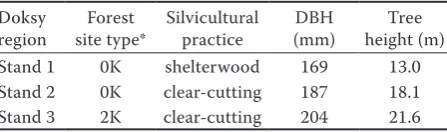
The research was conducted in the Doksy study lo-cality, of which the natural occurrence of Scots pine in the Czech Republic is typical. Extraction took place in three forest stands that are characteristic of the Doksy region and represent different silvicultural practices or site conditions (Table 1). Forest stands are owned by the Municipal Forests of the town of Doksy and are located in the Natural Forest Region PLO 18 (Severočeská pískovcová plošina and Český ráj), where average precipitation is 550 mm, the aver-age temperature is between 7 and 8°C, according to the data from the nearest meteorological station, and the altitude reaches up to 450 m a.s.l. Seven sample trees were selected from each stand, from which test material was made. An important criterion for the selection of sample trees was the representation of characteristic individuals of the relevant stand, their vitality and absence of growth irregularities and de-fects. Stand 1 is characterized by the advanced under-storey of pine that grows in the shade of parent trees. Sampled trees represent these individuals growing under the canopy of parent stand tended by regen-eration fellings. Stands 2 and 3 were established on a clear-cut area, i.e. sampled trees have grown without the shelter of parent trees in a single-layered even-aged stand since the very beginning.
[image:2.595.65.289.664.730.2]A total of 21 sample trees were felled in winter to assess wood density from the Doksy locality. To assess the vertical variability of wood density, two logs were cut out from individual sample trees in the direction from the base to the crown. A basal log was always cut out from the breast-height diameter area (in the middle of the section), and the central log was cut out at 1/3 of the height of the trunk only if the trunk had a diameter greater than 15 cm. The length of each section was 150 cm. In stand 1 the trunk did not have the required dimensions, and therefore the central log was not cut. A disc was cut out from each log so that a tree ring analysis could be carried out. In order to assess the variability in the horizontal plane of the trunk, a central plank was cut out from each log whose width allowed for test materials to be produced. The timber prepared in this way was interleaved and stored in a covered space with free air flow. When the wood moisture content dropped below 15%, the individual planks
Table 1. Average values of sample trees from selected stands
Doksy
were cut lengthwise in the direction from the pith toward the cambium making laths of 20 × 20 mm in cross-section (Fig. 1). The material prepared in this way served as a basis for the preparation of test specimens. After final modifications, the test speci-mens had dispeci-mensions of 20 × 20 × 30 mm for physi-cal tests. The examined physiphysi-cal property was the basic variable, i.e. density at 12% moisture content. The test specimens were stabilized in a condition-ing chamber at 12% equilibrium moisture content in the environment with an air temperature of 20 ± 2°C and relative humidity of 65 ± 5%. A total of 1,636 specimens were tested for density. The qual-ity of all the samples complied with the standard ČSN 49 0101 and they were free of irregular growth defects and compression wood.
The standard ČSN 49 0108 was used to evalu-ate density. Density was evaluevalu-ated at 12% moisture content (ρ12) according to Eq. 1:
–3
12 12
12
ρ m g·cm
V
(1)
where:
m12 – mass of the specimens at 12% moisture content (g), V12 – volume of the specimens at 12% moisture content
(cm3).
We used an A3 Epson GT-15000 scanner (Epson, Japan) and resolution of 800 dpi to scan the disk for tree ring width analysis. The NIS-Elements AR Image Analysis Software (Version 4.11, 2014) was employed to measure the width of tree rings.
To assess the statistical significance of individ-ual impacts, the multifactor ANOVA tests (Fisher
F-test) and Duncan’s multiple comparison tests
were used. The level of significance α = 0.05% was used for all statistical analyses. The evaluated fac-tors were vertical position (along the height of the trunk), horizontal position (distance from the pith), and silvicultural measures and site conditions. Sta-tistical analyses were carried out using the STATIS-TICA program (Version 13, 2016).
RESULTS AND DISCUSSION
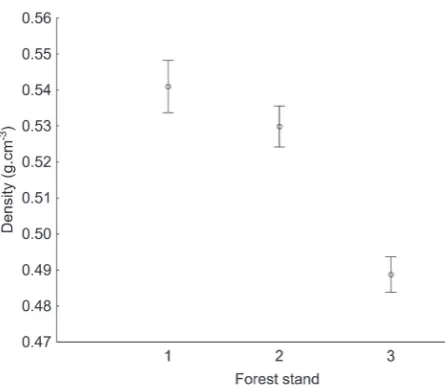
A difference in density on different sites (forest type groups 0K and 2K) was observed between stands 2 and 3, which were regenerated on a clear-cut area. The descriptive statistics of individual stands are shown in Table 2. Table 2 shows that the average value of pine wood density at 12% mois-ture content reaches 0.529 g·cm–3 for stand 2, and 0.488 g·cm–3 for stand 3. An analysis of variance of the examined stands revealed that the wood density of Scots pine differs significantly, P < 0.05 (Fig. 2). Stand 2 shows higher density values than those in-dicated by many authors (Lexa et al. 1952; Požgaj et al. 1997; Wagenführ 2002; Fellner 2007). Conversely, the wood density of stand 3 is compa-rable with literature (Novák 1970; Šimůnková, Kučerová 2000), but the variability of density is high. Jelonek et al. (2005), Tomczak and Jelonek (2013), and Hautamäki et al. (2014) reported
dif-Table 2. Descriptive statistics – comparison of density in individual stands
Stand 1 Stand 2 Stand 3 Mean
(g·cm–3) 0.541 0.529 0.488
Median
(g·cm–3) 0.534 0.528 0.477
Coefficient
of variation (%) 7.9 10.9 17.1 Standard
deviation (g·cm–3) 0.0428 0.0581 0.0836
Number
[image:3.595.305.533.86.228.2]of specimens 342 556 738
Fig. 1. Tree sampling and the test sample description
[image:3.595.307.530.533.727.2] [image:3.595.66.268.612.730.2]ferent results of pine density in various sites. This phenomenon was confirmed by Tsoumis (1991), who stated that site conditions may significantly af-fect density.
The monitored differences in density depending on silvicultural measures were observed between stand 1 and stand 2. These stands are found in the same site conditions (forest type group 0K), and it is therefore possible to monitor differences in properties caused by different regeneration meth-ods used. A statistically significant difference (P < 0.05) in density values was confirmed between the investigated stands. Higher average density values of 0.541 g·cm–3 were obtained in stand 1, which is regenerated using the shelterwood method, and conversely, lower values of 0.529 g·cm–3 were shown in stand 3, which was regenerated using the clear-cutting method. Low values of wood density for planted pines were also reported for example by Eriksson et al. (2006) and Mederski et al. (2015).
The density variability in the horizontal direction is shown in Fig. 3a and Table 3 with the average density values in individual sections. The density variability in the horizontal direction for stands 2 and 3 demonstrated a clear trend of increasing the value in the direction from the pith to the bark, similarly to what was stated by Nicholls and Brown (1973), Fritts et al. (1991), and Ivković et al. (2013). A statistically significant difference
(P < 0.05) was demonstrated between these stands in individual positions. Sample trees from stand 1 grew in the shade. For this reason they show low annual increments at the early stages of growth. After the regeneration felling in 2008, there was a sudden significant increase in the thickness of the tree ring of the understorey individuals. This trend was described by Eriksson et al. (2006).
In order to assess the variability of wood prop-erties, it is necessary to take into consideration in which part of the trunk the wood is located. It is evident from Fig. 3b and Table 3 that wood density in the basal part of the tree shows higher density values than those in the middle part. A statistically significant difference (P < 0.05) was found between individual sections. No significant difference in density (P = 0.066) was found between stands 1 and 2 at the base part. Stand 3 indicates a lower density value in all sections than the other stands. Higher density values in the basal part of the trunk were described for example by Tsoumis (1991), Požgaj et al. (1997), Repola (2006), and Riesco Muñoz et al. (2008).
[image:4.595.63.531.55.234.2]The tree ring analysis is shown in Fig. 4. It is evi-dent from the image that stands 2 and 3 have the widest tree rings in the part closest to the pith. With increasing distance from the pith, the width of the tree rings shows a decreasing tendency un-til it essentially stabilizes (Tomczak et al. 2007).
Table 3. Mean density variability within a trunk
Density variability (g·cm–3)
vertical horizontal
basal section middle section 1st position 2nd position 3rd position
Stand 1 0.541 – 0.535 0.548 0.528
Stand 2 0.551 0.495 0.497 0.542 0.602
[image:4.595.61.535.678.757.2]Stand 3 0.511 0.458 0.435 0.495 0.569
Stand 1 indicates a completely opposite trend. This trend largely copies the horizontal course of densi-ty, wherein the density decreases with the increas-ing width of the tree rincreas-ings, similarly to what was stated by Mörling (2002) or Ivković et al. (2013), as mentioned earlier.
Table 4 shows a comparison of our results with those of the authors who investigated the density of Scots pine wood in the region of Central Europe. In most cases, the investigated pine wood density from the Doksy region shows higher density values when compared to these authors.
CONCLUSIONS
The aim of this study was to primarily evaluate the impact of silvicultural measures and site conditions on the wood density of Scots pine from the Doksy region in the Czech Republic. In most cases, the in-vestigated pine wood density from the Doksy region reaches higher density values when compared to the results of other authors (Lexa et al. 1952; Novák 1970; Wagenführ 2002), who investigated the den-sity of Scots pine in neighbouring territories. Given the fact that wood density significantly affects the mechanical properties of wood, it can be presumed that pine, which grows on natural pine sites in the study locality, achieves high wood qualities for final use. Forest site was proven to be a significant factor that affected wood density. Silvicultural practice was also proven to have an impact on wood density; the shelterwood method with long regeneration period
indicates a more even distribution of density along the radius of the trunk. With regard to the final pro-cessing of wood, it is necessary to take into consider-ation which part of the tree the wood comes from – wood with greater density is found more in the basal part of the tree than in the middle part. Pine wood plays an important role in the wood processing in-dustry in the Czech Republic, and it will be increas-ing in the Czech Republic the more it is planted.
References
Auty D., Achim A., Macdonald E., Cameron A.D., Gardiner B.A. (2014): Models for predicting wood density variation in Scots pine. Forestry: An International Journal of Forest Research, 87: 449–458.
Eriksson D., Lindber H., Bergsten U. (2006): Influence of silvicultural regime on wood structure characteristics and mechanical properties of clear wood in Pinus sylvestris. Silva Fennica, 40: 743–762.
Fellner J., Teischinger A., Zschokke W. (2007): Spektrum dřevin: vyobrazení, popis a srovnávací údaje. Vienna, proHolz Austria: 111.
Fritts H.C., Vaganov E.A., Sviderskaya I.V., Shashkin A.V. (1991): Climatic variation and tree-ring structure in coni-fers: Empirical and mechanistic models of tree-ring width, number of cells, cell size, cell-wall, thickness and wood density. Climate Research, 1: 97–116.
Hautamäki S., Kilpeläinen H., Verkasalo E. (2014): Factors and models for the bending properties of sawn timber from Finland and north-western Russia. Part II: Scots pine. Baltic Forestry, 20: 142–156.
Ivković M., Gapare W., Wu H., Espinoza S., Rozenberg P. (2013): Influence of cambial age and climate on ring width and wood density in Pinus radiata families. Annals of For-est Science, 70: 525–534.
Jelonek T., Pazdrowski W., Tomczak A., Grzywiński W. (2012): Biomechanical stability of pines growing on former farmland in northern Poland. Wood Research, 57: 31–44. Jelonek T., Pazdrowski W., Tomczak A., Szaban J. (2008): The
effect of social position of a tree in the stand and site on wood quality of scots pine (Pinus sylvestris L.). Electronic Journal of Polish Agricultural Universities, 11: 10. Jelonek T., Tomczak A., Jakubowski M., Pazdrowski W.
[image:5.595.63.291.52.226.2](2005): Properties of Scots pine (Pinus sylvestris L.) timber growing on former arable and forest land. Acta Scientiarum Polonorum Silvarum Colendarum Ratio et Industria Lig-naria, 4: 35–47.
Table 4. Comparison of the wood density of Scots pine with various authors
Measured values Wagenführ (2002) Novák (1970) Lexa et al. (1952)
[image:5.595.64.531.726.758.2]Density (g·cm–3) 0.488–0.541 0.510 0.470 0.510
Fig. 4. Tree ring analysis of the basal section
7 6 5 4 3 2 1 0
Jozsa L.A., Middleton G.R. (1994): A Discussion of Wood Quality Attributes and Their Practical Implications. Van-couver, Forintek Canada Corporation: 42.
Kask R. (2015): The influence of growth conditions on physi-co-mechanical properties of Scots pine (Pinus sylvestris L.) wood in Estonia. [Ph.D. Thesis.] Tartu, Institute of Forestry and Rural Engineering: 164.
Kimberley M.O., Cown D.J., McKinley R.B., Moore J.R., Dowling L.J. (2015): Modelling variation in wood density within and among trees in stands of New Zealand-grown radiata pine. New Zealand Journal of Forestry Science, 45: 22.
Kollmann F. (1951): Technologie des Holzes und der Holz-werkstoffe. Berlin, Heidelberg, Springer-Verlag: 1050. Kretschmann D.E., Moody R.C., Pellerin R.F., Bendtsen B.A.,
Cahill J.M., McAlister R.H., Sharp D.W. (1993): Effect of Various Proportions of Juvenile Wood on Laminated Veneer Lumber. Madison, USDA Forest Service, Forest Products Laboratory: 31.
Lexa J., Nečesaný V., Paclt J., Tesařová M., Štofko J. (1952): Technológia dreva I. Mechanické a fyzikálne vlastnosti dreva. Bratislava, Práca: 436.
MacDonald E., Moore J., Connolly T., Gardiner B. (2010): Assessing timber quality of Scots pine (Pinus sylvestris L.). In: Ridley-Ellis D.J., Moore J.R. (eds): The Future of Quality Control for Wood and Wood Products, Edinburgh, May 4–7, 2010: 180–190.
Mederski P.S., Bembenek M., Karaszewski Z., Giefing D.F., Sulima-Olejniczak E., Rosińska M., Łącka A. (2015): Density and mechanical properties of Scots pine (Pinus sylvestris L.) wood from a seedling seed orchard. Drewno, 58: 117–124.
Ministry of Agriculture of the Czech Republic (2016): Zpráva o stavu lesa a lesního hospodářství České republiky v roce 2015. Available at http://www.uhul.cz/ke-stazeni/infor-mace-o-lese/zelene-zpravy-mze (accessed Dec 17, 2016). Mörling T. (2002): Evaluation of annual ring width and ring
density development following fertilisation and thinning of Scots pine. Annals of Forest Science, 59: 29–40. Nicholls J.W.P., Brown A.G. (1973): The relationship between
ring width and wood characteristics in double-stemmed trees of radiata pine. New Zealand Journal of Forestry Science, 4: 105–111.
Novák V. (1970): Dřevařská technická příručka. Prague, Státní nakladatelství technické literatury: 748.
Peltola H., Kilpeläinen A., Sauvala K., Räisänen T., Ikonen V. (2007): Effects of early thinning regime and tree status on the radial growth and wood density of Scots pine. Silva Fennica, 41: 489–505.
Požgaj A., Chovanec D., Kurjatko S., Babiak M. (1997): Štruktúra a vlastnosti dreva. Bratislava, Príroda: 485. Repola J. (2006): Models for vertical wood density of Scots
pine, Norway spruce and birch stems, and their applica-tion to determine average wood density. Silva Fennica, 40: 673–685.
Riesco Muñoz G.R., Soilán Cañas M.A., Rodríguez Soalleiro R. (2008): Physical properties of wood in thinned Scots pines (Pinus sylvestris L.) from plantations in northern Spain. Annals of Forest Science,65: 507–507.
Roszyk E., Moliński W., Kusiak W., Prądzyński W., Zborowska M. (2016): Physical properties of Scots pine wood from the Notecka Forest. Sylwan, 160: 547–555.
Šimůnková E., Kučerová I. (2000): Dřevo. Prague, Stop: 134. Tomczak A., Jelonek T. (2013): Radial variation in the wood
properties of Scots pine (Pinus sylvestris L.) grown on former agricultural soil. Leśne Prace Badawcze (Forest Research Papers), 74: 171–177.
Tomczak A., Jelonek T., Jakubowski M. (2013): Density of scots pine (Pinus sylvestris L.) wood as an indicator of tree resistance to strong winds. Sylwan, 157: 539–545. Tomczak A., Pazdrowski W., Jelonek T., Stypuła I. (2007):
Vertical variability of selected macrostructural proper-ties of juvenile wood organization in trunks of Scots pine (Pinus sylvestris L.) trees. Acta Societatis Botanicorum Poloniae, 76: 27–33.
Tsoumis G. (1991): Science and Technology of Wood: Structure, Properties, Utilization. New York, Chapman and Hall: 494.
Viewegh J., Kusbach A., Mikeska M. (2003): Czech forest eco-system classification. Journal of Forest Science, 49: 74–82. Wagenführ R. (2002): Dřevo – obrázkový lexikon. Prague,
Grada Publishing, a.s.: 348.