
ARTISTE Final Report
42
0
0
Full text
(2) Document Changes Rev. A. Date. Section. Comment. 2002-09-20. All. Initial Issue. Reviewers of Current Revision Rev. A. Name, Organisation. Role. ARTISTE PMT. Project Management Team. Warren Sterling, NCR. Project Board Chair. Susan Ahrenst, NCR. Proof reading. Trademarks All trademarks and service marks mentioned in this document are marks of their respective owners and are as such acknowledged by the ARTISTE Consortium.. Control Information Page 39 is the last page of this document.. ii. ARTISTE - Deliverable D1.2. 905-0004672 Rev. A 2002-09-20.
(3) Contents 1. Executive Summary.....................................................................................................1 1.1 Introduction ..........................................................................................................1 1.2 Project Overview ..................................................................................................1 2. ARTISTE Project Results ...........................................................................................3 2.1 ARTISTE Database Management System............................................................3 2.2 Structure Metadata................................................................................................3 2.3 Metadata Integration for Multimedia Image Collections .....................................4 2.4 Image Retrieval and Recognition Software..........................................................4 2.5 Distributed Query Layer.......................................................................................5 2.6 Dynamic Linking Layer........................................................................................6 2.7 ARTISTE User Interface ......................................................................................6 2.8 ORDBMS Performance Results and RFCs ..........................................................7 2.9 ORDBMS User Defined Methods........................................................................7 3. ARTISTE Deliverables................................................................................................8 3.1 Project Management .............................................................................................8 3.2 Requirements and Evaluation...............................................................................8 3.3 Data Capture.......................................................................................................11 3.4 Image Analysis ...................................................................................................11 3.5 ORDBMS Technology .......................................................................................13 3.6 Distributed Query and Metadata Layer ..............................................................14 3.7 Presentation Layer ..............................................................................................16 3.8 Systems Integration ............................................................................................21 3.9 Dissemination and Exploitation..........................................................................23 4. Assessment of Project Objectives .............................................................................27 4.1 Business Objectives............................................................................................27 4.2 Technical Objectives ..........................................................................................28 4.3 Management Objectives .....................................................................................31 5. Conclusions.................................................................................................................32 6. References...................................................................................................................34 Appendix A. ARTISTE Deliverable List ....................................................................35 Appendix B. ARTISTE Contact Details .....................................................................37. 905-0004672 Rev. A 2002-09-20. ARTISTE - Deliverable D1.2. iii.
(4) 1. Executive Summary 1.1 Introduction This report is the Final Report for the IST FP5 project: IST_1999_11978, "An Integrated Art Analysis and Navigation Environment" ARTISTE. The technical work of the project commenced on February 1, 2000 and officially completed by August 31, 2002. This report is the final report and summarises the project, its results and objectives and provides the overall conclusions with regard to these objectives. A general overview of the project is given below. Chapter 2 provides descriptions of the projects major results, which the project partners, intend to use in the near future. Chapter 3 describes the ARTISTE public deliverables and provides a reference as to where it can be acquired. In chapter 4, each objective, as defined in the official Description of Work[1] is accessed against the various project results. Finally, the major conclusions for the project are included in chapter 5. A list of all project deliverables is included in Appendix A.. 1.2 Project Overview ARTISTE has developed a sophisticated image retrieval system that analyses and cross links art works in four of Europe's greatest museums: London's National Gallery, London's Victoria and Albert Museum, Paris's Louvre, and Florence's Uffizi Gallery. In this groundbreaking work, metadata and visual content are analysed across four databases containing nearly 170,000 separate, high-resolution 2D images. Local metadata schemas are seamlessly translated to common standards so that the individual collections are searched as though they were all a single entity. The innovative search capability offers new ways to study art and identify similarities between works in disparate collections.. 1.2.1 Objectives and Application Areas The user partners had a variety of objectives. The Victoria & Albert Museum wanted a system that would provide quick access and retrieval of images and related information for documentation or inclusion in the products of publishing and editing organisations. The Uffizi and the Centre for Research & Restoration for the Museums of France (C2RMF), which includes the Louvre, wanted a system to help them in paintings restoration – for example, to detect surface cracks and their correlation with patterns of wooden planks on the backs of canvases.. 905-0004672 Rev. A 2002-09-20. ARTISTE - Deliverable D1.2. 1.
(5) 1.2.2 Image Content Analysis Image content analysis algorithms are key to many of the search features. They enable searches in which the user submits an image to the system and requests images to be returned that are similar to the query in some way such as colour or texture. A sub-image can be presented with a request to search for the parent image.. 1.2.3 Metadata The system allows a metadata search to be carried out simultaneously with an image content search. This narrows down the process so that images are only returned that also match the metadata request – perhaps the name of a painter and/or the term ‘watercolour’. ARTISTE supports metadata in English, French and Italian.. 1.2.4 Wizard-based interface ARTISTE has a simple, wizard driven user interface that makes it easy to create, execute and browse the results of complex metadata and content-based queries. This interface supports four languages (English, French, Italian and Danish) reflecting the language needs of the members of the consortium.. 1.2.5 Impact on Standards ARTISTE has used existing standards and technologies where possible for metadata structuring and translation. This underpins an open standards approach to providing an open interface for metadata harvesting and image search and retrieval. Extensive use of RDF (Resource Description Framework[2]) in ARTISTE provides a way to establish common semantics for both content-based analysis and textual metadata searching in heterogeneous collections. This goes a long way towards interoperability between multiple digital libraries. However, common semantics are not enough to provide interoperability with third-party systems. To achieve this requires adoption of standards for the process of search and retrieval itself, i.e. use of standard protocols. ARTISTE supports and advances two standards in this area. The first is the Open Archive Initiative (OAI[3]) protocol for metadata harvesting. The second is a Search and Retrieval Web (SRW[4]) service standard proposed by ZING, which builds upon the well-established z39.50 digital library protocol. Information about this can be viewed at http://www.it-innovation.soton.ac.uk/artiste.. 1.2.6 Public trial system The trial site is at http://artiste.it-innovation.soton.ac.uk. Users register with their e-mail address and a password of their choice. Searches are personalised, so that users can view their own search history.. 2. ARTISTE - Deliverable D1.2. 905-0004672 Rev. A 2002-09-20.
(6) 2. ARTISTE Project Results This section provides a short description of the main results of the work in the ARTISTE project. Contact details for all partners are included in Appendix B.. 2.1 ARTISTE Database Management System ARTISTE is an image search and retrieval system that integrates distributed heterogeneous image collections. ARTISTE allows users to catalogue art objects and to seamlessly execute content-based and text-based searches over distributed art collections. Key features of ARTISTE include: • Easy to use multilingual web-based access to multiple image collections, using wizards that guide the user in composing and executing complex queries. •. Integration of image analysis and text based metadata searches within a single query.. •. No need to change the local metadata schema of an image collection since ARTISTE can transparently translate to common standards such as Dublin Core and CIMI consortium attribute sets.. •. Dynamic and automatic linking of search results to external information sources or services, for example reference information on painting techniques or e-commerce sites for gallery merchandise.. •. Exposure of searching facilities as a search and retrieve web service (SRW) to allow interoperability with distributed 3rd party applications.. •. Interface to Object Relational Database storage technology to provide a robust and scalable system capable of storing Terabyte data volumes and very high-resolution images.. •. Sophisticated algorithms that support a wide range of image content-based retrieval searches, for example ‘similar colour’, ‘similar texture’ and ‘sub image’.. 2.2 Structure Metadata Metadata from the ARTISTE User partners (C2RMF, NGL, Uffizi, and VAM) was mapped to Dublin Core for the purposes of the ARTISTE project. The metadata was then converted to the RDF schema in XML format, to provide a set of controlled vocabularies and a common metadata set.. 905-0004672 Rev. A 2002-09-20. ARTISTE - Deliverable D1.2. 3.
(7) 2.3 Metadata Integration for Multimedia Image Collections In ARTISTE, queries can be executed across multiple, distributed image collections without requiring each collection to conform to a standard metadata schema. RDF technology is used to define semantics for standard metadata terms such as Dublin Core and CIMI consortium attribute sets. Each collection provides an RDF mapping that relates these standard metadata terms to individual database table and column values. Queries based on metadata are composed using RDF, and subsequently translated to SQL at each site. RDF is also used to define semantics for combined textual metadata and image content-based querying. The Benefits of this approach include: • RDF mapping provides a flexible solution to cross-collection searching. •. Mapping to a common schema allows common semantics to be supported without changes to local metadata and schemas.. •. Users can be dynamically constrained in their querying so that they only request queries that are within the common capabilities of one or more specific collections.. •. Multilingual translation allows the user to use their native language when specifying which attributes to search over.. Specification of the semantics of both image content and textual metadata based queries allows declarative and seamless integration into a single query language.. 2.4 Image Retrieval and Recognition Software The image retrieval and recognition software is all the C++ image algorithms and associated tools developed as part of the ARTISTE project. The algorithms include: 1) RGB/Lab Histogram: Allows retrieval of similar images by example, based on the colour distribution. 2) Monochrome Histogram: Allows retrieval of similar images by example, based on brightness distribution. 3) Pyramid Wavelet Transform: Allows retrieval of similar images by example, based on the texture energy distribution. 4) Multimodal Neighbourhood Search: Allows retrieval of similar images by example, based on the frequency of colour pairs within the image. 5) Score Normalisation: Allows texture and colour histogram to be used together for possible style searching. 6) Border finder / classifier: used to detect and classify frames surrounding paintings. 7) UV Spot Detection: Allows visualisation of areas where the UV reflectance image is black (i.e. No UV reflectance). 8) Stretcher Detection: Detects stretchers by their line edges so that they can be located, measured, and counted.. 4. ARTISTE - Deliverable D1.2. 905-0004672 Rev. A 2002-09-20.
(8) 9) Crack Detection/Classification: Detects and classifies cracks from x-ray images of paintings which show cracks in varnish and paint. 10) Colour Picker: Allows retrieval of images containing a specified amount of a selected colour or colours. 11) Query by Fax/Low Quality Image: Allows retrieval of images by example, where the query is a low quality monochrome image such as a fax. This algorithm was also found to be a useful general-purpose matcher in some circumstances. 12) Colour Coherence Vectors: Allows retrieval of similar images by example, based on the colour distribution with distribution between colours, which are homogenous to some sizeable area. This can be used with sketches, which are generated offline to allow query by sketch. 13) Grid Based Matching: Allows retrieval of similar images, based on the spatial distribution of features. 14) Multiscale RGB Histogram: Allows retrieval of similar images by example, based on the colour distribution of images and subimages. 15) Multiscale Colour Coherence Vectors: Allows retrieval of similar images by example, based on the general colour distribution of the image and sub-images, with discrimination between colours in images which are homogenous to some sizeable area. 16) Multiscale Monochromatic Histogram: Allows retrieval of similar images by example, based on the general distribution of brightness in the image and sub-images. 17) Multiscale Pyramidal Wavelet Transform: Allows retrieval of similar images by example, based on the general texture distribution of the image and sub-images. 18) Generic Multiscale Matching: Allows retrieval of similar images by example, based on some feature at various resolutions.. 2.5 Distributed Query Layer ARTISTE has developed an image search and retrieval system that integrates distributed heterogeneous image collections through use of a ‘Distributed Query Layer’. This software: • Transparently translates local metadata schema to common standards such as Dublin Core and CIMI consortium attribute sets to allow cross-collection searching; •. Supports a methodology for combining metadata and image content-based analysis into single search queries to enable versatile retrieval and navigation facilities within and between gallery collections; and. •. Provides an open interface for cross-collection search and retrieval that advances existing open standards for remote access to digital libraries, such as OAI (Open Archive Initiative) and ZING SRW (Z39.50 International: Next Generation Search and Retrieval Web Service).. A large part of ARTISTE is concerned with the use of existing standards for metadata frameworks. However, one area where existing standards have not been sufficient is multimedia content-based search and retrieval. ARTISTE has made a proposal to ZING for additions to SRW. This will enable ARTISTE to make a valuabler contribution to this rapidly evolving standard.. 905-0004672 Rev. A 2002-09-20. ARTISTE - Deliverable D1.2. 5.
(9) 2.6 Dynamic Linking Layer Traditionally on the WWW, links are hard-coded into HTML pages. In ARTISTE, a separate link database is maintained and the links are applied dynamically at presentation time. Links are applied on a keyword basis. For example, when used on a collection of images and metadata, if the keyword “Van Gogh” is present in the link database, then the link(s) for Van Gogh will be applied every time that the name Van Gogh is displayed to the user. Dynamic linking has several advantages over conventional hard-coded static links. • Links can be easily authored and edited. When links are added or changed, modifications can be made to the link database, rather than to all the original documents. •. Link presentation can be personalised. For example, ’Van Gogh’ might link to Van Gogh books on a gallery’s online shop if the user is a member of the general public, or to articles on the restoration of Van Gogh paintings if the user is a restorer.. Multiple links can be applied to a single key word. If there is a choice of links, then the various links can be presented in a table along with a description of each link.. 2.7 ARTISTE User Interface The User Interface represents a key aspect of the architecture of the ARTISTE system. It allows the user to interrogate the system and visualise the results. Main components of the User Interface are: • Browser: this is a standard Web browser. The user can access the ARTISTE system only through his browser. Cross-browser compatibility is supported. Advanced functionality is provided by standard Web methods such as applets or plug-ins •. Web server: this is a standard Web server. •. Java Server Pages (JSP): these form the core of the user interface and are used to present information to the user as HTML. Only presentation aspects (look and feel) are contained in this module: no control logic is contained here. •. Servlets: the Java servlets (Java functions) contain the control logic for the user interface and enable the JSP pages to talk to the Distributed Query layer and the server module of the system.. User Interface functionality includes: • A multilingual query wizard that guides the user through querying formulation without a need for technical understanding of image content analysis algorithms.. 6. •. Percentage score to show how close each result is to the query image.. •. Estimation of the query execution time.. •. Email notification on query completion for log queries.. •. Collection management functionality to manually validate generated metadata.. •. Administration functionality to install and run analysers from the user interface.. ARTISTE - Deliverable D1.2. 905-0004672 Rev. A 2002-09-20.
(10) 2.8 ORDBMS Performance Results and RFCs The Teradata Database Engineering organisation measured various aspects of the performance of the Teradata Object Relational Database (TOR), which was used as the repository of the ARTISTE system. The performance data characterises how quickly TOR performs a number of database operations. Based on the ARTISTE experience, the Teradata SE-Copenhagen organisation compiled a list of technical changes (RFCs) that need to be incorporated into the main Teradata Database to give it the functionality required to serve as the ARTISTE repository. Note that TOR has been discontinued as a product separate from the main Teradata Database; hence, the RFCs were written against the main Teradata Database. These RFCs include functions in TOR that are not currently in the Teradata Database and functional deficiencies identified in TOR itself.. 2.9 ORDBMS User Defined Methods IT Innovation integrated independent image processing algorithms into the ARTISTE system by creating User Defined Methods (UDM) that can be executed by an Object Relational Database Management System (ORDBMS). Through this process, IT Innovation has built up knowledge on ORDBMS UDM implementation, ORDBMS usage and API development. In ARTISTE, an Image Processing Application Processing Interface (API) has been defined in order to facilitate the porting of the image processing techniques across database systems. The ARTISTE Image Processing API allows image-processing routines to be implemented independently of the specific ORDBMS UDM APIs, for example the one provided by NCR’s Object Relational Database Technology. The Image Processing API is coded in C++. IT Innovation has used the Image Processing API and NCR specific ORDBMS UDM API to implement software wrappers that integrate (a) image ‘feature vector’ generation using image processing algorithms, (b) image ‘feature vector’ comparison to calculate distance between feature vectors, (c) utility functionality such as ‘thumbnail’ image generation. Together these constitute the functionality needed to perform image content-based query and retrieval within an ORDBMS.. 905-0004672 Rev. A 2002-09-20. ARTISTE - Deliverable D1.2. 7.
(11) 3. ARTISTE Deliverables The ARTISTE deliverables are results of work within the following nine workpackages: • Project Management •. Requirements and Evaluation. •. Data Capture. •. Image Analysis. •. ORDBMS Technology. •. Distributed Query and Metadata Layer. •. Presentation Layer. •. Systems Integration. •. Dissemination and Exploitation. The sections below briefly summarise the deliverables within each Workpackage. Appendix A contains a list of all project deliverables. For public deliverables, this include a link to the document/software.. 3.1 Project Management The deliverables in the Project Management workpackage consisted of 10 Management Reports and 6 Progress Reports. They describe the progress in the specific period, project highlights, potential issues for the period and the resource usage. In addition to these, the Technological Implementation Plan has been created as part of this Work package.. 3.1.1 Technological Implementation Plan The Technological Implementation Plan, TIP, is in three parts, Part I is a summary of the project, assessment of European impact and overview of results. Part II describes the project results (see section 2) and provides contact details for potential interested organisations. Part III is the project partners' exploitation and dissemination intentions. Part III is confidential, but Part I and Part II is publicly available, and can be found at the EC's Cordis results web site at http://www.cordis.lu/fp5/results.htm.. 3.2 Requirements and Evaluation The deliverables from this workpackage closely followed the release of the ARTISTE prototypes. Initially user partners' requirements were collected. Following each prototype,. 8. ARTISTE - Deliverable D1.2. 905-0004672 Rev. A 2002-09-20.
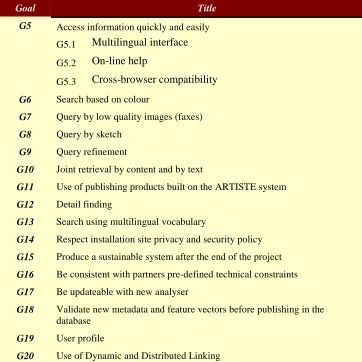
(12) the project partners' evaluation as well as external evaluations were documented and the requirements were refined after each step in the iterative development process.. 3.2.1 Initial User Requirements The report D2.1 documents the requirements as expressed by the ARTISTE user group prior to the release of the initial prototype. The requirements were used as input to the algorithm development in workpackage 4 as well as the development of the second prototype.. 3.2.2 First Prototype Evaluation report and Evaluation plan The aim of the first prototype was to prove that the proposed framework would work. Therefore no sophisticated functionality of User interface was included in the prototype. The aim of the first prototype evaluation report (D2.2) was thus two-fold: 1) Get input to further qualify the ARTISTE requirements. 2) Get input on user interface requirements. 3.2.3 Second Prototype Evaluation The second prototype was the first system based on initial requirements and contained some real algorithms as a result of image R&D. The second prototype evaluation (D2.4) was now extended to include system performance, database performance, content-based analysis, and usability evaluation. As a result valuable input to the final user requirements was achieved.. 3.2.4 Final User Requirements Through the first and second prototype evaluation, the initial requirements have been clarified and extended. In addition to this, specific goals for the ARTISTE system were established. The final requirements and overall goals for the ARTISTE system are documented in the final user requirement document, D2.3. The set of goals as established in this document are listed in Table 3.1 ARTISTE User Goals below: Goal. Title. G1. Matching of similar images. G2. Automatic search using synonyms. G3. Search based on the concept of style. G4. Search based on features oriented to the restoration framework. 905-0004672 Rev. A 2002-09-20. G4.1. Detection of Butterfly. G4.2. Detection of planks.. G4.3. Detection of Parqueting. G4.4. Detection of re-paintings. G4.4. Detection of Craquelure. G4.5. Detection of Borders. ARTISTE - Deliverable D1.2. 9.
(13) Goal G5. Title Access information quickly and easily G5.1. Multilingual interface. G5.2. On-line help. G5.3. Cross-browser compatibility. G6. Search based on colour. G7. Query by low quality images (faxes). G8. Query by sketch. G9. Query refinement. G10. Joint retrieval by content and by text. G11. Use of publishing products built on the ARTISTE system. G12. Detail finding. G13. Search using multilingual vocabulary. G14. Respect installation site privacy and security policy. G15. Produce a sustainable system after the end of the project. G16. Be consistent with partners pre-defined technical constraints. G17. Be updateable with new analyser. G18. Validate new metadata and feature vectors before publishing in the database. G19. User profile. G20. Use of Dynamic and Distributed Linking. Table 3.1 ARTISTE User Goals. 3.2.5 Third Prototype Evaluation The third ARTISTE prototype implementation was a response to the final user requirement document. It contained several algorithms and enhanced metadata. In addition, this prototype provided multilingual support. The ARTISTE user partners and the ARTISTE Interest User Group (AIUG) were asked to provide feedback in terms of: • System performance •. Performance of content-based algorithms. •. Usability of the system. The report D2.5 reports on these evaluations.. 3.2.6 Final Prototype Evaluation The final prototype was developed in two steps to allow a faster completion of the evaluation. The final prototype was enhanced in several ways compared to prior releases and new features and additional algorithms were added to the system. No official report on the evaluation of P4.0 was produced. However, the feedback was provided directly to allow final changes to be applied into the final prototype.. 10. ARTISTE - Deliverable D1.2. 905-0004672 Rev. A 2002-09-20.
(14) The report D2.6, final evaluation report is an extensive report that evaluates all aspects of the final system and concludes that all user partners are happy with the end results.. 3.3 Data Capture 3.3.1 Data Capture in ARTISTE Data Capturing of works of art at the partner sites has been an ongoing effort during the project. At the beginning of the project, the number of digital images varied a lot between the partners. Also, digital images, which were required for image algorithm development and testing purposes, were not available to allow successful completion of all the goals identified during requirement identification. The report, D3.1 Data Capture in ARTISTE, discusses the types of images selected, and matches the goals established in the final user requirements document, D2.3, with the required capturing work to be performed during the project. At the time when the report was compiled, the amount of captured data was about 12,500 images from three partners at a total size close to 10GB. At the end of the project, the amount of captured data included in the ARTISTE system was 170000 images at a total size of 146GB in four separate collections from the NGL, Uffizi, C2RMF, and VAM. The smallest image is 1KB and the largest is 344 MB.. 3.4 Image Analysis 3.4.1 Image Content Analysis Algorithms The identification of user requirements led to a set of goals for image analysis algorithms. This deliverable, D4.1, which is a publicly available report, gives a short overview of each of the goals that were established and expresses the expected difficulty of achieving the goal (on a scale of 0 [no work required] to 10 [impossible]). The mapping of the image algorithm goals against the developed algorithms is included below: Goal 1, 6. Algorithm RGB/Lab Histogram. Comments Allows retrieval of similar images by example, based on the colour distribution. 1 Monochrome Histogram Allows retrieval of similar images by example, based on brightness distribution. 1, 6 Colour Coherence VectorsAllows retrieval of similar images by example, based on the colour distribution with distribution between colours, which are homogenous to some sizeable area. Pyramid Wavelet Allows retrieval of similar images by example, based on 1 Transform the texture energy distribution. Query by low quality Allows retrieval of similar images by example, based on 1 image a normalised brightness texture energy distribution. This algorithm was found to be a useful general matching algorithm as well as for low quality images. Multimodal Allows retrieval of similar images by example, based on 1, 6 Neighbourhood Search the frequency of colour pairs within the image. Score Normalisation Allows texture and colour histogram to be used together 3, 11 for possible style searching.. 905-0004672 Rev. A 2002-09-20. ARTISTE - Deliverable D1.2. 11.
(15) Goal 4 4 4 6 7 8. 8 12 12. 12. 12. 12. Algorithm UV Spot Detection. Comments Allows visualisation of areas where the UV reflectance image is black (i.e. No UV reflectance). Stretcher Detection Detects stretchers by their line edges so that they can be located, measured, and counted. Crack Detects and classifies cracks from x-ray images of Detection/Classification paintings which show cracks in varnish and paint. Colour Picker Allows retrieval of images containing a specified amount of a selected colour or colours. Query by Fax/Low Allows retrieval of images by example, based on a Quality Image normalised brightness texture energy distribution. Colour Coherence VectorsAllows retrieval of similar images by example, based on the colour distribution with distribution between colours, which are homogenous to some sizeable area. This can be used with sketches, which are generated offline to allow query by sketch. Grid Based Matching Allows retrieval of similar images, based on the spatial distribution of features. Multiscale RGB Allows retrieval of similar images by example, based on Histogram the colour distribution of images and subimages. Multiscale Colour Allows retrieval of similar images by example, based on Coherence Vectors the general colour distribution of the image and subimages, with discrimination between colours in images, which are homogenous to some sizeable area. Multiscale Allows retrieval of similar images by example, based on Monochromatic the general distribution of brightness in the image and Histogram sub-images. Multiscale Pyramidal Allows retrieval of similar images by example, based on Wavelet Transform the general texture distribution of the image and subimages. Generic Multiscale Allows retrieval of similar images by example, based on Matching some feature at various resolutions. Table 3.2 ARTISTE Algorithm Goals versus developed algorithms. The document presents some of the research behind the algorithm development and discusses technical aspects of each of the ARTISTE algorithms. Description of additional tools developed to support the usage of the algorithm within the ARTISTE system is also addressed. The document also discusses the ARTISTE image processing API, which defines the communication process between the image processing algorithm and another application (here the underlying Object Relational Database Management System). The use of this API made the development of the image-processing algorithm independent of the underlying application and allows easy integration of any image algorithm developed in C++ with the ARTISTE system.. 3.4.2 Image Content Analysis Software The image algorithm source code, including the additional tools as mentioned above, is not publicly available, but information on how to get it can be found at http://www.itinnovation.soton.ac.uk/artiste.. 12. ARTISTE - Deliverable D1.2. 905-0004672 Rev. A 2002-09-20.
(16) As part of the image algorithm development, non-technical descriptions of what the algorithms are doing have been developed. These description are available as help-text in the final ARTISTE system and can be found at: http://www.ecs.soton.ac.uk/~dpd98r/artiste/help. 3.5 ORDBMS Technology 3.5.1 ORDBMS Requirements Analysis This report, D5.1, analyses the database requirements identified during the requirements and design phase as well as during the implementation of the first and second prototypes of the ARTISTE system The database used in the project was NCR's Object Relational database. The requirements are listed and the status is reflected as either: supported, unsupported, or workaround. If a workaround exists then this is documented. Overall, the Object Relational Database supported all needed features. Though in some cases a work-around was needed. Some "nice-to-have" features like the "EXPLAIN" statement from NCR's main stream database, Teradata, which provides an overall estimate for the time required to execute a database request, would have been useful. If, for example, a complex query would take hours or days rather than minutes or seconds, then a notice in advance would be preferred. In the same category is the ability to get statistical information from the database server. In the future, NCR plans to release Teradata with similar features as in the Object Relational database used in the project. As a consequence, an assessment of whether a combination of the Object Relational database and Teradata would be feasible was conducted. This investigation revealed too much overhead in the implementation to identify which database to query and when, would make the application too complex and dependent on the database instead of creating an easy portable application independent of the underlying database.. 3.5.2 ORDBMS Support Evaluation This report, D5.2, evaluates the ORDBMS support provided by NCR to the partners in the ARTISTE project. The objective of the support was to ease the usability of NCR’s Object Relational database upon which the ARTISTE system is based. Different kinds of support have been provided: remote support out of Copenhagen (the main support), onsite education and consultancy at the partner sites. The report prioritises the support activities and groups them into different categories. Potential trends are identified, which are seen as useful in future object relational development and further enhancement of the database documentation.. 3.5.3 ORDBMS Enhancements for Art Archives The document, D5.3, evaluates how NCR Teradata (and thus most other non-object relational databases) can support the ARTISTE project.. 905-0004672 Rev. A 2002-09-20. ARTISTE - Deliverable D1.2. 13.
(17) The report focuses on what the immediate needs are to be able to act as a database supporting the ARTISTE system. Also, the implemented User Defined Functions capability is evaluated and recommendations on potential future usage included. An evaluation of the algorithms developed in the project (up to prototype 3) reveal that most of the algorithms (if not all) are useful for application areas other than the fine art.. 3.6 Distributed Query and Metadata Layer 3.6.1 Distributed Query and Metadata This document is the D6.1 public deliverable – Distributed Query Layer and Metadata Report – for the ARTISTE project. Museums and galleries often have several digital collections ranging from public access images to specialised scientific images used for conservation purposes. Cross-collection access is recognised as important, for example to compare the treatments and conditions of Europe’s paintings, which form a core part of our cultural heritage. However direct access from one gallery to another is currently uncommon for textual data and almost unheard of in terms of image-based search and retrieval. Thus access to a wealth of digital image information is limited. In part this is because of a lack of relevant metadata to describe the images, in part because the metadata which does exist does not conform to a common schema, and in part exploitation of digital collections is limited because of a lack of appropriate and convenient access methods. Over the last two and a half years, ARTISTE has developed an image search and retrieval system that integrates distributed, heterogeneous image collections, providing a single interface to the art and its metadata. In doing so ARTISTE has addressed issues of interoperability at the metadata level, at the access protocol level and at the linguistic level. This report describes: • the innovative use of emerging technical standards such as XML and RDF, along with common metadata standards such as Dublin Core, to enable users to seamlessly execute cross-collection metadata searches while maintaining the diverse legacy database schemas of those collections; •. the further use of such standards to enable multilingual access to the metadata which is itself multilingual;. •. the use of image processing algorithms in combination with XML and RDF standards to allow users to catalogue art objects and dynamically generate metadata describing the images;. •. the support for and extension of standard information retrieval protocols such as the Open Archive Initiative Metadata Harvesting Protocol and the z39.50 digital library standard to create an open interface for cross-collection search and retrieval;. The intended audience for this report includes museum and gallery owners who are interested in providing or extending services for remote access, developers of collection management and image search and retrieval systems. The report is available from http://www.it-innovation.soton.ac.uk/artiste.. 14. ARTISTE - Deliverable D1.2. 905-0004672 Rev. A 2002-09-20.
(18) 3.6.2 Impact on World-wide metadata Standards This document is the D6.2 public deliverable – Impact on World-Wide Metadata Standards – for the ARTISTE project. Museums and galleries often have several digital collections ranging from public access images to specialised scientific images used for conservation purposes. Direct access from one gallery to another is currently uncommon for textual data and almost unheard of in terms of image-based search and retrieval. However, cross-collection access is recognised as important, for example to compare the treatments and conditions of Europe’s paintings, which form a core part of our cultural heritage. Over the last two and a half years, ARTISTE has developed an image search and retrieval system that integrates distributed heterogeneous image collections. This report describes the work achieved in ARTISTE with respect to metadata standards and approaches for open search and retrieval using digital library technology. In particular, this report describes three key aspects of ARTISTE: • The transparent translation of local metadata schema to common standards such as Dublin Core and CIMI (Computer Interchange of Museum Information) consortium attribute sets to allow cross-collection searching; •. A methodology for combining metadata and image content-based analysis into single search queries to enable versatile retrieval and navigation facilities within and between gallery collections; and. •. An open interface for cross-collection search and retrieval that advances open standards for remote access to digital libraries, for example OAI (Open Archive Initiative) and ZING SRW (Z39.50 International: Next Generation Search and Retrieval Web Service).. The intended audience for this report includes museum and gallery owners who are interested in providing or extending services for remote access, developers of collection management and image search and retrieval systems, and standards bodies in both the fine art and digital library domains.. 3.6.3 Distributed Query and Metadata Software As described above, ARTISTE implements a Distributed Query Layer (DQL) that is responsible for interoperability between ARTISTE servers and support for OAI and SRW clients. The Distributed Query Layer is closely coupled to the ARTISTE Server and does not function as a stand-alone software entity since it depends on services that only the ARTISTE Server can offer. The ARTISTE Server is built on top of NCR’s Object Relational database. IT Innovation have released the software deliverable D6.3 in a publicly accessible form to encourage wider uptake of the results of the project. The deliverable consists of a reference server hosted at IT Innovation along with by both OAI and SRW clients available for download and use by third parties. The reference server and clients will be accompanied by documentation in the form of user guides and the deliverable D6.1 and D6.2.. 905-0004672 Rev. A 2002-09-20. ARTISTE - Deliverable D1.2. 15.
(19) The software and documentation provides a description and reference implementation of how ARTISTE has used and extended standards for search and retrieval. This should be of interest to a wide audience outside of the project. Of course, the full software will still be available to the consortium as part of D8.4 described in section 3.8.4 below. The software consists of: Open Archives Initiative (OAI) support • Publicly accessible OAI server. This will be hosted on the ARTISTE dissemination system at IT Innovation. The OAI server will provide access to metadata on the 1.000 image collection from the Victoria and Albert Museum. •. Downloadable IT Innovation Web-based OAI Client.. •. Link to official OAI Repository Explorer.. •. User Guide to harvesting metadata from the dissemination system using the IT Innovation client.. •. User Guide to harvesting metadata from the dissemination system using the official OAI Repository Explorer.. Search and Retrieve Web service (SRW) support • Publicly accessible SRW server. This will be hosted on the ARTISTE dissemination system at IT Innovation. The SRW server will provide access to images and metadata on the 1.000 image collection from the Victoria and Albert Museum using combined textual metadata and image content-based analysis. •. Downloadable IT Innovation SRW Client for use with dissemination system SRW Server. •. User Guide to querying ARTISTE dissemination system using IT Innovation SRW Client. •. IT Innovation report detailing ARTISTE experience with z39.50 and SRW.. D6.3 will be accessible through a public Web page available at: http://www.itinnovation.soton.ac.uk/artiste. This web page will also provide access to D6.1 and D6.2 as downloadable documents. The Web page will be maintained for at least 6 months beyond the end of the project.. 3.7 Presentation Layer 3.7.1 Dynamic Linking and Content Based Navigation This document is the D7.1 deliverable – Dynamic Linking and Content-Based Navigation – for the ARTISTE project. A dynamic linking facility has been successfully implemented and integrated into the ARTISTE system. However, since user requirements for content-based navigation were not forthcoming, a content-based navigation facility has not been incorporated. The ARTISTE dynamic linking facility enables organisations to provide links to resources associated with the images in their collections. Each organisation will maintain a linkbase that contains a set of URLs to resources published on the Internet that are referenced by keywords. When an image is viewed in the user interface, ARTISTE will examine the image metadata and attach links to keywords that appear in the linkbase. The main benefits of dynamic linking are:. 16. ARTISTE - Deliverable D1.2. 905-0004672 Rev. A 2002-09-20.
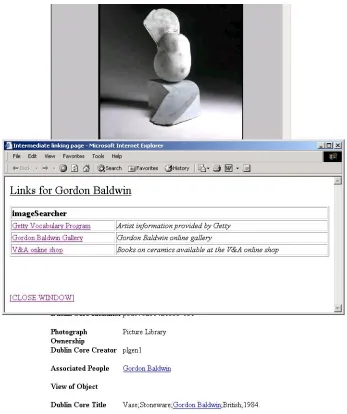
(20) •. Existing metadata does not have to be changed.. •. Links can be applied to metadata associated with multiple images that have the same keywords in their metadata.. Also, as each organisation maintains its own linkbase, and links are attached at presentation time, results from other collections will contain links associated with the local organisation. This is desirable as linkbases from other organisation may contain irrelevant or inappropriate information. The requirements for a dynamic linking facility were initially specified in Goal 20 of D2.3, the final user requirement document (see section 3.2.4). This document further specified that implementation of the dynamic linking facility would occur in the final system. Overall, the end-user partners were unanimous in their approval of the dynamic linking facility, and expressed an opinion that dynamic linking was one of the many successes of the ARTISTE system. Below is an example on Dynamic Linking extracted from the overview section in D7.1: 3.7.1.1. Dynamic Linking example. In the ARTISTE system, a search results in the generation of an ordered set of images that are presented to the user as a series of ‘browse results’ pages (see Figure 3.1). Each results page, however, presents minimal information about the images. Details about each image are available by clicking on the MORE INFO link. A new window – referred to as the ‘more info’ page - will open containing the image and all its metadata (see Figure 3.2). It is on this metadata that dynamic links will be placed. The links associated with each linked keyword are displayed on an intermediate page when the user selects a given ‘linked’ keyword (see Figure 3.3 and Figure 3.4). Users can navigate between the various links using the browser navigation buttons.. Figure 3.1Browse results page from a metadata search, ‘caption contains Baldwin’, performed over 1000 images from the V&A collection. 905-0004672 Rev. A 2002-09-20. ARTISTE - Deliverable D1.2. 17.
(21) Figure 3.2 A sub-section of the ‘more info’ page containing a link for Gordon Baldwin. 18. ARTISTE - Deliverable D1.2. 905-0004672 Rev. A 2002-09-20.
(22) Figure 3.3 An example of the list of links presented on the ‘intermediate linking’ page as a result of clicking on a link for Gordon Baldwin on the ‘more info’ page. 905-0004672 Rev. A 2002-09-20. ARTISTE - Deliverable D1.2. 19.
(23) Figure 3.4 An example of clicking on Gordon Baldwin Gallery link on the intermediate linking page displayed in Figure 3.3. Users can return to the list using the browser back button. 3.7.2 User Interface Description This document, D7.2, deals with the description of the user interface. It presents the ARTISTE User Group and analyses the task scenarios, through the architecture of the current system and discusses the principles used for the user interface design. Also, the document provides an explanation of each single component that builds the architecture of the user interface. The use of Java Server Pages (JSP), Java servlets, and standard HTML language results in a state of art user interface, which is compatible with most common web browsers. The user interface architecture provides information on how data has to be exchanged among functional modules, but does not offer any information on the contents of its components. For example, it does not provide anything about one of the most critical parts of an interface, which is the choice of the style, colours, buttons, logos, tables and. 20. ARTISTE - Deliverable D1.2. 905-0004672 Rev. A 2002-09-20.
(24) graphical elements. This is quite a critical task: as an unattractive or non user-friendly interface can lead the user to leave a system before having tested all its functionality.. 3.8 Systems Integration 3.8.1 ARTISTE System Design This document describes System Design and represents the Deliverable D8.2 “System Design Document”. The approach taken here is to develop an initial design, that will be refined over time, based on the major outcomes of the initial requirements study (projects goals, user requirements, system/environment requirements). The requirements (see section 3.2.4) are encapsulated in a range of brief scenarios that have been developed together with the users to illustrate the function of the desired system. These are developed as UML 'use cases' and as 'robustness diagrams' to contribute to the overall design specification in a concrete fashion. A logical model has been developed, which describes the principal objects that comprise the ARTISTE system. In addition, a logical data model has also been specified for the relational data underpinning the ARTISTE database(s). This logical data model has been developed to be 'generic' in supporting a very wide range of actual data, which will ensure longevity as well as general applicability. The logical data model is illustrated with example data that illustrates the user scenarios.. 3.8.2 ARTISTE User Defined Module This document describes the user-defined modules developed in ARTISTE and represents the Deliverable D8.2 “User Defined Module Report”. It describes an Application Programmers Interface (API) that can be used by software engineers to develop imageprocessing algorithms that can operate within the ARTISTE system. The ARTISTE approach is to store all data, where applicable, in the database. Therefore the images (however large), feature vectors and metadata are stored in the database (as opposed to externally referenced files). This allows the ARTISTE system to take full advantage of the database' object-relational capabilities.. 3.8.3 Systems Integration This document is the deliverable D8.3 Systems Integration Report. It describes the systems integration of the ARTISTE project. ARTISTE is a system that enables content-based analysis, classification, navigation and access of digital images stored in European museums and galleries. Systems integration is the process of integrating software components developed by different individuals/organisations into a final software system. The document D8.3 discuss the integration of data and software components delivered from each technical partner including: • Data Capture from C2RMF, NGL, UFFIZI and VAM. 905-0004672 Rev. A 2002-09-20. ARTISTE - Deliverable D1.2. 21.
(25) •. Image Analysis algorithms developed by UoS MMRG;. •. ORDBMS Technology developed by NCR; and. •. Presentation Layer developed by Giunti ILabs. Integrating these components was challenging as all organisations were in different countries within the European Community. To ensure that the software components were integrated successfully, effective processes and communication mechanisms had to be applied. Also it was important that the interfaces between the software components were defined so that developers in each organisation had a clear picture of the functionality that their component should support. The user partners provided a total of 170,000 images and associated metadata that had to be imported into the Object Relational database management system. The final system results form an iterative process of prototype, feedback, requirements, and design. In total, four prototypes have been constructed with the fourth prototype forming the final system. This evolutionary process is discussed.. 3.8.4 Final Prototype Software The final prototype software is deliverable D8.4. Contact details for access requests are available at http://www.it-innovation.soton.ac.uk/artiste. The web page is available for at least six months beyond the end of the project. The software, D8.4 consists of: Software package. Contents. artiste.ear. Enterprise Java Artiste Server including the Distributed Query Layer, which provides OAI and SRW support.. artiste-client.jar. Java interfaces to the Enterprise Java Artiste Server. artiste-webclient.jar. Web Server-based interface to Artiste using the Java interface in artiste-client.jar to access the Enterprise Java Artiste Server.. Common RDF files. Schema and mapping files as described in D6.1 and D6.2. Mappings and metadata for individual gallery collections are not included.. Image contentbased analysers. Image analysers packaged as TOR User Defined Modules (UDM).. D8.4 does not include ‘pre-existing know-how’ such as NCR’s Teradata Object Relational (TOR) database, images or metadata from any of the gallery collections. Furthermore, D8.4 does not contain any potentially proprietary data such as any RDF mappings or thesauri that are gallery specific.. 22. ARTISTE - Deliverable D1.2. 905-0004672 Rev. A 2002-09-20.
(26) 3.9 Dissemination and Exploitation Exploitation and Dissemination, both internal to the consortia partners and external to the Museum/Gallery, Multimedia, and R&D communities, have been addressed. Another channel established to facilitate dissemination and exploitation of the project results is the ARTISTE Interest User Group (AIUG). Three deliverables on ARTISTE dissemination, the ARTISTE web site (D9.1), The dissemination plans (D9.2), and the Dissemination activity report (D9.5), have been delivered. Two deliverables on Exploitations have been delivered: the initial exploitation plans, D9.3, and the Collection management systems migration report, D9.4. Highlights on the AIUG and on each of the above mentioned deliverables are included below.. 3.9.1 ARTISTE Interest Users' Group The ARTISTE AIUG was established to ensure relevance and applicability of the results, and facilitate dissemination and exploitation. Two AIUG workshops were initially planned. However, only the first was held. We cancelled the second workshop, which should have taken place in Europe, on the request from the EC. Instead the EC requested ARTISTE to disseminate the project as part of the EuroChina 2002 event April 15-20, 2002. The members of the AIUG are not only based in Europe, as representation includes participants from Canada, India, New Zealand, and USA. The first workshop for the AIUG was held on 28 March 2001 in Florence. It was organised in association with the EVA 2001 Florence Conference, one of a series of EVA events, which attracted user, supplier and scientific research communities working in the field of electronic imaging and the visual arts to exchange experiences, ideas and plans. The workshop was entitled 'Combining content and metadata based retrieval for the visual arts'. The speakers included representatives from the Victoria and Albert Museum, NCR, C2RMF (the Louvre-based restoration unit for French museums), and Giunti Interactive Labs. They described how the ARTISTE project is developing web-based applications, which promises an exciting future. Many members of the audience joined in interesting discussions arising from the presentations. There was a good audience of around 35 people, including existing members of the AIUG. This was from a total of 365 people who attended all or part of the five-day EVA event. Seventeen joined the AIUG as new members. Most attendees were from Italy, but others came from France, Greece, Luxembourg, Russia, and the UK. Attendance exceeded the project's aim to have at least 10 people registered to participate, and the workshop achieved many of the ARTISTE and AIUG objectives: •. to increase membership of the AIUG and demonstrate the mutual benefits of involvement;. •. to raise awareness and generate new interest in the ARTISTE project in the electronic imaging and visual arts world; and. 905-0004672 Rev. A 2002-09-20. ARTISTE - Deliverable D1.2. 23.
(27) •. to learn about complementary work being done by others in similar areas.. The AIUG participated in the evaluation of the ARTISTE prototypes. From Prototype 3, a copy of the ARTISTE system, with images from the VAM, has been publicly available at http://artiste.it-innovation.soton.ac.uk. The AIUG members provided valuable input to the continued improvement and development of ARTISTE. During the lifetime of the project, we have issued seven AIUG newsletters, which have been distributed to the AIUG members and other interested people/organisations. All issues are publicly available on the ARTISTE web site www.artisteweb.org, where new AIUG members have the opportunity to join. The planning for the future of the AIUG has completed. As part of the ARTISTE followup project, SCULPTEUR, the existing members are transferred to the SCULPTEUR Interest Group (SIG) and hopefully continue to provide their valuable input to that project as well. The AIUG proved to be a major success. Today the AIUG has more than 80 members, and the number of members is expected to increase with the SCULPTEUR project and the extended scope.. 3.9.2 ARTISTE Web site ARTISTE World Wide Web home page, www.artisteweb.org . The home page has been operational since April 2000. The web was the key interface to get input to and from the ARTISTE AIUG (see below). New AIUG members were enrolled through the web.. 3.9.3 ARTISTE Dissemination Plan The report D9.2 is the initial plan describing partners intended dissemination activities.. 3.9.4 ARTISTE Dissemination Activity Report ARTISTE partners have throughout the project been very active in disseminating the project and its results. Brochures, posters, Web/CD (multimedia presentation of the project), national press releases and project presentations conclude the set of dissemination tools the Consortium exploited for disseminating the ARTISTE results. A few highlights from the report are:. 24. •. ARTISTE Demo of prototype with Brain and surgery images in database given to Dutch Hospitals, Huub Hillege, NCR, November 22, 2001.. •. W. Sterling, G. Presutti, The ARTISTE Project: Architecture and Evaluation, 6th World Multiconference on Systemics, Cybernetics and Informatics (SCI 2002), Orlando, Florida, USA, July 14-18, 2002 (presentation and proceedings paper).. •. Giorgio Da Bormida, Paper “Artiste: An integrated Art Analysis and Navigation Environment” presented at EVA 2000, Florence, 31st March 2000. •. Attended MILIA 2001, Cannes, 10th – 14th February. Reserved space at the EC stand was used to disseminate the ARTISTE project and show the presentation “Building a system for Art Image Storage Retrieval Analysis and Navigation”. ARTISTE - Deliverable D1.2. 905-0004672 Rev. A 2002-09-20.
(28) •. M.F.A.Fauzi and P.H.Lewis, Query by Fax for Content Based Image Retrieval Challenge of Image and Video Retrieval, London, July 2002. Proceedings to be Published in Lecture Notes in Computer Science, Springer Verlag.. •. P. Allen, M. Boniface, P. Lewis, K. Martinez “Interoperability between Multimedia Collections for Content and Metadata-Based Searching”, Eleventh International World Wide Web Conference, Honolulu, Hawaii. 7-11 May 2002 (http://www2002.org/CDROM/alternate/196/index.html). •. Presentation of the ARTISTE prototype on stand 38, EuroChina 2002, Beijing, 15th20th April 2002. •. Publication of the ARTISTE brochure in the Journal of the Association for Historical and Fine Art Photography, 2001. •. Public seminary on "Digital Technology and Museum. Speech: Christian Lahanier, Chef du Département Documentation, Les technologies de l'information appliquées à la conservation-restauration, Dix ans de recherche et développement dans le cadre de projets européens.. •. The International Committee for Conservation of the International Council of Museums (ICOM_CC) 13th Triennial Meeting at Rio de Janeiro in Brazil in September 2002 from 22nd to 28th. Special dedicated session organised in the frame of the Documentation Working Group for conservation experts to show the effectiveness of the ARTISTE algorithms to the field of restoration.. •. UIA (Università Internazionale dell’Arte) – 2000, 2001, 2002: Dissemination to what is ARTISTE Project and to the aims of the Project to the students of the school. UIA is an Internationally University for Art based in Florence with students from all over the world.. 3.9.5 ARTISTE Exploitation Plan This deliverable, D9.3 represents the ARTISTE partners initial investigations and plans concerning exploitation strategies and expected return on investment. The report was produced after six months in the project and only a weak feeling of the potential of the project results were present in the project. Part III of the Technological Implementation plan (see section 3.1.1) is an update to the initial exploitation plan, representing the ARTISTE partners' dissemination and exploitation intentions of the results described in section 2.. 3.9.6 Collection Management Systems Migration The ARTISTE system is mainly designed for use as a tool for research and restoration of fine art. However, the gap between a research and restoration database for the fine arts and a collection management system for art museums is not very wide. This public report, D9.4, compares the two systems and lists the similarities and differences between them. Another relevant issue is that the ARTISTE system has additional features that are lacking in existing collection management systems.. 905-0004672 Rev. A 2002-09-20. ARTISTE - Deliverable D1.2. 25.
(29) The report is written mainly for existing users and owners of collection management systems. It does not go through any advanced aspects of a collection management system, but merely lists the general features of such a system. The report concludes with a recommendation on how to use the ARTISTE system for collection management purposes. In addition to add the possibility to do content-based queries within the Collection Management Systems, then the major benefit for a CMS is to include the ARTISTE dynamic linking facility.. 26. ARTISTE - Deliverable D1.2. 905-0004672 Rev. A 2002-09-20.
(30) 4. Assessment of Project Objectives Technical excellence in the implementation and evaluation of ARTISTE was a goal in itself. Information about the system and the benefits of using it, should be disseminated as widely as possible. At the beginning of the project (in the Description of Work[1]), we therefore defined definite objectives for the project in three areas: Business Objectives, Technical Objectives and Management Objectives for the successful management of the project. This section assesses the results briefly summarised in Section 2 and the deliverables described in Section 3 against these objectives.. 4.1 Business Objectives BO1: Identify how the technical systems developed in the project can be deployed and exploited in a number of sectors Ambition. Our Response. Increase in supplier partners ROI based on deployment in other sectors. Partners' exploitation plans envisage sale in the publishing market and believe ROI becomes positive within four years.. Result. Internal exploitation at the user partner sites is believed to speed-up the restoration process and provide a excessive increase in the time needed to identify lost/requested images within their collection.. 9. BO2: Establish business models that give the content owners direct control over the distributed representation, access and exploitation of digital multimedia content and metadata Ambition. Our Response. At least one business model is executed following the end of the project. The Technological Implementation Plan reflects that Business plans to sell ARTISTE systems are intended.. 905-0004672 Rev. A 2002-09-20. More than one business model has been identified. In addition to the sale of ARTISTE like systems, then we believe the dynamic linking facility has a great potential. Marketing plans for this is at the initial stage.. ARTISTE - Deliverable D1.2. Result. 9. 27.
(31) BO3: Ensure that the vision and results of the project become as widely known and understood as possible Ambition. Our Response. Result. 10 attendees signed up for the first workshop planned for project start + 8 months. 20 attendees signed up by the last workshop planned at project start + 20. The first AIUG workshop clearly exceeded the goal of 10 attendees. Even the goal for the second was achieved at that time with an attendance of 35 people. Also the high number of members in the AIUG and their worldwide location indicates that the ARTISTE results are widely known.. 9. The broad dissemination of the ARTISTE results in Europe and the US is a good indicated of success towards achieving the objective.. 4.2 Technical Objectives TO1: Meet specified end-user requirements (originating from WP 2 ) for achieving a system directly useful to professional users in the fine arts. Ambition. Our Response. Result. All end-user essential requirements to be met by the final system. The difficulty of the established goals in the final requirement specification was high. Therefore the user partners made a priority amongst the goals. Of the 20 established goals (see section 3.2) 70% have been fully achieved, 20% partially achieved and 10% not addressed. Also, all users' top priority goals were achieved and Virtually all goals not fully achieved were identified as ‘risky’ in the user requirements documents.. 9. TO2: To capture works of art in digital form where there is a lack of digital data currently available. 28. Ambition. Our Response. Result. A prototype environment with at least 10.000 small images or at least 100 large images per organisation. This will lead to data volumes of 100G per organisation (assuming 10K for small images and between 100MB and 1Gb for large images). The final prototype environment contains nearly 170.000 images with associated metadata in 4 collections. In total there are 146Gb of data, with the size ranging from the smallest image at 1Kb to the largest image of 344 Gb. 9. ARTISTE - Deliverable D1.2. 905-0004672 Rev. A 2002-09-20.
(32) TO3: Research and develop advanced image content analysis techniques for multimedia collections Ambition. Our Response. At least 3 useful new algorithms developed, implemented and evaluated. The suite of image content analysis algorithms (see section 3.4.1) covers algorithms for: • Retrieval of images with similar colour • Retrieval of images with similar texture • Query of images by example • sub image identification • query by fax • restoration coverage (UV reflectance) • crack identification and classification • stretcher detection • border identification and classification. Result. 9. TO4: Develop techniques to automatically categorise art works using these algorithms Ambition. Our Response. Each module will generate at least one autoindexing metadata term.. ARTISTE automatically classifies the type of border. The user can chose to accept this classification of validate the suggested type. The images metadata is updated with the classification.. Result. 9. Algorithms for retrieval of images of similar texture, classification of cracks, detection of stretchers and restoration coverage are developed.. TO5: Develop metadata representations for image categorisation (both automatically through the use of image content analysis and externally generated categorisation) Ambition. Our Response. At least 3 externally generated art thesauri will be integrated. In addition to mapping legacy database schemas to common metadata standards and enabling multilingual functionality ARTISTE uses RDF and RDFS to support metadata thesauri. ARTISTE supports a total of 15 thesauri for legacy gallery metadata attributes: seven from the Victoria & Albert Museum and eight from the C2RMF. ARTISTE also supports one thesaurus for a dynamically generated metadata element (see D6.1). Result. 9. TO6: Develop seamless distributed access to multiple collections Ambition. Our Response. We will demonstrate distributed queries over at least 3 autonomously managed collections. ARTISTE implements a distributed query layer, based on open standards, which allows seamless access to images and metadata in distributed collections. In the current system querying 4 collections is supported.. 905-0004672 Rev. A 2002-09-20. ARTISTE - Deliverable D1.2. Result 9. 29.
(33) ARTISTE participates in an initiative to redesign the primary open standard for interoperability between digital libraries, z39.50. The z39.50 into the Next Generation (ZING) initiative has proposed a Search and Retrieve Web Service (SRW) based on the z39.50 protocol for searching databases that contain metadata and objects. ARTISTE is one of the early implementers of SRW and has extended the capabilities of SRW to enable image content and metadata based searches over multiple ARTISTE collections. Having emerged from the digital library community z39.50 has been traditionally concerned with text based searching. ARTISTE has been working with ZING to incorporate the ability to deal with content-based searching of images and thus expand international standards of information retrieval. The implemented support for an extended version of the SRW protocol forms the basis of a ‘distributed query layer’ (DQL) through which the ARTISTE servers communicate with each other (see D6.1).. TO7: Develop distributed content-based navigation methods for art collections Ambition. Our Response. Result. Module integrated in prototypes and final system. Used successfully by the end-users (art researchers). A dynamic linking facility is successfully implemented and integrated into the ARTISTE system. However, requirements for content-based navigation were not forthcoming, and a content-based navigation facility was not implemented. Once design and initial implementation of the Dynamic Linking module started, its commercial potential became clear to the Project Management team. As no requirements for the content-based navigation were put forward, we decided to re-prioritise the Dynamic Linking and Content based navigation work, so the Dynamic Linking module became a more complete and directly exploitable module.. /. TO8: Build and prove the value of a robust and scalable integrated environment that incorporates the above components using an object-relational database Ambition. Our Response. Result. Successful integration with ORDBMS and usage of final system.. ARTISTE was developed using a 4-tier distributed architecture including client, web, business, and persistence tiers (database). This approach is proven to provide a scalable and flexible solution for large-scale web-based applications. Taking into account that the final system contained 170000 images and associated metadata, then the speed of operation of the final system has improved considerable and works fine.. 30. ARTISTE - Deliverable D1.2. 9. 905-0004672 Rev. A 2002-09-20.
(34) 4.3 Management Objectives MO1: To execute the project maximising project internal efficiency, and ensuring that the direction of the project is user lead Ambition. Our Response. The timely availability of all deliverables within costs. The co-operation and integration of the partners to achieve a common goal is achieved. The final user requirement document and the content of the final prototype as well as the additional development and installation at the C2RMF in July clearly reflect that the goals to achieve is driven by the user partners. Overall, we believe timely availability of all deliverables is appropriately addressed. The Technical activities in the project lasted 31 months compared to the initially planned 30 months. Reprioritisation of deliverables to fit the available resources over time has made some deliverables delayed. Other deliverables were postponed, as it during the course of the project became evident that the original schedule for these deliverable was not appropriate. For example, it did not make sense to release the report describing the developed User Defined Modules for the Object Relational database, before all modules were completed in the final prototype.. 905-0004672 Rev. A 2002-09-20. Result. ARTISTE - Deliverable D1.2. 9. 31.
(35) 5. Conclusions A content-based analysis, classification, navigation system has been successfully developed that enables distributed access to digital images stored in European museums and galleries. The final evaluation and positive feedback from users and the AIUG has shown that the technical partners have been able to respond to concerns and recommendations ensuring that the users were satisfied with the final system. Many challenges were overcome during systems integration to ensure the successful delivery of ARTISTE. The user interface was successfully developed by GIUNTI and integrated into the second and third prototypes. Complex image processing algorithms were integrated and proven to work effectively on very large datasets within the TOR ORDBMS. The scalability of the system design was proven with the integration of 170.000 images in excess of 100Gbytes of data. NCR’s decision to discontinue the TOR database means that further work on migrating the ARTISTE server to another database needs to be undertaken. An analysis of potential solutions has been carried out identifying three options for porting the system. It is clear that user constraints should be considered when selecting an alternative database to ensure that the ARTISTE system is compatible with their needs. As part of the ARTISTE follow-up project, SCULPTEUR, ARTISTE will be migrated to a new database by end 2002. Currently the algorithms are already installed at C2RMF using mySQL, which is an open and publicly available database and one of the three candidates considered. Migration of ARTISTE also ensures sustainability of the results after the project. ARTISTE has both consumed and attempted to influence standards for metadata and digital libraries. A proposal has been made to ZING for additions to SRW, supported by documentation, public presentation, hosting of a reference server implementation and release of an open source demonstration client. This will hopefully enable ARTISTE to make a useful contribution to this rapidly evolving standard. The current momentum will be maintained into the SCULPTEUR project, which seeks to extend the capabilities of ARTISTE into 3D representations, and has an explicit activity for IT Innovation to develop and disseminate multimedia digital library interoperability protocols. More than 90 individuals worldwide have now joined the ARTISTE AIUG. This is a much wider audience than initially expected at project start. The AIUG members have and continue to express their satisfaction with the resulting system. Also, they have expressed their interest in continuation of the AIUG following the SCULPTEUR project (the SCULPTEUR Interest Group) Internal in the project user partners installs ARTISTE for usage in their daily work. However, there is still a need for more algorithms to fulfil the need for image restoration.. 32. ARTISTE - Deliverable D1.2. 905-0004672 Rev. A 2002-09-20.
Figure



+3

Outline
Related documents