JOURNAL OF FOREST SCIENCE, 64, 2018 (2): 74–85
doi: 10.17221/109/2017-JFS
Optimization of low volume road pavement design
and construction
Jaroslav HAUSER
1*, Lenka ŠEVELOVÁ
2, Radek MATULA
3, Petr ZEDNÍK
31Geostar, spol. s r.o., Brno, Czech Republic
2 Department of Landscape Management, Faculty of Forestry and Wood Technology, Mendel University in Brno, Brno, Czech Republic
3Transport Research Centre, v.v.i., Brno, Czech Republic
*Corresponding author: [email protected]
Abstract
Hauser J., Ševelová L., Matula R., Zedník P. (2018): Optimization of low volume road pavement design and construction. J. For. Sci., 64: 74–85.
Low volume roads in the Czech Republic are roads with lower traffic volume that primarily include forest and field roads, and they are an integral part of the Czech transport network. When building road pavements, we can use pro-cesses for surveying, designing, building and inspecting road constructions included in national and international, particularly European, standards. In addition, the roads are evaluated in terms of their environmental impacts, in order to maintain the quality of the environment. However, during the construction of road pavements decisions based on financial, time and other reasons are made. The decisions have impacts on the operation of roads and lead to other measures and additional costs of repairs and reconstructions. The article summarizes the authors’ research results from constructions of low volume road pavements and contains evaluations of laboratory and in situ material tests (soils, layers) of installed road pavements as well as evaluations of modelled laboratory and long-term monitored in situ structures.
Keywords: California bearing ratio; compaction; MEPDG; moisture content; soil tests; triaxial shear tests
Supported by the Ministry of Education, Youth and Sports of the Czech Republic, Project No. LO1610, and by the Technology Agency of the Czech Republic, Project No. TA01020326.
Many economically less advanced countries pay much higher attention to low volume roads (LVRs), even though their proportion in the infrastructure is comparable with that of the Czech Republic. In the third world countries, the existence and qual-ity of LVRs connect remote areas with centres of basic social facilities. Although LVRs have dif-ferent functions in difdif-ferent countries, they have common specific features and need to meet gen-eral criteria of reliability, bearing capacity, and duration. In addition, their importance for forest management may not contradict environmental and economic priorities of society. In the Czech
professional community as well as by the public in the Czech Republic.
Road pavements in the Czech Republic are stan-dardly designed according to technical guidelines (TP 170, 2010), while their last amendment comes from 2011. The design is based on the knowledge of traffic volume, road importance and material char-acteristics while taking into account the locality, climatic conditions and designed level of damage. The basic input parameter is traffic volume, which has a crucial impact on the construction duration through its long-term and repeated load. Traffic loading (TNVk) is determined from the average number of heavy vehicles within 24 h in both di-rections during the design period. If tertiary roads with low traffic volume, where the transport of a known amount of material is predominant, are concerned, it is possible to determine traffic vol-ume by an expert estimate of transported material. The design itself is based on the minimum param-eter value of subgrade bearing capacity. However, when roads run through areas with specific natural conditions, the design value cannot be met. Stricter environmental criteria for subgrade improvement methods often prevent repairs by road binders as well as subsequent use of standard procedures and catalogue composition according to the existing standards.
Material characteristics of subgrade and con-struction layers for the purpose of road pavement designing are empirically defined or obtained from laboratory tests. The selection of the method varies based on the requirements and development of di-mension calculation models. The “traditional” road pavement composition based on California bearing ratio (CBR) values (ČSN EN 13286-47 2004), used for several decades, was based on laboratory tests of defective samples of subgrade materials, since non-rigid pavements are rarely damaged within their life span due to a loss of the subgrade strength.
The first design methods and classification methods of materials used in the road structure were introduced in the USA. The most frequently used tests worldwide for road designing, i.e. Proc-tor standard and CBR, appeared as early as in the 1940s. Most experts worldwide in the field of road traffic carefully monitor the research and develop-ment in that country, since road designing has been at a very high level for many decades in the USA.
AASHTO (American Association of State High-way and Transportation Officials) has had a long-term experience in road designing and publishes so-called “guides”, where designing procedures are recommended. A guide (AASHTO 2008),
originally called GDPS (Guide for Design of Pave-ment Structures), which has been named MEPDG (Mechanistic-Empirical Pavement Design Guide) since 2004, recommends superseding the currently used “strength” parameters, e.g. CBR, by resilient modulus (Mr). The guide MEPDG divides road de-signing in the USA into three levels by traffic vol-ume. Regarding the first road design level, where a high traffic volume is expected, subgrade elastic moduli are determined by the laboratory cyclic tri-axial test. Regarding the second and third design levels, where the traffic volume is relatively low, this laboratory test is not required due to its de-manding nature. Regarding the second level, it is recommended to determine elastic moduli from other soil properties with the use of found correla-tions. The third level uses values of elastic moduli obtained just from soil properties based on their classification.
In order to increase the road pavement design level with lower traffic volume while taking into account the world trends, a new certified meth-odology “Methodological Guide for Design and Construction of Low Volume Roads” (hereinafter referred to as LVR methodology) was accepted and approved for use in the Czech Republic in the mid-dle of 2015. The methodology is innovative in many aspects and its use is a significant step to design reliable and durable low volume roads (Ševelová et al. 2015). It is intended for low volume roads, which is a newly used term, so far undefined in Czech standards. Foreign standards, e.g. American organization AASHTO, uses this term for roads with TNVk of fewer than 400 vehicles for all traf-fic lanes within the design period (AASHTO 2001). Therefore, in comparison with Czech technical guidelines TP 170, it includes roads with lower traf-fic load.
parameter, which allows to respect specific features and requirements for easy feasibility of LVRs.
According to the existing technical guidelines TP 170, the determining subbase bearing capacity pro-cedure uses deformation modulus (Edef, 2) from the static plate load test (SPLT), which is considered financially and technologically too demanding for LVRs. In order to simplify the process to test the subbase bearing capacity, dynamic modulus of de-formation (Mvd) determined by the dynamic plate load test with the light falling weight deflectom-eter (LFWD) was selected. One of the main ben-efits of LVR methodology is the determination of a unified subbase bearing capacity parameter Mvd from the LFWD test and its correlation with Edef, 2 from the SPLT. In addition, a potential reduction of the value of the active zone subbase minimum bearing capacity (from the value of 45 to 15 MPa, or from 30 to 10 MPa respectively) was found and verified. This new parameter is also an input value for designing the road pavement construction lay-ers composition in the methodological guide, data-sheets and the designing software.
Despite the existence of various differently ad-vanced design processes and sophisticated deter-mination of input characteristics, the most com-mon procedures for dimensioning low volume road pavements worldwide, thanks to their simplicity, are still those based on empirical research, experi-ments, knowledge of values from a laboratory or
in situ loading tests, even though they are still
unable to express the real state of the mechani-cal behaviour of subgrade and construction layer materials, and thus allow an analysis of strain and deformation conditions. The irreplaceability of ex-perimental procedures is shown by the results and conclusions made on the basis of extensive mea-surements in the laboratory geotechnical testing field (LGTF) in Transport Research Centre, which were performed to determine correlations between Edef, 2 and Mvd (Zedník et al. 2015), and further to reduce the minimum values of the active zone sub-base bearing capacity. The correlation of SPLT and LFWD was performed separately within Project CEZ: MD4499457501: “Research project sustain-able transport – chance for future” (2004–2008) and Project CZ.1.05/2.1.00/03.0064: “Transport R & D Centre”, and published by Ministry of Trans-port of the Czech Republic as a methodology for “Correlation” (Zedník et al. 2012).
However, there is no substitute for the knowledge of adequate deformation characteristics for the needs of modelling of real stress condition, analy-sis reliability, and design evaluation. A stochastic
analysis of the road pavement construction was performed for a pilot testing road with the use of the finite element model for low volume roads and compatible deformation characteristics. The test-ing concerned the value of the introduced param-eter and variants of potential improvement of the subgrade. In addition, the behaviour of road pave-ment with one and two construction layers for the needs of datasheets was compared.
MATERIAL AND METHODS
In order to determine parameters of subgrade and layers, a decision was made during the project that the majority of tests will be performed directly
in situ. LGTF modelling was selected to
accurate-ly determine relationships of individual testing methods.
Low volume roads
Research studies and measurements on forest roads in operation, as well as in localities where forest roads were in the phase of designing, were performed within the Technology Agency of the Czech Republic Project No. TA01020326 “Opti-mization of design and construction of low vol-ume road pavements”. In addition, LGTF (full-scale model) measurements were performed.
The authors tried to use the investigated locali-ties to present the basic types of various geological environments in the Czech Republic.
The results of static loading tests and dynamic falling weight tests were compared and their cor-relations were determined. Consequently, the LVR methodology (Ševelová et al. 2015) used the pro-posed range of parameter Mvd for individual types of soils, so that this simple, fast, and cheap test could become the main parameter to determine the subgrade bearing capacity. In relation to the poten-tial layered subgrade, penetration tests were per-formed that may help to reveal non-homogeneities without damaging the subgrade. Good correlations between dynamic penetration resistance and sub-grade moduli were found.
All investigated structures were divided into seg-ments with the same composition, which were rep-resented by measuring profiles. Sets of in situ and laboratory tests were performed for individual pro-files and subsequently evaluated.
(i) Test soil pit to the depth of approximately 1 m under the future subbase level, in order to deter-mine the road subgrade composition, to collect and classify soil from each concerned layer, and potentially find the level of groundwater; (ii) A set of tests to determine deformation modulus
from SPLT by a circular plate and deforma-tion modulus from dynamic plate load tests by LFWD, from which the average modulus was derived using three to five measurements. These two tests/results were compared;
(iii) Determination of bulk density in situ;
(iv) Light and heavy dynamic penetration test, etc.; (v) Other tests (e.g. CBR, sand equivalent test).
The overview of tests is shown in Tables 1–4. In total 8 localities were investigated.
Existing constructions in operation: (i) forest road (FR) Křivá borovice – Ochoz u Brna, (ii) FR Návojná, (iii) FR Řásná.
New constructions or reconstructions of ex-isting roads: (i) biathlon track Nové Město na Moravě, (ii) Kultury – Štítná nad Vláří, (iii) LVR Moutnice, (iv) FR Okružní – Moravský Beroun.
[image:4.595.63.531.73.150.2]Testing forest road segment Kuběnka (construc-tion of pilot testing forest road). Different types of
Table 1. Overview of performed tests on roads in operation
Road No. of profiles No. of tests per profile
SPLT LFWD DPT SC BD other
Křivá Borovice 6 14 45 24 6 19 5
Návojná 10 21 95 40 10 22 11
Řásná 10 10 40 – 5 10 –
Total 26 45 190 64 21 51 16
[image:4.595.64.531.212.303.2]SPLT – static plate load test, LFWD – light falling weight deflectometer, DPT – dynamic penetration test, SC – soil clas-sification, BD – bulk density
Table 2. Overview of performed tests on new constructions and reconstructed roads
Road No. of profiles SPLT LFWD No. of tests per profileDPT SC BD other
Nové Město 10 40 40 50 10 30 5
Kultury 10 40 120 120 10 10 10
Moutnice 10 20 60 10 20 20 8
Okružní 10 20 60 40 20 20 7
Total 40 120 280 220 60 80 30
SPLT – static plate load test, LFWD – light falling weight deflectometer, DPT – dynamic penetration test, SC – soil clas-sification, BD – bulk density
Table 4. Overview of performed tests on the testing segment of Kuběnka forest road
Construction phase No. of profiles SPLT LFWD No. of tests per profileDPT SC BD other
Preparation 14 28 112 56 14 – 35
Construction 10 21 84 28 4 28 4
Before putting into operation 10 14 56 28 – – 5
In operation 10 14 168 – 6 4 8
Total 44 77 320 112 24 32 52
SPLT – static plate load test, LFWD – light falling weight deflectometer, DPT – dynamic penetration test, SC – soil clas-sification, BD – bulk density
Table 3. Assigned treatment/improvement to individual sections of the Kuběnka testing segment
Profile
No. Treatment
1 fly ash I
2 fly ash II
3 hydraulic binder Dorosol C50 (Holcim, Czech Republic)
4 quicklime
5 hemp shives
6 recycled material 0/4
[image:4.595.304.531.485.601.2] [image:4.595.64.534.638.729.2]subgrade modifications were tested in the Kuběnka locality (Fig. 1). Different materials were tested on an approximately 350 m long testing road segment – fly ash, quicklime CaO, mixed hydraulic binders, re-cycled material, and fine aggregates. The forest road was opened in 2012. The road was provided with longitudinal drainage ditches in 2013, which had a significant impact on the road pavement bearing capacity and confirmed the fact that road pavement drainage is among the most important measures to increase the life span of LVR road pavements.
Full-scale testing of road pavement constructions in LGTF
LGTF allows performing real-scale geotechnical tests for selected road pavement structures.
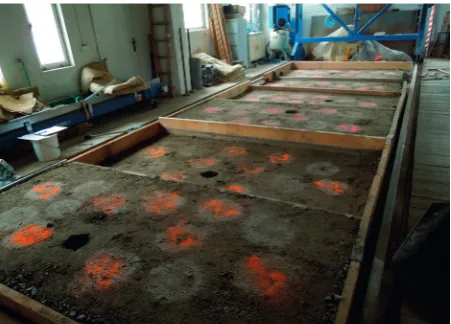
For the needs of bearing capacity evaluation, six different testing low volume road pavement com-positions were designed and investigated (Figs 2 and 3). LGTF (depth 2.2 m) was divided into three fields of 3 × 3 m in size, where the soil simulating the subgrade of the construction with different bearing capacity (modifying their moisture) was placed. The modifications of subgrade soil with dif-ferent moisture were performed by mixing, spray-ing, and drying before and partially after laying the soil in LGTF. Compacting was performed in two layers by a rammer and a heavy vibratory plate. The composition of the subgrade of testing structures was as follows:
[image:5.595.67.530.58.203.2](i) soil layer of approximately 50 cm in thickness, loamy clay (simulating a weak subgrade) with Edef, 2 at approximately 15 MPa;
Fig. 2. Scheme of designed testing constructions in a labora-tory geotechnical testing field
M1 – work-hardened aggregates, M2 – broken stone,
M3 – crushed stone, Edef, 2 – deformation modulus, w –
moisture content
Fig. 3.Overall view of testing constructions in a laboratory
[image:5.595.307.529.374.488.2]geotechnical testing field Fig. 1. Longitudinal and cross sections of Kuběnka forest road
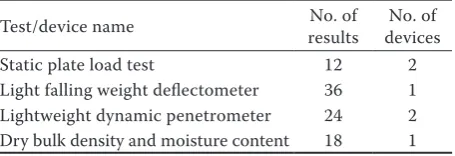
[image:5.595.306.532.568.730.2]Testing procedures were selected (Table 5) for the evaluation of the bearing capacity of subgrade and construction layers. CBR tests were made for selected materials with the aim to find ways of their further use (cyclic CBR – a part of the research).
The correlations of the test results (and also of the bearing capacity evaluation itself) were assessed at two levels – on the basis of the above-mentioned six different road pavement compositions, and on the basis of in situ tests on the existing, reconstructed, or new forest roads (6 localities). One of the locali-ties included a testing road segment where seven partial road segments were built; 7 × 2 variants of road pavement compositions.
Static plate load tests in LGTF were performed in all (3 × 2) LGTF fields by two devices, one with an automatic test control and the other without an au-tomatic control. Four light dynamic tests for each field were performed for subgrades with different moisture level (w = 17.5, 20.8 and 21.6%) in LGTF.
Stochastic analysis of road pavement compositions and subgrade modification tests
In order to verify procedures designed for the needs of LVR methodology, a pilot testing road seg-ment was built, where the conclusions from LGTF were evaluated for a newly defined bearing capac-ity parameter and for variants of potential subgrade improvements, and the road pavement behaviour with one and two construction layers was com-pared. The construction layers were designed with materials and technologies for the needs of LVR with lower qualitative requirements. The testing segment of the total length 309 m was divided into two parts. The road pavement of one part is built of a single 250 mm thick layer of mechanically com-pacted aggregates for LVR. A two-layer construc-tion was designed for the other part – 250 mm of the subgrade layer from crushed stone for LVR and 200 mm surface course from material M1 – work-hardened aggregates. In order to compare subgrade improvement variants, improvements of the active
zone were selected with the use of two types of fluid fly ash, lime, Dorosol C50, technical hemp shives, brick recycled material, and sieved quarry material.
Road pavement composition and active zone im-provement technology used in the LVR methodol-ogy and design software were tested with the use of a stochastic analysis, which allows considering the effect of uncertainties on input quantities. Re-gardless of the sources of uncertainties, these can be included in the calculation through numerical simulation methods (Florian 1992). The created stochastic model consists of a corresponding cal-culation model for the analysis of the construction in combination with simulation methods. Indi-vidual input quantities affected by uncertainties are considered in the stochastic model as random quantities or processes and are described by corre-sponding distribution of probability and statistical parameters. The use of simulation methods leads to a repeated calculation with appropriately generated values of input quantities. The simulation result is a statistical set of data. Further statistical processing brings the required information on the monitored construction behaviour.
In order to create a calculation model of the ana-lysed forest road with improved properties of the active zone, a calculation system ANSYS (Version 16.0, 2016), based on the finite element method, was used. The model was created as a parametric plane 2D model in the xy-plane. It is geometrically linear and physically non-linear, and the calcula-tion is based on the plane deformacalcula-tion theory. The boundary conditions are defined by simple rela-tionships at two vertical edges of the model, which prevent displacement in horizontal direction (x -ax-is direction) and relationships at the bottom edge of the model, which prevent vertical displacement (y-axis direction). PLANE 82 four-node elements are used in order to create the network. They have two degrees of freedom in each node, i.e. displace-ments Ux and Uy. The individual construction layers are considered to be perfectly bonded (Ševelová, Kozumplíková 2010).
[image:6.595.64.292.87.165.2]The basic requirement regarding the model preparation was to set the real state of stress and strain and deformation in the loading axis by the designed axle. Consequently, suitable material characteristics, particularly the elasticity modulus of unbound materials, were selected and prepared. The basic requirements for the prepared elasticity modulus included compatibility with the model, simple laboratory preparation, ability to express a relationship between changing moisture and com-pactness rate, and up-to-datedness in relation to
Table 5. Designed tests and devices for evaluation of the subgrade bearing capacity
Test/device name resultsNo. of devicesNo. of
Static plate load test 12 2
newly introduced European standards for func-tional tests. Regarding the validity of funcfunc-tional test requirements, the module must be determined from a test which is as close as possible to the real behaviour of the material in road pavement, and which simulates the real way of recurred loading in the construction.
Laboratory test CBR was selected for the prepa-ration of elasticity modulus. The test was modified and extended by an innovative approach to mea-sure the cyclic elasticity modulus Mr according to a Dutch theory of Prof. A.A.A. Molenaar (Mole-naar 2008) and completed in cooperation with Mendel University in Brno and geotechnical labo-ratory Geostar, spol. s r.o. in Brno. The elasticity modulus in the Czech Republic is prepared under constant stress. The suitability of the prepared de-formation characteristics – elasticity modulus Mr – was tested on real road pavement construction ma-terials and laboratory and in situ tests performed during the project (Florian, Ševelová 2013). The module determined from a cyclic device CBR was found to be a very good estimate of soil deforma-tion behaviour after applied loading, which is com-patible with a finite element numerical module, and which further takes into account changeable behaviour of natural materials as well as materials recycled under different moisture and compact-ness. Numerical modelling of the finite element method is satisfactory.
Some of the most commonly used numerical sim-ulation methods include simple random sampling (Monte Carlo method), Latin hypercube sampling and updated Latin hypercube sampling (Florian 1998). Updated Latin hypercube sampling was found to be the most suitable to our needs.
RESULTS
Low volume roads
In situ measurements in constructions in
op-eration proved some well-known issues present in transport constructions of lower importance. The three most common ones are as follows.
Filtration criterion. It is not always observed,
despite the fact it prevents mixing subbase materi-als with the subgrade. In order to evaluate potential degradation of higher-quality coarse backfill with finer soil, it is necessary to evaluate whether a given criterion is met, e.g. a criterion given by the rela-tionship d15k/d85z ≥ 5 (d15 layers of coarse backfill/
d85 subgrade from fine soil). Parameters d15 and d85
have the value of grain diameter (mm) correspond-ing with the granularity curve of 15 and 85% of the slump. If the soils in contact with the layers fail to meet the filtration criteria, granularity needs to be modified or appropriate separation geotextile needs to be used.
Failing to meet the filtration criterion is reflected in the reduced bearing capacity of the construction layer, volume changes at frost, and defects can be expected in the road pavement.
Rehabilitation of subgrade by coarse aggre-gates. It is one of the potential measures to reach
the higher bearing capacity of the subgrade, but it is still necessary to observe the rules for layer con-tact – see above “Filtration criterion”, so that degra-dation of the subbase and rutting would not occur. A failure to observe this rule was revealed during the construction and it is just a matter of time when the degradation of aggregates with clay from the subgrade causes the reduced bearing capacity of the road surface.
Malfunctioning drainage. Stable quality of the
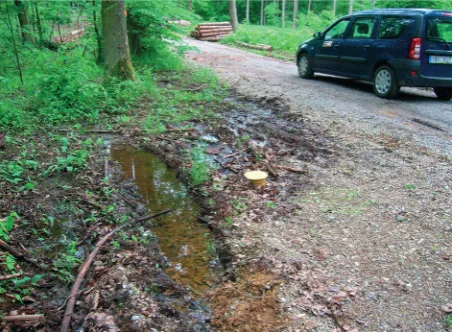
road pavement in time is ensured by stable proper-ties of road pavement materials. One of the main parameters of unsealed mixtures is aggregate moisture. Excessive moisture of the construction needs to be prevented by correctly built road gra-dients, drainage and sewage system. Insufficiently installed drainage was recorded during the con-struction of the Kuběnka testing road segment in profile 10 (Fig. 4), including a negative impact on the construction bearing capacity. When building the LVR road pavement, it is necessary to install the designed drainage correctly.
[image:7.595.305.533.564.730.2]Moisture gradually decreased after building the drainage, which led to an increase in the road pave-ment bearing capacity. This fact is docupave-mented in Fig. 5, which shows an increase of Mvd from dynamic
plate load tests with LFWD in MPa for profiles 1 to 14 in comparison with the values measured after the road pavement was built in August 2014. The measurements in November 2013 showed an in-crease in the pavement bearing capacity for profiles which were the most affected by higher moisture. The subgrade in profiles with low longitudinal gra-dient reduced moisture more slowly due to the low permeability of subgrade soils, since no sufficient drainage could be installed for the subgrade. The measurements performed in July 2014 showed that additionally installed ditches helped to increase de-formation moduli on the surface. None of the mea-sured values Mvd decreased below 100 MPa. The only exception was profile P14, where the value of 98.2 MPa was recorded on the surface.
Full-scale testing of road constructions in LGTF
Regarding the limited article size, the following evaluations of all performed tests in LGTF were
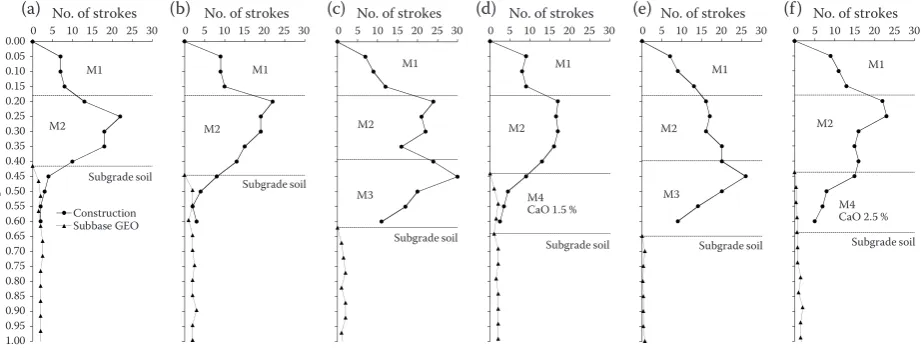
summarized and the results of bearing capacity measurements with the use of SPLT and LFWD were compared. The comparison was complement-ed with the measurement from dynamic penetra-tion tests (Fig. 6).
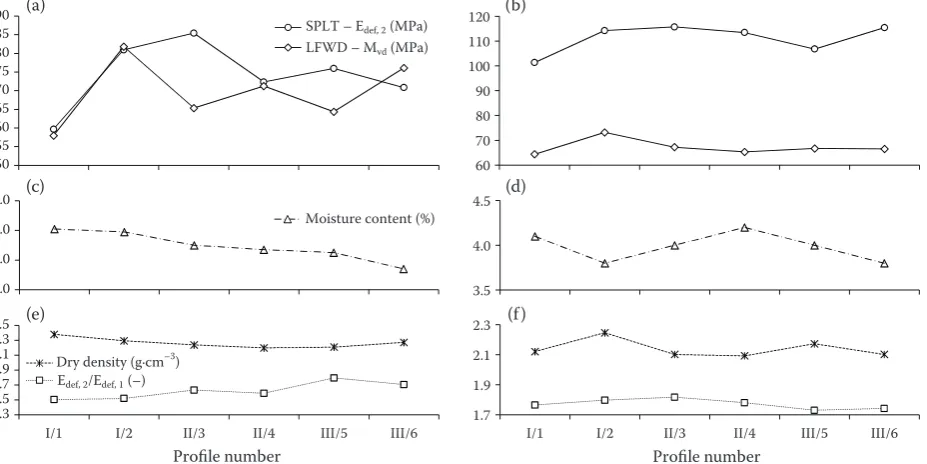
The graphs in Figs 7 and 8 show relationship of LFWD test results on the moisture of the subgrade.
Stochastic analysis of tested pavement compositions and subgrade treatment
The results of the performed stochastic analy-sis of subgrade improvement include estimates of mean value, standard deviation, coefficient of variation, skewness, and minimum and maximum values of the vertical displacement (deflection). The mean value describes the average trend of a given quantity, standard deviation and coefficient of variation describe its random variability (i.e. how concentrated the individual values are around the mean value), skewness describes the non-sym-metry of this concentration, and minimum and
No. of strokes
M1
M2
M4 CaO 2.5 %
Subgrade soil M1
M2
M3
Subgrade soil M4
CaO 1.5 % M1
M2
Subgrade soil M3
M1
M2
Subgrade soil M1
M2
Subgrade soil 0.00
0.05 0.10 0.15 0.20 0.25 0.30 0.35 0.40 0.45 0.50 0.55 0.60 0.65 0.70 0.75 0.80 0.85 0.90 0.95 1.00
0 5 10 15 20 25 30 0 5 10 15 20 25 30 0 5 10 15 20 25 30 0 5 10 15 20 25 30 0 5 10 15 20 25 30 0 5 10 15 20 25 30
D
ep
th
(m
)
Construction Subbase GEO
M1
M2
Subgrade soil
[image:8.595.62.403.60.186.2]No. of strokes No. of strokes No. of strokes No. of strokes No. of strokes
Fig. 6. Graph of relationships of light dynamic penetration test results: profile I/1 (a), profile I/2 (b), profile II/3 (c), profile II/4 (d), profile III/5 (e), profile III/6 (f)
[image:8.595.71.532.536.711.2]M1 – work-hardened aggregates, M2 – broken stone, M3 – crushed stone, M4 – lime stabilization
Fig. 5. Time course of
de-formation modulus (Edef, 2)
on the surface of individual constructions of road pave-ments of Kuběnka testing segment
0 20 40 60 80 100 120 140 160 180 200
1 2 3 4 5 6 7 8 9 10 11 12 13 14
Edef,
2
(MPa)
Marked profiles (constructions) of pavement
8/8/2012 2/7/2013 25/11/2013 28/7/2014
Fig. 7. Graph of relationships of test results: SPLT – Edef, 2, LFWD – Mvd, moisture (a, b), dry density, ratio of moduli Edef, 2/Edef, 1 (c, d) and subgrade: soil (a, c), treatment soil (b, d)
SPLT – Edef, 2 (MPa) – deformation modulus determined by static plate load test, LFWD – Mvd (MPa) – dynamic modulus
of deformation determined by dynamic plate load test with the light falling weight deflectometer
Fig. 8. Graph of relationships of test results: SPLT – Edef, 2, LFWD – Mvd (a, b), moisture (c, d), dry density, ratio of moduli
Edef, 2/Edef, 1 (e, f) and protection layer (a, c, e) and layer of mechanically reinforced aggregates (b, d, f)
SPLT – Edef, 2 (MPa) – deformation modulus determined by static plate load test, LFWD – Mvd (MPa) – dynamic modulus
of deformation determined by dynamic plate load test with the light falling weight deflectometer
5 10 15 20 25 30 35
1.5 1.7 1.9 2.1
I/1 I/2 II/3 II/4 III/5 III/6
Profile number
0 5 10 15 20 25 30 35 40 45
1.5 2.0 2.5
I/1 I/2 II/3 II/4 III/5 III/6
Profile number
SPLT – Edef, 2 (MPa)
LFWD – Mvd (MPa)
Moisture content (%)
Edef, 2/Edef, 1 (–)
Dry density (g·cm–3)
50 55 60 65 70 75 80 85 90
2.0 4.0 6.0 8.0
1.3 1.5 1.7 1.9 2.1 2.3 2.5
I/1 I/2 II/3 II/4 III/5 III/6
Profile number
60 70 80 90 100 110 120
3.5 4.0 4.5
1.7 1.9 2.1 2.3
I/1 I/2 II/3 II/4 III/5 III/6
Profile number
SPLT – Edef, 2 (MPa)
LFWD – Mvd (MPa)
Moisture content (%)
Edef, 2/Edef, 1 (–)
Dry density (g·cm–3)
maximum values describe the interval in which the analysed quantity may occur. Apart from this, another calculation (deterministic analysis) based on nominal values (equal to mean values) of input quantities is performed. It is necessary to notice that the calculation made with quantities set to mean values does not generally provide informa-tion about the mean values of quantities analysed, i.e. provides no information about average
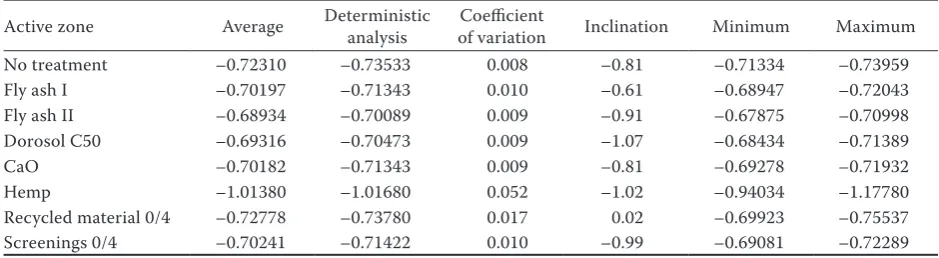
behav-iour of the structure. Complete results are shown in Table 6.
Nominal values of vertical displacements are al-ways higher for all variants than average values ob-tained from reliability analysis. It is clear that a sin-gle construction calculation with input quantities set to mean values is not able to provide informa-tion on average behaviour of the structure – pave-ment deflection under the centre of the loading
(a) (b)
(c) (d)
(e) (f) (a) (b)
[image:9.595.71.535.467.699.2]plate. In contrast, in this case the nominal values are very close to maximum values, i.e. extreme val-ues of vertical displacement.
Comparing the results obtained with the variant without improvement, the improvement with the use of brick recycled material and particularly hemp shives shows higher nominal values of vertical dis-placement. It is valid not only for nominal values, but also for mean, minimum and maximum values. The best results are obtained for variants fly ash II and Dorosol, although the other three variants are not too far behind and objectively contribute to an improvement of static behaviour of the structure.
Comparing the amplitude of random change-ability of deflections described by the coefficient of variation, the above-mentioned two variants show at least twice higher random variability in contrast to the remaining variants as well as to the variant without any improvement. The higher random variability must be considered as a negative phe-nomenon, since this fact indicates a significant in-crease in the probability of a potential defect.
DISCUSSION
The activities within the project included testing a number of research methods used for geotechnical investigations of road constructions. The dynamic plate load test with the use of LFWD 100 was se-lected from all tested methods. It is suitable for its speed, and in contrast to the static plate load test, there is no need for counterweight. It is relatively cheap and thanks to its speed, it is possible to ob-tain large statistical files for the measured profiles. Therefore, we can eliminate scarce extreme values that occur due to local non-homogeneities in the subgrade. The use of dynamic and penetration tests is recommended, since they can be a basis for sim-plified geological profiles and help to discover areas of local non-homogeneities in the subgrade.
When performing tests on roads in operation as well as on roads under construction (including the testing segment of Kuběnka FR), some deficien-cies were found which stem from underestimation of the importance of those roads, which leads to: (i) insufficient or missing geotechnical investiga-tion, (ii) underestimated design preparation, (iii) insufficient or missing inspection activity of cus-tomers, (iv) quality underestimation by contractor. The following deficiencies were found: (i) failure to observe the rule of backfill granularity in relation to the subgrade – filtration criterion, (ii) wrong ap-plication of geotextile, (iii) incorrect mechanical subgrade treatment, (iv) incorrect rehabilitation of soft subgrade, (v) non-functional drainage, (vi) treatment of soil with binders without certification tests, (vii) low-quality materials used for road con-struction layers.
The evaluation of measurement results of con-structions and their subgrades in LGTF shows the relatively high closeness of linear correlations for all evaluated testing procedures. Regarding some of the results, the proportion of the relationship comes directly from the essence of the evaluated pair (e.g. relationship of bulk density and moisture). In contrast, correlated results of SPLT and LFWD tests also show a high level of correlation, although the relationship has been scarcely mentioned so far. The use of an LFWD test in combination with dy-namic penetration (e.g. DPT) for determining the layer thickness with different bearing capacity ap-pears to be a useful and effective method in terms of speed, financial and technical demands, and suf-ficient accuracy.
The stochastic analysis of seven variants of the ac-tive zone treatment shows that two designed vari-ants – brick recycled waste and particularly hemp shives – fail to improve static behaviour of the road pavement in question. Their use leads to an increase in deflections and their extreme values. In addition, their random changeability characterized by the
co-Table 6. Statistical characteristics of deflection for individual variants of the active zone treatment
Active zone Average Deterministic analysis of variation Coefficient Inclination Minimum Maximum
No treatment –0.72310 –0.73533 0.008 –0.81 –0.71334 –0.73959
Fly ash I –0.70197 –0.71343 0.010 –0.61 –0.68947 –0.72043
Fly ash II –0.68934 –0.70089 0.009 –0.91 –0.67875 –0.70998
Dorosol C50 –0.69316 –0.70473 0.009 –1.07 –0.68434 –0.71389
CaO –0.70182 –0.71343 0.009 –0.81 –0.69278 –0.71932
Hemp –1.01380 –1.01680 0.052 –1.02 –0.94034 –1.17780
Recycled material 0/4 –0.72778 –0.73780 0.017 0.02 –0.69923 –0.75537
[image:10.595.62.532.74.203.2]efficient of variation is significantly increased. This fact indicates a significant increase in the probabil-ity of occurrence of a potential defect. The other five variants show very similar behaviour, while the treatment of the active zone with fly ash II and Do-rosol C50 appears to be the most suitable.
The first cause of this finding particularly concerns the materials with lower values of elasticity modulus and its higher random changeability characterized by a higher value of the coefficient of variation in comparison with the other five variants with treat-ment. Another potential cause is the fact that in contrast to the other variants, the treatment is sen-sitive to the level of moisture, i.e. with an increas-ing amount of moisture significantly decreases their elasticity modulus. It is obvious with brick recycled waste, which generally shows the high absorption ability of a higher amount of water, as well as with hemp shives, which contributes to soil aeriation and thus to a significant increase in the ability to absorb water. In contrast, the other materials are not influ-enced by the above mentioned, and furthermore, the hydraulic reaction leads not only to an increase in stiffness, i.e. elasticity modulus, but also to binding a certain amount of moisture in the active zone.
CONCLUSIONS
The optimization of the construction process of low volume roads requires selecting a suitable spa-tial arrangement, materials, and using mechanisms and work procedures. The construction process must be based on the knowledge of construction site conditions and requirements for traffic vol-ume. A simplified geotechnical investigation corre-sponding with the importance of the designed low volume road is used to find the construction condi-tions. The set of geotechnical investigation results evaluated by geotechnics is a necessary basis for an LVR construction project.
The article mentions the results of tests which were performed beyond the framework of the geo-technical investigation in order to more accurately describe the state and conditions of low volume road construction.
They also included laboratory and in situ tests which were performed in different localities within the project. LVR subgrade was classified according to the Proctor standard (PS) test into classes PS I to PS VI according to the prescribed methodology by the authors.
Based on the additional soil tests, they were im-proved with binders in investigated localities with
the presence of subgrade soils with low bearing ca-pacity. The treatment was applied and tested in a wide scale on the testing segment FR Kuběnka, and on other testing localities Moutnice, Kultury, and in LGFT.
Based on the completion of the mentioned exten-sive set of measurements in LGTF and in situ mea-surements, the procedures and the bearing capacity parameters were recommended.
Regarding the generally large extent of dispersion of individual measurements as well as the variety and changeability of subgrade and frequently low quality of used materials, the frequency of mea-surements may be the crucial aspect to guarantee the construction quality.
The above-mentioned LVR methodology was a significant support for the production of software with the title: “Software for calculation and evalu-ations of low volume roads” (hereinafter referred to as SLVR), intended for the administrator (inves-tor) and designers of low volume roads, which is recommended for designing and evaluating the road construction layers. The software is based on gained experience and results of laboratory and in situ tests and includes theoretical evaluation dur-ing the design of road construction layers.
The composition of road pavement and the tech-nology of the active zone treatment were verified with the use of a stochastic analysis.
LVR methodology and designing SLVR form a unit and become a suitable tool for an optimized construction, while the geotechnics plays a signifi-cant role to resolve potential problems within the whole course of individual construction phases.
The set of the above-mentioned activities and procedures is an important high-quality and eco-nomic tool for all participants in the construction of low volume roads.
References
AASHTO (2001): Guidelines for Geometric Design of Very Low-Volume Local Roads. Washington, D.C., AASHTO: 94.
AASHTO (2008): Mechanistic Empirical Pavement Design Guide: A Manual of Practice. Washington, D.C., AASHTO: 218.
Czech Statistical Office (2016): Infrastruktura silniční dopra-vy. Available at https://www.czso.cz/csu/xc/infrastruktura-silnicni-dopravy-k-1-1-2016
Florian A. (1998): Moderní numerické simulační metody – přehled. Stavební obzor 2/98: 60–64.
Florian A., Ševelová L. (2013): Computer simulation of low volume roads made from recycled materials. World Academy of Science, Engineering and Technology: Inter-national Journal of Civil and Environmental Engineering and Technology, 7: 744–748.
Florian A., Ševelová L. (2015): Certifikovaná metodika “metodický průvodce návrhem a realizací vozovek níz-kokapacitních komunikací” – zkušební poloprovozní úsek komunikace. In: Krajinné inženýrství 2015. Provoz a údržba staveb krajinného inženýrství. Prague, Česká společnost krajinných inženýrů: 163–174.
Molenaar A.A.A. (2008): Repeated load CBR testing, a simple but effective tool for the characterization of fine soils and unbound materials. In: Transportation Research Board 87th
Annual Meeting: Compendium of Papers, Washington, D.C., Jan 13–17, 2008: 1–22.
Ševelová L., Kozumplíková A. (2010): The numerical model for parametric studies of forest haul roads pavements. Acta Universitatis Agriculturae et Silviculturae Mendelianae Brunensis, LVIII: 361–367. (in Czech with English abstract) Ševelová L., Hauser J., Zedník P., Lažek D., Matula R., Ko-zumplíková A., Florian A. (2015): Metodický průvodce návrhem a realizací vozovek nízkokapacitních komunikací. Certifikovaná metodika 23327/2015-MZE-16222/M108. Brno, Mendel University in Brno: 62.
Zedník P., Matula R., Pospíšil K. (2015): Parameter for evalu-ating bearing capacity of subgrade and base forest road lay-ers. Polish Journal of Environmental Studies, 24: 809–815. Zedník P., Pospíšil K., Matula R. (2012): Metodika pro vyu-žívání lehkých zatěžovacích zkoušek – statické zatěžovací zkoušky a zkoušky lehkou dynamickou deskou a jejich korelace při výstavbě pozemních komunikací. Prague, Ministry of Transport of the Czech Republic: 28.