Abstract—Maintaining the pulp vitality during the
orthodontic treatment phase is an important aim during the treatment of periodontal disease. It was hypothesized that due to periodontal resorption the same amount of force determines an increase of maximum stress in the dental pulp, which might affect its vitality. The objective was to quantify stress produced in the dental pulp at 10 different bone levels under transverse and vertical orthodontic loadings, for the special case of a two roots second mandibular premolar. The alveolar bone and PDL has been reduced in height by 10%, from 0% to 90%, and subjected to 6 constant loadings of 1-10 N/mm2. The von Mises
stress values for the dental pulp were calculated. For 0% bone loss, a 1 N/mm2 intrusive load produced a maximum stress of 5.4E-05N/mm2. When resorption reached 50% the stress value was of 14.3E-05N/mm2 while for the 90% level the stress was 53.5E-05N/mm2. After 30% periodontal resorption (5.7 mm) the stress significantly increase and is assumed to be the starting point for dramatic changes in stress level. The mesial-distal loadings produced the highest stress values in the vital dental pulp for the 80% bone loss. The periodontal resorption determined a steady increase in the equivalent stress. Results lead to the conclusion that application of higher forces will determine higher stresses in the root apical third, which might affect the vitality of the pulp during the orthodontic treatment phase, and could worsen the periodontal problems.
Index Terms—Dental pulp, periodontal resorption, finite
element analysis, stress
I. INTRODUCTION
URING the last decades, reserchers have conducted studies regarding the interrelationship between endodontics, orthodontics and periodontics [1]. Those studies found a relationship between the pulpal and periodontal disease [2], [3]. However, few evaluated the influence of periodontitis upon pulpal tissues [3] when loaded with orthodontic forces, despite the fact that the orthodontic treatment it is still considered an important phase during the treatment of the periodontitis. Pulp vitality plays an important role for the tooth viability [4]. Recent studies revealed the potential for successful pulp regeneration and revascularization therapies[4], [5]. It is also a suitable alternative to extraction of severely compromised
Manuscript received February 29, 2016. This work was supported from author's funds.
R. A. Moga is Assistant Professor with the Department of Odontology, Faculty of Dental Medicine, University of Medicine and Pharmacy Iuliu Hatieganu Cluj-Napoca, No.33 Motilor street, 400001 Cluj, Romania
(corresponding author's phone: 0040740000767; email:
C. G. Chiorean is Professor and head of Department of Structural Mechanics, Technical University Cluj-Napoca, Cluj, Romania (e-mail: [email protected]).
teeth with intra-bony defects to or beyond the root apex [5]. Application of excessive and prolonged orthodontic intrusive forces to teeth may result in loss of pulp vitality especially in case of a history of dental trauma and severe periodontal injury [6]-[8].
The dental pulp is one of the tooth-periodontal ligament(PDL)-alveolar bone complex components and it is affected by the way the complex dissipates the loads incurred during mastication [9]. The periodontal disease determines loss of attachment and bone resorption (periodontal resorption) and reduces the capability of the complex to efficiently support current functional loadings [9]-[11]. The conservation of the tooth-PDL-alveolar bone complex at various levels of periodontal resorption, among other factors [10], is heavily dependent on knowing the dental pulp stress distribution.
Stresses in the root canal, pulp chamber and vital dental pulp are difficult to be measured experimentally, the most used method is the finite element analysis-FEA [11]. For investigating the stress distribution in an anatomical structure, a Cone beam computed tomography (CBCT) examination could be performed. Then a similar three-dimensional-3D model should be created and then subjected to FEA [12]-[15].
Increased periodontal resorption can also be detected in patients referred for orthodontic treatment [15].
Previous studies have investigated stress distribution in the root and root canal morphology of restored, endodontically treated, filled with gutta-percha and posts [16]-[18]. Results revealed no semnificative difference of deformation in posts, root canal cement and the treated tooth [16]. The highest stresses were found at the canal wall, the round canals showing lower uniform distributions, whilst the oval canals showing uneven distributions [17]. Stresses within the root were lower and more evenly distributed than before preparation [17]. The removal of dentin does not always result in an increased fracture susceptibility [20]. The canal wall curvature is a major factor in stress concentration and hence in the pattern of fracture [11]. Lateral loading produced maximum stresses greater than axial loading, and pulp tissues, however, experienced minimum levels of stresses [21].
However, the publications available regarding stress distribution in the vital dental pulp subjected to orthodontic forces and correlated with bone and PDL height loss are not many also are very different and compare them is challenging.
The used FEA's boundary conditions affect the accuracy of the results and stress distribution varies depending on
Vital Dental Pulp Stress Analysis During
Periodontal Resorption
R.A. Moga, C.G. Chiorean
axial loadings [10], [13], [14].
Previous periodontal researches revealed that it is important to simulate various levels of bone height for understanding how axial loadings are absorbed and dissipated. Previous studies used models having various levels of bone height [15], [22], [23], a PDL's thickness of 0.14-0.40 mm [15], [24], [25] and constantly loaded forces varying from 0.3 N up to 1500 N(46 MPa) [10], [12], [13], [15], [22], [23], [26]. Two of the main problems regarding previous researches were related to the fact that they did neither closely investigated the linear periodontal resorption nor used highly anatomical accurate models. Previous FEA research assumed axially applied static loads instead of the more realistic dynamic-cyclic loads [27].
The selection process of the boundary conditions in this study was performed in order to compare the obtained data with published data [14], [15], [23], [28]. The 6 constant orthodontic loadings used values of: 1, 3 and 10 N/mm2, described the biomechanical behavior of the vital pulp in the second human lower right premolar for a periodontal resorption of 10%-90%. Previous studies used models of simulated curved canals [19], [29], lower [17], [30] and upper [30]-[32] incisors [33], upper and lower canines [34], upper and lower [35], [36] premolars, but none used the second lower premolar containing vital dental pulp. The lower premolar, has a complex geometry(e.g. the one used in this study, a special case, has two root canals and two fused roots) but still similar in shape with other lower and upper premolars. It's location on the mandible (a mobile bone) might influence the stress distribution in the periodontal tissues due oral kinematics. Recent studies also demonstrated that FE models constructed from CBCT data could be used as a valid model to perform FEA with acceptable accuracy [37]. The boundary conditions and input data affect the accuracy of the results [12], [13], [15], [38]-[40]. The stresses generated in the dental pulp by the applied force is an important factor to be evaluated due to changes produced in the pulp, periodontal ligament, alveolar bone and cement during tooth movement [41]-[42]. Therefore sensitivity analysis is needed for assess the robusticity of the results [38]. Previous studies did not mention anything regarding their sensitivity tests on their FEA models.
This study used a completely new accurate anatomical model, created based on the information provided by CT slices, and simulating a bone loss of 10%-90%. Accurate new information regarding the behavior of vital dental pulp under different orthodontic loadings is expected to be obtained. This new data should complete the knowledge regarding the human teeth investigated during periodontal resorption and help practitioners during clinical treatment. It should also fill the gaps regarding the way the stress distribution occurs in the vital pulp of a premolar during the gradual linear resorption process [9] and has potential clinical applicability.
It was hypothesized that due to periodontal resorption the same amount of force determines an increase of maximum stress in the dental pulp, which might affect its vitality. The aim of this study was to quantify stress produced in the vital dental pulp consequent to different orthodontic forces
application at 10 different bone levels.
II. MATERIAL AND METHODS
A. Model creation
This research used 2200 2D CBCT slices (voxel size of 0.08 mm) of the second lower right premolar of a 34-year-old healthy male. A manual image segmentation process was used for creating a highly accurate anatomical detailed 3D models of each tooth-PDL-alveolar bone complex components and having 320×320×320 mm. Total bone height was 19.2 mm. Bone beneath the tooth was 6 mm. The second lower right premolar was 26 mm. After the replication of the initial model, ten 3D models with the same configuration were obtained(except for the alveolar bone height and PDL). A progressive periodontal homogenous horizontal linear resorption (0% - 90%) was simulated [22], [26] by reducing the alveolar bone and PDL in height by 10% (1.92 mm equal to 24 slices). The manual image segmentation (based on gray scale values and on Houndsfield units) and 3D model generation was performed using the software platform AMIRA 5.4.0.. Based on the assumptions of previous researches, the cement layer in the roots area was considered to have the same properties as the dentin. The PDL had a varying thickness of 0.16-0.24 mm/2-3 voxels being attached to the intra-alveolar surface and to the root [23]. The minimum thickness of the cortical bone layer was 2mm. Triangles were used for calculating and describing the 3D models. The surface models were strongly simplified but maintaining the shapes of the original surfaces, and then meshes were obtained by filling the volumes restricted by the surfaces with tetrahedrons. The final mesh contained 14395 nodes and 73913 tetrahedrons.
B. Finite element analysis
The finite element analysis allows stress analysis in geometrically complex small anatomical structures by dividing them into a finite number of geometrically simple elements. For obtaining realistic simulations of the biomechanical behavior, the final mesh was exported and analyzed in ABAQUS 6.1.1.1. (Fig. 1). Each voxel was then assigned with boundary conditions that defined the way the model would deform under stress. The FEA process solved the model as a series of nodal displacements and the resulting equivalent von Mises stresses were calculated and displayed. Their magnitudes, represented numerically as a color-coded projection onto the model geometry, described the mechanical behavior of the vital dental pulp. This study investigated the vital dental pulp’s overall stress value (von Mises stress values) in N/mm2 under the each of the 6 orthodontic loadings, in a particular case of a lower premolar with two roots. The von Mises stresses were selected because they accurately define the yielding criteria for isotropic materials under different loading conditions representing the overall stress intensity.
C. Material models and modeling assumptions
The main advantages of this type of approach are the simplicity and accuracy of results. However, the components of the real anatomical structure, show non-homogeneous, anisotropic and nonlinear behavior and they should be modeled as elasto-plastic porous materials with a complex microstructure [12]. This aproach should involve complex FE models enhanced with advanced nonlinear constitutive equations experimentally calibrated which is scarce in the published data. Table I shows all materials' elastic constants/Young's modulus and Poisson's ratio [12], [13], [23], [38], [39], [42]. Young’s modulus indicates the material's stiffness, describing the way it deforms elastically under axial loading conditions, while Poisson's ratio describes how much a material expands-contracts. The boundary conditions refers to a prescription of displacements in different regions of the model. In present case, the base of the model (Fig. 1) was considered to be encastred (zero displacement) while the other parts of the model were free of boundary conditions. This method of restraining of all forms of translational movements [12], [13], [42] prevented any rigid body motion while the loadings were acting [15]. For avoiding any perturbation caused by the length of the mandible over the studied complex, all models have been created with mesial and distal edges at some reasonable distance from the tooth. The numerical studies performed on the model confirmed the localized nature of the phenomenon only to the investigated structures. The interfaces between all components were assumed to be perfectly bonded interfaces [12], [13], [42] and all the components interact with each other. Coronal-apical(intrusive) loads of 1 N/mm2 and 10 N/mm2, and 1 N/mm2 and 3 N/mm2 vestibular-palatinal(transversal) and mesio-distal(transversal) loads were applied, one at the time (in different loading sequences), at the enamel surface, centrally in the occlusal face of the crown, in order to estimate the loads' effect over the pulp. The other surfaces were treated as free surfaces with zero loads.
Table I. Elastic properties of materials used in the study
Material Constitutive
equation
Young's modulus, E (GPa)
Poisson ratio, ʋ
Refs.
Enamel Isotropic,
homogeneous and linear elastic
80 0.33 [39]-[42]
Dentin Isotropic,
homogeneous and linear elastic
18.6 0.31 [39]-[42]
Pulp Isotropic,
homogeneous and linear elastic
0.0021 0.45 [39]- [42]
PDL Isotropic,
homogeneous and linear elastic
0.0689 0.45 [23],[
39]-[42]
Cortical bone Isotropic,
homogeneous and linear elastic
14.5 0.323 [12], [13],
[42]
Cancellous bone
Isotropic, homogeneous and linear elastic
1.37 0.30 [12], [13],
[39]- [42]
III. RESULTS
Coronal apical load. 0% bone loss. The highest level of stress was located on the mesial and distal sides of the
coronal pulp decreasing toward the root pulp (1 N/mm2 load) (Fig. 2A-Table II). The lowest stress value at the apical level was approximately 2.4% of the coronal stress (Table III). For the 10 N/mm2 load, the stress distribution maintained in the same locations, while the numerical values increased by 10 times.
Fig. 1(a, b, c, d, e) The FE Mesh used in Abaqus for 0% resorption level with boundary conditions: a-model, vestibular view; b-PDL, lingual view; c-premolar, lingual view, d-vital dental pulp, mesial view, e-the occlusal face of the crown were the loads were applied
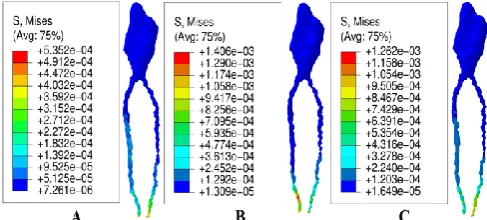
Alveolar bone loss. The highest stress values were found at the apical level (Fig. 4A-Table II). The von Mises stress gradually increased with the increase in bone resorption. The stress increased 2.6 times when resorption reached 50% of the bone height, and 10.8 times for the 80% bone loss (1 N/mm2 load). The stress level distribution maintained in the same locations for the 10 N/mm2 load, while the numerical values increased by 10 times.
Vestibulo-lingual load. 0% bone loss. The highest level of stress was located on the mesial and distal sides of the coronal pulp (1-3 N/mm2 loads) (Fig. 2B-Table II). The lowest apical stress value was approximately 3% of the coronal stress (Table III).
Alveolar bone loss. The highest stress values were found at the apical level (Fig. 4B-Table II). The maximum stress gradually increased, 2.2 times for the 50% bone loss and 14 times for the 80% bone resorption
Mesio-distal load. 0% bone loss. The highest stress level was found on the mesial side of the coronal pulp (1 N/mm2 and 3 N/mm2 loads) (Fig. 2C-Table II). The lowest apical stress value was approximately 2.5% up to 3.8% of the coronal stress (Table III).
Alveolar bone loss. The highest stress values were found at the apical level (Fig. 4C-Table II). The maximum stress gradually increased, up to 13.4 times for the 50% bone loss and up to 51.4 times for the 80% bone resorption. At the 90% bone loss, for all loads, a decrease in stress values was observed, due to the geometry of the model and massive bone height loss. The mesial-distal loading (1 N/mm2 load), produces the highest von Mises stress values in the vital dental pulp (Fig. 5a) for the 80% bone loss, while the same results maintained for the 3 and 10 N/mm2 loadings (Fig. 5b).
IV. DISCUSSIONS
[image:3.595.42.289.524.760.2]through CT's slice image manual segmentation.
Most of the living biological tissues do not react according to those principles and some of the stress values that produce biological changes (e.g. resorption process) are not entirely known and understood [12], [13]. Boundary conditions, which were limited to certain behaviors, were used in this process. The numerical values used were depending on a lot of variables and were not necessarily identical with the actual values [12], [13]. Due to all these aspects FEA should not be considered the only way to investigate the biomechanical behavior and therefore clinical experimentation for validating the results are required. However, the stress in the root canals is difficult to be measured experimentally so in this case the FEA is the proper method to investigate the von Mises equivalent stress [11].
For a robust FEA's results sensitivity testes are advisable [38]. Despite all these, previous studies failed to mention anything about their sensitivity testes. This study complied with the sensitivity tests criteria regarding the modeling decisions [38] and conducted a geometric morphometric analysis for confirming the deformation results.
For simplifying the FEA, all the interfaces were perfectly bonded interfaces [12], [13] but this assumption does not necessarily simulate clinical situations and represents an inherent limitation. However, the goal of this study was a qualitative analysis and these boundary conditions do not alter the accuracy of the results.
Previously FEA conducted studies regarding the stress field in root canals [35], [36], considered all model components as homogeneous, elastic and isotropic materials [15]. They showed that the stress distribution depended on apical geometry (e.g. canal curvature) [11] and usually did not involve the periodontal resorption process [19]. However, minor informations regarding the stress distribution during complete linear periodontal resorption are available. The results obtained in this study filled the knowledge gaps and studied stress distribution in the vital dental pulp at ten different bone levels (from 0% to 90%) under transverse and vertical loadings, being hypothesized that a reduction in alveolar support causes an increase in the maximum stress in the periodontal structures. Each 10% of resorption had 1.92mm/24 slices.
The used model's complexity (a 14395 nodes highly anatomically accurate model, created through image manual segmentation) and the simulated periodontal linear resorption are the main causes of the differences between the results of this study and the previous studies. Some studies used models created after Ash's dental anatomy having 556-37884 nodes [15], [23], [26], a PDL thickness of 0.16-0.40 mm [15], [24], [25] and a periodontal resorption ranging from 0% to 75% [15], [22], [13]. Nevertheless, none described a periodontal resorption of 0% up to 90%. It has also been shown that an accurate CT examination can generate detailed 3D root canal models [37]. The boundary conditions are identical to those used in previous studies, enabling the comparison of results [16].
There are studies that include the evaluation of the von Mises equivalent stress at different bone levels [23], [36], [40] but the periodontal resorption process is not studied in
details and no data regarding the biomechanical behavior of the vital dental pulp were found.
In this study, for the FEA, 6 orthodontic loadings of 1-10N/mm2(MPa) were used, each at a time, similar to those used in previous studies [14], [15], [33] and the results of the structural response of the system have been obtained in terms of the von Mises cervical stress (Table II).
The previous studies showed that increased loadings affected the hard-tissue structures but not the dental pulp [32]. It was also found that a variation in the inner diameter of the pulp chamber had an impact on stress distribution in periodontal tissues [36] and that the enlargements of root canal diameter determine an increase in the stress of the root canals wall [40].
The obtained results showed that the mesial-distal loadings, produced the highest von Mises stress values in the vital dental pulp (Fig. 5) similar to other previous studies [19], [34]. For 0% bone loss the highest von Mises stress values were located on the mesial and distal sides of the coronal pulp and towards the pulp root canal (Fig. 2) which is in agreement with previous studies [17], [34]. Maximum stresses (for the 0% bone loss) were concentrated on force application areas (Fig. 2 and Table II), which confirms the previous studies [31].
The von Mises equivalent stress values analyzed in this study were found to be up to 0.006 MPa (3 N/mm2 transverse loading) in the vital dental pulp while other studies reported values starting from 6 MPa (15 N transverse loading) for a tooth with retentive post [34]. This can be explained by the fact that the vital pulp is well protected by the surrounding dentine and little influenced by external forces [32]. However, when the tooth is endodontically treated(change in curvature and the inner diameter of pulp cavity and root canal) the stress values increase [30], [36] due to canal preparation, despite the fact that appropriate canal preparation techniques have little influence on stress distribution [29]. This study confirms that root canal treatment should remove only infected tissue and avoid over-cutting of hard tissue which is in agreement with previous studies [33], [40].
The highest stress value for the 0% bone loss was 0.00054 MPa (for the 10 N/mm2 vertical load) which is well under the 1 MPa reported for a 24 N vertical load [34]. This difference appeared due to the different geometry of the model and loadings. For the 90% bone loss (Table III) stress values were significantly reduced due to the combination of bone and PDL loss and the anatomical configuration of the apical region. The stress sign in our study is obviously positive, because it represents the equivalent of von Mises stresses.
This 3D model might be applied for future estimations regarding the biomechanical behavior of the vital dental pulp [19].
The model used is the second lower right premolar, with two root canals, while most of the studies used single-rooted and single canal teeth [18]. This aspect influences the biomechanical behavior of the tooth. Even the shape of the canal section (round and oval) and the curvature influence the stress distribution [11], [17].
stress values at all levels [19]. This study is in agreement with that and provides an accurate description of the entire biomechanical behavior of the vital dental pulp. Following the values (Table II-III), a certain predictability regarding the rise of stress values and their tendency to increase can be noted. The differences between these results and the previous ones seem to be due to the different tooth chosen and to the different simplification assumptions-physical properties adopted during modeling. The model itself might produce these differences due to mesh size and normal variations in dimensions-configurations.
The present study, due to its highly anatomical accurate model design, brings new theoretical and clinical applicable information to the field. The qualitative analysis explains why after a long period of slow periodontal resorption process, with the dental pulp showing no warning signs of degeneration, as soon as a certain resorption degree is passed, the pulp might rapidly degenerate and the endodontic treatment might be needed. According to literature data previous studies investigated mostly endodontically treated incisors, premolars and molars, so this study, by investigating a the vital dental pulp of a premolar, fills the knowledge gaps regarding the biomechanical behavior of the vital dental pulp. The gradual linear periodontal resorption simulation and the fact that the mesial-distal loadings generate the highest stresses are extremely important in the orthodontic and dental prosthetic planning phase, in endodontics and in periodontal treatments. It has the potential to improve tooth-PDL-alveolar bone complex oral behavior predictability and its conservation in oral the cavity through an improvement of the treatment planning phase.
The novelty in this approach consists in: the high anatomical accuracy of the 3D models, the gradual periodontal resorption that simulated a complete process (0-90%), the FEA conducted according to sensitivity tests criteria, totally new numerical stress values for the 70-90% resorption levels and new values for 0-70% resorption levels.
Additional vital dental pulp might be needed in the future. In the open literature there is no data regarding the maximum tolerable stress for living tissues [23], however, the stress increase during periodontal resorption is so high that it can be considered to be out of the range of tolerable stress, similar with Geramy's conclusions [23]. Previous studies showed that histological changes following the application of stress might occur and produce changes in the physical properties of tissues that might affect the results [14] Further studies are needed for finding the maximum tolerable stress and allowing a more accurate discussion regarding this study's results
V. CONCLUSIONS
It was observed that during the linear periodontal resorption simulation the von Mises stress gradually increased along with the PDL and bone height loss thus validating the research hypothesis. Each 2 mm layer of PDL and bone protects from stress the periodontal tissues beneath. After 30% periodontal resorption the stress
significantly increase. Approximately 5.7 mm of periodontal loss(30%) is assumed to be the starting point for dramatic changes in stress level. The maximum stress values were found to be at 80% bone resorption. The mesial-distal loadings produced the highest von Mises stress values in the vital dental pulp for the 80% bone loss. The results show that due to periodontal resorption the same amount of force determines an increase of maximum stress in the dental pulp, which ultimately might affect its vitality and could worsen the periodontal problems. All these should be taken into consideration by the orthodontist when applies the orthodontic forces at patients having periodontitis. This study provides an integrated approach to the solutions of biological and biomedical problems such as the conservation of a tooth in the oral cavity, for as long as possible. It also filled the knowledge gaps regarding the biomechanical behavior of the vital dental pulp during periodontal resorption and confirming FEA as a feasible and effective method for studying the vital dental pulp and stress field in root canals.
Figure 2(A, B, C) Von Mises stress distribution for 1N/mm2 for 0%
resorption level: A-Coronal apical load; B-Vestibulo-lingual load; C-Mesio-distal load
Figure 3(A, B, C) Von Mises stress distribution for 1N/mm2 for 50% resorption level: A-Coronal apical load; B-Vestibulo-lingual load; C-Mesio-distal load
Figure 4(A, B, C) Von Mises stress distribution for 1N/mm2 for 90%
[image:5.595.306.552.310.427.2] [image:5.595.307.547.475.586.2] [image:5.595.305.549.633.743.2]CA VL
MD
0.00E+00 5.00E-04 1.00E-03 1.50E-03 2.00E-03
0% 10% 20% 30% 40% 50% 60% 70% 80% 90% (CA) Coronal aplical load 1 N/mm2(MPa)
(VL) Vestibulo-lingual load 1 N/mm2(MPa) (MD) Mesio-distal load 1 N/mm2(MPa)
CA VL
MD
0.00E+00 1.00E-03 2.00E-03 3.00E-03 4.00E-03 5.00E-03 6.00E-03 7.00E-03
0% 10% 20% 30% 40% 50% 60% 70% 80% 90% (CA) Coronal aplical load 10 N/mm2(MPa)
(VL) Vestibulo-lingual load 3 N/mm2(MPa) (MD) Mesio-distal load 3 N/mm2(MPa)
a b
Figure 5(a, b): a-Maximum von Mises stresses in the vital dental pulp for 1 N/mm2(MPa) loading forces for the 10 levels of bone height loss; b Maximum
[image:6.595.57.545.65.232.2]von Mises stresses in the vital dental pulp for 3-10 N/mm2(MPa) loading forces for the 10 levels of bone height loss
Table II. The highest pulp's von Mises stress values in N/mm2(MPa), under the 6 loadings, during periodontal resorption simulation
alveolar bone reduced in
height
alveolar bone and PDL
height
A. Coronal apical
load
B. Vestibular-Lingual load
C. Mesial-Distal
load
% mm 1 N/mm2 (MPa) 10 N/mm2
(MPa)
1 N/mm2 (MPa) 3 N/mm2
(MPa)
1 N/mm2 (MPa) 3 N/mm2
(MPa)
0% 19.2 5.4E-05 54.E-05 10.E-05 30E-05 4E-05 13E-05
10% 17.28 5.9E-05 59E-05 15E-05 46E-05 15E-05 46E-05
20% 15.36 11E-05 110.E-05 22E-05 67E-05 20E-05 60E-05
30% 13.44 11.6E-05 116E-05 22.8E-05 68E-05 20.7E-05 62E-05
40% 11.52 12.4E-05 124E-05 26.9E-05 80E-05 25.7E-05 77E-05
50% 9.6 14.3E-05 143E-05 22.9E-05 68.E-05 53.9E-05 161E-05
60% 7.68 26.8E-05 268E-05 48.9E-05 146E-05 58E-05 174E-05
70% 5.76 52.5E-05 525E-05 80.5E-05 241E-05 111.2E-05 333E-05
80% 3.84 58.4E-05 584.E-05 144.6E-05 433E-05 205.9E-05 617E-05
90% 1.92 53.5E-05 535E-05 140.6E-05 421E-05 126.2E-05 378E-05
Table III. The lowest pulp's von Mises stress values in N/mm2(MPa), under the 6 loadings, during periodontal resorption simulation
alveolar bone reduced in height
alveolar bone and PDL height
A.
Coronal apical load
B. Vestibulo-lingual load
C.
Mesio-distal load
% mm 1 N/mm2(MPa) 10 N/mm2(MPa) 1 N/mm2(MPa) 3 N/mm2(MPa) 1 N/mm2(MPa) 3 N/mm2(MPa)
0% 19.2 0.13E-05 1.3E-05 0.3E-05 0.9E-05 0.1E-05 0.5E-05
10% 17.28 0.15E-05 1.5E-05 0.5E-05 1.5E-05 0.5E-05 1.5E-05
20% 15.36 0.29E-05 2.9E-05 0.9E-05 2.7E-05 0.53E-05 1.59E-05
30% 13.44 0.41E-05 4.1E-05 1.3E-05 3.9E-05 1.14E-05 3.43E-05
40% 11.52 0.88E-05 8.8E-05 2.3E-05 6.9E-05 2.48E-05 7.44E-05
50% 9.6 1.15E-05 11.5E-05 2E-05 6.1E-05 2.54E-05 7.62E-05
60% 7.68 1.65E-0 16.5E-05 3.1E-05 9.4E-05 4.33E-05 12.99E-05
70% 5.76 1.60E-05 16E-05 3E-05 9.E-05 3.96E-05 11.89E-05
80% 3.84 4.87E-05 48.7E-05 12.E-05 36.1E-05 17.16E-05 51.47E-05
90% 1.92 0.72E-05 72E-05 1.3E-05 3.9E-05 1.64E-05 4.94E-05
REFERENCES
[1] Paul BF, Hutter JW., 1997. The endodontic-periodontal continuum
revisited: new insights into etiology, diagnosis and treatment. J Am Dent Assoc. 128, 1541-1548.
[2] Simring M, Goldberg M., 1964. The pulpal pocket approach:
Retrograde periodontitis. J Periodontol. 35, 22–48.
[3] Solomon C, Chalfin H, Kellert M, Weseley P., 1995. The
endodontic-periodontal lesion: a rational approach to treatment. J Am Dent Assoc. 126, 473-479.
[4] Zhang W, Yelick PC., 2010. Vital pulp therapy-current progress of
dental pulp regeneration and revascularization. Int J Dent. 2010:856087.
[5] Cortellini P, Stalpers G, Mollo A, Tonetti MS. Periodontal
regeneration versus extraction and prosthetic replacement of teeth severely compromised by attachment loss to the apex: 5-year results
of an ongoing randomized clinical trial. J Clin Periodontol. 2011 Oct;38(10):915-24.
[6] Han G, Hu M, Zhang Y, Jiang H. Pulp vitality and histologic changes
in human dental pulp after the application of moderate and severe intrusive orthodontic forces. Am J Orthod Dentofacial Orthop. 2013 Oct;144(4):518-22.
[7] Javed F, Al-Kheraif AA, Romanos EB, Romanos GE. Influence of
orthodontic forces on human dental pulp: a systematic review. Arch Oral Biol. 2015 Feb;60(2):347-56.
[8] Bauss O, Röhling J, Meyer K, Kiliaridis S. Pulp vitality in teeth suffering trauma during orthodontic therapy. Angle Orthod. 2009 Jan;79(1):166-71
[9] Naveh GR, Lev-Tov Chattah N, Zaslansky P, Shahar R, Weiner S.,
2012. Tooth-PDL-bone complex: response to compressive loads encountered during mastication - a review. Arch Oral Biol. 57:1575-1584.
[10] Poiate IA, de Vasconcellos AB, de Santana RB, Poiate E., 2009.
[image:6.595.58.540.286.433.2] [image:6.595.55.545.460.605.2]ligament in masticatory, parafunctional, and trauma loads: finite element analysis. J Periodontol. 80, 1859-1867.
[11] Lertchirakarn V, Palamara JE, Messer HH., 2003. Finite element
analysis and strain-gauge studies of vertical root fracture. J Endod. 29, 529-534.
[12] Achour T, Merdji A, Bachir Bouiadjra B, Serier B, Djebbaral N.,
2011. Stress distribution in dental implant with elastomeric stress barrier. Mater Design 32, 282–290.
[13] Merdji A, Bachir Bouiadjra B, Achour T, Serier B, Ould Chikl B, Feng ZO. Stress analysis in dental prosthesis. Comp Mater Sci 2010;49:126–133.
[14] Puente MI, Galbán L, Cobo JM., 1996. Initial stress differences
between tipping and torque movements. A three-dimensional finite element analysis. Eur J Orthod. 18, 329-339.
[15] Geramy A., 2002. Initial stress produced in the periodontal membrane
by orthodontic loads in the presence of varying loss of alveolar bone: a three-dimensional finite element analysis. Eur J Orthod. 24, 21-33 [16] Vitale MC, Chiesa M, Coltellaro F, Bignardi C, Celozzi M, Poggio
C., 2008. FEM analysis of different dental root canal-post systems in young permanent teeth. Eur J Paediatr Dent. 9, 111-117.
[17] Versluis A, Messer HH, Pintado MR., 2006 Changes in compaction
stress distributions in roots resulting from canal preparation. Int Endod J. 39, 931-919.
[18] Cleghorn BM, Christie WH, Dong CC., 2007. The root and root canal
morphology of the human mandibular second premolar: a literature review. J Endod. 33, 1031-1037.
[19] Cheng R, Zhou XD, Liu Z, Hu T., 2007. Development of a finite
element analysis model with curved canal and stress analysis. J Endod. 33, 727-731.
[20] Sathorn C, Palamara JE, Palamara D, Messer HH., 2005. Effect of
root canal size and external root surface morphology on fracture susceptibility and pattern: a finite element analysis. J Endod. 3, 288-292.
[21] Romeed SA, Malik R, Dunne SM., 2012. Stress analysis of occlusal
forces in canine teeth and their role in the development of non-carious cervical lesions: abfraction. Int J Dent. 2012:234845.
[22] Reddy MK, Vandana KL., 2005 Three-dimensional finite element
analysis of stress in the periodontium. J Int Acad Periodontol. 7, 102-107.
[23] Geramy A, Faghihi S., 2004. Secondary trauma from occlusion:
three-dimensional analysis using the finite element method. Quintessence Int. 35, 835-43.
[24] Consolaro A, Consolaro MF M-O., 2010. ERM functions, EGF and
orthodontic movement or Why doesn't orthodontic movement cause alveolodental ankylosis?. Dental Press J Orthod 2, 24-32.
[25] Coolidge ED., 1937. The thickness of human periodontal membrane.
J Am Dent Assoc 24, 1260-1270.
[26] Chen WP, Lee BS, Chiang YC, Lan WH, Lin CP., 2005. Effects of
various periodontal ligament elastic moduli on the stress distribution of a central incisor and surrounding alveolar bone. J Formos Med Assoc. 104, 830-838.
[27] Li J, Li H, Shi L et al., 2007. A mathematical model for simulating the bone remodeling process under mechanical stimulus. Dent Mater 23, 1073-1078.
[28] Ona M, Wakabayashi N., 2006. Influence of alveolar support on
stress in periodontal structures. J Dent Res. 85, 1087-1091.
[29] Cheng R et al., 2009. Finite element analysis of the effects of three preparation techniques on stresses within roots having curved canals. Int Endod J. 42, 220-226.
[30] Lertchirakarn V, Palamara JE, Messer HH., 2003. Finite element
analysis and strain-gauge studies of vertical root fracture. J Endod. 2003;29:529-534.
[31] Belli S, Eraslan O, Eskitascioglu G, Karbhari V., 2011. Monoblocks
in root canals: a finite elemental stress analysis study. Int Endod J. 44, 817-826.
[32] da Silva BR, Moreira Neto JJ, da Silva FI Jr, de Aguiar AS., 2013. Three-dimensional finite element analysis of the maxillary central incisor in two different situations of traumatic impact. Comput Methods Biomech Biomed Engin. 16 158-164.
[33] Cailleteau JG, Rieger MR, Akin JE., 1992. A comparison of
intracanal stresses in a post-restored tooth utilizing the finite element method. J Endod. 18, 540-544.
[34] Kalachev YS., 2004. Analysis of stresses in hard dental tissues
generated by clinical application of retentive root canal posts. Folia Med (Plovdiv). 46, 42-46.
[35] Manda M, Galanis C, Venetsanos D, Provatidis C, Koidis P., 2011. The effect of select pulp cavity conditions on stress field development
in distal abutments in two types of fixed dental prostheses. Int J Prosthodont. 24, 118-126.
[36] Qiu JX. et al., 2010. A structural mechanics study with human
maxillary premolar. Sichuan Da Xue Xue Bao Yi Xue Ban. 41, 303-306
[37] Chen G et al., 2012. Tooth fracture risk analysis based on a new finite
element dental structure models using micro-CT data. Comput Biol Med. 42, 957-963.
[38] Gröning F, Fagan M, O'Higgins P. Modeling the human mandible
under masticatory loads: which input variables are important? Anat Rec (Hoboken). 2012;295:853-863
[39] Piotr Kowalczyk., 2009. Influence of the shape of the layers in
photo-cured dental restorations on the shrinkage stress peaks—FEM study. Dent Mater 25, e83–e91.
[40] Chen J, Yue L, Wang JD, Gao XJ., 2006. The correlation between the
enlargement of root canal diameter and the fracture strength and the stress distribution of root. Zhonghua Kou Qiang Yi Xue Za Zhi. 41, 661-663
[41] Hemanth M, Deoli S, Raghuveer HP, Rani MS, Hegde C, Vedavathi
B. Stress Induced in the Periodontal Ligament under Orthodontic Loading (Part I): A Finite Element Method Study Using Linear Analysis. J Int Oral Health. 2015 Aug;7(8):129-33.
[42] Moga RA, Chiorean CG. Strain Analysis of a Human Tooth with