Substantiation of the parameters of the disk-knife working
body and the study of its work
Savelii Kukharets
1*, Gennadii Golub
2, Viktor Biletskii
1,
Oleksandr Medvedskyi
11
Department of Mechanical Engineering and Agroecosystems, Zhytomyr National
Agroecological University, Zhitomir, Ukraine
2
Department of Tractors, Automobiles and Bioenergy Systems, National University
of Life and environmental sciences of Ukraine, Kyiv, Ukraine
*Corresponding author: [email protected]
Abstract
Kukharets S., Golub G., Biletskii V., Medvedskiy O. (2017): Substantiation of the parameters of the disk-knife working body and the study of its work. Res. Agr. Eng., 64: 195–201.
The work is devoted to the issue of improving the quality of cultivating of root-bearing soil layer and optimizing its agrotechnological properties. Improving the quality of cultivation is due to the application of soil cultivating tools equipped with knife working bodies. They are provided theoretical and experimental study of the work of the disk-knife working body, and it is substantiated its rational parameters. The basis of the substantiation of the parameters of the cultivating tool is the original analytical model, which reflects the process of interaction of the working body with the soil. To study the performance of the process, on the basis of kinematic equations of motion of the individual points of the working bodies, it is developed the analytical model of the motion of the battery of the working bodies. On the basis of the provided analytical researches, they were determined geometrical parameters and developed ex-perimental samples of the disk-knife working body. It was carried out a comparative test in the field of tools equipped with disk-knife working bodies and with standard spherical cut-off discs, which confirmed the effectiveness of the use of disk-knife working bodies. The use of disk-knife working bodies ensures: the burying of plant remains and fertiliz-ers into the root-bearing soil layer, improving the quality of soil cultivation, preserving of its structure, reducing the traction resistance of the body.
Keywords: modeling; field test; twist angle; burying factor; approach angle; tillage depth; traction resistance
In the system of basic and pre-sowing soil treat-ments, it became widespread soil treatment with tools with disk working tools. Their use reduces soil preparation time (Rusu 2014; Damanauskas, Janulevičius 2015, Hamzei, Seyyedi 2016). It is appropriate to use disk soil tillage tools and in systems of the hill soil tillage (Tarverdyan, Tonapetyan 2016). The use of disk cultivation can reduce the neg-ative impact of crop predecessors on the main culture (Ercoli et al. 2017). The use of disk soil cultivation can reduce carbon dioxide emissions into the atmo-sphere (Šima et al. 2013; Lu, Liao 2016).
sur-face, which greatly reduces the efficiency of their use (Colbach at al. 2014; Scherner at al 2016). The tillage with serial disk tools does not provide an ade-quate degree of organic waste burying, which reduc-es the efficiency of their decomposition (Schneider at al. 2006; Brennan et al. 2014; Sizmur at al 2017).
The results of the performed analysis of existing designs of disk working bodies indicate the prom-ise of their use. However, existing types of designs of disk tillage tools cannot fully ensure the bury-ing of organic residues and organic fertilizers and partially disturb the soil. In addition, they do not provide a rational distribution for the depth of cul-tivation of plant residues and fertilizers. Therefore, it is necessary to develop a design of a disk work-ing body that would provide the necessary quality indicators for burying into the soil at the optimum depth of stubble, straw, organic and mineral fertil-izers with preservation of the soil structure.
MATERIAL AND METHODS
Computer simulation. To study the
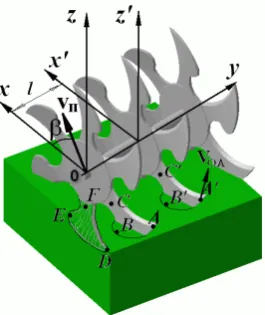
perfor-mance of the process, on the basis of the kinematic equations of motion of the individual points of the working bodies, it was created the analytical mod-el of the movement of the battery of the working bodies (Fig. 1), which was described by a system of equations:
cosβcos( α) sinβ sinβ
cosβ sinβcos( α) cosβ
sin( α)
i п i i
x t a t b nl
y b a t nl
z a t
X Z
Z Z
½
°
¾
°
¿
(1)
where: xi, yi, zi – coordinates of the studied characteristic points А, B, C, D, E, F, A’, B’ of the model of the working body (m); un – velocity of the translational motion of the working body (m/s); b – approach angle of the working body (°); wt – rotation angle of the working body, deducted from the OX axis in a clockwise direction (°); l – the dis-tance between the working bodies in the battery (m); а, b, – parameters that determine the linear coordinates of the location of the characteristic points of the knife of the working body (m); α – a parameter that defines the angu-lar coordinates of the location of characteristic points (°); n – serial number of disks in the battery (n = 0,1,2...)
Field studies. To determine the burying factor,
they were taken pictures of the field surface. The received photos were processed on a computer by
the method of numerical analysis of visual infor-mation. Visual information was converted into a numerical array on the basis of intensity and col-our. The described numerical array after the corre-sponding statistical processing and generalization of the information on the surface of the field served to determine the index of burying completeness, as the ratio of the surface area with full burying of the upper layer to the entire area of the treated surface.
[image:2.595.352.485.96.254.2]The parameters of the quality of soil cultivation (agricultural background – fall-plowing) were de-termined in two ways: basic (the cultivation was performed with standard spherical cut-off discs of the “European” type installed on a disk harrow with a width of 1.8 m), the proposed (the cultivation was carried out with disk-knife working bodies mount-ed on a disk harrow with a width of 1.8 m, Fig. 2). Fig. 1. Graphic presentation of the model of the battery of working bodies
A, B, C, D, E, F, A’, B’ – characteristic points of the knives of working bodies; Vn – direction of movement of the unit
[image:2.595.306.533.564.716.2]Determination of traction resistance was carried out by the method of strain gauging in the ground channel. In this case, it was fixed the horizontal component (Px, H) of the resistance forces depend-ing on the approach angle β (°) and the depth of soil cultivation h (m). The value of the traction resist-ance was determined using a strain-gauge station, with the signal from the electric dynamographs on the two channels being received on the registration device.
Indicator of distribution of plant residues for the depth of cultivation kr was determined by the for-mula:
5...20 r
п
M k
М (2)
where: Мп – mass of plant residues, artificially distrib-uted on the surface of the field prior to the tillage tool (kg); М5...20 – the mass of plant residues in the layer of soil 5–20 cm after tillage with the tool (kg)
Distribution of plant remains in the soil layers 0–5 cm, 5–10 cm, 10–15 cm and 15–20 cm, was determined by laundering of the soil monolith with the area of 0.1 m2, of the corresponding
thick-ness, through sieves with a diameter of the holes of 3.1 mm and 0.25 mm.
RESULTS
The aim of the presented work is to improve the quality of cultivating of the root-bearing layer of soil by using disk-knife working bodies. To do this, it is necessary to substantiate the process of work and structural and technological parameters, to experi-mentally determine the influence of the parameters of disk-knife working bodies on the quality of soil cultivation and to perform comparative studies of the proposed working body with serial working bodies.
Theoretical determination of geometric parameters of a disk-knife working body
The basis of the substantiation is the analytical model (Kukharets et al., 2002; Kukharets et al. 2006), which reflects the process of interaction of the working body with the soil. It is determined, taking into account the complete stress tensor at the top of the crack, the general equations of the
working surface (in the conditions of an unblocked or semi-blocked cutting) with a clean detachment Eq. (3) and a pure shear Eq. (4):
2 2
1 1 1 1
1 1
1 1
1
θ 3 θ θ 3 cos 1 sin sin θ cos 1 sin sin θ
2 2 2 2 2 2 θ θ 3
2sin cos cos θ 0 2 2 2
x y
x y
T § · c § · c
¨ ¸ ¨ ¸
© ¹ © ¹
c c
(3)
2
θ 2
z tgc xc (4)
where: θ1, θ2 – parameters of the working surface, depending on the physical characteristics of soils (°); x’, y’, z’ – current coordinates of the working surface (m)
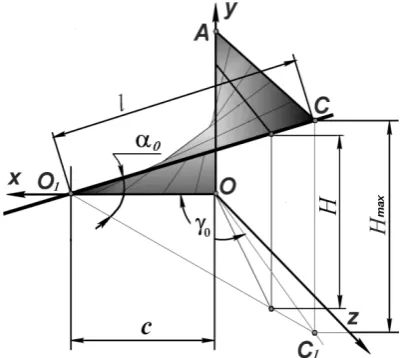
As a result of the joint solution of Eqs (3) and (4), it was established the dependence of the shape of the front working surface of the disk-knife soil treating working body on the depth of soil cultivation. The resulting form of the working surface describes the surface of the hyperbolic paraboloid (Fig. 3):
max 0
γ
H z
x
tg y
u
u (5)
where: Нmax – max. depth of soil cultivation with the work-ing body (0.12–0.20 m); γ0 – the twist angle of the working surface of the knife, towards the rotor’s plane of rotation (°); x, y, z – coordinates of the working surface (m)
[image:3.595.311.514.508.687.2]It was found the dependence of the twist angle γ0 of the working surface of the knife on the depth of cultivation:
Fig. 3. Geometric form of working surface (hyperbolic paraboloid)
0 0 max max γ
γ γ H d
dH
(6)
where: γmax – max. twist angle of the working surface, for a specific type of soil (7–28о); dγ
0/dH – an indicator taking into account the mechanical characteristics of the soil environment (16–19°·m–1)
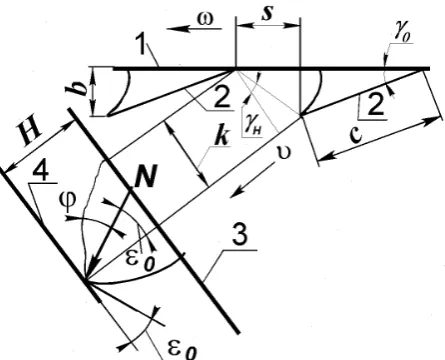
The number of (n = 6) knives on one working body (Fig. 4) is defined as:
02π cos γr
r n
s c d
(7)
where: rr – the radius of the working body, along with the knives installed on it (m); s – projection of distance k between the nearest points of adjacent knives to the plane parallel to the rotor’s plane of rotation (m); с – the length of knife (m)
They are defined basic geometrical parameters of the working surface of a knife (Fig. 5).
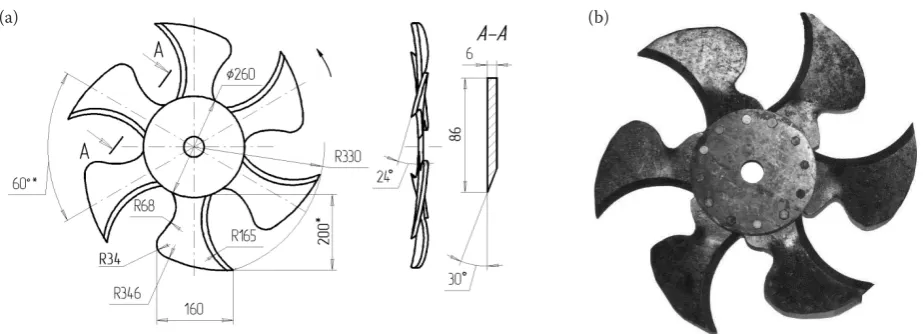
On the basis of the analytical studies they were determined geometric parameters and developed experimental samples of the disk-knife working body (Fig. 6).
Computer modeling of the work of the disk-knife working body
The analysis of the results of experiments on the influence of the structural parameters of knives (length с (mm) and the twist angle γ0 (°) of the work-ing surface) on the coefficient of burywork-ing kz, allowed to obtain the following equation:
2 2 0
3 1 2
0 0
89.278 2.027 9.984 2.2 10 –
7 10 1,86 10
z
k c c
c
J
J J
u u
u u u u (8)
Its research on the extremum allowed (with a deter-mination level of 98.7%) to finally establish the length of the working surface с, which, taking into account the scale factor μ = 5, is 175 mm and the twist angle of the anterior working surface γ0 = 24°. When these parameters are met, the max. index of kz is set at 85%.
The analysis of the results of modeling of the in-fluence of the approach angle β (°) of the battery of the working bodies and the distance l between the working bodies in the battery on the height of the butt hг (m) of the furrow sole allowed obtaining the following equation:
2
3 2 2 2
0.141 2.7 10 β 5.731
2 10 β 3.5 10 β 9.434
г
h l
l l
u u u
[image:4.595.65.288.389.569.2]u u u u u u (9)
[image:4.595.308.531.493.683.2]Fig. 4. Scheme to determine the number of knives on the disk and the distance between neighboring knives 1 – horizontal projection of the plane of rotation of the work-ing body; 2 – horizontal projections of the upper edge of the knives; 3 – field surface; 4 – furrow sole; b – projection of the operating width of the working body to the plane perpendicu-lar to the rotor’s plane of rotation; k – the distance between the nearest points of the adjacent knives; γН – the twist angle of the working surface of the knife to the plane of rotation of the working body, at the nominal depth of cultivation; φ – the angle of friction on the surface of the working body, e0– the angle of the bottom edge of the knife to the furrow sole; ω – direction of rotation of the working body; υ – direction of linear movement of soil treating tools
Fig. 5. Theoretical profile of the working part (M) of the knife
Its research on the extremum allowed to deter-mine the optimal values of the approach angle of the battery of the working bodies β 20–24о (β
оpt = 20о) and the distances between the working bodies in the battery 0.18–0.218 m. (lоpt = 0.2 m).
Experimental studies of the work of the disk-knife working body
According to the results of experimental studies, the traction resistance of the disk-knife working body is lower on average by 21.6–3.1% of the traction resistance of the spherical cut-out working body and depends on the angle of installation of the working bodies β 18–24°(Fig. 6) and the depth of soil cultiva-tion h 0.12–0.2 m. Herewith, the confidence level of the results of the experiment estimated on the stu-dent’s criterion is 97%.
The analysis of the results of the dependence of the traction resistance Р (N) on the approach angle β (°) and the depth of cultivation h (m) allowed ob-taining the following equation:
2
2
616.518 4,538β 84,197 0,694β –
0.856 β 3.669
P h
h h
u u (10)
On the basis of the conducted experimental re-search, it was concluded that due to reduction of the contact area with the soil and due to the conoid shape of the working surface of the knife, the pro-posed design of the working body allows to reduce the size of the traction resistance by 15.7% with the optimal value of the approach angle β = 20° and the depth of cultivation h = 0.12 m.
According to the experimental data, it was deter-mined an indicator of the distribution of kr plant
res-idues according to the depth for the disk-knife work-ing organ, which, dependwork-ing on the approach angle β, can be described by the polynomial of the 3rd degree (with the determination coefficient R2= 0.99):
3 2
2,333β 15β 22.667β 72
r
k (11)
Reducing of the approach angle β < 20о leads to the appearance of untreated areas of the field, and with an increase in the approach angle it is observed a decrease in the efficiency of distribution of plant remains due to the deterioration of the rotating abil-ity of the disk-knife working organ. The max. disper-sion rate for a disk-knife working body is reached at an approach angle β = 20о, and is 76%, which is by 15% more than for spherical cut-out discs.
DISCUSSION
Using of disc-knife working body causes a de-crease of energy consumption and labor costs by 20–25% when compared to other types of tillage machines (Rusu 2014; Ahmadi 2016).
Disc-knife working body soil tillage tools have lower specific traction resistance in comparison with other implements for basic soil cultivation (Kogut et al. 2016).
Disc-knife working body fully provides agrotech-nical requirements for the burying of fertilizers, plant residues, herbicides, weed seeds, etc in com-parison with existing tillage implements and that allows to improve soil quality indicators (Raiesi, Kabiri 2016; Pires et al. 2017).
[image:5.595.64.526.92.259.2]According to the results of the study of the structural and aggregate soil composition, it was Fig. 6. Disc-knife working body: (а) geometric parameters, (b) general view of the prototype
established that the number of soil aggregates (d < 0.25 mm and d > 10 mm) which did not meet the agrotechnical requirements from the point of view of erosion stability using disk-knife working bodies decreased by 28.1% to the background The index of burying in comparison with spherical-cut discs has increased by 1.14 times.
Absolute weight moisture of soil in a layer 0–20 cm, when cultivating with disk-knife working tools, in comparison with spherical-cut discs was higher by 5.9% and corresponded to agrotechnical requirements. The bulk density of the soil cultivat-ed with implements with disk-knife working bod-ies corresponded to the agronomic requirements and was 1.20 g·cm–3, which is by 6.2% less than for the variant with spherical-cutting discs and by 36.8% less when compared to the agricultural back-ground. It was established that during the cultiva-tion with disk-knife working tools the value of the resistance of the soil hardening is minimal and is 49.8 kPa, which is less by 15.7% when compared to the treatment with spherical cut-off discs and by 43.0% less when compared to the background. The volume bearing ratio while using disk-knife work-ing bodies was by 51.4% smaller when compared to the background and corresponded to a standard value for a plowed field.
The analysis of the obtained from the production inspection results on the quality of soil cultiva-tion suggests a positive effect on the structural and agrotechnological state of the soil treated with the disk-knife working body when compared to treat-ment with the spherical cut-out discs (Šima et al. 2013; Ahmadi 2016).
Further research is planed to be conducted not only with passive disk-knife working tools but with active ones as well.
CONCLUSION
The main structural parameters of the working surface of the knife of the working body are: geo-metric form – straight conoid (hyperbolic parabo-loid); height (corresponds to max. depth) h 0.2 m; moldboard length с 0.175 m; twist angle of the gen-eratric γ0 24°; radius of the front cutting edge rrk 0.165 m; radius of the bottom edge rnk0.346 m; the shape of the rear edge is described by the part of the ellipse with radii of curvature ае 0.1 m and be 0.06 m. Number of knives n was 6. The range of
optimal values of the angle of attack of the battery of the disk-knife working bodies is defined within β 20–4°; the distance between the working bodies in the battery is l = 0.18–0.218 m. The zone of the op-timum values of the speed of the machine-tractor unit varies uп = 3–0 km·h–1.
Application of soil tillage tools with disk-knife working bodies allows reducing the number of ero-sion-dangerous aggregates of soil by 28.1% when compared to agricultural background and by 7.0% when compared to the use of spherical cut-out discs; the coefficient of structurality when compared to spherical cut-out discs increased by 12.9%. The index of burying of fertilizers and plant residues in com-parison with spherical cut-out discs increased by 1.14 times and was 82%. The distribution of plant residues was 76%, which is by 15% more than for spherical cut-out discs. The maximum ridgeness of the field surface in terms of cultivation with tolls equipped with disk-knife working bodies does not exceed 5.6 cm.
References
Ahmadi І. (2016): Development and assessment of a draft force calculator for disk plow using the laws of classical mechanics. Soil and Tillage Research, 163: 32–40. Andruschkewitsch R., Koch H., Ludwig B. (2014): Effect of
long-term tillage treatments on the temporal dynamics of water-stable aggregates and on macro-aggregate turnover at three German sites. Geoderma, 217: 57–64.
Brennan J., Hackett R., McCabe T., Grant J., Fortune R., Forristal P. (2014): The effect of tillage system and residue management on grain yield and nitrogen use efficiency in winter wheat in a cool Atlantic climate. European Journal of Agronomy, 54: 61–69.
Colbach N., Busset H., Roger-Estrade J., Caneill J. (2014): Predictive modelling of weed seed movement in response to superficial tillage tools. Soil and Tillage Research, 138: 1–8. Damanauskas V., Janulevičius A. (2015): Differences in tractor
performance parameters between single-wheel 4WD and dual-wheel 2WD driving systems. Journal of Terramechan-ics, 60: 63–73.
Ercoli L., Masoni A., Mariotti M., Pampana S., Pellegrino E., Arduini I. (2017): Effect of preceding crop on the agro-nomic and ecoagro-nomic performance of durum wheat in the transition from conventional to reduced tillage. European Journal of Agronomy, 82: 125–133.
Kabiri V., Raiesi F., Ghazavi M. (2016): Tillage effects on soil microbial biomass, SOM mineralization and enzyme activ-ity in a semi-arid Calcixerepts, Agriculture. Ecosystems & Environment, 232: 73–84.
Kogut Z., Sergiel L., Żurek G. (2016): The effect of the disc setup angles and working depth on disc harrow working resistance. Biosystems Engineering, 151: 328–337. Kukharets S., Brodskii Y., Busma V., Kukharets V. (2006):
Modeling of parameters of work of rotational working bod-ies of soil tillage tools. Bulletin of the State Agroecological University, 2: 224–232.
Kukharets S., Sheludchenko B., Zabrodskii P. (2002): Kin-ematic model of rotational soil tillage tool. Bulletin of the State Agroecological University, 1: 133–137.
Lu X., Liao Y. (2016): Effect of tillage practices on net carbon flux and economic parameters from farmland on the Loess Plateau in China. Journal of Cleaner Production, 121: 1–8. Pires L., Borges J., Rosa J, Cooper M., Heck R., Passoni S.,
Roque W. (2017): Soil structure changes induced by tillage systems. Soil and Tillage Research, 165: 66–79.
Raiesi F., Kabiri V. (2016): Identification of soil quality indi-cators for assessing the effect of different tillage practices through a soil quality index in a semi-arid environment. Ecological Indicators, 71: 198–207.
Rücknagel J., Rademacher A., Götze P., Hofmann B., Christen O. (2017): Uniaxial compression behaviour and soil
physi-cal quality of topsoils under conventional and conservation tillage. Geoderma, 286: 1–7.
Rusu T. (2014): Energy efficiency and soil conservation in conventional, minimum tillage and no-tillage. International Soil and Water Conservation Research, 2: 42–49. Scherner A., Melander B., Kudsk P. (2016): Vertical
distribu-tion and composidistribu-tion of weed seeds within the plough layer after eleven years of contrasting crop rotation and tillage schemes. Soil and Tillage Research, 161: 135–142. Schneider O., Roger-Estrade J., Aubertot J., Doré T. (2006):
Effect of seeders and tillage equipment on vertical distri-bution of oilseed rape stubble. Soil and Tillage Research, 85: 115–122.
Šima T., Nozdrovický L., Dubeňová M., Krištof K., Krupička J. (2013): Effect of the crop residues on nitrous oxide flux in the controlled traffic farming system during the soil tillage by LEMKEN Rubin 9 disc harrow. Agronomy Research, 11: 103–110.
Sizmur T., Martin E., Wagner K., Parmentier E., Watts C., Whitmore A. (2017) Milled cereal straw accelerates earth-worm (Lumbricus terrestris) growth more than selected organic amendments. Applied Soil Ecology, 113: 166–177. Tarverdyan A., Tonapetyan P. (2016): Development and
substantiation of the universal working tools parameters of sloped processing with minimal technologies. Annals of Agrarian Science, 14: 346–350.