To the Minister for Enterprise, Trade & Employment
Pursuant to the Industrial Development Act, 1993, Forfás herewith presents its report and accounts for the year ended December 31, 2002.
Do Aire Fiontar, Trádála agus Fostaíochta De bhun an Achta um Fhorbairt Tionscail, 1993, tá a thurascáil agus a chuntais don bhlian dar chríoch 31 Nollaig, 2002, a dtíolacadh leis seo ag Forfás.
Peter Cassells
Chairman
Martin Cronin
Functions of Forfás >
Is é Forfás an bord náisiúnta um polasaí
agus comhairle le haghaidh fiontraíochta,
trádála, eolaíochta, teicneolaíochta agus
nuála. Is é an comhlacht é a bhfuil comhactaí
dlíthiúla an stáit maidir le cur-chun-cinn
tionscail agus forbairt teicneolaíochta
dílsithe ann. Is é an comhlacht é freisin trína
dciomnaítear cumhachtaí ar Fhiontraíocht
Éireann le tionscail dúchais a chur chus cinn
agus ar ghníomhaireacht Forbartha Tionscail
na hÉireann (GFT Éireann) le hinfheistíocht
isteach sa tir a chur chun tosaight. Is iad
feighmeanna Fhorfáis:
comhairle a chur ar an Aire ó thaobh cúrsaí a bhaineann le forbairt tionscail sa Stát; comhairle maidir le forbairt agus comhordú polasaithe a chur ar fáil d’Fhiontraíocht Éireann, d’GFT Éireann agus d’aon fhoras eile dá leithéid (a bunaíodh go reachtúil) a d’fhéadfadh an tAire a ainmniú trí ordú;
forbairt na tionsclaíochta, na heolaíochta agus na teicneolaíochta, na nuála, na margaíochta agus acmhainní daonna a spreagadh sa Stát; bunú agus forbairt gnóthas tionsclaíoch ón iasacht a spreagadh sa Stát; agus Fiontraíocht Éireann agus GFT Éireann a chomhairliú agus a chomhordú ó thaobh a gcuid feidhmeanna.
Forfás is the national policy and advisory
board for enterprise, trade, science,
technology and innovation. It is the body in
which the State’s legal powers for industrial
promotion and technology development have
been vested. It is also the body through
which powers are delegated to Enterprise
Ireland for the promotion of indigenous
industry and to IDA Ireland for the promotion
of inward investment. The broad functions of
Forfás are to:
advise the Minister on matters relating to the development of industry in the State;
advise on the development and co-ordination of policy for Enterprise Ireland, IDA Ireland and such other bodies (established by or under statute) as the Minister may by order designate;
encourage the development of industry, science and technology, innovation, marketing and human resources in the State;
encourage the establishment and development in the State of industrial undertakings from outside the State; and
04
Board Members
05
Chairman’s Statement
13
Chief Executive’s Report
18
Overview of 2002
25
Activities in 2002
41
Statutory Obligations
43
Management Structure
46
Forfás Advisory Groups
50
Forfás Publications
1
4
9 10
12 3
5
8
11
14
13 2
6
Forfás Board Members
>
7
1 Professor Yvonne Scannell retired from the Forfás Board on 31 December 2002. 2 David Lovegrove retired at the end of 2002 and was replaced by Michael O’Leary. 1 Peter Cassells
Chairman
2 Martin Cronin Chief Executive Forfás
3 Sean Dorgan
Chief Executive IDA Ireland
4 Dan Flinter Chief Executive Enterprise Ireland
5 Paul Haran
Secretary General Department of Enterprise, Trade & Employment
6 Professor Michael Hillery Chair of Manufacturing Engineering University of Limerick
7 Rody Molloy
Director General FÁS
8 William Murphy
Partner
Tynan Dillon & Company
9 Feargal O’Rourke Partner, Taxation PricewaterhouseCoopers
10 Professor Yvonne Scannell 1
Professor at Law University of Dublin Trinity College
11 Toni Wall Managing Director Wall 2 Wall Ltd
12 Jane Williams Managing Director The Sia Group Ltd
13 David Lovegrove 2
Secretary to the Board
14 Michael O Leary 2
Economic dynamism and social progress go hand
in hand. An innovative, enterprising economy
offers the best opportunity to construct a fair and
inclusive society in which all can contribute to and
benefit from rising prosperity. During this period of
global economic and political uncertainty it is vital
that policy-makers and economic development
agencies maintain a clear focus on the
determinants of long-term economic and social
progress and improvements in Irish living
Chairman’s Statement >
Many factors will work together to shape our future economic landscape. Of these, three priorities stand out for 2003. First, we must continue to create new jobs and grow new industries. The role of the development agencies, Enterprise Ireland and IDA Ireland is crucial in this regard. Secondly, we must put in place measures to further increase
productivity and profitability across existing sectors of the economy. More investment in research, innovation, physical infrastructure and education, combined with higher levels of competition, all play a role in supporting productivity growth across the economy. Finally, as a small economy, we must be ever vigilant about sustaining our competitiveness in terms of prices and wage costs.
The unyielding pace of technological change and intense competition from lower cost locations has forced an acceleration in the pace of industrial restructuring. This in turn has resulted in significant job losses and a recent rise in unemployment. The pace of such industrial restructuring and
employment turnover is unlikely to ease in the near-term. New job creation must remain an important objective for policy-makers, despite a
demographically related slowdown in labour force growth.
As some product areas in Ireland decline, the emergence and growth of others will be required to replace them. This is the nature of modern economies. In this regard, it is important to recognise the work of Forfás’ sister agencies: Enterprise Ireland and IDA Ireland. Companies under the remit of the enterprise development agencies created more than 25,000 new “permanent full-time jobs” in 2002. Although this employment creation
was outweighed by job losses of just over 35,000, it remains an impressive performance given the difficult global economic conditions. Most of the job losses were concentrated in the computer hardware and software sectors reflecting the severe global slowdown suffered by the information and communications technology (ICT) industry. Other agency-supported sectors, such as international financial services and life sciences, recorded net increases in full-time employment. Moreover, despite recent difficulties it is important to remember that employment in agency-supported companies is 40 per cent higher than it was at the beginning of the 1990s.
“New job creation must remain an important
objective for policy-makers, despite a
demographically related slowdown in labour
force growth.”
“Productivity will be the long-term
determinant of sustainable
improvements in Irish incomes
Improvements in national income and living standards stem from two sources: increases in the level of employment (both numbers employed and hours worked per person) and improvements in productivity (the manner in which capital, human and technological “inputs” are combined to produce more and better “outputs” for each hour worked). Notwithstanding the ongoing need to replace lost jobs with new ones, demographic changes and the low rate of unemployment mean that overall employment levels and hours worked will not grow as quickly in the coming years as they did in the 1995-2001 period. With this in mind, improvements in productivity, through greater innovation and efficiency at the firm level and greater participation in the provision of high value products and services, will be key to sustainable growth in incomes and living standards over the coming years.
The ability to achieve continuing productivity growth depends on a number of factors which come within the remit of policy-makers and the development agencies, including:
Investment in infrastructure Investment in skills and education Innovation and creativity Greater competition
Promoting growth, social partnership and national competitiveness
Encouraging Investment in Infrastructure Investment in infrastructure, both public and private, is an important driver of productivity growth at the firm level. Rapid economic growth in Ireland’s main cities during the 1990s, particularly along the eastern seaboard, outpaced the provision of the necessary public economic and social infrastructure. This has resulted in increasing congestion and quality of life issues. Improving the physical infrastructure of the economy, including transport, energy and communications networks, will allow easier movement of goods, services and people. The resulting efficiency and cost gains will, in turn, increase the medium-term growth potential of the economy.
The Government’s priorities for investment in physical infrastructure were outlined in the National Development Plan (NDP) 2000-2006. The Mid-Term Review of the NDP, which is taking place this year, provides an important opportunity to re-prioritise infrastructure projects for the coming years and to address some of the problems in the delivery of projects experienced in recent years. Forfás will work with relevant stakeholders in addressing these issues.
needs of new industries and business models but at the same time do not undermine Ireland’s economic dynamism. Particularly challenging in this regard will be our ability over the coming years to stem growth in greenhouse gas emissions by Irish industry, in line with commitments made under the Kyoto Protocol, without damaging the
competitiveness of Irish industry.
Investment in Skills and Education In a competitive global economy, ensuring sustained economic growth will critically depend on the skills and flexibility of the Irish workforce. Indeed, many international studies have found that investment in skills and education is the most important factor for growth in national productivity. It is also particularly important at a time when Ireland is facing increasing competition from countries that are raising the skill content of their labour force as part of national strategies. A pressing concern is the declining proportion of students taking courses in the physical sciences, engineering and technology at third level. Left unchecked, this decline will inevitably impact on Ireland’s ability to develop the scientific, technological and research capabilities needed to support growth in identified high value-added sectors. The challenge of reversing this trend has been taken up across the development agencies and the education sector, and in this regard I would particularly like to pay tribute to the work of the Expert Group on Future Skills Needs, the National Skills Awareness Campaign and the Science, Technology and Innovation Awareness Programme, all of which are supported by Forfás. In this context, it is essential that the implementation of the recommendations in the report of the Task Force on Physical Sciences are implemented in full as soon as possible.
Encouraging Innovation and Creativity Innovation involves the creation of new products and services valued by customers, as well as finding ways to lower the cost and improve the quality of existing products and services. While innovation ultimately occurs at the firm level, it depends on effective knowledge linkages between firms, their suppliers and customers, as well as universities, research institutes, Government and its agencies. Such linkages and networks are the essence of what is often called “a national system of innovation”. A national system of innovation can be developed through a number of actions by policy-makers and the development agencies. These include the development of technology transfer capabilities within universities; the introduction of innovation led procurement policies; the design of public financial participation in private venture capital organisations; support of the development of international marketing capability in Irish firms and the establishment by them of an overseas presence in low cost shared facilities.
The importance attached by Government to improving Ireland’s science and technology infrastructure is reflected in the unprecedented allocations for investment in science, technology and innovation under the NDP. At €2.48 billion, budgeted spending for 2000-2006 compares with an allocation of just €0.5 billion over the period 1994-1999. This commitment is also reflected in the announcement of increased research funding for Science Foundation Ireland (SFI) in the 2003 Budget Estimates, particularly at a time of budgetary constraint. SFI is using these funds to support over 90 outstanding researchers, from Ireland and overseas, with some of the most substantial government grants for scientists in the world. This investment sends a strong signal to industry nationally and internationally of the Government’s long-term commitment to making Ireland an attractive environment for technology driven and innovative enterprise.
An Tánaiste and Minister for Enterprise, Trade and Employment, Mary Harney T.D., has pointed out that the strong focus on the role of science and technology in our economic and social life indicates that we have added a new dimension to industrial policy. This science based industrial policy aims to foster clusters of world-class technology based companies, both Irish and foreign owned, that work in new knowledge areas in collaboration with the university research initiatives. Together, they will generate maximum value for Ireland by
commercialising research output, creating high-level jobs for our people, and building an entrepreneurial environment in which new technology based businesses prosper.
Need for Greater Competition
All these factors - investment in infrastructure, education and skills and research, development and innovation - will be vital to growth in productivity and innovation over the coming years. Another important driver in creating greater productivity growth and innovation will be greater levels of domestic competition. Intense competition between firms in the domestic market makes a key
contribution to competitiveness on international markets by driving greater innovation and efficiency. The Irish Competition Authority has indicated that too many sectors of the Irish economy, from utilities to banking, retailing and distribution and many professional services, remain, to different degrees, protected from competitive forces.
Productivity Growth, Social Partnership and National Competitiveness
Productivity will be the long-term determinant of sustainable improvements in Irish incomes and living standards. However, sustaining
competitiveness and employment levels in Ireland, as in all small open regional economies, requires an appropriate match between productivity, prices and wages. This is particularly true now that Ireland no longer has an independent exchange rate policy. There is increasing evidence that the cost base of the Irish economy, including pay levels, has been rising more quickly than can be justified by productivity growth, and is now well above European averages. A major contribution has been rapid price and pay inflation in domestically-traded services sectors of the economy. This has been exacerbated by a lack of competition, more recently by Government increases in excise taxes and administered prices and is adversely affecting the competitiveness of Ireland as a location for internationally-traded activities.
“Sustaining Progress”, the new national pay and partnership agreement, offers evidence that the social partners recognise the need to bring pay increases into line with productivity growth in order to protect employment and national
competitiveness. The agreement is a timely reminder of the contribution of social partnership to national economic and social development. I would like to pay tribute to the commitment and effort of all those involved in bringing these difficult negotiations to a successful conclusion.
Equally, pay moderation must come in parallel with a slowing of other price and cost increases in order to protect living standards and the real value of wage increases. The National Competitiveness Council, whose Secretariat is provided by Forfás, has put a series of recommendations designed to bring price inflation down towards the average in other European countries. I encourage the Government and other social partners to reflect carefully on these proposals.
Acknowledgements
During 2002, Forfás received significant support from An Taoiseach, Mr Bertie Ahern, T.D., from An Tánaiste and Minister for Enterprise, Trade and Employment, Ms Mary Harney, T.D., and from other Government Ministers and Departments in carrying out its work. I wish to acknowledge this support and its practical expression in the content of a range of Government policies and publications aimed at the further development of the enterprise sector in Ireland.
In 2002, our sister agencies, namely, Enterprise Ireland, Fás, IDA Ireland, Shannon Development and Údarás na Gaeltachta, achieved strong results in the context of difficult global economic conditions and strongly supported the work of Forfás. I
acknowledge and appreciate the support of the third-level sector, employer bodies and business organisations, trade unions and the media. Their contributions were essential to the results of the development agencies and the pro-enterprise policies put in place across a range of Government Departments.
As Chairman, I would like to express my thanks and appreciation to my fellow Board Members, in particular Professor Yvonne Scannell who retired from the Board on 31 December 2002 after four years of service to the organisation.
I would also like to express the appreciation of the Board for the work of David Lovegrove who retired in
“There is increasing evidence that the cost base of
the Irish economy, including pay levels, has been
rising more quickly than can be justified by
productivity growth, and is now well above
December 2002 having served as Secretary to the Board since the establishment of Forfás in 1994. I also want to thank many other organisations that contributed to the work of Forfás during the year, in particular the members of the following groups:
The Irish National Accreditation Board (NAB), chaired by Dr Máire Walsh
The National Competitiveness Council (NCC), chaired by Mr William Burgess
The Irish Council for Science, Technology and Innovation (ICSTI), chaired by Dr Edward M. Walsh
The Expert Group on Future Skills Needs, chaired by Dr Daniel O’Hare
I wish to acknowledge the significant support provided by the EU for enterprise development and the support of science and technology in Ireland through the NDP and through a range of other programmes which impact significantly on the environment for enterprise.
Finally, I want to thank the staff of Forfás for their continued dedication, hard work and
professionalism throughout the year. I would like to pay particular tribute to the Chief Executive, Mr Martin Cronin. Since his appointment in May 2002, Martin has led the organisation through a period of profound change, resulting in a new management team and organisation structure and a renewed sense of purpose. In the light of these changes, I am confident of the contribution that Forfás and its associated bodies will make to driving forward the next stage of Ireland’s economic and social development.
Peter Cassells
Economic Overview
The long awaited recovery in worldwide economic
growth is being delayed by continued global
economic and political uncertainty. This
uncertainty has dampened consumer demand,
international trade and business investment.
At an estimted 6.3 per cent, growth in the overall economy (as measured by gross domestic product (GDP)) slowed during 2002, but remained more than double the EU average. Labour market conditions also remained positive with
unemployment holding at around 4.5 per cent of the labour force.
This is not to say that businesses in Ireland were immune to the difficult global conditions. While industrial production grew by eight per cent, most of this growth occurred in the first half of the year, and was down from growth of 10 per cent in 2001 and 15 per cent in 2000. Similarly, exports grew by just one per cent in 2002, down from growth of over 10 per cent in 2001.
While overall employment levels in the Irish economy increased marginally in 2002, this was mostly as a result of job creation in the public sector and other domestic services sectors of the
economy. Employment in firms in the more exposed internationally-traded manufacturing and service sectors contracted for a second consecutive year.
Outlook
Looking ahead to the rest of 2003, it seems likely that economic conditions in Ireland and across the world will remain challenging. Economic growth in Ireland this year is likely to be in the region of three per cent, which is below its potential. Like all economic cycles, this global downturn is a short-term phenomenon. An eventual recovery in investor certainty and confidence will inevitably be accompanied by a resumption in the growth of
international flows of trade, investment and technology. We must ensure that when this happens, Ireland is in the best possible position to take advantage of any pick-up in the global economy.
Our economy already has many strengths - a low level of indebtedness, a strong base of modern manufacturing and internationally-trading services, a competitive taxation system, growing investment in publicly funded research, unrivalled international telecoms connectivity and an ability, because of our small size, to adapt in a timely way to changing circumstances. Our challenge is to build on these strengths in order to respond to the changing competitive landscape and to take advantage of the opportunities that global economic recovery will offer.
The Future Competitive Challenge
The past 10 years have brought two fundamental changes. Firstly, Ireland has reached a new stage of development driven principally by strong growth in the production of internationally-traded goods and
Chief Executive’s Report >
“Developing and reinforcing a
strong Irish presence in growing
internationally-trading
businesses will enable us to
generate the wealth required to
address wider economic and
social development.”
“Considering our exposure to global
services. Secondly, international competition has been transformed by the emergence of lower cost locations as credible sites for most of the activities on which our prosperity is based (i.e. both medium and high end manufacturing and medium and high end services).
Our strategic response must be informed by these realities and by the certainty that globalisation will continue.
To remain successful in a globalising economy Ireland must build distinctive competencies in businesses and activities where we are, or can become, significant players. Our small size implies that these will be niche businesses and increasingly specialised activities.
Ireland must build its competitiveness based not only on competitive costs, high skills and low tax but also on the availability of specialist suppliers and service providers, appropriate infrastructure, a good regulatory environment and research and development capacity. Each of these must be tailored, where possible, to support the kinds of business for which we can make Ireland a “super-competitive” location.
Developing and reinforcing a strong Irish presence in growing internationally-trading businesses will enable us to generate the wealth required to address wider economic and social development. Ireland is already a significant player in many areas of business with long-term potential including for example communications software, medical devices and financial services, to name but three. Both Irish and overseas owned companies have
internationally significant operations here, making Ireland one of the leading locations for these businesses. If we work to shape the national business environment in a way that reinforces their competitiveness, such business areas can continue to succeed and grow in Ireland. The allocation of communications bandwidth can promote Ireland as a wireless test centre; the establishment under the Programme for Research in Third Level Institutions (PRTLI) of the National Centre for Biomedical Engineering at NUI Galway will help to underpin the medical device industry; and the establishment by the National College of Ireland of the International Financial Services Institute (IFSI) will ensure a strong supply of relevant skills for the financial services industry. These are concrete examples of how such businesses can be strategically embedded in the economy by sector specific initiatives.
It is also important to put in place horizontal measures to support all industries. The provision of national physical infrastructure, broadband communications, the encouragement of competition in domestic markets and the
maintenance of an operating environment in which business can respond flexibly to changing
conditions remain important determinants of overall competitiveness. The Mid-Term Review of the NDP and the associated prioritisation of projects will be important in this regard.
“The education system was a
pivotal enabler of our recent
economic success and it will play
Building an Innovation Economy
Most important in ensuring that the Irish economy adapts and prospers in the new competitive environment is to put in place policies that will sharply increase the role of innovation in our economy. This can be achieved through the development and rapid adoption in Ireland, of new and innovative products, services and business models. This requires the right mix of strong growth in both privately and publicly funded research. Ireland must ensure that a number of crucial enablers are in place, particularly:
A more developed capacity to absorb and apply the outputs of research in both the private and public sectors;
Adequate availability of the full spectrum of venture funding from proof-of-concept funding to late stage venture capital;
A regulatory environment that facilitates the emergence of new ideas and new businesses; A deeper understanding of international markets and an ability to seek out new export
opportunities and to identify the most competitive sources for our imports;
Well functioning links between business, third-level institutions, the financial community and Government that facilitate the interactions necessary for vibrant innovation.
Ireland has benefited greatly from the performance of science driven sectors, principally ICT and life sciences. Spill over effects from high-tech foreign enterprises and rapidly developing research activities in the universities have stimulated the opening of a range of new technology based firms in areas such as software which add to traditional indigenous strengths. As a result of our strategic use of structural funds to build up the technological infrastructure in the university sector, we are seeing an increase in the number of campus companies and high potential start-ups. The challenge now is to consolidate these advances at a time of increasing
uncertainty in world markets and to lay the groundwork for moving to a new stage of industrial development.
The role of the NDP (National Development Plan) here is crucial. The €2.48 billion which has been allocated for R&D must continue to be spent in a manner which generates most impact. Given the importance of enhancing national R&D capabilities, maintaining the current levels of finance for R&D programmes is essential and should not be adversely affected by short-term budgetary constraints.
To foster a climate of inventiveness and innovation, a further strengthening of Ireland’s national policies regarding the commercialisation of science and technology research outcomes is required. In this regard we are undertaking policy analysis in conjunction with the development agencies in areas such as intellectual property, R&D tax credits, technology transfer resources and capability and the development of a more coherent programme of national research.
The education system was a pivotal enabler of our recent economic success and it will play an even more vital role in the innovation driven economy towards which we are aiming. Forfás will work for consensus among the relevant stakeholders on issues such as:
The redefinition of basic skills to include technological literacy and fluency in foreign languages;
How to achieve greater participation in the physical sciences;
Our approach to life-long learning for both educators and their students;
Economic Crossroads
Much has been achieved over the past decade. Incomes and living standards have improved; unemployment has been drastically reduced; significant progress has been made in the provision of national infrastructure; public debt is now amongst the lowest in the EU; and we have created a solid foundation of internationally-trading companies. This is an excellent starting point from which to tackle the challenges which have begun to emerge. If we act now to promote enhanced competitiveness the Irish economy will be well placed to take advantage of a global economic recovery.
Activities of Forfás
We are currently engaged with the Department of Enterprise, Trade and Employment in supporting a review of enterprise policy. This is a key element in consolidating Ireland’s existing enterprise base to move to the next phase of economic development. It will also assist in ensuring that the right policies and skills are in place to support our ability to compete as an emerging knowledge economy. Forfás is working on a review of the current National Innovation System and the further development of a national strategy to promote an innovation culture in Irish enterprise. This will respond to and take cognisance of the decision taken at the EU Spring Council which exhorted Member States to encourage the growth of a business environment which fosters the climate for innovation. The work will also include a review of the policy options to promote product, process and service innovation in companies based in Ireland and a detailed examination of the diffusion mechanisms available nationally to ensure that the results of research translate effectively into the enterprise environment. For Ireland to maintain its economic position in the emerging knowledge based global economy a systematic approach towards an innovation-friendly environment is a must.
Forfás considers innovation to be at the heart of a competitive knowledge based economy. It is essential to take a long-term view when building a sustainable national system of innovation linking the private and public sector, knowledge creators and knowledge users. Implementation of the recommendations from the Technology Foresight exercise completed in 1999 contributed
significantly to the growth of the research base in Ireland. The establishment of Science Foundation Ireland, the National Foundation for Excellence in Scientific Research, provides a solid base from which to develop innovation policies and strategies. Similarly, our participation in EU research networks and the development of a European Research Area will support our national efforts to build an innovation driven economy. Finally, through our work with the National Competitiveness Council, we are promoting a new competitiveness agenda, which tackles the traditional macroeconomic issues of costs, wages and infrastructure, while also addressing issues such as productivity, creativity and entrepreneurship.
We are involved in a large number and variety of projects. Our objective is that they will play a significant role in creating and maintaining a vibrant Irish enterprise sector and will positively contribute to the well-being of society at large. Over the past six months, Forfás has implemented a substantial reorganisation. New structures and new staff have combined to create an organisation which will continue over the coming months and years to meet the needs of clients. I would like to take this opportunity to express my appreciation to everyone within Forfás for the professionalism, enthusiasm and understanding which they have shown throughout this process.
Martin Cronin
Employment in Agency-Supported Companies Total full-time employment in companies under the remit of Enterprise Ireland, IDA Ireland, Shannon Development and Údarás na Gaeltachta amounted to 304,000 in 2002, a decrease of 9,500 (-3.0 per cent) on the previous year. 2002 is the second year running in which there has been a net decrease in employment in agency-supported companies.
There are now 13,000 fewer jobs in manufacturing and
internationally-traded services compared to the peak of 317,000 recorded in 2000. It should be noted, however, that employment in these companies is still 40 per cent higher than it was at the beginning of the 1990s. The overall net decline of 9,500 in 2002 comprises 6,000 fewer jobs in foreign-owned
companies (bringing
employment among this group
[image:18.595.69.544.153.754.2]to 153,500) and 3,500 fewer jobs among Irish-owned companies. Total employment in Irish-Irish-owned companies now amounts to 150,500.
Figure 2below highlights the components of the net change in employment. 25,500 jobs were created in manufacturing and internationally-traded services in 2002 but these job gains were offset by job losses of 35,000 during the same period. The net decrease in employment recorded in 2001 and 2002 is in marked contrast with the situation that pertained in the years immediately prior to this. In sectoral terms, most of the net decrease in employment has been concentrated in electrical and electronic equipment (including computers) and internationally-traded services (including software) reflecting the continued slowdown in global ICT markets. International financial services, which mostly comprises firms in the IFSC3, was one
of the few sectors in which a net increase in full-time employment was recorded in 2002.
Overview Section >
Source: Forfás Annual Employment Survey, 2002
100000 150000 200000 250000 300000 350000
Overall Total Irish-owned Foreign-owned
’02 ’01 ’00 ’99 ’98 ’97 ’96 ’95 ’94 ’93
Permanent Full-Time Employment 1993-2002
Manufacturing and Internationally-Traded/Financial Services
Figure:One
Source: Forfás Annual Employment Survey, 2002
-40000 -30000 -20000 -10000 0 10000 20000 30000 40000 50000
Net Change Job Losses Job Gains
’02 ’01 ’00 ’99 ’98 ’97 ’96 ’95 ’94 ’93
Job Gains, Losses & Net Change in Permanent, Full-Time Employment 1993-2002, Manufacturing & Internationally-Traded/Financial Services
Figure:Two
Regional Distribution of Employment Creation
Figure 3shows the distribution of jobs created in agency-supported companies between the Southern and Eastern Region (Objective 1 in Transition) and the Border, Midland and West Region4. The Border,
Midlands and West (BMW) Region has tended in the past to perform less satisfactorily than the rest of the country in terms of increasing and sustaining its employment in manufacturing and internationally-traded services.
The chart shows that the BMW Region accounts for 26.5 per cent of the population and 25.5 per cent of the labour force. In 1999, the Region accounted for 18 per cent of gross job gains in agency-assisted companies. By 2002, this share had increased to more than 21 per cent, although this is down from 24 per cent in the previous year. Forfás will continue to monitor the regional share of employment gains
in agency-assisted companies into the future. Part-Time, Temporary and Short-Term Contract Employment
In addition to the 304,000 persons employed full-time in manufacturing and internationally-traded services, 33,000 persons were also employed in part-time, temporary and
short-term contract positions in 2002. Employment in this category has grown over the last decade and now accounts for almost 10 per cent of all jobs in agency-assisted companies. Taking the two categories of employment together (permanent full-time and temporary/part-time), there are now 334,000 persons employed in agency-assisted companies, up from 236,000 in 1993.
* Excludes companies under the remit of Shannon Development. Source: Forfás Annual Employment Survey, 2002
5000 10000 15000 20000 25000 30000 35000 40000
Overall Total Irish-owned Foreign-owned
’02 ’01 ’00 ’99 ’98 ’97 ’96 ’95 ’94 ’93
Part-Time, Temporary and Short-Term Contract Employment 1993-2002* Manufacturing and Internationally-Traded/Financial Services
Figure:Four
** CSO Statistics Source: Forfás Annual Employment Survey, 2002
0 20 40 60 80 100
Border, Midlands & West Southern & Eastern Region
Share of Jobs Created in 2002 Share of Jobs
Created in 2001 Share of Jobs
Created in 2000 Share of Jobs
Created in 1999 Share of Labour Force 2002** Share of Population 2002**
73.5% 74.5% 82.0% 79.5% 75.9%
78.8% 26.5% 25.5% 18.0% 20.5% 24.1% 21.2%
Share of Jobs Created in Agency-Supported Companies by Region 1999-2002 Relative to Share of Population and Labour Force
Figure:Three
Expenditure by Agency-Supported Firms in the Irish Economy
Data relating to the direct expenditure of agency-supported companies in 2001 was compiled by Forfás and the agencies concerned (Enterprise Ireland, IDA Ireland, Shannon Development and Údarás na Gaeltachta) during 2002. The data highlights the contribution made by agency-supported companies to the economy through direct expenditure on payroll costs, Irish raw materials and services purchased in Ireland. The data points to the fact that the overall output of firms in manufacturing and internationally-traded services and their expenditure in the economy continued to increase in 2001, albeit at a lower rate than in previous years. The overall sales of manufacturing and internationally-traded services companies increased by 9.4 per cent in 2001 (compared to 19.4 per cent recorded in the previous year’s survey), while direct expenditure in the economy increased by 10.2 per cent (compared to 16.8 per cent recorded in the previous year’s survey).
Direct expenditure by these firms in the economy totalled €34 billion in 2001, comprising payroll costs (€10.4 billion), Irish raw materials (€14.8 billion) and expenditure on Irish services (€8.8 billion). Irish-owned companies accounted for
€15.5 billion (46 per cent) of this direct
expenditure with raw material inputs accounting for the largest share. This is driven largely by the food and drink sector which purchases most of its raw material inputs domestically. Foreign-owned companies spent €18.6 billion directly in the economy and this is spread quite evenly across three categories - payroll costs, raw materials purchases and services purchased in Ireland.
Direct Expenditure of Agency-Supported Firms in the Irish Economy
Irish-Owned Firms Foreign-Owned Firms All Firms
2000 2001 2000 2001 2000 2001 Change
Sales €m 21,579 23,965 66,205 72,102 87,784 96,067 9.4% Payroll Costs €m 3,837 4,309 5,470 6,120 9,307 10,429 12.1% Irish Raw Materials €m 7,589 8,358 6,107 6,474 13,696 14,832 8.3% Services bought in Ireland €m 2,562 2,805 5,338 5,985 7,900 8,790 11.3% Direct Expenditure in the Economy €m 13,988 15,472 16,915 18,579 30,903 34,051 10.2% Direct Expenditure as % Sales % 64.8 64.6 25.5 25.8 35.2 35.4
Source: Annual Business Survey of Economic Impact, 2001 (co-ordinated by Forfás and administered by the Survey Unit, ESRI)
Corporation Tax Payments
In addition to their expenditure in the economy, manufacturing and internationally-traded services companies provide a very significant direct return to the exchequer by way of corporation tax payments.
The total corporation tax yield from all sources was
€4.8 billion in 20025, an increase of 10.3 per cent
in real terms on the previous year. The most recent data in respect of the corporation tax payments of agency-supported companies in manufacturing and internationally-traded services relates to 2001. These show that agency-supported firms accounted for €2.4 billion (57 per cent) of the €4.2 billion total corporation tax take in that year.
Companies in the chemicals/pharmaceuticals sector accounted for €783 million (33 per cent) of the €2.4 billion, financial services companies linked to the IFSC accounted for just over €600 million (25 per cent) and other internationally-traded services companies (software etc.) accounted for €430 million of the total.
State Expenditure on Science & Technology The Forfás annual publication, State Expenditure on Science & Technology, shows that Government allocations to scientific and technological activities in 2001 amounted to €1,760 million, an increase of
€399.3 million, or 29.4 per cent over 2000 out-turn levels. This is mainly accounted for by an increase in public funds (Exchequer plus EU), which rose by 35 per cent in 2001 to €1,565 million. The balance of €195 million arises from income earned from the activities of the Government Departments and agencies.
5 Source: Exchequer Returns for 2002, Department of Finance
Source: Forfás Corporation Tax Survey, 2001
0 1000 2000 3000 4000 5000
Manufacturing/Internationally Traded & Financial Services Firms Total Corporation Tax
’01 ’00 ’99 ’98 ’97 ’96 ’95 ’94 ’93 ’92 ’91 ’90 ’89 ’88
Corporation Tax Payments (Constant 2002 Prices)
Table 2above illustrates the share of the total public allocation for 2000 and 2001 accounted for by Government Departments. In 2001, almost 60 per cent of the total public allocation can be attributed to the Department of Education & Science, followed by the Department of Enterprise, Trade &
Employment (11 per cent) and the Department of Public Enterprise (8 per cent).
Research and Development in the Public Sector
Altogether, research and development (R&D) represents about a quarter of public science and technology expenditure and the 2001 budget allocation amounted to €342 million. This represents a very significant increase of €98 million over the actual expenditure in 2000 of €244 million (see Table 3).
The major contributors to this increased funding are:
The Department of Education and Science:
€39.1 million
The Department of Enterprise, Trade and Employment: €28 million
The Department of Public Enterprise:
€10.6 million
Other significant increases are in the Department of Agriculture, Food & Rural Development (€7.5 million) and the Department of Communications, Marine & Natural Resources (€7.5 million). State Expenditure on Science & Technology by Government Department,
2000-2001
Total Public Funds (€m)
2000 2001 % change Outturn Allocation
Education and Science 743.3 927.6 25% Enterprise, Trade & Employment 138.3 177.0 28% Public Enterprise 44.0 124.3 182% Agriculture and Food 98.3 118.4 20% Government Offices 53.2 85.3 61% Marine and Natural Resources 27.9 39.3 41% Social, Community and Family Affairs 8.0 33.6 319% Health and Children 23.3 28.9 24% Environment and Local Government 12.2 15.2 24% Arts, Heritage, Gaeltacht and the Islands 5.6 8.2 46%
Finance 4.7 6.0 28%
Taoiseach 0.6 0.7 17%
Total 1159.5 1564.7 35%
Source: Forfás, State Expenditure on Science & Technology 2001
Table:Two
Public Funding of R&D, 2000-2001 (€million)
2000 2001 Outturn Allocation
Exchequer 175.78 285.09
EU 68.28 56.74
Total Public 244.06 341.84
Earned income 76.88 75.07
Total 320.95 416.90
Source: Forfás, State Expenditure on Science & Technology (2000 & 2001 publications)
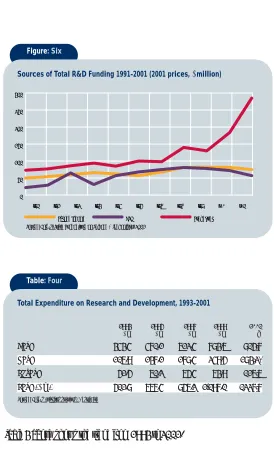
[image:22.595.61.320.240.495.2]Figure 6right depicts the sources of funds for total public R&D expenditure over the past decade. The most notable aspect is the fact that exchequer funding has significantly increased its percentage of the total funding from 50 per cent in 1991 to 68 per cent in 2001, which is an increase in real terms of €212 million (292 per cent) since 1991. This represents an annual growth rate of 14.6 per cent over the last decade. The contribution of EU Community Support Framework Programmes has decreased in real terms from €81 million in 1998 to
€57 million in 2001.
Gross Domestic Expenditure on Research & Development (GERD), 2001
Data on gross expenditure on research and development (GERD) for Ireland are drawn from Forfás surveys for the three sectors that constitute the national R&D system:
Business expenditure on research and development (BERD)
Higher-education expenditure on research and development (HERD)
Government expenditure on research and development (GOVERD)
Table 4above shows the trend from 1993 to 2001. Gross expenditure on R&D continued to grow in aggregate terms between 1999 and 2001. Total GERD amounted to €1,338.8 million in 2001 up from €1,097 million in 1999.
Source: Forfás, State Expenditure on Science & Technology, 2001
0 50 100 150 200 250 300
Earned Income CSF Exchequer
’01 ’00 ’99 ’98 ’97 ’96 ’95 ’94 ’93 ’92 ’91
Sources of Total R&D Funding 1991-2001 (2001 prices, €million)
Figure:Six
Total Expenditure on Research and Development, 1993-2001
1993 1995 1997 1999 2001
€m €m €m €m €m
BERD 343.4 470.1 612.4 783.6 916.8
HERD 106.9 137.1 178.4 249.5 294.3* GOVERD 51.5 60.2 65.4 63.9 127.7
GERD (€m) 501.8 667.4 856.2 1,097.0 1338.8
Source: Forfás (various surveys) * estimate
[image:23.595.266.538.206.402.2]Table 5 shows the trend of gross expenditure on research and development as a percentage of gross national product (GNP). GERD as a percentage of GNP has seen a steady increase since 1993. However, in 2001 there was a decline relative to the position in 1999. There was a decrease in the rate of growth of BERD in this period compared with earlier periods and this, combined with the rapid increase in GNP in this period, led to the slowing of the overall growth rate of GERD.
Gross Expenditure on R&D as a Percentage of GNP, GDP, 1993- 2001
1993 1995 1997 1999 2001
€m €m €m €m €m
GERD (€m) 502 667 856 1,097 1,338.8
GERD as a % GNP 1.30 1.43 1.45 1.45 1.38
GERD as a % of GDP 1.16 1.27 1.28 1.24 1.17 EU Average as a % GDP 1.92 1.81 1.80 1.86 1.88
OECD Average as a % GDP 2.25 2.11 2.16 2.21 2.24
Source: Forfás (various surveys)
[image:24.595.65.319.363.462.2]Forfás’ activities in the area of policy advice and co-ordination in 2002 were driven by three distinct, but cross-cutting themes:
Building a science, technology and innovation infrastructure in Ireland that is required to underpin the next stage of our economic development;
Encouraging actions across a range of domestic public policies designed to sustain the competitiveness and growth of our existing industries;
Working with Government Departments on shaping EU and other international policies that impact on enterprise and technology
development in Ireland.
Building Ireland’s Science,
Technology & Innovation
Infrastructure
Positioning innovation and technology at the centre of Irish enterprise development over the next decade requires a continuation of the rapid growth in Ireland’s investment in science, technology and innovation. Ireland’s total investment in research and development (R&D), from both public and private sources, was estimated at €1,339 million or 1.17 per cent of GDP in 2001. Although this represents a large increase on previous levels of research expenditure relative to GDP, it is still significantly below that of other knowledge intensive economies, such as Sweden (3.8 per cent), Finland (3.2 per cent), Japan (3.0 per cent), USA (2.8 per cent), South Korea (2.7 per cent), Netherlands (2.1 per cent), Denmark (2.1 per cent), Taiwan (2.1 per cent) and the UK (1.9 per cent). The EU has set itself a target of increasing research investment to three per cent of GDP by 2010, in the context of achieving the objective of the Lisbon Strategy.
Ireland is committed to making its contribution to this effort. The size of the allocations by
Government to science, technology and innovation in the current National Development Plan indicates its commitment to technological development. The allocation for the period 2000-2006 (€2.48 billion) is almost five times the amount invested during the five year period 1994-1999 (€0.5 billion). Science Foundation Ireland (SFI) has also received increased research funding in the 2003 Budget Estimates, again showing Government commitment to research excellence and a pro-active approach to moving towards the levels of research investment required to ensure Ireland’s development as a knowledge intensive economy.
The large increase in public research investment over the coming years presents the challenge of ensuring that these investments deliver the economic and social benefits that they are intended to achieve. This will require monitoring and reviewing cost effectiveness, efficiency and coherence in all aspects of science, technology and innovation policy formulation and implementation. At the request of the Government, the Irish Council for Science, Technology & Innovation (ICSTI), chaired by Dr. Edward Walsh and supported by Forfás, established a Commission comprising relevant experts, both from Ireland and overseas, to bring forward proposals on developing an
appropriate overarching national framework for research and technological development. The Commission’s report, submitted to An Tánaiste and Minister for Enterprise, Trade and Employment in December 2002 for consideration by Government, has proposed a number of measures for improving the structures and mechanisms for the formulation and implementation of national policy for science, technology and innovation.
Measuring and Evaluating Research Work is already well progressed on improving arrangements to monitor and assess the impact of the public investments in science, technology and innovation. In Autumn 2002, ICSTI published a report entitled Measuring and Evaluating Research. The report examines the rationale for the public funding of research and the tools used to measure and assess the inputs and outputs from research. To achieve this, it reviewed the principal indicators and techniques used internationally to measure science, technology and innovation (STI) policy activities and their impacts. It provided an account of the current situation in Ireland with respect to STI indicators and their collection as well as the application of STI evaluation tools. The report concluded that expertise in indicators and evaluation techniques for STI policy should be more widely embedded in public policy agencies in Ireland.
It is particularly important that the Government is in a position to evaluate the impact of the €600 million investment by Science Foundation Ireland (SFI) in the period 2001-2006 for research in biotechnology and information and
communications technologies. To assist in the evaluation process, a study was commissioned by Forfás to assess the baseline research situation in biotechnology and in ICT before SFI came on stream. This study commenced in mid 2001, was completed by end 2002, and was published early in 2003 under the title Baseline Assessment of the Public Research System in Ireland in the areas of Biotechnology and Information and Communications Technologies.
Utilising Intellectual Property for Competitive Advantage
Following the ICSTI Statement on Commercialisation of Research published in February 2001, new issues were raised in relation to intellectual property from publicly funded research and linking third-level research and industry. In particular, ICSTI explored the benefits, or otherwise, of possible new guidelines or legislation for intellectual property management. ICSTI also examined best practice in other countries and, during this year, led a delegation to Denmark and Switzerland to
investigate, in a more detailed manner, the practices for IP management operating in those countries. Drawing from this work, in early 2003 ICSTI published a Statement entitled Utilising Intellectual Property for Competitive Advantage, which covers the issues involved and recommends the
development of an agreed national code of practice involving all funding departments and agencies, research institutions and the enterprise sector. On the occasion of the first meeting of the ICSTI Commission in June 2002
Industrial Design and Development Design and Development, an ICSTI Statement on initiatives to strengthen the implementation of strategic design practices in industry was completed in 2002 and published in early 2003. This work benchmarks product design and development practices in indigenous, non-food manufacturing firms and, in addition, identifies appropriate mechanisms to encourage firms to improve their strategic use of design.
R&D Tax Credits
The quality and volume of publicly-financed research being carried out in our universities and research institutes is an important driver of research activity in the private sector. Another key stimulus is the tax system. In 2002, Forfás, in conjunction with Enterprise Ireland and IDA Ireland, submitted proposals, for consideration as part of the Budget 2003 deliberations, for the introduction of an R&D tax credit designed to increase private sector R&D expenditure in Ireland. Forfás will encourage implementation of the R&D tax credit proposals in 2003 in order to ensure that Ireland is not disadvantaged as an investment location of choice.
Science, Technology & Innovation Awareness Programme
The declining proportion of students taking courses in sciences, engineering and technology at third-level, left unchecked, will inevitably impact on Ireland’s ability to develop the necessary scientific, technological and research capabilities needed to support growth in identified high value-added sectors. The challenge of reversing this trend has been taken up across the development agencies and in particular by the Science, Technology and Innovation Awareness Programme (STIAP), which is managed by Forfás on behalf of the Department of Enterprise, Trade and Employment.
The main activities of the Programme in 2002 were:
Science Week Ireland(November 10-17): The objective of Science Week Ireland is to improve the public perception of science and technology. The target audience is young people, their parents and the general public. Some 200 or more events were organised, with festivals in selected larger towns and cities.
Primary Science Day(December 3): The objective of Primary Science Day is to encourage children of primary school age to discover the fun of science, while also linking the activity to the revised primary school curriculum. The event is sponsored by the Department of Education & Science. The theme in 2002 was electricity. A kit including
supporting information, worksheets and a range of classroom materials was provided to enable children gain hands-on experience of science.
All Island Innovation Awards 2002(December 9): The objective of the Innovation Awards is to reward and encourage innovative activity among Irish firms, large and small. In 2002 the Awards were jointly sponsored by
InterTradeIreland, Invest Northern Ireland, Forfás and The Irish Times. The overall winner of the 2002 Awards was Ulster Carpets. The company won the award for its innovation in the fields of design, design software and proprietry installation software. It has also moved towards providing customised carpets for the residential market.
Sustaining National Competitiveness
Growth and employment across a wide range of industrial sectors in Ireland is being put at risk by price and wage inflation. Ireland’s relative cost competitiveness against other main competitors deteriorated significantly in 2002, with consumer price inflation running at more than twice the EU average. Comparative Consumer Prices in the Eurozone & Consumer Price Inflation in the Changeover Period, a report published by Forfás in June 2002, estimated that by 2002, following several years of rapid inflation, Ireland had become the second most expensive country in the eurozone for consumer goods, after Finland.
Moreover, at around three times the EU average, nominal wage costs are also rising rapidly. EU data now estimates that average Irish nominal wages for full-time employees was 3.6 per cent above the eurozone average in 2001, with average wage levels forecast to rise to 13 per cent above the average by 2003. The competitiveness of Irish goods and services in many of our main export markets was further undermined by the appreciation of the euro against sterling and the dollar in 2002.
National Competitiveness Council
A major challenge for Irish enterprise policy in 2002 was to encourage actions across a range of public policies that help to maintain Ireland’s
competitiveness and protect existing employment levels and enterprise activities. Much of this work was carried out under the auspices of the National Competitiveness Council (NCC), chaired by Mr William Burgess. The NCC was established by Government in 1997 to advise on developments in national competitiveness and to recommend actions to Government to protect and improve Ireland’s international competitiveness standing. Forfás acts as Secretariat to the NCC.
In November 2002, the NCC published the fifth Annual Competitiveness Report (ACR) and Competitiveness Challenge, which together cover the full spectrum of competitiveness issues and represent the Council’s main policy statements for the year. The ACR examined Ireland’s international competitiveness and in particular highlighted a number of threats to our economy. The most significant threats which the Council identified include rising costs, increasing wages, a higher than acceptable inflation rate and lower investment in infrastructure than is required. The Competitiveness Challenge then made a number of policy
recommendations to tackle these issues using the analysis contained in the ACR.
Infrastructure
Strong economic growth in recent years has placed significant pressures on many of the key
infrastructures required to promote enterprise development. In 2002 Forfás worked closely with the other enterprise development agencies and relevant Government Departments to ensure that Ireland can provide a world-class physical environment at the lowest possible cost to support Ireland’s competitiveness.
Energy:Building on previous work on infrastructure investment requirements and supply-demand balances in electricity and gas, in 2002 Forfás undertook an assessment of the policy requirements to facilitate an efficient and competitive national energy market. Following detailed consultations with the Government, the Commission for Energy Regulation (CER), Eirgrid, ESB, IBEC and others, Forfás submitted proposed reforms to the CER as an input to their ongoing review of electricity market trading arrangements in Ireland for 2005. Forfás also completed an evaluation of the potential of the electricity transmission and distribution network to support the development of agency business parks, webworks facilities and large scale utility intensive sites being proposed by Enterprise Ireland and IDA Ireland.
Online Regional Database of Infrastructure:
In order to facilitate a more efficient spatial distribution of industry, in 2001 An Tánaiste requested Forfás to construct and maintain a database of the physical and social infrastructure in the regions to help identify the developmental capacity / potential of various locations and regions and pinpoint areas in need of improvement. With funding from the Government’s Information Society Fund, the database was completed in 2002 and takes the form of an Internet-based databank of tables and maps of physical and social
infrastructure and industrial development agency-supported enterprises. The database can be accessed at www.infrastructure.ie.
Infrastructure Corridors:At the request of the Cross-Departmental Team on Infrastructure and Public Private Partnerships (PPPs), in 2002 Forfás and IDA Ireland, together with TES Engineering Consultants, examined the possibility of bundling certain types of infrastructure development as part of “infrastructure corridors”. Through an analysis of international and domestic experience, engineering assessments and interviews with relevant stakeholders in Ireland, the Forfás review indicated that a corridor approach to infrastructure provision would be both beneficial and technically feasible if the appropriate routes and lands are identified and protected. To date, the draft Sligo and Mayo County Development Plans have adopted Forfás
recommendations with regard to infrastructure corridors and have included the infrastructure corridor provision into their respective land use strategies.
Water and Wastewater Infrastructure:In 2002, Forfás completed a study of 27 locations including those identified in the National Spatial Strategy as gateways and development hubs, to assess the capacity of their water and wastewater treatment infrastructures to meet the requirements of future population growth and enterprise development. The study identified nine centres of population that will require additional water treatment capacity and 14 centres that will require additional wastewater treatment capacity.
Telecommunications:In addition to being a key driver of growth in the Irish economy over the last decade, developments in the telecommunications sector are also critical for the promotion of the broader knowledge economy and information society in Ireland. In particular, the availability of advanced broadband technologies is critical for Ireland to develop as an eBusiness hub and for the promotion of regional development. Benchmarking analysis undertaken by Forfás in 2002 indicated that while significant progress has been achieved in this area, Ireland still compares poorly relative to other countries on a number of metrics monitoring the price, quality, and availability of broadband telecommunications services. Forfás has advocated the need for Government investment to accelerate the development of broadband infrastructure in advance of demand, and has worked closely with the Department of Communications, Marine & Natural Resources to ensure that the broadband priorities of the development agencies are incorporated in the current Government broadband investment initiatives.
Skills
Sustaining the competitiveness of Irish industry will critically depend on the skills and flexibility of the workforce. This is particularly important in an environment where Ireland is facing increased competition from countries that are raising the skill content of their labour force as part of national strategies.
Much of Forfás’ work in this area in 2002 was carried out under the auspices of the Expert Group on Future Skills Needs. The Expert Group was established by Government in 1997 to develop national strategies to tackle the issue of skills needs, manpower estimating, training for business and education in Ireland. Forfás provides the Secretariat to the Group.
During 2002 the Expert Group commissioned four studies on sectors of high value to Ireland in pursuing its strategic goal of becoming a
knowledge-based economy. These reports examine future skills needs and make appropriate
recommendations for the following industry sectors: Biotechnology
Construction Engineering Food Processing
Supply and Demand of Skills in the Food Processing Sector
In its report on the skills needs of the food processing sector the Expert Group highlighted how the industry, education institutions, training and State support organisations need to respond to the significant changes that the industry is currently experiencing. The response to these changes will be a key determinant of whether or not Ireland can retain a vibrant and successful food processing industry into the future.
Although the report found that there are currently no indications that there is a need to increase the overall number of graduates coming into the food sector, there are clear indications of a need to review and rebalance the content of third-level curricula relating to the sector. Food scientists in the future will need to have a more broad understanding of the management needs of the industry and managers will need to acquire a clearer appreciation of the importance of long-term planning if the industry is to continue to flourish.
Third National Vacancy Study
The Third National Vacancy Study was
commissioned by the Expert Group to examine the incidence, level, nature and consequences of vacancies in both the private and public sector. This was the first time that the public sector was included in the study of national vacancies. The report found that vacancy rates were higher in the intermediate and higher skilled jobs in the public sector while the majority of vacancies in the private sector were in intermediate and lower skilled jobs. The fall in private sector vacancy rate from six to three per cent since 2000 illustrates the slow-down in employment growth.
Benchmarking Education and Skills
Nationally, the Expert Group recognised the need for the establishment of a systematic process of benchmarking education and training in Ireland against other developed countries. A study, entitled Benchmarking Education and Training in Ireland, brings together the most up-to-date data from existing comparative sources of education, training and labour market information. The report highlights the trend of an increasingly educated population, although there are still areas that need to be addressed. It recommends that that key areas on which policy should focus include: increasing participation and graduate rates of males to upper secondary level improving third level completion rates particularly in Institutes of Technology; and encouraging increased adult participation in life long learning and training.
Attitudes to CAO Choice
The Expert Group, in order to establish why certain career choices are made and to identify the factors that CAO applicants consider when making a choice on further education and future careers, undertook a survey of over 700 students who had completed CAO application forms. The study aimed to investigate how choices can be influenced and therefore how to design effective promotional activity on key skills areas.
The study found that personal interest and ability in a subject area are the most significant factors influencing choice of Leaving Certificate subject and CAO course and that any campaign directed at increasing participation rates should take these factors into account. Awareness initiatives should focus on younger age groups as students may already be locked into certain career choices on the basis of subject choice.
National Skills Awareness Campaign
The National Skills Awareness Campaign, which is managed by Forfás, operates under the aegis of the Expert Group on Future Skills Needs. The mission of the Campaign is to promote the work undertaken by the Expert Group and to encourage school leavers to consider careers in specific sectors. Amongst the activities undertaken during the year were:
Production of an interactive CD-ROM for second level students which explores options in a range of careers across engineering, IT and the sciences. It was distributed to all secondary schools in the republic in early 2003. The CD-ROM was launched by Mr Noel Dempsey, T.D., Minister for Education and Science;
Participation in major career exhibitions such as FÁS Opportunities 2002 and The Irish Times Higher Options Conference;
The production and distribution of a video of the “Just the Job” TV series;
The publication of a book entitled Engineering as a Career
The publication of an events calendar and the GETSET newsletter, in association with the Science, Technology and Innovation Awareness Programme (also run by Forfás) and the STEPS campaign managed by the Institution of Engineers of Ireland;
The “Change of Mind” campaign was undertaken to raise the level of awareness of potential opportunities in the ICT sector. The campaign was co-sponsored by ICT Ireland and The Expert Group and was aimed at encouraging Leaving Certificate students to avail of their Central Applications Office (CAO) Change of Mind Form before the closing date of July 1 and apply for one of the many courses which provide a route to this sector.
eBusiness and Digital Content
Given the emergence of new information and communications technologies (ICT) and the speed of eBusiness development, changes are required to strengthen and improve the legal and regulatory framework. In October, Forfás published Legislating for Competitive Advantage in e-Business and Information and Communications Technologies. Among the recommendations is a proposal to establish specialist technology courts (eCourts) to adjudicate on legal disputes relating to ICT, eBusiness and intellectual property and to provide a secure, certain and quick legal system for
knowledge intensive business.
In November 2002, Forfás published A Strategy for the Digital Content Industry in Ireland, prepared at the request of the Department of Enterprise, Trade and Employment and involving Enterprise Ireland, IDA Ireland, the Department of Enterprise, Trade and Employment and the Commission for
Four market sectors were identified where Ireland has the potential to develop internationally recognised competitive advantage and that will be jointly targeted by Enterprise Ireland and IDA Ireland for promotion. These are:
eLearning Wireless Services Digital Libraries Non-Media Applications
Promoting a Supportive International
Environment for Irish Enterprise
European Union Issues
Enterprise and technological development in Ireland must operate within a wider international economic and regulatory environment, which has a significant impact on the policies that can be applied here. In particular, decisions taken by the European Union (EU) and its Member States often have significant implications for Irish enterprise development across a range of dimensions.
Research:EU funding has been crucial to Ireland’s efforts to grow its research base over the last decade. The implementation and funding of the EU’s research and technology development policy is done through multi-annual Framework Programmes. The Sixth Framework Programme 2002-2006 (FP6) was adopted in June 2002 with the first calls for proposals launched in December 2002. Over the course of the year, Forfás provided policy advice to the Department of Enterprise, Trade and
Employment in respect of EU research policy and on the negotiations of FP6. Forfás also monitored Irish participation rates in EU Framework Programmes and co-ordinated the National Delegates and National Contact Points for each of the specific programmes within the Framework Programme. Other important EU research initiatives on which Forfás advised included the process of
benchmarking of national