Original Article
Decreased expression of long noncoding RNA MT1JP
may be a novel diagnostic and predictive
biomarker in gastric cancer
Jian Yang1, Yongbin Zhang2, Piao Liu3, Hailong Yan1, Jichun Ma3, Mingxu Da2
1Clinical Medical College, Ningxia Medical University, Yinchuan 750004, P. R. China; 2Department of Surgical
On-cology, Gansu Province People’s Hospital Lanzhou, Gansu, P. R. China; 3Clinical Medical College, Gansu University
of Traditional Chinese Medicine, Lanzhou 730000, P. R. China
Received September 21, 2016; Accepted November 4, 2016; Epub January 1, 2017; Published January 15, 2017
Abstract: Growing evidence suggests that long non-coding RNAs (lncRNAs) may play critical roles in epithelial-to-mesenchymal transition (EMT) progress. However, the complex molecular mechanisms remain largely unclear. In this study, the expression levels of lncRNAs and their target genes in EMT pathway-focused was measured by lncPathTM microarray. Levels of representative lncRNA-metallothionein 1J, pseudogene (MT1JP) and mRNA-metallo-thionein 1M (MT1M) were then further verified by real-time quantitative reverse transcription PCR (qRT-PCR). The re-lationship of their levels with clinicopathological factors was evaluated in patients with gastric cancer (GC). Receiver operating characteristic curve was used analyses potential diagnostic values. MT1JP and MT1M were downregulat-ed in GCs tissues from microarray analysis results, which were further confirmdownregulat-ed by qRT-PCR. The areas under ROC curves were 0.710 and 0.657 for MT1JP and MT1M, respectively. The level of MT1JP in normal tissue is significantly higher than that in precancerous lesions and early cancers. LncRNA Microarrays provide comprehensive insights into the expressional relationship between LncRNAs and their target genes, which will be helpful for establishing rapid connections between the LncRNA regulatory mechanisms and their biological functions. The reduced expres-sion of MT1JP and MT1M in gastric cancer tissues, its associations with tumor diameter, differentiation, lymphatic metastasis, distal metastasis, invasion and tumor-node-metastasis (TNM) stage, and its aberrant expression in early cancer and precancerous lesions suggest that they may be a potential biomarker for the diagnosis of GC.
Keywords: Gastric cancer (GC), biomarker, long non-coding RNA (lncRNA), epithelial-to-mesenchymal transition (EMT)
Introduction
Gastric cancer is one of the most common and aggressive human malignancies in the world, with a constantly increasing frequency, espe-cially in China [1, 2]. Although recent advances in clinical and experimental oncology, have sig-nificantly improved outcomes for patients with GC, long-term prognosis of GC remains poor, due to late detection of disease, frequent can-cer metastasis, high recurrence rate, and lack of effective therapeutic intervention for termi-nally staged tumors [3, 4]. Unfortunately, the complex molecular mechanisms underlying its carcinogenesis and progression remain largely unclear. Therefore, there is an urgent need to identify novel oncogenes and clinically
epitheli-um-derived cancer cells with a more motile, invasive potential [10].
EMT seems to drive the initiation of metastasis. Although several lncRNAs have been reported to modulate tumor metastases [11, 12], the specific roles of lncRNAs in regulating EMT are not well studied.
In this study, we investigated the expression level of lncRNAs and corresponding target genes related to EMT signaling pathways in Gastric cancer. LncRNA-MT1JP (uc002ejp.1), at band of 16q13 of chromosome 16, locate 1776 bp away from the nearest pathway genes
and histological grade were in accordance with the guidelines of the American Joint Committee on Cancer (ACJJ, 7th Ed) and the World Health Organization digestive system cancer guide-lines. All patients received no treatment prior to resection. In this study, all individual partici-pants signed informed consent. The Ethics Committee of Gansu Province People Hospital approved this study.
Total RNA preparation and cDNA synthesis
Total RNAs was isolated from 100 mg tissue using Trizol reagent (Invitrogen, Carlsbad, CA, USA), according to the manufacturer’s
instruc-MT1M, the expression of MT1JP and MT1M in GC tis-sues remains unreported. We investigated the potential re- lationship between the expre- ssion of MT1JP/MT1M and clinicpathological features of patients with GC. Our results suggest the potential of Lnc- RNA-MT1JP as a novel diag-nostic biomarker and a treat-ment target for GC.
Materials and methods
Patients and specimens
[image:2.612.95.371.78.445.2]During February 2013 to June 2015, we collected tissue sa- mples from surgical or biopsy specimens at Gansu Province People Hospital. Ninety-three paired gastric cancer tissues and corresponding adjacent non-tumorous tissues, thir-teen precancerous lesion sues, and ten early cancer tis-sues were collected in conse- cutive cases that underwent surgery or endoscopic biopsy. All tissues were preserved in liquid nitrogen immediately af- ter resection. RNA was extra- cted from these samples and stored at -80°C refrigerator. Each tissue sample was histo-pathologically confirmed by at least two pathologists. Tumor-node-metastasis (TNM) stage
tions. Genomic DNA contamination was re- moved by on-column DNAse treatment. The purity and concentration of the RNA was deter-mined using the Nanodrop ND-1000 (Nanodrop technologies). At least 100 ng RNA was reverse-transcribed into cDNA using the iScript cDNA synthesis kit (BioRad) according to the suppli-er’s protocol. First-strand cDNA was generated using the Reverse Transcription System Kit (Takara, Dalian, China).
LncRNAs microarray assay
The LncPathTM Human EMT Pathway LncRNA Microarray (Arraystar Inc., MD, USA) were used in this study, which profile 390 LncRNAs and 219 their target genes simultaneously in EMT pathway-focused from the authoritative data sources. The sample preparation and microar-ray hybridization were performed based on the manufacturer’s standard protocols. For micro-array analysis, Agilent Array platform was employed.
QRT-PCR detection of MT1JP and MT1M
Real-time quantitative PCR (qPCR) was per-formed on a LightCycler® Nano (Roche) using the 2× IQ SYBR Green PCR mix (BioRad) and 400 nM of the forward and reverse primer. The data were analyzed by the ΔCt method [13]. All results were expressed as the Means ± SD of three independent experiments. The sequenc-es of the PCR primers for MT1JP, MT1M, and β-actin were as follows: MT1JP 5’-GAAATGG- ACCCCAACTACTCC-3’ (sense); 5’-GTTCCCACA- TCAGGCACAG-3’ (antisense) MT1M; 5’-GCAGC- WCTTCTTGCAGCAGG-3’ (sense); 5’-CCGTCCG-
GGTGGGGCCTA-3’ (antisense); β-actin 5’-CCA- CGGCTGCTTCCAGCTCC-3’ (sense); 5’-GGACT- CCATGCCCAGGAAGGAA-3’ (antisense).
Serological tumor marker analysis
Using an AU5400 Automation Chemistry Sy- stem Instrument (Olympus, Tokyo, Japan) mea-sure serum carcinoembryonic antigen (CEA) and carbohydrate antigen 19-9 (CA19-9). The cutoff values for CEA and CA19-9 were respec-tively 5 ng/ml and 35 U/ml.
Statistical analysis
Statistical analysis was performed using SPSS 23.0 software (SPSS, Chicago, IL) and GraphPad Prism 6.0 (GraphPad Software, La Jolla, CA). Date were summarized as mean ± SD. Stati- stical analysis of group differences was per-formed using the one-way analysis of variance test, two-tailed Student’s t-test and rank-sum test in this work. A receiver operating charac-teristic (ROC) curve was established to evalu-ate the diagnostic value. P < 0.05 was consid-ered statistically significant.
Results
Aberrantly expression of LncRNAs associated with EMT in gastric carcinoma
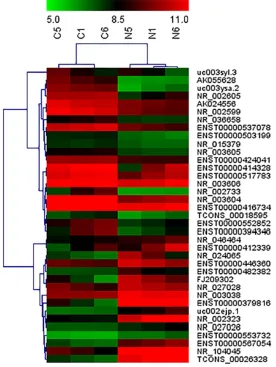
[image:3.612.94.520.73.220.2]LncPathTM Human EMT Pathway LncRNA Mic- roarray was used to analyze lncRNA expression profiles 3 GC tissues and their paired adjacent non-neoplastic gastric tissues, the expression levels of 390 LncRNAs and 219 target genes related to epithelial mesenchymal transition were detected. Total of 39 lncRNAs, which
expression change was more than 1.5 fold and P < 0.05. Among them, 22 up expressed and 17 down expressed (Figure 1). MT1JP expres-sion was downregulated (mean fold change 3.43, P < 0.05). MT1JP was annotated with the coding gene MT1M (mean fold change 4.42, P < 0.05), potential regulatory mechanisms “neigh-boring LncRNA”. We chose MT1JP and MT1M for further research.
QRT-PCR validation for MT1JP and MT1M ex-pression were downregulated in GCs tissues we examined MT1JP and MT1M expression in gastric cancer tissue samples and paired
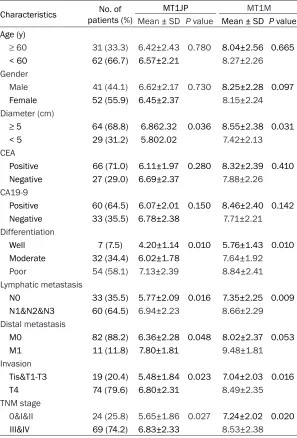
adja-0.016), distal metastasis (P = 0.048), tumor invasion (P = 0.023), and TNM stage (P = 0.012). Expression of MT1M in the gastric can-cer tissue was correlated with tumor diameter (P = 0.031), degree of histological differentia-tion (P = 0.01) lymphatic metastasis (P = 0.009), distal metastasis (P = 0.053), tumor invasion (P = 0.016), and TNM stage (P = 0.020), but not with age, gender, CEA and CA19-9 (P > 0.05).
[image:4.612.92.389.96.534.2]Diagnostic values of MT1JP and MT1M for GC Receiver operating characteristic curve analy-ses indicated that MT1JP and MT1M have some
Table 1. Correlation of clinicopathological factors with MT1JP and MT1M expression in gastric cancer
Characteristics patients (%)No. of MT1JP MT1M
Mean ± SD P value Mean ± SD P value Age (y)
≥ 60 31 (33.3) 6.42±2.43 0.780 8.04±2.56 0.665
< 60 62 (66.7) 6.57±2.21 8.27±2.26
Gender
Male 41 (44.1) 6.62±2.17 0.730 8.25±2.28 0.097
Female 52 (55.9) 6.45±2.37 8.15±2.24
Diameter (cm)
≥ 5 64 (68.8) 6.862.32 0.036 8.55±2.38 0.031
< 5 29 (31.2) 5.802.02 7.42±2.13
CEA
Positive 66 (71.0) 6.11±1.97 0.280 8.32±2.39 0.410
Negative 27 (29.0) 6.69±2.37 7.88±2.26
CA19-9
Positive 60 (64.5) 6.07±2.01 0.150 8.46±2.40 0.142
Negative 33 (35.5) 6.78±2.38 7.71±2.21
Differentiation
Well 7 (7.5) 4.20±1.14 0.010 5.76±1.43 0.010
Moderate 32 (34.4) 6.02±1.78 7.64±1.92
Poor 54 (58.1) 7.13±2.39 8.84±2.41 Lymphatic metastasis
N0 33 (35.5) 5.77±2.09 0.016 7.35±2.25 0.009
N1&N2&N3 60 (64.5) 6.94±2.23 8.66±2.29
Distal metastasis
M0 82 (88.2) 6.36±2.28 0.048 8.02±2.37 0.053
M1 11 (11.8) 7.80±1.81 9.48±1.81
Invasion
Tis&T1-T3 19 (20.4) 5.48±1.84 0.023 7.04±2.03 0.016
T4 74 (79.6) 6.80±2.31 8.49±2.35
TNM stage
0&I&II 24 (25.8) 5.65±1.86 0.027 7.24±2.02 0.020
III&IV 69 (74.2) 6.83±2.33 8.53±2.38
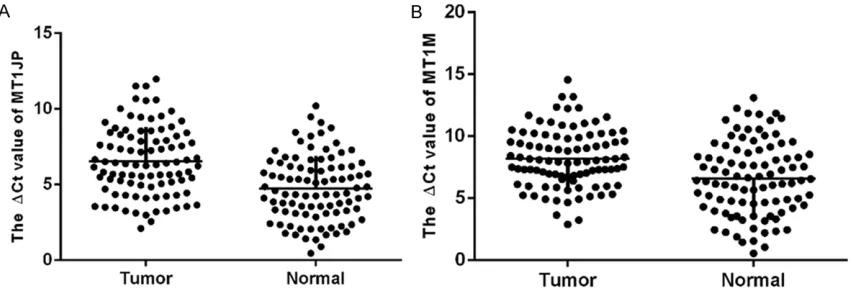
cent non-neoplastic tiss- ue samples. The results showed that MT1JP and MT1M were downregulated in 86.02% (13/93) and 80.64% (18/93) of GC tis-sues relative to that in the non-neoplastic tissues (P < 0.01, Figure 2). Taken to- gether, these data indicate that MT1JP and MT1M are downregulated in human GC.
Correlation of clinicopatho-logical factors with MT1JP and MT1M expression of GC patients
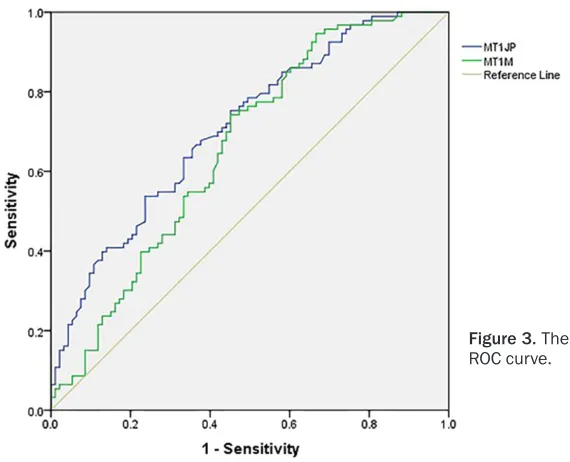
capability for distinguishing GC tissues from benign tissues. The areas under ROC curve val-ues were 0.710 and 0.657 for MT1JP and MT1M, respectively (Figure 3). The positive detection rates of MT1JP and MT1M are 86.0% and 80.9%. Obviously, both of them are higher than gastric cancer biomarker CEA (71.0%) and CA19-9 (64.5%) (Table 1).
Expression of MT1JP was aberrant in precan-cerous lesions and precanprecan-cerous
We measured the expression level of MT1JP in early cancer and precancerous lesions to search the early diagnostic values. We were very surprised to find that the level was con-spicuous lower in these precancerous lesions compared with those of corresponding adja-cent non-tumorous tissues (Figure 4A). The level of MT1JP in normal tissues was remark-able higher than that in precancerous lesions and early cancer tissues. Besides, the expres-sion level in precancerous leexpres-sions tissues was significantly higher than the early cancer tis-sues (Figure 4B).
Discussion
Gastric cancer patients currently have a poor prognosis, and early detection and treatment could significantly increase their chances of survival. Recently, lncRNAs have shown as potent regulators of tumor progression and
Growing evidence suggests that lncRNAs may play critical roles in EMT progress not only in GC [16, 20] but also in other cancers [24, 25]. To study the potential biological functions of lncRNAs in GC, we firstly assessed the lncRNAs and their target genes expression profile simul-taneously in EMT pathway-focused in human GC through LncPathTM Human EMT Pathway LncRNA Microarray. We focused on lncRNA-MT1JP and mRNA-MT1M, further validated expression levels by qPCR. We found that MT1JP and MT1M expression in GC were signifi-cantly downregulated (Figure 2). More impor-tantly, the expression levels of MT1JP and MT1M were significantly correlated with lymph node metastasis, distant metastasis, TNM stages, and differentiation. These results sug-gest that MT1JP and MT1M may as an impor-tant player in inhibiting the development of gas-tric cancer.
[image:5.612.92.377.72.303.2]Recent studies showed that lncRNAs can guide changes in gene expression either in cis (on neighboring genes) or in Trans (distantly locat-ed genes) manner [26, 27]. MT1JP may exert its functional role by regulating the neighboring gene MT1M at transcriptional or posttranscrip-tional level. MT1M, encodes a member of the metallothionein superfamily, is located next to MT1JP. MT1M expression markedly decreased in human HCC specimens and identified as a suppressor of hepatocellular carcinoma [28]. MT1M promoter methylation status was high
Figure 3. The ROC curve.
expression in hepatocellular carcinoma [29]. Based on these findings, we speculate these that lncRNA MT1JP regulate EMT by guide MT1M promoter methylation status change in gastric cancer. However, a limitation current study is that we did not clearly demonstrate this molecular function which should be further explored.
Molecular tumor biomarkers are vital diagnos-tic and prognosdiagnos-tic tools in the early stage to reduce GC mortality rate. Our data show that the expression of MT1JP was aberrant in early gastric cancer and gastric precancerous lesions (Figure 4A). And the extraordinary changes maybe appear in the precancerous lesions (Figure 4B). This investigation indicates that MT1JP may be a candidate biomarker of gastric cancer.
In summary, we depict LncRNAs and their tar-get genes simultaneously in EMT pathway-focused expression that associated with gas-tric cancer. The reduced expression of lncRNA- MT1JP and mRNA-MT1M suggest that they may be participated in gastric cancer. LncRNA MT1JP may be a regulator of GC and may have potential as a novel biomarker and treatment target for this type of cancer.
Acknowledgements
This project is supported by the National Na- tural Science Foundation of China (grant no. 81560391).
Disclosure of conflict of interest
None.
Address correspondence to: Dr. Mingxu Da, Depart- ment of Surgical Oncology, Gansu Province People’s Hospital, 204 Donggang West Road, Lanzhou 730000, P. R. China. E-mail: hxdamingxu@hotmail. com
References
[1] Chen W, Zheng R, Baade PD, Zhang S, Zeng H, Bray F, Jemal A, Yu XQ and He J. Cancer statis-tics in China, 2015. CA Cancer J Clin 2016; 66: 115-132.
[2] Torre LA, Bray F, Siegel RL, Ferlay J, Lortet-Tieu-lent J and Jemal A. Global cancer statistics, 2012. CA Cancer J Clin 2015; 65: 87-108. [3] Hartgrink HH, Jansen EP, van Grieken NC and
van de Velde CJ. Gastric cancer. Lancet 2009; 374: 477-490.
[4] Ilson DH. Adjuvant treatment for gastric can-cer: too much is not enough. Lancet Oncol 2014; 15: 788-789.
[5] Wapinski O and Chang HY. Long noncoding RNAs and human disease. Trends Cell Biol 2011; 21: 354-361.
[6] Mercer TR, Dinger ME and Mattick JS. Long non-coding RNAs: insights into functions. Nat Rev Genet 2009; 10: 155-159.
[7] Ponting CP, Oliver PL and Reik W. Evolution and functions of long noncoding RNAs. Cell 2009; 136: 629-641.
[8] Sethi N and Kang Y. Unravelling the complexity of metastasis - molecular understanding and targeted therapies. Nat Rev Cancer 2011; 11: 735-748.
[9] Hanahan D and Weinberg RA. Hallmarks of cancer: the next generation. Cell 2011; 144: 646-674.
[image:6.612.98.518.74.215.2][10] Thiery JP, Acloque H, Huang RY and Nieto MA. Epithelial-mesenchymal transitions in develop-ment and disease. Cell 2009; 139: 871-890.
[11] Gupta RA, Shah N, Wang KC, Kim J, Horlings HM, Wong DJ, Tsai MC, Hung T, Argani P, Rinn JL, Wang Y, Brzoska P, Kong B, Li R, West RB, van de Vijver MJ, Sukumar S and Chang HY. Long non-coding RNA HOTAIR reprograms chromatin state to promote cancer metastasis. Nature 2010; 464: 1071-1076.
[12] Prensner JR, Iyer MK, Sahu A, Asangani IA, Cao Q, Patel L, Vergara IA, Davicioni E, Erho N, Ghadessi M, Jenkins RB, Triche TJ, Malik R, Be-denis R, McGregor N, Ma T, Chen W, Han S, Jing X, Cao X, Wang X, Chandler B, Yan W, Sid-diqui J, Kunju LP, Dhanasekaran SM, Pienta KJ, Feng FY and Chinnaiyan AM. The long non-coding RNA SChLAP1 promotes aggressive prostate cancer and antagonizes the SWI/SNF complex. Nat Genet 2013; 45: 1392-1398. [13] Sun W, Wu Y, Yu X, Liu Y, Song H, Xia T, Xiao B
and Guo J. Decreased expression of long non-coding RNA AC096655.1-002 in gastric can-cer and its clinical significance. Tumour Biol 2013; 34: 2697-2701.
[14] Dhamija S and Diederichs S. From junk to mas-ter regulators of invasion: lncRNA functions in migration, EMT and metastasis. Int J Cancer 2016; 139: 269-280.
[15] Huarte M. The emerging role of lncRNAs in cancer. Nat Med 2015; 21: 1253-1261. [16] Xu ZY, Yu QM, Du YA, Yang LT, Dong RZ, Huang
L, Yu PF and Cheng XD. Knockdown of long non-coding RNA HOTAIR suppresses tumor in-vasion and reverses epithelial-mesenchymal transition in gastric cancer. Int J Biol Sci 2013; 9: 587-597.
[17] Remiszewski P, Szczerba E, Kalinowski P, Gierej B, Dudek K, Grodzicki M, Kotulski M, Paluszkiewicz R, Patkowski W, Zieniewicz K and Krawczyk M. Epithelioid hemangioendo-thelioma of the liver as a rare indication for liver transplantation. World J Gastroenterol 2014; 20: 11333-11339.
[18] Hu Y, Wang J, Qian J, Kong X, Tang J, Wang Y, Chen H, Hong J, Zou W, Chen Y, Xu J and Fang JY. Long noncoding RNA GAPLINC regulates CD44-dependent cell invasiveness and associ-ates with poor prognosis of gastric cancer. Cancer Res 2014; 74: 6890-6902.
[19] Zhao Y, Guo Q, Chen J, Hu J, Wang S and Sun Y. Role of long non-coding RNA HULC in cell prolif-eration, apoptosis and tumor metastasis of gastric cancer: a clinical and in vitro investiga-tion. Oncol Rep 2014; 31: 358-364.
[20] Xie M, Nie FQ, Sun M, Xia R, Liu YW, Zhou P, De W and Liu XH. Decreased long noncoding RNA SPRY4-IT1 contributing to gastric cancer cell metastasis partly via affecting epithelial-mes-enchymal transition. J Transl Med 2015; 13: 250.
[21] Park SM, Park SJ, Kim HJ, Kwon OH, Kang TW, Sohn HA, Kim SK, Moo Noh S, Song KS, Jang SJ, Sung Kim Y and Kim SY. A known expressed sequence tag, BM742401, is a potent lincRNA inhibiting cancer metastasis. Exp Mol Med 2013; 45: e31.
[22] Xu TP, Huang MD, Xia R, Liu XX, Sun M, Yin L, Chen WM, Han L, Zhang EB, Kong R, De W and Shu YQ. Decreased expression of the long non-coding RNA FENDRR is associated with poor prognosis in gastric cancer and FENDRR regu-lates gastric cancer cell metastasis by affect-ing fibronectin1 expression. J Hematol Oncol 2014; 7: 63.
[23] Peng W, Si S, Zhang Q, Li C, Zhao F, Wang F, Yu J and Ma R. Long non-coding RNA MEG3 func-tions as a competing endogenous RNA to regu-late gastric cancer progression. J Exp Clin Can-cer Res 2015; 34: 79.
[24] Wang TH, Lin YS, Chen Y, Yeh CT, Huang YL, Hsieh TH, Shieh TM, Hsueh C and Chen TC. Long non-coding RNA AOC4P suppresses he-patocellular carcinoma metastasis by enhanc-ing vimentin degradation and inhibitenhanc-ing epithe-lial-mesenchymal transition. Oncotarget 2015; 6: 23342-23357.
[25] Xu S, Sui S, Zhang J, Bai N, Shi Q, Zhang G, Gao S, You Z, Zhan C, Liu F and Pang D. Downregu-lation of long noncoding RNA MALAT1 induces epithelial-to-mesenchymal transition via the PI3K-AKT pathway in breast cancer. Int J Clin Exp Pathol 2015; 8: 4881-4891.
[26] Han L, Zhang K, Shi Z, Zhang J, Zhu J, Zhu S, Zhang A, Jia Z, Wang G, Yu S, Pu P, Dong L and Kang C. LncRNA profile of glioblastoma reveals the potential role of lncRNAs in contributing to glioblastoma pathogenesis. Int J Oncol 2012; 40: 2004-2012.
[27] Hung T and Chang HY. Long noncoding RNA in genome regulation: prospects and mecha-nisms. RNA Biol 2010; 7: 582-585.
[28] Mao J, Yu H, Wang C, Sun L, Jiang W, Zhang P, Xiao Q, Han D, Saiyin H, Zhu J, Chen T, Roberts LR, Huang H and Yu L. Metallothionein MT1M is a tumor suppressor of human hepatocellu-lar carcinomas. Carcinogenesis 2012; 33: 2568-2577.