Abstractـــــ In Wireless Sensor Networks (WSNs), it is imperative to utilize the most power efficient techniques to prolong the lifetime of a sensor node. Minimization of power consumption in WSN's has been discussed extensively in literatures. Usually, central nodes (e.g. cluster head nodes) in WSNs consume large amount of power due to the necessity to decode every received packet regardless of the fact that the
transmission may suffer from packets collision
.
Unlike otherpower consumption techniques, instead of decoding every received signal at the central nodes which consume too much power, we propose a suite of novel, yet simple and power-efficient technique to detect a collision without the need for full-decoding of the received packet. Our novel approach aims at detecting collision through fast examination of the signal statistics of a short snippet of the received packet via a relatively small number of computations over a small number of received IQ samples. Hence, operating directly at the output of the receiver’s analog-to-digital-converter (ADC) and eliminating the need to pass the signal through the entire demodulator/decoder line-up. We present a complexity and power-saving comparison between our novel techniques and conventional full-decoding (for a select coding scheme) to demonstrate the significant power and complexity saving advantage of our techniques. In addition, we also demonstrate how to tune various design parameters in order to allow a system designer multiple degrees of freedom for design trade-offs and optimization.
Index Termsـــــ WSN Protocols, Power Consumption Techniques, Low Complexity Protocols, Packets Collision, Pilot Periods Transmission.
I. I
NTRODUCTIONIRELESS Sensor Networks (WSNs) have become increasingly popular due to their various applications. WSNs nodes are usually deployed in remote areas to perform their functions. They mainly use broadcast communication and the network topology can change due to the fact that some nodes may be prone to fail. One of the key challenges in wireless sensor design is power consumption, since the nodes have limited power resources as they typically operate off of batteries that are difficult to replace or recharge [1]. Therefore, a considerable amount of research in WSNs has focused on power saving techniques including the proposal of various power-efficient designs of electronic transceiver circuitry [10] and power-efficient Medium Access Control (MAC) protocols [11].
Manuscript received November 8, 2014; revised March 6, 2015. This work has been sponsored by Stevens Institute of Technology, Hoboken, NJ, USA.
Authors are with the Electrical and Computer Engineering Department, Stevens institute of Technology. Hoboken, New Jersey 07030, USA. (email: [email protected]).
There are various sources of overhead power consumption in WSNs. For example, sensor nodes consume power when in idle mode, i.e., waiting and listening for packets to be received, but not transmitting. Another cause for overhead energy loss in WSNs is the reception of packets which are not addressed to a node, and re-transmission of control packets, which is considered as protocol overhead [2]. One of the main sources of overhead power consumption in wireless sensors, which is the focus of this paper, is collision detection. When multiple sensors transmit at the same time, their transmitted packets collide at the central (e.g., access) node [4][13]. However, until the access node has expended the required power and processing-time to detect the received packet, it wouldn‟t know that the packet is invalid and corrupted due to collision.
In the MAC layer of WSNs, the most popular
strategies to deal with packet collisions use the
combination between carrier sensing and collision
avoidance. In carrier sensing, all nodes in the network
share the same transmission medium, a node starts
with listening to the medium before transmitting its
own packets in a pre-specified time period, which is
determined by an access point (e.g. a cluster head node
in WSNs). If the state of the transmission medium is
busy, a node takes a random bakeoff time and then
continues transmitting its packets in order to avoid
collisions with other nodes which are listening and
contending for the medium as well. However, when
the collision avoidance fails to detect corrupted
packets, network resources such as the channel
bandwidth and the system throughput will be wasted
and decreased respectively due to the fact that some
corrupted packets are still transmitted in their entirety.
This situation may exacerbate since the rate of
collision may increase with increasing the number of
transmitters (e.g. sensors which have packets ready to
transmit) [14].
Some coding schemes that benefit from traditional communication networks may not perform well in WSN's [15]. For example, LDPC codes have been attracting a great deal of research interest in WSN's [12]. LDPC codes can be decoded either with soft-decision or hard-decision decoding algorithms which have low computational complexity (less number of real operations) in comparison with equivalent Viterbi algorithm [12]. Soft-decision decoding in LDPC codes implemented by iterative decoding based on Brief Propagation (BP) algorithm. However, the implementation of BP algorithms in WSN's is still restricted due to the computational complexity as well as consuming power for
Fawaz Alassery, Walid K. M. Ahmed, Mohsen Sarraf, and Victor Lawrence
Novel Low-Complexity and Power-Efficient
Techniques for Fast Collision Detection in
Wireless Sensor Networks
check nodes, which are responsible for decoding packets (e.g. cluster head nodes) [5]. In addition, most full decoding algorithms entail going through the entire complex receiver‟s front-end digital processing (e.g., for RF impairment correction …etc.) and modem demodulation, synchronization and decoding processing only to discover that the received packet has been corrupted by collision. Therefore, current collision detection mechanisms have largely been revolving around direct demodulation and decoding of received packets and deciding on a collision based on some form of a frame error detection mechanism, such as a CRC check [6]. The obvious drawback of full detection of a received packet is the need to expend a significant amount of energy and processing complexity in order to fully-decode a packet, only to discover the packet is illegible due to a collision. These facts would contradict the critical design goal of WSN's which have limited power recourses.
In this paper, we propose a suite of novel, yet simple and power-efficient techniques to detect a collision without the need for full decoding of the received packet. Our novel approach aims at detecting collision through fast examination of the signal statistics of a short snippet of the received packet via a relatively small number of computations over a small number of received IQ samples. Hence, operating directly at the output of the receiver‟s analog-to-digital-converter (ADC) and eliminating the need to pass the signal through the entire demodulator/decoder line-up. In addition, we show that with a relatively short measurement period, our scheme can achieve low False-Alarm and Miss probabilities, resulting in a reliable collision-detection mechanism. We also demonstrate how to tune various design parameters in order to allow a system designer multiple degrees of freedom for design trade-off and optimization.
The reminder of this paper is organized as follow. Section II describes our proposed system. Section III defines our algorithm, and shows how to select the system threshold. In section IV, we evaluate the power saving based on our proposed technique. In addition, we compare the computational complexity of our algorithm against commonly used decoding techniques (e.g., Max-Log-MAP algorithm)1. In section V, we present performance analysis results and finally in section VI we conclude the paper.
II. SYSTEM DESCRIPTION
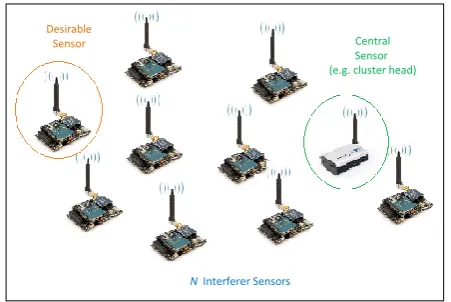
Figure 1 depicts an example of a WSN where a number of intermediate sensors are deployed arbitrarily to perform certain functionalities including sensing and/or collecting data and then communicating such information to a central sensor node (e.g. cluster head node). The central node may process and relay the aggregate information to a backbone network.
As seen in Figure 1, there are N wireless sensors that communicate to the central sensor node, where at any point in time, multiple sensors may accidentally transmit simultaneously and cause a collision2. Without loss of
1 For the remainder of this paper, we shall refer to our proposed approach as the “Statistical Discriminator, or SD” method. We shall also refer to the traditional full-decoding methods as “FD” methods.
2We assume the maximum number of sensors i.e. N= 30. This number can be tuned as required is order to meet designers' requirements.
generality, we shall assume for the sake of argument that one sensor is denoted a “desirable” sensor, while the rest of the colliding sensors become “interferers”.
A commonly accepted model for packet arrivals, i.e., a packet is available at a sensor and ready to be transmitted, is the well-known Bernoulli-trial-based arrival model, where at any point in time, the probability that a sensor has a packet ready to transmit is 3.
Upon the receipt of a packet, the central node processes and evaluates the received packet and makes a decision on whether the packet is a collision-free (good) or has suffered a collision (bad). In this paper, we propose a suite of fast collision detection techniques where the central node evaluates the statistics of the received signal‟s IQ samples at the output of the receiver‟s analog-to-digital converter (ADC) directly using simple discrimination metrics, as will be explained in more detail in the following sections, saving the need to expend power and time on the complex modem line-up processing (e.g., demodulation and decoding). If the packet passes the SD approach test, it is deemed collision-free and undergoes all the necessary modem processing to demodulate and decode the data. Otherwise, the packet is deemed to have suffered a collision, which in turn triggers the central node to issue a NACK message per the mechanism and rules mandated by the specific multiple-access scheme employed in the network.
Fig.1. Wireless Sensor Network (WSN) with one desirable sensor, N
interferer sensors and a central sensor.
III. ALGORITHM DESCRIPTION
As mentioned earlier, our proposed algorithm is based upon evaluating the statistics of the received signal at the receiver ADC output via the use of a simple statistical discrimination approach calculation that is performed on a relatively small portion of the received IQ packet samples. The resulting approach value is then compared with a pre-specified threshold to determine if the statistics of the received samples reflect an acceptable Signal-to-Interference-plus-Noise Ratio (SINR) from the decoding mechanism perspective. If so, the packed is deemed collision-free and qualifies for further decoding. Otherwise, the packet is deemed to have suffered a collision with other interferer(s) and is rejected without expending any further processing/decoding energy. A repeat request may then be issued so the transmitting sensors to re-try depending on the
3The actual design details and choice of the multiple access mechanism,
e.g., slotted or un-slotted Aloha, are beyond the scope of this paper and irrelevant to the specifics of the techniques proposed herein.
Desirable
Sensor Central
Sensor (e.g. cluster head)
[image:2.595.314.540.355.506.2]MAC scheme. In other words, the idea is to use a fast and simple calculation to determine if the received signal strength (RSS) is indeed due to a single transmitting sensor that is strong enough to achieve an acceptable SINR at the central node‟s receiver, or the RSS is rather due to the superposition of the powers of multiple colliding packets, hence the associated SINR is less than acceptable to the decoding mechanism.
Let‟s define the kth received signal (complex-valued) IQ sample at the access node as:
k N
m k m k
k x x n
y
1
1 , ,
0
where
Q k I k
k y jy
y , , ,j 1,
Q k I k
k x jx
x0, 0, , 0, ,
is a complex-valued quantity that represents the kth IQ sample component contributed by the desired sensor, while
1 ,..., 1 ; , , , ,
, x jx m N xmk mkI mkQ
is the kth IQ sample component contributed by the mth interfering (colliding) sensor. Finally,
n
k
n
k,I
jn
k,Qis acomplex-valued Additive-White-Gaussian Noise (AWGN) quantity (e.g., thermal noise).
We propose two statistical discrimination (SD) schemes that are applied to the envelope value, yk y2k,Iy2k,Q ,
of the received IQ samples at the central node as detailed in the following subsections.
A. Zero-Power Periods Transmission
The scheme is based on zero-power periods transmission as it will be explained further below. For the sake of case study we assume the following:
Let the transmitted packet be divided into U periods (i.e. slots) where each packet has Z zero-power periods (i.e. power-off slots which carry neither information nor power) and D actual data periods (i.e. power-on slots).
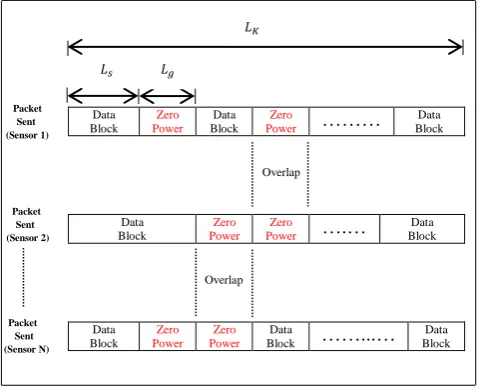
We form C(U,Z) N possible (distinct) zero-power periods combination (i.e. each sensor transmitted packet has its own zero-power periods in locations that can be overlapped with some zero-power periods for packets transmitted from other sensors).
let is the maximum possible size (or length) of the transmitted packet; = 1,2,…,K. Also, let is the length of the zero power period4; = 1,2,…G, and is the length of the actual data period; =1,2,…,S.
We assume and represent the lth and hth zero power period and actual data period respectively; l= 1,2,...Z and h= 1,2,...D.
The absolute power is assumed to be the minimum average power over all packet's slots which have been checked by the central node. It can be defined as:
(∑ ( ∑ | |) ∑ ( ∑ | |)) (1)
where
4
We assume the length of the zero-power period ( ) is 5% of the total number of samples. In our design we try to minimize as much as possible without degradation in the system performance.
| | ; i =1,2,…,G
| | ; j =1,2,…,S Figure 2 shows an example for packets which are transmitted from different sensors where zero-power periods may overlap in their locations.
Data Block
Zero Power
Data Block
Zero
Power ……… BlockData
Overlap
Data Block
Zero Power
Zero
Power ….…
Data Block
Overlap
Data Block
Zero
Power Power Zero BlockData ……...…
Data Block
Fig.2. Example of a packet structure for the zero-power periods scheme.
Upon the receipt of a packet, the sink node sweeps all possible zero-power and actual data periods for a packet in order to find the absolute power ( ) and hence compares it with a pre-specified threshold level ( ) that is set based on a desired Signal to Interference plus Noise Ratio (SINR) cut-off assumption ( )5 as will be described in more detail later in this paper. That is a system designer pre-evaluates the appropriate threshold value that corresponds to the desired . If is higher than the threshold value, then the SD approach value reflects a SINR that is less than and the packet is deemed not usable, and vice-versa. Accordingly, a “False-Alarm” event occurs if the received SINR is higher than but the SD approach erroneously deems the received SINR to be less than . On the other hand, if the SD approach deems the SINR to be higher than while it is actually less than , a “Miss” event is encountered. Miss and False-Alarm probabilities directly impact the overall system performance as will be discussed in the following sections. Therefore, it is desired to minimize such probabilities as much as possible.
B. Single Pseudo-Coded On-OFF Pilot Period Transmission
This scheme is based on a single pseudo-coded ON-OFF pilot period per packet. Figure 3 depicts a pictorial illustration of the packet structure for the single pilot period scheme. In the single pilot scheme we assume the following:
A distinct sequence per sensor. That is,
.
must have the same duty-cycle (D) for all 1 j N.
5
In order to have a threshold setting that is independent of the absolute level of the received signal power (hence independent of path loss, receiver gain …etc.) the collected IQ samples of the measurement period may first be normalized to unity power.
Packet Sent (Sensor 1)
Packet Sent (Sensor N)
Packet Sent (Sensor 2)
𝐿𝐾
[image:3.595.306.547.128.323.2] The length of the actual data block is , and the length of the pilot period ( ) is L.
L is divided into slots which include all zeros slots and all ones slots, i.e., we assume the same ratio of to as well as different ratio (e.g. 40%,50%, etc.). Also, each slot has the same number of samples ( ). Accordingly, we evaluate different length of L based how many and (i.e. L= ). In our design we try to minimize L as much as possible and ensure the SD approach would still work reliably. For example, we assume =8 slots and =2 samples, so L= 16 samples (It can be tuned as required by a designer).
The central node is aware of what transmitted period to expect for each sensor.
We evaluate various "soft" decision percentages (i.e. ) when decoding the pilot period at the central node. We quantify the effect and performance versus different such as 60%,70% and 90% (It can be tuned as required by a designer).
The relative power is assumed to be the average power for the actual data block to the average power for the pseudo-coded ON-OFF pilot period. It can be defined as:
(
∑ )
( ∑
)
(2)
where
| | ; i =L+1,L+2,…,
| | ; j =1,2,…,L
PNP1 Actual Data 1
PNPi Actual Data i
PNPj Actual Data j
Fig.3. Example of a packet structure for the single pseudo-coded ON-OFF pilot period.
In the single pilot period approach, the central node needs to decode (i.e. through ML detection) the pilot sequence for each received packet and compare it with the pre-stored look-up table (code-book) of all the valid sequences. If the sequence of the decoded pseudo-coded ON-OFF pilot period match (or more) of any pre-stored sequence, then the received packet is a collision-free packet, and vice versa.
For a collision-free packet and as we explained in previous technique, the relative power ) is compared with a pre-specified threshold value that is set based on
. If is higher than the threshold value, then the SD approach value reflects a SINR that is less than
and the packet is deemed not usable, and
vice-versa. Accordingly, a “False-Alarm” event occurs if the received SINR is higher than but the SD approach erroneously deems the received SINR to be less than . On the other hand, if the SD approach deems the SINR to be higher than while it is actually less than , a “Miss” event is encountered.
In the following we show how to decode the single pseudo-coded ON-OFF pilot period through the Maximum Likelihood (ML) detection [3]. Let the transmitted block be ; k=1,2,…, , and the received block be ; k=1,2,…, . As mentioned earlier, the kth received signal (complex-valued) IQ sample at the central node is:
k N
m k m k
k x x n
y
1
1 , ,
0
where is a complex-valued quantity that represents the kth IQ sample component contributed by the desired sensor, while is the kth IQ sample component contributed by the mth interfering (colliding) sensor. Finally, is a complex-valued Additive White Gaussian Noise (AWGN) quantity. Accordingly, the channel transition probability density function (pdf) P | )is:
P | ) =
) ( ∑ | |
) (3)
Hence, ML detection algorithm needs to maximize P( │ ) ,i.e., similar to (3) for all received packets, where in this case is the vector for the received pilot period, and is the vector for the transmitted pilot period. Equivalently, ML detector can maximize the log-likelihood function for the pilot period as follows:
( ( ))
= ∑ | |
The following procedures implement the ML detection for our proposed single pseudo-coded ON-OFF pilot period approach:
1. Start with k =1.
2. Calculate: = ∑ | | 3. Store .
4. Increment k by one. 5. If k=L+1 go to step 7. 6. Go to step 2.
7. Find the sequence that correspond to the largest and declare it as the detected sequence ( ).
As mentioned earlier, if the sequence match (or more) of any pre-stored sequence, then the corresponding received packet is declared as a collision free packet. For the collision free packet, is compared with a pre-specified threshold level (i.e. set based on ) in order to analyze packets' statistics (i.e. False-Alarm and Miss probabilities).
C. Threshold Selection
The decision threshold is chosen based on evaluating the False-Alarm and Miss probabilities and choosing the Packet
Sent (Sensor 1)
Packet Sent (Sensor i)
Packet Sent (Sensor j)
All Zeros (OFF)
All Ones (ON)
threshold values that satisfy the designer‟s requirements of such quantities. For example, we generate, say, a 100,000 Monte-Carlo simulated snapshots of interfering sensors (e.g., 1~30 sensors with random received powers to simulate various path loss amounts) where for each snapshot we compute the discrimination (SD) approach value (i.e. ) for the received SINR and compare it with various threshold levels, determine if there is a corresponding False-Alarm or Miss event and record the counts of such events. At the end of the simulations the False-Alarm and Miss probabilities are computed and plotted versus the range of evaluated threshold values, which in-turn, enables the designer to determine a satisfactory set point for the threshold.
IV. POWER SAVING AND SYSTEM THROUGHPUT ANALYSIS
To analyze the power saving of our proposed SD system we introduce the following computational complexity metrics:
= S + (4)
= S + ) (5)
In above formulas, S is the number of computational operations incurred in our proposed approach, while F is the number of computational operations incurred in a full-decoding approach, and are the probabilities of Miss and False-Alarm events respectively. Hence, represents the computational complexity for the case where the central node makes a wrong decision to fully-decode the received packet (i.e., declared as a collision-free packets) while the packet should has been rejected (i.e., due to collision). On the other hand, is the computational complexity for the case where the central node makes a correct decision to fully decode received packet6.
In addition, and for the comparison purposes, we introduce the following formulae in order to compare the computational complexity saving achieved by our proposed SD approach (i.e. ) over the FD approach (i.e. ):
= + (6) = F (7)
In above formulae, and are the probabilities of collision and no-collision events respectively. and have been obtained via Monte-Carlo simulation for our system described in section II, and we found the collision probabilities to be
= 0.3649 and = 0.6351.
A. Comparing with Full-Decoding
In order to assess the computational complexity of our SD scheme, we first quantize our metrics calculation in order to define fixed-point and bit-manipulation requirement of such calculations. We also assume a look-up table (LUT) approach for the logarithm calculation. Note that the number of times the algorithm needs to access the LUT equals the number of IQ samples involved in the metric calculation. Thus, our algorithm only needs to perform addition operations as many times as the number of samples. Hence, if the number of bits per LUT word/entry is equal to M at the output of the LUT, our algorithm needs as many M-bit addition operations as the number of IQ samples involved in
6 Our system throughput is defined as Throughput =
) ; Where denotes the False-Alarm probability.
the metric calculation.
As a case-study, we compare the complexity of our SD scheme with the complexity of a FD algorithm assuming a Max-log-MAP algorithm. This algorithm has been attractive choice for WSNs [7][9]. Authors in [8] measure the computational complexity of Max-log-MAP algorithm (per information bit of the decoded codeword) based on the size of the encoder memory. It has been shown in [8] that for a memory length of
, the total computational complexity per information bit for log-MAP can be estimated as:Max_Log-MAP152 17
F (8)
In contrast, our SD system does not incur such complexity related to the size of the encoder memory. In addition, our SD system avoids other complexities required by a full decoding such as time and frequency synchronization, Doppler shift correction, fading and channel estimation, etc., since our SD scheme operates directly at the IQ samples at the output of the ADC “as is”. Finally, the FD approaches require buffering and processing of the entire packet/codeword while our SD scheme needs only to operate on a short portion of the received packet.
Now let‟s compute the computational complexity for our SD approach. Let‟s assume that the IQ ADCs each is D bits. Also, let‟s assume a
2operation is done through a LUT approach to save multiplication operations. In addition, let‟s also assume that the square-root,
, is also done through a LUT approach. Hence, each of the I2and 2Q operations consume of the order of D bit-comparison operations to
address the
2 LUT. Then, if the output of the LUT is G bits, it follows that we need about G bit additions for an2 2
Q
I operation. Let‟s assume that the LUT has G bits for input addressing and K output bits. Then, we need about G+1 bit-comparison operations to address the LUT. Finally, for simplicity, let‟s assume that a bit comparison operation costs as much as a bit addition operation [8]. Accordingly, the total number of operations needed to
compute the
2 2
QI for one IQ sample is:
1
2 2 12DG G D G (9) However, our approach is based on calculating the power for the pilot period and the actual data period. So, the total number of operations needed to compute the ( ) for one IQ sample is:
G D
2 (10) If we assume the IQ over-sampling rate (OSR) to be Z (i.e., we have Z samples per information symbol), then we need aboutZG bit additions to add the Z( ) values for every information symbol. Hence, for one information symbol, we need a total of:
2DG
ZZG=
2D2G
Z (11) Now if we assume an M-ary modulation (i.e.,log2
M information bits are mapped to one symbol), then the computational complexity per information bit can be computed as:
M Z G D S2 log
2 2 InfoBit
/ (12)
Also, let‟s assume a memory size of =4 for the Max-Log-MAP. Using the formulae (8), it follows the Log-MAP FD algorithm costs 257 operations per an information bit, while our SD approach based on formula (12) costs only 48 operations per an information bit, which represents an 81% saving on the computational complexity.
In addition, in a no-collision event, the SD approach check would represent a processing overhead. Nonetheless, our SD approach still provides a significant complexity saving over the FD approaches as demonstrated by the following example. Table II in the Appendix shows the probability of Miss and False-Alarm to be 0.0712 and 0.0718, respectively for QPSK, =70%, a 50 bits measurement period and the single pilot period scheme. Now, based on formulae (4) and (5), and (per information bit) for our SD approach will equal:
= S +
= 48 + 0.0712 257= 66 Operations per Info Bit
= S + 1 )
= 48 + (1 0.0718) 257= 286 Operations per Info Bit For the comparison purposes between our SD approach and FD algorithms (i.e. the Max-Log-MAP algorithm), formulae (6) and (7) are used to find the computational complexity when no-collision is detected:
= + = 66 36.49% + 286 63.51%
= 205 Operations pert Info Bit
= = 257Operations per Info Bit
Hence, the complexity savings (in number of operations per information bit) against the Log-MAP algorithm becomes:
= ) = (257 – 205) / 257 = 20.23 % Note that the above complexity saving calculations, in fact, represent a lower bound on the saving since the above calculations did not take into account the modem line-up operational complexity in order to demodulate and receive the bits in their final binary format properly (i.e., synchronization, channels estimation, etc.).
V. PERFORMANCE EVALUATION
In this section we provide numerical performance evaluation of our proposed SD approach for various system design scenarios and parameter choices. We also consider a QPSK modulation scheme. In addition, we evaluate the sensitivity of our proposed discriminators to the SINR deviation from the 5dB cut-off point. That is, since the thresholds designed for the discriminators are pre-set based on studying (e.g., simulating) the statistics of the IQ signal envelope assuming “cut-off” SINR of 5dB, it is important to investigate if the algorithm would still work reliably if the signal‟s SINR is offset by a dB. Moreover, for our SD scheme we evaluate various measurement periods in bits (R), quantization levels (B), over-sampling rate (Z), and number of samples (V) in order to allow a system designer multiple degrees of freedom for design trade-off and optimization.
Figures 4 and 5 show the Miss (purple points) and False-Alarm (cyan points) probabilities versus the choice of the metric comparison threshold level ( ) (i.e., above which we decide the packet is valid (collision-free) and vice-versa) for our proposed approach, and for QPSK modulation scheme, (the choice of system parameters is defined in the caption of the corresponding figure). As shown in the figures, the
intersection point of the purple and cyan curves, can be a reasonable point to choose the threshold level in order to have a reasonable (or balanced) consideration of the Miss and False-Alarm probabilities, but certainly a designer can refer to the Appendix to choose an arbitrarily different point for a different criterion of choice.
Fig.4. Miss probability=18.32% vs. False-Alarm probability=18.30% vs. threshold=17.00, = 1.5dB, = 5dB, QPSK, measurement period (R)=100 bits, quantization level (B)=10, over-sampling rate(Z)=8, zero-power periods scheme.
Fig.5. Miss probability =6.98% vs. False-Alarm probability=6.95% vs. threshold=79.0, = 1dB, = 5dB, QPSK, measurement period= 500 bits, quantization level (B)=4, over-sampling rate(Z)=2, =
50%, = 70%, single pilot period scheme.
VI. CONCLUSION
In this paper we analyzed the performance of a novel power saving scheme for WSNs which is based on fast analysis of the statistics of the received signal. Hence, the receiver can quickly decide whether to decode or discard received packets. Our proposed algorithm offers low computational complexity and short measurement period requirements. With our proposed algorithm the total delay to decode stream of bits will be minimized as the decision to decode the signal can be made after checking only a small part of a received packet instead of the need to buffer and decode the entire packet as is the case with a full-decoding approach.
A
PPENDIX AIn the following we show two tables for the simulation results of our proposed schemes. We assume that the probability of transmission per sensor ( ) is 0.3, the modulation scheme is QPSK, and = 5dB. In the following tables,R is the measurement period in bits, B is the number of quantization levels for the received signal envelop, Z is the oversampling rate, is the number of slots per pilot period, is the ratio of zeros slots to ones
slots, L is the length of the pilot period, V is number of samples per measurement period, is the soft decision percentage when decoding the received pilot sequence at the central node, is the tolerance level for the SINR (e.g. = 1dB means the SINR = 6dB for calculating
TABLE I
QPSK–ZERO-POWER PERIODS SCHEME
QPSK V Z B R 65 11.00 39.77% 39.72% 1dB 2 4 50 156 15.00 26.08% 26.16% 1dB 5 8 50 206 16.00 24.53% 24.57% 1dB 8 10 50 56 10.00 36.16% 36.14% 1.5dB 2 4 50 156 15.00 21.01% 20.92% 1.5dB 5 8 50 205 16.00 19.12% 19.04% 1.5dB 8 00 50 110 15.00 26.53% 26.50% 1dB 2 4 100 310 17.00 20.17% 20.21% 0dB 5 8 100 410 17.00 18.32% 18.30% 1dB 8 00 100 110 15.00 21.02% 21.08% 1.5dB 2 4 100 310 17.00 14.90% 14.90% 1.5dB 5 8 100 410 17.00 12.22% 12.20% 1.5dB 8 00 100 220 17.00 20.01% 20.00% 1dB 2 4 200 620 18.00 15.84% 15.83% 1dB 5 8 200 820 19.00 14.06% 14.08% 1dB 8 00 200 220 17.00 15.00% 15.00% 1.5dB 2 4 200 620 18.00 10.22% 10.18% 1.5dB 5 8 200 820 18.00 9.64% 9.60% 1.5dB 8 10 200 550 19.00 14.11% 14.10% 1dB 2 4 500 1550 19.00 11.16% 11.10% 1dB 5 8 500 2050 19.00 10.15% 10.10% 1dB 8 10 500 550 18.00 12.19% 12.11% 1.5dB 2 4 500 1550 18.00 10.20% 10.15% 1.5dB 5 8 500 2050 18.00 9.22% 9.20% 1.5dB 8 00 500 1100 20.00 10.02% 10.05% 1dB 2 4 0000 0000 20.00 8.30% 8.36% 1dB 5 8 0000 4000 20.00 7.60% 7.56% 1dB 8 00 0000 0000 19.00 9.26% 9.21% 1.5dB 2 4 0000 0000 19.00 7.41% 7.43% 1.5dB 5 8 1000 4000 19.00 6.18% 6.20% 1.5dB 8 10 1000 TABLE II
QPSK–SINGLE PSEUDO-CODED ON-OFFPILOT PERIOD SCHEME
QPSK V L Z B R 92.0 21.62% 21.61% 1dB 60% 66 16 0.5 8 2 4 50 Bits .0 90 20.83% 20.50% 1.5dB 105.0 22.65% 22.45% 1dB 60% 214 14 0.4 7 8 10 .0 006 21.11% 21.14% 1.5dB 90.0 8.68% 8.61% 1dB 70% 66 16 0.5 8 2 4 .0 90 7.12% 7.18% 1.5dB 105.0 9.13% 9.25% 1dB 70% 214 14 0.4 7 8 10 .0 006 8.37% 8.20% 1.5dB 89.0 0.33% 0.31% 1dB 90% 66 16 0.5 8 2 4 .0 89 0.20% 0.21% 1.5dB 105.0 0.45% 0.47% 1dB 90% 214 14 0.4 7 8 10 105.0 0.30% 0.30% 1.5dB 80.0 19.65% 19.69% 1dB 60% 516 16 0.5 8 2 4 500 Bits 79.0 18.26% 18.21% 1.5dB 96.0 20.65% 20.45% 1dB 60% 2014 14 0.4 7 8 10 96.0 19.50% 19.42% 1.5dB 79.0 6.98% 6.95% 1dB 70% 516 16 0.5 8 2 4 79.0 5.34% 5.32% 1.5dB 95.0 7.65% 7.45% 1dB 70% 2014 14 0.4 7 8 10 95.0 6.29% 6.23% 1.5dB 77.0 0.28% 0.29% 1dB 90% 516 05 0.5 8 2 4 .0 77 0.15% 0.18% 1.5dB 88.0 0.41% 0.44% 1dB 90% 2014 04 0.4 7 8 10 88.0 0.22% 0.28% 1.5dB 80.0 18.29% 18.29% 1dB 60% 1016 16 0.5 8 2 4 1000 Bits .0 80 17.81% 17.84% 1.5dB 95.0 19.85% 19.93% 1dB 60% 4014 04 0.4 7 8 10 95.0 18.21% 18.27% 1.5dB 80.0 5.89% 5.81% 1dB 70% 1016 05 0.5 8 2 4 .0 80 4.12% 4.11% 1.5dB 95.0 6.05% 6.05% 1dB 70% 4014 04 0.4 7 8 10 95.0 5.10% 5.13% 1.5dB 76.0 0.20% 0.22% 1dB 90% 1016 05 0.5 8 2 4 76.0 0.13% 0.12% 1.5dB 90.0 0.35% 0.36% 1dB 90% 4014 04 0.4 7 8 10 90.0 0.23% 0.23% 1.5dB REFERENCES
[1] Kori, R.H.; Angadi, A.S.; Hiremath, M.K.; Iddalagi, S. M., "Efficient Power Utilization of Wireless Sensor Networks: A Survey," Advances in Recent Technologies in Communication and Computing, 2009. ARTCom '09. International Conference on , vol., no., pp.571,575, 27-28 Oct. 2009.
[2] Sandra, S.; Jaime, L.; Miguel, G.; Jose, F.T, "Power Saving and Energy Optimization Techniques for Wireless Sensor Networks (Invited Paper)." Journal of Communications, vol. 6. No.6, pp.439-459, 2011.
[3] Harry L. Van Trees. Detection, Estimation, and Modulation Theory: Part I, John Wiley and Sons, 1968.
[4] Miranda, J.; Gomes, T.; Abrishambaf, R.; Loureiro, F.; Mendes, J.; Cabral, J.; Monteiro, J.L., "A Wireless Sensor Network for collision detection on guardrails," Industrial Electronics (ISIE), 2014 IEEE 23rd International Symposium on , vol., no., pp.1430,1435, 1-4 June 2014.
[5] Haigang Zhang; Dongfeng Yuan; Cheng-Xiang Wang, "An improved normalized BP based decoding algorithm for LDPC codes," Wireless, Mobile and Multimedia Networks (ICWMMN 2008), IET 2nd International Conference on , vol., no., pp.223,226, 12-15 Oct. 2008. [6] J. Chen, and M. P. C. Fossorier. "Near optimum universal belief
propagation based decoding of low-density parity check codes", IEEE Transactions on Communications, vol. 50, no. 3, pp. 406--414, Mar. 2002.
[7] Chen, J.; Abedi, A, "Distributed Turbo Coding and Decoding for Wireless Sensor Networks," Communications Letters, IEEE , vol.15, no.2, pp.166,168, February 2011.
[8] Robertson, P.; Villebrun, E.; Hoeher, P., "A comparison of optimal and sub-optimal MAP decoding algorithms operating in the log domain," Communications, 1995. ICC '95 Seattle, 'Gateway to Globalization', 1995 IEEE International Conference on , vol.2, no., pp.1009,1013 vol.2, 18-22 Jun,1995.
[9] Liang Li; Maunder, R.G.; Al-Hashimi, B.M.; Hanzo, L., "A Low-Complexity Turbo Decoder Architecture for Energy-Efficient Wireless Sensor Networks," Very Large Scale Integration (VLSI) Systems, IEEE Transactions on , vol.21, no.1, pp.14,22, Jan. 2013. [10] M. Hempstead, M. J. Lyons, D. Brooks, and G-Y Wei, " Survey of
Hardware Systems for Wireless Sensor Networks", Journal of Low Power Electronics, Vol.4,pp.1-10,2008.
[11] Karapistoli, E.; Stratogiannis, D.G.; Tsiropoulos, G.I; Pavlidou, F., "MAC protocols for ultra-wideband ad hoc and sensor networking: A survey," Ultra-Modern Telecommunications and Control Systems and Workshops (ICUMT), 2012 4th International Congress on , vol., no., pp.834,841, 3-5 Oct. 2012.
[12] Sartipi, M.; Fekri, F., "Source and channel coding in wireless sensor networks using LDPC codes," Sensor and Ad Hoc Communications and Networks, 2004. IEEE SECON 2004. 2004 First Annual IEEE Communications Society Conference on, vol., no., pp.309,316, 4-7 Oct. 2004.
[13] Xiaoyu Ji; Yuan He; Jiliang Wang; Wei Dong; Xiaopei Wu; Yunhao Liu, "Walking down the STAIRS: Efficient collision resolution for wireless sensor networks," INFOCOM, 2014 Proceedings IEEE , vol., no., pp.961,969, April 27 2014-May 2 2014.
[14] T.V. Dam and K. Langendoen, “An Adaptive Energy-Efficient MAC Protocol for Wireless Sensor Networks”, The First ACM Conference on Embedded Networked Sensor Systems (Sensys„03), Los Angeles, CA, USA, November 2003.