Selected physical parameters and chemical compounds
of different types of tomatoes
Justyna Ewa Bojarska
1*, Beata Piłat
1, Katarzyna Małgorzata Majewska
1,
Daria Anna Sobiechowska
1, Agnieszka Narwojsz
21Department of Food Plant Chemistry and Processing, Faculty of Food Science, University
of Warmia and Mazury, Olsztyn, Poland
2Department of Human Nutrition, Faculty of Food Science, University of Warmia and Mazury,
Olsztyn, Poland
*Corresponding author: [email protected]
Citation: Bojarska J.E., Piłat B., Majewska K.M., Sobiechowska D.A., Narwojsz A. (2020): Selected physical parameters and che-mical compounds of different types of tomatoes. Czech J. Food Sci., 38: 28–35.
Abstract: The aim of this experiment was to compare selected types and varieties of tomatoes (‘Beef-red’, ‘Beef-orange’, ‘Olmeca’, ‘Malinowy’, ‘Cherry-red’, ‘Cherry-mini malina’, ‘Cherry-orange’, ‘Papryczkowy’) by examining their chemical composition and identifying the selected physical properties. The research material consisted of tomato fruit purchased on the regional market (Warmia and Mazury voivodeship, Poland) from one producer. An analysis of colour and tex-ture measurement was performed. Moreover, the total dry matter content, total extract, total acidity, pH value, pectin content, total carotenoids and phenolic compounds, as well as DPPH scavenging activity were determined. The analyses showed that the investigated tomatoes were varied in terms of physical properties and chemical composition. Small--fruited tomatoes were characterized by lower hardness and firmness compared to medium and large tomatoes. Besides they contained significantly more total polyphenols and carotenoids (except for ‘Cherry-mini malina’), therefore they have been recognized as an attractive source of health-promoting ingredients for the consumer.
Keywords: tomatoes; types and varieties; chemical compounds; physical parameters
Tomatoes (Lycopersicon esculentum Mill.) are among the most commonly consumed vegetables, both raw and processed. Their consumption in Europe in 2013 amounted to 26.7 kg per capita and was over 20% higher than the world average. The leading produc-er of tomatoes in Europe is Italy, from which more than 30% of the European Union harvests come from (Bugała et al. 2017b). The annual harvest of these fruits in Poland is not among the highest in Europe; in 2016 it amounted to 867 000 tons (GUS – Statistics Poland 2017), which is only a few percent of the Eu-ropean Union’s harvest. However, their economic im-portance in Poland is the highest among vegetables,
as evidenced by more than 30% of the value of their export and import in the total value obtained for fresh vegetables in 2007–2015 (Bugała et al. 2017b).
The range of available tomato types and varieties presents the consumer with a wide variety of choices. They are a source of many nutrients and health bene-fits, among others, carotenoids (β-carotene, lycopene, lutein) and flavonoids, with strong antioxidant activ-ity, vitamin E, as well as macro and microelements (Leonardi et al. 2000; Toor & Savage 2005; Kacjan Maršić et al. 2011; Oboulbiga et al. 2018; Renna et al. 2018). The high availability of tomato fruit in various climate zones, as well as their considerable varietal
diversity, presented consumers with increasingly dif-ficult choices. The desired high quality of tomatoes is perceived by the consumer through appropriate size, colour and fruit firmness (Batu 2004; Tijskens & Eve-lo 1994). Smaller tomatoes, initially used for decora-tion of dishes, are currently more popularly enjoyed, preferred for consumption in the form of a snack or as an addition to salads. Nowadays, both the organolep-tic characteristhe organolep-tics as well as the increasingly important pro-health values, have an impact on the final consumer selection (Gajc-Wolska et al. 2000; Magkos et al. 2003). The quality of tomatoes of a certain type or variety is genetically determined, but also depends on the agro-nomic conditions, including plant nutrition, at the time of their growth (Haase et al. 2017; Sikorska-Zimny et al. 2017). The aim of this experiment was to compare se-lected types and varieties of tomatoes (red’, ‘Beef-orange’, ‘Olmeca’, ‘Malinowy’, ‘Cherry-red’, ‘Cherry-mini malina’, ‘Cherry-orange’, ‘Papryczkowy’), from the point of view of the consumer, by examining their chemical composition and determining their physical properties.
MATERIAL AND METHODS
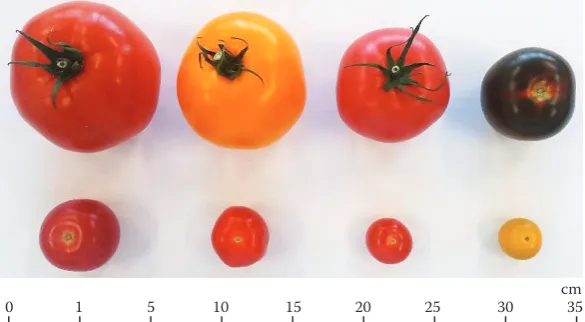
The research material was fresh fruit of eight types and varieties of tomato (large-fruited: ‘Beef-red’ ‘Beef-orange’, ‘Olmeca’, ‘Malinowy’; and small-fruited: red’, mini malina’, ‘Cherry-orange’, ‘Papryczkowy’) (Figure 1). Analysed samples, in the amount of 2 kg, were purchased on the local market (Warmia and Mazury voivodeship, Poland) from one producer and they were coming from con-ventional cultivation. All the tested tomatoes were grown in greenhouses in the same soil and climate conditions, using a uniform set of agrotechnical treat-ments. They included both small-berry type of cherry tomatoes, having a diameter up to 20 mm, as well
as cocktail tomatoes whose diameter was in the range 20–40 mm. The fruits of commercial maturity were tested twice (with a week interval) and stored for 3 days at 6–8 °C until analysis. The fruit quality of each variety was analysed by specifying selected physical parameters and chemical components.
Texture. The texture of the tomatoes was determined using the Instron Universal Testing Machine 4301 (In-ston, USA) according to the method described by Bo-jarska et al. (2015). The examined fruit was placed on the UMT Instron tripod (Instron Co., UK), directing the trace of sepal in the horizontal axis. The analysis was carried out at room temperature. The penetra-tion test was applied to measure hardness and firm-ness of analysed fruits. A cylindrical flat-beheaded mandrel of a diameter of 3 mm, which was moving at a speed of 50 mm min–1, penetrated the tested
ma-terial to a depth of 10 mm. Based on the penetration curves shown in the force-deformation (F-d) system, the maximum penetration force Fmax (N) and
the cor-responding deformation dmax (mm), as well as the
maximum penetration energy Emax (J) were analysed. The firmness Z (N mm–1) of the tomato fruit
was cal-culated according to the formula:
Z = Fmax/dmax (N mm–1) (1)
[image:2.595.64.357.594.755.2]Colour. CIE L*, a* , and b* colour analysis was performed using the Konica Minolta Model CR-400 (Konica Minolta, Japan) colourimeter accord-ing to the method described by Biller (2003). After calibrating the colourimeter to the white standard, the colour of the peel and flesh (on the cross-section of the fruit) of the tomato fruit was measured. The co-lour parameters were measured by the light source C. The following colour components were analysed: a*– red colour, b*– yellow colour, and L*– brightness.
Figure 1. Examined tomato types and varieties
From left, top row: red’, ‘Beef-orange’, ‘Malinowy’, ‘Olmeca’; lower row: ‘Cherry-mini malina’, ‘Papryczkowy’, ‘Cherry-red’, ‘Cherry-orange’
Chemical components. The contents of the fol-lowing chemical components: dry matter (PN-EN 12145:2001), total extract (PN-EN 12143:2000), total acidity (PN-EN 12147:2000), pH value (EN 1132:1999), pectin content (AOAC 1990), carotenoids with a RP-HPLC technique (Chen & Yang 1992; Czaplicki et al. 2016), and the total phenolic compounds (AOAC 1990; Singleton et al. 1999), as well as antioxidant activity by trapping the DPPH radical (Moure et al. 2001), were determined. The measurement was performed in zero and 16 min after the addition of a methanolic solution of DPPH (0.36 × 10⁻³ mol).
All analyses were performed in triplicate, except for texture and colour parameters, where the num-ber of replicates was n = 10 and n = 20, respectively. The results were statistically analysed using the Sta-tistica 12.0 program (StatSoft Inc., USA) performing the Duncan test at the significance of level P < 0.05. Besides, a linear correlation analysis was performed (P < 0.05) to check the relationship between the tested features (Bower 2013). The error bars on the graphs represent the standard deviation.
RESULTS AND DISCUSSION
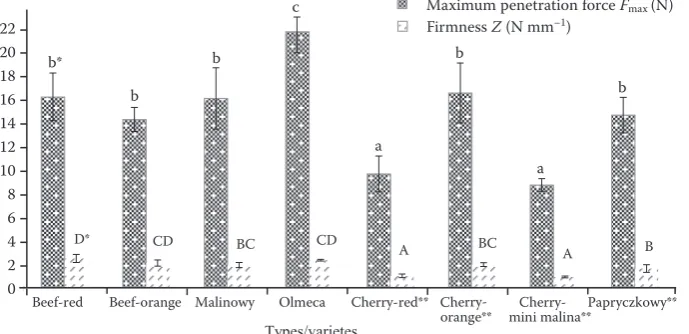
The texture of the tomato types and cultivars was de-termined by analysing the maximum penetration force (Fmax), the fruit firmness (Z), and the maximum
pene-tration energy of the fruit (Emax) at the given test
defor-mation. The parameter Fmax was from
8.80 N (‘Cherry-mini malina’) to 21.40 N (‘Olmeca’), while the fruit’s firmness was from 0.89 N mm–1 (‘Cherry-mini
ma-lina’) to 2.43 N mm–1 (‘Beef-red’) (Figure 2).
The pa-rameter Emax observed in the studied tomato types/
cultivars ranged from 3.2 × 10⁻² J (‘Cherry - mini
ma-lina’) to 9.4 × 10⁻² J (‘Olmeca’) (Figure 3). The average
values of texture parameters differed significantly. It was noticed that small-fruited tomatoes were char-acterized by lower values of maximum penetration force, firmness and maximum penetration energy, by approximately 29, 38 and 35%, respectively. Ac-cording to Kowalczyk et al. (2011), the hardness of the peel and flesh and the firmness of the fruit depend on the harvest date, the culture medium on which they are grown and their variety. As reported by Cantwell et al. (2009), the lower firmness of small fruits is as-sociated with the higher content of acids and sugars. The described regularity was also observed in the con-ducted studies. Small-fruited tomatoes were charac-terized by lower hardness as well as higher content of total extract and total acidity.
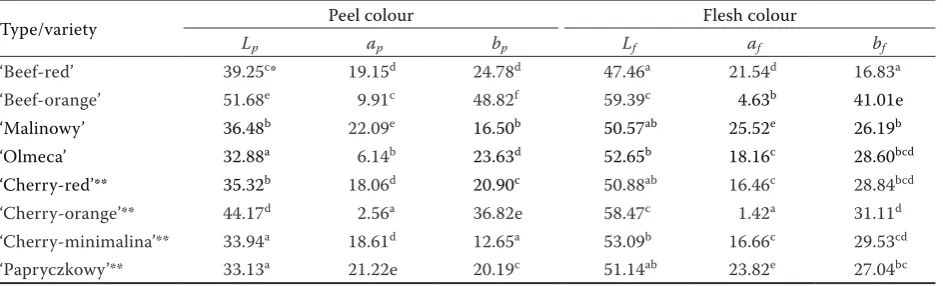
The types and varieties of tested fruits differed in co-lour and intensity. The parameters determined for the peel and flesh on the CIE L*, a*, and b* scale are shown in Table 1. The values of the a* parameter, cor-responding to the red colour, ranged from 2.56 (‘Cher-ry-orange’) to 22.09 (‘Malinowy’) for peel and from 1.42 (‘Cherry-orange’) to 25.52 (‘Malinowy’) for flesh. The highest saturation of yellow b*, as a characteris-tic trait, was observed in the varieties ‘Beef-orange’ and ‘Cherry-orange’. The values of the Lp* parameter
determining the peel brightness of the tested sam-ples ranged from 32.88 (‘Olmeca’) to 51.68 (‘Beef-orange’). The colour of the fruit, its intensity and saturation, depend on the variety and the ripeness stage of the fruit. Zalewska-Korona &
Jabłońska-Figure 2. The values of the maximum penetration force Fmax and firmness Z in the examined types/varieties of tomatoes
*Values with the same letter in the column do not differ significantly (P < 0.05) according to Duncan’s test; **small-fruited types and varieties
Maximum penetration force Faxmax (N)
Firmness Z (N mm–1)
Beef-red Beef-orange Malinowy Olmeca red**
Cherry-orange** mini malina**Cherry- Papryczkowy** Types/varietes
A
A B
BC BC
CD CD
D*
22 20 18 16 14 12 10 8 6 4 2 0
b*
b
b
b b
a
a
c Maximum penetration force Fmax (N)
[image:3.595.132.477.545.712.2]Ryś (2012) examined the colour of ground tomatoes. They obtained slightly higher values of the a* param-eter, at the level of 22.72–34.01, and the b* parameter, at the level of 14.53–28.86. According to Ordóńez-Santos et al. (2008), the tomato colour parameters a* and b* were at the levels of 9.55–21.09 and 4.91–18.85, respectively. Similar results were obtained in studies by Kacjan Maršić et al. (2011), carried out on oval, oblong and cherry tomatoes. The following values were obtained for the colour parameters: a* 19.8–26.7, b* 26.3–29.5, and L* 42.0–45.5.
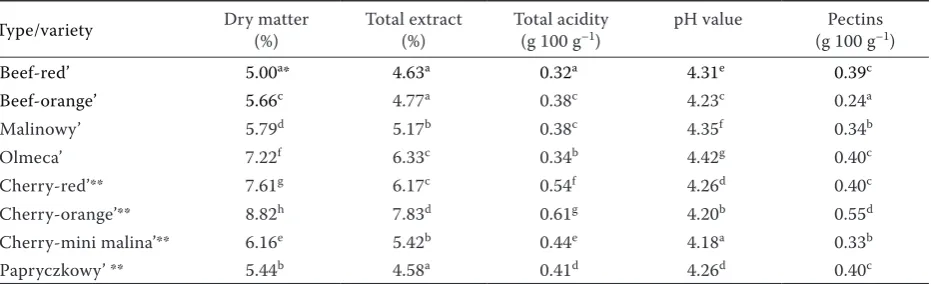
The content of dry matter in the tested tomato fruit was from 5.00% (‘Beef-red’) to 8.82% (‘Cherry-orange’), while the total extract was from 4.58% (‘Pa-pryczkowy’) to 7.83% (‘Cherry-orange’) (Table 2). The average parameters set for the small-berry types or varieties are noticeably higher (7.01 and 6.00%, respectively) than for large types/varieties (5.92 and
5.23%), respectively. The total acidity of the tested to-mato types/varieties was from 0.32 g 100 g–1 of fruit
‘Beef-red’, to 0.61 g 100 g–1 of fruit ‘Cherry-orange’
(Table 2). It was slightly higher in small-berry fruit types/varieties (0.50 g 100 g–1) compared to
large-fruited types/varieties (0.35 g 100 g–1). The pH value
was from 4.18 (‘Cherry mini-malina’) to 4.42 (‘Olmeca’). The dry mass of the examined tomatoes, the total ex-tract content and the total acidity determined in this work were similar to those obtained by Abukhovich & Kobryń (2010), respectively: dry mass of 4.97–8.09%, total extract of 2.41–4.36%, total acidity of 0.36–0.50 g 100 g–1. Converging results of the dry matter content
[image:4.595.119.488.98.255.2]were also found by Hernández Suárez et al. (2008), from 5.9% to 6.2%. In studies conducted by Zalewska-Korona et al. (2013), the mean dry matter content in tomatoes was 5.95%, the total extract was 4.38% and the average total acidity was 0.3 g 100 g–1. The results of total acidity
Table 1. Colour parameters of peel and flesh in tested tomato fruit
Type/variety Peel colour Flesh colour
Lp ap bp Lf af bf
‘Beef-red’ 39.25c* 19.15d 24.78d 47.46a 21.54d 16.83a
‘Beef-orange’ 51.68e 9.91c 48.82f 59.39c 4.63b 41.01e
‘Malinowy’ 36.48b 22.09e 16.50b 50.57ab 25.52e 26.19b
‘Olmeca’ 32.88a 6.14b 23.63d 52.65b 18.16c 28.60bcd
‘Cherry-red’** 35.32b 18.06d 20.90c 50.88ab 16.46c 28.84bcd
‘Cherry-orange’** 44.17d 2.56a 36.82e 58.47c 1.42a 31.11d
‘Cherry-minimalina’** 33.94a 18.61d 12.65a 53.09b 16.66c 29.53cd
‘Papryczkowy’** 33.13a 21.22e 20.19c 51.14ab 23.82e 27.04bc
[image:4.595.64.536.587.730.2]L – the brightness; a – the yellow colour; b– the red colour; *values with the same letter in the column do not differ significantly (P < 0.05) according to Duncan’s test; **small-fruited types and varieties
Figure 3. The maximum penetration energy Emax in the examined types/varieties of tomatoes
*Values with the same letter in the column do not differ significantly (P < 0.05) according to Duncan’s test; **small-fruited types and varieties
0 2 4 6 8 10
Beef-red Beef- orange Malinowy Olmeca red**
Cherry-orange** Cherry- mini malina**Papryczkowy** Types/varieties
bc bcd
cd* d
b
e
a a
× 10–2
Ma
xim
um
pene
tra
tium
ener
gy
Ema
x
do not differ from the values presented by Gupta et al. (2011), obtained for different tomato genotypes (0.50– 0.54 g 100 g–1). In addition, convergent values of total
acidity and pH to those obtained in this experiment were presented by Mendez et al. (2011) (0.30–0.72 g 100 g–1
and pH 3.96–4.75).
The pectin content was from 0.24% (‘Beef-orange’) to 0.55% (‘Cherry-orange’) (Table 2). It was found that the content of the tested compound was higher in the fruits of the small-fruited types/varieties, espe-cially ‘Cherry-orange’, which could be related to the higher ratio of the fruit surface to its mass and the lo-cation of the pectin under the fruit peel.
The total polyphenol content of the tested sam-ples ranged from 38.13 mg gallic acid 100 g–1
(‘Beef-red’) to 74.07 mg 100 g–1 (‘Cherry-red’)
(Fig-ure 4). Significant differences between the amount of tested compounds in particular types/varieties of tomatoes were observed, as well as their higher content in the finer fruits, indeed. The antioxidant activity (Figure 5), related to the content of the tested antioxidant substances, in the tested types/ varieties reached 9.01% (‘Beef-red’) to 33.79% (‘Pa-pryczkowy’). The content of phenolic compounds (38.13–74.07 mg 100g–1) wasconsistent with
biblio-graphic information. Hallmann & Rembiałkowska (2007) determined the total polyphenol content in the tomatoes from organic farming and conven-tional farming at the level of 46.88 and 33.07 mg gallic acid 100 g–1, respectively.
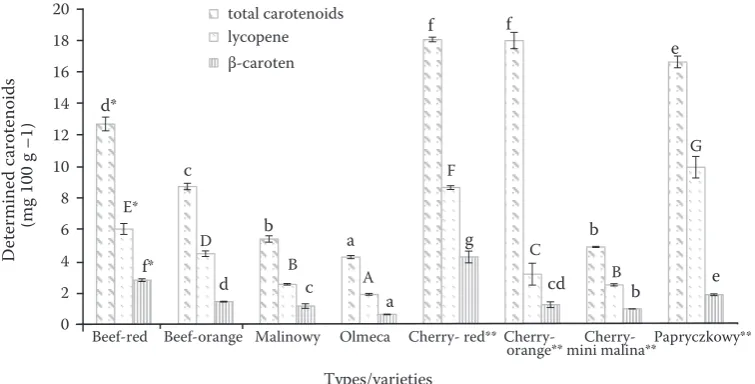
Among the biologically active substances con-tained in the fruit of tomatoes, carotenoids (in-cluding lycopene and carotene) deserve attention. The total carotenoid content of the tested tomato types/varieties ranged from 4.26 mg 100 g–1
(‘Ol-meca’) to 18.06 mg 100 g–1 (‘Cherry-red’) (Figure 6).
The dominant carotenoid was lycopene, constituting 44.4–59.8% of the total carotenoid content, followed by β-carotene in the amount of 11.3–24.4%.
The small-fruited types and varieties tested in this experiment showed significantly higher carotenoid content than large-fruited, traditionally consumed types/varieties, except for ‘Cherry-mini malina’. Minor differences were observed in the qualita-tive composition of carotenoids – the average lyco-pene and β-carotene content in fruit of small-ber-ried types and varieties was about 7% higher than in case of the large-fruited ones. The highest content of β-carotene has been observed in small-berried tomatoes. According to Garande and Patil (2014), orange-yellow tomatoes have a significantly higher content of this compound compared to red fruits. Our research does not explicitly indicate such reg-ularity. On the other hand, as reported by Veljović et al. (2012), in the fresh fruit there is more lycopene than in the heat treated fruit. Quite the opposite is the case for the antioxidant activity and the total content of phenolic compounds. The content of bio-logically active compounds increases after thermal treatment (Veljović et al. 2012).
Strong positive correlations (P < 0,05) between to-tal polyphenols content and toto-tal acidity (0.888), dry matter (0.743) and extract (0.613), as well as between total carotenoids content and total acidity (0.633) and pectin content (0.574) were assessed. Moreover, a strong negative correlation was noted between the total polyphenols content and fruit firmness (–0.651) and between the content of the total extract and the ap parameter, determining the red colour
[image:5.595.66.532.115.257.2]of the peel (–0.630). Table 2. The selected fruit quality parameters in studied types and varieties of tomatoes
Type/variety Dry matter(%) Total extract (%) Total acidity (g 100 g–1) pH value (g 100 gPectins –1)
‘Beef-red’ 5.00a* 4.63a 0.32a 4.31e 0.39c
‘Beef-orange’ 5.66c 4.77a 0.38c 4.23c 0.24a
‘Malinowy’ 5.79d 5.17b 0.38c 4.35f 0.34b
‘Olmeca’ 7.22f 6.33c 0.34b 4.42g 0.40c
‘Cherry-red’** 7.61g 6.17c 0.54f 4.26d 0.40c
‘Cherry-orange’** 8.82h 7.83d 0.61g 4.20b 0.55d
‘Cherry-mini malina’** 6.16e 5.42b 0.44e 4.18a 0.33b
‘Papryczkowy’ ** 5.44b 4.58a 0.41d 4.26d 0.40c
Figure 4. The total polyphenol content in the examined types/varieties of tomatoes
[image:6.595.109.490.315.461.2]*Values with the same letter in the column do not differ significantly (P < 0.05) according to Duncan’s test; **small-fruited types and varieties
Figure 5. Antioxidant activity of the methanol extracts of the examined types/varieties of tomatoes
*Values with the same letter in the column do not differ significantly (P < 0.05) according to Duncan’s test; **small-fruited types and varieties
Figure 6. The content of total carotenoids, lycopene and β-caroten in the examined types/varieties of tomatoes *Values with the same letter in the column do not differ significantly (P < 0.05) according to Duncan’s test; **small-fruited types and varieties
0 5 10 15 20 25 30 35 40
Beef-red Beef-orange Malinowy Olmeca red**
Cherry-orange**mini malina**Cherry- Papryczkowy**
Types/varieties
-a*
b c c c
d
e e
An
tio
xid
an
t ac
tiv
ity
(DPPH inhibitions) (%)
0 2 4 6 8 10 12 14 16 18 20
Beef-red Beef-orange Malinowy Olmeca Cherry- red** Cherry-
Cherry-mini malina**Papryczkowy** total carotenoids
lycopene β-caroten
Types/varieties a
b b
c d*
e
f f
A
C B
E*
F
B D
G
e a
d c b
f*
g
cd
mg
100
g
orange**
–1
(mg
100
g
–1)
D
et
er
mine
d
car
ot
enoid
s
0 10 20 30 40 50 60 70 80
Tot
al
phenolic
com
pound
s
(mg g
allic ac
id 100 g
–1)
Beef-red Beef-orange Malinowy Olmeca Cherry-red**
Cherry-orange**mini malina**Papryczkowy**
a*
b b b c c
d e
[image:6.595.110.488.519.711.2]CONCLUSION
The conducted analysis showed that the tested types and varieties of tomatoes were varied in terms of physical properties and chemical composition. It was noticed that small-fruited tomatoes were char-acterized by lower hardness and firmness compared to medium and large tomatoes. The tested varieties of cherry tomatoes contained significantly higher total phenolic compounds (about 30%) (especially the ‘Cherry-red’ type), lycopene and β-carotene than medium and large tomatoes. Therefore, in addition to the decorative value, they are of high health value.
Acknowledgement. The authors are grateful to MSc. Marta Klisz from University of Warmia and Mazury in Olsztyn, Faculty of Food Science, for technical help in carrying out laboratory tests.
REFERENCES
Abukhovich A., Kobryń J. (2010): Yield and changes in the fruit quality of cherry tomato grown on the cocofibre and rockwool slabs used for the second time. Acta Scientiarum Polonorum, Hortorum Cultus, 9: 93–98.
Batu A. (2004): Determination of acceptable firmness and colour values of tomatoes. Journal of Food Engineering, 61: 471–475.
Biller E. (2003): Instrumentalny pomiar barwy (Instrumental colour measurement). In: Biller E., Wierzbicka A. (eds): Wybrane Procesy w Technologii Żywności (Selected Processes in Food Technology). Wydawnictwo SGGW, Warszawa: 117–124. (in Polish)
Bojarska J. E., Majewska K. M., Zadernowski R. (2015): Teks-tura owoców wybranych odmian truskawek (Texture of the fruit of selected varieties of strawberries). Żywność. Nauka. Technologia. Jakość, 4: 113–124. (in Polish)
Bower J.A. (2013): Statistical Methods for Food Science: Association, correlation and regression. Introductory Procedures for the Food Practitioner, 2nd Ed. John Wiley & Sons, Ltd., Hoboken, NJ, USA.
Cantwell M., Nie X., Hong G. (2009): Impact of storage condi-tions on grape tomato quality. In: Procceedings 6th ISHS Post-harvest Symposium, 8–12 April 2009, Antalya, Turkey: 1–8. Chen B.H., Yang S.H. (1992): An improved analytical method
for the determination of carotenoids and xanthophylls in dried plant materials and mixed feeds. Food Chemistry, 44: 61–66.
Czaplicki S., Tańska M., Konopka I. (2016): Sea-buckthorn oil in vegetable oils stabilisation. Italian Journal of Food Science, 28: 412–425.
Gajc-Wolska J., Skąpski H., Szymczak J.A. (2000): Chemical and sensory characteristic of the fruits of eight cultivars of field grown tomato. Acta Physiologiae Plantarum, 3: 369–373.
Garande V.K., Patil R.S. (2014): Orange fruited tomato cultivars: rich source of beta carotene. Journal of Horticulture, 1: 1–5. Gupta A., Kawatra A., Sehgal S. (2011): Physical-chemical
properties and nutritional evaluation of newly-developed tomato genotypes. African Journal of Food Science and Technology, 2: 167–172.
GUS – Statistics Poland (Główny Urząd Statystyczny )(2017): Wyniki produkcji roślinnej w 2016 r. (Plant production results in 2016). Warszawa: 53–55. (in Polish)
Haase R., Hütter N., Kaletta M., Löw V., Pflanz M., Jäger D., Zude-Sasse M. (2017): Influence of plant nutrition on the fruit quality of tomato. In: Proceedings 10th Interna-tional FRUTIC Symposium. Quality and Safety of Fresh Horticultural Commodities. 7 February 2017, Berlin, Germany: 76.
Hallmann E., Rembiałkowska E. (2007): Estimation of fruits quality of selected tomato cultivars (Lycopersicon esculen-tum Mill.) from organic and conventional cultivation with special consideration of bioactive compounds content. Journal of Resarch and Applications in Agricultural Engi-neering, 52: 55–60.
Hernández Suárez M., Rodríguez Rodríguez E.M., Díaz Romero C. (2008): Chemical composition of tomato ( Ly-copersicon esculentum) from Tenerife, the Canary Islands. Food Chemistry, 106: 1046–1056.
Kacjan Maršić N., Gašperlin L., Abram V., Budič M., Vidrih R. (2011): Quality parameters and total phenolic content in tomato fruits regarding cultivar and microclimatic conditions. Turkish Journal of Agriculture and Forestry, 35: 185–194.
Kowalczyk K., Gajc-Wolska J., Radzanowska J., Marcinkows-ka M. (2011): Assessment of chemical composition and sensory quality of tomato fruit depending on cultivar and growing conditions. Acta Scientiarum Polonorum, Hortorum Cultus, 10: 133–140.
Leonardi C., Ambrosino P., Esposito F., Fogliano V. (2000): Antioxidant activity and carotenoid and tomatine contents in different typologies of fresh consumption tomatoes. Journal of Agricultural and Food Chemistry, 48: 4723–4727.
Magkos F., Arvaniti F., Zampelas A. (2003): Organic food: nutritious food or food for thought? A review of the evi-dence. International Journal of Food Sciences and Nutri-tion, 54: 357–371.
Moure A., Franco D., Sineiro J., Domínguez H., Núñez M. J., Lema J. M. (2001): Antioxidant activity of extracts from Gevuina avellana and Rosa rubiginosa defatted seeds. Food Research International, 34: 103–109.
Bugała A. Kraciński P., Nosecka B., Strojewska I., Zaremba Ł. (2017a): Spożycie owoców, warzyw i ich przetworów (w pr-zeliczeniu na świeże) oraz soków pitnych i nektarów. In: Nosecka B. (ed.): Polski i światowy rynek wybranych ow-oców, warzyw i ich przetworów (Polish and world market of selected fruits, vegatables and their preserves). Państwowy Instytut Badawczy, Warszawa: 107–129. (in Polish) Bugała A. Kraciński P., Nosecka B., Strojewska I., Zaremba Ł.
(2017b): Polski rynek owoców i warzyw świeżych oraz ich przetworów. In: Nosecka B. (ed.): Polski i światowy rynek wybranych owoców, warzyw i ich przetworów (Polish and world market of selected fruits, vegatables and their preserves). Państwowy Instytut Badawczy, Warszawa: 13–15. (in Polish)
Renna M., Durante M., Gonnella M., Buttano D., D’Imperio M., Mita G., Serio F. (2018): Quality and Nutritional Evaluation of Regina Tomato, a Traditional Long-Storage Landrace of Puglia (Southern Italy). Agriculture, 8 (article No. 83): 1–15.
Sikorska-Zimny K., Kowalczyk W., Badełek E., Grzegorze-wska M. (2017): The influence of nutrient solution dif-ferent chemical composition on storage durability and the content of pro-healthy components in cherry tomato cultivated in rockwool. In: Proceedings10th International
FRUTIC Symposium. Quality and Safety of Fresh Horti-cultural Commodities. 7 February 2017, Berlin, Germany. (Abstrakt No. P24): 73.
Singleton V.L., Orthofer R., Lamuela-Raventos R.M. (1999): Analysis of total phenols and other oxidation substrates and antioxidants by means of Folin–Ciocalteau reagent. Methods in Enzymology, 299: 152–178.
Tijskens L.M.M., Evelo R.W. (1994): Modelling colour of to-matoes during postharvest storage. Postharvest Biology and Technology. 4: 85–89.
Toor R.K., Savage G.P. (2005): Antioxidant activity in differ-ent fractions of tomatoes. Food Research International, 38: 487–494.
Veljović M., Davidović S., Pecić S., Despotović S., Leskošek-Čukalović I., Vukosavljević P. (2012): Lycopene content and antioxidant capacity of tomato jam. In: Proceedings 6th Central European Congress on Food, Serbia, CEFood2012: 137–143.
Zalewska-Korona M., Jabłońska-Ryś E. (2012): Ocena przydatności do przetwórstwa owoców wybranych odmian pomidora gruntowego (The evaluation of the suitability for fruit processing of selected tomato varieties). Żywność. Nauka. Technologia. Jakość: 77–87. (in Polish)
Zalewska-Korona M., Jabłońska-Ryś E., Michalak-Majewska M. (2013): Wartości odżywcze i prozdrowotne owoców pomidora gruntowego (The nutritional and health benefits of ground tomato fruits). Bromatologia i Chemia Toksyko-logiczna, XLVI (16): 200–205. (in Polish)