Proceedings of the Fourteenth Workshop on Innovative Use of NLP for Building Educational Applications, pages 87–91 87
Artificial Error Generation with Fluency Filtering
Mengyang Qiu†‡ Jungyeul Park† †Department of Linguistics
‡Department of Communicative Disorders and Sciences
State University of New York at Buffalo
{mengyang,jungyeul}@buffalo.edu
Abstract
The quantity and quality of training data plays a crucial role in grammatical error correction (GEC). However, due to the fact that obtain-ing human-annotated GEC data is both time-consuming and expensive, several studies have focused on generating artificial error sentences to boost training data for grammatical error correction, and shown significantly better per-formance. The present study explores how flu-ency filtering can affect the quality of artifi-cial errors. By comparing artifiartifi-cial data fil-tered by different levels of fluency, we find that artificial error sentences with low fluency can greatly facilitate error correction, while high fluency errors introduce more noise.
1 Introduction
Grammatical Error Correction (GEC), a NLP task of automatically detecting and correcting gram-matical errors in text, has received much attention in the past few years, because of an ever-growing demand for reliable and quick feedback to facil-itate the progress of English learners. In a typi-cal GEC task, an error sentence such asI follows
his advice needs to be corrected to a grammati-cal sentenceIfollowhis advice, while a grammat-ical sentence She follows his advice should out-put the same sentence without any modification. Currently, neural machine translation (NMT) sys-tems using sequence-to-sequence (seq2seq) learn-ing (Sutskever et al.,2014) that “translate” incor-rect sentences into corincor-rect ones, have shown to be promising in grammatical error correction, and several recent NMT approaches have obtained the state-of-the-art results in GEC (e.g.,Chollampatt and Ng,2018;Ge et al.,2018;Zhao et al.,2019).
While designing a GEC-oriented seq2seq archi-tecture is one important aspect to achieve high performance in grammatical error correction, the quantity and quality of data also plays a crucial
role in the NMT approach to GEC, as NMT pa-rameters cannot learn and generalize well with limited training data. Due to the fact that ob-taining human-annotated GEC data is both time-consuming and expensive, several studies have fo-cused on generating artificial error sentences to boost training data for grammatical error correc-tion. One main approach is to extract errors and their surrounding context (the context window ap-proach) from available annotated data, and then apply the errors to error-free sentences naively or probabilistically (Yuan and Felice, 2013; Fe-lice, 2016). The other approach uses machine back-translation, which switches the source-target sentence pairs in GEC and learns to ”translate” correct sentences into their incorrect counterparts (Kasewa et al., 2018). While the first approach may not generalize well to unseen errors, and the second one may have no control over what kind of error is produced, artificial error sentences gen-erated from both approaches contribute to better performance in grammatical error correction.
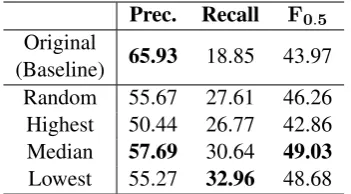
artifi-cial error data. The model trained with artifiartifi-cial error sentences with the lowest fluency obtains the highest recall among the four settings, while the one trained with error sentences with the median fluency achieves the highest performance in terms ofF0.5, with an absolute increase of 5.06% over the baseline model.
2 Related Work
Our work mainly builds on the context window approach to artificial error generation. In this ap-proach, all the possible error fragments (errors and their surrounding context) and their corresponding correct fragments are first extracted from GEC an-notated corpora. For example, I follows his and
I follow his are the fragments extracted from the example sentences in the first paragraph. With these correct-incorrect fragments, for each error-free sentence, if we find the same correct fragment in the sentence, we can inject errors by replacing that fragment with the incorrect one.Felice(2016) has shown that a context window size of one, that is, one token before and after the error words or phrases, is able to generate a decent amount of er-ror sentences while maintaining the plausibility of the errors. Thus, the current study also adopts this context window size in extracting fragments.
The current work is also inspired by the fluency boost learning proposed in Ge et al. (2018). In their study, sentence fluency is defined as the in-verse of the sentence’s cross entropy. During flu-ency boost training, the fluflu-ency of candidate sen-tences generated by their GEC seq2seq model is monitored. Candidate sentences with less than perfect fluency compared to the correct ones are appended as additional error-contained data for subsequent training. Fluency is also used during multi-round GEC inference, in that inference con-tinues as long as the fluency of the output sen-tences keeps improving. The present study uses fluency measure in an opposite way. We examine how the decrease of fluency in artificial error sen-tences influences the performance of grammatical error correction.
3 Proposed Methods
To filter candidate error sentences based on flu-ency, our first step is to generate all the candi-date sentences. With correct-incorrect fragment pairs extracted from GEC annotated corpora, we replace all correct fragments found in each
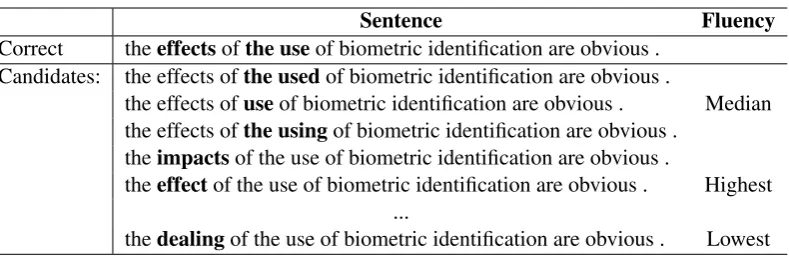
error-free sentence with their incorrect counterparts ex-haustively. Unlike a method described in Felice (2016) that multiple errors can apply to one sen-tence at the same time, we only allow one error at a time. Table1 shows an example of an error-free sentence and the candidate sentences after ap-plying all the possible error replacements. There is only one error in each candidate sentence, and the same position in the correct sentence can have multiple different replacements (e.g., effects →
impacts|effect|dealing). We then calculate the flu-ency score of each candidate sentence and select the ones with the highest fluency, lowest fluency and median fluency. Fluency score is measured by sentence perplexity, the inverse probability of the sentence based on a language model, normal-ized by the number of words in that sentence. A sentence’s fluency score is negatively related to its perplexity. Our prediction is that low sentence flu-ency (high perplexity) can facilitate error detec-tion and correcdetec-tion by maximizing and highlight-ing the difference between correct and incorrect sentences. Conversely, artificial error sentences of high fluency can be confusing to the model as the difference between correct and incorrect sentences may be subtle.
4 Experiments and Results
4.1 Dataset and evaluation
We used the four datasets — FCE, NUCLE, W&I+LOCNESS and Lang-8 — provided in the BEA 2019 Shared Task on GEC1 as the training data for our baseline model (in total about 1.1M sentence pairs). Table2shows the summary of the four datasets. There are slightly over half a mil-lion error-contained sentences in these datasets, where we extracted 1.3M correct-incorrect frag-ments. We applied our artificial error injection procedure to the remaining 0.6M error-free sen-tences, and over 0.4M of them received replace-ments. We trained a 3-gram language model on all the correct-side sentences using KenLM (Heafield, 2011). The language model was used to calcu-late perplexity of artificial error sentences. From the 0.4M sentences with error injections, we cre-ated four different artificial datasets: one with the highest fluency error sentences among the candi-dates of each correct sentence, one with the low-est, one with the median, and the last one was
1https://www.cl.cam.ac.uk/research/nl/
Sentence Fluency
Correct theeffectsofthe useof biometric identification are obvious . Candidates: the effects ofthe usedof biometric identification are obvious .
the effects ofuseof biometric identification are obvious . Median the effects ofthe usingof biometric identification are obvious .
theimpactsof the use of biometric identification are obvious .
theeffectof the use of biometric identification are obvious . Highest ...
[image:3.595.79.474.59.190.2]thedealingof the use of biometric identification are obvious . Lowest
Table 1: An example of an error-free sentence and its error injected candidate sentences with three levels of fluency.
Corpus # Sent Pairs
FCE (Train) 28,346
NUCLE 57,113
W&I+LOCNESS
(Train) 34,304
LANG-8 1,037,561
Total 1,157,324
Correct 601,958
Error Injection
[image:3.595.103.262.227.366.2]to Correct 444,521
Table 2: Summary of training data.
randomly selected. Each version was then com-bined with the original error-contained sentences and the remaining unchanged correct sentences so that all these settings had the same number of sen-tence pairs as in our baseline model (1.1M). The goal of the experiment was to compare the GEC performance trained with these four settings to the baseline. The W&I+LOCNESS development set of 4,382 sentences was used as validation, and the W&I+LOCNESS test set of 4,477 sentences as evaluation2. All these settings were run for three times. Performance was evaluated in terms of pre-cision, recall and F0.5 using ERRANT (Bryant et al.,2017).
4.2 Experimental settings
We used the 7-layer convolutional seq2seq model3 proposed inChollampatt and Ng(2018) for gram-matical error correction with minimal modifica-tion. The only difference toChollampatt and Ng (2018) is that the word embedding dimensions in both encoders and decoders were set to 300 rather than 500, and the word embeddings were trained
2
https://competitions.codalab.org/ competitions/21922
3https://github.com/pytorch/fairseq
separately using the error and correct side training data instead of external corpora. Other parame-ters were set as recommended inChollampatt and Ng(2018), including the top 30K BPE tokens as the vocabularies of input and output, 1,024 × 3 hidden layers in the encoders and decoders, Nes-terov Accelerated Gradient as the optimizer with a momentum of 0.99, dropout rate of 0.2, initial learning rate of 0.25, and minimum learning rate of10−4. A beam size of 10 was used during model inference. No spell checker was incorporated in the present study, either as pre-processing or post-processing.
4.3 Experimental results
Prec. Recall F0.5
Original
(Baseline) 65.93 18.85 43.97 Random 55.67 27.61 46.26 Highest 50.44 26.77 42.86 Median 57.69 30.64 49.03
[image:4.595.94.270.62.159.2]Lowest 55.27 32.96 48.68
Table 3: Performance of multi-layer CNNs for GEC on W&I+LOCNESS test set with different error data from different fluency filtering.
5 Conclusions and Future Work
The goal of the current study was to explore how the fluency of artificial error sentences can affect the performance of grammatical error correction. We greedily generated all possible error sentences using the similar context window approach as in Felice(2016), and then selected among candidate sentences based on fluency score (sentence per-plexity). As predicted, the model trained with artificial error sentences of highest fluency per-formed even worse than the baseline model with a large proportion of correct sentence pairs. Mod-els in both lowest and median fluency conditions performed significantly better than the other three models. The former one achieved the highest re-call, while the latter one was more balanced with the highest F0.5. These results indicate that flu-ency filtering can be used a means to select high-quality artificial error sentences for grammatical error detection and correction.
Although the present study just focused on flu-ency and ignored error probability, the two factors are not mutually exclusive. Rather, combining the two approaches may generate even better artifi-cial errors. Additionally, fluency filtering is not restricted to the context window approach to er-ror generation, it can be part of the machine back-translation approach to help select among the N best translations.
One limitation of the current study is that we only generated one error at a time for each tence. In the training data, the 0.5M error sen-tences contain 1.3M errors, which means that on average each sentence has 2.4 errors. Our next step is to explore using fluency filtering to ensure the quality of artificial multi-error sentences and to see if this can boost GEC performance even fur-ther.
References
Christopher Bryant, Mariano Felice, and Ted Briscoe. 2017. Automatic Annotation and Evaluation of Er-ror Types for Grammatical ErEr-ror Correction. In Pro-ceedings of the 55th Annual Meeting of the Associa-tion for ComputaAssocia-tional Linguistics (Volume 1: Long Papers), pages 793–805, Vancouver, Canada. Asso-ciation for Computational Linguistics.
Shamil Chollampatt and Hwee Tou Ng. 2018. A Mul-tilayer Convolutional Encoder-Decoder Neural Net-work for Grammatical Error Correction. In Pro-ceedings of The Thirty-Second AAAI Conference on Artificial Intelligence (AAAI-18), New Orleans, Louisiana.
Mariano Felice. 2016. Artificial error generation for translation-based grammatical error correction. Technical Report UCAM-CL-TR-895, University of Cambridge, Computer Laboratory.
Tao Ge, Furu Wei, and Ming Zhou. 2018. Fluency Boost Learning and Inference for Neural Grammati-cal Error Correction. InProceedings of the 56th An-nual Meeting of the Association for Computational Linguistics (Volume 1: Long Papers), pages 1055– 1065, Melbourne, Australia. Association for Com-putational Linguistics.
Kenneth Heafield. 2011. KenLM: Faster and Smaller Language Model Queries. In Proceedings of the Sixth Workshop on Statistical Machine Translation, pages 187–197, Edinburgh, Scotland. Association for Computational Linguistics.
Sudhanshu Kasewa, Pontus Stenetorp, and Sebastian Riedel. 2018. Wronging a Right: Generating Bet-ter Errors to Improve Grammatical Error Detec-tion. In Proceedings of the 2018 Conference on Empirical Methods in Natural Language Process-ing, pages 4977–4983, Brussels, Belgium. Associ-ation for ComputAssoci-ational Linguistics.
Ilya Sutskever, Oriol Vinyals, and Quoc V. Le. 2014. Sequence to Sequence Learning with Neural Net-works. In Z. Ghahramani, M. Welling, C. Cortes, N. D. Lawrence, and K. Q. Weinberger, editors, Ad-vances in Neural Information Processing Systems 27, pages 3104–3112. Curran Associates, Inc.
Ziang Xie, Guillaume Genthial, Stanley Xie, Andrew Ng, and Dan Jurafsky. 2018. Noising and Denois-ing Natural Language: Diverse Backtranslation for Grammar Correction. In Proceedings of the 2018 Conference of the North American Chapter of the Association for Computational Linguistics: Human Language Technologies, Volume 1 (Long Papers), pages 619–628, New Orleans, Louisiana. Associa-tion for ComputaAssocia-tional Linguistics.
Bulgaria. Association for Computational Linguis-tics.