244
Learning Word Embeddings without Context Vectors
Alexey Zobnin Yandex,
National Research University Higher School of Economics,
Moscow, Russia [email protected]
Evgenia Elistratova Moscow State University,
Moscow, Russia [email protected]
Abstract
Most word embedding algorithms such as word2vec or fastText construct two sort of vec-tors: for words and for contexts. Naive use of vectors of only one sort leads to poor results. We suggest using indefinite inner product in skip-gram negative sampling algorithm. This allows us to use only one sort of vectors with-out loss of quality. Our “context-free”cf al-gorithm performs on par with SGNS on word similarity datasets.
1 Introduction
Vector representation of words are widely used in NLP tasks. Two approaches to word embeddings are usually contrasted: implicit (word2vec-like) and explicit (SVD-like). Implicit models are usu-ally faster and consume less memory than their ex-plicit analogues.
Typically, word embedding algorithms produce two matrices both for “words” and “contexts”. Usually, contexts are the words themselves. It is believed that word and context vectors cannot be equated to each other.
In practice, however, only the vectors of one sort are considered. For example, typical solutions to word similarity or analogy problems use only the inner products of word vectors.
We present a modified skip-gram negative sam-pling algorithm that produces related word and context vectors. One may say that some compo-nents of our word and context vectors are equal, while other components have different signs. An-other point of view is to say that word and context vectors are completely equal, but the inner prod-uct between them is indefinite. This relation was suggested by the properties of explicit SVD em-beddings.
2 Preliminaries
We briefly recall the skip-gram negative sampling (SGNS) algorithm implemented in popular pro-grams word2vec(Mikolov et al., 2013a,b) and
fastText(Bojanowski et al.,2017). Given row vectors of a current wordw, its contextc0and neg-ative context samplesc1, . . . , ck, SGNS algorithm
computes the loss
L=−lnσ(wcT0)−
k
X
j=1
lnσ(−wcTj), (1)
where σ(x) = 1+1e−x is the sigmoid function.
Starting from random initial approximation of word vectors, the algorithm uses stochastic gradi-ent descgradi-ent (SGD) for optimization. The intuition is the following: the word vector should be similar to the true context vector and dissimilar to random negative contexts. Due to the properties ofσ(x), the gradient and update formulas look simple.
Let n be the size of the vocabulary, and d be the dimension of embeddings. Let W andC be n × d matrices of word (respectively, context) vectors written in rows. The SGNS loss (1) de-pends only on elements of W CT, and does not depend onW orCseparately. The optimal solu-tion of SGNS is not unique: the transformasolu-tion W 7→ W S, C 7→ C S−1T
for an invertible d×d-matrixS, gives an equivalent solution. How-ever, such transformation could change the inner products between word vectors dramatically ifS is not orthogonal. Nevertheless, SGNS produces a “good” solution without any regularization. This phenomenon is not well understood, and can be seen as “implicit regularization” of SGD.
Levy and Goldberg showed that the implicit ma-trixM = W CT tends to the shifted PMI matrix
where
PMI(wi, wj) = log
P(wiwj)
P(wi)P(wj)
is the pointwise mutual information of the pair of wordswi,wj, andkis the amount of negative
sam-ples. Thus, SGNS can be considered as an implicit matrix factorization problem.
We recall that a (compact) singular value de-composition (SVD) of a real-valuedm×n-matrix M of rank r is a decomposition M = UΣVT, whereU andV are respectivelym×randn×r matrices with orthogonal columns, andΣisr×r diagonal matrix with non-zero singular values on diagonal. We refer to (Golub and Van Loan,2012) for details. SVD embeddings are obtained from truncated SVD decomposition M ≈ UdΣdVdT,
where onlydtop singular values and vectors are kept. The common way is to takeW = Ud
√ Σd
andC=Vd
√ Σd.
3 Main result
First of all, we make an observation about SVD embeddings. We shall use it further to modify the SGNS algorithm.
3.1 SVD of real symmetric matrices
Proposition. Let M be a real-valued symmetric
n×n-matrix.
1. There exists a decompositionM =W DWT, whereD= diag(±1).
2. There exists a compact SVD M = UΣVT
such thatV =U D.
3. If all singular values ofM are different, then all singular value decompositions ofM have this form1.
In other words, the corresponding columns ofU andV either coincide, or differ in sign.
Proof. All eigenvalues of a real symmetric ma-trix are real. Moreover,M has an eigendecompo-sitionM =CΛCT, whereΛ = diag(λi) is a
di-agonal matrix of eigenvalues, andC is an orthog-onal matrix. Letrbe the rank ofM. We may re-move columns inCandΛthat correspond to zero eigenvalues and assume thatCisn×r-matrix and
1This is also valid for a more general case when equal
singular values ofM correspond to the eigenvalues of the same sign.
Λisr×r-matrix with non-zero eigenvalues on di-agonal. Note that non-zero singular values σi of
M are absolute values ofλi.
1. Let Σ = diag(σi) be a diagonal matrix of
non-zero singular values. ThenΛ = ΣD = √
ΣD√Σ, where
Dii=
(
1, ifλi >0,
−1, ifλi <0.
Now takeW =C√Σ.
2. WriteM asCΣDCT and takeU =C,V =
CD.
3. If all singular values are different, then SVD is determined uniquely up to a simultaneous change of signs in some columns of U and V. Take the SVD constructed above and note that the relationV = U Dis preserved after these transformations.
We denote byqthe amount of−1inD. Due to the Sylvester’s law of inertia, it is uniquely deter-mined byM and equals to the amount of negative eigenvalues ofM.
3.2 Negative eigenvalues of word relation matrices
Consider ann×n-matrix M = (f(wi, wj))
de-scribing the relation between the wordswiandwj.
For example,f(wi, wj)may be the shifted PPMI,
as suggested in (Levy and Goldberg,2014):
f(wi, wj) = max (0,PMI(wi, wj)−logk).
As a rule, the relationf is symmetric, and hence M is symmetric too.
Let’s look at the SVD embeddings obtained from this matrix. LetM = UΣVT be an SVD, and M ≈ Md = UdΣdVdT be its truncated
ap-proximation. Then symmetric SVD embeddings areW = Ud
√
Σd andC = Vd
√
Σd. In the
fol-lowing, we will naturally assume that topd singu-lar values ofM are different and non-zero: all real cases are just like that. By the proposition we have that some columns ofW andCcoincide, while the others differ in sign. As a consequence, we ob-tain that for such SVD embeddings word and con-text vectors are equally good in applied problems, because inner products(wiwj) and(cicj)are the
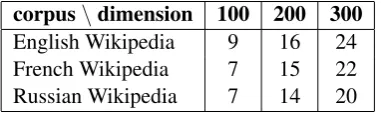
The amount of negative eigenvalues ofM mea-sures the deviation from the positive definiteness in some sense. To estimate it, we construct shifted PPMI matrices for Wikipedia corpora in three dif-ferent languages (English, French and Russian). Each corpus contains 1M articles. We measure the amount of negative eigenvalues among top by magnitude eigenvalues. The results for k = 1
(pure PPMI matrix, no shift) and for k = 5are presented in Tables1and2, respectively. We see that the rate of negative eigenvalues is about 11– 13% fork = 1and about 7–8% fork = 5. Sur-prisingly, this rate actually does not depend on the language.
[image:3.595.89.277.263.320.2]corpus\dimension 100 200 300 English Wikipedia 15 27 39 French Wikipedia 10 22 34 Russian Wikipedia 11 22 31
Table 1: Amount of negative eigenvalues in the trun-cated SVD of PPMI matrix (k= 1, i. e., no shift).
corpus\dimension 100 200 300 English Wikipedia 9 16 24 French Wikipedia 7 15 22 Russian Wikipedia 7 14 20
Table 2: Amount of negative eigenvalues in the trun-cated SVD of shifted PMI matrix withk= 5.
3.3 Context-free SGNS algorithm
Recall that SGNS loss depends on the inner prod-ucts of words and contexts. Let’s fix the matrix
D= diag(−1, . . . ,−1 | {z }
q
,1,1, . . . , 1 | {z }
p=d−q
)
specifying indefinite inner product in the embed-ding space. The amount of minus ones in this ma-trix,q, will be a hyperparameter of our algorithm. Next, we equate word and context vectors to each other. This corresponds to the implicit factoriza-tionW DWT instead ofW CT.
Thus, we replace the initial SGNS loss (1) with
Lq =−lnσ(wDwT0)−
k
X
j=1
lnσ(−wDwjT).
The solution of this new optimization problem is also not unique. Replacing W with W S for
any matrix S that preserves D, i. e., such that SDST = D, yields another solution. Neverthe-less, the solution set in our case is “smaller” in some sense than in the pure SGNS case, whereS may be any invertible matrix.
Since we got rid of context vectors, we call this algorithmcontext-free SGNS2and denote itcf.
4 Experimental results
4.1 Training setup
We train word embeddings on the English Wikipedia dump. We preprocess this dump us-ing gensim.corpora.wikicorpus package3and take a subsample of 100K articles. Our corpus consists of approximately 175M words withn ≈312000. We use fastText4skipgram mode with the default values of parameters and without ngrams (-maxn 0) as a vanilla SGNS implementation. We plement our model by modifying the C++ im-plementation of fastText5. We learn cf vectors of dimension d = 100 and 100 +q for q = 0,5,10,15,20,25. Vectors of dimension100 +q were projected to100“positive” components.
4.2 Datasets
Datasets for word similarity evaluation consist of pairs of words rated by humans. We use the following well-known English similarity datasets: MEN-3k (Bruni et al., 2014), MTurk-287 (Ha-lawi et al.,2012), RW-STANFORD (Luong et al., 2013), SimLex-999 (Hill et al., 2015), SimVerb-3500 (Gerz et al.,2016), VERB-143 (Baker et al., 2014), and WS-353 (Finkelstein et al.,2002) split-ted into similarity and relasplit-tedness parts (Agirre et al.,2009). We use the evaluation code (Faruqui and Dyer, 2014) for computing Spearman rank correlationρbetween the similarity scores and the annotated ratings.
4.3 Results
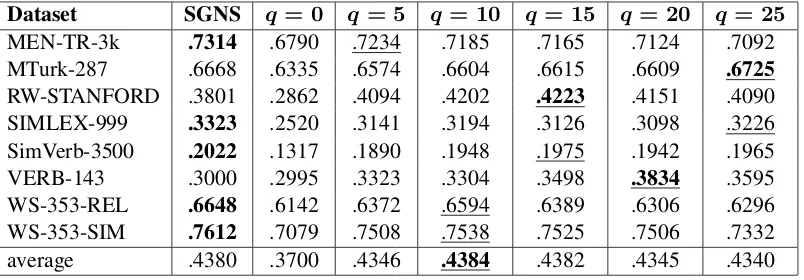
Table3 shows the results for word vectors of di-mension 100 with q negative components in D. The best results are written in bold, and the best
cf results are underlined. We see that q = 0, i. e., the case of positive semidefinite approxima-tion, has the worst performance. The better
perfor-2
Not to be confused with context-free grammars.
3
https://radimrehurek.com/gensim/ corpora/wikicorpus.html.
4
https://fasttext.cc/.
5https://github.com/jen1995/fastText/
[image:3.595.87.278.381.438.2]Dataset SGNS q = 0 q = 5 q = 10 q = 15 q= 20 q = 25
MEN-TR-3k .7314 .6790 .7234 .7185 .7165 .7124 .7092 MTurk-287 .6668 .6335 .6574 .6604 .6615 .6609 .6725 RW-STANFORD .3801 .2862 .4094 .4202 .4223 .4151 .4090 SIMLEX-999 .3323 .2520 .3141 .3194 .3126 .3098 .3226 SimVerb-3500 .2022 .1317 .1890 .1948 .1975 .1942 .1965 VERB-143 .3000 .2995 .3323 .3304 .3498 .3834 .3595 WS-353-REL .6648 .6142 .6372 .6594 .6389 .6306 .6296 WS-353-SIM .7612 .7079 .7508 .7538 .7525 .7506 .7332 average .4380 .3700 .4346 .4384 .4382 .4345 .4340
Table 3: Word similarity ford= 100.
Dataset SGNS q = 0 q = 5 q = 10 q = 15 q= 20 q = 25
[image:4.595.99.501.62.202.2]MEN-TR-3k .7314 .6790 .7333 .7348 .7351 .7371 .7370 MTurk-287 .6668 .6335 .6612 .6697 .6719 .6746 .6645 RW-STANFORD .3801 .2862 .4015 .4091 .4069 .4022 .3999 SIMLEX-999 .3323 .2520 .3138 .3127 .3199 .3166 .3235 SimVerb-3500 .2022 .1317 .1926 .1917 .1894 .1905 .1914 VERB-143 .3000 .2995 .3362 .3148 .3141 .3285 .3315 WS-353-REL .6648 .6142 .6673 .6714 .6765 .6718 .6741 WS-353-SIM .7612 .7079 .7627 .7476 .7577 .7554 .7480 average .4380 .3700 .4382 .4394 .4394 .4392 .4394
Table 4: Word similarity forp= 100(only “positive” components ofp+q-dimensionalcfvectors were taken).
mance ofcfis achieved atq= 10orq = 15. This argees with empirical results of Subsection3.2. In general,cfis either on par with SGNS, or slightly loses. In the second experiment we learncf vec-tors of higher dimension 100 +q and projected them to100“positive” components. These results are shown in Table4. Starting fromq = 5, they are slightly better than SGNS.
5 Related work
There were several attempts to establish a connec-tion between word and context vectors. In (Li et al., 2017) a PMI matrix is approximated by a positive semidefinite matrix of the form W WT. Dependencies between word and context vec-tors for word2vec SGNS model were studied in (Mimno and Thompson,2017).
In (Allen et al.,2018) it is suggested that word and context vectors should be conjugated in the complex space. Our model can be reformulated in terms of complex vectors too in the case p = q, but we prefer to stay in reals. One of the problems with complex embedding is thatσ(z)is not holo-morphic in the whole complex plane, and should be replaced with σ(|z|) or σ(Rez).
Complex-valued embeddings are also discussed in (Trouil-lon et al.,2016), where a complex decomposition likeM = ReUΛ ¯UT is suggested.
In (Assylbekov and Takhanov, 2019) it was conjectured that context vectors are reflections of word vectors in half the dimensions. Our result is similar, but we suggest using lower amount of reflections. Perhaps this difference is due to the fact that we consider shifted PPMI matrices, while they consider pure PMI matrices.
Embeddings in hyperbolic space with Minkowski metric was suggested in (Leimeister and Wilson, 2018). In (Soleimani and Matwin, 2018) there is an erroneous statement that a thresholded PMI matrix, as well as any symmetric matrix, has SVD decompositionUΣUT: in fact it is true only for positive semidefinite matrices.
6 Conclusion
We proposed cf, an alternative to SGNS algo-rithm that do not use context vectors. Instead, indefinite inner product between word vectors is used. Our algorithm shows similar results com-pared to SGNS.
The phenomenon of implicit regularization of SGNS, as well as the problem of finding the lin-guistic interpretation of “negative” components of word vectors in our algorithm, deserve further in-vestigation.
Acknowledgements
The authors thank Anna Potapenko for fruitful discussions and anonymous referees for valuable comments.
References
Eneko Agirre, Enrique Alfonseca, Keith Hall, Jana Kravalova, Marius Pas¸ca, and Aitor Soroa. 2009. A study on similarity and relatedness using distribu-tional and wordnet-based approaches. In Proceed-ings of Human Language Technologies: NAACL-2009, pages 19–27. ACL.
Carl Allen, Ivana Balaˇzevi´c, and Timothy Hospedales. 2018. What the vec? Towards probabilistically grounded embeddings. arXiv:1805.12164.
Zhenisbek Assylbekov and Rustem Takhanov. 2019. Context vectors are reflections of word vectors in half the dimensions. arXiv:1902.09859.
Simon Baker, Roi Reichart, and Anna Korhonen. 2014. An unsupervised model for instance level subcate-gorization acquisition. InProceedings of the 2014 Conference on Empirical Methods in Natural Lan-guage Processing (EMNLP), pages 278–289.
Piotr Bojanowski, Edouard Grave, Armand Joulin, and Tomas Mikolov. 2017. Enriching word vectors with subword information. Transactions of the Associa-tion for ComputaAssocia-tional Linguistics, 5:135–146.
Elia Bruni, Nam-Khanh Tran, and Marco Baroni. 2014. Multimodal distributional semantics. Journal of Ar-tificial Intelligence Research, 49:1–47.
Manaal Faruqui and Chris Dyer. 2014. Community evaluation and exchange of word vectors at word-vectors. org. InProceedings of 52nd Annual Meet-ing of ACL: System Demonstrations, pages 19–24.
Lev Finkelstein, Evgeniy Gabrilovich, Yossi Matias, Ehud Rivlin, Zach Solan, Gadi Wolfman, and Ey-tan Ruppin. 2002. Placing search in context: The concept revisited. ACM Transactions on informa-tion systems, 20(1):116–131.
Alexander Fonarev, Oleksii Grinchuk, Gleb Gusev, Pavel Serdyukov, and Ivan Oseledets. 2017. Rie-mannian optimization for skip-gram negative sam-pling. In Proceedings of the 55th Annual Meeting of the ACL (Volume 1: Long Papers), pages 2028– 2036.
Daniela Gerz, Ivan Vuli´c, Felix Hill, Roi Reichart, and Anna Korhonen. 2016. Simverb-3500: A large-scale evaluation set of verb similarity. In Proceed-ings of the 2016 Conference on Empirical Methods in Natural Language Processing, pages 2173–2182.
Gene H Golub and Charles F Van Loan. 2012. Matrix computations, volume 3. JHU press.
Suriya Gunasekar, Blake E Woodworth, Srinadh Bho-janapalli, Behnam Neyshabur, and Nati Srebro. 2017. Implicit regularization in matrix factorization. InAdvances in Neural Information Processing Sys-tems, pages 6151–6159.
Guy Halawi, Gideon Dror, Evgeniy Gabrilovich, and Yehuda Koren. 2012. Large-scale learning of word relatedness with constraints. In Proceedings of the 18th ACM SIGKDD international conference on Knowledge discovery and data mining, pages 1406– 1414. ACM.
Felix Hill, Roi Reichart, and Anna Korhonen. 2015. Simlex-999: Evaluating semantic models with (gen-uine) similarity estimation. Computational Linguis-tics, 41(4):665–695.
Matthias Leimeister and Benjamin J Wilson. 2018. Skip-gram word embeddings in hyperbolic space. arXiv:1809.01498.
Omer Levy and Yoav Goldberg. 2014. Neural word embedding as implicit matrix factorization. In Ad-vances in Neural Information Processing Systems, pages 2177–2185.
Shaohua Li, Jun Zhu, and Chunyan Miao. 2017. Ps-dvec: A toolbox for incremental and scalable word embedding. Neurocomputing, 237:405–409.
Thang Luong, Richard Socher, and Christopher Man-ning. 2013. Better word representations with recur-sive neural networks for morphology. In Proceed-ings of the 17th Conference on Computational Nat-ural Language Learning, pages 104–113.
Cong Ma, Kaizheng Wang, Yuejie Chi, and Yuxin Chen. 2018. Implicit regularization in nonconvex statistical estimation: Gradient descent converges linearly for phase retrieval and matrix completion. InProceedings of the 35th International Conference on Machine Learning, volume 80.
Tomas Mikolov, Ilya Sutskever, Kai Chen, Greg S Cor-rado, and Jeff Dean. 2013b. Distributed representa-tions of words and phrases and their compositional-ity. InAdvances in neural information processing systems, pages 3111–3119.
David Mimno and Laure Thompson. 2017. The strange geometry of skip-gram with negative sampling. In Proceedings of the 2017 Conference on Empirical Methods in Natural Language Processing, pages 2873–2878.
Cun Mu, Guang Yang, and Zheng Yan. 2018. Revisit-ing skip-gram negative samplRevisit-ing model with rectifi-cation. arXiv:1804.00306.
Behnam Neyshabur, Ryota Tomioka, Ruslan Salakhut-dinov, and Nathan Srebro. 2017. Geometry of op-timization and implicit regularization in deep learn-ing. arXiv:1705.03071.
Behrouz Haji Soleimani and Stan Matwin. 2018. Spec-tral word embedding with negative sampling. In 32nd AAAI Conference on Artificial Intelligence.