It Depends: Dependency Parser Comparison
Using A Web-based Evaluation Tool
Jinho D. Choi
Emory University 400 Dowman Dr. Atlanta, GA 30322, USA
Joel Tetreault
Yahoo Labs 229 West 43rd St. New York, NY 10036, USA
Amanda Stent
Yahoo Labs 229 West 43rd St. New York, NY 10036, USA
Abstract
The last few years have seen a surge in the number of accurate, fast, publicly avail-able dependency parsers. At the same time, the use of dependency parsing in NLP applications has increased. It can be difficult for a non-expert to select a good “off-the-shelf” parser. We present a com-parative analysis of ten leading statistical dependency parsers on a multi-genre cor-pus of English. For our analysis, we de-veloped a new web-based tool that gives a convenient way of comparing depen-dency parser outputs. Our analysis will help practitioners choose a parser to op-timize their desired speed/accuracy trade-off, and our tool will help practitioners ex-amine and compare parser output.
1 Introduction
Dependency parsing is a valuable form of syn-tactic processing for NLP applications due to its transparent lexicalized representation and robust-ness with respect to flexible word order languages. Thanks to over a decade of research on statisti-cal dependency parsing, many dependency parsers are now publicly available. In this paper, we re-port on a comparative analysis of leading statis-tical dependency parsers using a multi-genre cor-pus. Our purpose is not to introduce a new pars-ing algorithm but to assess the performance of ex-isting systems across different genres of language use and to provide tools and recommendations that practitioners can use to choose a dependency parser. The contributions of this work include:
• A comparison of the accuracy and speed of ten state-of-the-art dependency parsers,
cov-ering a range of approaches, on a large multi-genre corpus of English.
• A new web-based tool, DEPENDABLE, for side-by-side comparison and visualization of the output from multiple dependency parsers. • A detailed error analysis for these parsers using DEPENDABLE, with recommendations for parser choice for different factors. • The release of the set of dependencies used
in our experiments, the test outputs from all parsers, and the parser-specific models.
2 Related Work
There have been several shared tasks on de-pendency parsing conducted by CoNLL (Buch-holz and Marsi, 2006; Nivre and others, 2007; Surdeanu and others, 2008; Hajiˇc and others, 2009), SANCL (Petrov and McDonald, 2012), SPMRL (Seddah and others, 2013), and Se-mEval (Oepen and others, 2014). These shared tasks have led to the public release of numerous statistical parsers. The primary metrics reported in these shared tasks are: labeled attachment score (LAS) – the percentage of predicted dependencies where the arc and the label are assigned correctly; unlabeled attachment score (UAS) – where the arc is assigned correctly; label accuracy score (LS) – where the label is assigned correctly; and exact match (EM) – the percentage of sentences whose predicted trees are entirely correct.
Although shared tasks have been tremendously useful for advancing the state of the art in depen-dency parsing, most English evaluation has em-ployed a single-genre corpus, the WSJ portion of the Penn Treebank (Marcus et al., 1993), so it is not immediately clear how these results
BC BN MZ NW PT TC WB ALL Training 171,120 206,057 163,627 876,399 296,437 85,466 284,975 2,084,081 Development 29,962 25,274 15,422 147,958 25,206 11,467 36,351 291,640 Test 35,952 26,424 17,875 60,757 25,883 10,976 38,490 216,357
Training 10,826 10,349 6,672 34,492 21,419 8,969 12,452 105,179
Development 2,117 1,295 642 5,896 1,780 1,634 1,797 15,161
[image:2.595.98.500.61.138.2]Test 2,211 1,357 780 2,327 1,869 1,366 1,787 11,697
Table 1: Distribution of data used for our experiments. The first three/last three rows show the number of tokens/trees in each genre.BC: broadcasting conversation,BN: broadcasting news,MZ: news magazine, NW: newswire,PT: pivot text,TC: telephone conversation,WB: web text,ALL: all genres combined.
eralize.1 Furthermore, a detailed comparative er-ror analysis is typically lacking. The most de-tailed comparison of dependency parsers to date was performed by McDonald and Nivre (2007; 2011); they analyzed accuracy as a function of sentence length, dependency distance, valency, non-projectivity, part-of-speech tags and depen-dency labels.2 Since then, additional analyses of dependency parsers have been performed, but ei-ther with respect to specific linguistic phenom-ena (e.g. (Nivre et al., 2010; Bender et al., 2011)) or to downstream tasks (e.g. (Miwa and others, 2010; Petrov et al., 2010; Yuret et al., 2013)).
3 Data
3.1 OntoNotes 5
[image:2.595.312.517.608.664.2]We used the English portion of the OntoNotes 5 corpus, a large multi-lingual, multi-genre cor-pus annotated with syntactic structure, predicate-argument structure, word senses, named entities, and coreference (Weischedel and others, 2011; Pradhan and others, 2013). We chose this corpus rather than the Penn Treebank used in most pre-vious work because it is larger (2.9M vs. 1M to-kens) and more diverse (7 vs. 1 genres). We used the standard data split used in CoNLL’123, but re-moved sentences containing only one token so as not to artificially inflate accuracy.
Table 1 shows the distribution across genres of training, development, and test data. For the most strict and realistic comparison, we trained all ten parsers using automatically assignedPOStags from the tagger in ClearNLP (Choi and Palmer, 2012a), which achieved accuracies of 97.34 and 97.52 on the development and test data, respec-tively. We also excluded any “morphological”
fea-1The SANCL shared task used OntoNotes and the Web
Treebanks instead for better generalization.
2A detailed error analysis of constituency parsing was
per-formed by (Kummerfeld and others, 2012).
3conll.cemantix.org/2012/download/ids/
ture from the input, as these are often not available in non-annotated data.
3.2 Dependency Conversion
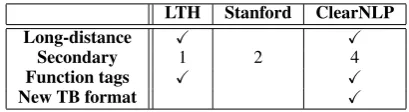
OntoNotes provides annotation of constituency trees only. Several programs are available for con-verting constituency trees into dependency trees. Table 2 shows a comparison between three of the most widely used: the LTH (Johansson and Nugues, 2007),4, Stanford (de Marneffe and Man-ning, 2008),5 and ClearNLP (Choi and Palmer, 2012b)6dependency converters. Compared to the Stanford converter, the ClearNLP converter pro-duces a similar set of dependency labels but gen-erates fewer unclassified dependencies (0.23% vs. 3.62%), which makes the training data less noisy.
Both the LTH and ClearNLP converters pro-duce long-distance dependencies and use function tags for the generation of dependency relations, which allows one to generate rich dependency structures including non-projective dependencies. However, only the ClearNLP converter adapted the new Treebank guidelines used in OntoNotes. It can also produce secondary dependencies (e.g. right-node raising, referent), which can be used for further analysis. We used the ClearNLP converter to produce dependencies for our experiments.
LTH Stanford ClearNLP
Long-distance X X
Secondary 1 2 4
Function tags X X
New TB format X
Table 2: Dependency converters. The “secondary” row shows how many types of secondary depen-dencies that can be produced by each converter.
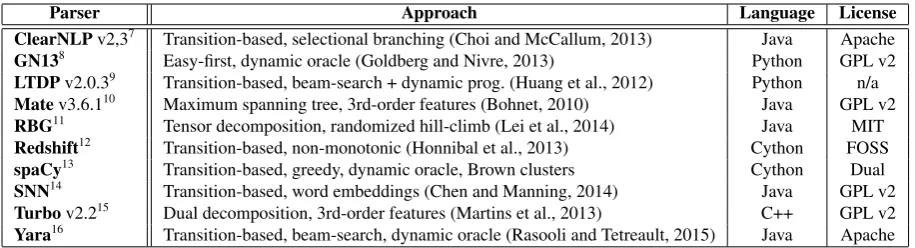
Parser Approach Language License ClearNLPv2,37 Transition-based, selectional branching (Choi and McCallum, 2013) Java Apache
GN138 Easy-first, dynamic oracle (Goldberg and Nivre, 2013) Python GPL v2
LTDPv2.0.39 Transition-based, beam-search + dynamic prog. (Huang et al., 2012) Python n/a
Matev3.6.110 Maximum spanning tree, 3rd-order features (Bohnet, 2010) Java GPL v2
RBG11 Tensor decomposition, randomized hill-climb (Lei et al., 2014) Java MIT
Redshift12 Transition-based, non-monotonic (Honnibal et al., 2013) Cython FOSS
spaCy13 Transition-based, greedy, dynamic oracle, Brown clusters Cython Dual
SNN14 Transition-based, word embeddings (Chen and Manning, 2014) Java GPL v2
Turbov2.215 Dual decomposition, 3rd-order features (Martins et al., 2013) C++ GPL v2
[image:3.595.71.529.61.185.2]Yara16 Transition-based, beam-search, dynamic oracle (Rasooli and Tetreault, 2015) Java Apache
Table 3: Dependency parsers used in our experiments.
4 Parsers
We compared ten state of the art parsers repre-senting a wide range of contemporary approaches to statistical dependency parsing (Table 3). We trained each parser using the training data from OntoNotes. For all parsers we trained using the automatic POS tags generated during data prepro-cessing, as described above.
Training settings For most parsers, we used the default settings for training. For the SNN parser, following the recommendation of the developers, we used the word embeddings from (Collobert and others, 2011).
Development data ClearNLP, LTDP, SNN and Yara make use of the development data (for pa-rameter tuning). Mate and Turbo self-tune param-eter settings using the training data. The others were trained using their default/“standard” param-eter settings.
Beam search ClearNLP, LTDP, Redshift and Yara have the option of different beam settings. The higher the beam size, the more accurate the parser usually becomes, but typically at the pense of speed. For LTDP and Redshift, we ex-perimented with beams of 1, 8, 16 and 64 and found that the highest accuracy was achieved at beam 8.17 For ClearNLP and Yara, a beam size of
7www.clearnlp.com
8cs.bgu.ac.il/˜yoavg/software/sdparser 9acl.cs.qc.edu/˜lhuang
10code.google.com/p/mate-tools 11github.com/taolei87/RBGParser 12github.com/syllog1sm/Redshift 13honnibal.github.io/spaCy
14nlp.stanford.edu/software/nndep.shtml 15www.ark.cs.cmu.edu/TurboParser
16https://github.com/yahoo/YaraParser 17Due to memory limitations we were unable to train
Red-shift on a beam size greater than 8.
64 produced the best accuracy, while a beam size of 1 for LTDT, ClearNLP, and Yara produced the best speed performance. Given this trend, we also include how those three parsers perform at beam 1 in our analyses.
Feature Sets RBG, Turbo and Yara have the op-tions of different feature sets. A more complex or larger feature set has the advantage of accuracy, but often at the expense of speed. For RBG and Turbo, we use the ”Standard” setting and for Yara, we use the default (”not basic”) feature setting.
Output All the parsers other than LTDP output labeled dependencies. The ClearNLP, Mate, RBG, and Turbo parsers can generate non-projective de-pendencies.
5 DEPENDABLE: Web-based Evaluation
and Visualization Tool
There are several very useful tools for evaluating the output of dependency parsers, including the venerable eval.pl18 script used in the CoNLL shared tasks, and newer Java-based tools that sup-port visualization of and search over parse trees such as TedEval (Tsarfaty et al., 2011),19 Mal-tEval (Nilsson and Nivre, 2008)20 and “What’s wrong with my NLP?”.21 Recently, there is mo-mentum towards web-based tools for annotation and visualization of NLP pipelines (Stenetorp and others, 2012). For this work, we used a new web-based tool, DEPENDABLE, developed by the first author of this paper. It requires no installation and so provides a convenient way to evaluate and com-pare dependency parsers. The following are key features of DEPENDABLE:
18ilk.uvt.nl/conll/software.html 19www.tsarfaty.com/unipar/
Figure 1: Screenshot of our evaluation tool.
• It reads any type of Tab Separated Value (TSV) format, including the CoNLL formats. • It computes LAS, UAS and LS for parse out-puts from multiple parsers against gold (man-ual) parses.
• It computes exact match scores for multiple parsers, and “oracle ensemble” output, the upper bound performance obtainable by com-bining all parser outputs.
• It allows the user to exclude symbol tokens, projective trees, or non-projective trees. • It produces detailed analyses byPOStags,
pendency labels, sentence lengths, and de-pendency distances.
• It reports statistical significance values for all parse outputs (using McNemar’s test).
DEPENDABLE can be also used for visualizing and comparing multiple dependency trees together (Figure 2). A key feature is that the user may select parse trees by specifying a range of accu-racy scores; this enabled us to perform the er-ror analyses in Section 6.5. DEPENDABLE al-lows one to filter trees by sentence length and highlights arc and label errors. The evalua-tion and comparison tools are publicly avail-able at http://nlp.mathcs.emory.edu/ clearnlp/dependable.
Figure 2: Screenshot of our visualization tool.
6 Results and Error Analysis
In this section, we report overall parser accu-racy and speed. We analyze parser accuaccu-racy by sentence length, dependency distance, non-projectivity,POStags and dependency labels, and genre. We report detailed manual error analy-ses focusing on sentences that multiple parsers parsed incorrectly.22 All analyses, other than pars-ing speed, were conducted uspars-ing the DEPEND -ABLE tool.23 The full set of outputs from all parsers, as well as the trained models for each parser, available at http://amandastent. com/dependable/.
We also include the greedy parsing results of ClearNLP, LTDP, and Yara in two of our anal-yses to better illustrate the differences between the greedy and non-greedy settings. The greedy parsing results are denoted by the subscript ‘g’.
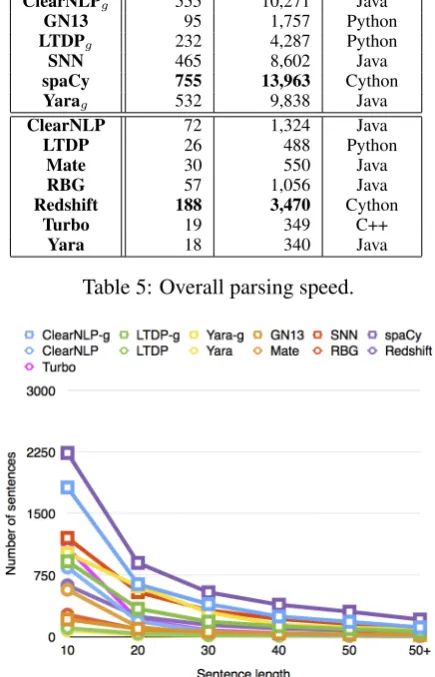
These two analyses are the overall accuracy re-sults, presented in Section 6.1 (Table 4), and the overall speed results, presented in Section 6.2 ( (Table 5 and Figure ). All other analyses exclude the ClearNLPg, LTDPgand Yarag.
22For one sentence in theNWdata, the LTDP parser failed
to produce a complete parse containing all tokens, so we removed this sentence for all parsers, leaving 11,696 trees (216,313 tokens) in the test data.
23We compared the results produced by DEPENDABLE
with those produced byeval07.pl, and verified that LAS, UAS, LA, and EM were the same when punctuation was included. Our tool uses a slightly different symbol set than
[image:4.595.332.500.69.294.2]With Punctuation Without Punctuation
Overall Exact Match Overall Exact Match
LAS UAS LS LAS UAS LS LAS UAS LS LAS UAS LS
ClearNLPg 89.19 90.63 94.94 47.65 53.00 61.17 90.09 91.72 94.29 49.12 55.01 61.31 GN13 87.59 89.17 93.99 43.78 48.89 56.71 88.75 90.54 93.32 45.44 51.20 56.88
LTDPg n/a 85.75 n/a n/a 46.38 n/a n/a 87.16 n/a n/a 48.01 n/a
SNN 86.42 88.15 93.54 42.98 48.53 55.87 87.63 89.59 92.70 43.96 49.83 55.91 spaCy 87.92 89.61 94.08 43.36 48.79 55.67 88.95 90.86 93.32 44.97 51.28 55.70 Yarag 85.93 87.64 92.99 42.94 47.77 54.79 87.39 89.32 92.24 44.25 49.44 54.96 ClearNLP 89.87 91.30 95.28 49.38 55.18 63.18 90.64 92.26 94.67 50.61 56.88 63.24
LTDP n/a 88.18 n/a n/a 51.62 n/a n/a 89.17 n/a n/a 53.54 n/a
[image:5.595.73.523.61.228.2]Mate 90.03 91.62 95.29 49.66 56.44 62.71 90.70 92.50 94.67 50.83 58.36 62.72 RBG 89.57 91.45 94.71 46.49 55.49 58.45 90.23 92.35 94.01 47.64 56.54 58.07 Redshift 89.48 91.01 95.04 49.71 55.82 62.70 90.27 92.00 94.42 50.88 57.28 62.78 Turbo 89.81 91.50 95.00 48.08 55.33 60.49 90.49 92.40 94.34 49.29 57.09 60.52 Yara 89.80 91.36 95.19 50.07 56.18 63.36 90.47 92.24 94.57 51.02 57.53 63.42
Table 4: Overall parsing accuracy. The top 6 rows and the bottom 7 rows show accuracies for greedy and non-greedy parsers, respectively.
6.1 Overall Accuracy
In Table 4, we report overall accuracy for each parser. For clarity, we report results separately for greedy and non-greedy versions of the parsers. Over all the different metrics, MATE is a clear winner, though ClearNLP, RBG, Redshift, Turbo and Yara are very close in performance. Look-ing at only the greedy parsers, ClearNLPgshows a
significant advantage over the others.
We conducted a statistical significance test for the the parsers (greedy versions excluded). All LAS differences are statistically significant atp < .01(using McNemar’s test), except for: RBG vs. Redshift, Turbo vs. Yara, Turbo vs. ClearNLP and Yara vs. ClearNLP. All UAS differences are sta-tistically significant atp < .01(using McNemar’s test), except for: SNN vs. LTDP, Turbo vs. Red-shift, Yara vs. RBG and ClearNLP vs. Yara. 6.2 Overall Speed
We ran timing experiments on a 64 core machine with 16 Intel Xeon E5620 2.40 GHz processors and 24G RAM, and used the unix time com-mand to time each run. Some parsers are multi-threaded; for these, we ran in single-thread mode (since any parser can be externally parallelized). Most parsers do not report model load time, so we first ran each parser five times with a test set of 10 sentences, and then averaged the middle three times to get the average model load time.24 Next, we ran each parser five times with the entire test set and derived the overall parse time by averag-ing the middle three parse times. We then sub-tracted the average model time from the average
24Recall we exclude single-token sentences from our tests.
parse time and averaged over the number of sen-tences and tokens.
Sent/Sec Tokens/Sec Language
ClearNLPg 555 10,271 Java
GN13 95 1,757 Python
LTDPg 232 4,287 Python
SNN 465 8,602 Java
spaCy 755 13,963 Cython
Yarag 532 9,838 Java
ClearNLP 72 1,324 Java
LTDP 26 488 Python
Mate 30 550 Java
RBG 57 1,056 Java
Redshift 188 3,470 Cython
Turbo 19 349 C++
[image:5.595.310.520.315.468.2]Yara 18 340 Java
Table 5: Overall parsing speed.
Figure 3: Number of sentences parsed per second by each parser with respect to sentence length.
[image:5.595.307.525.331.670.2]shows an analysis of parsing speed by sentence length in bins of length 10. As expected, as sen-tence length increases, parsing speed decreases re-markably.
6.3 Detailed Accuracy Analyses
For the following more detailed analyses, we used all tokens (including punctuation). As mentioned earlier, we exclude ClearNLPg, LTDPg and Yarag
[image:6.595.308.525.126.297.2]from these analyses and instead use their respec-tive non-greedy modes yielding higher accuracy. Sentence Length We analyzed parser accuracy by sentence length in bins of length 10 (Figure 4). As expected, all parsers perform better on shorter sentences. For sentences under length 10, UAS ranges from 93.49 to 95.5; however, UAS de-clines to a range of 81.66 and 86.61 for sen-tence lengths greater than 50. The most accurate parsers (ClearNLP, Mate, RBG, Redshift, Turbo, and Yara) separate from the remaining when sen-tence length is more than 20 tokens.
Figure 4: UAS by sentence length.
Dependency Distance We analyzed parser ac-curacy by dependency distance (depth from each dependent to its head; Figure 5). Accuracy falls off more slowly as dependency distance increases for the top 6 parsers vs. the rest.
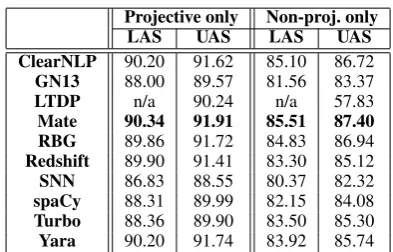
Projectivity Some of our parsers only produce projective parses. Table 6 shows parsing accuracy for trees containing only projective arcs (11,231 trees, 202,521 tokens) and for trees containing non-projective arcs (465 trees, 13,792 tokens). As before, all differences are statistically significant atp < .01except for: Redshift vs. RBG for over-all LAS; LTDP vs. SNN for overover-all UAS; and
[image:6.595.316.513.342.468.2]Turbo vs. SpaCy for overall UAS. For strictly pro-jective trees, the LTDP parser is 5th from the top in UAS. Apart from this, the grouping between “very good” and “good” parsers does not change.
Figure 5: UAS by dependency distance.
Projective only Non-proj. only
LAS UAS LAS UAS
ClearNLP 90.20 91.62 85.10 86.72 GN13 88.00 89.57 81.56 83.37
LTDP n/a 90.24 n/a 57.83
Mate 90.34 91.91 85.51 87.40
RBG 89.86 91.72 84.83 86.94 Redshift 89.90 91.41 83.30 85.12 SNN 86.83 88.55 80.37 82.32
spaCy 88.31 89.99 82.15 84.08
Turbo 88.36 89.90 83.50 85.30
Yara 90.20 91.74 83.92 85.74 Table 6: Accuracy for proj. and non-proj. trees.
Dependency Relations We were interested in which dependency relations were computed with high/low overall accuracy, and for which accuracy varied between parsers. The dependency relations with the highest average LAS scores (> 97%)
werepossessive, hyph, expl, hmod, aux,
detandposs. These relations have strong
lexi-cal clues (e.g.possessive) or occur very often (e.g. det). Those with the lowest LAS scores (< 50%) werecsubjpass,meta, dep, nmod
andparataxis. These either occur rarely or are
very general (dep).
The most “confusing” dependency relations (those with the biggest range of accuracies across parsers) were csubj, preconj, csubjpass,
parataxis,metaandoprd(all with a spread
[image:6.595.74.286.363.535.2]had the highest accuracy for 4 out of the top 10 “most accurate” dependency relations. SNN had the lowest accuracy for 5 out of the top 10 “least accurate” dependency relations, while the RBG had the lowest accuracy for another 4.
POS Tags We also examined error types by part of speech tag of the dependent. ThePOStags with the highest average LAS scores (> 97%) were the highly unambiguous tagsPOS,WP$, MD, TO,
HYPH,EX,PRPandPRP$. With the exception of
WP$, these tags occur frequently. Those with the lowest average LAS scores (<75%) were punctu-ation markers ((,)and:, and the rare tagsAFX,
FW,NFPandLS.
Genres Table 7 shows parsing accuracy for each parser for each of the seven genres comprising the English portion of OntoNotes 5. Mate and ClearNLP are responsible for the highest accuracy for some genres, although accuracy differences among the top four parsers are generally small. Accuracy is highest for PT(pivot text, the Bible) and lowest for TC (telephone conversation) and WB(web data). The web data is itself multi-genre and includes translations from Arabic and Chi-nese, while telephone conversation data includes disfluencies and informal language.
6.4 Oracle Ensemble Performance
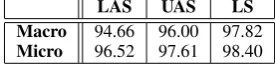
One popular method for achieving higher accuracy on a classification task is to use system combina-tion (Bj¨orkelund and others, 2014; Le Roux and others, 2012; Le Roux et al., 2013; Sagae and Lavie, 2006; Sagae and Tsujii, 2010; Haffari et al., 2011). DEPENDABLEreports ensemble upper bound performance assuming that the besttreecan be identified by an oracle (macro), or that the best arc can be identified by an oracle (micro). Ta-ble 8 provides an upper bound on ensemTa-ble per-formance for future work.
LAS UAS LS
[image:7.595.312.518.315.441.2]Macro 94.66 96.00 97.82 Micro 96.52 97.61 98.40 Table 8: Oracle ensemble performance.
The highest match was achieved between the RBG and Mate parser (62.22 UAS). ClearNLP, GN13 and LTDP all matched with Redshift the best, and RBG, Redshift and Turbo matched with Mate the best. SNN, spaCy and Turbo did not match well
with other parsers; their respective ”best match” score was never higher than 55.
6.5 Error Analysis
From the test data, we pulled out parses where only one parser achieved very high accuracy, and parses where only one parser had low accuracy (Table 9). As with the detailed performance anal-yses, we used the most accurate version of each parser for this analysis. Mate has the highest num-ber of “generally good” parses, while the SNN parser has the highest number of “uniquely bad” parses. The SNN parser tended to choose the wrong root, but this did not appear to be tied to the number of verbs in the sentence - rather, the SNN parser just makes the earliest “reasonable” choice of root.
Parser UAS ≥90 =100 <90 <90 All others UAS <90 <90 ≥90 =100
ClearNLP 42 11 45 15
LTDP 29 12 182 36
GN13 26 8 148 65
Mate 75 19 44 10
RBG 49 21 49 15
Redshift 38 17 28 8
SNN 70 23 417 142
spaCy 48 17 218 73
Turbo 54 15 28 14
Yara 33 15 27 7
Table 9: Differential parsing accuracies.
To further analyze these results, we first looked at the parse trees for “errorful” sentences where the parsers agreed. From the test data, we extracted parses for sentences where at least two parsers got UAS of<50%. This gave us 253 sentences. The distribution of these errors across genres varied: PT - 2.8%, MZ - 3.5%, BN - 9.8%, NW - 10.3%, WB- 17.4%,BC- 25.3%,TC- 30.8%.
[image:7.595.110.248.629.661.2]BC BN MZ NW PT TC WB
LAS UAS LAS UAS LAS UAS LAS UAS LAS UAS LAS UAS LAS UAS
ClearNLP 88.95 90.36 89.59 91.01 89.56 91.24 89.79 91.08 95.88 96.68 87.17 88.93 87.93 89.83 GN13 86.75 88.40 87.38 88.87 87.31 89.10 87.36 88.84 94.06 95.00 85.68 87.60 85.20 87.19 LTDP n/a 86.81 n/a 87.43 n/a 88.87 n/a 88.40 n/a 93.52 n/a 85.85 n/a 86.37 Mate 89.03 90.73 89.30 90.82 90.09 91.92 90.28 91.68 95.71 96.64 87.86 89.87 87.86 89.89
RBG 88.64 90.58 88.99 90.86 89.28 91.45 89.85 91.47 95.27 96.41 87.36 89.65 87.12 89.61 Redshift 88.60 90.19 88.96 90.46 89.11 90.90 89.63 90.99 95.36 96.22 87.14 88.99 87.27 89.31 SNN 85.35 87.08 86.13 87.78 86.00 87.92 86.17 87.74 93.47 94.64 83.50 85.74 84.29 86.50 spaCy 87.27 89.05 87.70 89.31 87.37 89.29 88.00 89.52 94.28 95.27 85.67 87.65 85.16 87.40 Turbo 87.05 88.70 87.58 89.04 88.34 90.02 87.95 89.33 94.39 95.36 85.91 87.93 85.66 87.70 Yara 88.90 90.53 89.40 90.89 89.72 91.42 90.00 91.41 95.41 96.32 87.35 89.19 87.55 89.61
[image:8.595.79.520.62.173.2]Total 2211 1357 780 2326 1869 1366 1787
Table 7: Parsing accuracy by genre.
Figure 6: Common error types in erroneous trees.
6.6 Recommendations
Each of the transition-based parsers that was in-cluded in this evaluation can use varying beam widths to trade off speed vs. accuracy, and each parser has numerous other parameters that can be tuned. Notwithstanding all these variables, we can make some recommendations. Figure 7 illus-trates the speed vs. accuracy tradeoff across the parsers. For highest accuracy (e.g. in dialog sys-tems), Mate, RBG, Turbo, ClearNLP and Yara are good choices. For highest speed (e.g. in web-scale NLP), spaCy and ClearNLPg are good choices;
SNN and Yarag are also good choices when
ac-curacy is relatively not as important.
7 Conclusions and Future Work
[image:8.595.99.269.91.445.2]In this paper we have: (a) provided a detailed com-parative analysis of several state-of-the-art statis-tical dependency parsers, focusing on accuracy
Figure 7: Speed with respect to accuracy.
[image:8.595.307.526.208.376.2]In this work we did not implement an ensemble of parsers, partly because an ensemble necessarily entails complexity and/or speed delays that render it unusable by all but experts. However, our anal-yses indicate that it may be possible to achieve small but significant increases in accuracy of de-pendency parsing through ensemble methods. A good place to start would be with ClearNLP, Mate, or Redshift in combination with LTDP and Turbo, SNN or spaCy. In addition, it may be possible to achieve good performance in particular genres by doing “mini-ensembles” trained on general pur-pose data (e.g. WB) and genre-specific data. We leave this for future work. We also leave for fu-ture work the comparison of these parsers across languages.
It remains to be seen what downstream impact differences in parsing accuracy of 2-5% have on the goal task. If the impact is small, then speed and ease of use are the criteria to optimize, and here spaCy, ClearNLPg, Yarag and SNN are good
choices.
Acknowledgments
We would like to thank the researchers who have made available data (especially OntoNotes), parsers (especially those compared in this work), and evaluation and visualization tools. Special thanks go to Boris Abramzon, Matthew Honnibal, Tao Lei, Danqi Li and Mohammad Sadegh Rasooli for assistance in installation, trouble-shooting and general discussion. Additional thanks goes to the kind folks from the SANCL-SPMRL community for an informative discussion of evaluation and vi-sualization tools. Finally, we would like to thank the three reviewers, as well as Martin Chodorow, Dean Foster, Joseph Le Roux and Robert Stine, for feedback on this paper.
References
Emily M. Bender, Dan Flickinger, Stephan Oepen, and Yi Zhang. 2011. Parser evaluation over local and non-local deep dependencies in a large corpus. In Proceedings of EMNLP.
Anders Bj¨orkelund et al. 2014. Introducing the IMS-Wrocław-Szeged-CIS entry at the SPMRL 2014 shared task: Reranking and morpho-syntax meet unlabeled data. In Proceedings of the First Joint Workshop on Statistical Parsing of Morphologically Rich Languages and Syntactic Analysis of Non-Canonical Languages.
Bernd Bohnet. 2010. Very high accuracy and fast de-pendency parsing is not a contradiction. In Proceed-ings of COLING.
Sabine Buchholz and Erwin Marsi. 2006. CoNLL-X shared task on multilingual dependency parsing. In Proceedings of CoNLL.
Danqi Chen and Christopher Manning. 2014. A fast and accurate dependency parser using neural net-works. InProceedings of EMNLP.
Jinho D. Choi and Andrew McCallum. 2013. Transition-based Dependency Parsing with Selec-tional Branching. InProceedings of the 51st Annual Meeting of the Association for Computational Lin-guistics, ACL’13, pages 1052–1062.
Jinho D. Choi and Martha Palmer. 2012a. Fast and Ro-bust Part-of-Speech Tagging Using Dynamic Model Selection. InProceedings of the 50th Annual Meet-ing of the Association for Computational LMeet-inguis- Linguis-tics, ACL’12, pages 363–367.
Jinho D. Choi and Martha Palmer. 2012b. Guidelines for the Clear Style Constituent to Dependency Con-version. Technical Report 01-12, Institute of Cogni-tive Science, University of Colorado Boulder, Boul-der, CO, USA.
Ronan Collobert et al. 2011. Natural language pro-cessing (almost) from scratch. Journal of Machine Learning Research, 12:2493–2537.
Marie-Catherine de Marneffe and Christopher D. Man-ning. 2008. The Stanford typed dependencies representation. In Proceedings of the COLING workshop on Cross-Framework and Cross-Domain Parser Evaluation.
Yoav Goldberg and Joakim Nivre. 2013. Training de-terministic parser with non-dede-terministic oracles. In Proceedings of TACL.
Gholamreza Haffari, Marzieh Razavi, and Anoop Sarkar. 2011. An ensemble model that combines syntactic and semantic clustering for discriminative dependency parsing. InProceedings of ACL-HLT.
Jan Hajiˇc et al. 2009. The CoNLL-2009 shared task: Syntactic and semantic dependencies in mul-tiple languages. InProceedings of CoNLL.
Matthew Honnibal, Yoav Goldberg, and Mark Johnson. 2013. A non-monotonic arc-eager transition system for dependency parsing. InProceedings of CoNLL.
Liang Huang, Suphan Fayong, and Yang Guo. 2012. Structured perceptron with inexact search. In Pro-ceedings of the NAACL.
Jonathan K. Kummerfeld et al. 2012. Parser show-down at the wall street corral: An empirical inves-tigation of error types in parser output. In Proceed-ings of EMNLP.
Joseph Le Roux et al. 2012. DCU-Paris13 systems for the SANCL 2012 shared task. InProceedings of the First Workshop on Syntactic Analysis of Non-Canonical Language (SANCL).
Joseph Le Roux, Antoine Rozenknop, and Jennifer Foster. 2013. Combining PCFG-LA models with dual decomposition: A case study with function la-bels and binarization. InProceedings of EMNLP. Tao Lei, Yu Xin, Yuan Zhang, Regina Barzilay, and
Tommi Jaakkola. 2014. Low-rank tensors for scor-ing dependency structures. In Proceedings of the 52nd Annual Meeting of the Association for Compu-tational Linguistics (Volume 1: Long Papers), pages 1381–1391, Baltimore, Maryland, June. Association for Computational Linguistics.
Mitchell P. Marcus, Mary Ann Marcinkiewicz, and Beatrice Santorini. 1993. Building a large anno-tated corpus of english: the Penn treebank. Compu-tational Linguistics, 19(2):313–330.
Andr´e F. T. Martins, Miguel B. Almeida, and Noah A. Smith. 2013. Turning on the turbo: Fast third-order non-projective turbo parsers. InProceedings of the ACL.
Ryan McDonald and Joakim Nivre. 2007. Character-izing the errors of data-driven dependency parsing models. InProceedings of EMNLP-CoNLL. Ryan McDonald and Joakim Nivre. 2011. Analyzing
and integrating dependency parsers. Computational Linguistics, 37(1):197–230.
Makoto Miwa et al. 2010. A comparative study of syn-tactic parsers for event extraction. InProceedings of BioNLP.
Jens Nilsson and Joakim Nivre. 2008. MaltEval: An evaluation and visualization tool for dependency parsing. InProceedings of LREC.
Joakim Nivre et al. 2007. The CoNLL 2007 shared task on dependency parsing. In Proceedings of CoNLL.
Joakim Nivre, Laura Rimell, Ryan McDonald, and Car-los G´omez Rodr´ıguez. 2010. Evaluation of de-pendency parsers on unbounded dependencies. In Proceedings of the 23rd International Conference on Computational Linguistics (Coling 2010), pages 833–841, Beijing, China, August. Coling 2010 Or-ganizing Committee.
Stephan Oepen et al. 2014. SemEval 2014 Task 8: Broad-Coverage Semantic Dependency Parsing. In Proceedings of the 8th International Workshop on Semantic Evaluation (SemEval 2014), pages 63–72.
Slav Petrov and Ryan McDonald. 2012. Overview of the 2012 shared task on parsing the web. In Pro-ceedings of the First Workshop on Syntactic Analysis of Non-Canonical Language (SANCL) Shared Task. Slav Petrov, Pi-Chuan Chang, Michael Ringgaard, and Hiyan Alshawi. 2010. Uptraining for accurate de-terministic question parsing. InProceedings of the 2010 Conference on Empirical Methods in Natural Language Processing, pages 705–713, Cambridge, MA, October. Association for Computational Lin-guistics.
Sameer Pradhan et al. 2013. Towards robust linguis-tic analysis using OntoNotes. In Proceedings of CoNLL.
Mohammad Sadegh Rasooli and Joel R. Tetreault. 2015. Yara parser: A fast and accurate dependency parser. CoRR, abs/1503.06733.
Kenji Sagae and Alon Lavie. 2006. Parser combina-tion by reparsing. InProceedings HLT-NAACL. Kenji Sagae and Jun’ichi Tsujii. 2010. Dependency
parsing and domain adaptation with data-driven LR models and parser ensembles. InTrends in Parsing Technology: Dependency Parsing, Domain Adapta-tion, and Deep Parsing, pages 57–68. Springer. Djam´e Seddah et al. 2013. Overview of the SPMRL
2013 shared task: A cross-framework evaluation of parsing morphologically rich languages. In Pro-ceedings of the 4th Workshop on Statistical Parsing of Morphologically Rich Languages.
Pontus Stenetorp et al. 2012. BRAT: A web-based tool for NLP-assisted text annotation. InProceedings of the EACL.
Mihai Surdeanu et al. 2008. The CoNLL-2008 shared task on joint parsing of syntactic and semantic de-pendencies. InProceedings of CoNLL.
Reut Tsarfaty, Joakim Nivre, and Evelina Andersson. 2011. Evaluating dependency parsing: Robust and heuristics-free cross-annotation evaluation. In Pro-ceedings of EMNLP.
Ralph Weischedel et al. 2011. OntoNotes: A large training corpus for enhanced processing. In Joseph Olive, Caitlin Christianson, and John McCary, ed-itors, Handbook of Natural Language Processing and Machine Translation. Springer.