Exploiting Linguistic Features for Sentence Completion
Aubrie M. Woods Carnegie Mellon University
5000 Forbes Avenue Pittsburgh, PA 15213, USA
Abstract
This paper presents a novel approach to automated sentence completion based on pointwise mutual information (PMI). Fea-ture sets are created by fusing the various types of input provided to other classes of language models, ultimately allowing multiple sources of both local and dis-tant information to be considered. Fur-thermore, it is shown that additional preci-sion gains may be achieved by incorporat-ing feature sets of higher-order n-grams. Experimental results demonstrate that the PMI model outperforms all prior models and establishes a new state-of-the-art re-sult on the Microsoft Research Sentence Completion Challenge.
1 Introduction
Skilled reading is a complex cognitive process that requires constant interpretation and evaluation of written content. To develop a coherent picture, one must reason from the material encountered to construct a mental representation of meaning. As new information becomes available, this repre-sentation is continually refined to produce a glob-ally consistent understanding. Sentence comple-tion quescomple-tions, such as those previously featured on the Scholastic Aptitude Test (SAT), were de-signed to assess this type of verbal reasoning abil-ity. Specifically, given a sentence containing 1-2 blanks, the test taker was asked to select the cor-rect answer choice(s) from the provided list of op-tions (College Board, 2014). A sample sentence completion question is illustrated in Figure 1.
To date, relatively few publications have fo-cused on automatic methods for solving sentence completion questions. This scarcity is likely at-tributable to the difficult nature of the task, which
Certain clear patterns in the metamorphosis of a butterfly indicate that the process is ——-.
(A) systematic (B) voluntary (C) spontaneous (D) experimental (E) clinical
Figure 1:An example sentence completion ques-tion (The Princeton Review, 2007).
occasionally involves logical reasoning in addition to both general and semantic knowledge (Zweig et al., 2012b). Fundamentally, text completion is a challenging semantic modeling problem, and so-lutions require models that can evaluate the global coherence of sentences (Gubbins and Vlachos, 2013). Thus, in many ways, text completion epito-mizes the goals of natural language understanding, as superficial encodings of meaning will be insuf-ficient to determine which responses are accurate. In this paper, a model based on pointwise mu-tual information (PMI) is proposed to measure the degree of association between answer options and other sentence tokens. The PMI model considers multiple sources of information present in a sen-tence prior to selecting the most likely alternative. The remainder of this report is organized as fol-lows. Section 2 describes the high-level character-istics of existing models designed to perform auto-mated sentence completion. This prior work pro-vides direct motivation for the PMI model, intro-duced in Section 3. In Section 4, the model’s per-formance on the Microsoft Research (MSR) Sen-tence Completion Challenge and a data set com-prised of SAT questions are juxtaposed. Finally, Section 5 offers concluding remarks on this topic.
2 Background
Previous research expounds on various architec-tures and techniques applied to sentence comple-tion. Below, models are roughly categorized on the basis of complexity and type of input analyzed.
2.1 N-gram Models
Advantages of n-gram models include their abil-ity to estimate the likelihood of particular token sequences and automatically encode word order-ing. While relatively simple and efficient to train on large, unlabeled text corpora, n-gram models are nonetheless limited by their dependence on lo-cal context. In fact, such models are likely to over-value sentences that are locally coherent, yet im-probable due to distant semantic dependencies.
2.2 Dependency Models
Dependency models circumvent the sequentiality limitation of n-gram models by representing each word as a node in a multi-child dependency tree. Unlabeled dependency language models assume that each word is (1) conditionally independent of the words outside its ancestor sequence, and (2) generated independently from the grammatical re-lations. To account for valuable information ig-nored by this model, e.g., two sentences that dif-fer only in a reordering between a verb and its ar-guments, the labeled dependency language model instead treats each word as conditionally indepen-dent of the words and labels outside its ancestor path (Gubbins and Vlachos, 2013).
In addition to offering performance superior to n-gram models, advantages of this representation include relative ease of training and estimation, as well as the ability to leverage standard smoothing methods. However, the models’ reliance on out-put from automatic dependency extraction meth-ods and vulnerability to data sparsity detract from their real-world practicality.
2.3 Continuous Space Models
Neural networks mitigate issues with data sparsity by learning distributed representations of words, which have been shown to excel at preserving lin-ear regularities among tokens. Despite drawbacks that include functional opacity, propensity toward overfitting, and elevated computational demands, neural language models are capable of outper-forming n-gram and dependency models (Gub-bins and Vlachos, 2013; Mikolov et al., 2013;
Mnih and Kavukcuoglu, 2013).
Log-linear model architectures have been pro-posed to address the computational cost associated with neural networks (Mikolov et al., 2013; Mnih and Kavukcuoglu, 2013). The continuous bag-of-words model attempts to predict the current word using n future and nhistorical words as context. In contrast, the continuous skip-gram model uses the current word as input to predict surrounding words. Utilizing an ensemble architecture com-prised of the skip-gram model and recurrent neu-ral networks, Mikolov et al. (2013) achieved prior state-of-the-art performance on the MSR Sentence Completion Challenge.
3 PMI Model
This section describes an approach to sentence completion based on pointwise mutual informa-tion. The PMI model was designed to account for both local and distant sources of information when evaluating overall sentence coherence.
Pointwise mutual information is an
information-theoretic measure used to dis-cover collocations (Church and Hanks, 1990; Turney and Pantel, 2010). Informally, PMI represents the association between two words, i
andj, by comparing the probability of observing them in the same context with the probabilities of observing each independently.
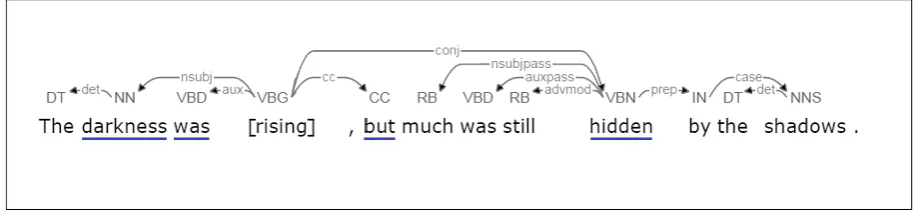
Figure 2:The dependency parse tree for Question 17 in the MSR data set. Words that share a grammati-cal relationship with the missing wordrisingare underscored. Following stop word removal, the feature set for this question is [darkness,was,hidden].
pronouns, and proper nouns.1 Next, feature sets
were defined to capture the various sources of in-formation available in a sentence. While feature set number and type is configurable, composition varies, as sets are dynamically generated for each sentence at run time. Enumerated below are the three feature sets utilized by the PMI model.
1. Reduced Context. This feature set con-sists of words that remain following the pre-processing steps described above.
2. Dependencies. Sentence words that share a semantic dependency with the candidate word(s) are included in this set (Chen and Manning, 2014). Absent from the set of dependencies are words removed during the pre-processing phase. Figure 2 depicts an ex-ample dependency parse tree along with fea-tures provided to the PMI model.
3. Keywords. Providing the model with a col-lection of salient tokens effectively increases the tokens’ associated weights. An analo-gous approach to the one described for stop word identification was applied to discover that common nouns consistently hold greater significance than other words assigned hypo-thetically informative part-of-speech tags. Let X represent a word-context matrix with n
rows andmcolumns. Rowxi:corresponds to word
iand columnx:j refers to contextj. The termx(i,j) indicates how many times wordioccurs in context
j. Applying PMI toXresults in thenxmmatrixY, where termy(i,j) is defined by (1). To avoid overly penalizing words that are unrelated to the context, 1Perhaps counterintuitively, most proper nouns are
unin-formative for sentence completion, since they refer to specific named entities (e.g. people, locations, organizations, etc.).
the positive variant of PMI is considered, in which negative scores are replaced with zero (4).
P(i, j) = Pn x(i, j)
i=1Pmj=1x(i, j) (1)
P(i∗) =
Pm
j=1x(i, j)
Pn
i=1Pmj=1x(i, j) (2)
P(∗j) =
Pn
i=1x(i, j)
Pn
i=1Pmj=1x(i, j) (3)
pmi(i, j) =max
0, log
P(i, j) P(i∗)P(∗j)
(4)
In addition, the discounting factor described by Pantel and Lin (2002) is applied to reduce bias to-ward infrequent words (7).
mincontext=min(Xn
k=1
x(k, j),Xm
k=1
x(i, k))
(5)
δ(i, j) = x(xi, j(i, j) + 1) ·mincontextmincontext+ 1 (6)
dpmi(i, j) =pmi(i, j)·δ(i, j) (7)
similarity(i, S) =X
j∈S
dpmi(i, j)·γ (8)
and context wordjare multiplied byγ, which re-flects the number of feature sets containingj. Ulti-mately, the candidate option with the highest sim-ilarity score is selected as the most likely answer.
Using the procedure described above, addi-tional feature sets of bigrams and trigrams were created and subsequently incorporated into the semantic similarity assessment. This extended model accounts for both word- and phrase-level information by considering windowed co-occurrence statistics.
4 Experimental Evaluation 4.1 Data Sets
Since its introduction, the Microsoft Research Sentence Completion Challenge (Zweig and Burges, 2012a) has become a commonly used benchmark for evaluating semantic models. The data is comprised of material from nineteenth-century novels featured on Project Gutenberg. Each of the 1,040 test sentences contains a single blank that must be filled with one of five candidate words. Associated candidates consist of the cor-rect word and decoys with similar distributional statistics.
To further validate the proposed method, 285 sentence completion problems were collected from SAT practice examinations given from 2000-2014 (College Board, 2000-2014). While the MSR data set includes a list of specified training texts, there is no comparable material for SAT ques-tions. Therefore, the requisite word-context ma-trices were constructed by computing token co-occurrence frequencies from the New York Times portion of the English Gigaword corpus (Parker et al., 2009).
4.2 Results
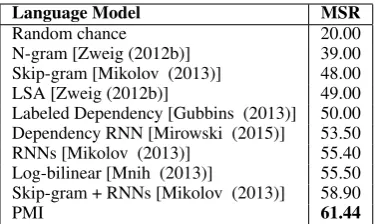
The overall accuracy achieved on the MSR and SAT data sets reveals that the PMI model is able to outperform prior models applied to sentence completion. Table 1 provides a comparison of the accuracy values attained by various architectures, while Table 2 summarizes the PMI model’s per-formance given feature sets of context words, de-pendencies, and keywords. Recall that the n-gram variant reflects how features are partitioned.
It appears that while introducing phrase-level information obtained from higher-order n-grams leads to gains in precision on the MSR data set, the same cannot be stated for the set of SAT
ques-Language Model MSR
Random chance 20.00
N-gram [Zweig (2012b)] 39.00 Skip-gram [Mikolov (2013)] 48.00
LSA [Zweig (2012b)] 49.00
Labeled Dependency [Gubbins (2013)] 50.00 Dependency RNN [Mirowski (2015)] 53.50 RNNs [Mikolov (2013)] 55.40 Log-bilinear [Mnih (2013)] 55.50 Skip-gram + RNNs [Mikolov (2013)] 58.90
[image:4.595.317.505.61.173.2]PMI 61.44
Table 1: Best performance of various models on the MSR Sentence Completion Challenge. Values reflect overall accuracy (%).
Features MSR SAT
Unigrams 58.46 58.95
Unigrams + Bigrams 60.87 58.95 Unigrams + Bigrams + Trigrams 61.44 58.95 Table 2: PMI model performance improvements (% accurate) from incorporating feature sets of higher-order n-grams.
tions. The most probable explanation for this is twofold. First, informative context words are much less likely to occur within 2-3 tokens of the target word. Second, missing words, which are selected to test knowledge of vocabulary, are rarely found in the training corpus. Bigrams and trigrams containing these infrequent terms are ex-tremely uncommon. Regardless of sentence struc-ture, the sparsity associated with higher-order n-grams guarantees diminishing returns for larger values ofn. When deciding whether or not to in-corporate this information, it is also important to consider the significant trade-off with respect to information storage requirements.
5 Conclusion
[image:4.595.312.512.237.280.2]References
Danqi Chen and Christopher Manning. 2014. A fast and accurate dependency parser using neural net-works. InProceedings of the 2014 Conference on Empirical Methods in Natural Language Process-ing, pages 740–750.
Kenneth Ward Church and Patrick Hanks. 1990. Word association norms, mutual information, and lexicog-raphy.Computational Linguistics, 16(1):22–29.
The College Board. 2014. Sat reading practice questions: Sentence completion. Retrieved from https://sat.collegeboard.org/practice/sat-practice-questions-reading/sentence-completion.
Joseph Gubbins and Andreas Vlachos. 2013. De-pendency language models for sentence completion. In Proceedings of the 2013 Conference on Empiri-cal Methods in Natural Language Processing, pages 1405–1410.
Tomas Mikolov, Kai Chen, Greg Corrado, and Jeffrey Dean. 2013. Efficient estimation of word represen-tations in vector space. InWorkshop Proceedings of the International Conference on Learning Represen-tations.
Piotr Mirowski and Andreas Vlachos. 2015. De-pendency recurrent neural language models for sen-tence completion. In Proceedings of the 53rd An-nual Meeting of the Association for Computational Linguistics and the 7th International Joint Confer-ence on Natural Language Processing, pages 511– 517. Association for Computational Linguistics.
Andriy Mnih and Koray Kavukcuoglu. 2013. Learning word embeddings efficiently with noise-contrastive estimation. InAdvances in Neural Information Pro-cessing Systems 26, pages 2265–2273. Curran Asso-ciates, Inc.
Patrick Pantel and Dekang Lin. 2002. Discovering word senses from text. InProceedings of the Eighth ACM SIGKDD International Conference on Knowl-edge Discovery and Data Mining, pages 613–619. Association for Computing Machinery.
Robert Parker, David Graff, Junbo Kong, Ke Chen, and Kazuaki Maeda. 2009. English gigaword fourth edition ldc2009t13.
The Princeton Review. 2007. 11 Practice Tests for the SAT and PSAT, 2008 Edition. Random House, Inc., New York City, NY.
Kristina Toutanova, Dan Klein, Christopher Manning, and Yoram Singer. 2003. Feature-rich part-of-speech tagging with a cyclic dependency network. In Proceedings of the Human Language Technol-ogy Conference of the North American Chapter of the Association for Computational Linguistics, vol-ume 1, pages 252–259. Association for Computa-tional Linguistics.
Peter D. Turney and Patrick Pantel. 2010. From frequency to meaning: Vector space models of se-mantics. Journal of Artificial Intelligence Research, 37(1):141–188.
Geoffrey Zweig and Christopher J.C. Burges. 2012a. A challenge set for advancing language modeling. InProceedings of the NAACL-HLT 2012 Workshop: Will We Ever Really Replace the N-gram Model? On the Future of Language Modeling for HLT, pages 29–36. Association for Computational Linguistics. Geoffrey Zweig, John C. Platt, Christopher Meek,