19
Syntax Helps ELMo Understand Semantics:
Is Syntax Still Relevant in a Deep Neural Architecture for SRL?
Emma Strubell Andrew McCallum
College of Information and Computer Sciences University of Massachusetts Amherst
{strubell, mccallum}@cs.umass.edu
Abstract
Do unsupervised methods for learning rich, contextualized token representations obviate the need for explicit modeling of linguistic structure in neural network models for semantic role labeling (SRL)? We address this question by incorporat-ing the massively successful ELMo em-beddings (Peters et al., 2018) into LISA (Strubell and McCallum,2018), a strong, linguistically-informed neural network ar-chitecture for SRL. In experiments on the CoNLL-2005 shared task we find that though ELMo out-performs typical word embeddings, beginning to close the gap in F1 between LISA with predicted and gold syntactic parses, syntactically-informed models still out-perform syntax-free models when both use ELMo, espe-cially on out-of-domain data. Our results suggest that linguistic structures are in-deed still relevant in this golden age of deep learning for NLP.
1 Introduction
Many state-of-the-art NLP models are now “end-to-end” deep neural network architectures which eschew explicit linguistic structures as input in favor of operating directly on raw text (Ma and Hovy, 2016; Lee et al., 2017; Tan et al., 2018). Recently, Peters et al.(2018) proposed a method for unsupervised learning of rich, contextually-encoded token representations which, when sup-plied as input word representations in end-to-end models, further increased these models’ perfor-mance by up to 25% across many NLP tasks. The immense success of these linguistically-agnostic models brings into question whether linguistic structures such as syntactic parse trees still
pro-vide any additional benefits in a deep neural net-work architecture for e.g. semantic role labeling (SRL).
In this work, we aim to begin to answer this question by experimenting with incorporat-ing the ELMo embeddincorporat-ings ofPeters et al.(2018) into LISA (Strubell and McCallum, 2018), a “linguistically-informed” deep neural network ar-chitecture for SRL which, when given weaker GloVe embeddings as inputs (Pennington et al.,
2014), has been shown to leverage syntax to out-perform a state-of-the-art, linguistically-agnostic end-to-end SRL model.
In experiments on the CoNLL-2005 English SRL shared task, we find that, while the ELMo representations out-perform GloVe and begin to close the performance gap between LISA with predicted and gold syntactic parses, syntactically-informed models still out-perform syntax-free models, especially on out-of-domain data. Our re-sults suggest that with the right modeling, incorpo-rating linguistic structures can indeed further im-prove strong neural network models for NLP.
2 Models
in-formation to further layers used to predict seman-tic roles. We summarize the key points of LISA in
§2.1.
Strubell and McCallum (2018) showed that LISA out-performs syntax-free models when both use GloVe word embeddings as input, which, due to their availability, size and large training cor-pora, are typically used as input to end-to-end NLP models. In this work, we replace those token rep-resentations with ELMo reprep-resentations to assess whether ELMo embeddings are sufficiently rich to obviate the need for explicit representations of syntax, or the model still benefits from syntactic information in addition to the rich ELMo encod-ings. In§2.2 and§2.3 we summarize how GloVe
and ELMo embeddings, respectively, are incorpo-rated into this model.
2.1 LISA SRL model
2.1.1 Neural network token encoder
The input to LISA is a sequence X of T token
representations xt. The exact form of these
rep-resentations when using GloVe embeddings is de-scribed in §2.2, and for ELMo described in §2.3.
FollowingVaswani et al. (2017), we add a sinu-soidal positional encoding to these vectors since the self-attention has no inherent mechanism for modeling token position.
These token representations are supplied to a se-ries ofJ multi-head self-attention layers similar to
those that make up the encoder model ofVaswani et al. (2017). We denote the jth layer with the functionS(j)(·)and the output of that layer for
to-kentass(tj):
s(tj)=S(j)(s(j−1)
t ) (1)
Each S(j)(·) consists of two components: (a)
multi-head self-attention and (b) a convolutional layer. For brevity, we will detail (a) here as it is how we incorporate syntax into the model, but we leave the reader to refer toStrubell and McCallum
(2018) for more details on (b).
The multi-head self attention consists ofH
tention heads, each of which learns a distinct at-tention function to attend to all of the tokens in the sequence. This self-attention is performed for each token for each head, and the results of theH
self-attentions are concatenated to form the final self-attended representation for each token.
Specifically, consider the matrixS(j−1)ofT
to-ken representations at layerj−1. For each
atten-tion head h, we project this matrix into distinct key, value and query representations Kh(j), Vh(j)
andQ(hj)of dimensionsT×dk,T×dq, andT×dv, respectively. We can then multiplyQ(hj) by Kh(j)
to obtain aT×T matrix of attention weightsA(hj)
between each pair of tokens in the sentence. Fol-lowing Vaswani et al. (2017) we perform scaled dot-product attention: We scale the weights by the inverse square root of their embedding dimension and normalize with the softmax function to pro-duce a distinct distribution for each token over all the tokens in the sentence:
A(hj)= softmax(d−k0.5Q(hj)Kh(j)T) (2)
These attention weights are then multiplied by
Vh(j)for each token to obtain the self-attended
to-ken representationsMh(j):
Mh(j)=Ah(j)Vh(j) (3)
RowtofMh(j), the self-attended representation for
token tat layerj, is thus the weighted sum with
respect tot (given byA(hj)) over the token
repre-sentations in Vh(j). The representations for each
attention head are concatenated, and this represen-tation is fed through a convolutional layer to pro-duce s(tj). In all of our models, we use J = 4,
H= 8anddk=dq =dv = 64.
2.1.2 Incorporating syntax
LISA incorporates syntax by training one atten-tion head to attend to each token’s parent in a syn-tactic dependency parse tree. At layerjp, H−1 heads are left to learn on their own to attend to rel-evant tokens in the sentence, while one headhpis trained with an auxiliary objective which encour-ages the head to put all attention weight on each to-ken’s syntactic parent. Denoting the entry ofA(jp)
hp
corresponding to the attention from tokentto
to-kenqasatq, then we model the probability thatq is the head oft as: P(q = head(t) | X) = atq.
Trained in this way,A(jp)
hp emits a directed graph,
where each token’s syntactic parent is that which is assigned the highest attention weight. During training, this head’s attention weights are set to match the gold parse: A(jp)
hp is set to the
adja-cency matrix of the parse tree,1 allowing down-stream layers to learn to use the parse
tion throughout training. In our experiments we setjp = 3.
In this way, LISA is trained to use A(jp)
hp as
an oracle providing parse information to down-stream layers. This representation is flexible, al-lowing LISA to use its own predicted parse, or a parse produced by another dependency parser. Since LISA is trained to leverage gold parse in-formation, as higher-accuracy dependency parses become available, they can be provided to LISA to improve SRL without requiring re-training of the SRL model.
2.1.3 Predicting POS and predicates
LISA is also trained to predict parts-of-speech and predicates using hard parameter sharing ( Caru-ana, 1993). At layer jpos, the token
representa-tion s(jpos)
t is provided as features for a multi-class multi-classifier into the joint label space of part-of-speech and (binary) predicate labels: For each part-of-speech tag which is the tag for a predi-cate in the training data, we add a tag of the form TAG:PREDICATE. Locally-normalized probabili-ties are computed using the softmax function, and we minimize the sum of this loss term with the SRL and syntax losses. In our experiments we use
jpos= 2.
2.1.4 Predicting semantic roles
LISA’s final network representationsS(J)are used
to predict semantic roles. Each token’s final rep-resentation s(tJ) is projected to distinct predicate androlerepresentationsspredt andsrole
t . Each pre-dicted predicate2is scored against all other tokens’ role representations to produce per-label scores for each predicate-token pair using a bilinear operator
U. Per-label scores across semantic roles with
re-spect to predicatefand tokentare thus given by:
sf t=spredf U s role
t (4)
With the locally-normalized probability of the cor-rect role label yf t given by: P(yf t | X) ∝ softmax(sf t). At test time, we use Viterbi decod-ing to enforce BIO constraints with fixed transi-tion probabilities between tags obtained from the training data.
2During training, semantic role predictions are tioned on the gold predicates. At test time they are condi-tioned on LISA’s predicted predicates (§2.1.3).
2.2 GLoVe embedding model
The GloVe word embedding model ( Penning-ton et al., 2014), like word2vec’s skip-gram and CBOW (Mikolov et al., 2013) algorithms, is a shallow, log-bilinear embedding model for learn-ing unsupervised representations of words based on the intuition that words which occur in sim-ilar contexts should have simsim-ilar representations. GloVe Vectors are learned for each word in a fixed vocabulary by regressing on entries in the word co-occurrence matrix constructed from a large cor-pus: The dot product between two words’ em-beddings should equal the log probability of the words’ co-occurrence in the data. We refer the reader toPennington et al.(2014) for a more de-tailed description of the model.
We incorporate pre-trained GloVe embeddings into our model following Strubell and McCal-lum (2018): We fix the pre-trained embeddings and add a learned word embedding representa-tion to the pre-trained word vectors, following the intuition that fixing the pre-trained embeddings and learning a residual word representation keeps words observed during training from drifting too far away from the pre-trained representations of unobserved words. We then feed these representa-tions throughKwidth-3 convolutional layers with
residual connections. SeeStrubell and McCallum
(2018) for more details on these layers. In our ex-periments we useK = 2and convolutional filters of size 1024. We use the typical 100 dimensional GloVe embeddings pre-trained on 6 billion tokens of text from Wikipedia and Gigaword.3
2.3 ELMo embedding model
The ELMo model (Peters et al., 2018) produces deep, contextually embedded token representa-tions by training stacked convolutional, highway and bi-directional LSTM (bi-LSTM) layers on a large corpus of text with an unsupervised language modeling (LM) objective. The expressiveness of this model compared to GloVe-style embeddings models differs in two key ways: (1) ELMo ob-serves the entire sentence of context to model each token rather than relying on a small, fixed window and (2) ELMo does not rely on a fixed vocabu-lary of token embeddings, instead building up to-ken representations from characters.
tional LM architecture from Peters et al. (2017). The model first composes character embeddings into word type embeddings using a convolutional layer followed by highway layers. Then these token representations are passed to multiple bi-LSTM layers, all of which are trained end-to-end to jointly optimize forward and backward LM ob-jectives. ELMo additionally learns a small number of task-specific parameters to compose and scale the outputs of each LM, producing a task-specific embedding for each token in context. The intu-ition behind these task-specific parameters is that different tasks will benefit from different weight-ings of shallower and deeper LM representations. For example, parsing might favor earlier layers which better capture syntactic patterns, whereas question answering might favor later layers which capture higher level semantics of the sentence. Pe-ters et al. (2018) experiment with adding ELMo embeddings on the input and output of some ar-chitectures, with varying results across different tasks. We incorporate ELMo embeddings into the model by keeping the pre-trained parameters fixed but learning a task-specific combination of the layer outputs which we feed as inputs to our model, as described inPeters et al.(2018). We fol-low their implementation for the SRL architecture of (He et al.,2017) and use the ELMo embeddings only as input to the model. We refer toPeters et al.
(2018) for more details on this model.
We use the pre-trained TensorFlow ELMo model4, which consists of one character-level con-volutional layer with 2048 filters followed by two highway layers followed by two bi-LSTM lay-ers with 4096 hidden units. All three laylay-ers are projected down to 512 dimensional representa-tions over which our task-specific parameters are learned. This model is trained on the 1B Word Benchmark (Chelba et al., 2014), which consists of filtered English newswire, news commentary and European parliament proceedings from the WMT ’11 shared task.
3 Related work
Our experiments are based on the LISA model of
Strubell and McCallum(2018), who showed that their method for incorporating syntax into a deep neural network architecture for SRL improves SRL F1 with predicted predicates on CoNLL-2005 and CoNLL-2012 data, including on
out-4https://github.com/allenai/bilm-tf
of-domain test data. Other recent works have also found syntax to improve neural SRL mod-els when evaluated on data from the CoNLL-2009 shared task: Roth and Lapata (2016) use LSTMs to embed syntactic dependency paths, and
Marcheggiani and Titov(2017) incorporate syntax using graph convolutional neural networks over predicted dependency parse trees. In contrast to this work, Marcheggiani and Titov (2017) found that their syntax-aware model did not out-perform a syntax-agnostic model on out-of-domain data.
The idea that an SRL model should incorpo-rate syntactic structure is not new, since many se-mantic formalities are defined with respect to syn-tax. Many of the first approaches to SRL ( Prad-han et al.,2005;Surdeanu et al.,2007;Johansson and Nugues, 2008; Toutanova et al., 2008; Pun-yakanok et al.,2008), spearheaded by the CoNLL-2005 shared task (Carreras and M`arquez, 2005), achieved success by relying on syntax-heavy lin-guistic features as input for a linear model, com-bined with structured inference which could also take syntax into account. T¨ackstr¨om et al.(2015) showed that most of these constraints could more efficiently be enforced by exact inference in a dy-namic program. While most techniques required a predicted parse as input,Sutton and McCallum
(2005) modeled syntactic parsing and SRL with a joint graphical model, and Lewis et al. (2015) jointly modeled SRL and CCG semantic parsing.
Collobert et al.(2011) were among the first to use a neural network model for SRL, using a CNN over word embeddings combined with globally-normalized inference. However, their model failed to out-perform non-neural models, both with and without multi-task learning with other NLP tag-ging tasks such as part-of-speech tagtag-ging and chunking. FitzGerald et al. (2015) were among the first to successfully employ neural networks, achieving the state-of-the-art by embedding lexi-calized features and providing the embeddings as factors in the model ofT¨ackstr¨om et al.(2015).
Recently there has been a move away from SRL models which explicitly incorporate syntac-tic knowledge through features and structured in-ference towards models which rely on deep neu-ral networks to learn syntactic structure and long-range dependencies from the data. Zhou and Xu
random field (Lafferty et al.,2001).Marcheggiani et al. (2017) and He et al. (2017) also achieved state-of-the-art results using deep LSTMs with no syntactic features. While most previous work as-sumes that gold predicates are given, like this work andStrubell and McCallum(2018),He et al.
(2017) evaluate on predicted predicates, though they train a separate model for predicate detec-tion. Most recently, Tan et al. (2018) achieved the state-of-the art on the CoNLL-2005 and 2012 shared tasks with gold predicates and no syntax using 10 layers of self-attention, and on CoNLL-2012 with gold predicates Peters et al.(2018) in-crease the score ofHe et al.(2017) by more than 3 F1 points by incorporating ELMo embeddings into their model, out-performing ensembles from
Tan et al.(2018) with a single model. We are in-terested in analyzing this relationship further by experimenting with adding ELMo embeddings to models with and without syntax in order to deter-mine whether ELMo can replace explicit syntax in SRL models, or if they can have a synergistic relationship.
4 Experimental results
In our experiments we assess the impact of re-placing GLoVe embeddings (+GloVe) with ELMo
embeddings (+ELMo) in strong, end-to-end
neu-ral network models for SRL: one which incorpo-rates syntax (LISA) and one which does not (SA).
The two models are identical except that the latter does not have an attention head trained to predict syntactic heads. Since the LISA model can both predict its own parses as well as consume parses from another model, as in Strubell and McCal-lum(2018) we experiment with providing syntac-tic parses from a high-quality dependency parser (+D&M), as well as providing the gold parses
(+Gold) as an upper bound on the gains that can
be attained by providing more accurate parses. We compare LISA models to two baseline mod-els: The deep bi-LSTM model ofHe et al.(2017) and the deep self-attention model of Tan et al.
(2018). Though both also report ensemble scores, we compare to the single-model scores of both works. We note that Tan et al. (2018) is not di-rectly comparable because they use gold predi-cates at test time. Despite this handicap, our best models obtain higher scores thanTan et al.(2018).
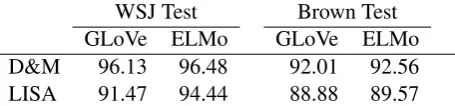
WSJ Test Brown Test
GLoVe ELMo GLoVe ELMo
[image:5.595.309.537.63.116.2]D&M 96.13 96.48 92.01 92.56 LISA 91.47 94.44 88.88 89.57
Table 1: Dependency parse accuracy (UAS) on CoNLL-2005.
4.1 Data and pre-processing
We evaluate our models on the data from the CoNLL-2005 semantic role labeling shared task (Carreras and M`arquez,2005). This corpus anno-tates the WSJ portion of the Penn TreeBank corpus (Marcus et al., 1993) with semantic roles in the PropBank style (Palmer et al.,2005), plus a chal-lenging out-of-domain test set derived from the Brown corpus (Francis and Kuˇcera, 1964). This dataset contains only verbal predicates and 28 dis-tinct role label types. We obtain 105 SRL labels (including continuations) after encoding predicate argument segment boundaries with BIO tags. We use Stanford syntactic dependencies v3.5.
4.2 Syntactic parsing
Table1presents the accuracy (UAS) of our depen-dency parsers. We experiment with adding ELMo embeddings to a strong graph-based dependency parser (Dozat and Manning, 2017), and present LISA’s parsing accuracy with GloVe and ELMo embeddings. ELMo increases parsing accuracy in both models and both datasets, though by a much wider margin (3 points) for LISA, which attains much lower scores without ELMo. Incorporating ELMo into LISA is very beneficial to parsing ac-curacy, helping to close the gap between LISA and D&M parsing performance. In subsequent exper-iments, D&M refers to the best model in Table1, D&M+ELMo.
4.3 Semantic role labeling
accu-Model Dev WSJ Test Brown Test
P R F P R F P R F
He et al.(2017) 80.3 80.4 80.3 80.2 82.3 81.2 67.6 69.6 68.5
Tan et al.(2018)† 82.6 83.6 83.1 84.5 85.2 84.8 73.5 74.6 74.1
SA+GloVe 78.54 76.90 77.71 81.43 80.69 81.06 70.10 66.01 67.99 LISA+GloVe 81.25 80.03 80.64 82.78 82.57 82.68 71.93 69.45 70.67 +D&M 82.68 82.12 82.40 84.12 83.92 84.02 73.96 70.97 72.43
+Gold 86.02 85.11 85.56 — — — — — —
SA+ELMo 83.67 82.37 83.02 84.29 83.95 84.12 73.76 71.02 72.36 LISA+ELMo 84.18 82.71 83.44 84.62 84.24 84.43 73.70 71.70 72.69 +D&M 84.56 83.29 83.92 85.40 84.93 85.17 75.27 73.40 74.33
[image:6.595.79.519.62.228.2]+Gold 87.56 86.01 86.77 — — — — — —
Table 2: Precision, recall and F1 on CoNLL-2005 with predicted predicates.†denotes that models were
evaluated on gold predicates.
racy by 3 points on the WSJ test set (Table 1). These results suggest that ELMo does model syn-tax in some way, or at least the model is able to leverage ELMo embeddings about as well as LISA’s predicted parses to inform its SRL deci-sions.
0-1011-2021-3031-4041-300Sentence length (tokens)72
.
575
.
077
.
580
.
082
.
585
.
087
.
590
.
0F1LISA+D&M+Gold
However, when we add higher-accuracy parses (+D&M) to LISA, we do see greater improve-ments over the syntax-agnostic model, even with ELMo embeddings. We see that incorporating ex-plicit syntax representations is still helpful even with ELMo’s strong representations. On the WSJ test set, supplying LISA with D&M parses gives about 1 point of F1 over the SA baseline, and on the out-of-domain test set, we see that the parses supply almost 2 additional points of F1 over the syntax-agnostic model. We note that with ELMo embeddings and D&M parses, LISA ob-tains new state-of-the-art results for a single model on this dataset when compared to a model (Tan et al.,2018) which is given gold predicates at test time, despite our models using predicted predi-cates. Our model’s gains in F1 come from obtain-ing higher precision thanTan et al.(2018) (fewer false positives).
The explicit parse representations appear to be particularly helpful on out-of-domain data, which makes sense for two reasons: First, since the Brown test set is out-of-domain for the ELMo em-beddings, we would expect them to help less on this corpus than on the in-domain WSJ text. Sec-ond, the parse trees should provide a relatively domain-agnostic signal to the model, so we would expect them to help the most in out-of-domain
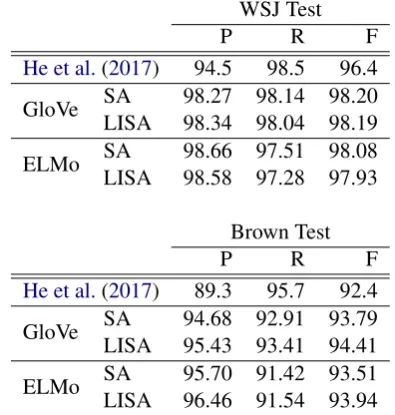
WSJ Test
P R F
He et al.(2017) 94.5 98.5 96.4 GloVe SALISA 98.27 98.14 98.2098.34 98.04 98.19
ELMo SALISA 98.66 97.51 98.0898.58 97.28 97.93
Brown Test
P R F
He et al.(2017) 89.3 95.7 92.4 GloVe SALISA 94.68 92.91 93.7995.43 93.41 94.41
ELMo SA 95.70 91.42 93.51 LISA 96.46 91.54 93.94
Table 3: Predicate detection precision, recall and F1 on CoNLL-2005.
evaluation.
We also evaluate on the development set with gold parse trees at test time. Fairly large gains of nearly 3 F1 points can still be obtained using gold parses even with ELMo embeddings, suggesting that syntax could help even more if we could produce more accurate syntactic parses, or more specifically, the types of mistakes still made by highly accurate dependency parsers (e.g. preposi-tional phrase attachments) negatively impact SRL models which rely on syntax.
[image:6.595.316.514.287.495.2]differ-0-10 11-20 21-30 31-40 41-300 Sentence length (tokens)
72.5
75.0
77.5
80.0
82.5
85.0
87.5
90.0
F1
[image:7.595.74.284.65.202.2]LISA +D&M +Gold
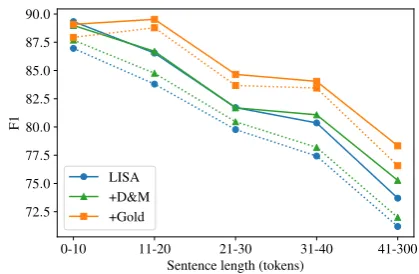
Figure 1: F1 score as a function of sentence length. Solid/dotted lines indicate ELMo/GLoVe embed-dings, respectively.
ence in scores can not be attributed to better pred-icate detection. If anything, the predpred-icate detec-tion scores with ELMo are slightly lower than with GloVe. We observe that in particular on the Brown test set, ELMo predicate detection precision is no-tably higher than GloVe while recall is lower.
4.4 Analysis
We followStrubell and McCallum(2018) andHe et al.(2017) and perform an analysis on the devel-opment dataset to ascertain which types of errors ELMo helps resolve, and how this compares with the types of errors that occur when LISA is pro-vided with a gold parse. In Figure 1 we bucket sentences by length and plot F1 score as a func-tion of sentence length across different models re-ported in Table2. Solid lines indicate ELMo mod-els, while dotted lines indicate models trained with GloVe. For GloVe models, we see that models without gold parses maintain about the same dif-ference in F1 across all sentence lengths, while the gold parse obtains significant advantages for sen-tence lengths greater than 10. With ELMo em-beddings, the relationship between models with gold and predicted parses remains the same, but interestingly the LISA and D&M parses obtain the same scores through sentence lengths 21-30, then diverge more as sentences get longer. This trend suggests that while the ELMo embeddings help LISA parse shorter sentences, up to length 30, the D&M model trained specifically on parsing is more accurate on longer sentences. This could be indicative of ELMo’s ability to model long-range dependencies.
In Figure2we follow the analysis fromHe et al.
(2017) which bins SRL errors into 7 different error
Orig. Fix
Labels MoveCore
Arg. Merge
Spans SpansSplit SpanFix
Boundary Drop
Arg. Arg.Add
82.5
85.0
87.5
90.0
92.5
95.0
97.5
100.0
F1
LISA +D&M +Gold
Figure 2: F1 score on CoNLL-2005 after perform-ing incremental corrections fromHe et al.(2017). Solid/dotted lines indicate ELMo/GLoVe embed-dings, respectively.
types,5then incrementally fixes each error type in order to better understand which error types con-tribute most to SRL errors. We followStrubell and McCallum(2018) and compare these errors across models with access to different levels of parse in-formation, and which are trained with GloVe and ELMo word representations. As in Figure1, solid lines in Figure 2 represent models trained with ELMo embeddings and the dashed lines indicate models trained with GloVe.
The overall trend is that supplying the gold parse helps most with segment boundary mistakes, i.e. those resolved by merging or splitting pre-dicted role spans, for both ELMo and GloVe mod-els. The ELMo models clearly begin to close the gap between models given predicted and gold parses by making less of these boundary mistakes, which is not simply due to better parse accuracy since the GlovE+D&M model has access to the same parses as ELMo+D&M.
5 Conclusion
To address the question of whether syntax is still relevant in SRL models with tokens embedded by deep, unsupervised, sentence-aware models such as ELMo, we compared the performance of LISA, a syntactically-informed SRL model, trained with ELMo and GloVe token representations. We found that although these representations improve LISA’s parsing and SRL tagging performance sub-stantially, models trained to leverage syntax still obtain better F1 than models without syntax even
[image:7.595.309.519.66.201.2]when provided with ELMo embeddings, espe-cially on out-of-domain data. We conclude that syntax is indeed still relevant in neural architec-tures for SRL. In future work, we are interested in exploring similar analysis for NLP tasks which have less obvious ties to syntactic structure.
Acknowledgments
We thank Luheng He for providing her excel-lent error analysis scripts, Timothy Dozat and the authors of tensor2tensor for releasing their code, Daniel Andor and David Weiss for helpful dis-cussions, and the reviewers for their thoughtful comments. This work is supported in part by the Center for Data Science and the Center for Intel-ligent Information Retrieval, in part by the Chan Zuckerberg Initiative under the project “Scientific Knowledge Base Construction,” and in part by an IBM PhD Fellowship Award to ES. Any opinions, findings and conclusions or recommendations ex-pressed in this material are those of the authors and do not necessarily reflect those of the sponsor.
References
Xavier Carreras and Llu´ıs M`arquez. 2005. Introduc-tion to the conll-2005 shared task: Semantic role
la-beling. InCoNLL.
Rich Caruana. 1993. Multitask learning: a
knowledge-based source of inductive bias. InICML.
Ciprian Chelba, Tomas Mikolov, Mike Schuster, Qi Ge, Thorsten Brants, Phillipp Koehn, and Tony Robin-son. 2014. One billion word benchmark for mea-suring progress in statistical language modeling. In
INTERSPEECH. pages 2635–2639.
Ronan Collobert, Jason Weston, L´eon Bottou, Michael Karlen, Koray Kavukcuoglu, and Pavel Kuksa. 2011. Natural language processing (almost) from
scratch. Journal of Machine Learning Research
12(Aug):2493–2537.
Timothy Dozat and Christopher D. Manning. 2017. Deep biaffine attention for neural dependency
pars-ing. InICLR.
Nicholas FitzGerald, Oscar T¨ackstr¨om, Kuzman Ganchev, and Dipanjan Das. 2015. Semantic role
labeling with neural network factors. In
Proceed-ings of the 2015 Conference on Empirical Methods in Natural Language Processing. pages 960–970.
W. N. Francis and H. Kuˇcera. 1964. Manual of infor-mation to accompany a standard corpus of present-day edited american english, for use with digital
computers. Technical report, Department of Lin-guistics, Brown University, Providence, Rhode Is-land.
Luheng He, Kenton Lee, Mike Lewis, and Luke Zettle-moyer. 2017. Deep semantic role labeling: What
works and whats next. InProceedings of the 55th
Annual Meeting of the Association for Computa-tional Linguistics.
Richard Johansson and Pierre Nugues. 2008. Dependency-based semantic role labeling of
propbank. In Proceedings of the 2008
Confer-ence on Empirical Methods in Natural Language Processing. pages 69–78.
John D. Lafferty, Andrew McCallum, and Fernando C. N. Pereira. 2001. Conditional random fields: Probabilistic models for segmenting and labeling
se-quence data. InProceedings of the Eighteenth
Inter-national Conference on Machine Learning (ICML).
pages 282–289.
Kenton Lee, Luheng He, Mike Lewis, and Luke
Zettle-moyer. 2017. End-to-end neural coreference
resolu-tion. InProceedings of the 2017 Conference on Em-pirical Methods in Natural Language Processing.
Association for Computational Linguistics, pages
188–197. http://aclweb.org/anthology/D17-1018.
Mike Lewis, Luheng He, and Luke Zettlemoyer. 2015. Joint A* CCG Parsing and Semantic Role Labeling. InEMNLP.
Xuezhe Ma and Eduard Hovy. 2016. End-to-end
sequence labeling via bi-directional lstm-cnns-crf. In Proceedings of the 54th Annual Meeting of the Association for Computational Linguistics. page
10641074.
Diego Marcheggiani, Anton Frolov, and Ivan Titov. 2017. A simple and accurate syntax-agnostic neural model for dependency-based semantic role labeling. InCoNLL.
Diego Marcheggiani and Ivan Titov. 2017. Encoding sentences with graph convolutional networks for
se-mantic role labeling. In Proceedings of the 2017
Conference on Empirical Methods in Natural Lan-guage Processing (EMNLP).
Mitchell P. Marcus, Mary Ann Marcinkiewicz, and Beatrice Santorini. 1993. Building a large annotated
corpus of English: The Penn TreeBank.
Compu-tational Linguistics – Special issue on using large corpora: II19(2):313–330.
Tomas Mikolov, Ilya Sutskever, Kai Chen, Greg Cor-rado, and Jeffrey Dean. 2013. Distributed represen-tations of words and phrases and their
composition-ality. InNIPS.
Martha Palmer, Daniel Gildea, and Paul Kingsbury. 2005. The proposition bank: An annotated corpus
Jeffrey Pennington, Richard Socher, and Christo-pher D. Manning. 2014. Glove: Global vectors for
word representation. InEMNLP.
Matthew Peters, Waleed Ammar, Chandra
Bhagavat-ula, and Russell Power. 2017. Semi-supervised
se-quence tagging with bidirectional language mod-els. In Proceedings of the 55th Annual Meet-ing of the Association for Computational Lin-guistics (Volume 1: Long Papers). Association
for Computational Linguistics, pages 1756–1765.
https://doi.org/10.18653/v1/P17-1161.
Matthew E. Peters, Mark Neumann, Mohit Iyyer, Matt Gardner, Christopher Clark, Kenton Lee, and Luke Zettlemoyer. 2018. Deep contextualized word
rep-resentations. InNAACL.
Sameer Pradhan, Wayne Ward, Kadri Hacioglu, James Martin, and Dan Jurafsky. 2005. Semantic role
la-beling using different syntactic views. In
Proceed-ings of the Association for Computational Linguis-tics 43rd annual meeting (ACL).
Vasin Punyakanok, Dan Roth, and Wen-Tau Yih. 2008. The importance of syntactic parsing and inference in
semantic role labeling. Computational Linguistics
34(2):257–287.
Michael Roth and Mirella Lapata. 2016. Neural se-mantic role labeling with dependency path
embed-dings. In Proceedings of the 54th Annual
Meet-ing of the Association for Computational LMeet-inguistics (ACL). pages 1192–1202.
Emma Strubell and Andrew McCallum. 2018.
Linguistically-informed self-attention for semantic role labeling. https://arxiv.org/abs/1804.08199v1.
Mihai Surdeanu, Llu´ıs M`arquez, Xavier Carreras, and Pere R. Comas. 2007. Combination strategies for
semantic role labeling. Journal of Artificial
Intelli-gence Research29:105–151.
Charles Sutton and Andrew McCallum. 2005. Joint
parsing and semantic role labeling. InCoNLL.
Oscar T¨ackstr¨om, Kuzman Ganchev, and Dipanjan Das. 2015. Efficient inference and structured
learn-ing for semantic role labellearn-ing.TACL3:29–41.
Zhixing Tan, Mingxuan Wang, Jun Xie, Yidong Chen, and Xiaodong Shi. 2018. Deep semantic role
label-ing with self-attention. InAAAI.
Kristina Toutanova, Aria Haghighi, and Christopher D. Manning. 2008. A global joint model for semantic
role labeling. Computational Linguistics34(2):161–
191.
Ashish Vaswani, Noam Shazeer, Niki Parmar, Jakob Uszkoreit, Llion Jones, Aidan N Gomez, Lukasz Kaiser, and Illia Polosukhin. 2017. Attention is all
you need. In31st Conference on Neural Information
Processing Systems (NIPS).
Jie Zhou and Wei Xu. 2015. End-to-end learning of semantic role labeling using recurrent neural
net-works. In Proc. of the Annual Meeting of the