3374
Exploring Numeracy in Word Embeddings
Aakanksha Naik∗, Abhilasha Ravichander∗, Carolyn Rose,Eduard Hovy
Language Technologies Institute, Carnegie Mellon University
{anaik, aravicha, cprose, ehovy}@cs.cmu.edu
Abstract
Word embeddings are now pervasive across NLP subfields as the de-facto method of form-ing text representataions. In this work, we show that existing embedding models are in-adequate at constructing representations that capture salient aspects of mathematical mean-ing for numbers, which is important for lan-guage understanding. Numbers are ubiquitous and frequently appear in text. Inspired by cog-nitive studies on how humans perceive num-bers, we develop an analysis framework to test how well word embeddings capture two es-sential properties of numbers:magnitude(e.g. 3<4) andnumeration(e.g. 3=three). Our ex-periments reveal that most models capture an approximate notion of magnitude, but are in-adequate at capturing numeration. We hope that our observations provide a starting point for the development of methods which better capture numeracy in NLP systems.
1 Introduction
Word embeddings operationalize the distributional hypothesis, where a word is characterized by “the company it keeps” (Harris,1954;Firth,1957), and have been shown to capture semantic regularities in vector space (Mikolov et al.,2013c). They have been a driving force in NLP in recent years, and enjoy widespread use in a variety of semantic tasks (Rumelhart et al.; Mikolov et al., 2013a,b; Col-lobert and Weston,2008;Glorot et al.,2011; Tur-ney and Pantel,2010;Turney,2013).
However, to what extent do these word repre-sentations capture numeric properties? Numbers often need to be dealt with precisely, and under-standing the meaning of text also requires a care-ful understanding of the quantities involved. They have been identified to play an important role in textual entailment, a benchmark natural language
∗
*The first two authors contributed equally to this work.
understanding task. Marneffe et al. (2008) ex-tract pairs of contradictions that occur naturally on Wikipedia and Google News, and find that as many as 29% of contradictions arise due to numeric discrepancies. They also identify that on many Recognizing Textual Entailment (RTE) datasets, 8.8% of contradictory pairs feature nu-meric contradictions. Naik et al.(2018) find that model inability to do numerical reasoning causes 4% of errors made by state-of-the-art models in Natural Language Inference. Spithourakis and Riedel (2018) emphasize the importance of nu-meracy in language modeling. Yet, numbers are often forgotten and even masked in NLP applica-tions (Mitchell and Lapata,2009).
In several domains such as economics, finance and scientific articles numbers can play a crucial role in text. Take for example a recent news head-line,
Met Office: Global Warming could exceed 1.5 C within five years
Ideally, the text representation we use should be able to capture that global warming can exceed 1.5 C, not 100 C. Magnitude is an essential aspect of a number’s meaning1 (Dehaene et al., 1998;
Whalen et al.,1999;Cantlon and Brannon,2006;
Gross, 2011; Cutini and Bonato, 2012; Agrillo et al., 2012; Feigenson et al., 2004) . Systems should also be able to draw valid inferences ir-respective of whether the text uses “five” or “5”. This requires an understanding of symbolic repre-sentations used to record numbers in text. Such representation systems are callednumeration sys-tems, and individual symbols within the system
1Prior work has shown that humans, as well as
are called numerals2. Systems must handle nu-meration, i.e. associations between distinct sym-bols used for the same number under different sys-tems (3=three).
In this work, we examine the extent to which word embeddings are capable of representing nu-meracy attributes, asking the question - if pre-trained word embeddings are utilized for repre-senting text across NLP tasks, what can they rep-resent about numbers?Our framework formulates triples of numbers to probe word embeddings on their ability to represent magnitude, and their ro-bustness to differences in numeration. We hope this analysis highlights limitations of current pre-trained word embeddings at capturing numeracy, and will motivate future research to develop more careful treatments of quantities in text.
2 Analysis Framework
We construct an analysis framework to evaluate embeddings on their ability to capturemagnitude andnumeration. Numbers follow a well-defined ordering, under a mathematical system, which holds independent of textual context (e.g.: 0 <
1 < 2...). This ordering is established by magni-tude (Izard and Dehaene,2008;Russell,2009) and is consistent across numeration systems. There-fore, an embedding representation that captures magnitude and numeration precisely should main-tain this ordering across numeration systems in the embedding space. We evaluate this ability by con-structing contrastive tests (Zhu et al.,2018).
A contrastive test for a propertypis defined as a triple(x, x+, x−)such thatxis closer tox+than x− under p. If embeddings capture p, x will be closer tox+thanx−in the embedding space, indi-cating that the embedding method passes the test. We propose three categories of tests, which differ in the choice ofx−3:
1. OVA (One-vs-All): Define x− = {y|y ∈ X−x, y6=x+}. A model must identifyxto be closer tox+than allx−.
2. SC(Strict Contrastive): Choose x− to be the second-closest toxafterx+underp.
3. BC (Broad Contrastive): Choosex− to be the furthest fromxunder propertyp.
2Several cultures have developed numeration systems
(Zhang and Norman, 1995). In this work, we restrict our scope to Arabic and English numeration systems (e.g. Arabic-2, English: two).
3x+is chosen to be the token closest toxunderp.
Model #English #Arabic
GloVe-6B-*D 120 (0.03%) 19409 (4.85%)
GloVe-42B-300D 239 (0.01%) 108839 (5.68%)
GloVe-840B-300D 532 (0.02%) 109353 (4.98%)
FastText-Wiki 374 (0.04%) 25549 (2.56%)
FastText-CC 592 (0.03%) 59386 (2.97%)
SkipGram-BoW 114 (0.06%) 2401 (1.31%)
SkipGram-Dep 111 (0.06%) 2416 (1.39%)
GloVe-Num 1117 (0.02%) 318109 (4.4%)
GloVe-All 973 (0.01%) 189598 (2.8%)
FastText-Num 1117 (0.02%) 317627 (4.4%)
FastText-All 973 (0.01%) 189366 (2.8%)
Word2Vec-Num 486 (0.02%) 67908 (2.7%)
[image:2.595.310.525.61.203.2]Word2Vec-All 434 (0.01%) 37164 (1.2%)
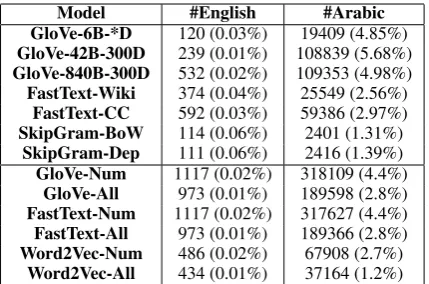
Table 1: Proportion of English and Arabic numerals containing representations in different models. Though embeddings are retrained on the same corpus, pre-processing choices (eg:lowercasing, filtering low fre-quency words etc.) result in different vocabularies
OVA requires that x+ must be the closest vector tox in the embedding space. High performance on this test would indicate that the property is cap-tured almost precisely. SC relaxes strictness by only requiring x+ to be closer than the second-closest token under propertyp. Finally BC is the least strict of the three. Models can succeed on BC if they manage to capture even an approximate no-tion ofp. We use this framework to construct three categories of contrastive tests for both magnitude and numeration. Example tests for magnitude are shown below4:
1. OVA-MAG: (3,4, x), such thatx ={y|y ∈ X− {3}, y6= 4}
2. SC-MAG: (3,4,5)
3. BC-MAG: (3,4,1000000)
Similarly for numeration,
1. OVA-NUM: (3, three, x), such that x =
{y|y∈Y, y6=three} 2. SC-NUM:(3, three, f our)
3. BC-NUM: (3, three, billion)
3 Representations
We evaluate the following embedding methods:
Skipgram (Mikolov et al., 2013a): Feedfor-ward network trained to predict words within a fixed window surrounding the current word, with hidden weights used as embeddings. We evaluate with window sizes in{2, 5}, dependency
4Note that we consider 2 and 4 equidistant from 3, so
Model OVA-MAG SC-MAG BC-MAG Random 0.04 49.82 49.34 GloVe-6B-50D 7.70 55.62 82.48 GloVe-6B-100D 10.27 57.83 82.83 GloVe-6B-200D 15.88 62.21 83.94 GloVe-6B-300D 18.41 62.92 83.98 GloVe-42B-300D 5.18 55.58 91.86 GloVe-840B-300D 11.06 55.40 88.54 FastText-Wiki 13.94 59.96 96.15 FastText-CC 7.83 53.89 85.40 SkipGram-2 7.12 55.49 95.84 SkipGram-5 8.85 55.40 96.42 SkipGram-Dep 3.32 51.99 94.60
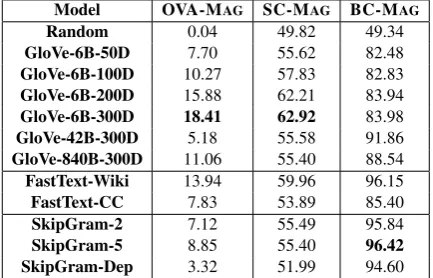
Table 2: Performance (% accuracy) of various embed-ding models on magnitude tests. We also report the performance of a random embedding baseline.
parse-based context (Levy and Goldberg,2014)
GloVe (Pennington et al., 2014): Embeddings generated by training log-bilinear models to predict global word co-occurrence statistics. We evaluate variants with #tokens in {6B, 42B, 840B}; dimensionality in{50, 100, 200, 300}
FastText (Bojanowski et al.,2017): Extended Skipgram model representing words as character n-grams to incorporate sub-word information. We evaluate Wikipedia and Common Crawl variants.
3.1 Retrained Word Vectors
We retrain all models on GigaWord5 and English Wikipedia6, under the setting: window size=5; di-mensionality=100. To evaluate whether having more occurrences of numerals in the training data correlates with better representations, we train two variants for each model: one on sentences contain-ing numbers (56M in total; 1.5B tokens) (Num), and another on 56M sentences (1.5B tokens) sub-sampled without constraints (All).
4 Experiments
How many numerals have representations? Table
1 shows the proportion of English7 and Arabic numerals in each. Overall, numerals make up less than 5% vocabulary in all models. Despite
5
We use the fourth edition:https://catalog.ldc. upenn.edu/LDC2009T13.
6We use the May 1, 2019 dump from https://
dumps.wikimedia.org/backup-index.html.
7To detect English numerals, we use word2number:
https://pypi.org/project/word2number/.
this, all variants contain representations for suffi-cient numerals to allow us to apply our framework.
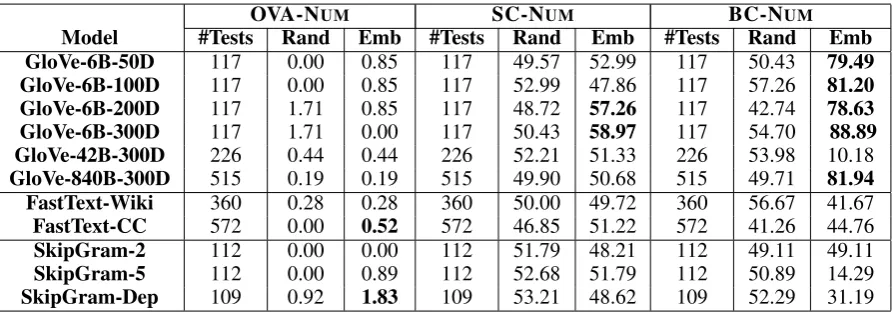
For off-the-shelf variants, we construct 2260 OVA-MAG, SC-MAG and BC-MAG tests. For numeration, we construct separate tests for each model, as there are few common numerals. Fur-ther statistics about number of tests for each model are reported in table3. For retrained embeddings, we construct 31860 OVA-MAG, SC-MAG and BC-MAG tests, 130 OVA-NUM and SC-NUM
tests, and 136 BC-NUMtests8.
4.1 Evaluating Off-The-Shelf Embeddings
Tables 2 and 3 present the performance of off-the-shelf embeddings on magnitude and numera-tion tests respectively. We use cosine similarity9 as the distance metric. High performance on BC-MAGindicates that all models capture an
approxi-mate notion of magnitude, distinguishing between very large and very small numbers. We specu-late this might be because numbers from different magnitude classes often appear in different con-texts (See §5.1). As tests become stricter, model performance drops massively. Models perform nearly 10x worse on OVA-MAG as compared to BC-MAG. This suggests model are unable to cap-ture magnitude precisely. Across models, Skip-Gram variants and FastText-Wiki perform best on BC-MAG. However, GloVe outperforms all oth-ers on OVA-MAGand SC-MAG. On numeration tests, models fare much worse. With the exception of GloVe models on BC-NUM, no model signifi-cantly outperforms a random baseline.
4.2 Evaluating Retrained Embeddings
Table4presents the performance of retrained em-beddings and a random embedding baseline on magnitude and numeration tests. There is no sig-nificant difference in performance between Num
andAllvariants, suggesting that seeing more nu-merals during training does not necessarily result in better representations. Results follow similar trends as off-the-shelf embeddings. All models capture an approximate notion of magnitude (high performance on BC-MAG), but do not capture nu-meration. Across models, FastText variants fare
8Since all embeddings are trained on the same corpus and
share the same vocabulary, there are enough common English numerals to construct a single set of numeration tests.
9We experiment with Euclidean distance, and observe
OVA-NUM SC-NUM BC-NUM
Model #Tests Rand Emb #Tests Rand Emb #Tests Rand Emb
GloVe-6B-50D 117 0.00 0.85 117 49.57 52.99 117 50.43 79.49
GloVe-6B-100D 117 0.00 0.85 117 52.99 47.86 117 57.26 81.20
GloVe-6B-200D 117 1.71 0.85 117 48.72 57.26 117 42.74 78.63
GloVe-6B-300D 117 1.71 0.00 117 50.43 58.97 117 54.70 88.89
GloVe-42B-300D 226 0.44 0.44 226 52.21 51.33 226 53.98 10.18
GloVe-840B-300D 515 0.19 0.19 515 49.90 50.68 515 49.71 81.94
FastText-Wiki 360 0.28 0.28 360 50.00 49.72 360 56.67 41.67
FastText-CC 572 0.00 0.52 572 46.85 51.22 572 41.26 44.76
SkipGram-2 112 0.00 0.00 112 51.79 48.21 112 49.11 49.11
SkipGram-5 112 0.00 0.89 112 52.68 51.79 112 50.89 14.29
[image:4.595.77.524.61.217.2]SkipGram-Dep 109 0.92 1.83 109 53.21 48.62 109 52.29 31.19
Table 3: Performance (% accuracy) of various embedding models on numeration tests. Since we construct a separate set of tests per model, we report the performance of a random embedding model for each set (Rand). Bolded numbers highlight cases where performance is higher than both random embedding and random choice. Note that random choice performance for OVA-NUMis #T ests1 .
Model Magnitude Numeration
OVA-MAG SC-MAG BC-MAG OVA-NUM SC-NUM BC-NUM
random 0.00 49.62 49.71 2.31 47.69 53.68
GloVe-Num 0.01 49.47 72.76 0.00 50.00 19.85
GloVe-All 0.01 49.08 74.02 0.00 46.15 19.85
FastText-Num 0.09 51.05 96.69 1.54 54.62 58.09
FastText-All 0.09 51.16 97.90 0.00 46.92 61.03
Word2Vec-Num 0.02 50.12 93.55 0.77 44.62 33.82
[image:4.595.110.493.286.381.2]Word2Vec-All 0.02 49.37 94.20 0.00 54.62 34.56
Table 4: Performance (% accuracy) of various (retrained) embedding models on magnitude and numeration tests.
best.
5 Discussion
5.1 Performance on Magnitude Tests
Tables 2 and 4 show that most models do not capture magnitudeprecisely (low performance on OVA-MAG; SC-MAG), but seem to learn an ap-proximate notion of magnitude (high performance on BC-MAG) 10. To examine the difference in contexts that separates numbers of vastly varying magnitudes, we sample 1 million sentences con-taining numbers from English Wikipedia and Gi-gaWord and compute pointwise mutual informa-tion (PMI), defined as
PMI (number,class) =log p(number,class) p(number,·)p(·,class)
10
Cognitive studies show that human babies initially start recognizing numbers by approximation and their ability to identify numbers precisely improves over their lifespan ( Hal-berda et al.,2012). (Moyer and Landauer,1967) were the first to observe that humans took longer to distinguish between closer numbers (eg: 8 and 9) than numbers which were fur-ther away in distance (eg: 2 and 9). This finding has since been replicated several times (Dehaene,2011). In our frame-work, models find it harder to distinguish between closer numbers (SC-MAG) than distant numbers (BC-MAG)- how-ever the differences here likely arise from different contexts in which numbers of vastly varying magnitudes are used.
between the contexts of primitive numbers (numbers 1-10) and large numbers (>500,>1000, >3000,>10000, >100000) as shown in Table5. We consider the word immediately following the number as context, since it appears in the context of the number across embedding methods, regard-less of sliding window size. We apply add-100 smoothing to identify contexts with maximum dis-criminatory power.
Primitives λ= 500 Primitives λ= 1000 Primitivesλ= 3000 Primitivesλ= 10000 Primitivesλ= 100000
Wiki
% Summer % Summer % BC % Exchange % Elected
July Census million Census million RPM million HD million Ontario
January Film July Film July BCE July Departs May Owner
April World January World January Inhabitants January Delhi July Spinneys September Election April Election May Hollywood May Raxaul January Thana
GW
percent index percent World percent DOWN percent novos percent novos
p.m GMT million GMT million Composite million ZIP million Tel
a.m World billion Olympic billion block billion University billion NDI
trillion Olympic p.m Olympics p.m LAS points UP points Refugees
[image:5.595.78.523.67.190.2]billion Olympics years season years UP p.m Old p.m Eritrean
Table 5: Top 5 nouns byP M I(word,class)for primives and large numbers (numbers> λ), in 1 million sentences drawn from Wikipedia (wiki) and GigaWord (GW) respectively.
leading to good performance on BC-MAG.
5.2 Recovering magnitude information from nearest neighbours
Model performance on SC-MAG and BC-MAG
indicates whether ordering relationships between a number,its closest, second-closest, and furthest numbers are maintained. However, infinite num-bers exist, making it infeasible to construct con-trastive tests to check ordering relationships be-tween all triples. To mitigate this, we experiment with a paradigm that performs regression with a number’s nearest neighbors to predict its magni-tude. If magnitude can be recovered from the structure of the embedding space, this provides ev-idence that magnitude ordering relations are main-tained to some extent. For this experiment, we di-vide the set of 2260 numbers common across off-the-shelf variants11 into training (80%) and test (20%) sets and run a kNN (k-nearest neighbor) regressor model to predict magnitude. R2 scores for are shown in table6. Most models show rea-sonably high R2 scores, indicating that some or-dering relationships must be maintained, helping embeddings capture approximate notions of mag-nitude. While this property of current embedding models is interesting, their failure to capture pre-cise magnitude is an important issue. Word em-beddings are used for semantic tasks such as natu-ral language inference or reading comprehension, wherein models might need to reason more pre-cisely about numbers.
6 Conclusion
Current NLP systems rely heavily on word em-beddings. In this work we demonstrate that three
11We do this to compare results across all models.
Re-trained variants contain embeddings for all 2260 numbers.
Model R2 Score
GloVe-6B-50D 0.53
GloVe-6B-100D 0.75
GloVe-6B-200D 0.67
GloVe-6B-300D 0.62
GloVe-42B-300D 0.44
GloVe-840B-300D 0.83
FastText-Wiki 0.71
FastText-CC 0.56
SkipGram-2 0.67
SkipGram-5 0.76
SkipGram-Dep 0.41
GloVe-Num 0.12
GloVe-All 0.30
FastText-Num 0.73
FastText-All 0.47
Word2Vec-Num 0.68
Word2Vec-All 0.65
Table 6: Results of kNN Regression Test for Magnitude
popular embedding models are inadequate at deal-ing precisely with numbers, in two aspects: mag-nitude and numeration. We hope this work will promote a more careful treatment of language, and serve a cautionary purpose against using word em-beddings in downstream tasks without recognizing their limitations. This work also raises important questions about other categories of word-like to-kens that need to be treated like special cases. We hope the community will carefully consider that distributed word representations cannot be relied upon in all scenarios.
7 Acknowledgements
[image:5.595.351.480.241.426.2]References
Christian Agrillo, Laura Piffer, Angelo Bisazza, and Brian Butterworth. 2012. Evidence for two numeri-cal systems that are similar in humans and guppies.
PloS one, 7(2):e31923.
Piotr Bojanowski, Edouard Grave, Armand Joulin, and Tomas Mikolov. 2017. Enriching word vectors with subword information. Transactions of the Associa-tion for ComputaAssocia-tional Linguistics, 5:135–146.
Jessica F Cantlon and Elizabeth M Brannon. 2006. Shared system for ordering small and large num-bers in monkeys and humans. Psychological sci-ence, 17(5):401–406.
Ronan Collobert and Jason Weston. 2008. A unified architecture for natural language processing: Deep neural networks with multitask learning. In Pro-ceedings of the 25th international conference on Machine learning, pages 160–167. ACM.
Simone Cutini and Mario Bonato. 2012. Subitizing and visual short-term memory in human and non-human species: a common shared system? Number without language: comparative psychology and the evolu-tion of numerical cognievolu-tion, 129.
Stanislas Dehaene. 2011. The number sense: How the mind creates mathematics. OUP USA.
Stanislas Dehaene, Ghislaine Dehaene-Lambertz, and Laurent Cohen. 1998. Abstract representations of numbers in the animal and human brain. Trends in neurosciences, 21(8):355–361.
Lisa Feigenson, Stanislas Dehaene, and Elizabeth Spelke. 2004. Core systems of number. Trends in cognitive sciences, 8(7):307–314.
J. Firth. 1957. A synopsis of linguistic theory 1930-1955. InStudies in Linguistic Analysis. Philological Society, Oxford. Reprinted in Palmer, F. (ed. 1968) Selected Papers of J. R. Firth, Longman, Harlow.
Xavier Glorot, Antoine Bordes, and Yoshua Bengio. 2011. Domain adaptation for large-scale sentiment classification: A deep learning approach. In Pro-ceedings of the 28th international conference on ma-chine learning (ICML-11), pages 513–520.
Hans J Gross. 2011. To bee or not to bee, this is the question the inborn numerical competence of hu-mans and honeybees: The inborn numerical com-petence of humans and honeybees. Communicative & integrative biology, 4(5):594–597.
Justin Halberda, Ryan Ly, Jeremy B Wilmer, Daniel Q Naiman, and Laura Germine. 2012. Number sense across the lifespan as revealed by a massive internet-based sample. Proceedings of the National Academy of Sciences, 109(28):11116–11120.
Zellig S Harris. 1954. Distributional structure. Word, 10(2-3):146–162.
V´eronique Izard and Stanislas Dehaene. 2008. Cal-ibrating the mental number line. Cognition, 106(3):1221–1247.
Omer Levy and Yoav Goldberg. 2014. Dependency-based word embeddings. In Proceedings of the 52nd Annual Meeting of the Association for Com-putational Linguistics (Volume 2: Short Papers), pages 302–308, Baltimore, Maryland. Association for Computational Linguistics.
Marie-Catherine Marneffe, Anna N Rafferty, and Christopher D Manning. 2008. Finding contradic-tions in text. Proceedings of ACL-08: HLT, pages 1039–1047.
Tomas Mikolov, Kai Chen, Greg Corrado, and Jef-frey Dean. 2013a. Efficient estimation of word representations in vector space. arXiv preprint arXiv:1301.3781.
Tomas Mikolov, Ilya Sutskever, Kai Chen, Greg S Cor-rado, and Jeff Dean. 2013b. Distributed representa-tions of words and phrases and their compositional-ity. InAdvances in neural information processing systems, pages 3111–3119.
Tomas Mikolov, Wen-tau Yih, and Geoffrey Zweig. 2013c. Linguistic regularities in continuous space word representations. InProceedings of the 2013 Conference of the North American Chapter of the Association for Computational Linguistics: Human Language Technologies, pages 746–751, Atlanta, Georgia. Association for Computational Linguistics.
Jeff Mitchell and Mirella Lapata. 2009. Language models based on semantic composition. In Proceed-ings of the 2009 Conference on Empirical Methods in Natural Language Processing: Volume 1-Volume 1, pages 430–439. Association for Computational Linguistics.
Robert S Moyer and Thomas K Landauer. 1967. Time required for judgements of numerical inequality.
Nature, 215(5109):1519.
Aakanksha Naik, Abhilasha Ravichander, Norman Sadeh, Carolyn Rose, and Graham Neubig. 2018. Stress test evaluation for natural language inference. InProceedings of the 27th International Conference on Computational Linguistics, pages 2340–2353, Santa Fe, New Mexico, USA. Association for Com-putational Linguistics.
Jeffrey Pennington, Richard Socher, and Christopher Manning. 2014. Glove: Global vectors for word representation. In Proceedings of the 2014 Con-ference on Empirical Methods in Natural Language Processing (EMNLP), pages 1532–1543, Doha, Qatar. Association for Computational Linguistics.
Bertrand Russell. 2009. Principles of mathematics. Routledge.
Georgios P Spithourakis and Sebastian Riedel. 2018. Numeracy for language models: Evaluating and im-proving their ability to predict numbers. arXiv preprint arXiv:1805.08154.
Peter D Turney. 2013. Distributional semantics beyond words: Supervised learning of analogy and para-phrase. Transactions of the Association for Com-putational Linguistics, 1:353–366.
Peter D Turney and Patrick Pantel. 2010. From fre-quency to meaning: Vector space models of se-mantics. Journal of artificial intelligence research, 37:141–188.
John Whalen, Charles R Gallistel, and Rochel Gelman. 1999. Nonverbal counting in humans: The psy-chophysics of number representation. Psychologi-cal Science, 10(2):130–137.
Jiajie Zhang and Donald A Norman. 1995. A represen-tational analysis of numeration systems. Cognition, 57(3):271–295.
Xunjie Zhu, Tingfeng Li, and Gerard de Melo. 2018. Exploring semantic properties of sentence embed-dings. InProceedings of the 56th Annual Meeting of the Association for Computational Linguistics (Vol-ume 2: Short Papers), pages 632–637, Melbourne, Australia. Association for Computational Linguis-tics.
A Magnitude Tests with Euclidean Distance
Table7describes the performance of word embed-ding models on magnitude tests with Euclidean distance.
Model OVA-MAG SC-MAG BC-MAG
Random 0.04 49.82 49.34
GloVe-6B-50D 7.7 54.87 79.78
GloVe-6B-100D 10.27 57.12 78.5
GloVe-6B-200D 15.88 58.72 80.09
GloVe-6B-300D 18.41 60.44 79.82
GloVe-42B-300D 5.18 55.27 55.09
GloVe-840B-300D 11.06 55.49 98.23
SkipGram-2 8.85 55.35 96.37
SkipGram-5 7.12 55.44 95.8
SkipGram-Dep 3.32 51.95 94.56
FastText-CC 7.83 54.07 91.28
FastText-Wiki 13.94 59.34 98.19
Table 7: Performance (% accuracy) of embedding models on magnitude tests with Euclidean distance
B Numeration Tests with Euclidean Distance
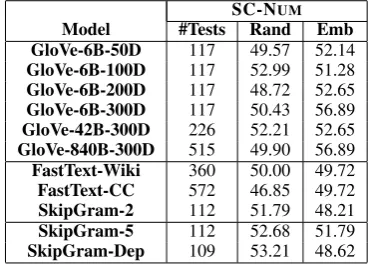
Tables8 and9 describe the performance of word embedding models on numeration tests with Eu-clidean distance.
SC-NUM
Model #Tests Rand Emb
GloVe-6B-50D 117 49.57 52.14
GloVe-6B-100D 117 52.99 51.28
GloVe-6B-200D 117 48.72 52.65
GloVe-6B-300D 117 50.43 56.89
GloVe-42B-300D 226 52.21 52.65
GloVe-840B-300D 515 49.90 56.89
FastText-Wiki 360 50.00 49.72
FastText-CC 572 46.85 49.72
SkipGram-2 112 51.79 48.21
SkipGram-5 112 52.68 51.79
SkipGram-Dep 109 53.21 48.62
Table 8: Performance (% accuracy) of embedding models on SC-NUM
BC-NUM
Model #Tests Rand Emb
GloVe-6B-50D 117 50.43 99.15
GloVe-6B-100D 117 57.26 100.0
GloVe-6B-200D 117 42.74 2.21
GloVe-6B-300D 117 54.70 87.57
GloVe-42B-300D 226 53.98 2.21
GloVe-840B-300D 515 49.71 87.57
FastText-Wiki 360 56.67 98.89
FastText-CC 572 41.26 98.89
SkipGram-2 112 49.11 49.11
SkipGram-5 112 50.89 14.29
SkipGram-Dep 109 52.29 31.19
[image:7.595.323.510.153.286.2] [image:7.595.75.513.503.638.2]