2263
Explicit Utilization of General Knowledge
in Machine Reading Comprehension
Chao Wang and Hui Jiang
Department of Electrical Engineering and Computer Science Lassonde School of Engineering, York University
4700 Keele Street, Toronto, Ontario, Canada
{chwang, hj}@eecs.yorku.ca
Abstract
To bridge the gap between Machine Reading Comprehension (MRC) models and human beings, which is mainly reflected in the hunger for data and the robustness to noise, in this paper, we explore how to integrate the neu-ral networks of MRC models with the geneneu-ral knowledge of human beings. On the one hand, we propose a data enrichment method, which uses WordNet to extract inter-word semantic connections as general knowledge from each given passage-question pair. On the other hand, we propose an end-to-end MRC model named as Knowledge Aided Reader (KAR), which explicitly uses the above extracted gen-eral knowledge to assist its attention mecha-nisms. Based on the data enrichment method, KAR is comparable in performance with the state-of-the-art MRC models, and significantly more robust to noise than them. When only a subset (20%–80%) of the training examples are available, KAR outperforms the state-of-the-art MRC models by a large margin, and is still reasonably robust to noise.
1 Introduction
Machine Reading Comprehension (MRC), as the name suggests, requires a machine to read a pas-sage and answer its relevant questions. Since the answer to each question is supposed to stem from the corresponding passage, a common MRC so-lution is to develop a neural-network-based MRC model that predicts an answer span (i.e. the an-swer start position and the anan-swer end position) from the passage of each given passage-question pair. To facilitate the explorations and innovations in this area, many MRC datasets have been estab-lished, such as SQuAD (Rajpurkar et al., 2016), MS MARCO (Nguyen et al., 2016), and Trivi-aQA (Joshi et al.,2017). Consequently, many pi-oneering MRC models have been proposed, such as BiDAF (Seo et al.,2016), R-NET (Wang et al.,
2017), and QANet (Yu et al., 2018). According
to the leader board of SQuAD, the state-of-the-art MRC models have achieved the same performance as human beings. However, does this imply that they have possessed the same reading comprehen-sion ability as human beings?
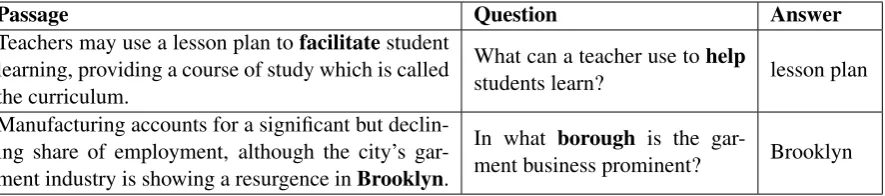
OF COURSE NOT. There is a huge gap between MRC models and human beings, which is mainly reflected in the hunger for data and the robust-ness to noise. On the one hand, developing MRC models requires a large amount of training exam-ples (i.e. the passage-question pairs labeled with answer spans), while human beings can achieve good performance on evaluation examples (i.e. the passage-question pairs to address) without training examples. On the other hand,Jia and Liang(2017) revealed that intentionally injected noise (e.g. mis-leading sentences) in evaluation examples causes the performance of MRC models to drop signif-icantly, while human beings are far less likely to suffer from this. The reason for these phenomena, we believe, is that MRC models can only utilize the knowledge contained in each given passage-question pair, but in addition to this, human beings can also utilize general knowledge. A typical cate-gory of general knowledge is inter-word semantic connections. As shown in Table 1, such general knowledge is essential to the reading comprehen-sion ability of human beings.
Passage Question Answer
Teachers may use a lesson plan tofacilitatestudent learning, providing a course of study which is called the curriculum.
What can a teacher use tohelp
students learn? lesson plan
Manufacturing accounts for a significant but declin-ing share of employment, although the city’s gar-ment industry is showing a resurgence inBrooklyn.
In what borough is the
[image:2.595.82.525.62.160.2]gar-ment business prominent? Brooklyn
Table 1: Two examples about the importance of inter-word semantic connections to the reading comprehension ability of human beings: in the first one, we can find the answer because we know “facilitate” is a synonym of “help”; in the second one, we can find the answer because we know “Brooklyn” is a hyponym of “borough”.
Freebase (Bollacker et al., 2008) storing factoid knowledge. In this paper, we limit the scope of general knowledge to inter-word semantic con-nections, and thus use WordNet as our knowl-edge base. The existing way to solve the second problem is to encode general knowledge in vector space so that the encoding results can be used to enhance the lexical or contextual representations of words (Weissenborn et al.,2017;Mihaylov and Frank, 2018). However, this is an implicit way to utilize general knowledge, since in this way we can neither understand nor control the functioning of general knowledge. In this paper, we discard the existing implicit way and instead explore an explicit (i.e. understandable and controllable) way to utilize general knowledge.
The contribution of this paper is two-fold. On the one hand, we propose a data enrichment method, which uses WordNet to extract inter-word seman-tic connections as general knowledge from each given passage-question pair. On the other hand, we propose an end-to-end MRC model named as Knowledge Aided Reader (KAR), which explic-itly uses the above extracted general knowledge to assist its attention mechanisms. Based on the data enrichment method, KAR is comparable in per-formance with the state-of-the-art MRC models, and significantly more robust to noise than them. When only a subset (20%–80%) of the training ex-amples are available, KAR outperforms the state-of-the-art MRC models by a large margin, and is still reasonably robust to noise.
2 Data Enrichment Method
In this section, we elaborate a WordNet-based data enrichment method, which is aimed at extract-ing inter-word semantic connections from each passage-question pair in our MRC dataset. The extraction is performed in a controllable manner,
and the extracted results are provided as general knowledge to our MRC model.
2.1 Semantic Relation Chain
WordNet is a lexical database of English, where words are organized into synsets according to their senses. A synset is a set of words expressing the same sense so that a word having multiple senses belongs to multiple synsets, with each synset cor-responding to a sense. Synsets are further related to each other through semantic relations. Accord-ing to the WordNet interface provided by NLTK (Bird and Loper, 2004), there are totally sixteen types of semantic relations (e.g. hypernyms, hy-ponyms, holonyms, meronyms, attributes, etc.). Based on synset and semantic relation, we define a new concept: semantic relation chain. A semantic relation chain is a concatenated sequence of se-mantic relations, which links a synset to another synset. For example, the synset “keratin.n.01” is related to the synset “feather.n.01” through the semantic relation “substance holonym”, the synset “feather.n.01” is related to the synset “bird.n.01” through the semantic relation “part holonym”, and the synset “bird.n.01” is related to the synset “parrot.n.01” through the semantic relation “hyponym”, thus “substance holonym→
part holonym→hyponym” is a semantic relation chain, which links the synset “keratin.n.01” to the synset “parrot.n.01”. We name each semantic re-lation in a semantic rere-lation chain as a hop, there-fore the above semantic relation chain is a3-hop chain. By the way, each single semantic relation is equivalent to a1-hop chain.
2.2 Inter-word Semantic Connection
them. To solve this problem, we define another new concept: the extended synsets of a word. Given a wordw, whose synsets are represented as a set Sw, we use another set Sw∗ to represent its extended synsets, which includes all the synsets that are in Sw or that can be linked to from Sw through semantic relation chains. Theoretically, if there is no limitation on semantic relation chains,
Sw∗ will include all the synsets in WordNet, which is meaningless in most situations. Therefore, we use a hyper-parameterκ∈Nto represent the
per-mitted maximum hop count of semantic relation chains. That is to say, only the chains having no more thanκhops can be used to constructSw∗ so thatSw∗ becomes a function ofκ:Sw∗(κ)(ifκ= 0, we will have Sw∗(0) = Sw). Based on the above statements, we formulate a heuristic rule for deter-mining inter-word semantic connections: a word
w1 is semantically connected to another wordw2
if and only ifSw∗1(κ)∩Sw2 6=∅.
2.3 General Knowledge Extraction
Given a passage-question pair, the inter-word se-mantic connections that connect any word to any passage word are regarded as the general knowl-edge we need to extract. Considering the require-ments of our MRC model, we only extract the positional information of such inter-word seman-tic connections. Specifically, for each word w, we extract a setEw, which includes the positions of the passage words thatw is semantically con-nected to (if w itself is a passage word, we will exclude its own position fromEw). We can con-trol the amount of the extracted results by setting the hyper-parameterκ: if we setκto0, inter-word semantic connections will only exist between syn-onyms; if we increaseκ, inter-word semantic con-nections will exist between more words. That is to say, by increasingκwithin a certain range, we can usually extract more inter-word semantic connec-tions from a passage-question pair, and thus can provide the MRC model with more general knowl-edge. However, due to the complexity and diver-sity of natural languages, only a part of the ex-tracted results can serve as useful general knowl-edge, while the rest of them are useless for the prediction of answer spans, and the proportion of the useless part always rises whenκis set larger. Therefore we setκ through cross validation (i.e. according to the performance of the MRC model on the development examples).
3 Knowledge Aided Reader
In this section, we elaborate our MRC model: Knowledge Aided Reader (KAR). The key com-ponents of most existing MRC models are their attention mechanisms (Bahdanau et al., 2014), which are aimed at fusing the associated represen-tations of each given passage-question pair. These attention mechanisms generally fall into two cat-egories: the first one, which we name as mutual attention, is aimed at fusing the question repre-sentations into the passage reprerepre-sentations so as to obtain the question-aware passage representa-tions; the second one, which we name as self at-tention, is aimed at fusing the question-aware pas-sage representations into themselves so as to ob-tain the final passage representations. Although KAR is equipped with both categories, its most re-markable feature is that it explicitly uses the gen-eral knowledge extracted by the data enrichment method to assist its attention mechanisms. There-fore we separately name the attention mechanisms of KAR as knowledge aided mutual attention and knowledge aided self attention.
3.1 Task Definition
Given a passageP ={p1, . . . , pn}and a relevant questionQ ={q1, . . . , qm}, the task is to predict an answer span[as, ae], where1 ≤as ≤ae≤n, so that the resulting subsequence {pas, . . . , pae}
fromP is an answer toQ.
3.2 Overall Architecture
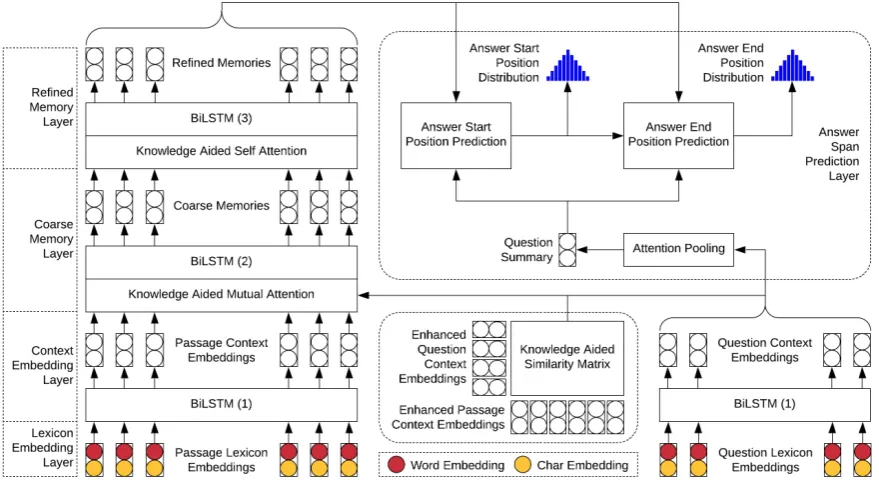
As shown in Figure1, KAR is an end-to-end MRC model consisting of five layers:
Lexicon Embedding Layer. This layer maps the words to the lexicon embeddings. The lexicon bedding of each word is composed of its word em-bedding and character emem-bedding. For each word, we use the pre-trained GloVe (Pennington et al.,
2014) word vector as its word embedding, and ob-tain its character embedding with a Convolutional Neural Network (CNN) (Kim, 2014). For both the passage and the question, we pass the con-catenation of the word embeddings and the charac-ter embeddings through a shared dense layer with ReLU activation, whose output dimensionality is
d. Therefore we obtain the passage lexicon em-beddings LP ∈ Rd×n and the question lexicon
embeddingsLQ ∈Rd×m.
Figure 1: An end-to-end MRC model: Knowledge Aided Reader (KAR)
For both the passage and the question, we process the lexicon embeddings (i.e. LP for the passage and LQ for the question) with a shared bidirec-tional LSTM (BiLSTM) (Hochreiter and Schmid-huber, 1997), whose hidden state dimensionality is 12d. By concatenating the forward LSTM out-puts and the backward LSTM outout-puts, we obtain the passage context embeddingsCP ∈ Rd×n and
the question context embeddingsCQ∈Rd×m. Coarse Memory Layer.This layer maps the con-text embeddings to the coarse memories. First we use knowledge aided mutual attention (introduced later) to fuseCQintoCP, the outputs of which are represented as G˜ ∈ Rd×n. Then we process G˜ with a BiLSTM, whose hidden state dimension-ality is 12d. By concatenating the forward LSTM outputs and the backward LSTM outputs, we ob-tain the coarse memories G ∈ Rd×n, which are the question-aware passage representations.
Refined Memory Layer. This layer maps the coarse memories to the refined memories. First we use knowledge aided self attention (introduced later) to fuse G into themselves, the outputs of which are represented as H˜ ∈ Rd×n. Then we processH˜ with a BiLSTM, whose hidden state di-mensionality is 12d. By concatenating the forward LSTM outputs and the backward LSTM outputs, we obtain the refined memoriesH∈Rd×n, which
are the final passage representations.
Answer Span Prediction Layer. This layer
pre-dicts the answer start position and the answer end position based on the above layers. First we obtain the answer start position distributionos:
ti =vs>tanh(Wshpi+UsrQ)∈R
os= softmax({t1, . . . , tn})∈Rn
where vs, Ws, and Us are trainable parameters;
hpirepresents the refined memory of each passage
wordpi(i.e. thei-th column inH);rQrepresents the question summary obtained by performing an attention pooling overCQ. Then we obtain the an-swer end position distributionoe:
ti =ve>tanh(Wehpi+Ue[rQ;Hos])∈R
oe= softmax({t1, . . . , tn})∈Rn
where ve, We, and Ue are trainable parameters;
[; ] represents vector concatenation. Finally we construct an answer span prediction matrixO = uptri(oso>e)∈ Rn×n, whereuptri(X)represents the upper triangular matrix of a matrixX. There-fore, for the training, we minimize−log(Oas,ae)
on each training example whose labeled answer span is [as, ae]; for the inference, we separately take the row index and column index of the maxi-mum element inOasasandae.
3.3 Knowledge Aided Mutual Attention
ques-tion context embeddingsCQinto the passage con-text embeddingsCP, where the key problem is to calculate the similarity between each passage con-text embedding cpi (i.e. the i-th column in CP)
and each question context embeddingcqj (i.e. the
j-th column in CQ). To solve this problem, Seo
et al.(2016) proposed a similarity function:
f(cpi, cqj) =v
>
f[cpi;cqj;cpicqj]∈R
where vf is a trainable parameter; represents element-wise multiplication. This similarity func-tion has also been adopted by several other works (Clark and Gardner,2017;Yu et al.,2018). How-ever, since context embeddings contain high-level information, we believe that introducing the pre-extracted general knowledge into the calculation of such similarities will make the results more rea-sonable. Therefore we modify the above similarity function to the following form:
f∗(cpi, cqj) =v
>
f[c∗pi;c
∗
qj;c
∗
pic
∗
qj]∈R
wherec∗xrepresents the enhanced context embed-ding of a wordx. We use the pre-extracted gen-eral knowledge to construct the enhanced context embeddings. Specifically, for each wordw, whose context embedding iscw, to construct its enhanced context embedding c∗w, first recall that we have extracted a set Ew, which includes the positions of the passage words thatw is semantically con-nected to, thus by gathering the columns in CP whose indexes are given by Ew, we obtain the matching context embeddingsZ ∈Rd×|Ew|. Then
by constructing acw-attended summary ofZ, we obtain the matching vectorc+w (ifEw =∅, which makesZ ={}, we will setc+w = 0):
ti =vc>tanh(Wczi+Uccw)∈R
c+w =Z softmax({t1, . . . , t|Ew|})∈R
d
wherevc,Wc, andUcare trainable parameters;zi represents thei-th column inZ. Finally we pass the concatenation of cw and c+w through a dense layer with ReLU activation, whose output dimen-sionality isd. Therefore we obtain the enhanced context embeddingc∗w ∈Rd.
Based on the modified similarity function and the enhanced context embeddings, to perform knowledge aided mutual attention, first we con-struct a knowledge aided similarity matrix A ∈ Rn×m, where each element Ai,j = f∗(cpi, cqj).
Then followingYu et al.(2018), we construct the
passage-attended question summariesRQand the question-attended passage summariesRP:
RQ=CQsoftmax>r(A)∈Rd×n
RP =CP softmaxc(A) softmax>r(A)∈Rd×n
wheresoftmaxrrepresents softmax along the row dimension andsoftmaxcalong the column dimen-sion. Finally followingClark and Gardner(2017), we pass the concatenation ofCP,RQ,CP RQ, andRPRQthrough a dense layer with ReLU ac-tivation, whose output dimensionality isd. There-fore we obtain the outputsG˜∈Rd×n.
3.4 Knowledge Aided Self Attention
As a part of the refined memory layer, knowledge aided self attention is aimed at fusing the coarse memories G into themselves. If we simply fol-low the self attentions of other works (Wang et al.,
2017;Huang et al.,2017;Liu et al.,2017b;Clark and Gardner, 2017), then for each passage word
pi, we should fuse its coarse memorygpi (i.e. the
i-th column in G) with the coarse memories of all the other passage words. However, we believe that this is both unnecessary and distracting, since each passage word has nothing to do with many of the other passage words. Thus we use the pre-extracted general knowledge to guarantee that the fusion of coarse memories for each passage word will only involve a precise subset of the other pas-sage words. Specifically, for each paspas-sage word
pi, whose coarse memory isgpi, to perform the
fu-sion of coarse memories, first recall that we have extracted a setEpi, which includes the positions
of the other passage words thatpi is semantically connected to, thus by gathering the columns inG
whose indexes are given by Epi, we obtain the
matching coarse memoriesZ ∈ Rd×|Epi|. Then
by constructing agpi-attended summary ofZ, we
obtain the matching vectorg+
pi (ifEpi =∅, which
makesZ ={}, we will setgp+i = 0):
ti =vg>tanh(Wgzi+Uggpi)∈R
gp+i =Zsoftmax({t1, . . . , t|Epi|})∈Rd
where vg, Wg, and Ug are trainable parameters. Finally we pass the concatenation of gpi and
g+pi through a dense layer with ReLU activation, whose output dimensionality is d. Therefore we obtain the fusion resulth˜pi ∈R
d, and further the
outputsH˜ ={˜hp1, . . . ,˜hpn} ∈R
4 Related Works
Attention Mechanisms.Besides those mentioned above, other interesting attention mechanisms in-clude performing multi-round alignment to avoid the problems of attention redundancy and atten-tion deficiency (Hu et al.,2017), and using mutual attention as a skip-connector to densely connect pairwise layers (Tay et al.,2018).
Data Augmentation. It is proved that properly augmenting training examples can improve the performance of MRC models. For example,Yang et al.(2017) trained a generative model to generate questions based on unlabeled text, which substan-tially boosted their performance; Yu et al.(2018) trained a back-and-forth translation model to para-phrase training examples, which brought them a significant performance gain.
Multi-step Reasoning. Inspired by the fact that human beings are capable of understanding com-plex documents by reading them over and over again, multi-step reasoning was proposed to bet-ter deal with difficult MRC tasks. For example,
Shen et al.(2017) used reinforcement learning to dynamically determine the number of reasoning steps; Liu et al.(2017b) fixed the number of rea-soning steps, but used stochastic dropout in the output layer to avoid step bias.
Linguistic Embeddings.It is both easy and effec-tive to incorporate linguistic embeddings into the input layer of MRC models. For example, Chen et al.(2017) andLiu et al.(2017b) used POS em-beddings and NER emem-beddings to construct their input embeddings; Liu et al. (2017a) used struc-tural embeddings based on parsing trees to con-structed their input embeddings.
Transfer Learning.Several recent breakthroughs in MRC benefit from feature-based transfer learn-ing (McCann et al.,2017;Peters et al.,2018) and fine-tuning-based transfer learning (Radford et al.,
2018; Devlin et al., 2018), which are based on certain word-level or sentence-level models pre-trained on large external corpora in certain super-vised or unsupersuper-vised manners.
5 Experiments
5.1 Experimental Settings
MRC Dataset. The MRC dataset used in this pa-per is SQuAD 1.1, which contains over100,000
passage-question pairs and has been randomly par-titioned into three parts: a training set (80%),
a development set (10%), and a test set (10%). Besides, we also use two of its adversarial sets, namely AddSent and AddOneSent (Jia and Liang,
2017), to evaluate the robustness to noise of MRC models. The passages in the adversarial sets con-tain misleading sentences, which are aimed at dis-tracting MRC models. Specifically, each passage in AddSent contains several sentences that are similar to the question but not contradictory to the answer, while each passage in AddOneSent con-tains a human-approved random sentence that may be unrelated to the passage.
Implementation Details. We tokenize the MRC dataset with spaCy 2.0.13 (Honnibal and Mon-tani, 2017), manipulate WordNet 3.0 with NLTK 3.3, and implement KAR with TensorFlow 1.11.0 (Abadi et al., 2016). For the data enrichment method, we set the hyper-parameterκto3. For the dense layers and the BiLSTMs, we set the dimen-sionality unitd to600. For model optimization, we apply the Adam (Kingma and Ba,2014) opti-mizer with a learning rate of 0.0005and a mini-batch size of 32. For model evaluation, we use Exact Match (EM) and F1 score as evaluation met-rics. To avoid overfitting, we apply dropout ( Sri-vastava et al., 2014) to the dense layers and the BiLSTMs with a dropout rate of0.3. To boost the performance, we apply exponential moving aver-age with a decay rate of0.999.
5.2 Model Comparison in both Performance and the Robustness to Noise
Single MRC model Dev set (EM / F1)
Test set (EM / F1)
AddSent (F1)
AddOneSent (F1)
FusionNet (Huang et al.,2017) 75.3 / 83.6 76.0 / 83.9 51.4 60.7
RaSoR+TR+LM (Salant and
Be-rant,2017) 77.0 / 84.0 77.6 / 84.2 47.0 57.0
SAN (Liu et al.,2017b) 76.2 / 84.1 76.8 / 84.4 46.6 56.5
R.M-Reader (Hu et al.,2017) 78.9 / 86.3 79.5 / 86.6 58.5 67.0
QANet (with data augmentation)
(Yu et al.,2018) 75.1 / 83.8 82.5 / 89.3 45.2 55.7
[image:7.595.75.525.62.202.2]KAR (ours) 76.7 / 84.9 76.1 / 83.5 60.1 72.3
Table 2: Model comparison based on SQuAD 1.1 and two of its adversarial sets: AddSent and AddOneSent. All the numbers are up to date as of October 18, 2018. Note that SQuAD 2.0 (Rajpurkar et al.,2018) is not involved in this paper, because it requires MRC models to deal with the problem of answer triggering, but this paper is aimed at improving the hunger for data and robustness to noise of MRC models.
To verify the effectiveness of general knowledge, we first study the relationship between the amount of general knowledge and the performance of KAR. As shown in Table3, by increasingκ from
0to5in the data enrichment method, the amount of general knowledge rises monotonically, but the performance of KAR first rises until κ reaches3
and then drops down. Then we conduct an ablation study by replacing the knowledge aided attention mechanisms with the mutual attention proposed bySeo et al.(2016) and the self attention proposed byWang et al.(2017) separately, and find that the F1 score of KAR drops by4.2on the development set,7.8on AddSent, and9.1on AddOneSent. Fi-nally we find that after only one epoch of train-ing, KAR already achieves an EM of71.9and an F1 score of80.8on the development set, which is even better than the final performance of several strong baselines, such as DCN (EM / F1: 65.4 /
75.6) (Xiong et al.,2016) and BiDAF (EM / F1:
67.7/77.3) (Seo et al.,2016). The above empiri-cal findings imply that general knowledge indeed plays an effective role in KAR.
To demonstrate the advantage of our explicit way to utilize general knowledge over the existing im-plicit way, we compare the performance of KAR with that reported by Weissenborn et al. (2017), which used an encoding-based method to utilize the general knowledge dynamically retrieved from Wikipedia and ConceptNet. Since their best model only achieved an EM of69.5and an F1 score of
79.7on the development set, which is much lower than the performance of KAR, we have good rea-son to believe that our explicit way works better than the existing implicit way.
κ
Average number of inter-word semantic connections per word
Dev set (EM / F1)
0 0.39 74.2 / 82.8
1 0.63 74.6 / 83.1
2 1.24 75.1 / 83.5
3 2.21 76.7 / 84.9
4 3.68 75.9 / 84.3
5 5.58 75.3 / 83.8
Table 3: Withκset to different values in the data en-richment method, we calculate the average number of inter-word semantic connections per word as an estima-tion of the amount of general knowledge, and evaluate the performance of KAR on the development set.
5.3 Model Comparison in the Hunger for Data
[image:7.595.308.525.279.406.2]Figure 2: With KAR, SAN, and QANet (without data augmentation) trained on the training subsets, we eval-uate their performance on the development set.
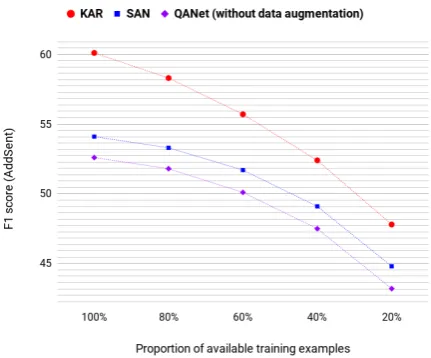
Figure 3: With KAR, SAN, and QANet (without data augmentation) trained on the training subsets, we eval-uate their performance on AddSent.
performs much better than SAN and QANet. As shown in Figure 3 and Figure 4, with the above KAR, SAN, and QANet trained on the same train-ing subsets, we also evaluate their performance on the adversarial sets, and still find that KAR per-forms much better than SAN and QANet. That is to say, when only a subset of the training exam-ples are available, KAR outperforms the state-of-the-art MRC models by a large margin, and is still reasonably robust to noise.
6 Analysis
According to the experimental results, KAR is not only comparable in performance with the state-of-the-art MRC models, but also superior to them in terms of both the hunger for data and the
robust-Figure 4: With KAR, SAN, and QANet (without data augmentation) trained on the training subsets, we eval-uate their performance on AddOneSent.
ness to noise. The reasons for these achievements, we believe, are as follows:
• KAR is designed to utilize the pre-extracted inter-word semantic connections from the data enrichment method. Some inter-word semantic connections, especially those ob-tained through multi-hop semantic relation chains, are very helpful for the prediction of answer spans, but they will be too covert to capture if we simply leverage recurrent neu-ral networks (e.g. BiLSTM) and pre-trained word vectors (e.g. GloVe).
• An inter-word semantic connection extracted from a passage-question pair usually also ap-pears in many other passage-question pairs, therefore it is very likely that the inter-word semantic connections extracted from a small amount of training examples actually cover a much larger amount of training examples. That is to say, we are actually using much more training examples for model optimiza-tion than the available ones.
[image:8.595.307.525.61.236.2] [image:8.595.73.289.293.472.2]7 Conclusion
In this paper, we innovatively integrate the neural networks of MRC models with the general knowl-edge of human beings. Specifically, inter-word se-mantic connections are first extracted from each given passage-question pair by a WordNet-based data enrichment method, and then provided as general knowledge to an end-to-end MRC model named as Knowledge Aided Reader (KAR), which explicitly uses the general knowledge to assist its attention mechanisms. Experimental results show that KAR is not only comparable in performance with the state-of-the-art MRC models, but also su-perior to them in terms of both the hunger for data and the robustness to noise. In the future, we plan to use some larger knowledge bases, such as Con-ceptNet and Freebase, to improve the quality and scope of the general knowledge.
Acknowledgments
This work is partially supported by a research do-nation from iFLYTEK Co., Ltd., Hefei, China, and a discovery grant from Natural Sciences and Engi-neering Research Council (NSERC) of Canada.
References
Mart´ın Abadi, Paul Barham, Jianmin Chen, Zhifeng Chen, Andy Davis, Jeffrey Dean, Matthieu Devin, Sanjay Ghemawat, Geoffrey Irving, Michael Isard, et al. 2016. Tensorflow: A system for large-scale machine learning. InOSDI, volume 16, pages 265– 283.
Dzmitry Bahdanau, Kyunghyun Cho, and Yoshua Ben-gio. 2014. Neural machine translation by jointly learning to align and translate. arXiv preprint arXiv:1409.0473.
Steven Bird and Edward Loper. 2004. Nltk: the nat-ural language toolkit. In Proceedings of the ACL 2004 on Interactive poster and demonstration ses-sions, page 31. Association for Computational Lin-guistics.
Kurt Bollacker, Colin Evans, Praveen Paritosh, Tim Sturge, and Jamie Taylor. 2008. Freebase: a collab-oratively created graph database for structuring hu-man knowledge. In Proceedings of the 2008 ACM SIGMOD international conference on Management of data, pages 1247–1250. ACM.
Danqi Chen, Adam Fisch, Jason Weston, and An-toine Bordes. 2017. Reading wikipedia to an-swer open-domain questions. arXiv preprint arXiv:1704.00051.
Christopher Clark and Matt Gardner. 2017. Simple and effective multi-paragraph reading comprehen-sion.arXiv preprint arXiv:1710.10723.
Jacob Devlin, Ming-Wei Chang, Kenton Lee, and Kristina Toutanova. 2018. Bert: Pre-training of deep bidirectional transformers for language understand-ing.arXiv preprint arXiv:1810.04805.
Christiane Fellbaum. 1998. WordNet. Wiley Online Library.
Sepp Hochreiter and J¨urgen Schmidhuber. 1997. Long short-term memory. Neural computation, 9(8):1735–1780.
Matthew Honnibal and Ines Montani. 2017. spacy 2: Natural language understanding with bloom embed-dings, convolutional neural networks and incremen-tal parsing. To appear.
Minghao Hu, Yuxing Peng, Zhen Huang, Xipeng Qiu, Furu Wei, and Ming Zhou. 2017. Reinforced mnemonic reader for machine reading comprehen-sion.arXiv preprint arXiv:1705.02798.
Hsin-Yuan Huang, Chenguang Zhu, Yelong Shen, and Weizhu Chen. 2017. Fusionnet: Fusing via fully-aware attention with application to machine compre-hension. arXiv preprint arXiv:1711.07341.
Robin Jia and Percy Liang. 2017. Adversarial exam-ples for evaluating reading comprehension systems. arXiv preprint arXiv:1707.07328.
Mandar Joshi, Eunsol Choi, Daniel S Weld, and Luke Zettlemoyer. 2017. Triviaqa: A large scale distantly supervised challenge dataset for reading comprehen-sion.arXiv preprint arXiv:1705.03551.
Yoon Kim. 2014. Convolutional neural net-works for sentence classification. arXiv preprint arXiv:1408.5882.
Diederik P Kingma and Jimmy Ba. 2014. Adam: A method for stochastic optimization. arXiv preprint arXiv:1412.6980.
Rui Liu, Junjie Hu, Wei Wei, Zi Yang, and Eric Ny-berg. 2017a. Structural embedding of syntactic trees for machine comprehension. arXiv preprint arXiv:1703.00572.
Xiaodong Liu, Yelong Shen, Kevin Duh, and Jian-feng Gao. 2017b. Stochastic answer networks for machine reading comprehension. arXiv preprint arXiv:1712.03556.
Bryan McCann, James Bradbury, Caiming Xiong, and Richard Socher. 2017. Learned in translation: Con-textualized word vectors. InAdvances in Neural In-formation Processing Systems, pages 6294–6305.
Tri Nguyen, Mir Rosenberg, Xia Song, Jianfeng Gao, Saurabh Tiwary, Rangan Majumder, and Li Deng. 2016. Ms marco: A human generated machine reading comprehension dataset. arXiv preprint arXiv:1611.09268.
Jeffrey Pennington, Richard Socher, and Christopher Manning. 2014. Glove: Global vectors for word representation. InProceedings of the 2014 confer-ence on empirical methods in natural language pro-cessing (EMNLP), pages 1532–1543.
Matthew E Peters, Mark Neumann, Mohit Iyyer, Matt Gardner, Christopher Clark, Kenton Lee, and Luke Zettlemoyer. 2018. Deep contextualized word rep-resentations. arXiv preprint arXiv:1802.05365.
Alec Radford, Karthik Narasimhan, Tim Salimans, and Ilya Sutskever. 2018. Improving language under-standing by generative pre-training. URL https://s3-us-west-2. amazonaws. com/openai-assets/research-covers/languageunsupervised/language under-standing paper. pdf.
Pranav Rajpurkar, Robin Jia, and Percy Liang. 2018. Know what you don’t know: Unanswerable ques-tions for squad.arXiv preprint arXiv:1806.03822.
Pranav Rajpurkar, Jian Zhang, Konstantin Lopyrev, and Percy Liang. 2016. Squad: 100,000+ questions for machine comprehension of text. arXiv preprint arXiv:1606.05250.
Shimi Salant and Jonathan Berant. 2017. Contextu-alized word representations for reading comprehen-sion.arXiv preprint arXiv:1712.03609.
Minjoon Seo, Aniruddha Kembhavi, Ali Farhadi, and Hannaneh Hajishirzi. 2016. Bidirectional attention flow for machine comprehension. arXiv preprint arXiv:1611.01603.
Yelong Shen, Po-Sen Huang, Jianfeng Gao, and Weizhu Chen. 2017. Reasonet: Learning to stop reading in machine comprehension. InProceedings of the 23rd ACM SIGKDD International Conference on Knowledge Discovery and Data Mining, pages 1047–1055. ACM.
Robert Speer, Joshua Chin, and Catherine Havasi. 2017. Conceptnet 5.5: An open multilingual graph of general knowledge. InThirty-First AAAI Confer-ence on Artificial IntelligConfer-ence.
Nitish Srivastava, Geoffrey Hinton, Alex Krizhevsky, Ilya Sutskever, and Ruslan Salakhutdinov. 2014. Dropout: A simple way to prevent neural networks from overfitting. The Journal of Machine Learning Research, 15(1):1929–1958.
Yi Tay, Anh Tuan Luu, Siu Cheung Hui, and Jian Su. 2018. Densely connected attention propagation for reading comprehension. InAdvances in Neural In-formation Processing Systems, pages 4906–4917.
Wenhui Wang, Nan Yang, Furu Wei, Baobao Chang, and Ming Zhou. 2017. Gated self-matching net-works for reading comprehension and question an-swering. InProceedings of the 55th Annual Meet-ing of the Association for Computational LMeet-inguistics (Volume 1: Long Papers), volume 1, pages 189–198.
Dirk Weissenborn, Tom´aˇs Koˇcisk`y, and Chris Dyer. 2017. Dynamic integration of background knowl-edge in neural nlu systems. arXiv preprint arXiv:1706.02596.
Caiming Xiong, Victor Zhong, and Richard Socher. 2016. Dynamic coattention networks for question answering. arXiv preprint arXiv:1611.01604.
Zhilin Yang, Junjie Hu, Ruslan Salakhutdinov, and William W Cohen. 2017. Semi-supervised qa with generative domain-adaptive nets. arXiv preprint arXiv:1702.02206.