• No results found

cattle plains

N/A
N/A
Protected

Academic year: 2020

Share "cattle plains"

Copied!
8
0
0

Loading.... (view fulltext now)

Full text

(1)

J. Range Manage.

56:13-20 January 2003

Diets of plains vizcacha, greater rhea and cattle in Argentina

JAVIER A. PEREIRA, RUBEN D. QUINTANA, AND SUSANA MONGE

Authors are Dissertation Student and Researcher and Laboratory Chief, Laboratorio de Ecologia Ambiental y Regional, Departamento de Ciencias Biologicas, FCEyN, Universidad de Buenos Aires. Ciudad Universitaria, Pabellon II, 1428 Buenos Aires, Argentina; and CONICET Technician, Instituto Argentino de Investigaciones de Zonas Aridas (IADIZA), CRICyT, CONICET. Calle Bajada del Cerro S/N, 5500 Mendoza, Argentina. At the time of the research, the senior author was Thallmann Visiting Scholar (UBA) and Research Associate, Dept. of Organismic and Evolutionary Biology, Harvard University, Cambridge, Mass. USA.

Abstract

Food habits of plains vizcacha (Lagostomus maximus), greater rhea (Rhea americana) and cattle (Bos taurus) in the Parana River Delta, Argentina, were studied over 2 years using micro- histological analysis of faeces. This was the first study of feeding habits of these herbivores grazing in common in a wetland of Argentina. Poaceae was the main diet component throughout the year for all 3 herbivores, with the exception of spring and sum- mer, when greater rhea consumed a higher proportion of Prosopis nigra (Griseb.) pods. Botanical composition of plains vizcacha and cattle diets was generally similar for the same sea- son but different from that of greater rhea. Panicum milioides Nees., Dichondra microcalyx (Hallier) Fabris. and P. nigra were the most consumed species for vizcacha, while P. nigra, Plantago myosuros Lam., Solanum sp. L., Spilanthes stolonifera (H. et A.) Baker and D. microcalyx dominated the greater rhea diet. The species most consumed by cattle were Luziola peruviana Gmel.

and P. milioides. Similarities between the diets of plains vizcacha and cattle seem to support the ranchers' view that vizcachas compete with domestic herbivores for forage. However, high overlap in food habits would result in competition only if forage is scarce. Greater rhea and cattle have different foraging pat- terns and hunting of greater rhea is not justified solely on the basis of forage competition with cattle.

Resumen

Se estudiaron los habitos alimenticios de la vizcacha (Lagostomus maximus), el iiandu (Rhea americana) y el ganado vacuno (Bos taurus) durante 2 anos en el Delta del Rio Parana, Argentina, utilizando analysis microhistologico de heces. El pre- sente es el primer estudio que focaliza en la comparacion de los habitos alimenticios de estos herbivoros en coexistencia en un area de humedal. Las poaceas fueron el componente principal en la dieta de los 3 herbivoros a to largo del ano, excepto en primav- era y verano, cuando los iiandues consumieron una mayor pro- porcion de vainas de Prosopis nigra (Griseb.). La composition botanica de la dieta de la vizcacha y el ganado fue en general sim- ilar para una misma estacion pero diferente de la del nandu.

Panicum milioides Nees., Dichondra microcalyx (Hallier) Fabris. y P. nigra fueron las especies mas consumidas por la vizcacha, mientras que P. nigra, Plantago myosuros Lam., Solanum sp. L., Spilanthes stolonifera (H. et A.) Baker y D. microcalyx dominaron en la dieta del nandu. Las especies mas consumidas por el ganado fueron Luziola peruviana Gmel. y P. milioides. La similitud entre las dietas de la vizcacha y el ganado parecen apoyar la idea de los ganaderos sobre la competencia por el forraje entre estos her- bivoros. Sin embargo, un elevado solapamiento dietario no se tra- duce en competencia a menos que el forraje resulte escaso. Por otra parte, el nandu y el ganado presentan diferentes patrones de forrajeo y la caceria que sufren estas ayes no esta justificada uni- camente sobre la base de la competencia por el forraje.

Key Words: diet composition, herbivory, Lagostomus max- imus, Parana River Delta, Rhea americana

In farming ecosystems, cattle and other domestic species often co-exist with wildlife. Roughly 80% of Argentina is dedicated to extensive cattle ranching (CONAPA 1991) where cattle interact with a large number of wild species that use the same resources.

However, few studies in Argentina have quantified these interac-

Research was funded by the TX-16 and PICT 98 N° 04503 grants of the UBACyT and the FONCYT programmes, respectively. The authors wish to thank Mr. I. Schojett for allowing the study to be conducted on his ranch, D. Villareal for his bibliography contribution and N. Madanes, M. Cagnoni, S. Arias, G. Aprile, N.

Fracassi, D. Varela and F. Gagliardi for their field support. A special thanks to L.

Azcoaga for her invaluable help with the English translation, Dr. 0. Solbrig for his support at Harvard University, and the anonymous reviewers for constructive criti- cism.

Manuscript accepted 14 May 02.

tions (e.g., Bonino et al. 1986, Kufner and Pelliza 1987, Martella et al. 1996, Quintana et al. 1998a, 1998b).

Plains vizcacha (Lagostomus maximus) and greater rhea (Rhea americana) are 2 native species found in these ecosystems. Plains vizcacha are large nocturnal rodents of the Chinchillidae family that dwell in communal burrows ("vizcacheras") of grasslands and semi-arid scrublands from southern Paraguay and Bolivia to central Argentina (Llanos and Crespo 1952, Branch 1993). Greater rhea also live in grasslands and bush country from Brazil and Bolivia to central Argentina. These birds live in polygamous social clusters and are generally associated with farming and cleared fields where native vegetation has been replaced by improved pastures (Martella et al. 1996, Reboreda and Fernandez 1997).

The plains vizcacha is often considered to be an agricultural pest, damaging soil and vegetation (Weir 1974) due to its burrow-

JOURNAL OF RANGE MANAGEMENT 56(1) January 2003 13

(2)

ing and grazing habits and causing losses in yield of crops such as corn, soybean, pastures, and horticultural species (Rendel 1990, Navarro et al. 1997). It is also hunt- ed for its pelt (Rendel 1990, Bruggers and Zaccagnini 1994) and used as a food resource by humans (Mares and Ojeda 1984). Hunting has severely reduced the numbers of plain vizcachas, and it is now extinct in large tracts of the wet Pampa (Redford and Eisenberg 1992). Greater rhea also have been hunted intensively for meat, feathers and skin, and was declared a harmful species due to its negative impact on crops (Bertonatti 1997) and potential competition with cattle for forage (Martella et al. 1996).

There have been few scientific studies on the feeding habits of these wild herbi- vores despite their widespread continental distribution. Plains vizcacha are selective grazers (Llanos and Crespo 1952) while greater rhea feed on vegetable matter as well as arthropods and small vertebrates (Bruning 1974).

This study focuses, for the first time, on a wetland area of Argentina (the Parana River Delta Region) and surveys the food habits of plains vizcachas, greater rheas and cattle sharing the same grazing area.

Materials and Methods

The study area was located on the "Don Jose" Ranch (1,500 ha, 33°27'S, 58°48'W), 6 km north of Ceibas, Department of Gualeguaychu, Entre Rios province, Argentina. Mean annual rainfall is 978 mm, and temperature averages 17.4 C° (Servicio Metereologico Nacional

1972). The study area is situated in one of the 11 wetland landscape units identified for the Parana River Delta Region. The landscape pattern corresponds to plains with a savanna physiognomy of grasses, patches of xerophitic Prosopis nigra (Griseb.) and Acacia caven (Mol.) Mol.

forest, and baldspots with a large percent- age of bare soil and sparse cover of Portulaca sp. L. The area is also criss- crossed by small lentic streams covered with floating and rooted aquatic plants (Malvarez 1997).

Unlike its neighboring areas, the study area is free from the periodical floods of the Parana River. Large areas are water- logged by rainfall due to the minimum slope of the land (Malvarez 1997) and the type of soils (Pratolongo 2000). During 1998, coincident with an "El Nino" event, both the waterlogged areas and the dura- tion of the waterlogging were longer than for 1996/97.

Soils are composed of a clayey, sodic horizon close to the surface. These sodic clays hamper water penetration because they swell when wet, creating a layer that is effectively impermeable. Trampling by cattle compounds the problem by com- pressing and hardening the soil, and erod- ing thin layers of topsoil (Arias 2000).

Extensive cattle ranching (0.7 cows per hectare per year), hunting of wildlife species for food and trade, and exploita- tion of P. nigra trees for lumber are the main human activities in this region.

Vizcachas dig their burrows both in the grasslands and the forest patches and their foraging is restricted to the areas sur- rounding the burrows (Branch and Sosa 1994, Arias 2000). Greater rhea and cattle, on the other hand, graze over extensive areas, including, in the case of cattle, veg- etation from the streams. Cattle were always present on the study area and the overall level of forage utilization was moderate.

Fresh faeces of plains vizcachas and cows were collected seasonally for 2 con- secutive years, between November 1996

(spring) and August 1998 (winter).

Greater rhea fresh faeces were collected only in spring/summer 1997 and fall/win- ter 1998, when these birds were present on the study area. Collection dates were in the middle of the respective season. All faeces were collected within the single grazing unit that comprised the study area.

Faeces of plains vizcachas were taken from 8 active burrows located on the edge between grassland and forest patches, while faeces of greater rhea and cattle were collected from droppings found both in grassland and forest patches. We veri- fied the vizcachas' burrows were active through direct observation of the animals, or signs of recent activity such as fresh faeces, footprints or diggings (Branch et al. 1994b). Fifty pellets were collected at each vizcacha burrow (a total of 400 pel- lets per season) to form 8 composite sam- ples (1 sample per burrow with 50 pellets each). This is an adequate number of sam- ples to estimate this rodent's diet (Bontti et al. 1997). For greater rhea and cattle, 32 and 24 samples of faeces of 4 g were col- lected, respectively, and formed into 8

composite samples for both herbivores (each composed of 4 and 3 faeces).

The botanical composition of the diets was determined by means of microhisto- logical analysis using the William's tech- nique (1969). Four slides were prepared from each of the composite samples and 100 randomly chosen microscopic fields were observed at 400x for each slide

(Holechek and Vavra 1981, Holechek et al. 1982). Frequencies of each consumed item were converted to percentages of the total sample weight (Holechek and Gross

1982, Martella et al. 1996).

Composite samples of greater rhea under- went a special procedure; whole or frag- mented pods and seeds of P. nigra and arthropods were separated from the herba- ceous components and each of these 3 com- ponents was dried and weighed. Herbaceous components were then analyzed following the technique described above.

The percent of each food item was cal- culated for each season. Diet correlations and dietary similarity among seasons and among herbivore species were analyzed using two-tailed Spearman's rank correla- tion coefficients (Zar 1996) and Kulczynski's similarity index (Smith and Shandruk 1979, Henley et al. 2001), respectively. Data were averaged for the 2 years for plains vizcacha and cattle to compare botanical composition of diets among seasons and herbivores.

Results

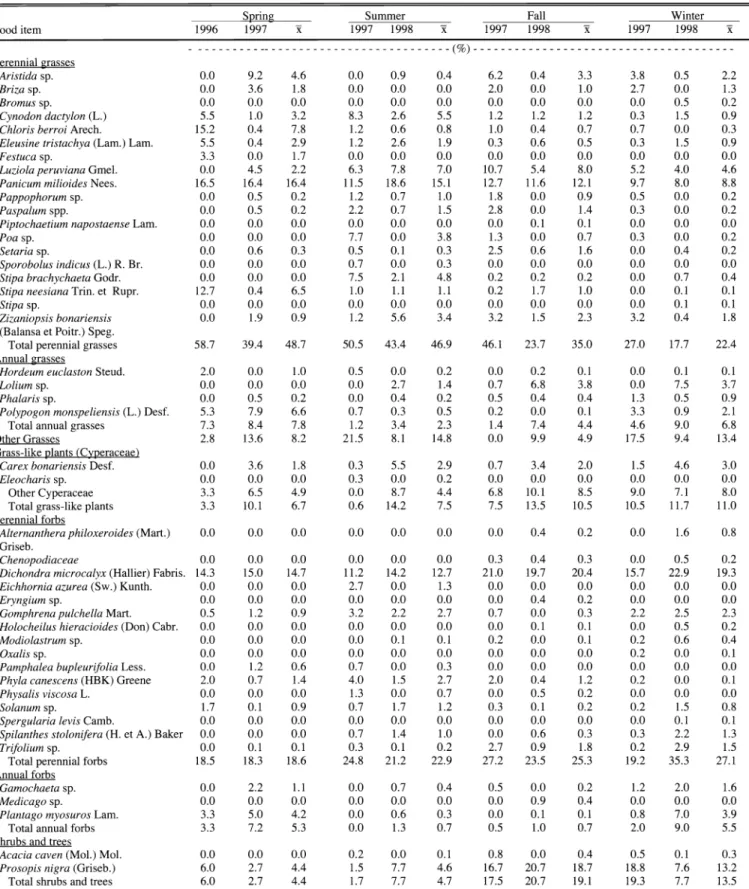
While vizcachas and cattle fed exclu- sively on plant leaves, greater rhea also fed on P. nigra pods and consumed some arthropods (Tables 1, 2, and 3). Plains viz- cacha fed on a wide variety of plants dur- ing all seasons (Table 1). A total of 45 plant species were identified in vizcacha diets over the length of the study. Grasses were the staple diet of this rodent, both in amount consumed and in number of species, 42.7% of the diet in winter with 20 species to 65.1% of the diet in spring with 17 species. Panicum milioides Nees.

was the most consumed grass, contribut- ing 8.8% and 16.4% of the diet in winter and spring, respectively. The item "Other Grasses" was at times similar to P. mil- ioides (14.8% vs. 15.1% in summer) or even higher (13.4% vs. 8.8% in winter).

Other major items were Dichondra micro- calyx (Hallier) Fabris. (20.4% and 19.3%, fall and winter) and P. nigra (18.7% and

13.2% in fall and winter, respectively).

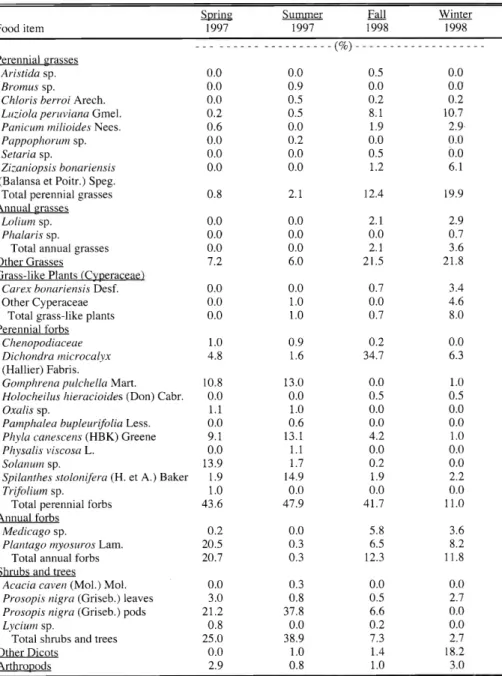
Legumes were the most common com- ponent of the greater rhea diet during spring and summer (25.3% and 38.9%;

Table 2) while grasses were more com- mon in fall and winter (35.8% and 45.3%).

The high content of legumes was due mainly to the consumption of P. nigra pods (21.2% and 37.8%, for spring and summer, respectively). Plantago myosuros Lam. (20.5%) and Solanaceae, particularly Solanum sp. L. (13.9%) were also impor- tant in the spring diet while Spilanthes

14 JOURNAL OF RANGE MANAGEMENT 56(1) January 2003

(3)

Table 1. Botanical composition (%) of plains vizcacha diets in different seasons in the Delta of the Parana River.

Food item Spring_ Summer Fall Winter

1996 1997 X 1997 1998 x 1997 1998 X 1997 1998 X

(%) ---

Perennial grasses

Aristida sp. 0.0 9.2 0.0 0.4 0.4

sp. 0.0 0.0 0.0 0.0 0.0 0.0

sp. 0.0 0.0 0.0 0.0 0.0 0.0 0.0 0.0 0.0 0.0 0.5

(L.) 1.2 1.2 1.2 0.3 1.5 0.9

Chloris berroi Arech. 15.2 0.4 7.8 1.2 0.6 0.8 1.0 0.4 0.7 0.7 0.0 0.3

Eleusine tristachya (Lam.) Lam. 5.5 0.4 2.9 1.2 2.6 1.9 0.3 0.6 0.5 0.3 1.5 0.9

Festuca sp. 3.3 0.0 1.7 0.0 0.0 0.0 0.0 0.0 0.0 0.0 0.0 0.0

Luziola peruviana Gmel. 0.0 4.5 2.2 6.3 7.8 7.0 10.7 5.4 8.0 5.2 4.0 4.6

Panicum milioides Nees. 16.5 16.4 16.4 11.5 18.6 15.1 12.7 11.6 12.1 9.7 8.0 8.8

Pappophorum sp. 0.0 0.5 0.2 1.2 0.7 1.0 1.8 0.0 0.9 0.5 0.0 0.2

Paspalum spp. 0.0 0.5 0.2 2.2 0.7 1.5 2.8 0.0 1.4 0.3 0.0 0.2

Piptochaetium napostaense Lam. 0.0 0.0 0.0 0.0 0.0 0.0 0.0 0.1 0.1 0.0 0.0 0.0

Poa sp. 0.0 0.0 0.0 7.7 0.0 3.8 1.3 0.0 0.7 0.3 0.0 0.2

Setaria sp. 0.0 0.6 0.3 0.5 0.1 0.3 2.5 0.6 1.6 0.0 0.4 0.2

Sporobolus indicus (L.) R. Br. 0.0 0.0 0.0 0.7 0.0 0.3 0.0 0.0 0.0 0.0 0.0 0.0

Stipa brachychaeta Godr. 0.0 0.0 0.0 7.5 2.1 4.8 0.2 0.2 0.2 0.0 0.7 0.4

Stipa neesiana Trin. et Rupr. 12.7 0.4 6.5 1.0 1.1 1.1 0.2 1.7 1.0 0.0 0.1 0.1

Stipa sp. 0.0 0.0 0.0 0.0 0.0 0.0 0.0 0.0 0.0 0.0 0.1 0.1

Zizaniopsis bonariensis 0.0 1.9 0.9 1.2 5.6 3.4 3.2 1.5 2.3 3.2 0.4 1.8

(Balansa et Poitr.) Speg.

Total perennial grasses 58.7 39.4 48.7 50.5 43.4 46.9 46.1 23.7 35.0 27.0 17.7 22.4

Annual grasses

Hordeum euclaston Steud. 2.0 0.0 1.0 0.5 0.0 0.2 0.0 0.2 0.1 0.0 0.1 0.1

Lolium sp. 0.0 0.0 0.0 0.0 2.7 1.4 0.7 6.8 3.8 0.0 7.5 3.7

Phalaris sp. 0.0 0.5 0.2 0.0 0.4 0.2 0.5 0.4 0.4 1.3 0.5 0.9

Polypogon monspeliensis (L.) Desf. 5.3 7.9 6.6 0.7 0.3 0.5 0.2 0.0 0.1 3.3 0.9 2.1

Total annual grasses 7.3 8.4 7.8 1.2 3.4 2.3 1.4 7.4 4.4 4.6 9.0 6.8

Other Grasses 2.8 13.6 8.2 21.5 8.1 14.8 0.0 9.9 4.9 17.5 9.4 13.4

cede) Grass-like plants (Cyper

,

Carex bonariensis Desf. 0.0 3.6 1.8 0.3 5.5 2.9 0.7 3.4 2.0 1.5 4.6 3.0

Eleocharis sp. 0.0 0.0 0.0 0.3 0.0 0.2 0.0 0.0 0.0 0.0 0.0 0.0

Other Cyperaceae 3.3 6.5 4.9 0.0 8.7 4.4 6.8 10.1 8.5 9.0 7.1 8.0

Total grass-like plants 3.3 10.1 6.7 0.6 14.2 7.5 7.5 13.5 10.5 10.5 11.7 11.0

Perennial forbs

Alternanthera philoxeroides (Mart.) 0.0 0.0 0.0 0.0 0.0 0.0 0.0 0.4 0.2 0.0 1.6 0.8

Griseb.

Chenopodiaceae 0.0 0.0 0.0 0.0 0.0 0.0 0.3 0.4 0.3 0.0 0.5 0.2

Dichondra microcalyx (Hallier) Fabris. 14.3 15.0 14.7 11.2 14.2 12.7 21.0 19.7 20.4 15.7 22.9 19.3

Eichhornia azurea (Sw.) Kunth. 0.0 0.0 0.0 2.7 0.0 1.3 0.0 0.0 0.0 0.0 0.0 0.0

Eryngium sp. 0.0 0.0 0.0 0.0 0.0 0.0 0.0 0.4 0.2 0.0 0.0 0.0

Gomphrena pulchella Mart. 0.5 1.2 0.9 3.2 2.2 2.7 0.7 0.0 0.3 2.2 2.5 2.3

Holocheilus hieracioides (Don) Cabr. 0.0 0.0 0.0 0.0 0.0 0.0 0.0 0.1 0.1 0.0 0.5 0.2

Modiolastrum sp. 0.0 0.0 0.0 0.0 0.1 0.1 0.2 0.0 0.1 0.2 0.6 0.4

Oxalis sp. 0.0 0.0 0.0 0.0 0.0 0.0 0.0 0.0 0.0 0.2 0.0 0.1

Pamphalea bupleurifolia Less. 0.0 1.2 0.6 0.7 0.0 0.3 0.0 0.0 0.0 0.0 0.0 0.0

Phyla canescens (HBK) Greene 2.0 0.7 1.4 4.0 1.5 2.7 2.0 0.4 1.2 0.2 0.0 0.1

Physalis viscosa L. 0.0 0.0 0.0 1.3 0.0 0.7 0.0 0.5 0.2 0.0 0.0 0.0

Solanum sp. 1.7 0.1 0.9 0.7 1.7 1.2 0.3 0.1 0.2 0.2 1.5 0.8

Spergularia levis Camb. 0.0 0.0 0.0 0.0 0.0 0.0 0.0 0.0 0.0 0.0 0.1 0.1

Spilanthes stolonifera (H. et A.) Baker 0.0 0.0 0.0 0.7 1.4 1.0 0.0 0.6 0.3 0.3 2.2 1.3

Trifolium sp. 0.0 0.1 0.1 0.3 0.1 0.2 2.7 0.9 1.8 0.2 2.9 1.5

Total perennial forbs 18.5 18.3 18.6 24.8 21.2 22.9 27.2 23.5 25.3 19.2 35.3 27.1

Annual forbs

Gamochaeta sp. 0.0 2.2 1.1 0.0 0.7 0.4 0.5 0.0 0.2 1.2 2.0 1.6

Medicago sp. 0.0 0.0 0.0 0.0 0.0 0.0 0.0 0.9 0.4 0.0 0.0 0.0

Plantago myosuros Lam. 3.3 5.0 4.2 0.0 0.6 0.3 0.0 0.1 0.1 0.8 7.0 3.9

Total annual forbs 3.3 7.2 5.3 0.0 1.3 0.7 0.5 1.0 0.7 2.0 9.0 5.5

Shrubs and trees

Acacia coven (Mol.) Mol. 0.0 0.0 0.0 0.2 0.0 0.1 0.8 0.0 0.4 0.5 0.1 0.3

Prosopis nigra (Griseb.) 6.0 2.7 4.4 1.5 7.7 4.6 16.7 20.7 18.7 18.8 7.6 13.2

Total shrubs and trees 6.0 2.7 4.4 1.7 7.7 4.7 17.5 20.7 19.1 19.3 7.7 13.5

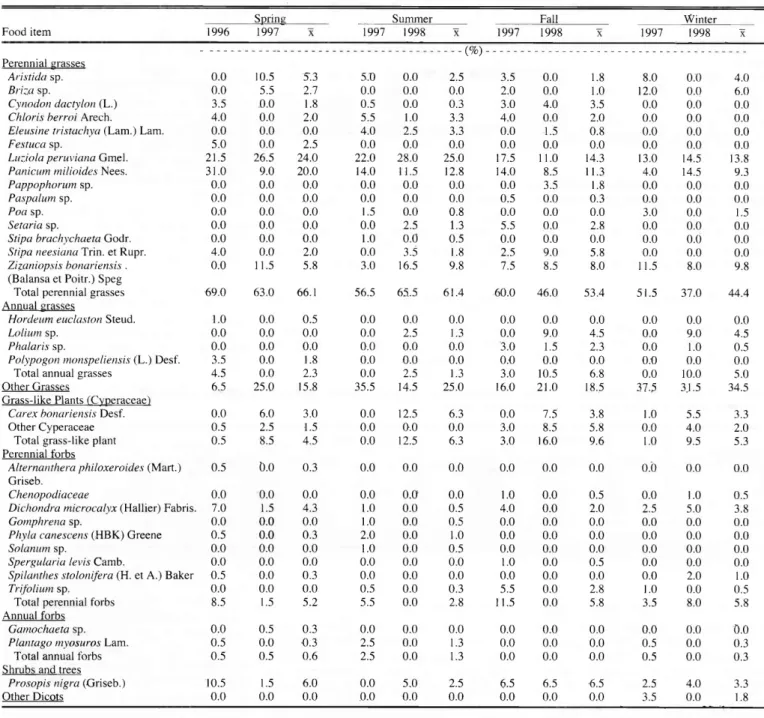
stolonifera (H. et A.) Baker was a major plied 18.2% of the diet. There were traces Grasses were also the dominant group in item in summer (14.9%) and D. microca- of arthropod consumption throughout the the cattle diet throughout the year, ranging lyx was the dominant food item in fall year, with the highest values in spring between 78.3% in fall and 87.3% in sum- (34.7%). In winter, "Other Dicots" sup- (2.9%) and winter (3.0%). mer (Table 3). Luziola peruviana Gmel.

JOURNAL OF RANGE MANAGEMENT 56(1) January 2003 15

(4)

Table 2. Botanical composition (%) of greater rhea diets in different seasons in the Delta of the Parana River.

S rin

Food item 1997

Perennial grasses

Summer Fall Winter

1997 1998 1998

--- (%)---

Aristida sp. 0.0 0.0

Bromus sp. 0.0 0.9

Chloris berroi Arech. 0.0 0.5

Luziola peruviana Gmel. 0.2 0.5

Panicum milioides Nees. 0.6 0.0

Pappophorum sp. 0.0 0.2

Setaria

sp.

0.0 0.0

Zizaniopsis bonariensis 0.0 0.0

(Balansa et Poitr.) Speg.

Total perennial grasses 0.8

Annual grasses

Lolium sp. 0.0 0.0

Phalaris sp. 0.0 0.0

Total annual grasses 0.0 0.0

Other Grasses 7.2 6.0

Grass-like Plants (Cyperaceae)

Carex bonariensis Desf. 0.0 0.0

Other Cyperaceae 0.0 1.0

Total grass-like plants 0.0 1.0

Perennial forbs

Chenopodiaceae 1.0 0.9

Dichondra microcalyx 4.8 1.6

(Hallier) Fabris.

Gomphrena pulchella Mart. 10.8

Holocheilus hieracioides (Don) Cabr. 0.0 0.0

Oxalis sp. 1.1 1.0

Pamphalea bupleurifolia Less. 0.0 0.6

Phyla canescens (HBK) Greene 9.1 13.1

Physalis viscosa L. 0.0

1.1

Solanum sp. 13.9 1.7

Spilanthes stolonifera (H. et A.) Baker 1.9 14.9

Trifolium sp. 1.0 0.0

Total perennial forbs 43.6 47.9

Annual forbs

Medicago sp. 0.2 0.0

Plantago myosuros Lam. 20.5 0.3

Total annual forbs 20.7 0.3

Shrubs and trees

Acacia caven (Mol.) Mol. 0.0 0.3

Prosopis nigra (Griseb.) leaves 3.0 0.8 Prosopis nigra (Griseb.) pods 21.2 37.8

Lycium sp. 0.8 0.0

Total shrubs and trees 25.0 38.9

Other Dicots 0.0 1.0

Arthropods 2.9 0.8

and P. milioides were commonly eaten (the former between 13.8% in winter and 25.0% in summer, and the latter ranging from 9.3% in winter and 20.0% in spring) with Zizaniopsis bonariensis (Balansa et Poitr.) Speg. somewhat lower (5.8% in spring and 9.8% both in winter and sum- mer). The item "Other Grasses" averaged about 15% over all seasons. Luziola peru- viana and P. milioides together with

"Other Grasses", constituted 60%, 63%, and 58% of the spring, summer and winter diets, respectively.

Within seasons, vizcacha and cattle diets differed in botanical composition between years (Table 4). Summer and winter diets

of the vizcacha were significantly correlat- ed between years but the correlation val- ues were low. Similarity index values showed the same trend, except for fall, when similarity was highest (Table 4).

Plains vizcacha and cattle diets were similar among the different seasons, some- thing that matches the rather high values of the similarity index (Table 5). The diet of greater rhea differed among most sea- sons, being similar only between spring and summer and between fall and winter.

Both comparisons also showed the highest similarity values between diets (Table 5).

Botanical composition of the diets of plains vizcacha and cattle was similar

within season and the similarity index val- ues oscillated between 50.5 and 57.9 (Table 6). Inversely, plains vizcacha and greater rhea segregated their grazing resources, without significant associations between diets, except in winter, which again had the highest similarity index value (Table 6). Cattle and greater rhea diets differed most with significant nega- tive correlations; also, the observed simi- larity index's values showed low values, especially in spring and summer (Table 6).

Discussion

Grasses were the main forage for plains vizcacha and cattle in all seasons. For greater rhea, grasses were the most impor- tant diet component when P. nigra pods were lacking. The importance of grasses in the plains vizcacha diet has also been reported by other authors (Giulietti and Jackson 1986, Kufner et al. 1992, Jofre 1994, Branch et al. 1994a, Navarro et al.

1997). Although plains vizcacha grazed on a large variety of plant species, only a few food items composed the bulk of its diet in each season. This last fact was observed in

other grassland habitats (Giulietti and Jackson 1986), although we found a greater consumption of dicots compared to that study (23 species versus 3 species).

Our results are more similar to those from the semiarid scrub of Central Argentina, where 53% of the species in the diet were dicots (Branch et al. 1994a). The number of items consumed by vizcachas in the Delta Region was 45, while Giulietti and Jackson (1986) and Branch et al. (1994a) record 20 and 62 items in grassland and scrub, respectively. The lower number of items found in the grassland might be explained by higher availability of more palatable species, a fact that might allow the rodents to fulfill their nutritional needs with fewer species, in agreement with classic foraging theory (Stephens and Krebs 1986).

In agreement with other studies (Martella et al. 1996, Comparatore and Martinez 1997), greater rhea had a high intake of greens throughout the year. P.

nigra pods were an important food item during certain parts of the year. These highly nutritious pods appear in spring, reach their peak during summer, their availability decreases in fall, and they can- not be found in winter (Pratolongo 2000), which correlates with their abundance in the rhea diet.

Variations in digestibility of the differ- ent food items could be taking place in the

16 JOURNAL OF RANGE MANAGEMENT 56(1) January 2003

(5)

Table 3. Botanical composition (%) of cattle diets in different seasons in the Delta of the Parana River.

Spring Summer Fall

Food item 1996 1997 , z R X

Perennial grasses

--- (%)---

Aristida sp. 0.0 10.5 0.0 3.5 0.0 4.0

0.0 0.0 0.0 0.0 2.0 0.0 0.0

0.0 0.0 0.0 0.0 0.0

0.0 0.0 0.0 0.0 0.0

0.0

1.5

0.0

sp. 0.0 0.0 0.0 0.0 0.0 0.0 0.0 0.0 0.0 0.0

Luziola peruviana Gmel. 21.5 26.5 24.0 22.0 28.0 25.0 17.5 11.0 14.3 13.0 14.5 13.8

Panicum milioides Nees. 31.0 9.0 20.0 14.0 11.5 12.8 14.0 8.5 11.3 4.0 14.5 9.3

Pappophorum sp. 0.0 0.0 0.0 0.0 0.0 0.0 0.0 3.5

1.8

0.0 0.0 0.0

Paspalum sp. 0.0 0.0 0.0 0.0 0.0 0.0 0.5 0.0 0.3 0.0 0.0 0.0

Poa sp. 0.0 0.0 0.0

1.5

0.0 0.8 0.0 0.0 0.0 3.0 0.0

1.5

Setaria sp. 0.0 0.0 0.0 0.0 2.5

1.3

5.5 0.0 2.8 0.0 0.0 0.0

Stipa brachychaeta Godr. 0.0 0.0 0.0 1.0 0.0 0.5 0.0 0.0 0.0 0.0 0.0 0.0

Stipa neesiana Trin. et Rupr. 4.0 0.0 2.0 0.0 3.5

1.8

2.5 9.0 5.8 0.0 0.0 0.0

Zizaniopsis bonariensis

.

(Balansa et Poitr.) Speg

0.0 11.5 5.8 3.0 16.5 9.8 7.5 8.5 8.0 11.5 8.0 9.8

Total perennial grasses Annual grasses

69.0 63.0 66.1 56.5 65.5 61.4 60.0 46.0 53.4 51.5 37.0 44.4

Hordeum euclaston Steud. 1.0 0.0 0.5 0.0 0.0 0.0 0.0 0.0 0.0 0.0 0.0 0.0

Lolium sp. 0.0 0.0 0.0 0.0 2.5

1.3

0.0 9.0 4.5 0.0 9.0 4.5

Phalaris sp. 0.0 0.0 0.0 0.0 0.0 0.0 3.0 1.5 2.3 0.0 1.0 0.5

Polypogon monspeliensis (L.) Desf. 3.5 0.0

1.8

0.0 0.0 0.0 0.0 0.0 0.0 0.0 0.0 0.0

Total annual grasses 4.5 0.0 2.3 0.0 2.5 1.3 3.0 10.5 6.8 0.0 10.0 5.0

Other Grasses 6.5 25.0 15.8 35.5 14.5 25.0 16.0 21.0 18.5 37.5 31.5 34.5

Grass-like Plants (Cyperaceae)

Carex honariensis Desf. 0.0 6.0 3.0 0.0 12.5 6.3 0.0 7.5 3.8 1.0 5.5 3.3

Other Cyperaceae 0.5 2.5

1.5

0.0 0.0 0.0 3.0 8.5 5.8 0.0 4.0 2.0

Total grass-like plant Perennial forbs

0.5 8.5 4.5 0.0 12.5 6.3 3.0 16.0 9.6

1.0

9.5 5.3

Alternanthera philoxeroides (Mart.) Griseb.

0.5 0.0 0.3 0.0 0.0 0.0 0.0 0.0 0.0 0.0 0.0 0.0

Chenopodiaceae 0.0 0.0 0.0 0.0 0.0 0.0 1.0 0.0 0.5 0.0

1.0

0.5

Dichondra microcalyx (Hallier) Fabris. 7.0

1.5

4.3 1.0 0.0 0.5 4.0 0.0 2.0 2.5 5.0 3.8

Gomphrena sp. 0.0 0.0 0.0 1.0 0.0 0.5 0.0 0.0 0.0 0.0 0.0 0.0

Phyla canescens (HBK) Greene 0.5 0.0 0.3 2.0 0.0 1.0 0.0 0.0 0.0 0.0 0.0 0.0

Solanum sp. 0.0 0.0 0.0 1.0 0.0 0.5 0.0 0.0 0.0 0.0 0.0 0.0

Spergularia levis Camb. 0.0 0.0 0.0 0.0 0.0 0.0 1.0 0.0 0.5 0.0 0.0 0.0

Spilanthes stolonifera (H. et A.) Baker 0.5 0.0 0.3 0.0 0.0 0.0 0.0 0.0 0.0 0.0 2.0 1.0

Trifolium sp. 0.0 0.0 0.0 0.5 0.0 0.3 5.5 0.0 2.8 1.0 0.0 0.5

Total perennial forbs Annual forbs

8.5

1.5

5.2 5.5 0.0 2.8 11.5 0.0 5.8 3.5 8.0 5.8

Gamochaeta sp. 0.0 0.5 0.3 0.0 0.0 0.0 0.0 0.0 0.0 0.0 0.0 0.0

Plantago myosuros Lam. 0.5 0.0 0.3 2.5 0.0

1.3

0.0 0.0 0.0 0.5 0.0 0.3

Total annual forbs Shrubs and trees

0.5 0.5 0.6 2.5 0.0 1.3 0.0 0.0 0.0 0.5 0.0 0.3

Prosopis nigra (Griseb.) 10.5

1.5

6.0 0.0 5.0 2.5 6.5 6.5 6.5 2.5 4.0 3.3

Other Dicots 0.0 0.0 0.0 0.0 0.0 0.0 0.0 0.0 0.0 3.5 0.0

1.8

digestive tract. Plant parts in the rhea fae- ces were hardly degraded. There were only traces of arthropods in the faeces, in spite of their high abundance in the field throughout the year. As with Martella et al. (1996), these traces were highly digest- ed, unlike the plant material. This seems to indicate that this method for diet quantifi- cation is unsuitable to analyze the food habits of the greater rhea, because differ- ences in digestibility produce a bias in establishing the true proportion of each item in its diet (Moreby 1988, Rosenberg and Cooper 1990, Martella et al. 1996).

Although the results obtained by com-

paring the diet compositions by means of correlations and similarity indices showed on the whole a similar trend, the former were clearer when comparing between years, seasons and species.

Differences observed in botanical com- position of the diets of plains vizcacha and cattle between the 2 years could be due to environmental variability. Observed dif- ferences in rainfall might account for vari- ability in both vegetation abundance and grazing area because of the waterlogging, resulting in changes in forage availability.

Plains vizcacha avoid waterlogged areas.

Waterlogging may also provoke changes

in the vegetation which may in turn influ- ence changes in the grazing patterns from one year to the next. While some grasses were eaten less in the wettest year (e.g.

Chloris berroi, Stipa neesiana, Polypogon monspeliensis), intake of Cyperaceae grew (See Tables

1

and 3). Despite the yearly changes in the foraging patterns, however, the staple components of the diet kept their high values between the 2 years of the study (e.g. Dichondra microcalyx and Panicum milioides for both vizcachas and cattle and Luziola peruviana for cattle).

Thus, these environmental changes corre- sponded to changes in the grazing patterns

JOURNAL OF RANGE MANAGEMENT 56(1) January 2003 17

(6)

Table 4. Comparison of the composition of plains vizcacha and cattle diets (Spearman's rank cor- relation coefficient, rS and Kulczynski's similarity index, K) between the same season of differ- ent years in the Parana River Delta.

Plains vizcacha Cattle

Comparisona nb rs P K n P K

SP 96 - SP 97 28 0.10

SU 97 - SU 98 36 0.35

F97-F98 39 0.30

W97-W98 39 0.42

bSP = Spring; SU = Summer; W = Winter; F = Fall.

n = Number of food items.

of both herbivores. Something similar was observed for wild and domestic herbivores in central Entre Rios (Quintana et al.

1998b). This underscores the need to con- duct surveys for at least 2 years, as pro- posed by Hansen and Lucich (1978).

Variations observed in the greater rhea diet throughout the year may be explained by changes in basic nutritional require- ments associated with reproductive activi- ties (Bruning 1974, Robbins 1981, Lombardi 1994, Martella et al. 1995,

of greater rhea were collected in 1997, while the fall and winter samples were from 1998, one might think that variation of intake of Prosopis nigra pods between spring/summer and fall/winter could also be due to environmental changes that took place from one year to the next. Yet, intake of these pods corresponded to the

availability of Prosopis nigra fruits through the year in this region (Burkart

1976, Pratolongo 2000), supporting our previous argument.

europaeus) (Bonino et al. 1986). Increased intake of P. nigra leaves by plains viz- cacha in fall and summer did not coincide with the results for cattle (except for a slight intake in fall) and this may be due to the wider range of movement of cattle as compared to that of the rodents. Cattle had easy access to areas with more tender, palatable grass, a preferred forage (Hansen and Gold 1977, Vavra et al. 1977, Samuel and Howard 1982). This forage was not as available for vizcachas because their for- aging was restricted to the surroundings of their burrows (Branch and Sosa 1994, Arias 2000). Greater rhea diet was more similar to those of the other 2 species in

seasons where the intake of Prosopis

seeds decreased.

According to Kufner et al. (1992), the larger number of items in the diet of plains vizcachas seems to indicate better adapted grazing habits than those of greater rhea and cattle, when faced with the resources available in their habitat. However, the

Table 5. Comparison of the composition of plains vizcacha, greater rhea and cattle diets (Spearman's rank correlation coefficient, rS and Kulczynski's similarity index, K) among seasons in the Parana River Delta.

Plains vizcacha Cattle Greater rhea

Comparisona nb rs P K N P K n P K

SP - SU 38 0.38 29 0.48 <0.01 71.2 24 0.58 <0.01 56.6

SP - F 41 0.47 <0.01 56.9 30 0.47 <0.01 67.9 25 0.17 0.42 34.1

SP-W 41 0.51 <0.01 61.6 27 0.48 0.01 63.3 25 -0.17 0.43 30.6

SU-F 43 0.61 <0.01 62.0 28 0.50 <0.01 68.0 30 0.07 0.72 23.3

SU - W 44 0.50 <0.01 64.6 27 0.31 0.11 69.0 28 -0.17 0.36 14.9

F - W 43 0.60 <0.01 76.6 26 0.48 0.01 68.6 25 0.56 <0.01 58.2

bp = Spring; SU = Summer; W = Winter; F = Fall.

n = Number of food items.

Reboreda and Fernandez 1997). Intake of insects, small vertebrates, and seeds satis- fy the need of minerals, vitamins, proteins, or specific nutrients in larger or lesser demand according to the season (Robbins 1981, Martella et al. 1996). This intake was higher during spring and summer, the mating season for this species (Reboreda and Fernandez 1997). Consequently, the similar diets observed in these seasons and their difference with the fall/winter intake is logical. Since spring and summer faeces

Grazing on common grounds explains the similarity observed in botanical com- position of diet observed throughout the year between plains vizcacha and cattle, including a few common dominant species (mainly grasses) and a wide range of less relevant species (<3%). Diet similarities between cattle and medium-sized wild herbivores such as the plains vizcacha have also been reported for mara (Dolichotis patagonum) (Kufner and Pelliza 1987) and European hares (Lepus

relevance of grasses as a resource shared by this rodent and cattle implies a signifi- cant dietary overlap that might be a nega- tive factor for the remaining populations of vizcacha in this area. Plains vizcacha and cattle had similar diets, which sup- ports the ranchers' view that vizcachas compete with domestic herbivores for for- aging resources and leads to their being hunted as pests. However, high overlap in the use of resources implies competition only if the resources are scarce (Wiens 1989). Hunting of greater rhea on ranches

Table 6. Comparison of the composition of plains vizcacha (PV), greater rhea (GR) and cattle (CA) diets (Spearman's rank correlation coefficient, rS

and Kulczynski's similarity index, K) in different seasons in the Parana River Delta.

PV vs CA PV vs GR GR vs CA

na rs P K N rs P K n rs P K

Spring 30 0.70 <0.01 56.7 35 -0.19 0.29 23.3 30 -0.38 0.04 16.1

Summer 36 0.57 <0.01 53.6 41 0.01 0.98 19.0 32 -0.38 0.04 10.8

Fall 40 0.82 <0.01 57.9 43 0.22 0.16 43.3 32 -0.04 0.83 36.2

Winter 40 0.64 <0.01 50.5 42 0.41 <0.01 49.6 24 0.34 0.11 59.6

a n = Number of food items.

18 JOURNAL OF RANGE MANAGEMENT 56(1) January 2003

(7)

and farms has been justified for the same reason: its perceived competition with cat- tle for the grazing resources. Our results suggest that greater rhea and cattle have different foraging patterns during the year, with little potential for diet competition.

Both native herbivores may have impor- tant ecological roles in this wetland area:

greater rhea in forest regeneration, not only dispersing P. nigra seeds but also speeding up the germination process as the seeds pass through their digestive tract and improving seed germination rates (Pratolongo 2000). Plains vizcachas help recycle nutrients, increase soil water infil- tration through their burrowing activities, which could improve these already degraded soils, and add to the creation of a new habitat type that is used by other wildlife species (Arias 2000).

Literature Cited

Arias, S. 2000. Effects of the vizcachas' (Lagostomus maximus) activity on vegetation and soil in an old marine lagoon of the Delta of the Parana River Region (In Spanish:

Efecto de la actividad de las vizcachas (Lagostomus maximus) sobre la vegetacion y el suelo en una antigua laguna litoral de la region del Delta del Rio Parana.). Graduate Diss., Univ. of Buenos Aires, Buenos Aires, Argentina.

Bertonatti, C. 1997. Conservation strategy for Argentinean birdlife. Readings on Nature and Conservation. Vol.

1

(In Spanish: Estrategia de conservacion para las ayes de la Argentina. Temas de naturaleza y conser- vacion. Vol. 1.). Asociacion Ornitologica del Plata, Buenos Aires, Argentina.

Bonino, N., G. Bonvissuto, A. Pelliza, and R.

Somlo. 1986. Food habits of the herbivores in the central zone of "Western Sierras and Mesetas of Patagonia" ecological area (In Spanish: Habitos alimentarios de los her- bivoros en la zona central del area ecologica

"Sierras y Mesetas Occidentales de Patagonia"). Revista Argentina de Produccion Animal 6:275-287.

Bontti, E., R. Boo, and L. Lindstrom. 1997.

Number of samples needed in the vizcachas (Lagostomus maximus) diet estimation (In Spanish: Numeeo de muestras necesario en la estimacion de la dieta de vizcachas (Lagostomus maximus)). Abst. XVIII Reunion Argentina de Ecologia, Buenos Aires, Argentina.

Branch, L. 1993. Social organization and mat- ing system of the plains vizcacha (Lagostomus maximus). J. Zool. (London) 229:473-491.

Branch, L. and R. Sosa. 1994. Foraging behavior of the plains vizcacha, Lagostomus maximus (Rodentia: Chinchillidae), in semi- arid scrub of central Argentina. Vida Silvestre Neotropical 3:96-99.

Branch, L., D. Villareal, A. Pelliza, and R.

Sosa.1994a. Diet selection of the plains viz-

cacha (Lagostomus maximus, family Chinchillidae) in relation to resource abun- dance in semi-arid scrub. Canadian J. Zool.

72:2210-2216.

Branch, L., D. Villareal, A. Sosa, M. Pessino, M. Machicote, P. Lerner, P. Borraz, M.

Urioste, and J. Hierro. 1994b. Structure of vizcacha colonies and problems associated with estimation of population density from burrow activity (In Spanish: Estructura de las colonias de vizcacha y problemas asociados con la estimacion de la densidad poblacional en base a la actividad de las vizcacheras).

Mastozoologia Neotropical 1:135-142.

Bruggers, R. and M. Zaccagnini. 1994.

Vertebrate pest problems related to agricul- tural production and applied research in Argentina. Vida Silvestre Neotropical

3:71-83.

Bruning, D. 1974. Social structure and repro- ductive behavior of the greater rhea. Living Bird 13:251-294.

Burkart, A. 1976. A monograph of the genus Prosopis (Leguminosae Subfam. Mimo- soideae). Arnold Arboretum 57:219-249.

Comparatore, V. and M. Martinez. 1997.

Greater rhea (Rhea americana) diet in an agroecosystem of Villa Gesell Municipality, Buenos Aires Province (In Spanish: Deeta del nandu (Rhea americana) en un agroecosis- tema del Partido de Villa Gesell, Provincia de Buenos Aires). Abst. XVIII Reunion Argentina de Ecologia, Buenos Aires, Argentina.

CONAPA.1991. National report to the United Nations Conference about environment and development (In Spanish: Informe Nacional a la Conferencia sobre Ambiente y Desarrollo de las Naciones Unidas).

Comision Nacional de Politica Ambiental, Buenos Aires, Argentina.

Giulietti, J. and J. Jackson. 1986. Annual composition of vizcacha (Lagostomus max- imus) diet in natural prairies of the San Luis province, Argentina (In Spanish:

Composicion anual de la dieta de la vizcacha (Lagostomus maximus) en pastizales natu- rales en la provincia de San Luis, Argentina).

Revista Argentina de Produccion Animal 6:229-237.

Hansen, R. and I. Gold. 1977. Blacktail prairie dogs, desert cottontails and cattle trophic relations on shortgrass range. J.

Range Manage. 30:210-214.

Hansen, R. and G. Lucich.1978. A field pro- cedure and study design for fecal collections to be used to determine wildlife and livestock food habits. Composition Analysis Laboratory, Colorado State University, Fort Collins, Colo.

Henley, S., D. Smith, and J. Raats. 2001.

Evaluation of 3 techniques for determining diet composition. J. Range Manage.

54:582-588.

Holechek, J. and B. Gross. 1982. Evaluation of different calculation procedures for micro- histological analysis. J. Range Manage.

35:721-723.

Holechek, J. and M. Vavra. 1981. The effect of slide and frequency observation numbers on the precision of microhistological analy-

sis. J. Range Manage. 34:337-338.

Holechek, J., M. Vavra, and R. Pieper.1982.

Botanical composition determination of range herbivore diets: A review. J. Range Manage. 35:309-315.

Jofre, G. 1994. Forage selection by vizcacha (Lagostomus maximus) in a degraded area of the western Chaco of San Luis (In Spanish:

Seleccion de forraje por vizcacha (Lagostomus maximus) en un area degradada del Chaco occidental de San Luis). PhD Thesis, Univ. of San Luis, San Luis, Argentina.

Kufner, M. and A. Pelliza. 1987. Botanic composition of the mara (Dolichotis patagonum) and cattle diets in the monte of Mendoza (In Spanish: Composicion botanica de la dieta del mara (Dolichotis patagonum) y del ganado bovino en el monte mendoci- no). Revista Argentina de Produccion Animal 7:255-264.

Kufner, M., M. Chambouleyron, and S.

Monge. 1992. Trophic relations in a desert herbivory community in the Monte desert (Argentina) during the dry winter season (In Spanish: Relaciones troficas de una comu- nidad de herbivoros del desierto del monte (Argentina) durante la sequia invernal).

Iheringia (Porto Alegre), Serie Zoologica 72:113-119.

Llanos, A. and J. Crespo. 1952. The ecology of vizcacha (Lagostomus maximus maximus Blainv) in northeastern Entre Rios (In Spanish: Ecologia de la vizcacha (Lagostomus maximus maximus Blainv) en el nordeste de la provincia de Entre Rios).

Revista de Investigaciones Agricolas 6:289-378.

Lombardi, C. 1994. Feeding and vigilance in wild greater rheas harems. Bird Behavior

10:29-35.

Malvarez, A. 1997. Plant communities of the Parana River Delta. Their relation with envi- ronmental factors and landscape patterns (In Spanish: Las comunidades vegetales del Delta del Rio Parana. Su Relacion con fac- tores ambientales y patrones de paisaje). PhD Thesis, Univ. of Buenos Aires, Buenos Aires, Argentina.

Mares, M. and R. Ojeda. 1984. Faunal com- mercialization and conservation in South America. Bioscience 34:580-584.

Martella, M., D. Renison, and J. Navarro.

1995. Vigilance in the greater rhea: effects of vegetation height and group size. J. Field Ornithol. 66:215-220.

Martella, M., J. Navarro, J. Gonnet, and S.

Monge. 1996. Diet of greater rheas in an agroecosystem of central Argentina. J. Wildl.

Manage. 60:586-592.

Moreby, S. 1988. An aid to the identification of arthropod fragments in the faeces of gamebird chicks (Galliformes). Ibis 130:519- 526.

Navarro, J., V. Rosati, and E. Fraire. 1997.

Effects of vizcachas (Lagostomus maximus) on a soybean crop (In Spanish: Incidencia de vizcachas (Lagostomus maximus) en un culti- vo de soja). Mastozoologia Neotropical 4:137-144.

JOURNAL OF RANGE MANAGEMENT 56(1) January 2003 19

(8)

Pratolongo, P. 2000. Structural analysis of Prosopis nigra (Griseb.) Hieron and Acacia caven (Mol.) Mol. populations in south Entre Rios and comparison of variables related to germination and seedling development (In Spanish: Analsis estructural de poblaciones de Prosopis nigra (Griseb.) Hieron. y Acacia caven (Mol.) Mol. del sur de Entre Rios y comparacion de variables ligadas a la germi- nacion y el desarrollo de las plantulas).

Graduate Diss., Univ. of Buenos Aires, Buenos Aires, Argentina.

Quintana, R., S. Monge, and A. Malvarez.

1998a. Feeding patterns of capybara Hydrochaeris hydrochaeris (Rodentia, Hydrochaeridae) and cattle in the non-insular area of the Lower Delta of the Parana River, Argentina. Mammalia 62:37-52.

Quintana, R., S. Monge, and A. Malvarez.

1998b. Composition and diversity of capy- bara (Hydrochaeris hydrochaeris) and live- stock diets in an agroecosystem of central Entre Rios, Argentina (In Spanish:

Composicion y diversidad de las dietas del capibara (Hydrochaeris hydrochaeris) y del ganado domestico en un agroecosistema del centro de Entre Rios, Argentina).

Ecotropicos 11:34-44.

Reboreda, J. and G. Fernandez. 1997.

Sexual, seasonal and group size differences in the allocation of time between vigilance and feeding in the greater rhea, Rhea ameri- cana. Ethology 103:198-207.

Redford, K. and J. Eisenberg. 1992.

Mammals of the Neotropics. The southern cone. Vol. 2. The University of Chicago Press, Chicago, Ill.

Rendel, C. 1990. Estimation of the vizcacha (Lagostomus maximus B.) damages in the Cordoba province. (In Spanish: Estimacion de danos causados por la vizcacha (Lagostomus maximus B.) en la provincia de Cordoba). Revista Argentina de Produccion Animal 10:63-79.

Robbins, C. 1981. Estimation of the relative protein cost of reproduction in birds. Condor 83:177-179.

Rosenberg, K. and R. Cooper. 1990.

Approaches to avian diet analysis. Studies on Avian Biology 13:80-90.

Samuel, M. and G. Howard. 1982. Botanical composition of summer cattle diets on the Wyoming High Plains. J. Range Manage.

35:305-308.

Servicio Metereologico Nacional. 1972.

Climatologic statistics. 4th. ed. (In Spanish:

Estadistica climatologica. 4a. ed). Fuerza Aerea Argentina, Serie B6., Buenos Aires, Argentina.

Smith, A. and L. Shandruk. 1979.

Comparison of fecal, rumen and utilization methods for ascertaining pronghorn diets. J.

Range Manage. 32:275-279.

Stephens, D. and J. Krebs. 1986. Foraging theory. Princeton University Press, Princeton, N.J.

Vavra, M., R. Rice, R. Hansen, and P. Sims.

1977. Food habits of cattle on shortgrass range in northeastern Colorado. J. Range Manage. 30:261-263.

Weir, B. 1974. The tuco-tuco and plains viz- cacha. Symp. Zoo!. Soc. London 34:113-130.

Wiens, J.A. 1989. The ecology of bird commu- nities, vol. 2. Processes and variations.

Cambridge University Press, Cambridge.

Williams, 0.1969. An improved technique for identification of plant fragments in herbivore feces. J. Range Manage. 22:51-52.

Zar, J. 1996. Biostatistical Analysis. Third Edition. Prentice-Hall, N.J.

20 JOURNAL OF RANGE MANAGEMENT 56(1) January 2003

Figure

Table  1.  Botanical composition (%) of plains vizcacha diets  in  different seasons in the  Delta of the  Parana  River
Table  2.  Botanical  composition  (%)  of  greater  rhea  diets  in  different  seasons  in  the  Delta of  the  Parana  River
Table  3.  Botanical composition (%)  of cattle diets  in  different seasons in the Delta of the  Parana  River
Table  5.  Comparison of the composition of plains  vizcacha,  greater rhea and  cattle diets  (Spearman's  rank  correlation coefficient,  rS  and Kulczynski's  similarity index,  K)  among seasons in the  Parana  River Delta

References

Related documents

Some prior studies have proposed using P2P approaches for the signaling phase of VoIP communication. However, a P2P approach may increase the call setup time, an important

Survey: The final renders will be presented to a number of participants as a short video sequence, containing three different simulations – Smoke, Fire and Water – from both Maya

It argues that a feminist research provides a powerful tool in assisting us to understand women’s lives, their experiences, their concerns based on

Our research conducted a data mining project on direct marketing campaigns for deposits subscriptions by using recent data of a Portuguese retail bank.. We used the Support

not provided to respondents (can be corrected by using “other” response option).. Survey Construction: Question Types.

The yearly aggregated tax income data of all, more than 8000, Italian municipalities are analyzed for a period of five years, from 2007 to 2011, to search for conformity or not

The mentoring for leadership empowerment and mentoring for personal development composite variables were both positively correlated with the dependent variable and also

Table 3-22 The effective refractive index and effective radius at three different RH conditions, and the derived growth factor (gf), κ(RH), and WUP for azelaic acid *(AzA)