Proceedings of the 55th Annual Meeting of the Association for Computational Linguistics (Short Papers), pages 358–365 Proceedings of the 55th Annual Meeting of the Association for Computational Linguistics (Short Papers), pages 358–365
Question Answering on Knowledge Bases and Text
using Universal Schema and Memory Networks
Rajarshi Das∗♠ Manzil Zaheer∗♥ Siva Reddy♣ and Andrew McCallum♠
♠College of Information and Computer Sciences, University of Massachusetts Amherst
♥School of Computer Science, Carnegie Mellon University
♣School of Informatics, University of Edinburgh
{rajarshi, mccallum}@cs.umass.edu, [email protected] [email protected]
Abstract
Existing question answering methods infer answers either from a knowledge base or from raw text. While knowledge base (KB) methods are good at answering composi-tional questions, their performance is often affected by the incompleteness of the KB. Au contraire, web text contains millions of facts that are absent in the KB, how-ever in an unstructured form. Universal schemacan support reasoning on the union of both structured KBs and unstructured text by aligning them in a common embed-ded space. In this paper we extend uni-versal schema to natural language question answering, employing memory networks
to attend to the large body of facts in the combination of text and KB. Our models can be trained in an end-to-end fashion on question-answer pairs. Evaluation results on SPADES fill-in-the-blank question an-swering dataset show that exploiting uni-versal schema for question answering is better than using either a KB or text alone. This model also outperforms the current state-of-the-art by 8.5F1points.
1 Introduction
Question Answering (QA) has been a long-standing goal of natural language processing. Two main paradigms evolved in solving this problem: 1) answering questions on a knowledge base; and 2) answering questions using text.
Knowledge bases (KB) contains facts expressed in a fixed schema, facilitating compositional rea-soning. These attracted research ever since the early days of computer science, e.g., BASEBALL (Green Jr et al., 1961). This problem has matured into learning semantic parsers from parallel ques-tion and logical form pairs (Zelle and Mooney,
1996; Zettlemoyer and Collins, 2005), to recent scaling of methods to work on very large KBs like Freebase using question and answer pairs (Berant et al., 2013). However, a major drawback of this paradigm is that KBs are highly incomplete (Dong et al., 2014). It is also an open question whether KB relational structure is expressive enough to rep-resent world knowledge (Stanovsky et al., 2014; Gardner and Krishnamurthy, 2017)
The paradigm of exploiting text for questions started in the early 1990s (Kupiec, 1993). With the advent of web, access to text resources became abundant and cheap. Initiatives like TREC QA competitions helped popularizing this paradigm (Voorhees et al., 1999). With the recent advances in deep learning and availability of large public datasets, there has been an explosion of research in a very short time (Rajpurkar et al., 2016; Trischler et al., 2016; Nguyen et al., 2016; Wang and Jiang, 2016; Lee et al., 2016; Xiong et al., 2016; Seo et al., 2016; Choi et al., 2016). Still, text representation is unstructured and does not allow the compositional reasoning which structured KB supports.
An important but under-explored QA paradigm is where KB and text are exploited together (Fer-rucci et al., 2010). Such combination is attractive because text contains millions of facts not present in KB, and a KB’s generative capacity represents infinite number of facts that are never seen in text. However QA inference on this combination is chal-lenging due to the structural non-uniformity of KB and text. Distant supervision methods (Bunescu and Mooney, 2007; Mintz et al., 2009; Riedel et al., 2010; Yao et al., 2010; Zeng et al., 2015) address this problem partially by means of aligning text pat-terns with KB. But the rich and ambiguous nature of language allows a fact to be expressed in many different forms which these models fail to capture.
Universal schema(Riedel et al., 2013) avoids the alignment problem by jointly embedding KB facts
kb:has_city kb:has_company kb:president_of arg 2 is the first
non-white president of arg 1
... ... USA/
Obama
USA/ Google ...
...
...
1 ...
USA/ NYC
1 1
USA/
Facebook 1 1
1 1
USA has elected _blank_ our first african-american president Bidirectional LSTM
Attention Layer Affine+Softmax
Barack
Obama Donald Trump Hillary USA NYC..
... ... ...
1
[image:2.595.126.472.67.245.2]arg2 is headquartered in arg 1
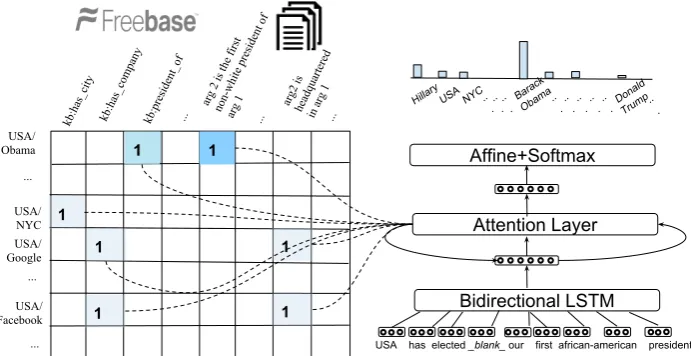
Figure 1: Memory network attending the facts in the universal schema (matrix on the left). The color gradients denote the attention weight on each fact.
and text into a uniform structured representation, allowing interleaved propagation of information. Figure 1 shows a universal schema matrix which has pairs of entities as rows, and Freebase and textual relations in columns. Although universal schema has been extensively used for relation ex-traction, this paper shows its applicability to QA. Consider the question USA has elected blank , our first african-american president with its answer Barack Obama. While Freebase has a predicate for representing presidents of USA, it does not have one for ‘african-american’ presidents. Whereas in text, we find many sentences describing the pres-idency of Barack Obama and his ethnicity at the same time. Exploiting both KB and text makes it relatively easy to answer this question than relying on only one of these sources.
Memory networks (MemNN; Weston et al. 2015) are a class of neural models which have an external memory component for encoding short and long term context. In this work, we define the mem-ory components as observed cells of the universal schema matrix, and train an end-to-end QA model on question-answer pairs.
The contributions of the paper are as follows (a) We show that universal schema representation is a better knowledge source for QA than either KB or text alone, (b) On the SPADES dataset (Bisk et al., 2016), containing real world fill-in-the-blank questions, we outperform state-of-the-art semantic parsing baseline, with 8.5F1points. (c) Our analy-sis shows how individual data sources help fill the weakness of the other, thereby improving overall performance.
2 Background
Problem Definition Given a question q with wordsw1,w2, . . . ,wn, where these words contain one blank and at least one entity, our goal is to fill in this blank with an answer entityqausing a knowledge base
K
and textT
. Few example question answer pairs are shown in Table 2.Universal Schema Traditionally universal schema is used for relation extraction in the context of knowledge base population. Rows in the schema are formed by entity pairs (e.g. USA, NYC), and columns represent the relation between them. A relation can either be a KB relation, or it could be a pattern of text that exist between these two entities in a large corpus. The embeddings of entities and relation types are learned by low-rank matrix factorization techniques. Riedel et al. (2013) treat textual patterns as static symbols, whereas recent work by Verga et al. (2016) replaces them with distributed representation of sentences obtained by a RNN. Using distributed representation allows reasoning on sentences that are similar in meaning but different on the surface form. We too use this variant to encode our textual relations.
read-ing comprehension (Sukhbaatar et al., 2015; Hill et al., 2016), where the memory consists of dis-tributed representation of sentences in the compre-hension. Recently, key-value MemNN are intro-duced (Miller et al., 2016) where each memory slot consists of a key and value. The attention weight is computed only by comparing the question with the key memory, whereas the value is used to com-pute the contextual representation to predict the answer. We use this variant of MemNN for our model. Miller et al. (2016), in their experiments, store either KB triples or sentences as memories but they do not explicitly model multiple memories containing distinct data sources like we do.
3 Model
Our model is a MemNN with universal schema as its memory. Figure 1 shows the model architecture.
Memory: Our memory
M
comprise of both KB and textual triples from universal schema. Each memory cell is in the form of key-value pair. Let(s,r,o)∈
K
represent a KB triple. We represent this fact with distributed keyk∈R2d formed by concatenating the embeddingss∈Rdandr∈Rd of subject entitysand relationrrespectively. The embeddingo∈Rd of object entityois treated as its valuev.Let (s, [w1, . . . ,arg1, . . . ,arg2,wn], o)∈
T
rep-resent a textual fact, where arg1 and arg2 corre-spond to the positions of the entities ‘s’ and ‘o’. We represent the key as the sequence formed by replac-ing arg1with ‘s’ andarg2with a special ‘ blank ’ token, i.e.,k = [w1, . . . ,s, . . . , blank , wn]and
value as just the entity ‘o’. We convertkto a dis-tributed representation using a bidirectional LSTM (Hochreiter and Schmidhuber, 1997; Graves and Schmidhuber, 2005), wherek∈R2dis formed by concatenating the last states of forward and back-ward LSTM, i.e., k = h−−−−→LSTM(k);←−−−−LSTM(k)i.
The valuevis the embedding of the object entityo. Projecting both KB and textual facts toR2doffers a unified view of the knowledge to reason upon. In Figure 1, each cell in the matrix represents a memory containing the distributed representation of its key and value.
Question Encoder: A bidirectional LSTM is also used to encode the input questionqto a dis-tributed representationq∈R2d similar to the key encoding step above.
Attention over cells: We compute attention weight of a memory cell by taking the dot
prod-uct of its keykwith a contextual vectorc which encodes most important context in the current iter-ation. In the first iteration, the contextual vector is the question itself. We only consider the memory cells that contain at least one entity in the question. For example, for the input question in Figure 1, we only consider memory cells containing USA. Using the attention weights and values of memory cells, we compute the context vectorctfor the next iterationtas follows:
ct=Wt ct−1+Wp
∑
(k,v)∈M(ct−1·k)v !
where c0 is initialized with question embedding
q, Wp is a projection matrix, andWt represents the weight matrix which considers the context in previous hop and the values in the current iteration based on their importance (attention weight). This multi-iterative context selection allows multi-hop reasoning without explicitly requiring a symbolic query representation.
Answer Entity Selection: The final contextual vector ct is used to select the answer entity qa (among all 1.8M entities in the dataset) which has the highest inner product with it.
4 Experiments 4.1 Evaluation Dataset
We use Freebase (Bollacker et al., 2008) as our KB, and ClueWeb (Gabrilovich et al., 2013) as our text source to build universal schema. For evalua-tion, literature offers two options: 1) datasets for text-based question answering tasks such as answer sentence selection and reading comprehension; and 2) datasets for KB question answering.
Model Dev. F1 Test F1
Bisk et al. (2016) 32.7 31.4
ONLYKB 39.1 38.5
ONLYTEXT 25.3 26.6
ENSEMBLE. 39.4 38.6
[image:4.595.311.527.69.179.2]UNISCHEMA 41.1 39.9
Table 1: QA results on SPADES.
ours, however this is not publicly released during the submission time.
Instead, we use SPADES (Bisk et al., 2016) as our evaluation data which contains fill-in-the-blank cloze-styled questions created from ClueWeb. This dataset is ideal to test our hypothesis for following reasons: 1) it is large with 93K sentences and 1.8M entities; and 2) since these are collected from Web, most sentences are natural. A limitation of this dataset is that it contains only the sentences that have entities connected by at least one relation in Freebase, making it skewed towards Freebase as we will see (§ 4.4). We use the standard train, dev and test splits for our experiments. For text part of universal schema, we use the sentences present in the training set.
4.2 Models
We evaluate the following models to measure the impact of different knowledge sources for QA.
ONLYKB: In this model, MemNN memory con-tains only the facts from KB. For each KB triple
(e1,r,e2), we have two memory slots, one for
(e1,r,e2)and the other for its inverse(e2,ri,e1).
ONLYTEXT: SPADEScontains sentences with blanks. We replace the blank tokens with the an-swer entities to create textual facts from the train-ing set. Ustrain-ing every pair of entities, we create a memory cell similar to as in universal schema.
ENSEMBLE This is an ensemble of the above two models. We use a linear model that combines the scores from, and use an ensemble to combine the evidences from individual models.
UNISCHEMA This is our main model with uni-versal schema as its memory, i.e., it contains mem-ory slots corresponding to both KB and textual facts.
4.3 Implementation Details
The dimensions of word, entity and relation em-beddings, and LSTM states were set tod=50. The
word and entity embeddings were initialized with word2vec (Mikolov et al., 2013) trained on 7.5
Question Answer
1. USA have elected blank , our first
african-american president. Obama 2. Angelina has reportedly been threatening
to leave blank . Brad Pitt
3. Spanish is more often a second and
weaker language among many blank . Latinos 4. blank is the third largest city in the
United States. Chicago
5. blank was Belshazzar ’s father. Nabonidus
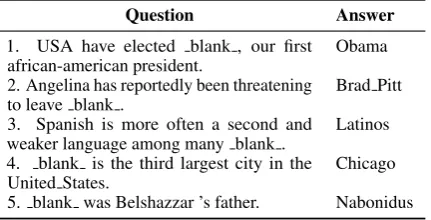
Table 2: A few questions on which ONLYKB fails to answer but UNISCHEMAsucceeds.
million ClueWeb sentences containing entities in Freebase subset of SPADES. The network weights were initialized using Xavier initialization (Glorot and Bengio, 2010). We considered up to a maxi-mum of 5k KB facts and 2.5k textual facts for a question. We used Adam (Kingma and Ba, 2015) with the default hyperparameters (learning rate=1e-3,β1=0.9,β2=0.999,ε=1e-8) for optimization. To overcome exploding gradients, we restricted the magnitude of the`2norm of the gradient to 5. The batch size during training was set to 32.
To train the UNISCHEMAmodel, we initialized the parameters from a trained ONLYKB model. We found that this is crucial in making the UNI S-CHEMAto work. Another caveat is the need to em-ploy a trick similar tobatch normalization(Ioffe and Szegedy, 2015). For each minibatch, we nor-malize the mean and variance of the textual facts and then scale and shift to match the mean and variance of the KB memory facts. Empirically, this stabilized the training and gave a boost in the final performance.
4.4 Results and Discussions
addi-Model Dev. F1
ONLYKB correct 39.1
ONLYTEXTcorrect 25.3
UNISCHEMAcorrect 41.1
ONLYKB or ONLYTEXTgot it correct 45.9
Both ONLYKB and ONLYTEXTgot it correct 18.5 ONLYKB got it correct and ONLYTEXTdid not 20.6
ONLYTEXTgot it correct and ONLYKB did not 6.80 Both UNISCHEMAand ONLYKB got it correct 34.6
UNISCHEMAgot it correct and ONLYKB did not 6.42 ONLYKB got it correct and UNISCHEMAdid not 4.47
Both UNISCHEMAand ONLYTEXTgot it correct 19.2 UNISCHEMAgot it correct and ONLYTEXTdid not 21.9
ONLYTEXTgot it correct and UNISCHEMAdid not 6.09
Table 3: Detailed results on SPADES.
tional type constraints (e.g., in sentence 5, Freebase does not have a special relation forfather. It can be expressed using the relationparentalong with the type constraint that the answer is of gendermale). We have also anlalyzed the nature of UNI S-CHEMA attention. In 58.7% of the cases the at-tention tends to prefer KB facts over text. This is as expected since KBs facts are concrete and accurate than text. In 34.8% of cases, the memory prefers to attend text even if the fact is already present in the KB. For the rest (6.5%), the memory distributes attention weight evenly, indicating for some ques-tions, part of the evidence comes from text and part of it from KB. Table 3 gives a more detailed quan-titative analysis of the three models in comparison with each other.
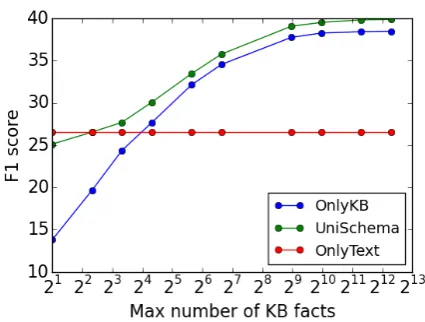
To see how reliable is UNISCHEMA, we gradu-ally increased the coverage of KB by allowing only a fixed number of randomly chosen KB facts for each entity. As Figure 2 shows, when the KB cov-erage is less than 16 facts per entity, UNISCHEMA outperforms ONLYKB by a wide-margin indicat-ing UNISCHEMAis robust even in resource-scarce scenario, whereas ONLYKB is very sensitive to the coverage. UNISCHEMAalso outperforms EN -SEMBLEshowing joint modeling is superior to en-semble on the individual models. We also achieve the state-of-the-art with 8.5F1 points difference. Bisk et al. use graph matching techniques to con-vert natural language to Freebase queries whereas even without an explicit query representation, we outperform them.
5 Related Work
A majority of the QA literature that focused on exploiting KB and text either improves the
infer-Figure 2: Performance on varying the number of available KB facts during test time. UNISCHEMA model consistently outperforms ONLYKB
ence on the KB using text based features (Krish-namurthy and Mitchell, 2012; Reddy et al., 2014; Joshi et al., 2014; Yao and Van Durme, 2014; Yih et al., 2015; Neelakantan et al., 2015b; Guu et al., 2015; Xu et al., 2016b; Choi et al., 2015; Savenkov and Agichtein, 2016) or improves the inference on text using KB (Sun et al., 2015).
Limited work exists on exploiting text and KB jointly for question answering. Gardner and Krish-namurthy (2017) is the closest to ours who generate a open-vocabulary logical form and rank candidate answers by how likely they occur with this logi-cal form both in Freebase and text. Our models are trained on a weaker supervision signal without requiring the annotation of the logical forms.
A few QA methods infer on curated databases combined with OpenIE triples (Fader et al., 2014; Yahya et al., 2016; Xu et al., 2016a). Our work differs from them in two ways: 1) we do not need an explicit database query to retrieve the answers (Neelakantan et al., 2015a; Andreas et al., 2016); and 2) our text-based facts retain complete senten-tial context unlike the OpenIE triples (Banko et al., 2007; Carlson et al., 2010).
6 Conclusions
[image:5.595.309.522.59.220.2]Acknowledgments
We sincerely thank Luke Vilnis for helpful insights. This work was supported in part by the Center for Intelligent Information Retrieval and in part by DARPA under agreement number FA8750-13-2-0020. The U.S. Government is authorized to reproduce and distribute reprints for Governmental purposes notwithstanding any copyright notation thereon. Any opinions, findings and conclusions or recommendations expressed in this material are those of the authors and do not necessarily reflect those of the sponsor.
References
Jacob Andreas, Marcus Rohrbach, Trevor Darrell, and Dan Klein. 2016. Learning to Compose Neural
Net-works for Question Answering. InNAACL.
Michele Banko, Michael J Cafarella, Stephen Soder-land, Matthew Broadhead, and Oren Etzioni. 2007.
Open Information Extraction from the Web. In
IJ-CAI.
Jonathan Berant, Andrew Chou, Roy Frostig, and Percy Liang. 2013. Semantic Parsing on Freebase from
Question-Answer Pairs. InEMNLP.
Yonatan Bisk, Siva Reddy, John Blitzer, Julia Hock-enmaier, and Mark Steedman. 2016. Evaluating In-duced CCG Parsers on Grounded Semantic Parsing. InEMNLP.
Kurt Bollacker, Colin Evans, Praveen Paritosh, Tim Sturge, and Jamie Taylor. 2008. Freebase: A col-laboratively created graph database for structuring
human knowledge. InICDM.
Antoine Bordes, Nicolas Usunier, Sumit Chopra, and Jason Weston. 2015. Large-scale simple question
answering with memory networks. CoRR.
Razvan C. Bunescu and Raymond J. Mooney. 2007. Learning to extract relations from the web using
min-imal supervision. InACL.
Andrew Carlson, Justin Betteridge, Bryan Kisiel, Burr Settles, Jr. Estevam R. Hruschka, and Tom M. Mitchell. 2010. Toward an Architecture for
Never-ending Language Learning. InAAAI.
Eunsol Choi, Daniel Hewlett, Alexandre Lacoste, Illia Polosukhin, Jakob Uszkoreit, and Jonathan Berant. 2016. Hierarchical question answering for long
doc-uments. arXiv preprint arXiv:1611.01839.
Eunsol Choi, Tom Kwiatkowski, and Luke Zettlemoyer. 2015. Scalable Semantic Parsing with Partial
On-tologies. InACL.
Xin Dong, Evgeniy Gabrilovich, Geremy Heitz, Wilko Horn, Ni Lao, Kevin Murphy, Thomas Strohmann,
Shaohua Sun, and Wei Zhang. 2014.
Knowl-edge Vault: A Web-scale Approach to Probabilistic Knowledge Fusion. New York, NY, USA, KDD ’14.
Anthony Fader, Luke Zettlemoyer, and Oren Etzioni. 2014. Open question answering over curated and
extracted knowledge bases. InKDD. ACM, pages
1156–1165.
David Ferrucci, Eric Brown, Jennifer Chu-Carroll, James Fan, David Gondek, Aditya A Kalyanpur, Adam Lally, J William Murdock, Eric Nyberg, John Prager, and others. 2010. Building Watson: An
overview of the DeepQA project.AI magazine.
Evgeniy Gabrilovich, Michael Ringgaard, and Amar-nag Subramanya. 2013. Facc1: Freebase
annota-tion of clueweb corpora. (http://lemurproject.
org/clueweb09/.
Matt Gardner and Jayant Krishnamurthy. 2017. Open-Vocabulary Semantic Parsing with both
Distribu-tional Statistics and Formal Knowledge. InAAAI.
Xavier Glorot and Yoshua Bengio. 2010. Understand-ing the difficulty of trainUnderstand-ing deep feedforward neural
networks. InAISTATS.
Alex Graves and J¨urgen Schmidhuber. 2005. Frame-wise phoneme classification with bidirectional lstm
and other neural network architectures. Neural
Net-works.
Bert F Green Jr, Alice K Wolf, Carol Chomsky, and Kenneth Laughery. 1961. Baseball: an automatic
question-answerer. InPapers presented at the May
9-11, 1961, western joint IRE-AIEE-ACM computer conference. ACM, pages 219–224.
K. Guu, J. Miller, and P. Liang. 2015. Traversing
knowledge graphs in vector space. InEMNLP.
Felix Hill, Antoine Bordes, Sumit Chopra, and Jason Weston. 2016. The goldilocks principle: Reading children’s books with explicit memory
representa-tions.ICLR.
Sepp Hochreiter and J¨urgen Schmidhuber. 1997. Long
short-term memory.Neural Computation.
Sergey Ioffe and Christian Szegedy. 2015. Batch nor-malization: Accelerating deep network training by
reducing internal covariate shift. In ICML. JMLR
Workshop and Conference Proceedings.
Mandar Joshi, Uma Sawant, and Soumen Chakrabarti. 2014. Knowledge Graph and Corpus Driven Seg-mentation and Answer Inference for Telegraphic
Entity-seeking Queries. InEMNLP.
Diederik P. Kingma and Jimmy Ba. 2015. Adam: A
Jayant Krishnamurthy and Tom Mitchell. 2012. Weakly Supervised Training of Semantic Parsers. In
EMNLP.
Julian Kupiec. 1993. MURAX: A robust linguistic ap-proach for question answering using an on-line
en-cyclopedia. InSIGIR. ACM.
Kenton Lee, Tom Kwiatkowski, Ankur Parikh, and Di-panjan Das. 2016. Learning recurrent span
repre-sentations for extractive question answering. arXiv
preprint arXiv:1611.01436.
Tomas Mikolov, Ilya Sutskever, Kai Chen, Greg S Cor-rado, and Jeff Dean. 2013. Distributed representa-tions of words and phrases and their
compositional-ity. InNIPS.
Alexander H. Miller, Adam Fisch, Jesse Dodge, Amir-Hossein Karimi, Antoine Bordes, and Jason Weston. 2016. Key-value memory networks for directly
read-ing documents. In EMNLP.
Mike Mintz, Steven Bills, Rion Snow, and Dan Juraf-sky. 2009. Distant supervision for relation
extrac-tion without labeled data. InACL.
Arvind Neelakantan, Quoc V Le, and Ilya Sutskever. 2015a. Neural programmer: Inducing latent
pro-grams with gradient descent. arXiv preprint
arXiv:1511.04834.
Arvind Neelakantan, Benjamin Roth, and Andrew Mc-Callum. 2015b. Compositional vector space models
for knowledge base completion. InACL.
Tri Nguyen, Mir Rosenberg, Xia Song, Jianfeng Gao, Saurabh Tiwary, Rangan Majumder, and Li Deng. 2016. MS MARCO: A Human Generated
MA-chine Reading COmprehension Dataset. CoRR
abs/1611.09268.
Pranav Rajpurkar, Jian Zhang, Konstantin Lopyrev, and Percy Liang. 2016. SQuAD: 100,000+ Questions
for Machine Comprehension of Text. In EMNLP.
Austin, Texas.
Siva Reddy, Mirella Lapata, and Mark Steedman. 2014. Large-scale semantic parsing without
question-answer pairs. TACL2.
Sebastian Riedel, Limin Yao, and Andrew McCallum. 2010. Modeling relations and their mentions
with-out labeled text. InECML PKDD.
Sebastian Riedel, Limin Yao, Andrew McCallum, and Benjamin M. Marlin. 2013. Relation extraction with matrix factorization and universal schemas. In
NAACL.
Denis Savenkov and Eugene Agichtein. 2016. When a knowledge base is not enough: Question answer-ing over knowledge bases with external text data. In
SIGIR. ACM.
Minjoon Seo, Sewon Min, Ali Farhadi, and
Han-naneh Hajishirzi. 2016. Query-reduction
net-works for question answering. arXiv preprint
arXiv:1606.04582.
Gabriel Stanovsky, Omer Levy, and Ido Dagan. 2014.
Proposition Knowledge Graphs.COLING 2014.
Sainbayar Sukhbaatar, Arthur Szlam, Jason Weston, and Rob Fergus. 2015. End-to-end memory
net-works. InNIPS.
Huan Sun, Hao Ma, Wen-tau Yih, Chen-Tse Tsai, Jingjing Liu, and Ming-Wei Chang. 2015. Open do-main question answering via semantic enrichment.
InWWW. ACM.
Adam Trischler, Tong Wang, Xingdi Yuan, Justin Har-ris, Alessandro Sordoni, Philip Bachman, and Ka-heer Suleman. 2016. NewsQA: A Machine
Compre-hension Dataset.CoRRabs/1611.09830.
Patrick Verga, David Belanger, Emma Strubell, Ben-jamin Roth, and Andrew McCallum. 2016. Multilin-gual relation extraction using compositional univer-sal schema .
Ellen M Voorhees et al. 1999. The trec-8 question
an-swering track report. InTrec. volume 99, pages 77–
82.
Shuohang Wang and Jing Jiang. 2016. Machine com-prehension using match-lstm and answer pointer.
arXiv preprint arXiv:1608.07905.
Jason Weston, Sumit Chopra, and Antoine Bordes.
2015. Memory networks.In ICLR.
Caiming Xiong, Victor Zhong, and Richard Socher. 2016. Dynamic Coattention Networks For Question
Answering.arXiv preprint arXiv:1611.01604.
Kun Xu, Yansong Feng, Songfang Huang, and Dongyan Zhao. 2016a. Hybrid Question Answering
over Knowledge Base and Free Text. InCOLING.
Kun Xu, Siva Reddy, Yansong Feng, Songfang Huang, and Dongyan Zhao. 2016b. Question Answering on Freebase via Relation Extraction and Textual
Evi-dence. InACL.
Mohamed Yahya, Denilson Barbosa, Klaus Berberich, Qiuyue Wang, and Gerhard Weikum. 2016. Rela-tionship queries on extended knowledge graphs. In
Proceedings of the Ninth ACM International Confer-ence on Web Search and Data Mining. ACM, pages 605–614.
Limin Yao, Sebastian Riedel, and Andrew McCallum. 2010. Collective cross-document relation extraction
without labelled data. InEMNLP.
Xuchen Yao and Benjamin Van Durme. 2014. Infor-mation Extraction over Structured Data: Question
Wen-tau Yih, Ming-Wei Chang, Xiaodong He, and Jianfeng Gao. 2015. Semantic Parsing via Staged Query Graph Generation: Question Answering with
Knowledge Base. InACL.
John M Zelle and Raymond J Mooney. 1996. Learn-ing to parse database queries usLearn-ing inductive logic
programming. InAAAI. Portland, Oregon.
Daojian Zeng, Kang Liu, Yubo Chen, and Jun Zhao. 2015. Distant supervision for relation extraction via piecewise convolutional neural networks. In
EMNLP.
Luke S. Zettlemoyer and Michael Collins. 2005. Learn-ing to Map Sentences to Logical Form: Structured Classification with Probabilistic Categorial