-.__ --I_ ‘.j ,__
J. Rznge Mznage.
4i3465-469 September 4995
Nitrogen fertilizer use efficiency in steer gain on old world bluestem
WILLIAM A. BERG AND PHILLIP L. SIhilS
Authors are soil scienrist and range scienlist. respectively, at the USDA-ARS Southern Plains Range Research Sration.
2000 I&h Street. Woodward, Oklu 73SOI.
Abstract
Old WC& blrrestem (BotJuiocMoa isclzaemum L.) is the major grass being planted for improved pastures on marginal farmland in western OkMhoma and adjacent areas in Texas. The farmland is often deficient in plant available N as a result of up to 100 years of cultivation and erosion. This study determined N fertiiiz-
er use efC5ency on steer gain when grazing Old World bluestem in northwestern Oklahoma where average annual precipitation is 57§ mm ST-‘. The study was conducted over 4 summer grazing seasons on Pratt soils (sandy, mised thermic Psammentic Eaplnsdfs). Nitrogen rates of 0,3J, 65, and 102 kg N ha-’ y?
were applied to paddocks in a randomized complete block design w<th 1 Mocks. Steer gain averaged 220 kg hd’ yr-’ and 3.3 kg per kg N applied at the 33 kg N ha-’ JT‘I rate. Steer gain ranged from 2.3 to 4.3 kg JY’ per kg of N applied at the rate of 34 kg N ha-’
yr’. Abwf an additional kg of steer gain per kg N applied was realized for the second 33 kg N ha-’ yr-’ increment from 34 to 68 kg N ha-‘~Y’, Gain n‘as negligible from the third 34 kg N ha-’ yr-’
increment from 6s to 102 kg N has’yr-l. Early summer grazing of N-fertilized Old World bluestem has high stocker production potential.
Key Words: Southern Plains, marginal farmland, grass fertiiii- Bon, Bo~hn~orr’lloa ischaemam
Old World bluestem (Buhiuchloa isclzaemum L.) is the major -ms being established for improved pastures on marginal farm- land in western Oklahoma and adjacent areas in Texas. This warm-season -ms is relatively easy to establish and has high for- age production potential @emaId et al. 19S5). Steer gain on 70 kg N ha-’ fertilized Old World bluestem averaged 200 kg ha-’ yr-’
under December through September grazing in western Oklahoma (Sims et al. 1983); steer gain on native rangeland in the area is about 50 kg ha*’ p’ (Shoop and hilcIlvain 1971). Thus,
The nu~hors thank Ron Charmasson, Rick Hurst, John Loch, Lonnie Parsons, and Dan Pzrsons for assatznce in field a ok, Jerry McLaughlin for laboratory analyses, Tom Popham for stxistical analyses 2nd Sherry De&d for mmmscript preparation.
hlanuscripl acceptsd 17 Nov. 1994.
the estimated 2 million ha of Old World bluestem established in Oklahoma and Texas has a high beef production potential. Some of this potential might be used to reduce summer grazing pressure on native rangeland.
Marginal farmland on the Southern Plains is deficient in N available to grass as a result of up to 100 years of cultivation and erosion. Clipping studies show a nearly linear Old World bluestem yield response to fertilizer N up to 70 kg N ha-’ yi’ on these soils (Berg 1990). Clipping data would apply when stands are hayed, however, clipping data may not adequately predict grazing response with N fertilization since N is being recycled in urine and feces (Russelle 1992).
Nitrogen fertilization of Caucasian bluestem (B. caucasica (Trin.) C. E. Hubb.) at 40 kg N ha-’ yr-* in western Oklahoma increased beef production from 115 to 200 kg ha-’ yr-’ for an aver- age efficiency of 2.1 kg of beef produced per kg of N applied (1963, 1964, and 1965 annual reports, Southern Plains Range Research Station, Woodmard, Okla., unpublished). This N fertil- izer use efficiency in steer gain is similar to that summarized for warm-season grasses fertilized at 110 kg N ha-’ yi’ in the south- eastern USA (Wilkinson and Langdale 1974), and for introduced cool-season grasses fertilized at 45 to 50 kg N ha-’ yi’ in western North Dakota [Rogler and Lorenz 1969, 1974). As N application rates increased N fertilizer use efficiency in beef gain decreased in southeastern USA (Wilkinson and Langdale 1974), North Dakota (Rogler and Lorenz 1969), and Australian studies (Jones 1990).
Beef gain response to pasture N fertilization may result from increases in forage production andfor greater average daily gain from higher quality forage. In western Oklahoma, average steer gain over 3 summers was 0.8 kg day-’ on unfertilized and 1.0 kg day-’ on N-fertilized Caucasian bluestem (1963, 1964, and 1965 annual reports, Southern Plains Range Research Station, Woodward, Okla. unpublished). In North Dakota, early-season steer gain over 10 years averaged 1.2 kg day-’ on unfertilized or N-fertilized crested wheatgrass (Agropyron desertorum (Fisch. ex Link) Schult.) (Rogler and Lorenz 1969).
The objective of this study was to develop guidelines for N application rates and grazing management of Old World bluestem established on marginal farmland in the Southern Plains.
- - - - 1 - - - _ - - - _ _ I . _
hlaterials and hiethods
This study was on the Southern Plains Experimental Range near Fort Supply in northwestern Oklahoma. The soil is predomi- nately a deep loamy sand (Pratt series-sandy, mixed, thermic Psammentic HapIustalfs). Prior to cultivation, the land supported a sand sagebrush (Artemisiafilifolia Torr.)-mixed grass prairie with sand bluestem (Andropogon hallii Hack), sand dropseed (Sporobohs czpandz-zzs (Ton-.) Gray), blue grama (Bouteloua gracilis (lXB.K)Lag.), switchgmss (Panicurn virgamm L.) and little bluestem (Schi~ach~rizzm scoparizzm (Michx.)Nash) as dom- inant grasses (Berg 1994).
The area was farmed for about 40 years before ‘WW-Spar’ Old World bluestem was established in the early 19SOs. The Old V+70rld bluestem was fertiliied with 6s kg N ha-’ yr-’ and grazed for the 2 years (1956, 19S7) preceding initiation of this study.
Analysis (Hanlon and Johnson 19S3) of 5 soil samples of 30 cores each of the surface 15 cm had the following averages;
nitrate was low (3 mg N03-N kg-‘, calcium sulfate extraction), P was adequate (32 mg P kg“, Bray 1 extraction), K was adequate (2S0 mg K kg-‘. ammonium acetate extraction), and pH was 5.5 (1:l mass soil/mass distilled water).
A randomized complete block design was used with 4 blocks.
This involved 16 paddocks and 3 N rates; 0,34,6S, and 102 kg N ha“ yr*l. The basic stocking was 3 test steers per paddock. ‘Put and take” steers mere used in an attempt to maintain similar amounts of available forage per steer in each paddock over the summer ,ming periods. Steer gain per paddock was the experi- mental unit used in the statistical analysis.
Paddocks were 1.2 ha for the control (no N) treatment and 0.S ha for each N fertilized treatment. The N source was ammonium nitrate broadcast in April of each year. Incremental N rates were obtained by adjusting a drop spreader for the 34 kg N ha*’ rate and then double or triple spreading for the higher rates. Aftermath in all paddocks was burned at the start of the study in late March 19SS, and again in March 1992. Aftermath was winter ,med after the 19SS. 19S9, and 1990 growing seasons, and standing residue mowed in March.
A low temperature of -20°C on 22 December 1989, following a dry fall (4 mm precipitation October through December 1989) resulted in extensive winterkill of Old World bluestem. To allow recovery, the bluestem was not grazed during the following (1990) growing season. However, N was applied before the extent of the cold damage was realized, thus, the study was N fer- tilized over 5 years (1988-1992) but only grazed during the growing seasons of 1988,1989,1991, and 1992.
Precipitation measured at the Southern Plains Experimental Range headquarters, about 1.5 km from the research site, was 500 mm in 19SS; 680 mm in 1989,440 mm in 1990,410 mm in 1991, and 4S0 mm in 1992. The 50-year mean is 575 mm yr-‘.
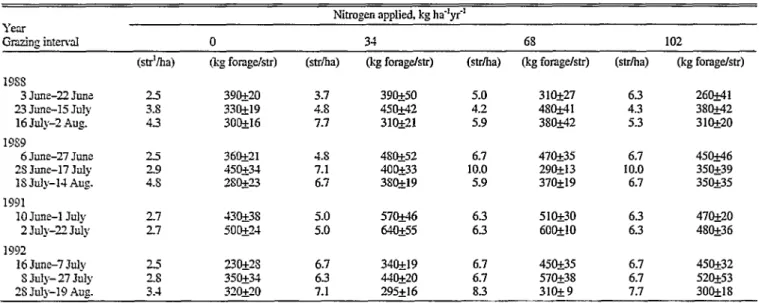
Yearling steers were placed in the paddocks in early June when grass was 15 to 20 cm tall. Steers were grazed until late July or mid-August with the objective of maximizing Old World bluestem use while quality and growth rates were higher, and then allowing a regrowth period before fall dormancy (Table 1).
The steers, Hereford or crosses of Hereford or Angus with Simmental, Limousin, or B&man, were implanted with a growth promotant in May. Initial steer weights averaged 220 kg in 1988, 250 kg in 1989,320 kg in 1991, and 235 kg in 1992. Steers were weighed at 3-week intervals, with the exception of a 2-week interval at the end of the 19X8 summer grazing and a 4-week interval at the end of the 1989 summer grazing. Before weighing, steers were held for 18 hours without feed or water. Steer num- bers in each paddock were adjusted after each weighing interval.
Steer gain ha-’ was calculated as the average test steer daily gain between weighing intervals times steer days in paddock divided by ha in paddock; this data was then summed for all summer poraing periods within each year.
The quantity of forage in each paddock was determined when steers were placed in the paddocks and subsequently whenever the steers were weighed. The exception was that forage was not sampled on 14 August 19X9 because the grass was severely hail damaged. A dormant season sampling was made each fall. At each sampling, forage was cut at a height of 7 cm from five 1.25 x 4 m areas within each paddock. Subsamples were dried at 60°C and oven dry yields calculated. Available forage was calculated
Table 1. Stocking density and ailable forage (lq@E) per steer per grazing period over 4 years on N-fertilization treatments on Old World bluestem.
0
Nitrogen applied, kg hd’yi’
34 68 102
19%
3 June-22 Junz 23 June-15 July 16 My-2 Aug.
19s9
6 June-27 June 2s June-17 July 1 S July-14 Aug.
1991
10 June-l July 2 July-22 July 1992
16 June-7 July S July- 27 July
(str’fna) (kg forage&r) (&ha) (kg foragelstr) @/ha) (kg fomgektr) (stdha) (kg forage/s@
2.5 39@20 3.7 390+50 5.0 31&27 6.3 260&l
3.s 33@19 4-s 450&2 4.2 480&l 4.3 380&2
4.3 300&x 7.7 31&21 5.9 3SO&2 5.3 31&20
25 360+21 4s 4S(k52 6.7 47&35 6.7 450+46
29 45&34 7.1 400+33 10.0 290+13 10.0 350&39
4.s 28&23 6.7 3SQ19 5.9 37&19 6.7 3x&35
2.7 43&38 5.0 57C&46 6.3 51&30 6.3 47&20
27 5OOg.l 5.0 m55 6.3 600&10 6.3 48&36
2.5 2s
230128 35&34
6.7 63 7.1
340&19 6.7 45&35
44&20 6.7 57Oi38
6.7 6.7 7.7
45@32 52&53
2s July-19 Aug. 3.4 320+20 295+16 8.3 310+9 3Oo&lS
1sa=sIea
466 JOURNAL OF RANGE MANAGEMENT 48(5), September 1995
as the average of forage mass in each paddock at the start and end of each steer weighing period divided by the number of steers in the paddock over that period. Forage quality was determined by separating leaves from stems (White 1990) and then analyzing for N (kjeldahl procedure, Bremner and Breitenbeck 19S3) and in vitro dry matter digestibility (Tilley and Terry 1963). Nitrogen concentration was multiplied by 6.25 to estimate crude protein.
Aftermath was gmzed by incoming stockers in the late fall and minter following the 19SS, 19S9, and 1990 growing seasons (Table 2). Aftermath was supplemented with 0.7 kg 41% protein cottonseed cake steer-’ day-‘. Grazing on aftermath was with herds of 25 to 30 steers placed in individual paddocks. Grazing man- agement on aftermath was to -me an estimated 2/3 to 314 of the standing crop. Steer weight gains on aftermath mere estimated from steer days in each paddock times an estimated average daily gain of 0.15 kg day-‘. The estimated daily gain of 0.15 kg day-’ is from past -“razing studies on Old World bluestem aftermath at the Experimental Range (Sims et al. 1953).
Table 2. Estimated steer gain on protein-supplemented dormant Old WmlS bluestem.
N kte kg ha-’ yr’
0 34 6S 102
3 Jan. - 13 Feb. I%9 6 Oct. 19S9 - 3 Jan. 1990 26 Dx. 1990 - 16 Feb. 1991
--___--- kgsteer,&ha-l-__----_
45 60 65 70
45 70 95 100
35 70 60 65
Peak standing forage production was measured on 15 July 19SS, 3s June 19S9, and 1 July 1991 in 5 x 150 m exclosures constructed between treatment paddocks. Exclosed areas were given N treatments and five 1.25 x 4 m areas harvested within each enclosure. In 1992, five 2.5 x 5 m enclosures were randomly placed within each paddock and 1.25 x 4 m areas harvested on 15 July within each exclosure for peak standing forage production.
Nitrogen fertilizer use efficiency in this report is the average steer gain increase per unit of N applied for a specified portion of a yield curve: this definition is synonymous to the term “yield efficiency” used in crop production (Bock 19&l)).
Analysis of variance was conducted for summer steer gain ha-’
as affected by N rates over years and for each year, then treat- ment effects were partitioned into linear, quadratic, cubic, and residual components by year. The same analysis was used on peak standing forage production. Analysis of variance was con- ducted for average daily steer gain and forage quality. Duncan’s new multiple range test (P=O.O5) was used to separate treatment effects on daily steer gain.
Results and Discussion
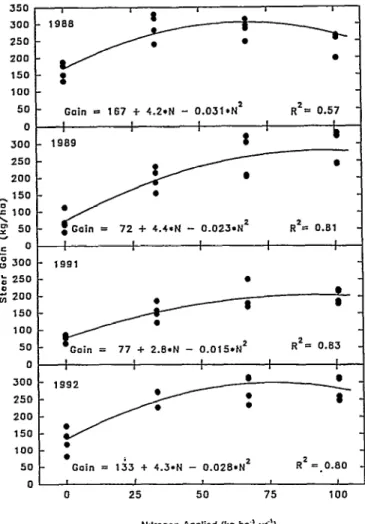
Steer gain ha-’ during the 4 summer ,ging seasons increased with N rates up to 34 or 6s kg N ha-‘. The gain response to N rates was quadratic and is presented for each year (Fig. 1) because the year x N rate interaction was significant (PC 0.01) in the combined analysis.
Steer gain over the 4 summer aOning seasons averaged 3.3 kg
350 1 ’ -
8
1 I 1
300 1966
.
- 8
250 - 0
200 - l -
150 - g 100 -
50 - Gain P 167 f 4.2*N - O.OJl*N’ R*= 0.57
0 300 250 200
;; 150
\ = 100 m t 50
5 O
8 300
; 250
. Gain = 72 + 4.4-N - 0.023*N2
Coin = 1;3 + 4.3.N - O.O28*N*
01 ’ r 1 I 1
0 25 50 75 100
Ntrogen Applied (kg ha-’ yf’)
Fig. 1. Steer gain over 4 summer grazing seasons as affected by N rates applied to Old World bluestem established on marginal farmland *m western Oklahoma.
per kg N applied at the lowest N rate of 34 kg N ha-‘. This N fer- tilizer use efficiency is greater than an average stocker gain of about 2 kg per kg N applied reported in the southeastern USA (Wilkinson and Langdale 1974) and the Northern Great Plains (Rogler and Lorenz 1969, 1974). A range in N fertilizer use effi- ciency of 1.3 to 4.7 kg steer gain per kg N applied was found for irrigated tropical pastures in Western Australia (Jones 1990).
Economic return is currently favorable for the initial 34 kg N ha*’ increment used in our study with cost of applied N about
$0.55 kg-’ N and custom grazing rates about 0.60 kg-’ of stocker gain. Returns would be marginal for the second 34 kg N ha-’
increment [from 34 to 65 kg N ha-‘) applied in our study which averaged about one kg steer gain per kg N. Gain was negligible from the third 34 kg N ha-’ increment (from 68 to 102 kg N ha-‘).
Steer gain in the unfertilized paddocks was surprisingly high, averaging 112 kg ha-’ yi’ over 4 years. Part of this productivity is probably residual effect from N fertilization and cycling of N in the pastures in the 2 years prior to this study and also N fertiliza- tion of grazed annual forages since the early 1960s. Thus, this study site appears to be on land with a relatively high N availabil- ity level due to recent management. Some marginal farmland in
-I 988
6/3-6/Z/22 6/23--7/;2 7/13-6/2
P 6,‘6-6/‘26
U-J 1.0 -2
s 0.5
? 6/3-612
1989
6/27-?/I7 7/l&6/14 ;i 6/6-6114
r r r
7/Z-7/23 Ti 61’1 l-7123
1992
7/E-7/28 7/29-a/79 ii 6/17-6/19
NITROGEN RATE (kg N/ha)
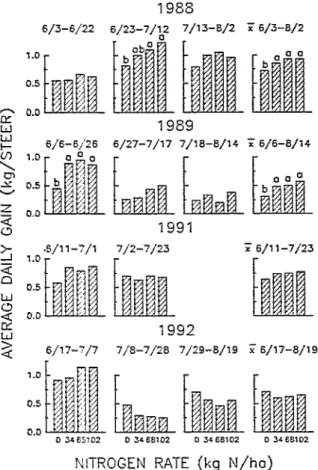
Fig. 2. Average daily steer gain during grazing intervals over 4 sum- mer grazing seasons as affected by N application rates to Old World bluestem. Gain within a time interval designated with a common letter or no letter are not significantly (P>O.O5) different.
the Southern Plains is more N deficient (Berg 1990) and may pro- duce an economical return to higher N rates.
Daily gain averaged 0.70 kg steer-’ and ranged from 0.3 to 0.9 kg stZef’ over the 4 summer ,-zing seasons (Fig. 2). Average daily gain was greater from N-fertilized than from unfertilized seatments in 198 and 19S9, but no difference was found in 1991 or 1992. Nitrogen fertilization increased crude protein concentra- tion but had little effect on forage digestibility (Table 3).
The daily gain averaging 0.70 kg day-’ for the N-fertiliied Old World bluestem over 4 years is less than daily gain averaging 0.97 kg day- for similar steers grazing nearby native range (unpublished data P. L. Sims) over the same time period. Average daily gain was disappointingly low during the second and third baing intervals in 19S9 and 1992 (Fig. 2). In these years above normal summer rainfall resulted in accelerated forage growth in the N-fertilized treatments (Fig. 3). consequently, stocking was increased flable 1).
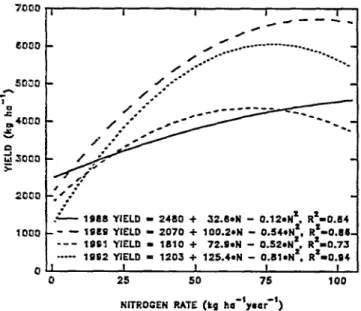
A growth characteristic of Old World bluestem is rapid growth in late May through June with the fully headed stage reached in early July. We estimated that peak standing crop (Fig. 3) occurs at the fully headed stage when leaves averaged 62% of the forage harvested in the exclosures. The forage yield response to N rates was quadratic and is presented for each year because the year x N rate interaction was significant (P < 0.01) in the combined analy- sis. Peak standing forage production ranged from 1,200 kg ha-’ in
Table 3. Forage quality of Old World bluestem in grazed pastures as a function of N rates and dates, 1988. Data from the other 3 years are similar and is not reported.
hkasurcment N Rate kg hx’yr’
0 34 68 102 F
--- Leaf Proportion
6l2 85
a?2 64
7/15 57
S/l 55
11116 53
Crude Protein, Leaves
6L2 9.2
6t22 6.5
7ll.5 6.1
S/l 4.6
11116 3.0
Crode Protein, Srems
6l2 6.9
6122 4.8
7115 4.2
S/l 2.8
11116 1.5
Digestibility, Leaves
6l2 70
6l22 65
7115 60
811 57
11116 53
Digestibility, Stems
6l2 71
6l22 64
7115 57
S/l 54
11116 4s
92 60 56 55 62
62 56 60
89 NS
59 NS
60 NS
61 NS
66 NS
11.6 13.1 14.0 **
7.6 8.5 9.2 **
7.5 8.2 10.0 **
4.9 5.7 6.7 **
4.0 4.1 4.9 **
8.5 9.8 10.8 **
5.3 6.0 7.8 **
4.8 5.6 6.9 **
3.3 4.3 5.5 **
2.1 2.3 3.0 **
72 72 72 NS
65 65 67 NS
62 61 63 *
55 57 57 NS
52 52 54 NS
72 72 72 NS
61 63 65 NS
57 55 57 NS
50 54 55 NS
45 46 49 NS
g/lOOg--- ---, _----
NS = non-significant, * = signifinnt at the PS 0.05, ** = significant at the P 5 0.01.
1992 on paddocks receiving no N fertilizer, to near 6,900 kg ha-’
in 19S9 on the higher N rate treatments (Fig. 3). Available forage averaged 400 kg per steer over the 4 summer grazing seasons (Table 1).
Grazing of aftermath during the dormant season resulted in estimated steer gains on N fertilized treatments of 15 to 55 kg ha-’
greater than the no N treatment (Table 2). The difference in dor- mant season gain between the N-fertilized and no N treatments should be attributed to both N fertilizer and more protein supple- ment fed to supplement the greater amount of forage in the N treatments. Because of this, and because steer gain on aftermath was only estimated, no additional value for N fertilizer use effi- ciency on the dormant season grazing was calculated. However, dormant season grazing would add to the N fertilizer use efficien- cy previously calculated for summer grazing.
Stocking management appears critical to optimizing summer stocker gain on Old World bluestem. Grass growth stage when grazing starts appears to be particularly important. For example, steers were placed in the paddocks on 3 June 1988 when growth was mostly leaves (S9%, Table 3). The initial stocking density of 6.2 steers ha-’ on the 102 kg N ha*’ treatment proved too high and was reduced (Table 1). Whereas, in 1989, 1991, and 1992 with a later turn-in, both in terms of calendar date (Table 1) and grass phenological development the stocking density of 6.2 steers ha’
was sustainable. However, Old World bluestem forage quality
466 JOURNAL OF RANGE MANAGEMENT 48(5), September 1995
7000 I I 1 I +---- I __---...__
_.-- /--- ---..
+--- --.*
/ .--
:j/ --__
--s_
#( ‘=’
. :
25 50 75
NITROGEN RATE (t9 ha-‘y.rr-‘)
Fig. 3. Peak standing forage production by Old World bluestem as affected bv N auuIication rates.
Jones, R. J. 1990. Nitrogen rate and stocking rate effects on steer gains from grazed pangola grass in the Ord Valley, Western Australia.
Australian J. Exp. Agr. 30:599-605.
Rogler, G. A. and R. J. Loreaz. 1969. Pasture productivity of crested wheatgrass as influenced by nitrogen fertilization and alfalfa. USDA- ARS Technical Bull. 1402.
Rogler, G. k and R. J. Lorenz. 1974. Fertilization of mid-continent range plants. p. 231-254. In: D. A. Mays (ed.) Forage Fertilization.
Amer. Sot. Agron. Madison, Wis.
Russelle, M. P. 1992. Nitrogen cycling in pasture and range. J. Prod.
Agric. 5: 13-23.
Shoop, htl. C. and E. II. McIlvain. 1971. Efficiency of combining improvement practices that increase steer gains. J. Range Manage.
241113-I 16.
Sims, P. L., C. L. Dewald, and S. Cowles. 1983. Advances with Old World bluestems. p, 4-I 1. In: H, T. Wiedemann and J. F. Cadenhead (compilers). Proc. Range and Pasture Seeding in the Southern Great Plains. Oct. 19S3. Vernon, Texas. Texas A&M Univ. Agr. Res. Ext.
Center, Vernon, Tex.
Tiiey, J. M. A. and R. A. Terry. 1963. A two stage technique for the in vitro digestion of forage crops. J. Brit. Grass]. Sot. 1X:104-1 11.
Wilkinson, S. R. and G. 1%‘. Langdale. 1974. Fertility needs of warm- season grasses. p. 119-145. In D. A. Mays (ed.) Forage Fertilization.
Amer. Sot. Agron. Madison, Wis.
White. L. hi. 1990. Mefluidide effect on Caucasian bluestem leaves, - .-
stems, forage yield and quality. J. Range Manage. 43:190-194.
decreased rapidly with time (Table 3) usually resulting in lower daily gain after the initial 3-week ,ting period (Fig. 2). Put and t&e stocking as used in this study is seldom a viable alternative in commercial operations. With set stocking, the timing of turn in would be even more critical.
Previous studies show that Old World bluestem fertilized with 45 kg N ha-r yi’ produced steer gain averaging 200 kg ha-’ yr-’
under December through September stocking at about l-7 steers ha-’ (Sims et al. 1933). This study provides data on an alternative management with early summer ,ging resulting in average steer gain of 220 kg ha-’ yr’ with stocking averaging about 5 steers ha-’
and N application of 34 kg ha-’ yr-I- Part of this potential might be used to reduce growing season =“razing pressure on native mnge- land- A N application rate of about 31 kg ha-’ yr-’ appears to be most efficient for pastures with a history of N fertilization in this climatic zone. A higher N rate is suggested for stands that do not have a history of N fertilization or are hayed.
Literature Cited
Berg, I%‘- A. 1990. Old World bluestem responses to nitrogen fertiliza- tion. J. Range Maninage. 33:265-270.
Berg, IV. A. 1994. Srnd sagebrush-mised prairie. p- 99. In: T. N. Shiflet (rd.) Rangeland cover types of the United States- Sot. Range hlanage.
Denver, Cola.
Bock, E. R. 19S4. Efficient use of nitrogen in cropping systems. p.
373-294. In: R. D. Hauck (ecL) Nitrogen in crop production. Amer.
Sot. Agron. hladison. Wis.
Eremner, J. M. and G. k Breitenbeck 19S3. A simple method for determination of ammonium in semimicro-kjeldahl analysis of soils and plant materials using a block digester. Commun. Soil Sci. Plant Anal. l-1:905-913.
DewaId, C- L, IV- A. Berg, P. L. Sims. 19SA New seed technology for old farmland. J. Soil Water Consem. 40:277-279.
Ha&m, E. and 6. Johnson. 19% OSU agronomic services procedure for soil. forage and water testing. OSU Extension Facts 2901 Oklahoma State Univ. Coop. Ext Ser. Stillwater, Okla
granite
&SFFr)
,>
i l Pasture & Range
, i l Erosion Controi
l Alfalfa
l Custom Seed Blends ,I l Over 300 Species in Stock _’ l Fast, professional service
Call or Fax for our Catalog (8OlJ53t-1456, f%x (801) 768-3967 Granite Seed Co., P-0. Box 177, Lehi, Utah 841143