778
ChID: A Large-scale Chinese IDiom Dataset for Cloze Test
Chujie Zheng1,2, Minlie Huang1∗, Aixin Sun3
1Institute for Artificial Intelligence, Dept. of Computer Science, Tsinghua University
1Beijing National Research Center for Information Science and Technology, China
2Dept. of Physics, Tsinghua University, Beijing 100084, China
3School of Computer Science and Engineering, Nanyang Technological University, Singapore
[email protected], [email protected] [email protected]
Abstract
Cloze-style reading comprehension in Chinese is still limited due to the lack of various cor-pora. In this paper we propose a large-scale Chinese cloze test datasetChID, which stud-ies the comprehension of idiom, a unique lan-guage phenomenon in Chinese. In this corpus, the idioms in a passage are replaced by blank symbols and the correct answer needs to be chosen from well-designed candidate idioms. We carefully study how the design of candi-date idioms and the representation of idioms affect the performance of state-of-the-art mod-els. Results show that the machine accuracy is substantially worse than that of human, indi-cating a large space for further research.
1 Introduction
Machine reading comprehension aims to assess the ability to comprehend natural language and answer questions from a given document or pas-sage. As a classical method of assessing language proficiency (Fotos, 1991; Jonz, 1991; Tremblay,
2011), cloze test (Taylor, 1953) has been widely employed due to its simplicity in form. Recently, a number of datasets for cloze test have been proposed for different languages. For instance, CNN/Daily Mail (Hermann et al.,2015) provides a benchmark for machine comprehension of En-glish text, while the People Daily and Children’s Fairy Tale dataset (Cui et al., 2016) and CMRC-2017 (Cui et al., 2018) pioneer explorations in Chinese language.
In this paper we explore idiom comprehension (Wray, 2002; Jackendoff and Jackendoff, 2002;
Cacciari and Tabossi, 2014; Jiang et al., 2018) in cloze test. Idiom , which is called “成语” (chengyu) in Chinese, is an interesting linguistic phenomena in Chinese language, and this work
∗
*Corresponding author: Minlie Huang.
Idiom 亡羊补牢
Literal To mend the fence after sheep are lost
Meaning Never be late to try
Table 1: An example of metaphor in idiom. The sense of “亡羊补牢” should be inferred figuratively but not represented literally using the meanings of the four constituent characters.
Idioms 侃侃而谈 口若悬河
Meanings To speak with fervour and assurance
Fluently and eloquently
Common Speak much and long
Difference Describe the deme-anor of the speaker
Describe the eloquence
Table 2: An example of near-synonyms in idiom, where idioms share similar meanings but are different in lan-guage usage.
is in parallel to several datasets (Hill et al.,2016;
Xie et al.,2018) that have considered different lan-guage phenomena in English. Compared to other types of words, many idioms are unique for their non-compositionality and metaphorical meaning (see an example in Table1). This feature requires a good representation of idiom. Meanwhile, the characteristic of near-synonym, i.e., words that have similar but not identical meanings (see an example in Table2), may challenge a machine to choose an accurate idiom in a given context. Due to the fact that idioms are widely used in daily communication and in various literary genres, it is a new challenge to assess the ability of under-standing and representing idioms in Chinese read-ing comprehension.
con-Dataset Lang. Extractive Option Answer Type Domain Size
CNN/Daily Mail EN Yes No Named entities News 1.38M Children’s Book Test EN Yes Yes Multiple types Children’s Books 678K Who-did-What EN Yes Yes Named entities News 206K LAMBADA EN Partial No Multiple types Novels 10K Story Cloze Test EN No Yes Single sentence Life Stories 102K CLOTH EN No Yes Multiple types Examinations 99K
People Daily &
Children’s Fairy Tale CN Yes No
Nouns, Named entities
News,
Children’s Stories 880K
CMRC-2017 CN Yes No Nouns,
Named entities Children’s Stories 359K
ChID (this work) CN No Yes Chinese idioms News, Novels,
Essays 729K
Table 3: Comparison of ChID with other cloze-style reading comprehension datasets. Extractivedenotes whether the answer is extracted directly from the given context. Optiondenotes whether candidate choices are provided. In theAnswer Typecolumn, the answers of all datasets except Story Cloze Test are single words.Sizedenotes the total number of queries or blanks in the dataset.
tains 581K passages and 729K blanks, and cov-ers multiple domains. In ChID, the idioms in a passage were replaced with blank symbols. For each blank, a list of candidate idioms including the golden idiom are provided as choice. As the difficulty level of cloze test depends on candidate choices, we investigate several strategies of select-ing candidate idioms. We evaluate several state-of-the-art models on the proposed corpus with dif-ferent representations of idioms. Results show that machine performs much worse than human, which indicates a large room for further research.
Our contributions are summarized as follows:
• We propose a new dataset, ChID, for cloze-style reading comprehension in Chinese lan-guage. ChID contains 581K passages and 729K blanks from three domains (news, nov-els, and essays).
• We conduct extensive experiments on the de-sign of candidate idioms and the idiom rep-resentation methods, and compare state-of-the-art models. Results show that the perfor-mance of these models is substantially worse than that of human.
• ChID provides a benchmark to evaluate the ability of understanding idioms, a unique yet common language phenomenon in Chinese. To our knowledge, this is the first work where this linguistic phenomenon is studied in the form of machine reading comprehension.
2 Related Work
Recently, machine reading comprehension has been advanced by many corpora with various task settings. For instance, CNN/Daily Mail (Hermann et al., 2015) collects news articles and uses the cloze test (Taylor, 1953) to assess the ability of reading comprehension in English. RACE (Lai et al.,2017) and CLOTH (Xie et al.,2018) are con-structed from questions in examinations designed for secondary and high school students. A num-ber of question-answer datasets (Rajpurkar et al.,
2016;Reddy et al., 2018) are also proposed and there are many other large-scale datasets (Nguyen et al., 2016; He et al., 2018). These corpora in-spire various neural models (Chen et al.,2016;Cui et al.,2016;Seo et al.,2017;Dhingra et al.,2017;
Cui et al., 2017). In Table 3, we present a sur-vey on existing cloze-style reading comprehension datasets.
while the key differences from CNN/Daily Mail include: a list of candidate choices is provided for each query, and more types of words are removed, including named entities, (common) nouns, verbs and prepositions. Who-did-What (Onishi et al.,
2016) collects its corpus from news and provides options for questions similar to CBT. Each ques-tion is formed from two independent articles: an article is treated as context to be read and a sep-arate article on the same event is used to form the query. LAMBADA (Paperno et al.,2016) re-moved the last word from a given passage and evaluates the ability of word prediction. By con-trast, the Story Cloze Test dataset (Mostafazadeh et al., 2017) evaluates the ability of story under-standing and script learning, where the task re-quires to select or generate a reasonable sentence to complete the story context.
To the best of our knowledge, People Daily (PD) and Children’s Fairy Tale (CFT) (Cui et al.,
2016) and CMRC-2017 (Cui et al.,2018) are the only two existing cloze-style datasets for Chinese reading comprehension. Similar to CNN/Daily Mail and CBT, PD & CFT and CMRC-2017 re-placed a word (usually a noun or named entity) in the document with a blank placeholder and treated the sentence containing this word as a query. PD collects data from news while CFT and CMRC-2017 are from children’s reading materials.
In most datasets, the answer can be directly found from context. CLOTH (Xie et al., 2018) has a similar setting to ChID, where the answer should be selected from given choices. However, CLOTH is collected from English examinations for secondary/high school students, whose size is limited because documents, blanks, and options are all manually created.
3 Chinese Idioms
Idiom is a common language phenomenon and usually called “成语” (chengyu) in Chinese. Thanks to its conciseness in form and expressive-ness in meaning, idiom is widely used in daily communication and in various text genres. The main challenges for machine reading comprehen-sion with idiom lie in: idiom representation which represents the meaning of an idiom, and thorough discrimination among the near-synonyms of an id-iom.
3.1 Idiom Representation
Many idioms are non-compositional and have metaphorical meanings (see an example in Ta-ble 1), which has also made idiom translation a challenging problem and attracted considerable re-search attentions (Anastasiou,2010;Salton et al.,
2014; Cap et al., 2015; Shao et al., 2017). The meaning of such idioms is generally different from the literal meanings of the constituent characters. Such idioms are usually originated from ancient cultural stories, but the meaning is reserved along the long history of language use. For instance, “塞
翁失马” has a metaphorical meaning, which is de-rived from this story:
Near China’s northern borders lived an old man who bred many horses. One day, one of his horses, for no reason at all, escaped into the territory of the northern tribes. Everyone commiserated with him. “Perhaps this will soon turn out to be a blessing,” said the old man. After a few months, his horse came back, and brought back a fine horse from the north.
So the idiom “塞翁失马” usually refers to a bless-ing in disguise. Thus comprehendbless-ing and repre-senting an idiom may require the access to the corresponding cultural history. In addition, due to the polysemy of a single character, even those compositional idioms are likely to have ambiguity, which also makes idiom representation a challeng-ing problem.
3.2 Near-synonyms
It is common that an idiom has near-synonyms. These idioms may be confused in language use due to their similar but not identical meanings1 (see an example in Table2). To discriminate those near-synonyms, machine is required to figure out their subtle differences in usage, which is also challenging.
To verify the near-synonym phenomena, we conducted a user study. Based on the idiom vo-cabulary we collected (see Section 4.1), we man-ually evaluated the number of near-synonyms per idiom. We randomly sampled 200 idioms. For each idiom, we picked up the 20 most similar id-ioms whose embedding similarity score to the in-put idiom is less than some threshold. According
1Idioms with identical meanings can be interchangeably
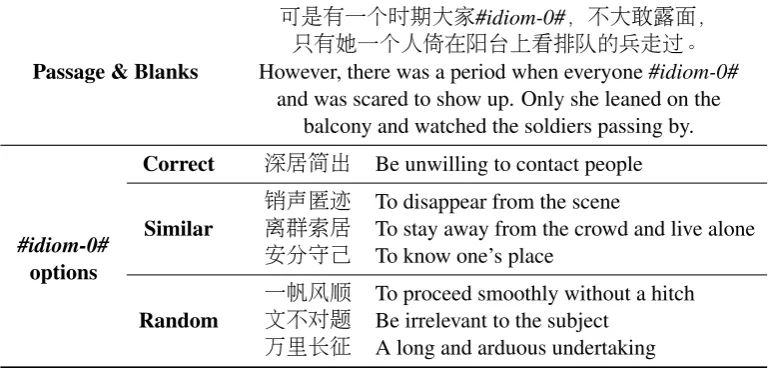
Passage & Blanks
可是有一个时期大家#idiom-0#,不大敢露面, 只有她一个人倚在阳台上看排队的兵走过。 However, there was a period when everyone#idiom-0#
and was scared to show up. Only she leaned on the balcony and watched the soldiers passing by.
#idiom-0# options
Correct 深居简出 Be unwilling to contact people
Similar
销声匿迹 离群索居 安分守己
To disappear from the scene
To stay away from the crowd and live alone To know one’s place
Random
一帆风顺 文不对题 万里长征
To proceed smoothly without a hitch Be irrelevant to the subject
[image:4.595.108.494.64.248.2]A long and arduous undertaking
Figure 1: An example in ChID. Each data contains a given passage with several blanks that replace the original idioms (in this example, there is only one blank). For each blank, several options are provided. Among the list of candidate choices, there is one golden answer, three similar idioms and another three random ones.
≥KNEARs #Idioms Proportion
1 179 89.5%
2 131 65.5%
3 80 40.0%
[image:4.595.314.518.314.426.2]4 40 23.0%
Table 4: Annotation result of near-synonyms. It shows the number of idioms in the 200 sampled idioms that have at least K near-synonyms, for K = 1,2,3,4. Fleiss’ kappa is 0.479, indicating moderate agreement.
to the similarity annotation result of Section 4.3 and Table 6, we set this threshold to 0.85. Then we hired four annotators to label these 4,000 idiom pairs in terms of whether a pair is near-synonyms or not. All the annotators have good command of Chinese.
The evaluation result is shown in Table4. Note that for each idiom, we rounded down the mean of the numbers of near-synonyms labeled by the four annotators. We estimate that about 90% id-ioms have at least 1 near-synonym. About 23% of the idioms have 4 or more near-synonyms. Fleiss’ kappa (Fleiss,1971) for measuring inter-annotator agreement is 0.479, indicating moderate agree-ment (within [0.4, 0.6]). This evaluation result strongly supports our claim that near-synonyms are very common among Chinese idioms.
4 Dataset Collection
Figure 1 presents an example in ChID. In each sample, idioms in a passage are replaced by blank
Level Freq. Num. Prop.
Very Low [20, 50) 832 21.6% Low [50, 100) 742 19.3% Medium [100, 200) 822 21.4% High [200, 400) 746 19.4% Very High [400, 534] 706 18.3%
Total [20, 534] 3,848 100.0%
Table 5: Idiom frequency statistics in the whole cor-pus. The minimum and the maximum are 20 and 534 respectively.
symbols, and each blank is provided with several candidate idioms including the golden idiom. The task is to select the golden answer from the candi-date choices given the context. Note that the an-swer is usually not occurring in the context in our setting, which is different from most existing cloze test corpora.
In the following subsections, we will explain the three steps in data collection: (1) Constructing the idiom vocabulary; (2) Extracting passages within a proper length; (3) Designing candidate choices.
4.1 Vocabulary Construction
We collected the idiom vocabulary from Chinese idioms Daquan 2, which contains over 23K id-iom entries. Since vast majority of idid-ioms con-sist of 4 characters, we only retained idioms with 4 characters in our vocabulary. In order to facili-tate the design of candidate choices, we removed
[image:4.595.86.278.315.393.2]those idioms that do not have a pre-trained embed-ding using the large-scale open-source corpus pro-vided bySong et al.(2018), where approximately 40% idioms were filtered out. We normalized syn-onyms with only slight morphological variation. Idioms that share the same explanation and mean-ing, but only differ in one character or the order of characters, are treated as the same idiom. This can be done with the Chinese idiom dictionary be-cause some idioms are marked with: “又作” (also written as), “犹” (like), “同” (the same as), “见” (also see). Such idioms in the passages are all re-placed by their re-normalized ones.
We then counted the frequency of each idiom in the corpus, and removed those idioms that ap-pear less than 20 times. Finally, the idiom vocabu-lary has 3,848 entries in total, and their frequency statistics on the whole corpus is shown in Table5. The minimum and the maximum idiom frequen-cies are 20 and 534 respectively. We simply divide the idiom frequency into five intervals: very low (from 20 to 50), low (from 50 to 100), medium (from 100 to 200), high (from 200 to 400) and very high (higher than 400). The proportions of idioms in the frequency intervals are almost uni-formly distributed.
4.2 Passage Extraction
To make the topic and domain more diversified, we collected passages from novel and essay on the Internet, and the news articles provided bySun et al.(2016)3. Since some documents may be very long, we took a paragraph as the basic unit. Each idiom except those in double quotation marks4is replaced with a blank symbol. A paragraph that is shorter than 100 characters is merged with the next paragraph to ensure that the context are suffi-cient for answer selection. Those passages that are longer than 600 characters are abandoned.
It is worth noting that if some idiom has a much higher word frequency than others, models may tend to bias answer selection to those more fre-quent idioms. In order to make frefre-quent and in-frequent idioms more balanced, we removed some passages which only contain high frequency id-ioms.
3The news articles are extracted from the THUCNews
dataset for Chinese text classification, which can be down-loaded fromhttp://thuctc.thunlp.org/.
4Because words in a quotation mark are usually entities
or other content that can not be inferred from the context.
Similarity SYN NEAR OTHER κ
[0.85, 0.90) 83.2% 16.8% 0.0% .642 [0.80, 0.85) 53.6% 42.8% 3.6% .447 [0.75, 0.80) 29.2% 53.6% 17.2% .485 [0.70, 0.75) 12.0% 57.2% 30.8% .496 [0.65, 0.70) 0.4% 52.8% 46.8% .466 [0.60, 0.65) 0.0% 34.0% 66.0% .528 [0.55, 0.60) 0.0% 10.4% 89.6% .657 [0.50, 0.55) 0.0% 6.0% 94.0% .787
Table 6: Annotation result of embedding similarity. The three labels are: SYN(synonym), NEAR (near-synonym),OTHER.κis the Fleiss’ kappa value.
4.3 Candidate Choice Selection
The semantic relevance between two idioms can be measured by the cosine similarity of their em-beddings (Mikolov et al., 2013), which helps us to design candidate choices. However, idioms that are similar in embedding may or may not be syn-onyms or near-synsyn-onyms. We thus manually eval-uated the correlation between embedding similar-ity and idiom synonymsimilar-ity. We split the embedding similarity from 0.9 to 0.5 into 8 intervals. Within each interval, 200 pairs of idioms are sampled. We used three labels to measure the relevance between two idioms: SYN (synonym, the two idioms are identical in meaning and can be interchangeably used),NEAR(near-synonym, have close or simi-lar meanings but can not be used interchangeably), OTHER(irrelevant or opposite in meaning). We hired five annotators to label these samples.
As shown in Table6, when the similarity score is larger than 0.75, there is a large proportion of idioms pairs that have the same meaning; when the score is between 0.65 and 0.80, there is a large probability that the two idioms are near-synonyms. For those pairs with high (larger than 0.85) or low (smaller than 0.60) similarity, an-notators tend to reach substantial agreement5 ac-cording to Fleiss’ kappa, while we have moderate agreement between the similarity interval [0.65, 0.85].
The above annotation results inspire us to de-sign proper candidate choices for each blank in a passage. First of all, we excluded those id-ioms that have a similarity score higher than 0.7 to the golden answer. This avoids to include synonyms of the golden answer in the candidate
5Substantial agreement corresponds to kappa within [0.6,
In-domain Out-of-domain
Total
Train Dev Test Total Out
# Passages 520,711 20,000 20,000 560,711 20,096 580,807
Avg. # tokens per passage 99 99 99 99 127 100
# Distinct idioms covered 3,848 3,458 3,502 3,848 3,626 3,848 Avg. idiom frequency 168.6 7.2 7.1 181.6 8.3 189.6
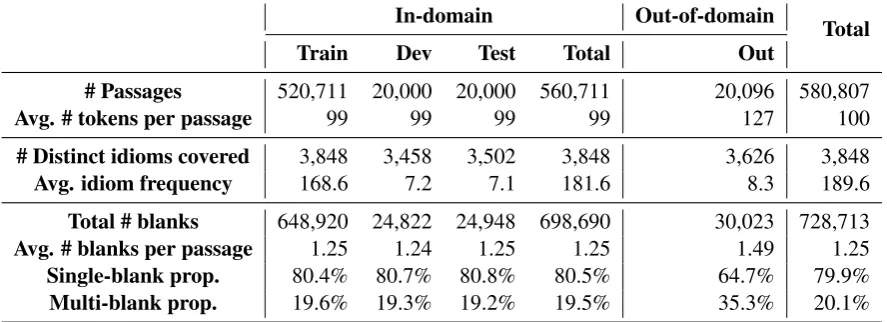
[image:6.595.79.523.65.226.2]Total # blanks 648,920 24,822 24,948 698,690 30,023 728,713 Avg. # blanks per passage 1.25 1.24 1.25 1.25 1.49 1.25 Single-blank prop. 80.4% 80.7% 80.8% 80.5% 64.7% 79.9% Multi-blank prop. 19.6% 19.3% 19.2% 19.5% 35.3% 20.1%
Table 7: ChID dataset statistics. The out-of-domain data have longer passages (127 vs. 99) and more blanks per passage (1.49 vs. 1.25) than the in-domain data.
Level Freq. In Out
Very Low [20, 50) 3.5% 8.2% Low [50, 100) 7.2% 12.0% Medium [100, 200) 16.0% 19.7% High [200, 400) 28.8% 28.7% Very High [400, 534] 44.5% 31.4%
Total [20, 534] 100.0% 100.0%
Table 8: Comparison on idiom frequency distribution between the in-domain and out-of-domain data.
choice. Then, we picked up top 10 similar idioms among the remaining idioms, and randomly chose three idioms as candidate choice. Note that the three idioms have a large probability of being near-synonyms of the golden answer, which affects the difficulty level of the cloze test to some degree. We further randomly sampled another three id-ioms from the remaining idid-ioms that do not in-clude the top 10 similar idioms. In this manner, the list of candidate choices consists of three parts: the correct answer, three similar idioms, and three other randomly sampled ones, as shown in Figure
1.
4.4 Corpus Statistics
The detailed statistics of ChID is shown in Ta-ble7. News and novels are treated as in-domain data, which are divided into the training setTrain, the development set Dev, and the test set Test. Essays are reserved for out-of-domain test Out to assess the generalization ability of cloze test models. The in-domain data cover 3,848 Chinese idioms, while Dev/Test/Out respectively cover
3,458/3,502/3,626 idioms.
There are some differences between in-domain and out-of-domain data. Firstly, the average length of passages in the in-domain data is nearly 100 words, while Out-of-domain data have longer pas-sages (127 words). The average number of blanks per passage is also different (1.25 vs. 1.49). Sec-ondly, the idiom distributions are different. As shown in Table8, compared to the in-domain data, low-frequency idioms occupy a higher proportion of all the idiom occurrences in the out-of-domain data (8.2% vs. 3.5% for very low frequency terval and 12.0% vs. 7.2% for low frequency in-terval) while the high-frequency idioms occur less frequently (31.4% vs. 44.5%). These differences make the out-of-domain test set more challenging.
5 Experiment 5.1 Models
In order to evaluate how well the state-of-the-art models can comprehend Chinese language with idiom, we tested the following models:
Language Model (LM): We trained a bidirec-tional LSTM (Hochreiter and Schmidhuber,1997) to obtain the hidden state at the blank (hb), and use the hidden state to score candidate choices:
− →
hb =
−−−−→ LSTM(w1:b),
←− hb=
←−−−−
LSTM(wb:|p|) (1)
hb=
− →
hb⊕
←−
hb (2)
αi= softmaxi hTbci
(3)
each candidate idiom. Then, the option that has the highestαiis chosen as the answer.
Attentive Reader (AR) (Hermann et al., 2015): The bidirectional LSTM model is augmented with the attention mechanism (Bahdanau et al.,2015). The hidden state at blankhb is used as the query to attentively read the context as follows:
mt= tanh(Whmht+Wbmhb) (4)
st= softmaxt wTmsmt
, r= |p| X
t=1
stht (5)
whereWhm,Wbm,wmsare all parameters. Then, the attention vectorrand the blank vectorhbare used to score each candidate choice:
g= tanh(Wrgr+Wbghb) (6)
αi= softmaxi gTci
(7)
whereWrg,Wbg are also parameters.
Stanford Attentive Reader (SAR) (Chen et al.,
2016): Compared to AR, SAR applies a bilinear matrixWsto compute attention weights instead of using a tanh layer. The weighted contextual vector ois used for scoring candidates:
st= softmaxt hTbWsht
, o= |p| X
t=1
stht (8)
αi= softmaxi oTci
(9)
5.2 Implementation Details
All the models were implemented with Tensorflow (Abadi et al.,2016). We employed the Jieba Chi-nese word segmenter6 to tokenize passages. We set the vocabulary size to 100K and used the 200-dimensional word embeddings initialized bySong et al. (2018). Those word embeddings that were not matched inSong et al.(2018) were initialized from a uniform distribution between (-0.1, 0.1). We applied a dropout rate of 0.5 on word embed-dings. The number of hidden units of RNN cells were all set to 100. The cross entropy cost func-tion is used to compute the training loss. ADAM (Kingma and Ba,2015) was used to optimize all the models with the initial learning rate to 0.001 and the gradient was clipped when the norm of the gradient was larger than 5. We set the batch size to 32. The training was stopped when the accuracy onDevdid not improve within an epoch.
6https://github.com/fxsjy/jieba
Dev Test Ran Sim Out
Human - 87.1 97.6 82.2 86.2 κ - .794 .953 .791 .769
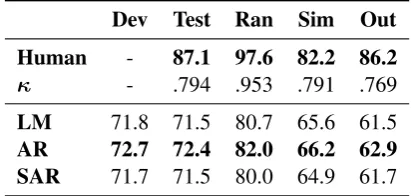
[image:7.595.314.520.63.161.2]LM 71.8 71.5 80.7 65.6 61.5 AR 72.7 72.4 82.0 66.2 62.9 SAR 71.7 71.5 80.0 64.9 61.7
Table 9: Performance of human and models. κ indi-cates Fleiss’ kappa. The overall best results are shown in bold, and AR performs significantly better than LM and SAR (sign test,p-value<0.05).
5.3 Option Settings
To evaluate how the method of candidate choice design will impact the performance, we prepared two additional test sets: Ran and Sim, both of which have the same passages withTest, but can-didate choices are designed differently. InRan, all the candidate choices are sampled from the idioms that are not similar to the golden answer. Instead, inSim, all the candidates are sampled from top 10 similar idioms. Therefore,Simis more challeng-ing than Ran as the former has more distracting options. Note that each blank has seven choices including the golden answer.
5.4 Results
To explore the ceiling of model performance, we also conducted Human Evaluation. We sam-pled 200 passages respectively from the aforemen-tioned test sets: Test, Ran, Sim and Out. We then hired three annotators to complete the 800 cloze tests. These three annotators are first-year or second-year university students and all have very good command of Chinese language. The aver-age accuracy of the annotators and the correspond-ing Fleiss’ kappa are reported as the final perfor-mance.
The experiment results are shown in Table 9. We analyzed the results from the following per-spectives:
Dev Test Ran Sim Out
Idiom Embedding
LM 71.8 71.5 80.7 65.6 61.5 AR 72.7 72.4 82.0 66.2 62.9 SAR 71.7 71.5 80.0 64.9 61.7
Average Character Embedding
LM 63.1 63.0 70.6 57.2 53.2 AR 64.5 63.8 72.5 57.8 53.5 SAR 62.9 62.5 71.4 56.9 52.0
Average Character Embedding + MLP
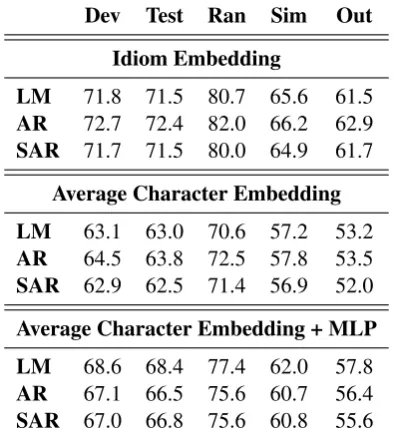
[image:8.595.84.282.65.283.2]LM 68.6 68.4 77.4 62.0 57.8 AR 67.1 66.5 75.6 60.7 56.4 SAR 67.0 66.8 75.6 60.8 55.6
Table 10: Performance comparison using different id-iom representations.
on other test sets which include similar options. This implies that similar options also make man-ual annotation harder.
Human vs. Models: Firstly, human mance is substantially better than model perfor-mance on all the test sets. The smallest gap be-tween human and machine is 14.6 (on Test) and the largest gap is 23.3 (on Out). Secondly, hu-mans perform very closely onTestandOut(87.1 vs. 86.2), however, the models perform much bet-ter onTestthan onOut(72.4 vs. 62.9). This ob-servation implies that human has a strong ability to generalize to out-of-domain data while the mod-els cannot generalize well toOut which contains more low-frequency idioms.
Model Comparison:AR outperforms all other models significantly. The reason for this may be due to the fact: AR firstly uses the blank represen-tation (hb) to make an attentive read of the context (see Eq. 4 and 5), and the blank vector is used again with the attentive vector (r) to score a can-didate choice. In this manner, the context is atten-tively used and the blank vector is used twice.
5.5 Comparison on Idiom Representation
In previous experiments, an idiom was treated as a token, and its representation are obtained through pretraining on a large corpus (Song et al.,2018). In this section, we explored another two methods for idiom representation, and evaluated the perfor-mance with different idiom representations. One
method simply uses the average embedding of 4 constituent characters as the representation of an idiom. This method mimics to understand idioms purely based on its literal meanings. The other is to apply an MLP (Multi-Layer Perceptron,Bishop et al.,1995;Fine,1999) which is fed with the con-catenation of 4 character embeddings, and the out-put vector is used to represent an idiom. This method also applies a composition assumption: the representation of an idiom is a composite func-tion of its constituent words. Note that the input to the MLP is an 800-dimension vector, and the MLP has a hidden layer of 400 units and uses tanh as the activation function. The final output of MLP is a 200-dimension vector.
Table10shows the performance comparison us-ing three methods for idiom representation. We can observe remarkable drops fromidiom embed-dingtoaverage character embedding + MLPand toaverage character embeddingfor all the mod-els, where all the differences are significant (sign test,p-value<0.01). The results indicate that the other two idiom representation methods are worse than treating an idiom as an independent seman-tic unit. This study also implies that idiom rep-resentation is a key factor for the success of Chi-nese reading comprehension with idiom. In other words, a good cloze test model should have not only a proper model structure, but also a good method to represent idioms.
6 Conclusion
findings indicate that the corpus may be a proper benchmark for Chinese cloze test and worth fur-ther research7.
Acknowledgments
This work was jointly supported by the Na-tional Science Foundation of China (Grant No.61876096), and the National Key R&D Pro-gram of China (Grant No. 2018YFC0830200).
References
Mart´ın Abadi, Paul Barham, Jianmin Chen, Zhifeng Chen, Andy Davis, Jeffrey Dean, Matthieu Devin, Sanjay Ghemawat, Geoffrey Irving, Michael Isard, et al. 2016. Tensorflow: A system for large-scale machine learning. In 12th{USENIX} Symposium on Operating Systems Design and Implementation ({OSDI}16), pages 265–283.
Dimitra Anastasiou. 2010. Idiom treatment experi-ments in machine translation. Cambridge Scholars Publishing.
Dzmitry Bahdanau, Kyunghyun Cho, and Yoshua Ben-gio. 2015. Neural machine translation by jointly learning to align and translate. InInternational Con-ference on Learning Representations.
Christopher M Bishop et al. 1995. Neural networks for pattern recognition. Oxford university press.
Cristina Cacciari and Patrizia Tabossi. 2014. Idioms: Processing, structure, and interpretation. Psychol-ogy Press.
Fabienne Cap, Manju Nirmal, Marion Weller, and Sabine Schulte Im Walde. 2015. How to account for idiomatic german support verb constructions in statistical machine translation. In Proceedings of the 11th Workshop on Multiword Expressions, pages 19–28.
Danqi Chen, Jason Bolton, and Christopher D Man-ning. 2016. A thorough examination of the cnn/daily mail reading comprehension task. In Pro-ceedings of the 54th Annual Meeting of the Associa-tion for ComputaAssocia-tional Linguistics (Volume 1: Long Papers), volume 1, pages 2358–2367.
Yiming Cui, Zhipeng Chen, Si Wei, Shijin Wang, Ting Liu, and Guoping Hu. 2017. Attention-over-attention neural networks for reading comprehen-sion. InProceedings of the 55th Annual Meeting of the Association for Computational Linguistics (Vol-ume 1: Long Papers), volume 1, pages 593–602.
Yiming Cui, Ting Liu, Zhipeng Chen, Wentao Ma, Shi-jin Wang, and Guoping Hu. 2018. Dataset for the
7The corpus Train is available at https://github.com/zhengcj1/ChID-Dataset.
first evaluation on chinese machine reading compre-hension. In Proceedings of the Eleventh Interna-tional Conference on Language Resources and Eval-uation (LREC-2018).
Yiming Cui, Ting Liu, Zhipeng Chen, Shijin Wang, and Guoping Hu. 2016. Consensus attention-based neural networks for chinese reading comprehension. In Proceedings of COLING 2016, the 26th Inter-national Conference on Computational Linguistics: Technical Papers, pages 1777–1786.
Bhuwan Dhingra, Hanxiao Liu, Zhilin Yang, William Cohen, and Ruslan Salakhutdinov. 2017. Gated-attention readers for text comprehension. In Pro-ceedings of the 55th Annual Meeting of the Associa-tion for ComputaAssocia-tional Linguistics (Volume 1: Long Papers), volume 1, pages 1832–1846.
Terrence L Fine. 1999. Feedforward Neural Network Methodology. Springer Science & Business Media.
Joseph L Fleiss. 1971. Measuring nominal scale agree-ment among many raters. Psychological bulletin, 76(5):378.
Sandra S Fotos. 1991. The cloze test as an integrative measure of efl proficiency: A substitute for essays on college entrance examinations? Language learn-ing, 41(3):313–336.
Wei He, Kai Liu, Jing Liu, Yajuan Lyu, Shiqi Zhao, Xinyan Xiao, Yuan Liu, Yizhong Wang, Hua Wu, Qiaoqiao She, et al. 2018. Dureader: a chinese machine reading comprehension dataset from real-world applications. InProceedings of the Workshop on Machine Reading for Question Answering, pages 37–46.
Karl Moritz Hermann, Tomas Kocisky, Edward Grefenstette, Lasse Espeholt, Will Kay, Mustafa Su-leyman, and Phil Blunsom. 2015. Teaching ma-chines to read and comprehend. InAdvances in Neu-ral Information Processing Systems, pages 1693– 1701.
Felix Hill, Antoine Bordes, Sumit Chopra, and Jason Weston. 2016. The goldilocks principle: Reading children’s books with explicit memory representa-tions. InInternational Conference on Learning Rep-resentations.
Sepp Hochreiter and J¨urgen Schmidhuber. 1997. Long short-term memory. Neural computation, 9(8):1735–1780.
Ray Jackendoff and Ray S Jackendoff. 2002. Founda-tions of language: Brain, meaning, grammar, evolu-tion. Oxford University Press, USA.
Zhiying Jiang, Boliang Zhang, Lifu Huang, and Heng Ji. 2018. Chengyu cloze test. InProceedings of the Thirteenth Workshop on Innovative Use of NLP for Building Educational Applications, pages 154–158.
Diederik P. Kingma and Jimmy Ba. 2015. Adam: A method for stochastic optimization. InInternational Conference on Learning Representations.
Guokun Lai, Qizhe Xie, Hanxiao Liu, Yiming Yang, and Eduard Hovy. 2017. Race: Large-scale reading comprehension dataset from examinations. In Pro-ceedings of the 2017 Conference on Empirical Meth-ods in Natural Language Processing, pages 785– 794.
Tomas Mikolov, Kai Chen, Greg Corrado, and Jeffrey Dean. 2013. Efficient estimation of word represen-tations in vector space. InInternational Conference on Learning Representations Workshop.
Nasrin Mostafazadeh, Michael Roth, Annie Louis, Nathanael Chambers, and James Allen. 2017. Ls-dsem 2017 shared task: The story cloze test. In Pro-ceedings of the 2nd Workshop on Linking Models of Lexical, Sentential and Discourse-level Semantics, pages 46–51.
Tri Nguyen, Mir Rosenberg, Xia Song, Jianfeng Gao, Saurabh Tiwary, Rangan Majumder, and Li Deng. 2016. Ms marco: A human generated machine reading comprehension dataset. arXiv preprint arXiv:1611.09268.
Takeshi Onishi, Hai Wang, Mohit Bansal, Kevin Gim-pel, and David McAllester. 2016. Who did what: A large-scale person-centered cloze dataset. In Pro-ceedings of the 2016 Conference on Empirical Meth-ods in Natural Language Processing, pages 2230– 2235.
Denis Paperno, Germ´an Kruszewski, Angeliki Lazari-dou, Ngoc Quan Pham, Raffaella Bernardi, San-dro Pezzelle, Marco Baroni, Gemma Boleda, and Raquel Fernandez. 2016. The lambada dataset: Word prediction requiring a broad discourse context. InProceedings of the 54th Annual Meeting of the As-sociation for Computational Linguistics (Volume 1: Long Papers), volume 1, pages 1525–1534.
Pranav Rajpurkar, Jian Zhang, Konstantin Lopyrev, and Percy Liang. 2016. Squad: 100,000+ questions for machine comprehension of text. InProceedings of the 2016 Conference on Empirical Methods in Nat-ural Language Processing, pages 2383–2392.
Siva Reddy, Danqi Chen, and Christopher D Manning. 2018. Coqa: A conversational question answering challenge. arXiv preprint arXiv:1808.07042.
Giancarlo D. Salton, Robert J. Ross, and John D. Kelle-her. 2014. Evaluation of a substitution method for idiom transformation in statistical machine transla-tion. InMWE@EACL.
Minjoon Seo, Aniruddha Kembhavi, Ali Farhadi, and Hannaneh Hajishirzi. 2017. Bidirectional attention flow for machine comprehension. In International Conference on Learning Representations.
Yutong Shao, Rico Sennrich, Bonnie L. Webber, and Federico Fancellu. 2017. Evaluating machine trans-lation performance on chinese idioms with a black-list method. InLanguage Resources and Evaluation Conference.
Yan Song, Shuming Shi, Jing Li, and Haisong Zhang. 2018. Directional skip-gram: Explicitly distinguish-ing left and right context for word embedddistinguish-ings. In Proceedings of the 2018 Conference of the North American Chapter of the Association for Computa-tional Linguistics: Human Language Technologies, Volume 2 (Short Papers), volume 2, pages 175–180.
M Sun, J Li, Z Guo, Z Yu, Y Zheng, X Si, and Z Liu. 2016. Thuctc: an efficient chinese text classifier. GitHub Repository.
Wilson L Taylor. 1953. “cloze procedure”: A new tool for measuring readability. Journalism Bulletin, 30(4):415–433.
Annie Tremblay. 2011. Proficiency assessment standards in second language acquisition re-search:“clozing” the gap. Studies in Second Lan-guage Acquisition, 33(3):339–372.
Alison Wray. 2002. Formulaic language and the lexi-con.