165
Reliability-aware Dynamic Feature Composition for Name Tagging
Ying Lin1, Liyuan Liu2, Heng Ji1,2, Dong Yu3 and Jiawei Han2
1 Dept. of Computer Science, Rensselaer Polytechnic Institute, Troy, NY, USA 2 Dept. of Computer Science, University of Illinois at Urbana-Champaign
Urbana, IL, USA
{yinglin8,ll2,hengji,hanj}@illinois.edu
3Tencent AI Lab, Bellevue, WA, USA
Abstract
While word embeddings are widely used for a variety of tasks and substantially improve the performance, their quality is not consis-tent throughout the vocabulary due to the long-tail distribution of word frequency. Without sufficient contexts, embeddings of rare words are usually less reliable than those of
com-mon words. However, current models
typ-ically trust all word embeddings equally re-gardless of their reliability and thus may in-troduce noise and hurt the performance. Since names often contain rare and unknown words, this problem is particularly critical for name tagging. In this paper, we propose a novel reliability-aware name tagging model to tackle this issue. We design a set of word frequency-based reliability signals to indicate the quality of each word embedding. Guided by the re-liability signals, the model is able to dynami-cally select and compose features such as word embedding and character-level representation using gating mechanisms. For example, if an input word is rare, the model relies less on its word embedding and assigns higher weights to its character and contextual features. Experi-ments on OntoNotes 5.0 show that our model outperforms the baseline model, obtaining up to 6.2% absolute gain in F-score. In cross-genre experiments on six cross-genres in OntoNotes, our model improves the performance for most genre pairs and achieves 2.3% absolute F-score gain on average.1
1 Introduction
Serving as the basic unit of the model input, word embeddings form the foundation of various nat-ural language processing techniques using deep neural networks. Embeddings can effectively en-code semantic information and have proven suc-cessful in a wide range of tasks, such as sequence
1Code and resources for this paper: https://github. com/limteng-rpi/neural_name_tagging
A MedChem spokesman said the products contribute about a third of MedChem's sales and 10% to 20% of its earnings
MedChem spokesman said ... Word
Embedding LSTM Encoder
ORG O O
CRF
Context-only Features
Rare word. Its embedding is unreliable. Rely more on surface and context clues.
Common word. Its word embedding should be reliable.
Reliability Signals
[image:1.595.309.522.224.389.2]Character-level Representation Gate
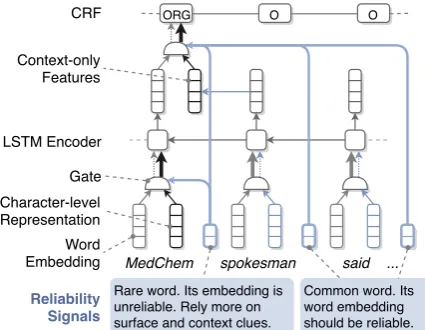
Figure 1: A simplified illustration of the proposed model. We only show the backward part in the figure.
labeling (Collobert et al.,2011;Chiu and Nichols,
2016;Ma and Hovy,2016;Lample et al.,2016), text classification (Tang et al., 2014; Lai et al.,
2015;Yang et al., 2016), and parsing (Chen and Manning, 2014;Dyer et al., 2015). Still, due to the long tail distribution, the quality of pre-trained word embeddings is usually inconsistent. Without sufficient contexts, the embeddings of rare words are less reliable and may introduce noise, as cur-rent models disregard their quality and consume them in the same way as well-trained embeddings for common words. This issue is particularly im-portant for name tagging, the task of identifying and classifying names from unstructured texts, be-cause names usually contain rare and unknown words, especially when we move to new domains, topics, and genres.
embed-ding is noisy or uninformative, the model should rely more on other features. Therefore, we aim to make the model aware of the quality of input embeddings and guide the model to dynamically select and compose features using explicit relia-bility signals. For example, in Figure1, since the model is informed of the relatively low quality of the word embedding of “MedChem”, which only occurs 8 times in the embedding training corpus, it assigns higher weights to other features such as its character-level representation and contex-tual features derived from its context words (e.g., “spokesman”).
The basis of this dynamic composition mecha-nism is the reliability signals that inform the model of the quality of each word embedding. Specifi-cally, we assume that if a word occurs more fre-quently, its word embedding will be more fully trained as it has richer contexts and its embedding is updated more often during training. Thus, we design a set of reliability signals based on word frequency in the embedding training corpus and name tagging training corpus.
As Figure1shows, we use reliability signals to control feature composition at two levels in our model. At the word representation level, in addi-tion to word embedding, we generate a character-level representation for each word from its compo-sitional characters using convolutional neural net-works (see Section2.1). Such character-level rep-resentation is able to capture semantic and mor-phological information. For example, the char-acter features extracted from “Med” and “Chem” may encode semantic properties related to medical and chemical industries. At the feature extraction level, we introduce context-onlyfeatures that are derived only from the context and thus not sub-ject to the quality of the current word tion. For rare words without reliable representa-tions, the contexts may provide crucial informa-tion to determine whether they are part of names or not. For example, “spokesman”, “products”, and “sales” in the context can help the model identify “MedChem” as an organization name. Additionally, context-only features are generally more robust because most non-name tokens in the context are common words and unlikely to vary widely across topics and scenarios. To incorpo-rate the character-level representation and context-only features, we design new gating mechanisms to mix them with the word embedding and
en-coder output respectively. These reliability-aware gates learn to dynamically assign weights to vari-ous types of features to obtain an optimal mixture. Experiments on six genres in OntoNotes (see Section3.1) show that our model outperforms the baseline model without the proposed dynamic fea-ture composition mechanism. In the cross-genre experiments, our model improves the performance for most pairs and obtains 2.3% absolute gain in F-score on average.
2 Model
In this section, we will elaborate each component of our model. In Section2.1, we will describe the baseline model for name tagging. After that, we will introduce the frequency-based reliability sig-nals in Section2.2. In Section2.3, We will elabo-rate how we guide gates to dynamically compose features at the word representation level and fea-ture extraction level.
2.1 Baseline Model
We adopt a state-of-the-art name tagging model LSTM-CNN (Long-short Term Memory - Con-volutional Neural Network) (Chiu and Nichols,
2016) as our base model.
In this architecture, the input sentence is repre-sented as a sequence of vectorsX ={x1, ...,xL},
where xi is the vector representation of the i-th
word, andL is the length of the sequence. Gen-erally, xi is a concatenation of word embedding
and character-level representation generated with a group of convolutional neural networks (CNNs) with various filter sizes from compositional char-acter embeddings of the word.
Next, the sequenceXis fed into a bi-directional Recurrent Neural Network (RNN) with Long-short Term Memory (LSTM) units (Hochreiter and Schmidhuber, 1997). The bi-directional LSTM network processes the sentence in a se-quential manner and encodes both contextual and non-contextual features of each word xi into a
hidden state hi, which is afterwards decoded by
a linear layer intoyi. Each component ofyi rep-resents the score for the corresponding name tag category.
On top of the model, a CRF (Lafferty et al.,
se-quence of predictionszˆ={zˆ1, ...,zˆL}to be
s(X,zˆ) = L+1
X
i=1
Aˆzi−1,zˆi+
L
X
i=1
yi,ˆzi,
where Azˆi−1,zˆi is the score of transitioning from
tag zˆi−1 to tag zˆi, and yi,ˆzi is the component of
yi that corresponds to tagzˆi. Additionally,zˆ0 and ˆ
zL+1 are the <start>and<end>tags padded to
the predictions.
During training, we maximize the sentence-level log-likelihood of the true tag path z given the input sequence as
logp(z|X) = log e s(X,z)
P
ˆ
z∈Zes(X,ˆz)
=s(X,z)−logX ˆ z∈Z
es(X,zˆ),
whereZis the set of all possible tag paths. Note that in addition to word embeddings and character-level representations, (Chiu and Nichols, 2016) uses additional features such as capitalization and lexicons, which are not included in our implementation. Other similar name tag-ging model will be discussed in Section4.
2.2 Reliability Signals
As the basis of the proposed dynamic feature com-position mechanism, reliability signals aim to in-form the model of the quality of input word em-beddings. Due to the lack of evaluation meth-ods that directly measure the reliability of a single word embedding (Bakarov,2018), we design a set of reliability signals based on word frequency as follows:
1. Word frequency in the word embedding train-ing corpusfe. Generally, if a word has more
occurrences in the corpus, it will appear in more diverse contexts, and its word embed-ding will be updated more times.
2. Word frequency in the name tagging train-ing setfn. By fine-tuning pre-trained word embeddings, the name tagging model can en-code task-specific information (e.g., “depart-ment” is often part of an organization name) into embeddings of words in the name tag-ging training set and improve their quality.
Because word frequency has a broad range of values, we normalize it withtanh (λf), whereλ
is set to 0.001 for fe and 0.01 for fn as the av-erage word frequency is higher in the embedding training corpus. We do not use relative frequency because it turns low frequencies into very small numbers close to zero. Usingtanhas the normal-ization function, the model can react more sensi-tively towards lower frequency values.
In addition to the above numeric signals, we introduce binary signals to give the model more explicit clues of the rarity of each word. For ex-ample, because we filter out words occurring less than 5 times during word embedding training, the following binary signal can explicitly inform the model whether a word is out-of-vocabulary or not:
b(fe,5) =
(
1, iffe<5 0, iffe≥5
We heuristically set the thresholds to5,10,100,
1000, and10000forfeand5,10,50forfnbased
on the average word frequency in both corpora. The reliability signals of each word are repre-sented as a vector, of which each component is a certain numeric or binary signal. We apply a dropout layer (Srivastava et al.,2014) with proba-bility 0.2 to the reliaproba-bility signals.
2.3 Dynamic Feature Composition Word Representation Level
It is a common practice in current name tagging models to utilize character-level representations to address the following limitations of word embed-dings: 1. Word embeddings take words as atomic units and thus ignore useful subword information such as affixes; 2. Pre-trained word embddings are not available for unknown words, which are typically represented using a randomly initialized vector in current models.
Unlike previous methods that generally use the character-level representation as an additional feature under the assumption that word- and character-level representations learn disjoint fea-tures, we split the character-level representation into two segments: the first segment serves as an alternative representation to encode the same semantic information as word embedding and is mixed with word embedding using gating mecha-nisms; the second segment is used as an additional feature to encode morphological information that cannot be captured by word embedding.
xci ∈ Rdc denotes its character-level
representa-tion, andxri ∈Rdr denotes the reliability signals.
The character-level representation xci consists of two subvectors:
xci =xca
i ⊕x
cc i ,
where⊕is the concatenation operator,xca
i ∈R
dw i
acts as an alternative representation to word em-bedding, andxcc ∈
Rdc−dwis concatenated as
ad-ditional features.
M e d C h e m
Max Pooling Layer
Convolution Layer
Character Embeddings Fully Connected Layer
Word Embedding xw
xca xcc
Reliability-aware Gates
xr Reliability Signals
[image:4.595.75.289.226.374.2]xc
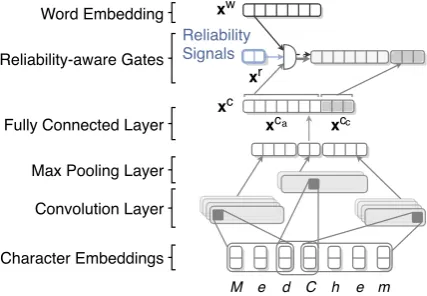
Figure 2: Dynamic feature composition at the word representation level.
In this example, because the word embedding of “MedChem” is not reliable and informative, the model should attend more to xca
i . To enable
the model to switch between both representations accordingly, we define a pair of reliability-aware gatesgwi andgci to filterxwi andxca
i respectively.
We refer to gwi as the word-level representation gate and gci as the character-level representation gate. We calculategwi as
gwi =σ(Wwxwi +Wcxci +Wrxri +b),
where Ww ∈ Rdw×dw, Wc ∈
Rdw×dw, Wr ∈ Rdw×dr, andb ∈Rdw are parameters of the gate.
The character-level representation gate gci is de-fined in the same way.
Finally, the enhanced representation of the i-th word is given by
xi = (gwi ◦xwi +gci ◦xcia)⊕x cc
i ,
where◦denotes the Hadamard product. We separately calculate gw
i and gci instead of
settinggci = 1−gwi because word- and character-level representations are not always exclusive.
Feature Extraction Level
Although character-level representations can en-code semantic information in many cases, they cannot perfectly replace word embeddings. For example, in the following sentence:
“How does a small town like Linpien come to be home to such a well-organized volunteer effort, and just how did the volunteers set about giving their town a make-over?”
The surface information of “Linpien” does not provide sufficient clues to infer its meaning and determine whether it is a name. In this case, the model should seek other useful features from the context, such as “a small town like” in the sen-tence.
However, in our pilot study on OntoNotes, we observe many instances where the model fails to recognize an unseen name even with obvious con-text clues, along with a huge performance gap in recall between seen (92-96%) and unseen (53-73%) names. A possible reason is that the model can memorize some words without reliable rep-resentations in the training set instead of exploit-ing their contexts in order to reduce the trainexploit-ing loss. As a solution to this issue, we encourage the model to leverage contextual features to reduce overfitting to seen names. Compared to names, the context usually consists of more common words. Therefore, contextual features should be more ro-bust when we apply the model to new data.
In LSTM, each hidden state hi is computed
from the previous forward hidden state−→hi−1, next
backward hidden state←h−i+1, and the current input
xi. To obtain features that are independent of the
current input and not affected by its quality, we define context-only features as
oi =−→oi⊕ ←−oi=F(
− →
hi−1)⊕F0(
←− hi+1),
where F and F0 are affine transformations fol-lowed by a non-linear function such that oi ∈ R2dhhas the same dimensionality ash
i.
In order to find an optimal mixture of hi and
oiaccording to the reliability of representations of
the current word and its context words, we define two pairs of gates to control the composition: the forward gates−→ghi and−→goi, and the backward gates ←g−h
i and
←−go
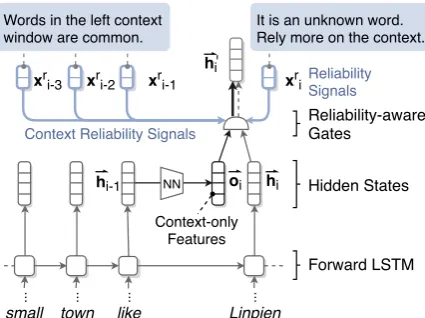
i. Figure3illustrates how to obtain the
forward context-only features−→oi and mix it with
− →
hiusing reliability-aware gates.
xri-2 xri-1
small town like Linpien
... ... ... ...
Context Reliability Signals
It is an unknown word. Rely more on the context. Words in the left context
window are common.
Reliability-aware Gates
Hidden States
Forward LSTM
Context-only Features
NN oi hi hi-1
hi'
xri
[image:5.595.74.287.62.221.2]xri-3 ReliabilitySignals
Figure 3: Dynamic feature composition at the feature extraction level. We only show the forward model for the purposes of simplicity.
the forward hidden state gate−→ghi as an example: −
→gh
i =σ(Uh−→oi+Ur(xri ⊕...⊕xri−C) +b0),
where −→ghi is parameterized by Uh ∈ Rdh×dh,
Ur ∈ Rdh×dr, and b0 ∈
Rdh. This gate is
con-trolled by the previous forward context-only fea-tures−→oi and reliability signals(xir⊕...⊕xri−C),
whereCis the context window size.
By contrast, the backward gates ←−ghi and ←g−oi take as input the backward context-only features and reliability signals of the right context. With these gates, we incorporate the context-only fea-tures by
h0i = (−→ghi◦−→hi+→−goi◦−→oi)⊕(←−ghi◦
←−
hi+←−goi◦←−oi)
The enhanced hidden state h0i is then decoded by a following linear layer as in the baseline model.
3 Experiment
3.1 Data Sets
We conduct our experiments on OntoNotes 5.02 (Weischedel et al.,2013), the final release of the OntoNotes project because it includes six di-verse text genres for us to evaluate the robustness of our approach as Table1shows.
We adopt the following four common entity types that are also used in other data sets such as TAC-KBP (Ji et al.,2011): PER(person),ORG
(organization),GPE(geo-political entity), andLOC
(location). We pre-process the data withPradhan
2https://catalog.ldc.upenn.edu/LDC2013T19
Code Genre Name #Sentences
Train Dev Test
bc Broadcast conversation 11,866 2,117 2,211
bn Broadcast news 10,683 1,295 1,357
mz Magazine 6,911 642 780
nw Newswire 33,908 5,771 2,197
tc Telephone conversation 11,162 1,634 1,366
wb Weblogs 7,592 1,634 1,366
Table 1: OntoNotes genres.
et al.’s scripts3 and therefore follow their split of training, development, and test sets.
We use the BIOES tag scheme to annotate tags. The S- prefix indicates a single-token name men-tion. Prefixes B-, I-, and E- mark the beginning,
inside, and end of a multi-token name mention. A word that does not belong to any name mention is annotated asO.
3.2 Experimental Setup
We use100-dimensional word embeddings trained on English Wikipedia articles (2017-12-20 dump) with word2vec, and initialize character embed-dings as 50-dimensional random vectors. The character-level convolutional networks have filters of width[2,3,4]of size50.
For the bidirectional LSTM layer, we use a hidden state size of 100. To reduce overfitting, we attach dropout layers (Srivastava et al.,2014) with probability0.5to the input and output of the LSTM layer. We use an Adam optimizer with batch size of20, learning rate of0.001and linear learning rate decay.
3.3 Within-genre Results
We use the LSTM-CNN model as our baseline in all experiments. We train and test models on each genre and compare the within-genre results in Ta-ble2. We also merge all genres and show the over-all scores in the last column.
Overall, with reliability-aware dynamic feature composition, our model achieves up to 6.2% ab-solute F-score gain on separate genres. T-test re-sults show that the differences are considered to be statistically significant (p < 0.05) to statistically highly significant (p <0.001).
In Figure 4, we visualize gates that control the mixture of hidden states and context-only fea-tures. Each block represents the average of out-put weights of a certain gate for the
[image:5.595.305.528.62.160.2]bc bn mz nw tc wb all
[image:6.595.75.291.62.125.2]LSTM-CNN 83.5 89.9 86.6 92.8 65.4 79.4 90.1 Rei et al.(2016) 85.4 90.4 87.2 92.5 71.1 77.4 90.0 Our Model* 86.2 91.2 89.8 92.9 71.3 78.5 90.3 Our Model 86.4 91.4 90.0 93.0 71.6 79.1 90.6
Table 2: Performance on OntoNotes (F-score, %). Our Model* is a variant of our model that does not incorpo-rate reliability signals. (Rei et al.,2016) uses a gate to control the mixture of character- and word-level repre-sentations.
ing word. The results of hidden state gates −→gh and←g−h show that for common words such as “a”
and “to”, the model mainly relies on their origi-nal hidden states. By contrast, the context-only feature gates −→go and←−go assign greater weights to the unknown word “Linpien”. Meanwhile, the model barely uses any context-only features for words following “Linpien” (“come” in the for-ward model and “like” in the backfor-ward model) to avoid using unreliable features derived from an unknown word.
To our surprise, the model also emphasizes context-only features for the beginning and ending words. Their context-only features actually come from the zero vectors padded to the sequence dur-ing gate calculation. Our explanation is that these features may help the model distinguish the be-ginning and ending words that differ from other words in some aspects. For example, capitaliza-tion is usually an indicator of proper nouns for most words except for the first word of a sentence.
How does
a
small town like
Linpien
come
to be
home
to
such
a
well
-organized volunteer
ef
fort
.
Forward Gate
Backward Gate
Forward Gate
Backward Gate
Context-only Feature Gates Hidden State Gates gh
gh
go
go
Figure 4: Visualization of reliability-aware gates. A darker color indicates a higher average weight.
3.4 Cross-genre Results
Different genres in OntoNotes not only differ in style but also cover different topics and hence dif-ferent names. As Table3shows, when tested on another genre, the model encounters a high per-centage of names that are unseen in the training genre. For example, 81.3% names are unseen when we train a model on mz and test it on bc. Therefore, through cross-genre experiments, we can evaluate the generalization capability of the model.
Train Test
bc bn mz nw tc wb
bc 36.3 53.4 73.2 68.9 81.4 51.5
bn 43.9 28.5 72.8 63.6 67.8 49.9
mz 81.3 79.8 41.1 82.1 88.1 86.4
nw 40.2 43.8 70.8 33.1 55.4 55.1
tc 82.4 83.2 93.4 87.0 67.8 79.0
[image:6.595.307.527.363.566.2]wb 54.6 60.6 75.4 70.8 85.3 53.4
Table 3: High percentage of unseen names (%).
Baseline Model
Train Test
bc bn mz nw tc wb
bc 83.5 82.4 70.4 67.9 74.8 75.2
bn 83.5 89.9 78.7 75.6 76.8 77.1
mz 59.2 70.7 86.6 65.9 66.1 58.0
nw 82.4 85.4 72.6 92.8 74.4 76.7
tc 53.2 51.2 34.0 38.9 65.4 44.3
wb 71.5 78.1 67.5 66.6 70.1 79.4 Our Model
Train Test
bc bn mz nw tc wb
bc 86.4 82.5 76.4 70.6 74.7 76.1
bn 84.8 91.4 78.7 79.2 76.5 76.1
mz 64.3 73.8 90.0 70.5 57.5 59.3
nw 81.5 86.1 74.0 93.0 74.9 78.3
tc 58.2 55.6 43.6 47.1 71.6 50.4
wb 76.3 78.4 70.5 69.6 72.3 79.1
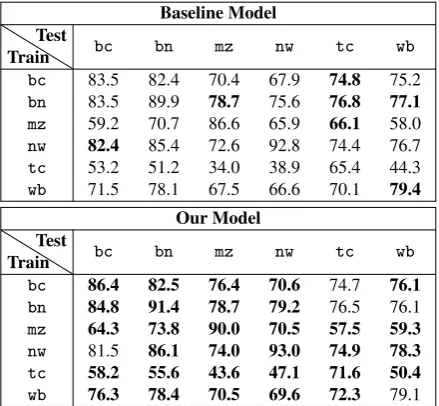
Table 4: Cross-genre performance on OntoNotes (F-score, %).
In Table4, we compare the cross-genre perfor-mance between the baseline and our model. For most cross-genre pairs, our model outperforms the baseline and obtains up to 9.6% absolute gains in F-score.
With dynamic feature composition, the cross-genre performance of our model even exceeds the within-genre performance of the baseline model in some cases. For example, when trained on the
[image:6.595.73.291.531.710.2]within-genre performance of the baseline model (83.5% F-score). Such generalization capability is important for real-word applications as it is in-feasible to annotate training data for all possible scenarios.
3.5 Qualitative Analysis
In Table 5, we show some typical name tagging errors corrected by our model. We highlight the difference between the outputs of the baseline model and our model in bold. We also underline words that probably have provided useful contex-tual clues.
Identification Errors ?BASELINE:
The 50-50 joint venture, which may be dubbed Euro-dynamics, would have combined annual sales of at least #1.4 billion ($2.17 billion) and would be among the world’s largest missile makers.
?OURMODEL:
The 50-50 joint venture, which may be dubbed [ORG
Eu-rodynamics] , would have combined annual sales of at least #1.4 billion ($2.17 billion) and would be among the world’s largest missile makers.
?BASELINE:
The Tanshui of illustrations is a place of unblemished beauty, a myth that remains unshakeable.
?OURMODEL:
The [GPETanshui] of illustrations is a place of unblem-ished beauty, a myth that remains unshakeable.
Classification Errors ?BASELINE:
As [PERSyms] ’s “core business of off-price retailing grows, a small subsidiary that is operationally unrelated be-comes a difficult distraction,” said [PERMarcy Syms], pres-ident of the parent, in a statement.
?OURMODEL:
As [ORGSyms] ’s “core business of off-price retailing grows, a small subsidiary that is operationally unrelated becomes a difficult distraction,” said [PER Marcy Syms], president of the parent, in a statement.
?BASELINE:
Workers at plants in [GPEVan Nuys] , [GPECalif.] , [GPE Oklahoma City] and [ORGPontiac] , [GPEMich.] , were told their facilities are no longer being considered to build the next generation of the [ORGPontiac] Firebird and [ORG Chevrolet] Camaro muscle cars.
?OURMODEL:
Workers at plants in [GPEVan Nuys] , [GPECalif.] , [GPE Oklahoma City] and [GPEPontiac] , [GPEMich.] , were told their facilities are no longer being considered to build the next generation of the [ORGPontiac] Firebird and [ORG Chevrolet] Camaro muscle cars.
Table 5: Name tagging result comparison between the baseline model and our model.
Character-level representations are particularly effective for words containing morphemes that are related to a certain type of names. For example, “Eurodynamics” in the first sentence consists of “Euro-” and “dynamic”. The prefix “Euro-” often appears in European organization names such as “EuroDisney” (an entertainment resort) and “Eu-roAtlantic” (an airline), while “dynamic” is used in some company names such as Boston dynam-ics (a robotdynam-ics company) and Beyerdynamic (an audio equipment manufacturer). Therefore, “Eu-rodynamics” is likely to be an organization rather than a person or location.
However, for words like “Tanshui” (a town) in the second example, character-level represen-tations may not provide much useful semantic in-formation. In this case, contextual features (“is a place”) play an important role in determining the type of this name.
Contextual features can be critical even for fre-quent names such as “Jordan” (can be a person or a country) and “Thomson” (can be various types of entities, including person, organization, city, and river). Take the third sentence in Table 5 as an example. The name “Syms” appears twice in the sentence, referring to the Syms Corp and Marcy Syms respectively. As they share the same word-and character-level representations, context clues such as “core business” and “president” are cru-cial to distinguish them. Similarly, “Pontiac” in the last example can be either a city or a car brand. Cities in its context (e.g., “Van Nuys, Calif”, “Ok-lahoma City”) help the model determine that the first “Pontiac” is more likely to be a GPE instead
of anORG.
Still, the contextual information utilized by the current model is not profound enough, and our model is not capable of conducting deep reasoning as human readers. For example, in the following sentence:
“In the middle of the 17th century the Ming dynasty loyalist Zheng Chenggong (also known
as Koxinga) brought an influx of settlers to
Tai-wan from the Fujian and Guangdong regions of China.”
4 Related Work
Name Tagging Models
Most existing methods treat name tagging as a se-quence labeling task. Traditional methods lever-age handcrafted features to capture textual signals and employ conditional random fields (CRF) to model label dependencies (Finkel et al.,2005; Set-tles,2004;Leaman et al.,2008).
Bi-LSTM-CRF (Huang et al., 2015) combines word embedding and handcrafted features, inte-grates neural networks with CRF, and shows per-formance boost over previous methods. LSTM-CNN further utilizes LSTM-CNN and illustrates the po-tential of capturing character-level signals (Chiu and Nichols, 2016). CRF and LSTM-CNNs-CRF are proposed to get rid of hand-crafted features and demonstrate the feasibility to fully rely on representation learning to capture textual features (Lample et al.,2016;Ma and Hovy,2016;
Liu et al., 2018b). Recently, language model-ing methods are proven effective as the repre-sentation module for name tagging (Liu et al.,
2018a;Peters et al.,2018;Akbik et al.,2018). At the same time, there has been extensive research about cross-genre (Peng and Dredze,2017), cross-domain (Pan et al., 2013; He and Sun, 2017), cross-time (Mota and Grishman, 2008), cross-task (Søgaard and Goldberg, 2016; Liu et al.,
2018b), and cross-lingual (Yang et al.,2017;Lin et al.,2018) adaptation for name tagging training. Unlike these models, although we also aim to enhance the performance on new data, we achieve this by improving the generalization capability of the model so that it can work better on unknown new data instead of transferring it to a known tar-get setting.
Word Representation Models
Recent advances on representation learning al-low us to capture textual signals in a data-driven manner. Based on the distributional hypothesis (i.e., “a word is characterized by the company it keeps” (Harris, 1954)), embedding methods rep-resent each word as a dense vector, while pre-serving their syntactic and semantic information in a context-agnostic manner (Mikolov et al.,2013;
Pennington et al.,2014). Recent work shows that word embeddings can cover textual information of various levels (Artetxe et al., 2018) and improve name tagging performance significantly (Cherry and Guo, 2015). Still, due to the long-tail
distri-bution of word frequency, embedding vectors usu-ally have inconsistent reliability, and such incon-sistency has been long overlooked.
Meanwhile, language models such as ELMo, Flair, and BERT have shown their effectiveness on constructing representations in a context-aware manner (Peters et al., 2018; Akbik et al., 2018;
Devlin et al., 2018). These models are de-signed to better capture the context information by pre-training, while our model dynamically com-poses representations in a reliability-aware man-ner. Therefore, our model and these efforts have the potential to mutually enhance each other.
In addition, (Kim et al., 2016) and (Rei et al.,
2016) also mix word- and character-level repre-sentations using gating mechanisms. They use a single gate to balance the representations in a reliability-agnostic way.
5 Conclusions and Future Work
We propose a name tagging model that is able to dynamically compose features depending on the quality of input word embeddings. Experiments on the benchmark data sets in both within-genre and cross-genre settings demonstrate the effective-ness of our model and verify our intuition to intro-duce reliability signals.
Our future work includes integrating advanced word representation methods (e.g., ELMo and BERT) and extending the proposed model to other tasks, such as event extraction and co-reference resolution. We also plan to incorporate external knowledge and common sense as additional sig-nals into our architecture as they are important for human readers to recognize names but still absent from the current model.
Acknowledgments
References
Alan Akbik, Duncan Blythe, and Roland Vollgraf. 2018. Contextual string embeddings for sequence labeling. InProceedings of the International Con-ference on Computational Linguistics (COLING 2018).
Mikel Artetxe, Gorka Labaka, Inigo Lopez-Gazpio,
and Eneko Agirre. 2018. Uncovering divergent
linguistic information in word embeddings with lessons for intrinsic and extrinsic evaluation. In Pro-ceedings of the Conference on Computational Natu-ral Language Learning (CoNLL 2018).
Amir Bakarov. 2018. A survey of word
em-beddings evaluation methods. arXiv preprint
arXiv:1801.09536.
Danqi Chen and Christopher D. Manning. 2014. A fast and accurate dependency parser using neural net-works. InProceedings of Conference on Empirical Methods in Natural Language Processing (EMNLP 2014).
Colin Cherry and Hongyu Guo. 2015. The unreason-able effectiveness of word representations for twit-ter named entity recognition. InProceedings of the Conference of the North American Chapter of the Association for Computational Linguistics: Human Language Technologies (NAACL HLT 2015).
Jason Chiu and Eric Nichols. 2016. Named entity
recognition with bidirectional LSTM-CNNs.
Trans-actions of the Association of Computational Linguis-tics.
Ronan Collobert, Jason Weston, L´eon Bottou, Michael Karlen, Koray Kavukcuoglu, and Pavel Kuksa. 2011. Natural language processing (almost) from scratch. Journal of Machine Learning Research.
Jacob Devlin, Ming-Wei Chang, Kenton Lee, and Kristina Toutanova. 2018. Bert: Pre-training of deep bidirectional transformers for language understand-ing. arXiv preprint arXiv:1810.04805.
Chris Dyer, Miguel Ballesteros, Wang Ling, Austin Matthews, and Noah A. Smith. 2015. Transition-based dependency parsing with stack long
short-term memory. InProceedings of The Annual
Meet-ing of the Association for Computational LMeet-inguistics (ACL 2015).
J. R. Finkel, T. Grenager, and C. Manning. 2005. In-corporating non-local information into information extraction systems by Gibbs sampling. InACL.
Zellig S Harris. 1954. Distributional structure.Word.
Hangfeng He and Xu Sun. 2017. A unified model
for cross-domain and semi-supervised named entity recognition in chinese social media. InProceedings of AAAI Conference on Artificial Intelligence (AAAI 2017).
Sepp Hochreiter and J¨urgen Schmidhuber. 1997. Long short-term memory.Neural computation.
Zhiheng Huang, Wei Xu, and Kai Yu. 2015. Bidirec-tional lstm-crf models for sequence tagging. arXiv preprint arXiv:1508.01991.
Heng Ji, Ralph Grishman, and Hoa Trang Dang. 2011. An overview of the tac2011 knowledge base pop-ulation track. In Proceedings of the Text Analysis Conference (TAC 2011).
Yoon Kim, Yacine Jernite, David Sontag, and Alexan-der M Rush. 2016. Character-aware neural language models. In AAAI Conference on Artificial Intelli-gence (AAAI 2016).
John D. Lafferty, Andrew McCallum, and Fernando
Pereira. 2001. Conditional random fields:
Prob-abilistic models for segmenting and labeling
se-quence data. In Proceedings of the International
Conference on International Conference on Ma-chine Learning (ICML 2001).
Siwei Lai, Liheng Xu, Kang Liu, and Jian Zhao. 2015. Recurrent convolutional neural networks for text classification. In Proceedings of AAAI Conference on Artificial Intelligence (AAAI 2015).
Guillaume Lample, Miguel Ballesteros, Sandeep Sub-ramanian, Kazuya Kawakami, and Chris Dyer. 2016. Neural architectures for named entity recognition. In Proceedings of Human Language Technologies: The Annual Conference of the North American Chapter of the Association for Computational Lin-guistics (NAACL HLT 2016).
Robert Leaman, Graciela Gonzalez, et al. 2008. Ban-ner: an executable survey of advances in biomedical named entity recognition. InPacific Symposium on Biocomputing.
Ying Lin, Shengqi Yang, Veselin Stoyanov, and Heng Ji. 2018. A multi-lingual multi-task architecture for low-resource sequence labeling. InProceedings of the Annual Meeting of the Association for Computa-tional Linguistics (ACL 2018).
Liyuan Liu, Xiang Ren, Jingbo Shang, Jian Peng, and Jiawei Han. 2018a. Efficient contextualized repre-sentation: Language model pruning for sequence la-beling. InEMNLP.
Liyuan Liu, Jingbo Shang, Xiang Ren,
Frank Fangzheng Xu, Huan Gui, Jian Peng,
and Jiawei Han. 2018b. Empower sequence
la-beling with task-aware neural language model. In AAAI Conference on Artificial Intelligence (AAAI 2018).
Xuezhe Ma and Eduard Hovy. 2016. End-to-end
Tomas Mikolov, Kai Chen, Greg Corrado, and
Jef-frey Dean. 2013. Efficient estimation of word
representations in vector space. arXiv preprint
arXiv:1301.3781.
Cristina Mota and Ralph Grishman. 2008. Is this NE tagger getting old? InProceedings of the Interna-tional Conference on Language Resources and Eval-uation (LREC 2008).
Sinno Jialin Pan, Zhiqiang Toh, and Jian Su. 2013. Transfer joint embedding for cross-domain named entity recognition. ACM Transactions on Informa-tion Systems.
Nanyun Peng and Mark Dredze. 2017. Multi-task do-main adaptation for sequence tagging. In Proceed-ings of the 2nd Workshop on Representation Learn-ing for NLP.
Jeffrey Pennington, Richard Socher, and Christopher
Manning. 2014. Glove: Global vectors for word
representation. InProceedings of the Conference on Empirical Methods in Natural Language Processing (EMNLP 2014).
Matthew E. Peters, Mark Neumann, Mohit Iyyer, Matt Gardner, Christopher Clark, Kenton Lee, and
Luke S. Zettlemoyer. 2018. Deep contextualized
word representations. In Proceedings of Human
Language Technologies: The Annual Conference of the North American Chapter of the Association for Computational Linguistics (NAACL HLT 2018).
Sameer Pradhan, Alessandro Moschitti, Nianwen Xue, Hwee Tou Ng, Anders Bj¨orkelund, Olga Uryupina, Yuchen Zhang, and Zhi Zhong. 2013. Towards ro-bust linguistic analysis using ontonotes. In Proceed-ings of the Conference on Computational Natural Language Learning (CoNLL 2013).
Marek Rei, Gamal Crichton, and Sampo Pyysalo. 2016. Attending to characters in neural sequence labeling models. InProceedings of International Conference on Computational Linguistics (COLING 2016).
Burr Settles. 2004. Biomedical named entity recog-nition using conditional random fields and rich
fea-ture sets. In Proceedings of the International
Joint Workshop on Natural Language Processing in Biomedicine and Its Applications.
Anders Søgaard and Yoav Goldberg. 2016. Deep
multi-task learning with low level tasks supervised at lower layers. InProceedings of The Annual Meet-ing of the Association for Computational LMeet-inguistics (ACL 2016).
Nitish Srivastava, Geoffrey Hinton, Alex Krizhevsky, Ilya Sutskever, and Ruslan Salakhutdinov. 2014. Dropout: a simple way to prevent neural networks from overfitting. The Journal of Machine Learning Research.
Duyu Tang, Furu Wei, Nan Yang, Ming Zhou, Ting
Liu, and Bing Qin. 2014. Learning
sentiment-specific word embedding for twitter sentiment clas-sification. InProceedings of the Annual Meeting of the Association for Computational Linguistics (ACL 2014).
Ralph Weischedel, Martha Palmer, Mitchell Marcus, Eduard Hovy, Sameer Pradhan, Lance Ramshaw, Nianwen Xue, Ann Taylor, Jeff Kaufman, Michelle
Franchini, et al. 2013. Ontonotes release 5.0
LDC2013T19. Linguistic Data Consortium,
Philadelphia, PA.
Zhilin Yang, Ruslan Salakhutdinov, and William W Cohen. 2017. Transfer learning for sequence tag-ging with hierarchical recurrent networks. In Pro-ceedings of International Conference on Learning Representations (ICLR 2017).
Zichao Yang, Diyi Yang, Chris Dyer, Xiaodong He,
Alex Smola, and Eduard Hovy. 2016.