Proceedings of the 57th Annual Meeting of the Association for Computational Linguistics, pages 252–262 252
Spatial Aggregation Facilitates Discovery of Spatial Topics
Aniruddha Maiti Temple University Philadelphia, PA-19122, USA
Slobodan Vucetic Temple University Philadelphia, PA-19122, USA
Abstract
Spatial aggregation refers to merging of doc-uments created at the same spatial location. We show that by spatial aggregation of a large collection of documents and applying a tra-ditional topic discovery algorithm on the ag-gregated data we can efficiently discover spa-tially distinct topics. By looking at topic dis-covery through matrix factorization lenses we show that spatial aggregation allows low rank approximation of the original document-word matrix, in which spatially distinct topics are preserved and non-spatial topics are aggre-gated into a single topic. Our experiments on synthetic data confirm this observation. Our experiments on 4.7 million tweets collected during the Sandy Hurricane in 2012 show that spatial and temporal aggregation allows rapid discovery of relevant spatial and temporal
top-ics during that period. Our work indicates
that different forms of document aggregation might be effective in rapid discovery of vari-ous types of distinct topics from large collec-tions of documents.
1 Introduction
Social microblogging sites such as Twitter gener-ate large volumes of short documents through the activity of hundreds of millions of users around the world. This provides an unprecedented ac-cess to the pulse of the global society. Due to the sheer volume and diversity of the generated con-tent, topic discovery has been an invaluable tool in an effort to make sense of this data. Regardless of a precise definition of a topic and a particular topic model, topics discovery is used to describe per-tinent themes in a document corpus and serve to identify events, trends, and interests at the global, local, or a social group level.
Among the most popular topic modeling tech-niques are Latent Dirichlet Allocation (LDA), La-tent Semantic Analysis (LSA), and Non-negative
Matrix factorization (NMF). When applying those techniques for topic discovery from microblogs, there are three main challenges: (1) how to im-prove computational speed, (2) how to extract use-ful topics, and (3) how to deal with short texts. Many papers were published that address one or more of these challenges and most of them pro-pose to modify the original topic models.
In this paper, we are focusing on aggregation
(a) Common Topic (b) Distinct Topic
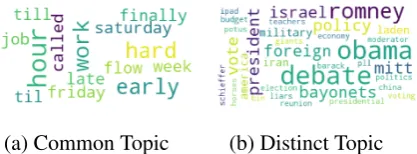
Figure 1: Examples of common and distinct topics. a) Common topic: a work-related topic. b) Distinct tem-poral topic: presidential debate
to reduction in a number of documents, aggrega-tion also leads to computaaggrega-tional savings.
While aggregation has received interest in the research community and there are several empir-ical studies illustrating its benefits, we are not aware of a study that manages to provide, beyond brief intuitive arguments, an insight into why ag-gregation works and what are its advantages and limitations. In this paper we attempt to provide such an insight from the perspective of discover-ing spatially specific topics. As will be evident, our insights extend to other means of aggregation. Our argument will be given in the context of matrix factorization, where a document-word ma-trixX is represented as a product W ·H, where j-th row of matrixHrepresents word distribution inj-th topic andi-th row of matrixW represents a distribution of topics ini-th document. We adopt the terminology from (Kim et al., 2015), which distinguishes betweencommonanddistincttopics (see Figure1), where distribution of common top-ics within the corpus is not impacted by the ag-gregation metadata such as location, time, or au-thor of a microblog, and distribution of distinct topics is correlated with the metadata. We show that factorization of the aggregated matrixXa,
ob-tained by merging documents based on metadata (e.g., location), allows its low rank approximation asWa ·Ha, where the resulting topic matrixHa
retains the distinct topics fromH(e.g., spatial top-ics) and where the common topics from H are merged into a single topic in Ha. We will show
empirical results confirming this observation both on synthetic and real-life data. In particular, we will demonstrate this behavior in case of spatial and temporal aggregation.
The main contribution of this paper is in demon-strating that applying standard topic discovery al-gorithms such as NMF and LDA on aggregated documents results in discovery of topics related to the aggregation method. Moreover, since the
aggregated matrixXacan be orders of magnitude
smaller than the original matrixX, the computa-tional cost can also be reduced by orders of mag-nitude. Finally, as observed in the previous work, aggregation also alleviates the problem of sparsity when discovering topics in microblogs.
2 Related Work
Topic modeling from microblogs has a vast amount of literature (Steiger et al., 2015). Early work includes using NMF on term correlation ma-trix (Yan et al., 2013) and ncut-weighted NMF (Yan et al., 2012). Recent work includes NMijF (Nugroho et al.,2017), which takes into account tweet-to-tweet interactions. Location recommen-dation model based on topic modeling was pro-posed in (Hu et al., 2013). NMF is used in Dis-cNMF (Kim et al., 2015) and STExNMF (Shin et al., 2017) to identify spatio-temporal topics. Pairfac (Wen et al.,2016) employs tensor decom-position accounting for location, time, and venue. In TopicOnTiles (Choi et al., 2018), the entire space-time is divided into small tiles and NMF is performed on each tile separately. LDA (Blei et al., 2003) has also been used for topic detec-tion. In (Zhao et al.,2011), LDA is used to catego-rize and summacatego-rize tweets. In (Weng et al.,2010), LDA is used to find influential users in Twitter.
3 Methodology
3.1 Problem Setup
Let us assume we are given a corpus of documents D = {d1, d2, d3, .., dN}, where N is the total
number of documents. Let V be the vocabulary of unique words in the corpus. By using the bag of words representation, the corpus can be repre-sented by a document-word matrix X of dimen-sion N ×V, where element Xi,j is the count of
j-th word ini-th document. We will also assume that each document di is associated with a time
stamp t(di) ∈ 1, ...T, where T is the number of
time steps, and locationl(di)∈1, ...L, whereLis the number of locations.
We will make an assumption that there are K topics t1, ...tK, where topic tk defines
probabil-ity that word wj will be generated by the topic
asp(wj|tk), and that each document in a corpus
is represented by a single topic. Our simplifying assumption that each document is generated by a single topic is acceptable when dealing with short documents such as microblogs. In addition, it will make it easier to describe the main effect of docu-ment aggregation.
Among the K topics, we will assume that the first Kd are spatially distinct topics and the
sec-ondKcare common topics. For common topics,
the probability or their occurrence does not de-pend on location of the document. In other words, p(tk|l) = p(tk), wherel is location. Conversely,
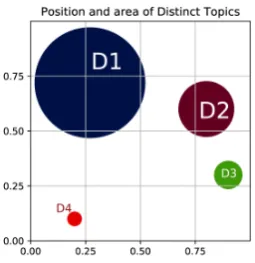
for spatially distinct topics, the probability of their occurrence is dependent on the document location. We illustrate such a setup in Figure2, where there are 4 spatially distinct topics generated within 4 different circular regions and 2 common topics oc-curring equally likely over the whole square re-gion. In this example, the probability that a dis-tinct topic is generated within its assigned circle is constant and is zero outside.
GivenD, the objective is to find the distinct top-ics. In the following we will argue that document aggregation enables computationally efficient dis-covery of the distinct topics.
3.2 Effect of Spatial Aggregation on Rank
In this section we will explain why spatial aggre-gation of documents facilitates discovery of spa-tially distinct topics. If we select a subsetXk of
all documents fromX generated by topic tk, the
best rank-1 approximation of Xk is proportional
tonk·hk, wherenkis a column vector of length
N whose i-th element is the sum of all words in i-th document and hk is a row vector of length
V whose j-th element hkj equals p(wj|tk). Let
us denote this rank-1 approximation as Xk1. If
we sort the document-word matrix X by topics, we can approximate it by vertically concatenating rank-1 matrices Xk1. The rank of the resulting
matrixX1will be less than or equal toJ.
We observe that the rank of matrixXcan be as high asV >> J and that matrix factorization of X into productW ·H cannot guarantee success-ful topic discovery. On the other hand, we observe that factorization of X1 can easily result in dis-covery of the underlyingJ topics. Unfortunately, generating matrix X1 is as difficult as the topic discovery problem itself. We argue in the follow-ing that aggregation based on location results in generation of a matrix closely related toX1. As such, we demonstrate that spatial aggregation is very useful for discovery of spatially distinct top-ics.
Let us define binary matrixQwithLrows and N columns as spatial aggregation matrix which merges the N original documents into L aggre-gated documents, whereQl,i = 1if documentxi
belongs to l-th location and Ql,i = 0 otherwise.
We construct the aggregated document-word ma-trix of sizeL×V asXa =Q·X. The expected value ofl-th row of matrixXaequals:
E(Xla) =X
k(nlk·hk), (1)
where,nlkis a scalar equal to the number of words
generated from topictkin documents froml-th
lo-cation and hk is a row vector defined in the first
paragraph of this subsection. If the number of doc-uments atl-th location is large, the observedXla will be close toE(Xa
l). Since based on equation
(1) each row ofXacan be approximated as the lin-ear combination ofKtopic vectors hk, it follows
that matrixXais approximately of rankKor less.
We can thus closely approximate Xa as product Wa·Ha, wherek-th row of matrixHaequalshk
and(l, k)-th element of matrixWaequalsn lk.
We will now show thatWa·Hahas rank lower thanK. Since theKccommon topics are assumed
to be location independent, the number of docu-ments generated byk-th common topic is approx-imately the same at every location. Thus, we can approximatenlk=nkfor each of theKccommon
topics. Therefore, the lastKc columns of matrix
Wa·Ha isKd + 1or less, where the Kc
com-mon topics increase the rank by only one. As a result, we can replace the lastKccolumns ofWa
with a single column equal to the sum of the last Kccolumns of Wa and replace the lastKc rows
ofHa with a single row equal to the sum of the last Kc rows of Ha. The resulting topic matrix
Hais of dimension(Kd+ 1)×V, where the last
row is a sum of word probabilities over all com-mon topics, while the first Kd rows are reserved
for each of the Kdspatially distinct topics. This
is a significant result showing that spatial aggrega-tion facilitates discovery of spatially distinct topics while it collapses all documents generated by the common topics into a matrix that can be closely approximated by a rank-1 matrix.
3.3 NMF and LDA on Aggregated Data
In the previous section we did not specify a particular algorithm for matrix factorization and topic discovery. NMF is a popular matrix fac-torization algorithm for nonnegative matrices such as document-word matrices. NMF finds non-negative and sparse matrices W and H whose product approximates the original matrix. It solves the following optimization problem:
F(W, H) = 1
2||X−W·H|| 2
F ro+α·ρ·||W||1+
α·ρ· ||H||1+ 1
2α(1−ρ)· ||W|| 2 F ro+
1
2α(1−ρ)· ||H|| 2
F ro. (2)
Here, the Frobenius norm of a matrixAis denoted by||A||F roandαandρare regularization parame-ters. Rows ofW of sizeN×Krepresent the topic mixture within a particular document whereKis the number of topics. Rows ofH of sizeK×V represent the word distribution within a particu-lar topic. The NMF optimization problem is typi-cally solved iteratively and the algorithm becomes expensive for large data sets. NMF is also sensi-tive on collections of short documents such as mi-croblogs. NMF favors commonly occurring top-ics and commonly ocurring words, which makes finding rare spatially distinct topics very difficult. Document aggregation based on metadata such as location directly addresses the aforementioned NMF issues.
[image:4.595.346.474.65.197.2]The arguments in the previous sections demon-strate the benefit of aggregation through matrix
Figure 2: Spatially distinct topics on simulated data
factorization. However, our assumptions made in 3.1 closely resemble the generating process used in LDA, where each document is a mixture over latent topics, and each topic is characterized by a distribution over words. From the corpus, LDA learns the topic distribution over documents and word distribution over topics. While, in theory, LDA should be able to discover topics directly from the original matrix X, it suffers from the same shortcomings as NMF: it is slow, fragile, and sensitive to sparse documents. As will be demon-strated in the experiments, document aggregation has very similar effects on both NMF and LDA.
To summarize, the resulting distinct topic discovery procedure has the following steps:
1. Construct document-word matrixX.
2. Construct spatial aggregation matrixQfrom metadata.
3. Perform NMF on aggregated matrixQ·Xto find spatially distinct topics.
If we wish to identify spatial-temporal topics, we may additionally aggregate the data based on time. First, the entire time span can be divided into smaller intervals. Then, all documents in each space-time cell are aggregated into a single docu-ment. Although we do not show it in our experi-ments, our major insight about the effect of docu-ment aggregation extends to other forms of aggre-gation such as author- or hashtag-based.
4 Experiments on Simulated Dataset
1 2 3 4 5
NMF on original dataset
0 20 40 60 80 100 120 Co un t of w or ds in N M F To pi cs
C1 C2 D1 D2 D3 D4
1 2 3 4 5
NMF on aggregated dataset
0 20 40 60 80 100 120 Co un t of w or ds in N M F To pi cs
[image:5.595.310.526.63.137.2]C1 C2 D1 D2 D3 D4
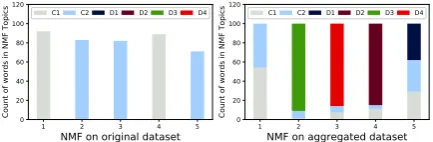
Figure 3: Five topics discovered by NMF on non-aggregated and non-aggregated documents
and four spatially distinct topics (D1,D2,D3and D4). Each common and distinct topic uses a vo-cabulary with 100 words. Each document is as-sociated with a single topic. To generate a doc-ument, a topic is chosen first, then 10 words are sampled randomly from the 100 words associated with that particular topic. Documents generated from the common topics are distributed randomly within the square. For each distinct topic, a cir-cular region is defined within the square and the documents associated with that topic are placed by uniformly sampling within the circle. The place-ment of the circular regions is shown in Figure-2. A total of10,000documents are generated for each common topic and1,000documents for each spatially distinct topic. We call this dataset the
non-aggregated dataset. To demonstrate how
ag-gregation affects the topic discovery, we divided the entire region in4×4small squares. Then we merged all the documents from each small square into a single aggregated document. In this way, we constructed16aggregated documents. We call this dataset theaggregated dataset.
NMF set to find 5 topics was applied to the non-aggregated and the non-aggregated datasets. In Figure 3, we show the distribution of words in each of the 5 identified topic. For example, the first bin in the left subplot shows that discovered topic 1 has 91 unique words, all belonging to common topicC1. On the other hand, the first bin in the right sub-plot shows that discovered topic 1 has 100 unique words, 38 belonging to common topicC1and 58 to common topicC2. We can see that none of the spatially distinct topics are discovered when we apply NMF on the non-aggregated data. All five identified topics contain words from the 2 com-mon topics. On the other hand, in the aggregated dataset, the first identified topic contains a mixture of words from the 2 common topics, while the re-maining 4 are almost entirely comprised of words from the 4 spatially distinct topics. This result
ex-1 2 3 4 5 6 7 8 9 10
NMF on original dataset
0 20 40 60 80 100 C ou nt o f w or ds in N M F To pi
cs C1 C2 D1 D2 D3 D4
1 2 3 4 5 6 7 8 9 10
NMF on aggregated dataset
0 20 40 60 80 100 120 C ou nt o f w or ds in N M F To pi
[image:5.595.76.288.63.154.2]cs C1 C2 D1 D2 D3 D4
Figure 4: Ten topics identified by NMF on
non-aggregated and non-aggregated documents
1 2 3 4 5
NMF on original dataset
0 20 40 60 80 100 120 C ou nt o f w or ds in N M F To pi
cs C1 C2 D1 D2 D3 D4
1 2 3 4 5
NMF on aggregated dataset
0 20 40 60 80 100 120 C ou nt o f w or ds in N M F To pi
cs C1 C2 D1 D2 D3 D4
Figure 5: Five topics identified by NMF on original and aggregated data using a smaller set of documents
perimentally supports our insight about the impact of spatial aggregation presented in section 3.2.
4.1 Effect of Number of Topics in NMF
We repeated the NMF experiment, but this time we set the number of NMF topics to10. We can see from Figure4that all10topics found on the non-aggregated data are still one of the two common topics. On the other hand, after applying NMF on the aggregated data, 4 of the discovered topics di-rectly correspond to the 4 spatially distinct topics, while the remaining 6 discovered topics are a mix-ture of the 2 common topics.
4.2 Effect of Number of Documents
We repeated the experiments on a smaller corpus to see its effect on topic discovery. We generated
1,000documents for each common topic and150
documents for each distinct topic. The result is summarized in Figure 5. As compared to Figure 3, we can see a slight deterioration of the quality of discovered spatially distinct topics from the ag-gregated data. In particular, all of the 4 discovered spatial topics are corrupted with more words from the common topics, which is particularly visible from the rightmost bin containing and an almost equal mixture of words from topicsD1,C1, and C2. We observe that topicD1corresponds to the largest circle.
4.3 Effect of Grid Density
[image:5.595.308.525.183.254.2]1 2 3 4 5
NMF on original dataset
0 20 40 60 80 100 120
C
ou
nt
o
f
w
or
ds
in
N
M
F
To
pi
cs C1 C2 D1 D2 D3 D4
1 2 3 4 5
NMF on aggregated dataset
0 20 40 60 80 100 120
C
ou
nt
o
f
w
or
ds
in
N
M
F
To
pi
cs C1 C2 D1 D2 D3 D4
Figure 6: Five topics identified by NMF using dense
spatial grid64×64
common topic and 150documents for each spa-tially distinct topic, but this time with gradually in-creasing aggregation density. In Figure6we show results of applying NMF set to discover 5 top-ics for the spatial aggregation scheme with a grid size64×64. As expected, the results look more similar to topic discovery from the non-aggregated dataset. Interestingly, despite the vary coarse ag-gregation (many spatial blocks were empty or with a single document), we still discovered topicsD3
andD4, which correspond to the smaller circles.
5 Experiments on Real Life Data
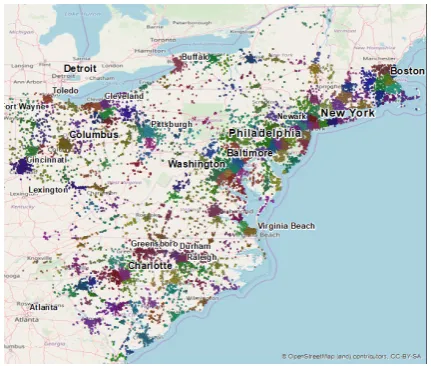
Identifying spatially distinct topics in a real life dataset is a challenging task. As we will demon-strate, we found that the aggregation scheme is quite successful in identifying distinct topics. We performed our experiments on Hurricane Sandy Twitter corpus downloaded through Twitter search API1using the tweet IDs released in (Wang et al., 2015). The downloaded corpus contains4.7 mil-lion tweets that temporally span12days surround-ing the Hurricane Sandy and a few other distin-guishable events between October 22nd, 2012 and November 2nd, 2012. Every tweet in the dataset is also geotagged to one of 13 states along the East Coast of the U.S. During preprocessing we transformed all characters to lowercase and re-moved stopwords and special characters. We also excluded repetitive letters that convey enthusiasm (e.g., birthdayy, birthdayyy, birthdayyyy). Finally, TF-IDF document-word matrix is constructed us-ing the20,000most frequent words in the corpus. Since the spatial distribution of tweets is highly imbalanced, we decided not to use a regular spa-tial grid. Instead, we employedk-means cluster-ing on the latitude and longitude information for each tweet to identify200cluster centers in space. Each tweet is assigned to its nearest cluster cen-ter for spatial aggregation. Figure7shows differ-ent clusters on50,000tweets randomly sampled
[image:6.595.73.290.62.135.2]1https://developer.twitter.com/
Figure 8: State specific distinct topics
[image:6.595.308.524.218.401.2]from the corpus. We can observe that the density of clusters is much larger within heavily populated urban areas along the East Coast.
Figure 7: K-means cluster for spatial aggregation
NMF was employed to find 500 topics with α = 0.1andρ = 0.5. Only107rows ofH were found to have at least one nonzero entry. Appli-cation of NMF on the200aggregated documents identifies some spatially distinct topics covering regions of varying size. Figure 8, shows word clouds for two large state-specific distinct topics. We also found that large metropolitan areas such as New York City, Philadelphia, and Pittsburgh are represented as separate spatially distinct top-ics. One such example is shown in Figure9. Al-most all the words in this topic are related to New York City airports.
In addition to spatial aggregation, we also per-formed experiments by aggregating data in space and time. In addition to thek = 200spatial clus-ters we divided the time interval into12days, re-sulting in a total of2,400spatio-temporally aggre-gated documents. As expected, this aggregation reveals distinct spatio-temporal topics.
Figure 9: NYC airport-specific distinct topic
Figure 10: Halloween and CMA temporal topics
NBA game between L.A. Lakers and Miami Heat that occurred on the same day. Figure10also con-tains another temporally distinct topic associated with the 2012 Country Music Association (CMA) Award event that happened on the same day.
To better illustrate this CMA-related topic, in Table 1 we show several representative tweets. These tweets were randomly selected from tweets containing at least one of the most frequent 10 words in the CMA-related topic.
5.1 Evaluation: Space-Time Scan Statistics
Looking at word clouds is a descriptive way to evaluate the quality of discovered topics. In this subsection we will present experimental results at-tempting to quantitatively evaluate the quality of the discovered topics. To achieve this we use the space-time scan statistics implemented in the SaTScan software (Kulldorff,2010). We selected the 10 most frequent words in each discovered topic and labeled each tweet from the corpus based on the presence of these words. If a tweet con-tains any of the 10 words it is assigned to the cor-responding topic. We call all tweets assigned to the given topic the positive tweets. If the topic
Table 1: Tweets related to CMA awards
Anyone know what channel the cma is on? Can’t wait for the cma awards
Everyone get prepared for a bunch of cma awards tweets
Tomorrow is 46 cma awards so watching that!! carrie underwood is amazing
Hunter hayes is perfect
Not sure why Taylor Swift is taking over the country charts...her music is more of a mix now between coun-try and pop
Luke bryan on the CMAS omg omg !!!
is strongly spatial, we would expect the assigned tweets to be strongly spatially clustered. If the topic is strongly spatio-temporal, we would expect the assigned tweets to cluster within a particular spatio-temporal area. The space-time scan statis-tic is employed to measure enrichment by posi-tive tweets of cylindrical windows covering a cir-cular spatial region and a temporal interval. The cylindrical window is moved in space and time to search for the statistically strongest clusters ( Kull-dorff, 2010). The cylinder with the strongest en-richment of positive tweets (e.g., based on the ratio between positive tweets and all tweets within the cylinder) is a potential candidate for the significant spatio-temporal cluster.
Distributional properties of scan statistics can be used to evaluate the statistical significance of the strongest cylinder (Dwass, 1957). This is done by permuting the labels of tweets multiple times (999times in this study) and calculating the score of the strongest cylinder in each permutation (Block, 2007). Thep-value is then calculated by counting the fraction of the permuted scores larger than the score on the actual data. Thep-value re-ported in this experiment can be thought of as a measure of the spatio-temporal distinctiveness of the identified topic.
Characterization of distinct topics usingp-value has some limitations. We observed that many distinct topics discovered through aggregation re-ceivep-value equal to zero, making it impossible to identify the strongest distinct topic. For this reason, we used deviation (∆), which measures how many standard deviations apart is the score of the best cylinder observed on the actual data com-pared to the scores of the best cylinders observed on the permuted data.
Table 2: Evaluation of the topic quality using SaTScan
Topic General Theme Deviation (∆) Topic Type
Power 26504.53 Temporal
NYC 25282.17 Spatial
NFL 12275.18 Temporal
Presidential Debate* 11089.34 Temporal
Snow 8624.95 Temporal
New Jersey* 8355.10 Spatial Halloween* 7679.58 Temporal Pennsylvania* 6728.94 Spatial NYC Airport* 6424.54 Spatial
Weather 2220.64 Temporal
Figure 11: Positive (red) and negative (blue) examples and the position of the cluster identified by SaTScan for topic : Power Outage
[image:8.595.338.493.67.187.2]the corresponding word clouds were shown in Fig-ures 1, 8, 9, 10. For the remaining topics, the top ten words are presented in Table 3. It may be noted that New York City, being a very large metropolitan area, has multiple identified topics. One such topic, called NYC airport, was previ-ously presented in Figure9. Another such topic, called NYC, is presented in Table2. The spatio-temporal region called Power outageis shown in Figure11.10,000tweets in this figure are labeled as positive or negative based on the presence or absence of the keywords of this topic. This topic corresponds to multiple power outages in the af-termath of the Sandy Hurricane.
Table 3: General theme of topics and related words
Topics Words
Power power sandy generator trees electricity tree open lights safe hurricane
NYC york brooklyn nyc park manhattan city square mta island halloween
NFL cowboys steelers romo giants harden church red-skins touchdown eagles party
Snow snow snowing cold weather delay boone wind blizzard snowed outside
Weather barometer humidity temperature mph wind rain blacksburg steady wnw rising
†
Offensive words are removed
5.2 Comparison between LDA and LSA
Previous studies indicate that NMF on Twitter data works better than other available topic modeling techniques (Klinczak and Kaestner,2015), ( God-frey et al., 2014). This may be attributed to a slightly better robustness of NMF to the short doc-ument lengths. This problem is ameliorated in this
0 20 40 60 80 100
Topics
0 5000 10000 15000 20000 25000 30000 35000
Di
sta
nc
e f
rom
me
an
(i
n s
td
) Comparison of NMF, LDA and LSA
NMF LSA LDA
Figure 12: Comparison of NMF, LDA and LSA
study through aggregation. In view of this, it is expected that other topic modeling approaches are also able to identify distinct topics in the aggre-gated data. To verify this, we tried two other popu-lar algorithms, LSA and LDA.2LSA is a truncated singular value decomposition technique. LDA is a generative probabilistic model. For LDA and LSA, the number of topics are taken to be100to be comparable to the number of topics identified by NMF. Document topic prior and topic word pri-ors in LDA were set to0.01.
[image:8.595.306.523.498.611.2]We found that LDA and LSA identify distinct topics comparable to NMF when applied to the spatio-temporally aggregated data. Some of the similar topics are selected manually from the LDA and NMF topic lists and shown in Table4for com-parison.
Table 4: Identified LDA topics similar to NMF
Topics Words
NYC york park brooklyn city pic nyc hal-loween st th center square street bar Power power sandy hurricane storm safe
phone wind stay rain closed open Weather wind mb mph rain humidity cb
barometer temp slowly cam mid-night falling relative
Presidential Debate romney obama debate class mitt president world vote talking week policy
†
Offensive words are removed
It is difficult to draw one-to-one correspondence among all the topics identified by the three meth-ods. We see from Table4that some topics are very similar in both NMF and LDA. However, while NMF discovers a topic related to the CMA, LDA and LSA do not. For this reason, instead of com-paring the corresponding topics one at a time, the following strategy is applied. The topics in the
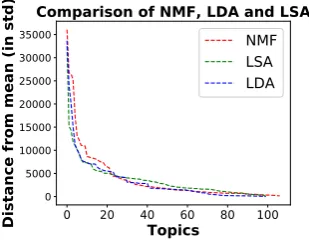
[image:8.595.70.289.525.637.2]three methods are first sorted based on the
devi-ation (∆) scores and plotted in Figure 12. The
most significant topics identified by all three algo-rithms exhibit similar scores. For the top 20 top-ics, performance of NMF is only slightly better. The average score of the top20topics for NMF is 3,823, while the average scores for LSA and LDA are 3,638 and 3,390 respectively.
5.2.1 Common Topics in LDA and NMF
[image:9.595.326.494.68.200.2]In Section5.2, we mentioned that topic discovery algorithms such as LDA, NMF, and LSA are capa-ble of finding distinct topics from aggregated doc-uments. When non-aggregated data is used, these algorithms find common topics associated with day to day conversations. In Table 5, words as-sociated with several common topics identified by LDA and NMF on a sample of the non-aggregated tweets are shown. It can be seen that the words in the identified topics do not correspond to a specific space or time.
Table 5: Common topics from non-aggregated data
LDA NMF
cold shot dry blessed smoking wonderful
cold weather hot room hun-gry feet world
making sounds coffee running
fun sounds making lot times safe games looks
talking saw anymore west facebook
twitter goodmorning jail facebook instagram guy past means throw
start
guys girl safe play awesome stay
†
Offensive words, informal words and internet short form of the words are removed
5.2.2 Influence of Aggregation Strategies and Randomization
Our experiments with the simulated data in Sec-tion 4.3revealed that topic discovery is impacted by the aggregation grid density. To see if the behavior transfers to Twitter data, we varied the number of clusters from 100and 1,000. As the number of clusters increased, we observed that some of the distinct topics discovered by NMF for k = 200 disappeared when k was increased to
[image:9.595.72.287.386.488.2]500or1,000. For example, the CMA topic disap-peared with those larger numbers of clusters. We also observed relatively small changes in discov-ered topics for different runs of the clustering for the same value ofk. We conclude that clustering used for aggregation has a modest impact on topic discovery.
Figure 13: Visualization of temporal trends of topics
5.3 Temporal Trends in Topics
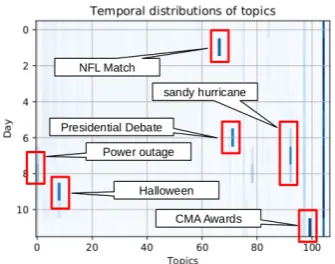
SaTScan reports the significant space-time cylin-ders for each topic. It is possible to categorize those cylinders as spatial or temporal by inspect-ing the their size. As an alternative, we can use matrix W obtained by NMF to identify tempo-ral clusters. LetW∗ be the matrix which is con-structed from W by summing all the rows cor-responding to the same time interval. W∗ then represents a purely temporal description of topic distribution. By inspecting the columns of W∗, shown in Figure 13, we can obtain an additional insight into the nature of temporal topics. We can observe that only a small fraction of the identified topics are strongly temporal in nature.
6 Conclusion
References
David Alvarez-Melis and Martin Saveski. 2016. Topic modeling in twitter: Aggregating tweets by
conver-sations. ICWSM, 2016:519–522.
David M Blei, Andrew Y Ng, and Michael I Jordan.
2003. Latent dirichlet allocation. Journal of
ma-chine Learning research, 3(Jan):993–1022.
Richard Block. 2007. Scanning for clusters in space
and time:: A tutorial review of satscan. Social
Sci-ence Computer Review.
Xueqi Cheng, Xiaohui Yan, Yanyan Lan, and Jiafeng Guo. 2014. Btm: Topic modeling over short texts.
IEEE Transactions on Knowledge and Data Engi-neering, 26(12):2928–2941.
Minsuk Choi, Sungbok Shin, Jinho Choi, Scott Langevin, Christopher Bethune, Philippe Horne, Nathan Kronenfeld, Ramakrishnan Kannan, Barry Drake, Haesun Park, et al. 2018. Topicontiles: Tile-based spatio-temporal event analytics via exclusive
topic modeling on social media. In Proceedings
of the 2018 CHI Conference on Human Factors in Computing Systems, page 583. ACM.
Meyer Dwass. 1957. Modified randomization tests for
nonparametric hypotheses. The Annals of
Mathe-matical Statistics, pages 181–187.
Salvatore Giorgi, Daniel Preotiuc-Pietro, Anneke Buf-fone, Daniel Rieman, Lyle H Ungar, and H Andrew
Schwartz. 2018. The remarkable benefit of
user-level aggregation for lexical-based population-user-level
predictions. arXiv preprint arXiv:1808.09600.
Daniel Godfrey, Caley Johns, Carl Meyer, Shaina Race, and Carol Sadek. 2014. A case study in text min-ing: Interpreting twitter data from world cup tweets.
arXiv preprint arXiv:1408.5427.
Liangjie Hong and Brian D Davison. 2010. Empirical
study of topic modeling in twitter. InProceedings of
the first workshop on social media analytics, pages 80–88. ACM.
Bo Hu, Mohsen Jamali, and Martin Ester. 2013. Spatio-temporal topic modeling in mobile social
me-dia for location recommendation. In Data Mining
(ICDM), 2013 IEEE 13th International Conference
on, pages 1073–1078. IEEE.
Hannah Kim, Jaegul Choo, Jingu Kim, Chandan K Reddy, and Haesun Park. 2015. Simultaneous dis-covery of common and discriminative topics via
joint nonnegative matrix factorization. In
Proceed-ings of the 21th ACM SIGKDD International Con-ference on Knowledge Discovery and Data Mining, pages 567–576. ACM.
Marjori NM Klinczak and Celso AA Kaestner. 2015. A study on topics identification on twitter using
clus-tering algorithms. In Computational Intelligence
(LA-CCI), 2015 Latin America Congress on, pages 1–6. IEEE.
M Kulldorff. 2010. Satscan user guide for version
9.0. Department of Ambulatory Care and Preven-tion, Harvard Medical School, Boston, MA.
Rishabh Mehrotra, Scott Sanner, Wray Buntine, and Lexing Xie. 2013. Improving lda topic models for microblogs via tweet pooling and automatic
label-ing. InProceedings of the 36th international ACM
SIGIR conference on Research and development in information retrieval, pages 889–892. ACM.
Robertus Nugroho, Weiliang Zhao, Jian Yang, Cecile Paris, and Surya Nepal. 2017. Using time-sensitive interactions to improve topic derivation in twitter.
World Wide Web, 20(1):61–87.
Xuan-Hieu Phan, Le-Minh Nguyen, and Susumu
Horiguchi. 2008. Learning to classify short and
sparse text & web with hidden topics from
large-scale data collections. In Proceedings of the 17th
international conference on World Wide Web, pages 91–100. ACM.
Dear Sungbok Shin, Minsuk Choi, Jinho Choi, Scott Langevin, Christopher Bethune, Philippe Horne, Nathan Kronenfeld, Ramakrishnan Kannan, Barry Drake, Haesun Park, et al. 2017. Stexnmf: Spatio-temporally exclusive topic discovery for anomalous
event detection. In Data Mining (ICDM), 2017
IEEE International Conference on, pages 435–444. IEEE.
Enrico Steiger, Joao Porto De Albuquerque, and Alexander Zipf. 2015. An advanced systematic lit-erature review on spatiotemporal analyses of twitter
data.Transactions in GIS, 19(6):809–834.
Asbjørn Steinskog, Jonas Therkelsen, and Bj¨orn Gamb¨ack. 2017. Twitter topic modeling by tweet
aggregation. InProceedings of the 21st Nordic
Con-ference on Computational Linguistics, pages 77–86.
Haoyu Wang, Eduard H Hovy, and Mark Dredze. 2015.
The hurricane sandy twitter corpus. InAAAI
Work-shop: WWW and Public Health Intelligence.
Xidao Wen, Yu-Ru Lin, and Konstantinos Pelechrinis.
2016. Pairfac: Event analytics through
discrim-inant tensor factorization. In Proceedings of the
25th ACM International on Conference on Informa-tion and Knowledge Management, pages 519–528. ACM.
Jianshu Weng, Ee-Peng Lim, Jing Jiang, and Qi He. 2010. Twitterrank: finding topic-sensitive
influen-tial twitterers. InProceedings of the third ACM
in-ternational conference on Web search and data
min-ing, pages 261–270. ACM.
Xiaohui Yan, Jiafeng Guo, Shenghua Liu, Xue-qi Cheng, and Yanfeng Wang. 2012. Clustering short text using ncut-weighted non-negative matrix
fac-torization. In Proceedings of the 21st ACM
Xiaohui Yan, Jiafeng Guo, Shenghua Liu, Xueqi Cheng, and Yanfeng Wang. 2013. Learning topics in short texts by non-negative matrix factorization
on term correlation matrix. In Proceedings of the
2013 SIAM International Conference on Data
Min-ing, pages 749–757. SIAM.
Wayne Xin Zhao, Jing Jiang, Jianshu Weng, Jing He, Ee-Peng Lim, Hongfei Yan, and Xiaoming Li. 2011. Comparing twitter and traditional media using topic
models. In European Conference on Information