ISSN Online: 2151-4771 ISSN Print: 2151-4755
DOI: 10.4236/ce.2017.814150 Nov. 9, 2017 2199 Creative Education
Initial Training Programs’ Development in
Physical Education through Video
Viewing Courses of Exemplary
Teaching Exercises
Ghazi Rekik
1,2, Naila Bali
1,31High Institute of Sport and Physical Education, Ksar-Saïd, University of Manouba, UMA, Tunis, Tunisia
2Tunisian Research Unit: Education, Motricity, Sport and Health, UR15JS01, High Institute of Sport and Physical Education of
Sfax, University of Sfax, Sfax, Tunisia
3Tunisian Research Laboratory Sport Performance Optimization, Tunis, Tunisia
Abstract
The present study examined the effect of integrating video viewing courses of exemplary teaching exercises during the start-up of the academic year of teaching practice on the Pre-service Teachers’ perceptions towards the initial training programs’ effectiveness in physical education. Two hundred thirty two Pre-service Teachers (92 females and 140 males) aged between 21 and 23 (Mage±SD = 21 ± 1.8 years) were recruited. Participants were randomly allocated into a control group (46 females, 70 males) which received a Traditional Form of Initial Training Program (TF-ITP), and an experimental group (46 females, 70 males) which received the New Form of Initial Training Program (NF-ITP). Responses to the Q4TE questionnaire (Grohmann & Kauffeld, 2013) for the assessment of the initial training programs’ effectiveness were obtained in the completion period of the initial training. The Pre-service Teachers’ perceptions regarding the initial training programs’ effectiveness were significantly higher during the NF-ITP in comparison with the TF-ITP (p < 0.001) without any difference between genders. Findings suggested that integrating video viewing courses of exemplary teaching exercises during the start-up of the academic year of teaching practice would lead to make the ini-tial training programs more efficient for the Pre-service Teachers of physical education.
Keywords
Video Viewing, Exemplary Teaching Exercises, Teacher Education, Physical Education
How to cite this paper: Rekik, G., & Bali, N. (2017). Initial Training Programs’ Devel-opment in Physical Education through Vid-eo Viewing Courses of Exemplary Teaching Exercises. Creative Education, 8, 2199-2209. https://doi.org/10.4236/ce.2017.814150
Received: October 5, 2017 Accepted: November 6, 2017 Published: November 9, 2017
Copyright © 2017 by authors and Scientific Research Publishing Inc. This work is licensed under the Creative Commons Attribution International License (CC BY 4.0).
DOI: 10.4236/ce.2017.814150 2200 Creative Education
1. Introduction
During the last decade, a sharp number of studies have examined the influence of video viewing on teacher education (Gaudin & Chaliès, 2015). Therefore, the literature reveals two different instructional approaches to video viewing in teacher education. The first one is designed from a developmental approach and its aim is to help Pre-service Teachers (P-sT) to elaborate action means by inter-preting and reflecting on classroom practices (Sherin, 2004). The second one is designed from a normative approach and its aim is to make P-sT observe and learn what to do in the classroom (Brouwer, 2011). For example, by showing examples of good teaching practices (Marsh, Mitchell & Adamczyk, 2010;Seago, 2003) or typical classroom lessons (Clarke et al., 2008; Yung, Wong, Cheng, Lam, & Hodson, 2007), and guide/coach teaching (Fadde & Rich, 2010;Janík & al., 2009;Masats, Sormunen, Hacklin, & Ducos, 2007).
According to the two different instructional approaches to video viewing in teacher education, most studies underline many benefits of video viewing. Among the most significant benefits is heightened motivation, improved teach-ing activity, and optimized selective attention and knowledge-based reasonteach-ing
DOI: 10.4236/ce.2017.814150 2201 Creative Education attention on the most relevant classroom events (Brunvand, 2010). P-sT develop and increase their ability to identify relevant events because, as they watch the video, they are not only able to focus on the teachers’ activity, but also on the students’ as well (Sherin & van Es, 2005;Yerrick, Ross & Molebash, 2005). Fur-thermore, Scott, Kucan, Correnti, & Miller (2013); Yadav & Koehler, (2007)
showed that video viewing challenges P-sT assumptions and helps them to criti-cally examine their beliefs and values about teaching and learning. Studies also showed the effectiveness of video self-analysis in helping P-sT to identify rele-vant classroom interactions and, more specifically, to take students’ perspective and to become better able to identify how well they have understood (Snoeyink, 2010). In view of the above consideration, it seems that video has become a per-manent element in teacher training (Sherin, 2004).
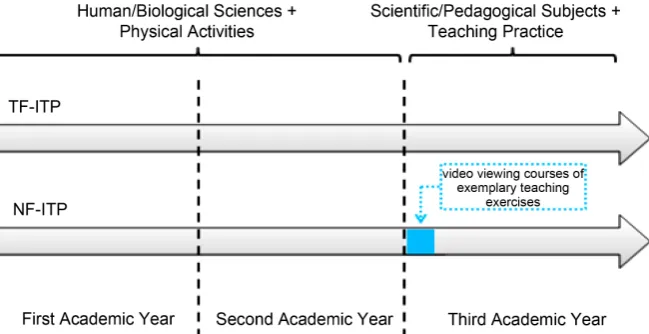
In Tunisia, High Institutes of Sports and Physical Education provide for fu-ture physical education teachers an initial training program includes two aca-demic years based on human/biological sciences and physical activities, and a third academic year of teaching practice where the scientific and pedagogical subjects are distributed throughout the course (Rekik & Bali, 2017). During this last year, P-sT are integrated in a school and assume all the responsibilities of a regular teacher (Beck & Kosnik, 2000). Thus, among the twelve professional competences of teacher (MEQ, 2001), P-sT are asked during their internship to design teaching/learning situations for the contents to be learned, according to the pupils concerned and the development of the skills referred to in the training program. That is why it is necessary to push towards an improvement of our ini-tial training program, particularly during the third academic year of teaching practice in order to develop this sort of competence as well in order to prepare well the future teachers to a successful professional life. To the best of our know-ledge, no empirical evidence is available about the effect of integrating video viewing courses of exemplary teaching exercises on the Pre-service Teachers’ perceptions towards the initial training programs’ effectiveness in physical edu-cation. In this exploratory study, it was hypothesized that integrating this sort of courses during the start-up of the academic year of teaching practice would lead to make the initial training programs more efficient for the Pre-service Teachers.
2. Material & Methods
2.1. Participants
DOI: 10.4236/ce.2017.814150 2202 Creative Education effectiveness of two initial training programs’ forms: Traditional Form vs. New Form. They were informed about the experimental procedures and they signed a written informed consent prior to participation. The experiment was conducted according to the Declaration of Helsinki and approval was obtained from the local Institutional Ethics Committee.
2.2. Experimental Design and Dependant Measures
Pre-service Teachers received two forms of initial training program: Participants of the control group received a Traditional Form of Initial Training Programs (TF-ITP = two academic years of human/biological sciences, physical activities and a third academic year of teaching practice where the scientific and pedagog-ical subjects are distributed throughout the course). Participants of the experi-mental group received a New Form of Initial Training Programs (NF-ITP = TF-ITP + integrating video viewing courses of exemplary teaching exercises during the start-up of the academic year of teaching practice) (Figure 1).
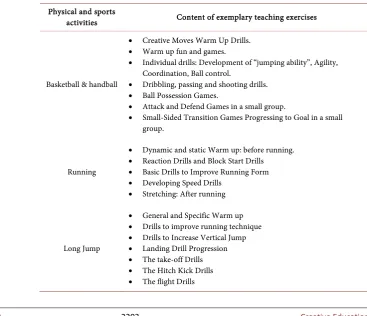
[image:4.595.212.537.525.692.2]The integration of these lessons was done in collaboration with 4 educators from two institutes of sports and physical education. Eight conferences were or-ganized successively for the experimental group during eight days at the rate of one conference per day which lasts 1 h 30 min. The experiment was conducted using a HP Pavilion Entertainment PC and the stimuli were presented on a 250 cm × 200 cm screen from a video projection system. The image on the screen was 200 cm × 160 cm, with a 45˚ viewing angle. In this phase, participants were asked to visualize the model clips of exemplary teaching exercises and to note and/or draw on a sheet of paper the (aim, schema, instructions and materiel used) of each exercise. The instructional content consisted of exemplary teaching exercises related to four types of physical and sports activities that must be taught during the preparatory internship for the professional life. Model clips were collected From YouTube, editing by Movavi Video Editor Software. In ad-dition, three experienced college supervisors of physical education (mean age =
DOI: 10.4236/ce.2017.814150 2203 Creative Education 46 years, mean experience = 12.5 years) independently rated on a 5-point Likert scale each sequence to guarantee that the illustrated information was a realistic depiction of an exemplary teaching exercises (0 = very non representative; 5 =
very representative). Nineteen sequences of exemplary teaching exercises were
rated 4 or above and thus were kept for the experimentation (Table 1).
[image:5.595.167.535.430.746.2]The (Q4TE; Grohmann & Kauffeld, 2013) responses were taken in the com-pletion period of the initial training. All participants of the experimental and control group were asked to assess the effectiveness of the initial training pro-gram on a 10-point rating scale (from totally disagree [0] to totally agree [10]) with six subscales (satisfaction, utility, knowledge, application to practice, the individual organizational results, and the global organizational results). Satisfac-tion refers to whether initial training programs were satisfactory. Utility refers to whether initial training programs were usefulness in teaching practice during the internship. Knowledge refers to whether initial training programs have contrib-uted in the acquirement of new knowledge. Application to practice refers to whether content of initial training programs have been applied in teaching prac-tice during the internship. The individual organizational results refer to whether initial training programs have contributed in the improvement of teaching prac-tice performances during the internship. The global organizational results refer to whether initial training programs have contributed in the amelioration of teaching practice climate during the internship. In this test phase, the instruction given to the participants of experimental group is to indicate the number of
Table 1. Content of exemplary teaching exercises’ videos.
Physical and sports
activities Content of exemplary teaching exercises
Basketball & handball
• Creative Moves Warm Up Drills.
• Warm up fun and games.
• Individual drills: Development of “jumping ability”, Agility,
Coordination, Ball control.
• Dribbling, passing and shooting drills.
• Ball Possession Games.
• Attack and Defend Games in a small group.
• Small-Sided Transition Games Progressing to Goal in a small
group.
Running
• Dynamic and static Warm up: before running.
• Reaction Drills and Block Start Drills
• Basic Drills to Improve Running Form
• Developing Speed Drills
• Stretching: After running
Long Jump
• General and Specific Warm up
• Drills to improve running technique
• Drills to Increase Vertical Jump
• Landing Drill Progression
• The take-off Drills
• The Hitch Kick Drills
DOI: 10.4236/ce.2017.814150 2204 Creative Education conferences that they assisted. The exclusion criterion was to eliminate copies of each participant who assisted less than eight conferences.
2.3. Statistical Analysis
All statistical tests were processed using STATISTICA Software (Stat Soft, France, version 8.0 for Windows). After the verification of normality with the Shapiro-Wilk test, data were analyzed using a two factors ANOVA (2 [Forms] × 2 [Genders]) with repeated measures. When ANOVAs revealed a significant difference, post-hoc multiple comparisons using the LSD Fisher’s test was con-ducted. Partial eta-squared
( )
2p
n were calculated to assess the practical signi-ficance of our results. The level of signisigni-ficance was set at p < 0.05.
3. Results
The reliability coefficient obtained by Cronbach’s alpha for the overall assess-ment of the initial training programs’ effectiveness was 0.96, and it was 0.68, 0.9, 0.82, 0.88, 0.89, and 0.92 for, satisfaction, utility, knowledge, application to prac-tice, the individual organizational results, and the global organizational results respectively.
The two-way ANOVA was conducted on overall responses score showed a significant main effect of forms F = 195.34, p < 0.001, 2
p
n = 0.33, non signifi-cant gender effect F = 1.39, p > 0.05, 2
p
n = 0.03, and non significant interaction (form x gender) F = 1.89, p > 0.05, 2
p
n = 0.18).
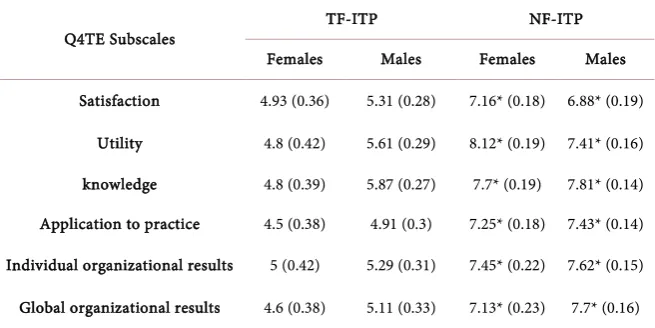
[image:6.595.210.538.546.710.2]In each of the individual subscales—satisfaction, utility, knowledge, applica-tion to practice, the individual organizaapplica-tional results, and the global organiza-tional results—analysis indicated that Pre-service Teachers’ perceptions regard-ing the initial trainregard-ing programs’ effectiveness were significantly higher durregard-ing the NF-ITP in comparison with the TF-ITP (p < 0.001) without any difference between genders (Table 2).
Table 2. Mean of pre-service teachers’ perceptions ± (standard deviations), towards the effectiveness of the two initial training programs’ forms.
Q4TE Subscales TF-ITP NF-ITP
Females Males Females Males
Satisfaction 4.93 (0.36) 5.31 (0.28) 7.16* (0.18) 6.88* (0.19)
Utility 4.8 (0.42) 5.61 (0.29) 8.12* (0.19) 7.41* (0.16)
knowledge 4.8 (0.39) 5.87 (0.27) 7.7* (0.19) 7.81* (0.14)
Application to practice 4.5 (0.38) 4.91 (0.3) 7.25* (0.18) 7.43* (0.14)
Individual organizational results 5 (0.42) 5.29 (0.31) 7.45* (0.22) 7.62* (0.15)
Global organizational results 4.6 (0.38) 5.11 (0.33) 7.13* (0.23) 7.7* (0.16)
DOI: 10.4236/ce.2017.814150 2205 Creative Education
4. Discussion
The study examined how an integration of video viewing courses of exemplary teaching exercises during the start-up of the academic year of teaching practice could enhance the Pre-service Teachers’ perceptions towards initial training programs’ effectiveness in physical education. To determine this dependent va-riable, a validated Questionnaire For Training Evaluation (Q4TE; Grohmann & Kauffeld, 2013) was used. Results shows those P-sT who learned from the NF-ITP reported significantly higher assessment levels than P-sT who learned from the TF-ITP towards—satisfaction, utility, knowledge, application to prac-tice, the individual organizational results, and the global organizational results— subscales.
DOI: 10.4236/ce.2017.814150 2206 Creative Education when they reflected on video clips of their teaching. In addition, P-sT mentioned the practical application of the content of this sort of this new initial training programs’ form in teaching practice during the internship. Finally, P-sT declared the improvement of their teaching practice performances and by the ameliora-tion of their teaching practice climate, when they received an initial training program containing video viewing courses of exemplary teaching exercises dur-ing the start-up of the academic year of teachdur-ing practice. Likewise, results con-firm studies carried out in the benefits of video viewing on Pre-service Teachers’ classroom practice that demonstrated that online videos of teaching practices contribute positively to feelings of self-efficacy in Pre-service Teachers during their internship (Karsenti & Collin, 2011;Fadde & Sullivan, 2013). In this study, it means that the integration of video viewing courses of exemplary teaching ex-ercises during the start-up of the academic year of teaching practice is a valuable device to enhance the initial training programs’ effectiveness for Pre-service Teachers. Although the present study makes useful contribution in teacher edu-cation particularly in physical eduedu-cation domain, certain limitations should be kept in mind, when interpreting the results, as the choice of the content of ex-emplary teaching exercises’ videos. In this study, we have based only on exem-plary teaching exercises related to four types of physical and sports activities, while the P-sT are asked to teach six types of physical and sports activities dur-ing the preparatory internship for the professional life. Moreover, examination of findings of this study in more realistic circumstances is recommended. In sum, this study aimed at describing the benefit of using video viewing courses of exemplary teaching exercises in the initial training programs of physical educa-tion. The results recommend the integration of this sort of courses during the start-up of the academic year of teaching practice in order to make the initial training programs more efficient for the Pre-service Teachers.
5. Conclusion
The present study demonstrates that an integration of video viewing courses of exemplary teaching exercises during the start-up of the academic year of teach-ing practice may contribute to the development of the initial trainteach-ing programs’ effectiveness in physical education. Thus, High Institutes of Sports and Physical Education could integrate video viewing courses of exemplary teaching exercises during the start-up of the academic year of teaching practice.
Acknowledgements
The authors wish to express their sincere gratitude to all the participants and educators from the Tunisian Institutes of Sport and Physical Education for their cooperation.
Disclosure Statement
DOI: 10.4236/ce.2017.814150 2207 Creative Education
Ethical Approval
All procedures performed in study involving human participants were in accor-dance with the ethical standards of the institutional and/or national research committee and with the 1964 Helsinki declaration and its later amendments or comparable ethical standards. Informed consent was obtained from all individu-al participants included in the study.
References
Barnett, C. S., & Tyson, P. A. (1999). Case methods and Teacher Change: Shifting Au-thority to Build Autonomy. In M. A. Lundeberg, B. B. Levin, & H. L. Harrington (Eds.), Who Learns What from Cases and How? (pp. 53-69). Mahwah, NJ: Lawrence Earlbaum Associates.
Beck, C., & Kosnik, C. (2000). Associate Teachers in Pre-Service Education: Clarifying and Enhancing Their Role. Journal of Education for Teaching: International Research and Pedagogy,26, 207-224.https://doi.org/10.1080/713676888
Brouwer, C. N. (2011). Imaging Teacher Learning. A Literature Review on the Use of Digital Video for Pre-Service Teacher Education and Professional Development. In The Annual Meeting of the American Educational Research Association in New Or-leans. Nijmegen: ILS Graduate School of Education, Radboud University Nijmegen. Brunvand, S. (2010). Best Practices for Producing Video Content for Teacher Education.
Contemporary Issues in Technology and Teacher Education, 10, 247-256.
Choi, H. J., & Johnson, S. D. (2007). The Effect of Problem-Based Video Instruction on Learner Satisfaction, Comprehension and Retention in College Courses. British Journal of Educational Technology, 38, 885-895.
https://doi.org/10.1111/j.1467-8535.2006.00676.x
Clarke, D. J., Mesiti, C., O’Keefe, C., Xu, L. H., Jablonka, E., Mok, I. A. C. et al. (2008). Addressing the Challenge of Legitimate International Comparisons of Classroom Prac-tice. International Journal of Educational Research, 46, 280-293.
Fadde, P. J., & Rich, P. (2010). Guerrilla Video: A New Protocol for Classroom Video. Educational Technology, 50, 4-8.
Fadde, P., & Sullivan, P. (2013). Using Interactive Video to Develop Preservice Teachers’ Classroom Awareness. Contemporary Issues in Technology and Teacher Education, 13, 156-174.
Gaudin, C., & Chaliès, S. (2015). Video Viewing in Teacher Education and Professional Development: A Literature Review. Educational Research Review, 16, 41-67.
Grohmann, A., & Kauffeld, S. (2013). Evaluating Training Programs: Development and Correlates of the Questionnaire for Professional Training Evaluation. International Journal of Training and Development, 17, 135-155.https://doi.org/10.1111/ijtd.12005 Harford, J., MacRuairc, G., & McCartan, D. (2010). Lights, Camera, Reflection: Using
Peer Video to Promote Reflective Dialogue among Student Teachers. Teacher Devel-opment, 14, 57-68.https://doi.org/10.1080/13664531003696592
Hewitt, J., Pedretti, E., Bencze, L., Vaillancourt, B. D., & Yoon, S. (2003). New Applica-tions for Multimedia Cases: Promoting Reflective Practice in Preservice Teacher Edu-cation. Journal of Technology & Teacher Education, 11, 483-500.
DOI: 10.4236/ce.2017.814150 2208 Creative Education Investigating Teaching and Learning in the Classroom (pp. 207-224). Munich: Wax-mann Publishing.
Karsenti, T., & Collin, S. (2011). The Impact of Online Teaching Videos on Canadian Pre-Service Teachers. Campus-Wide Information Systems, 28, 195-204.
https://doi.org/10.1108/10650741111145724
Koc, M. (2011). Let’s Make a Movie: Investigating Pre-Service Teachers’ Reflections on using Video-Recorded Role Playing Cases in Turkey. Teaching and Teacher Education, 27, 95-106.
Marsh, B., Mitchell, N., & Adamczyk, P. (2010). Interactive Video Technology: Enhanc-ing Professional LearnEnhanc-ing in Initial Teacher Education. Computers & Education, 54, 742-748.
Masats, D., Sormunen, K., Hacklin, S., & Ducos, G. (2007). The Use of Online Video Case Studies in Teacher Training Programs: A Literature Review. Paper Presented at the 32nd ATEE Conference, Telford, 25-29 August 2007.
Ministry of Education of Quebec (MEQ) (2001). Training Program of the Quebec School. Pre-School Education. Primary Education. Quebec: Government of Quebec.
Moreno, R., & Valdez, A. (2007). Immediate and Delayed Effects of using a Classroom Case Exemplar in Teacher Education: The Role of Presentation Format. Journal of Educational Psychology, 99, 194.https://doi.org/10.1037/0022-0663.99.1.194
Moreno, R., Abercrombie, S., & Hushman, C. (2009). Using Virtual Classroom Cases as Thinking Tools in Teacher Education. In Proceedings of Society for Information Technology & Teacher Education International Conference (pp. 2615-2622).
Overbaugh, R. C. (1995). The Effects of Course Focus on Pre-Service Teachers’ Attitudes toward Personal and School Uses of Computers and Computer Anxiety. Journal of Computing in Teacher Education, 12, 18-23.
Rekik, G., & Bali, N. (2017). Tunisian Physical Education Student Trainees’ Agreement Rate about the Consistency between Initial Training and Integration during the Prepa-ratory Internship for Professional Life. Creative Education, 8, 373-382.
https://doi.org/10.4236/ce.2017.83029
Rosaen, C. L., Lundeberg, M., Cooper, M., Fritzen, A., & Terpstra, M. (2008). Noticing Noticing: How Does Investigation of Video Records Change How Teachers Reflect on Their Experiences? Journal of Teacher Education, 59, 347-360.
https://doi.org/10.1177/0022487108322128
Santagata, R., & Guarino, J. (2011). Using Video to Teach Future Teachers to Learn from Teaching. ZDM the International Journal of Mathematics Education, 43, 133-145. https://doi.org/10.1007/s11858-010-0292-3
Scott, S. E., Kucan, L., Correnti, R., & Miller, L. A. (2013). Using Video Records to Me-diate Teaching Interns’ Critical Reflection. Journal of Technology and Teacher Educa-tion, 21, 119-145.
Seago, N. (2003). Using Video as an Object of Inquiry Mathematics Teaching and Learn-ing. In J. Brophy (Ed.), Using Video in Teacher Education (Vol. 10, pp. 259-285). Amsterdam: Advances in Research on Teaching.
Seidel, T., Stürmer, K., Blomberg, G., Kobarg, M., & Schwindt, K. (2011). Teacher Learn-ing from Analysis of Videotaped Classroom Situations: Does It Make a Difference Whether Teachers Observe Their Own Teaching or That of Others? Teaching and Teacher Education, 27, 259-267.
DOI: 10.4236/ce.2017.814150 2209 Creative Education Sherin, M. G., & van Es, E. A. (2005). Using Video to Support Teachers’ Ability to Notice
Classroom Interactions. Journal of Technology and Teacher Education, 13, 475e491. Snoeyink, R. (2010). Using Video Self-Analysis to Improve the “Withitness” of Student
Teachers. Journal of Digital Learning in Teacher Education, 26, 101-110.
Star, J., & Strickland, S. (2008). Learning to Observe: Using Video to Improve Pre-Service Mathematics Teachers’ Ability to Notice. Journal of Mathematics Teacher Education, 11, 107-125.https://doi.org/10.1007/s10857-007-9063-7
Wang, X. (2013). A Potential Approach to Support Pre-Service Teachers’ Professional Learning: The Video Analysis of the Authentic Classroom. US-China Education Re-view B, 3, 149-161.
Yadav, A., & Koehler, M. J. (2007). The Role of Epistemological Beliefs in Preservice Teachers’ Interpretation of Video Cases of Early-Grade Literacy Instruction. Journal of Technology and Teacher Education, 15, 335-361.
Yerrick, R., Ross, D., & Molebash, P. (2005). Too Close for Comfort: Real-Time Science Teaching Reflections via Digital Video Editing. Journal of Science Teacher Education, 16, 351-375.https://doi.org/10.1007/s10972-005-1105-3