Munich Personal RePEc Archive
Transfers by force and deception lead to
stability in an evolutionary learning
process when controlled by net profit but
not by turnover
Friedrich, Thomas
Humboldt-Universität zu Berlin
13 March 2019
Online at https://mpra.ub.uni-muenchen.de/97806/
Transfers by force and deception lead to stability in an evolutionary
learning process when controlled by net profit but not by turnover
T. Friedrich
An evolutionary process is characterized by heritable variation through
random mutation, positive selection of the fittest, and random genetic drift.
A learning process can be similarly organized and does not need insight
or understanding. Instructions are changed randomly, evaluated, and
better instructions are propagated. While evolution of an enzyme or a
company is a long-lasting process (change of hardware) learning is a fast
process (change of software). In my model the basic ensemble consists of
a source and a sink. Both have saturating benefit functions (b) and linear
cost functions (c). In cost domination (b-c<0) source gives substrate and
in benefit domination (b-c>0) sink takes it - both at free will - thus creating
a basic superadditivity. It is not reasonable to give when b-c>0 or take
when b-c<0. However, with force and deception source and sink of an
ensemble can be overcome to give or take although it is not reasonable
for them. This leads to further superadditivity within the ensemble. But now
subadditivity will appear in addition in certain regions of the transfer space.
I observe organisms or companies learning by trial and error to optimize
superadditivity without changing the characteristics of the benefit function
or the cost function. The role of a third-party master of an ensemble to
create superadditivity in the absence of cost domination in source or
benefit domination in sink by force and deception is investigated in
connected and unconnected ensembles. Employees and companies can
be rated according to turnover or net profit. My model confirms the
superiority of the benchmark net profit as self-limiting, sustainable
incentive in an evolutionary learning process.
Introduction
One of the central ideas in science is the conservation of mass and energy:
“ex nihilo nihil fit”. My papers deal with the rearrangement of a conserved
amount of substrate between two compartments with catalytic active
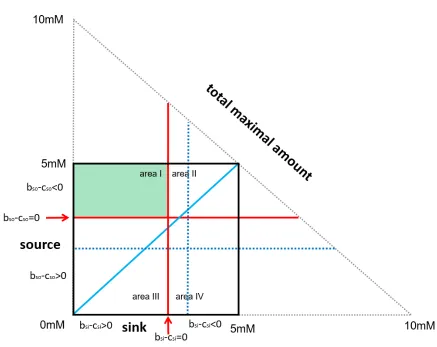
[image:3.595.79.516.261.608.2]entities forming an ensemble of a source and a sink (figure 1).
Figure 1
Figure 1
My model resembles the Solow model (1) with a saturating production
(utility) function and a linear cost function but with three dimensions and
two parties forming an ensemble capable to transfer substrate internally
under control of the law of mass conservation. The characteristic of the
saturating function does not stand on economic ground but on a similar
biochemical ground which is the Michaelis-Menten kinetic
(V=Vmax*[S]/(Km+[S])) in source and sink. This choice offers a way to
separately (by mutation, 2) vary the steepness (Km) of the initial part and
the height (Vmax) of the flat part of the saturating function. In addition, this
is the basic form of productivity in all organisms. In my recent paper (2) I
examined the evolution of organisms or companies viewed as ensembles
of ensembles with a peaceful and rational behaviour of two Homo
Economicus active only in area I of the transfer space (3) resulting in only
superadditive net profit in symmetric ensembles. Weak asymmetric
ensembles also show peaceful subadditivity in area I (the abstract was a
little short here). Km, Vmax, cost factor (cf) and benefit factor (bf) differ in
source and sink in asymmetric ensembles.
Area I is an area of peaceful transfers though not always superadditive
and reasonable from an ensemble´s viewpoint. However, there is
additional superadditivity in area II and area III (figure 1). This additional
superadditivity comes with two types of additional cost.
1. Force and deception are investments to cross the limit b-c=0 which
inactivates giving and taking behaviour. This time source and sink
are not completely informed and not absolute strong; they can be
overcome. It is therefore possible with a limited investment to force
and deceive them. In a skilful investment the gain for the investor but
not necessarily for the ensemble will overcompensate the initial
investment. Force and deception are an extrinsic cost. This type of
2. An increasing transfer beyond b-c=0 through force and deception
will lead besides additional superadditivity to an increasing amount
of subadditivity reducing the total amount of superadditivity coming
out of area I to III. This will finally lead to complete subadditivity (3,
4). Subadditivity could be characterized as an intrinsic cost. This
intrinsic cost will automatically show up in the later calculations.
These costs above are to be discriminated from the basic cost of the
substrate, i.e. “c”. This type of cost is inevitable connected to the benefit,
“b”. Benefit and cost are inseparable, opposing features of the substrate.
They are two sides of the same coin, in which the cost looks to the past
and presence of the substrate and the benefit looks to the future.
In the absence of a master, force and deception will be used by that party
which has not yet reached c=0. The other party has already reached
b-c=0 and therefore does neither take nor give anymore. The cost of the
investment into force and deception and into countermeasures is not
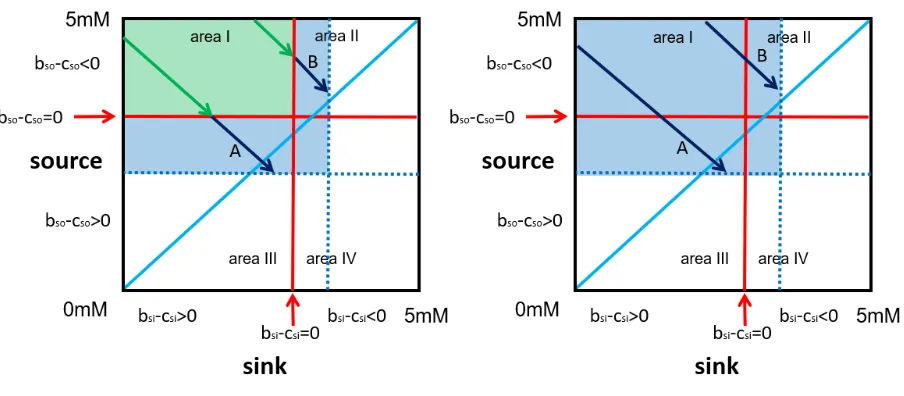
considered. Source (bso-cso<0) may force sink to take more (figure 2, blue
arrows B, one and two steps from area I into area II but not IV) and sink
(bsi-csi>0) may force source to give more (figure 2 blue arrows A, one and
two steps from area I into area III but not IV). Both, source and sink using
force and deception, will not cross their own limit b-c=0, they will only force
or deceive the other party of the ensemble to do so. Therefore, the
ensemble will not enter area IV.
But here I will investigate a master behaviour. A master is a third party.
The master is not active in catalysis or production. He is either an honest
broker bringing source and sink together in area I (2) or he forces and
deceives both, source and sink, to transfer beyond b-c=0 from area I into
There are two types of masters (4). A conditional and an unconditional
violent and deceptive master. The conditional violent and deceptive
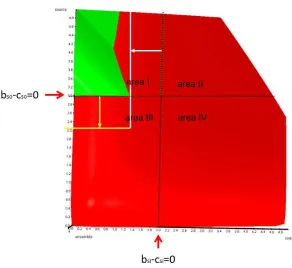
master is at first an honest broker in area I (figure 2 left, green), a
brokerage fee is not considered. He starts violence and deception at the
limit b-c=0 outside of area I to his new limit (figure 2 left, blue area, dotted
blue lines). The unconditional violent and deceptive master will force and
deceive source and sink to transfer beyond b-c=0 already at
[image:6.595.73.525.361.559.2]concentrations in area I (figure 2 right, all blue).
Figure 2
Figure 2
A top down view of the transfer space. The dimension net profit of the ensemble points towards the observer. Areas of peaceful transfers (green) and transfers by force and deception (blue) are marked. Exemplary transfers are indicated by arrows (green peaceful, blue with force and deception). All transfers finally end at a blue dotted limit in source and sink, a transfer size of an arbitrary example. Due to mass conservation – the amount taken from source equals the amount given to sink – the arrows run diagonally (volumes and other physical conditions in source and sink are identical). In both cases is the rational limit bso-cso=0 for source or bsi-csi=0 for sink exceeded. Left:
This is an irrational behaviour as in area I force and deception are not
necessary to induce transfers. However, this will produce additional
superadditivity as soon as the border b-c=0 is exceeded. The intrinsic cost
is an even faster growing subadditivity (5).
The effect of introducing a cost for force and deception is not considered
here but was investigated earlier (4, 5). To cross the red lines (bso-cso=0
and bsi-csi=0) will at first increase the amount of superadditivity further.
When in symmetric ensembles the transfer will cross the blue line of strict
equivalence (line of mixing of substrate) a small amount of subadditivity
will appear in the centre of the transfer space. This is different in some
asymmetric ensembles (figure 3). A further amount of subadditivity
appears when the red lines to area IV are crossed. This is an area of
complete irrationality where source in benefit domination is forced to give
substrate to sink in cost domination. There are several ways - irrational
and even rational ones - to create subadditivity as described earlier (2, 6).
In the previous paper I observed ensembles with the ability to change the
characteristic values of “b” and “c” (Km, Vmax, bf, and cf) by mutation (or
adjustment, bf as complexity factor, 2). The rational source and sink were
only active in area I (2). In the following examples I observe cases where
the saturating production function “b” and the linear cost function “c” are
fixed again (Km, Vmax, bf, and cf values do not change by mutation).
However, now the limit to which the master will force and deceive source
and sink to transfer to will change. This is understood as a learning
process guided by selection. The master of the ensemble learns to change
the transfer size (size of turnover) beyond b-c=0. Selection will then either
reward the increased transfer size or the increased net profit as result of a
changed (a change can be an increase or decrease) transfer size.
Independent of what selection will prefer, “transfer size” and “superadditive
What is net profit, superadditivity and subadditivity and how are they
related?
According to the Cambridge English dictionary net profit is: “the money
made from selling something after all costs, taxes, etc. have been paid”.
Another definition found (Investopedia): “Profit is a financial benefit that is
realized when the amount of revenue gained from a business activity
exceeds the expenses, costs and taxes needed to sustain the activity”.
In the second definition “benefit” and “cost” are used together like in my
model. Benefit and cost have the same dimension (money or glucose) and
by subtraction we determine the (net) profit. However, in economy a
driving force is to maximize net profit. This stands in contrast to the
behaviour of net profit in my model which behaves identically to the
Solow-growth model. The system develops by redistribution (give cost dominated
substrate, take benefit dominated substrate) towards an equilibrium of
benefit and cost (b-c=0), not a maximal difference. In case the
characteristics of b or c change (e.g. by mutation or invention through
research) the system will occupy in the absence of force and deception a
new stable point; b-c=0. As an alternative I could use the expression
“efficiency” instead of net profit.
I look with a biochemist´s eye on the concept of net profit. Enzyme and
substrate are the core components. The enzyme-substrate complex is a
Janus-headed thing and he is formed in source and sink. Excess substrate
as well as excess enzyme are problematic. Source and sink as separate
compartments will produce product. Substrate may be redistributed
between them to increase productivity in both compartments. The cost is
related to the acquisition and keeping of the substrate and the benefit is
related to the product that will be produced. The size ratio of benefit and
in source and sink and is fixed there but can be changed by relocation.
The point b-c=0 is an optimal substrate to enzyme ratio. Within an
ensemble the substrate is transferred and transformed. It is taken into the
ensemble, redistributed between source and sink to avoid oversaturation
or idleness and then it will be catalytically transformed. Redistribution is
the key step to optimize the net profit within the ensemble. In a symmetric
ensemble with unequal substrate distribution mixing is a simple way to
optimize productivity. An optimal distribution will lead to superadditivity
(additional net profit), a wrong distribution may even worsen the
productivity (subadditivity) in comparison to no redistribution.
Redistribution is a way to change the size of the net profit. Wise
redistribution of substrate is a possibility to maximize net profit.
Superadditivity and subadditivity appear inside the ensemble and are
related to the degree of saturation and kinetic parameters of both sides.
Superadditivity and subadditivity have the dimension “np*mM2”, an integral
of the volume between all possible net profits of an active and an inactive
ensemble in a certain concentration range (here 0-5mM). Net profit is point
like and belongs to a single concentration pair. Superadditivity and
subadditivity also appear here and are the difference of net profit with
transfer and without transfer at a single concentration pair. The dimension
here is np. Although in my definition net profit (np) and super/subadditivity
(np*mM2) have different units they are practically identical. The difference
is the scale; local versus global.
Superadditivity and subadditivity appear in different areas of the transfer
space, sometimes simultaneously. To determine the final balance of many
transfers within the given concentration range superadditivity and
subadditivity are to be subtracted. The final value of an active ensemble
may be superadditive or subadditive in comparison to an inactive
Results and discussion of the results
Superadditivity and subadditivity appear in the transfer space when net
profit of an ensemble without transfer of substrate (inactive) and net profit
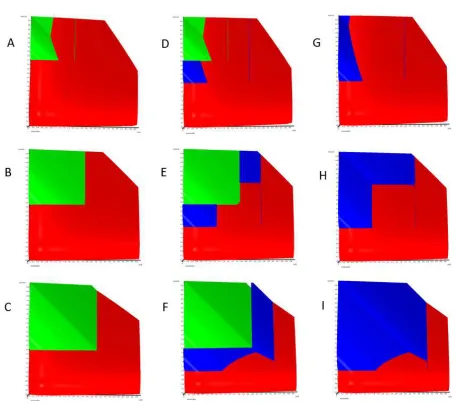
of the same ensemble with transfer (active) are compared (figure 3).
Ensembles can be completely symmetric according to the features of
source and sink (figure 3, row B, E, H) or asymmetric. The transfer in the
active area may be voluntary and induced by force and deception.
The first asymmetric type consists of a weak source and a weak sink, a
weak ensemble (figure 3, row A, D, G). In this ensemble type source does
not like to give (high Vmax or low Km or low cost) and sink does not like
to take (low Vmax or high Km or high cost).
The second asymmetric type consists of a strong source and a strong sink,
a strong ensemble (figure 3, row C, F, I). In this ensemble type source
easily gives (low Vmax or high Km or high cost) and sink easily takes (high
Vmax or low Km or low cost).
The parameters are:
Weak asymmetric ensemble, b-c=0 at 3mM in source, 2mM in sink,
Km=0.5mM, Vmax=5µmol/min in source and sink; cf=(10/7)c/mM in
source and cf=2c/mM in sink, bf=1b*min/µmol in source and sink.
Symmetric ensemble, b-c=0 at 2.5mM in source and 2.5mM in sink,
Km=0.5mM, Vmax=5µmol/min, and cf=(5/3)c/mM in source and sink.
Strong asymmetric ensemble, b-c=0 at 2mM in source, 3mM in sink,
Km=0.5mM, Vmax=5µmol/min in source and sink; cf=(10/7)c/mM in sink
Figure 3
Figure 3
A top down view on several single ensembles and their transfer space. The dimension net profit of the ensembles points always towards the observer, source to the left, sink to the bottom. Red, no transfers, simple additivity; green, peaceful transfers (to the limit b-c=0 in source and sink); blue, transfers by force and deception (1mM beyond b-c=0 as example). Superadditive surfaces are above the red surface, subadditive below (not visible). The end of subadditivity is indicated by a thin green or blue line, an artefact where red, green or blue are of identical value.
Weak asymmetric ensembles: b-c=0 at 2mM in sink and 3mM in source, row A, D, G; strong asymmetric ensembles: b-c=0 at 3mM in sink and 2mM in source, row C, F, I.
Symmetric ensembles: row B, E, H; b-c=0 at 2.5mM in sink and 2.5mM in source.
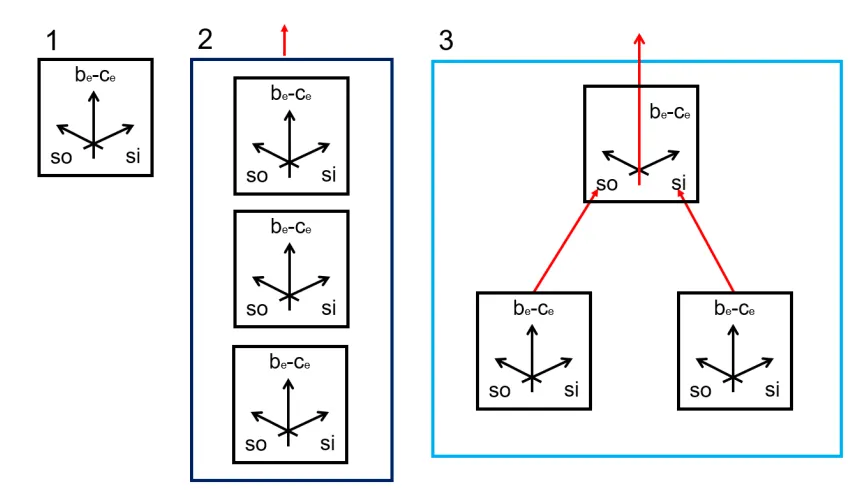
The ensembles in figure 3 were single ensembles from the type 1 in figure
4. In the following section I will mainly concentrate on ensembles of
ensembles (figure 4-2 and 4-3) like in my previous paper. All necessary
[image:12.595.79.506.234.482.2]details of the calculations can be found there (2).
Figure 4
Figure 4
1: a single symmetric or asymmetric ensemble. It may be independent or dependent on a conditional or unconditional violent and deceptive master. The net profit of the ensemble is be-ce and in comparing an active and an inactive ensemble we may
observe superadditivity or subadditivity.
2: an unconnected ensemble of ensembles. Three ensembles of type 1 contribute together to the total outcome (red arrow) of either superadditivity and subadditivity or they contribute together to the total amount transferred when the master is interested in transfer fees.
The amount of superadditivity and subadditivity created depends on the
type of asymmetry and the use of force and deception. Superadditivity as
well as subadditivity appear in peaceful ensembles and by conditional or
unconditional violence and deception without or with a master. A mixture
of conditional and unconditional violence and deception is not
investigated. Neither in the single ensemble nor in all three ensembles of
the organism or company as ensemble of ensembles.
Besides a setting where all concentrations are of equal probability there is
also the possibility that a substrate is to both sides of the ensemble either
rare or in complete abundance. The ensemble will then only be active in
area II or area III. We start with the observation of an equal probability for
all concentrations (concentration pairs) in the range from 0 to 5mM in
source and sink of all three ensembles.
Unconnected ensembles:
In the following section every organism is composed of three unconnected
ensembles (figure 4-2). The population contains nine organisms controlled
by nine masters. All nine masters are either conditionally or unconditionally
violent and deceptive. Every organism is made entirely of ensembles of
the type A (figure 3A, all weak asymmetric ensembles) or type B (figure
3B, all symmetric) or type C (figure 3C, all strong asymmetric ensembles)
from the most left column in figure 3. This gives us the basic value of
superadditivity corrected for subadditivity if present. Km, Vmax, benefit
factors (bf) and cost factors (cf) are fixed and identical in source and sink
of all 9*3 ensembles of a population. The masters (conditional or
unconditional) are present but not yet active; this is indistinguishable from
an independent ensemble. Then the masters start to learn to change the
transfer size beyond b-c=0 in source and sink either by conditional or
Transfers of the same size and direction:
The master learns to force and deceive source to give beyond b-c=0
(decrease of substrate concentration) and sink to take beyond b-c=0
(increase of substrate concentration) by the same step size. As result the
superadditive net profit of the ensemble will change. The intersection of
the dotted blue lines in figure 2 moves on a diagonal connecting the
concentrations 0mM sink 5mM source with 5mM sink, 0mM source. The
three starting ensembles in every organism have a maximal range of 3mM
(A), 2.5mM (B) or 2mM (C) to transfer substrate within their respective
borders. Savings, fat reserves, a storage or credit do not exist. Differing
and independent step sizes on source and sink side are later investigated.
Two types of masters are observed: an all conditional violent and
deceptive master (figure 3 D, E, F, figure 5) or an all unconditional violent
and deceptive master (figure 3 G, H, I, figure 6). Every master will be
punished or rewarded by selection for the result of his three ensembles.
The three best masters and their ensembles will have one offspring each,
the three next survive and the last three die. As we observe the evolution
of a population of 9 masters and their ensembles the average of the nine
outcomes (9*3) is depicted according to:
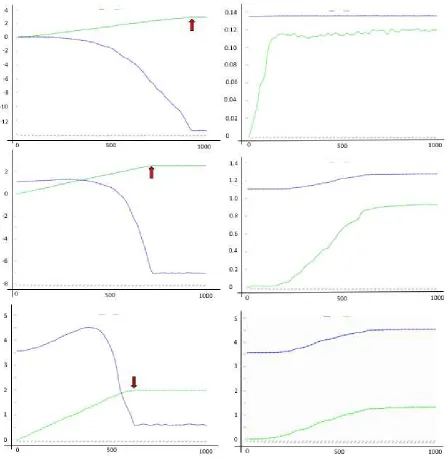
• transfer size (green) changed by mutation, always starts at zero • net profit (blue), a result of the changed transfer, different beginnings
Either the increase of the transfer size or the increase of the net profit is
rewarded in the evolutionary learning process. Observed is side by side
the development of transfer size and superadditive net profit. The outcome
is depicted always with the generation time as x-axis. The y-axis is either
the transfer size (mmol) or the size of the superadditive net profit (np*mM2)
for both evolutionary ratings. In figure 5 we observe the learning process
Figure 5
Figure 5
We look at the average of a population of nine conditional violent and deceptive masters and their unconnected and dependent ensembles of ensembles (9*3) over the time of 1000 generations (x-axis). The colours (blue, green) are not related to the usage of colours in figure 2 and 3. In the left column selection favours transfer size and in the right column selection favours superadditive net profit. The curves show the development of superadditive net profit (blue) and transfer size (green) over (generation) time. The pattern top to bottom is related to the pattern D, E, F in figure 3 (top, weak asymmetric ensemble; middle, symmetric ensemble; bottom, strong asymmetric ensemble). The number on the y-axis is either the amount (mmol) of substrate transferred (green) or the superadditive net profit (blue, np*mM2) scaled by
In the beginning the master is an honest broker. He brings source and sink
together, and they transfer at free will until b-c=0. A brokerage fee is not
considered. Then the master learns that there is more superadditivity or
more substrate to transfer. It is obvious (figure 5) that within 1000
generations the masters learn to increase either transfer size or net profit.
However, the aim to maximize transfer size (figure 5 left column) finds no
limit within the borders of the system independent of the ensemble type
(symmetric, asymmetric). The system comes to an external limit (red
arrow). There, additional substrate is no longer available within the
ensembles and the increase in transfer size stops. The development of
net profit is depressing. Net profit may go through a small or larger phase
of initial increase but in the end net profit will decrease far below the
starting value. This development stops when transfer stops. In two cases
superadditive net profit is negative (subadditive) before the system finds
its external limit. In the strong asymmetric ensemble, the final net profit
stays positive (superadditive) but is far below the starting value (figure 5,
left column, bottom). In the case where selection favours a better net profit
(figure 5, right column) the system finds an internal limit and equilibrium.
Net profit is maximized and then the increase of transfer size stops
because more transfer would decrease the net profit again which is
punished. In the weak asymmetric ensemble, the increase in net profit is
barely visible (figure 5, right column, top) as the amount of subadditivity
produced by this type of asymmetry is already considerable at the start.
The starting value of superadditive net profit is 1.35 np*mM2 and does not
increase detectable while transfer size increases only a little. The situation
in figure 3 D (transfer size of 1mmol) is a possibility only for the case where
selection favours transfer size. The net profit of the whole ensemble is
already negative at that transfer size.
Figure 6
Figure 6
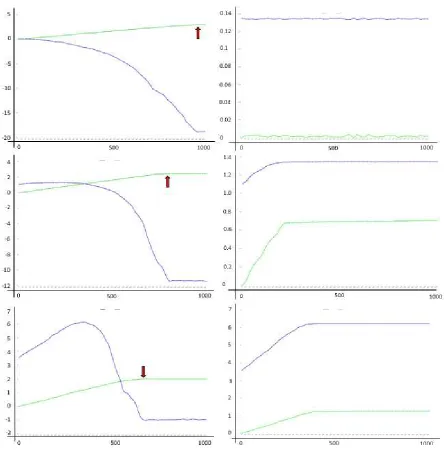
The observations with the unconditional violent and deceptive masters
(figure 6) are very similar to the conditional violent and deceptive masters.
But there are a few interesting differences. It is already known from my
older work (5) that the superadditivity of this master will increase faster
and to a higher level but will then also decrease faster and steeper. This
was observed with symmetric ensembles.
Remarkable is the observation that within the weak asymmetric ensemble
(figure 6 right column, top) there is no increase in transfer size and
superadditive net profit. It was already clear from figure 3 that the amount
of subadditivity produced is larger within an ensemble of an unconditional
violent and deceptive master in comparison to a conditional violent and
deceptive master. The amount of subadditivity is of the same size as the
amount of superadditivity. The system can no longer react as every
movement of the limit in either direction away from b-c=0 (shrink or grow)
will increase superadditivity and subadditivity or decease superadditivity
and subadditivity to the same extent.
The observations in figure 5 and figure 6 also explain a common
misunderstanding of ideologists. In the beginning of some ensemble types
an increase of transfer size will increase net profit. Simple minds start now
to think in straight lines. However, there is an early end to this lockstep
and that is not even the external limit. The simple thinking must end when
net profit starts to break down. That is the point where realists and idealists
separate.
In the preceding paper (2) it has already been learned that recombination
does not change the basic outcome of the results. Evolution with
recombination is just faster and this is well known from Biology. The data
Transfers of different size and direction:
In figure 5 and 6 the growth of transfer size and net profit of a weak
asymmetric ensemble is neglectable or not present at all (figure 5 and 6,
right column, top picture). The reason is the considerable amount of
subadditivity produced right from the very beginning in combination with a
master linking the step size and direction on the source side to the step
size and direction on the sink side. This is changed now. On the source
and sink side different step sizes and different directions on either side of
b-c=0 are possible. Every single transfer is still controlled by the law of
[image:19.595.152.444.395.663.2]mass conservation. An illustration of this idea is presented in figure 7.
Figure 7
Figure 7
The transfer space is a model that could be called an “outer model” or an
objective, factual model. Such facts are Km, Vmax, bf, cf, the substrate
and it´s concentration range. The outer model is inhabited by up to three
parties. The outer model is the reality for source, sink, and master. The
three parties must decide whether they become active or stay inactive. For
this they need their own model. I call this an “inner model” or a subjective
model. The inner model used by the master could be the only model to
match the complexity of the outer model as the master is no component
of the transfer space.
To determine concentrations is a simple way to orient within the transfer
space. The inner model of a Homo Economicus regarding a concentration
as a limit to give (source) or to take (sink) can come to the same result as
the outer model; b-c=0 i.e. 2.5mM in a symmetric ensemble. Therefore,
Homo Economicus acts reasonable and rational. But that is also the
starting point for conflicts. Source and/or sink must be forced or deceived
to change their reasonable behaviour. Source and sink could have other
inner models than the model of a Homo Economicus. Conflicts would be
absent if source and sink would have no inner model at all. The possibility
of superadditivity and subadditivity would still exist as this depends on the
outer model. Whether the source and sink are active or not would then
depend on the on the inner model of the master. Whatever inner model
source and sink would use to guide their behaviour, conflicts will only arise
when the inner model of master and source and sink differ. Inner models
can be the cause of subadditivity in source and sink even in the absence
of a master because the inner models can misguide source and sink within
the outer model, their reality.
In the preceding section I observed two intentions with different
complexity: more transfer (increase concentration limit in sink, decrease
decrease concentration limit only when net profit will increase). The
determination of a net profit is a very challenging task in comparison to the
determination of a concentration or a concentration difference. The
simplicity or complexity comes from dimensionality of the model, the
necessity to obtain the appropriate information (an additional cost) and to
behave accordingly.
The transfer space is a three-dimensional model. The inner model of
source and sink may range from a single concentration (a point, dimension
zero) to a two-dimensional model with the assumption of certain values (b
or c). Source and sink are two-dimensional entities. Although source and
sink may use such complex models (b-c=0 as limit) they are not
necessarily superior to a simple limit like a concentration. In case the cost
function or the benefit function come from wrong assumptions the limit will
be wrong, too. The model of the master may range from a single
target-concentration in source and sink to a three-dimensional model or of even
higher dimensionality than the transfer space. A model with higher
dimensionality than the transfer space will not help but confuse as it will
result in overfitting.
In a past paper (4) I already introduced a master with a complex behaviour
and intention. His aim was to maximize superadditivity by avoiding
subadditivity. I called him “prudent master”, a designation and behaviour
introduced by Adam Smith. In symmetric ensembles the prudent master
will not cross the line of strict equivalence or mixing. He has a linear inner
model. This is a very adaptive, demanding, and intelligent strategy as he
can´t stick to a fixed value of a substrate concentration like a wise limit (4)
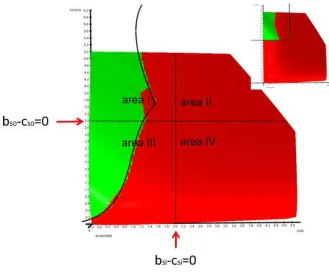
which is a constant inner model. In figure 8 we observe again a type of a
prudent master but now with a nonlinear inner model suitable for an
Figure 8
Figure 8
A single weak asymmetric ensemble is shown top down (source to the left, b-c=0 at 3mM; sink at the bottom, b-c=0 at 2mM; net profit of the ensemble towards the observer). After 2000 generations the master has leaned to optimize superadditive net profit with two sinus functions as limits (black lines) of his inner model. Although source and sink have no inner model, the limit b-c=0 is marked in source and sink as this is still a fact in the outer model. Force and deception are therefore not necessary. The small inset is the starting condition at generation time zero. The master will induce giving and taking left of the black line, producing only a small amount of subadditivity in area I and a large amount of superadditivity in area III.
In figure 5 and 6 the superadditive net profit of the ensemble of ensembles
with asymmetric weak ensembles was about 1.35np*mM2 on average of
the whole population and could no longer improve. The system was
frozen. The superadditive result of a more complex limit discovered by an
evolutionary learning process is 7.9np*mM2 within a single ensemble
(figure 8). The starting generation began at the former borders b-c=0
and in sink separately. The letters a, b, c, and d are parameters which are
changed during the evolutionary learning process. They are mutated with
a random, normal distributed value and an expected value of zero and a
standard deviation of 0.01. S is the amount of substrate in source and sink
of the concentration pair at the limit. The concentration pairs along the
diagonal (to the upper left of this pair) will result in a certain amount of
superadditivity or subadditivity if the values before and after a transfer are
compared. In contrast to the starting conditions (figure 8, inset)
subadditivity within the borders is reduced and superadditivity is
increased. With a more complex limit (a*sin(b*S+c)+d + e*sin(f*S+g)+h)
7.9np*mM2 could not be improved further.
In figure 8 it is demonstrated that within an ensemble of a source and a
sink without an inner model the master can freely set limits without using
force and deception. The complex limits he uses, simultaneously reduces
subadditivity and increases superadditivity considerably in comparison to
the starting conditions. This time the prudent master will not allow source
to give to sink beyond certain values as this will produce subadditivity. The
master will reduce the amount already given by source to sink in the
starting configuration. The master´s inner model is again shaped by an
evolutionary learning process and selection. Every increase or decrease
in transfer size will result in an increase or decrease of superadditive net
profit. Selection will only reward inner models resulting in an increase of
the final balance (superadditivity minus subadditivity). This can be
achieved by reduction of subadditivity and by increase of superadditivity.
But imagine you are a two-dimensional entity (source, sink) with your own
inner model. You observe how your limits are ignored, violated and
unreliably changed when concentrations change and this appears biased
towards another party; conflicts will be the result. Source will not accept
to the limit bso-cso=0. Furthermore, also sink will be angry because sink
could use this substrate to get closer to its own limit bsi-csi=0. This is valid
for area I and II. On the other side (area I and area III) the master will
increase the amount of substrate taken from source and given to sink. On
this side there is still plenty of additional superadditivity. However, this
would be against the interest of the source as the source on this side is
forced to give beyond the limit bso-cso=0. For many different reasons a
rational inner model makes source and sink oppose the prudent master.
Prudence would have to be enforced by force and deception (conditional
or unconditional) as “prudence” relates to the aim and not to the measures.
The prudent master tries to maximize superadditive net profit. Therefore,
the prudent master is even able and willing to decrease the transfer size.
The master who lives on transfer fees is unable to understand this and
unwilling to do so.
The model implies another possible idea of the master. He is capable to
decrease area I on one side (area I to area II). That is very helpful in an
asymmetric ensemble like figure 3 A, D, G. Here, the decrease in transfer
size on one side and the increase in transfer size on the other side will
synergistically affect the overall increase in superadditivity (figure 7 and
8). What happens if the master will decrease the size of area I on both
sides? In a symmetric ensemble such a behaviour of the master would
have a different effect and purpose. Area I with only superadditivity would
become smaller; a harm to the ensemble not reaching the full potential of
superadditivity. Source and sink must look for another sink or another
source to reach b-c=0. This could be the true motivation of the master. The
master may be biased towards a new source or sink. He will endure the
loss either as a smaller transfer fee or a smaller net profit to share. Later
he will then enjoy the better access to net profit share or transfer fees with
Connected ensembles - substrate probability:
Until now the different concentrations of substrate in source and sink had
the same probability. At a given concentration pair in source and sink a
definite net profit and a fixed superadditivity or subadditivity is produced
when the net profit before and after a transfer is compared. These point
like portions of superadditivity or subadditivity are of different size over the
concentration range. Some size classes appear more often than other size
classes. A size and frequency distribution of this local portions of super-
and subadditivity can be observed; a spectrum. This has not been
important before as the ensemble was single or unconnected and only the
total amount of superadditivity minus subadditivity was calculated. As soon
as connected ensembles (figure 4-3) are observed this is different. Now
the top ensemble will receive a spectrum of superadditivity and
subadditivity. Only the basic ensembles have an equal substrate
distribution over the whole concentration range. This is the only place
where substrate enters from the outside with equal probability. Then the
substrate is handed over within the ensemble. The decrease in substrate
concentration handed to the top ensemble is compensated by a single
benefit factor, here bf=6 (2). Now bf has features of a complexity factor.
The result is a higher substrate concentration range (again 5mM) for
source or sink but now as a spectrum and no longer a uniform distribution
with equal probability for all concentration pairs. The production of
superadditivity in the top ensemble depends on a high input on the source
side and a low input on the sink side. The reverse input may result in
subadditivity in the top. This is different when transfer size is the aim. Then
the transfer will become large on both sides of the top ensemble. However,
the result in the top ensemble depends on what will increase first and in
what sequence and size. The observable spectrum in a single symmetric
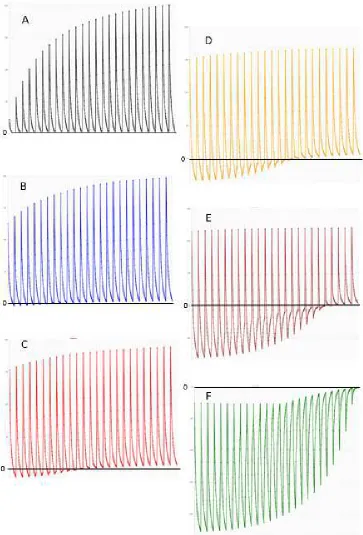
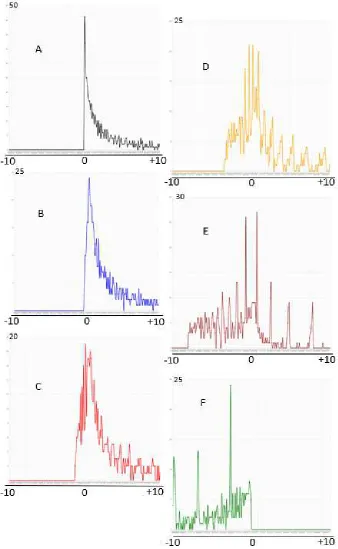
The spectrum in figure 9 is a two-dimensional representation of a
three-dimensional distribution – a repeating cross section. The active part of the
transfer space is divided by a 25*25 grid into 625 single columns. The
numbering starts at 5mM source, 0mM sink and ends at the actual transfer
limit, e.g. 2.5mM source, 2.5mM sink in figure 9A or at 0mM source and
5mM sink in figure 9F. The size of superadditivity and subadditivity is
displayed on the vertical axis, the position number between 1 to 625 on
the horizontal axis. Figure 9A is the starting condition, the ensemble has
transferred at free will or with a master in one step to the limit b-c=0 (only
superadditivity, 0mM to 2.5mM in source and sink). In 9B to 9F we observe
how subadditivity develops and the spectrum of superadditivity changes
while the master increases transfers in steps of 0.5mM beyond 2.5mM to
finally 5mM. It is easily visible how subadditivity develops below zero. In
9F the ensemble is completely subadditive.
The spectrum of superadditivity and subadditivity handed over to the top
ensemble is dependent on the mutational step size (normal distributed)
and the location and sequence of the mutational steps (source side or sink
side within the same ensemble, in case they are independent like only in
figure 8). Therefore, the sequence of differently sized mutational step sizes
in source or sink will lead to a unique historical process of the evolution of
a connected ensemble. Every specific mutation in step size will result in a
different spectrum and in return in a different development of super and
subadditivity in the top ensemble. As the Michaelis-Menten equation is not
defined in the negative substrate range the subadditivity is set to zero in
the connected ensemble in figure 11. In economics this might be different
as the subadditivity of a lower level could be felt as a negative income of
a higher level. Under real conditions only single concentration pairs will
occur per timepoint within one ensemble of ensembles and the result will
Figure 9
Figure 9
Figure 10
Figure 10
Connected ensembles – evolutionary behaviour:
Every organism (company) in the following part is composed of three
connected ensembles (figure 4-3). The top ensemble will receive a
spectrum of substrate concentration from the two lower levels (figure 10).
Only the two basic ensembles have equal substrate probabilities in the
range of 0mM to 5mM substrate. The benefit factor for the top ensemble
(a complexity factor of 6 like in publication 2) compensates for decrease
in concentration from the lower level to the top level because Km, Vmax
and cf are the same in the basic and top ensemble. Superadditivity can be
interpreted here as both, efficiency or additional net profit. The substrate
entering the ensembles at the bottom is distributed in a way that there will
be better efficiency or additional net profit. Either substrate is left over after
superadditive redistribution and is then used in a higher level or additional
net profit after redistribution of substrate can be invested in a higher level.
The higher level is also understood as a higher level of complexity. This is
comparable with the investment of money (glucose) either in workforce
(muscles) or computer-controlled automatization (brain). The leverage of
the same substrate in the higher level is larger than in the lower level. It
should not be forgotten that within the unconnected ensembles three times
two substrate portions are consumed while in the connected ensembles
only two times two substrate portions are consumed.
A master living on transfer fees (figure 11A, the y axis is transfer in mM)
will depend on the transfer size in the ensembles at the bottom where he
will enforce transfers by force and deception and will be rewarded for an
increase there. The master here is unconditionally violent and deceptive.
Besides the increase in transfer in the ensembles at the bottom we are
going to observe the production of net profit of the top ensemble. A transfer
there by force or deception is absent. A population average of 9 connected
observed. According to the transfer size the best three have one offspring
each, the next three survive and the last three die. The average (net profit
and transfer size) of the population is observed.
A master living on net profit (figure 11B, the y-axis is superadditive net
profit – mM2*np) will participate in the net profit of the top ensemble where
no force or deception is used and will be rewarded and observed
accordingly. He will use force and deception in the ensembles at the
bottom to induce transfers but controlled by net profit in the top. A
population average of superadditivity within the top ensemble of 9
connected ensembles (9*3) with 9 unconditional violent and deceptive
masters is observed. According to net profit production the best three have
one offspring each, the next three survive and the last three die. In parallel
the average transfer size within the bottom level ensembles will be
observed.
In connected ensembles the two different strategies of masters (10A - live
on transfer fees, 11B - live on net profit) reveal very different results. In
general, the development of a connected ensemble over the generation
time is no longer very reproducible. Every run is unique but reveals a
typical behaviour.
In figure 11A the connected ensemble starts superadditive, develops
increasing subadditivity which will later reverse but will stay subadditive at
the end of transfer. When the transfer arrives at the maximal amount, the
system shows only small fluctuations. Locking at three times three
connected ensembles (figure 11A, inset), a transitory change (alternating
increase and decrease) in superadditivity/subadditivity is observable as
long as transfer will go on. At the end of this phase the system is
Figure 11
Figure 11
In figure 11B transfer does not go far beyond 1mM. The reason is that the
master is controlled by net profit. Because of the nature of the spectrum,
there is an ongoing improvement of net profit although an increase of
transfer in the lower levels is barely detectable. Superadditive peaks on
the source side of the top ensemble coming from the basic ensemble are
combined with subadditive (set to zero by definition) areas on the sink
side. Evolution moves upwards with waiting times (plateaus) from smaller
peaks to larger peaks in the vicinity. This leads to a step wise and ongoing
increase in superadditivity. This is achieved by minimal changes of the
spectrum via minuscule changes in the transfer size on source and sink
side. Net profit as bench mark leads again to an internal equilibrium of
transfer. This equilibrium is still able to improve!
Other reasons for different substrate probability:
In the past I have always used equal probability for all concentrations
(concentration pairs) entering the ensemble from the outside; here in the
range from 0 to 5mM in source and sink. This might be viewed as an
artificial situation as in nature the concentration of substrate will be
probably either high for source and sink or low for source and sink.
Substrate will be cost dominated for both sides as there is plenty of
substrate or substrate will be benefit dominated for both sides as substrate
is scarce.
In figure 12 I look at an illustration of this idea. A single symmetric
ensemble has either a substrate concentration higher than 2.5mM for
source and sink (area II) or lower than 2.5mM for source and sink (area
III). The symmetric ensemble exists either in area II or in area III (for
Figure 12
Figure 12
In previous examinations I always compared masters in control of the
whole transfer space. This is different here. Due to the non-uniform
substrate distribution the master only controls a part of the transfer space.
He is either in control of a saturated ensemble in area II or a hungry
ensemble in area III. If I want to compare such masters, I must take care
for equal starting conditions. Why are the starting conditions unequal? At
a concentration of 5mM in source and 0mM in sink the transfer space
contains a certain amount of substrate. At 5mM in source and 5mM in sink
the ensemble contains the double amount of substrate in identical volumes
for source and sink. Equal conditions are present when always the same
amount of substrate is present within the whole ensemble. This is the case
in my example at a concentration of 10mM in source plus sink (figure 12).
Now I can compare the two masters.
The concentration range is now triangular shaped. Even in a symmetric
ensemble the four areas are no longer of identical size and shape.
However, there is now a just access to the same maximal amount in
source and sink.
In case source and sink have no inner model, the master will steer them
without problems. In case source and sink are two Homo Economicus the
master must force them to give (source, area III) or to take (sink, area II).
Force and deception start at b-c=0 (border between area I and II or border
between area I and III). The cost of force and counter force is omitted. Now
I am going to compare two masters who rule either an ensemble with
abundance (area II) or deficiency (area III). The masters are no prudent
masters. Starting at b-c=0 they learn that more substrate can be
transferred, and more net profit can be made by force and deception. We
observe the balance of super- and subadditivity. It is here no longer
possible to differentiate the unconditional violent and deceptive master
Figure 13
Figure 13
Figure 14
Figure 14
Figure 15
Figure 15
In figure 13 to 15 we compare two masters using force and deception.
They live under two different conditions i.e. lack in area III and surplus in
area II. In addition, we lock at three different types of ensembles, two
asymmetric ensembles and one symmetric ensemble. The transfer size is
limited to maximal 2.5mmol in steps of 0.05mmol beyond b-c=0. The limit
b-c=0 differs within the three figures (figure 13, 14, 15)!
In a weak asymmetric ensemble (figure 13) the master who is in control of
the ensemble which has to deal with a lack of substrate is always doing
better. This is only true for the observable part of the subadditive range. In
the symmetric ensemble (figure 14) the master in control of the ensemble
with lack of substrate is in the beginning doing better. Later, when
subadditivity starts to develop in both ensembles, the master with an
ensemble active with surplus of substrate is doing better as subadditivity
does not develop so dramatic. Interestingly there is a transfer size
(1.65mmol) where the ensemble with surplus of substrate is still
superadditive while the ensemble with lack of substrate is already
subadditive. Finally, in an asymmetric ensemble with a strong sink (figure
15) it is interesting to observe that in the beginning the ensemble with
surplus is doing still slightly worse than the ensemble with lack of
substrate. However, later in the observed transfer range (2.5mmol) the
master with the ensemble in surplus will dominate with superadditivity
while the master and his ensemble with lack of substrate will be completely
General Discussion
The roots of the idea
The idea of a complete balance within the transfer space of a source and
a sink goes back to Antoine-Laurent de Lavoisier (born 26.08.1743 –
executed 08.05.1794), economist and chemist. He is acknowledged as
one of the fathers of modern chemistry. He changed chemistry from a
qualitative to a quantitative science by introducing the mass balance. As
administrator of the “Ferme Générale”, a tax farming company in the
pre-revolutionary France, he was used to the concept of a balance sheet. In
his experiments e.g. with mercury(II) oxide (HgO) he understood that he
not only had to observe the weight of the vessel where mercury(II) oxide
would decompose to mercury upon heating but he also had to control the
weight of “the other vessel” - the surroundings - to make a complete
balance. He collected the developing gas (oxygen) and found that the
mass of the starting material (mercury(II) oxide) was identical to the sum
of the mass of the products (mercury and oxygen).
The same is simply repeated here again. We do not only have to observe
what happens in one enzyme-filled vessel (cell, organism, company or
country) when we put substrate in; we also must observe the vessel where
this amount of substrate came from. For simplicity this vessel should be
as identical as possible. A complete balance should include both vessels
connected with each other as source and sink. The mass (and energy) is
conserved during the transfer. The productivity after a transfer from source
to sink with its non-linear, saturating behaviour will show us new features
(superadditivity and subadditivity) in comparison to the condition “no
transfer”.
This may appear to some readers like the parable of the broken window
But my model is not about a microeconomic opportunity cost. It is not about
“here or there” in one party. The paper is about “before a transfer and after
a transfer” within an ensemble of the same two parties; a source and a
sink.
Quantity and Quality
A function in mathematics is the model of how a quantity depends on the
variation of another quantity; y=f(x). In the physical world we often face the
fact that a quantity depends not only on a single other quantity but usually
on many others with different functions; y=f1(x1)+f2(x2)+…+fn(xn). Solid
experiments try to control complex dependencies either with the skilful
exclusion of such effects or by control experiments.
A second possibility is that a single quantity (x1) may have different
features (functions); y=f1(x1)+f2(x1)+…+fn(x1). Here it is not possible to
reduce the experiment to one single dependency. We may observe in
controls a first function with a positive influence and a second function with
a negative influence on the outcome; y. Therefore, we sometimes observe
an unexpected change (“Nach fest kommt ab.” - Don´t push too hard.)
while we change the quantity e.g. a linear force increase.
Experience is teaching that “more is not better” or that there is the
possibility of “too much of a good thing”. This is often discussed as a
problem of quantity versus quality. But what if quality is a combination of
two independent features connected and related by a common quantity?
Quality emerges from the relative share of the two different features. In
case the quantitative nature of a first feature is obvious and easily
determined and the quantity of the second feature is difficult to determine,
entanglement (7) the kin and its fate for the balance of all identical genes
appears as a quality in comparison to the self as a quantity and as an
orthogonal dimension. The “two times two” features (b, c) in entanglement
(ef, degree of informational identity) are connected by a single substrate
and the two pairs of benefit and cost are orthogonal as are source and
sink, i.e. parent and offspring. The effect of the success factor (sf, an
external factor indicating the probability of survival) in entangled,
symmetric parties is asymmetry. In reverse, the success factor can
compensate for asymmetries in Km, Vmax, cost factor and benefit factor.
How can we judge where we are in “quality” (good – too much good) when
we measure only a single feature of the quantity (thing)? – Not at all! We
must determine both aspects (features) of that quantity.
“Too much of a good thing” implies the presence of an optimum or at least
a change of character. “Much” will be good - better than little - but “too
much” will be no longer as good. There are many functions producing
optima or go from positive values to negative values. I create such
behaviours with two monotonously rising functions both dependent on the
quantity x1.
Let there be two features of the quantity - e.g. a substrate. The two
features of the substrate (x1) are a benefit with the function (f1) and a cost
with the function (f2); f1(x1) and f2(x1). When we increase the amount of the
substrate the two features independently and monotonously rise and
follow their respective functions. In case they intersect we will see on one
side of the intersection values of function f1 dominate over values of f2 and
on the other side we will see values of function f2 dominate over values of
f1 (change of character). When we look at each single function (feature)
we will always see an improvement. But the improvements stand in
physical dimension we can subtract the values (y=f1(x1)-f2(x1)), in case
they are measured in different physical dimensions we divide them (y=
f1(x1)/f2(x1)). The intersection in subtraction will be zero and in division one.
Depending on the sequence (f1,f2 or f2,f1) and the shape of the functions
we may observe a maximum or a minimum somewhere.
Why is net-profit such an important concept?
In the investigated evolutionary learning process two types of evolutionary
ratings are examined. On one side I use a positive relation between
success and amount; “more transfer is better”. In the alternative rating I
use a positive relation between success and superadditive net profit;
“more superadditive net profit is better” which is basically more net profit
in a wide range of concentrations. It is generally acknowledged that net
profit is the most important and most used criterion to judge whether a
company is successful or not. The same could be said about organisms
when we compare e.g. the consumption of energy (glucose consumption
as cost c) of a hunting predator and the gain of energy equivalents (protein
and fat of the prey as benefit b).
Why is net profit such an important measure? I think it would be too simple
to argue from a quasi-evolutionary standpoint like: “Other criteria to judge
the success in economics and in biology have not proven to be as effective
as the use of the concept net profit”. This is not an explanation, this is only
an observation. Why do we make this observation?
From my results it seems that we reach independently of what we observe
(amount transferred or superadditive net profit) only with superadditive net
profit as selection criterion stability. Turnover as criterion will always go to
negative (net profit) values. With net profit as criterion the ensemble will
find an internal point of stability. The external limits of the ensemble are
not exceeded. Transfer size as criterion will always exhaust the capacity
of the ensemble and blow up the limits. Wise limits may be violated by
both criteria.
In connected ensembles there are additional observations. The increase
in net profit takes place in steps. Source and sink at the bottom should go
different directions. The ensemble on the source side should deliver much
superadditivity, the ensemble on the sink side should deliver only a little
superadditivity or deliver subadditivity. Most amazing is the effect of the
spectrum of the super- and subadditivity in masters living on transfer fees.
While there is increasing transfer there will be “something to observe”. If
such a master is going to observe the net profit - which is basically not his
personal interest - he will be very surprised. An increase in transfer may
increase superadditivity and in the next step of increase it will produce
subadditivity.
“Certain forms of knowledge and control require a narrowing of vision” (8).
This narrowing of vision is the starting point for a master to fail. What
appears useful under a certain condition may be complete nonsense in
the direct adjacent condition. Linear minds only succeed to extract simple
patterns from complex, nonlinear patterns. Those simple patterns produce
easy to understand, convincing models but they fail the test of reality –
repeatedly. The reason for the repetition of mistakes is the lack of insight
into cause and effect and the lack of a sense of personal responsibility and
Culture, Religion and political Ideology
A Greek proverb says: “A society grows great when old men plant trees
whose shade they know they shall never sit in.” Culture seems to be an
integrated system of force and especially deception in man to create
superadditivity outside of area I. However, this will include irrational,
self-harming economic behaviour on the level of the single party.
Two advances are immediately obvious:
• additional superadditivity of the ensemble when the limits are carefully chosen and the additional costs are controlled;
• the ensemble can be active when substrate is benefit dominated for source and sink (area III) or cost dominated for source and sink (area
II) simultaneously (figure 12 – figure 15). An ensemble of rational
entities (two Homo Economicus, strong and informed) would be
inactive under such conditions.
It seems to be a very probable situation that the substrate distribution is
for source and sink similar; either both lack substrate dominated by benefit
(b-c>0) or both have a surplus of substrate dominated by cost (b-c<0).
Religion and ideology are deceptive concepts to induce transfers beyond
the rational limit b-c=0, outside of area I. The specific deception will
convince someone to take a cost dominated substrate or to give a benefit
dominated substrate without expensive and harming force. This will only
work if benefit and cost - the inseparable connected features of the
substrate - are separated within the ideological framework. Even in
science there are attempts to construct a world where benefit and cost are
separated (9, 10) and net profit is no benchmark. The basic assumption in
all this scientific teaching is the existence of a phlogiston-like concept
in biology is based on an ideologically and religiously founded emotional
rejection of the rational and self-limiting net profit. Phlogiston-like
constructs and miracles always vanish when a complete balance is
implemented.
The ability of an ensemble to find a rational and sustainable internal limit
using net profit as benchmark is a danger to an external instance (master)
living not on increased net profit of the ensemble but on transfer fees.
Therefore, this type of master hates the idea of net profit. His teaching, the
whole culture he will create, will praise emotions and irrational behaviours
of role models and deter and discredit rational behaviour. He will either
avoid scientific proof and claim higher values and believes to discourage
and break resistance or scientific proof is claimed although the scientific
method is not followed as the predicted progress reveals as an endless
failure. This type of master is interested to increase the size and amount
of transfers. The ensemble, dependent on its internal superadditivity, is
doomed as the unlimited and irrational transfer will increase subadditivity
until all superadditivity is consumed. The master with his ideology moves
on as archenemy of the free man (Homo Economicus) and ensembles
formed by him. Homo Economicus – as an ideal strong and informed – will
never fall prey to force and deception thus avoiding area II, area III, and
especially area IV of the transfer space. His freedom of decision to stay
away from areas II, III, and IV comes at a price. Such ensembles can´t be
active outside of area I. This inactivity is a strategic weakness and comes
from strength and knowledge; what an irony, what a tragedy.
But maybe that is the difference between humans and animals. The inner
model of animals shaped by evolution may be very identical to reality (the
outer model). Therefore, animals behave like a Homo Economicus. This
realistic inner model, this genetic a priori knowledge, is at least partially
models and therefore can be active outside of area I. Outside of area I
superadditivity is produced by harm to at least one party. This is rewarding
to the master and maybe to the ensemble they are a part of as long as
superadditivity dominates. To compensate the harm reciprocity or a
constant natural overproduction is necessary. Replacement of burned
parties by a new generation will stabilize the ensemble and prevent a Nash
equilibrium. It should not be forgotten that the balance we observe is made
within a steady state equilibrium of a biological system constantly powered
by the sun; this is not a closed system. Although we observe in Biology
and Economy an open system mass and energy will be conserved in its
very basic meaning – nothing comes from nothing and nothing vanishes
into nothing. A complete balance will always show this.
Literature
1. Solow RM (1956) A Contribution to the Theory of Economic Growth. The Quarterly Journal of Economics, Vol. 70(1) 65-94
2. Friedrich T (2018) Evolution towards higher net profit in a
population of ensembles of ensembles leads to division of labour. MPRA_paper_85517
3. Friedrich T and Köpper W (2013) Schumpeter´s Gale - Mixing and compartmentalization in Economics and Biology.
MPRA_paper_45405
4. Friedrich T (2015) The limits of wise exploitation in dependent and independent symmetric ensembles. MPRA_paper_68250
5. Friedrich T (2016) Aquila non captat muscas: Homo Economicus between exploration and exploitation. MPRA_paper_75601 6. Friedrich T (2014) Work cycles of independent ensembles.
MPRA_paper_55090
7. Friedrich T (2014) Entanglement by Genes or Shares - Hamilton´s rule of kin selection revisited. MPRA_paper_60267
8. Scott JC (1998) Seeing like a state. How certain schemes to improve the human condition have failed. The Yale ISPS series 9. Nowak MA (2006) Five rules for the evolution of cooperation.
Science 314:1560-1563