2524
A Helping Hand:
Transfer Learning for Deep Sentiment Analysis
Xin Dong Rutgers University New Brunswick, NJ, USA
Gerard de Melo Rutgers University New Brunswick, NJ, USA
Abstract
Deep convolutional neural networks excel at sentiment polarity classification, but tend to require substantial amounts of training data, which moreover differs quite signifi-cantly between domains. In this work, we present an approach to feed generic cues into the training process of such networks, leading to better generalization abilities given limited training data. We propose to induce sentiment embeddings via super-vision on extrinsic data, which are then fed into the model via a dedicated memory-based component. We observe significant gains in effectiveness on a range of differ-ent datasets in seven differdiffer-ent languages.
1 Introduction
Over the past decades, sentiment analysis has grown from an academic endeavour to an essential analytics tool. Across the globe, people are voicing their opinion in online social media, product review sites, booking platforms, blogs, etc. Hence, it is important to keep abreast of ongoing developments in all pertinent markets, accounting for different domains as well as different languages. In recent years, deep neural architectures based on convolu-tional or recurrent layers have become established as the preeminent models for supervised sentiment polarity classification. At the same time, it is also frequently observed that deep neural networks tend to be particularly data-hungry. This is a problem in many real-world settings, where large amounts of training examples may be too costly to obtain for every target domain. A model trained on movie reviews, for instance, will fare very poorly on the task of assessing restaurant or hotel reviews, let alone tweets about politicians.
In this paper, we investigate how extrinsic sig-nals can be incorporated into deep neural networks
for sentiment analysis. Numerous papers have found the use of regular pre-trained word vector representations to be beneficial for sentiment anal-ysis (Socher et al.,2013;Kim, 2014;dos Santos and de C. Gatti, 2014). In our paper, we instead consider word embeddings specifically specialized for the task of sentiment analysis, studying how they can lead to stronger and more consistent gains, despite the fact that the embeddings were obtained using out-of-domain data.
An intuitive solution would be to concatenate regular embeddings, which provide semantic re-latedness cues, with sentiment polarity cues that are captured in additional dimensions. We instead propose a bespoke convolutional neural network architecture with a separate memory module dedi-cated to the sentiment embeddings. Our empirical study shows that the sentiment embeddings can lead to consistent gains across different datasets in a diverse set of domains and languages if a suitable neural network architecture is used.
2 Approach
2.1 Sentiment Embedding Computation
Our goal is to incorporate external cues into a deep neural network such that the network is able to generalize better even when training data is scarce. While in computer vision, weights pre-trained on ImageNet are often used for transfer learning, the most popular way to incorporate external informa-tion into deep neural networks for text is to draw on word embeddings trained on vast amounts of word context information (Mikolov et al.,2013; Penning-ton et al.,2014;Peters et al., 2018). Indeed, the semantic relatedness signals provided by such rep-resentations often lead to slightly improved results in polarity classification tasks (Socher et al.,2013; Kim,2014;dos Santos and de C. Gatti,2014).
specifically. We thus seek to examine how com-plementary sentiment-specific information from an external source can give rise to further gains.
Transfer Learning. To this end, our goal is to in-duce sentiment embeddings that capture sentiment polarity signals in multiple domains and hence may be useful across a range of different sentiment anal-ysis tasks. The multi-domain nature of these dis-tinguish them from the kinds of generic polarity scores captured in sentiment polarity lexicons. We achieve this via transfer learning from trained mod-els, benefiting from supervision on a series of senti-ment polarity tasks from different domains. Given a training collection consisting of nbinary clas-sification tasks (e.g., with documents inn differ-ent domains), we learnncorresponding polarity prediction models. From these, we then extract token-level scores that are tied to specific predic-tion outcomes. Specifically, we trainnlinear mod-elsfi(x) =w|ix+bifor tasksi= 1, . . . , n. Then,
each vocabulary word indexjis assigned a newn -dimensional word vector xj = (w1,j,· · ·, wn,j)
that incorporates the linear coefficients for that word across the different linear models.
A minor challenge is that na¨ıvely using bag-of-word features can lead to counter-intuitive weights. If a word such as “pleased” in one domain mainly occurs after the word “not”, while the reviews in another domain primarily used “pleased” in its un-negated form, then “pleased” would be assessed as possessing opposite polarities in different domains. To avoid this, we assume that features are prepro-cessed to better reflect whether words occur in a negated context. In our experiments, we simply treat occurrences of “not hwordi” as a single fea-ture “nothwordi”. Of course, one can replace this heuristic with much more sophisticated techniques that fully account for the scope of a wider range of negation constructions.
Graph-Based Extension.Most sentiment-related resources are available for the English language. To produce vectors for other languages in our experiments, we rely on cross-lingual projec-tion via graph-based propagaprojec-tion (de Melo,2015;
de Melo, 2017; Dong and de Melo, 2018). At
this point, we have a set of initial sentiment em-bedding vectors v˜x ∈ Rn for words x ∈ V0. We assume that we have a lexical knowledge graph GL = (V, AL) with a node set consist-ing of an extended multilconsist-ingual vocabularyV ⊇
V0 and a set of weighted directed arcs AL =
{(x1, x01, w1), . . . ,(xm, x0m, wm)}. Each such arc
reflects a weighted semantic connection between two vocabulary itemsx, x0 ∈V, where vocabulary items are words labeled with their respective lan-guage. Typically, many of the arcs in theGLwould reflect translational equivalence, but in our experi-ments, we also include monolingual links between semantically related words. Given this data, we aim to minimize
−X x∈V
v|x
1
P
(x,x0,w)∈AL w
X
(x,x0,w)∈AL wvx0
+C X
x∈V0
kvx−v˜xk2 (1)
The first component of this objective seeks to en-sure that sentiment embeddings of words accord with those of their connected words, in terms of the dot product. The second part ensures that the devi-ation from any available initial word vectorsv˜xis
minimal (for some very high constantC). For opti-mization, we preinitializevx = ˜vxfor allx∈V0, and then rely on stochastic gradient descent steps.
2.2 Dual-Module Memory based CNNs
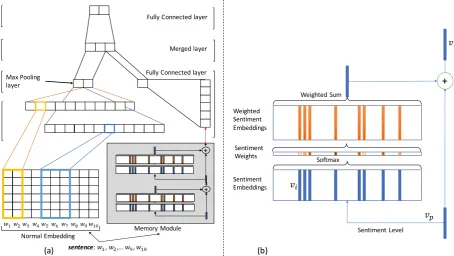
To feed this sentiment information into our archi-tecture, we propose a Dual-Module Memory based Convolutional Neural Network (DM-MCNN) ap-proach, which incorporates a dedicated memory module to process the sentiment embeddings, as illustrated in Fig.1. While the module with regular word embeddings enables the model to learn salient patterns and harness the nearest neighbour and lin-ear substructure properties of word embeddings, we conjecture that a separate sentiment memory module allows for better exploiting the information brought to the table by the sentiment embeddings.
Convolutional Module Inputs and Filters. The Convolutional Module input of the DM-MCNN is a sentence matrixS ∈ Rs×d, the rows of which
represent the words of the input sentence after to-kenization. In the case of S, i.e., in the regular module, each word is represented by its conven-tional word vector representation. Here,srefers to the length of a sentence, anddrepresents the dimensionality of the regular word vectors.
We perform convolutional operations on these matrices via linear filters. Given rows representing discrete words, we rely on weight matricesW∈
Rh×dwith region sizeh. We use the notationSi:j
Sentiment Level Sentiment
Embeddings Weighted Sentiment Embeddings
Softmax Sentiment
Weights
Weighted Sum
+
Normal Embedding Feature Map Max Pooling
layer
Merged layer
Fully Connected layer
sentence: !",!#,…!$,!"%
!"!# !' !( !) !* !+ !, !$ !"%
Fully Connected layer
+
Memory Module +
(b) (a)
-.
-/ -0
Figure 1: (a) Dual-Module Memory based Convolutional Neural Network architecture. (b) Single layer in Memory Module
j. Supposing that the weight matrix has a filter width ofh, a wide convolution (Kalchbrenner et al., 2014) is induced such that out-of-range submatrix valuesSi,j with i < 1 ori > sare taken to be
zero. Thus, applying the filter on sub-matrices of
Syields the output sequenceo∈Rs+h−1as
oi=WSi:i+h−1, (2)
where the operator provides the sum of an
element-wise multiplication. Wide convolutions ensure that filters can cover words at the margins of the normal weight matrix.
Next, the ci in feature maps c ∈ Rs+h−1 are
computed as:ci =f(oi+b), wherei= 1, . . . , s+
h−1, the parameterb∈Ris a bias term, andf is
an activation function.
Multiple Layers in Memory Module.The mem-ory module obtains as input a sequence of senti-ment embedding vectors for the input, and attempts to draw conclusions about the overall sentiment po-larity of the entire input sequence. Given a set of sentence wordsS = {w1, w2, w3, . . . , wn}, each
word is mapped to its sentiment embedding vector of dimensiondsand we denote this set of vectors asVs. The preliminary sentiment levelvpis also a vector of dimensionalityds. We take the mean of all sentiment vectorsvi for words wi ∈ S to
initializevp. Next, we compute a vectorsof sim-ilaritiessi betweenvp and each sentiment word vectorvi, by taking the inner product, followed by
`2-normalization and a softmax:
si=
exp v
| pvi kv|pvik2
P
i
exp v|pvi kv|pvik2
(3)
As the sentiment embeddings used in our paper are generated from a linear model, the degree of cor-respondence betweenvpandvican adequately be
assessed by the inner product. The resulting vector of scoresscan be regarded as yielding sentiment weights for each word in the sentence. We apply
`2-normalization to ensure a more balanced weight distribution. The output sentiment level vectorvo is then a sum over the sentiment inputsviweighted
by the`2-normalized vector of similarities:
vo = X
i
si ksk2
vi (4)
[image:3.595.71.526.63.319.2]this vector. Assuming thatvko has been produced by thek-th pass, then the subsequent levelvkp+1in the next pass is:
vkp+1 =vko+vkp (5)
The intuition here is that multiple passes can enable the model to adaptively retrieve iterative sentiment level statistics beyond the initial average sentiment information.
Merging Layer and Prediction. Subsequently, for the convolutional module, 1d-max pooling is applied toc, which ought to capture the most promi-nent signals. In the memory module, the final sentiment vector is modulated by a weight matrix
Ws ∈Rl×ds to form a feature vector of
dimension-alityl. In general, we can use multiple filters to obtain several features in the convolutional module, while the memory module allows for adjusting the number of passes over the memory.
Finally, the outputs of these two modules are concatenated to form a fixed-length vector, which is passed to a fully connected softmax layer to obtain the final output probabilities.
Loss Function and Training.Our loss function is the cross-entropy function
L=−1
n
n
X
i=1 X
c∈C
yi,cln ˆyi,c, (6)
wherenis the number of training examples,Cis the set of (two) classes,yi,care ground truth labels
for a given training example and classc, andyˆi,c
are corresponding label probabilities predicted by the model, as emitted by the softmax layer. We train our model using Adam optimization (Kingma and Ba,2014) for better robustness across different datasets. Further details about our training regime follow in the Experiments section.
3 Experiments
We now turn to our extensive empirical evaluation, which assesses the effectiveness of our novel archi-tecture with sentiment word vectors.
3.1 Experimental Setup
Datasets. For evaluation, we use real world datasets for 7 different languages, taken from a range of different sources that cover several do-mains. These are summarized in Table1, with ISO 639-3 language codes. In our experimental setup, these are all cast as binary polarity classification
Table 1: Dataset Descriptions
Language Source Domain train test
en SST Movies 6,920 1,821
AFF Food 5,945 1,189
es SE16-T5 Restaurants 2,070 881
ru TA Hotels 2,387 682
de TA Restaurants 1,687 481
cs TA Restaurants 1,722 491
it TA Hotels 3,437 982
ja TA Restaurants 1,435 411
tasks, for which we use accuracy as our evaluation metric.
• The Stanford Sentiment Treebank (SST)
dataset (Socher et al.,2013) consists of movie reviews taken from the Rotten Tomatoes web-site, including binary labels. We only used sentence-level data in our experiment.
• The SemEval-2016 Task 5 (SE16-T5) dataset (Pontiki et al.,2016) provides Spanish reviews of restaurants. It targeted aspect-based senti-ment analysis, so we converted the entity-level annotations to sentence-level polarity labels via voting. As the number of entities per sen-tence is often one or very low, this process is reasonably precise. In any case, it enables us to compare the ability of different model variants to learn to recognize pertinent words.
• From TripAdvisor (TA), we crawled German, Russian, Italian, Czech, and Japanese reviews of restaurants and hotels. We removed three-star reviews, as these can be regarded as neu-tral ones, so reviews with a rating < 3 are considered negative, while those with a rating
>3were deemed positive.
• The Amazon Fine Food Reviews AFF
(McAuley and Leskovec,2013) dataset pro-vides food reviews left on Amazon. We chose a random subset of it with preprocessing as for TripAdvisor.
As there was no test set provided for TripAdvisor or for the Amazon Fine Food Reviews data, we randomly partitioned this data into training, val-idation, and test splits with a 80%/10%/20% ra-tio. Additionally, 10% of the training sets from SE16-T5 were randomly extracted and reserved for validation, while SST provides its own validation set. The new datasets are available fromhttp: //gerard.demelo.org/sentiment/.
Table 2: DM-MCNN Model Parameter Settings.
(a) General configuration.
Description Values
Convol. Module
filter region size (3,4,5)
feature maps 100
pooling 1d-max pooling
Memory Module # passes (k) 2 feature vector size 100
dropout rate 0.5
optimizer Adam
activation function ReLU
batch size 50
(b) Learning rateαused in DM-MCNN un-der 7 languages.
en es de ru
α 0.0004 0.0008 0.003 0.003
cs it ja
α 0.003 0.003 0.003
Common Crawl data1, while for other languages, we rely on the Facebook fastText Wikipedia em-beddings (Bojanowski et al.,2016) as input repre-sentations. All of these are 300-dimensional. The vectors are either fed to the CNN, or to the convo-lutional module of the DM-MCNN during initial-ization, while unknown words are initialized with zeros. All words, including the unknown ones, are fine-tuned during the training process.
For our transfer learning approach, our experi-ments rely on the multi-domain sentiment dataset byBlitzer et al.(2007), collected from Amazon cus-tomers reviews. This dataset includes 25 categories of products and is used to generate our sentiment embeddings using linear models. Specifically, we train linear SVMs using scikit-learn to extract word coefficients in each domain and also for the union of all domains together, yielding a 26-dimensional sentiment embedding.
For comparison and analysis, we also consider several alternative forms of infusing external cues. Firstly, lexicon-driven methods have often been used for domain-independent sentiment analysis. We consider a recent sentiment lexicon called VADER (Hutto and Gilbert, 2014). The polar-ity scores assigned to words by the lexicon are taken as the components of a set of 1-dimensional word vectors (dividing the original scores by the difference between max and min polarity scores for normalization). Secondly, as another particu-larly strong alternative, we consider the SocialSent Reddit community-specific lexicons mined by the
1https://nlp.stanford.edu/projects/glove/
Stanford NLP group (Hamilton et al.,2016). These contain separate domain-specific scores for 250 different Reddit communities, and hence result in 250-dimensional embeddings.
For cross-lingual projection, we extract links between words from a 2017 dump of the English edition of Wiktionary. We restrict the vocabulary link set to include the languages in Table1, mining corresponding translation, synonymy, derivation, and etymological links from Wiktionary.
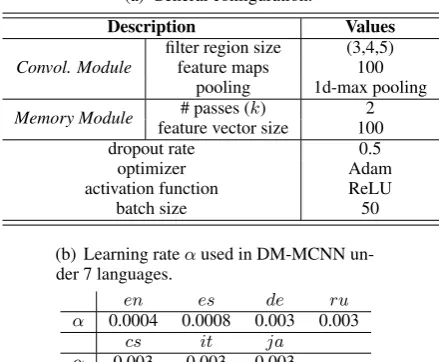
Neural Network Details.For CNNs, we make use of the well-known CNN-non-static architecture and hyperparameters proposed byKim(2014), with a learning rate of 0.0006, obtained by tuning on the validation data. For our DM-MCNN models, the configuration of the convolutional module is the same as for CNNs, and the remaining hyperparam-eter values were as well tuned on the validation sets. An overview of the relevant network parame-ter values is given in Table2.
For greater efficiency and better convergence properties, the training relies on mini-batches. Our implementation considers the maximal sentence length in each mini-batch and zero-pads all other sentences to this length under convolutional mod-ule, thus enabling uniform and fast processing of each mini-batch. All neural network architectures are implemented using the PyTorch framework2.
3.2 Results and Analysis
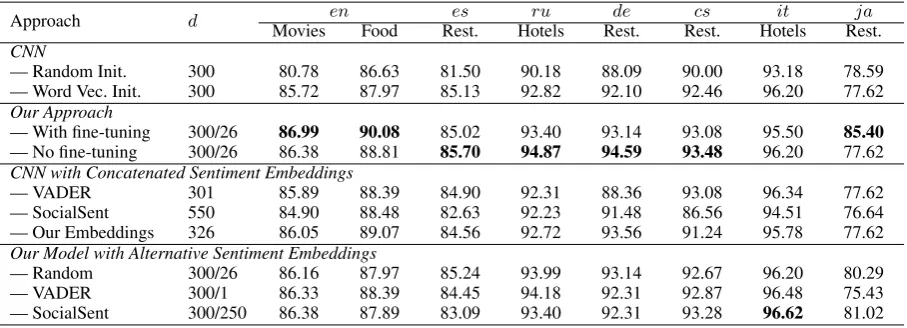
Baseline Results. Our main results are summa-rized in Table3. We compare both regular CNNs and our dual-module alternative DM-MCNNs un-der a variety of settings. A common approach is to use a CNN with randomly initialized word vec-tors. Comparing this to CNNs with GloVe/fastText embeddings, where GloVe is used for English, and fastText is used for all other languages, we observe substantial improvements across all datasets. This shows that word vectors do tend to convey perti-nent word semantics signals that enable models to generalize better. Note also that the accuracy us-ing GloVe on the English movies review dataset is consistent with numbers reported in previous work (Zhang and Wallace,2015).
Dual-Module Architecture. Next, we consider our DM-MCNNs with their dual-module mecha-nism to take advantage of transfer learning. We ob-serve fairly consistent and sometimes quite
Table 3: Accuracy on several different English and non-English datasets from different domains, compar-ing our architecture against CNNs. Rest.: restaurants domain.
Approach d en es ru de cs it ja
Movies Food Rest. Hotels Rest. Rest. Hotels Rest.
CNN
— Random Init. 300 80.78 86.63 81.50 90.18 88.09 90.00 93.18 78.59
— Word Vec. Init. 300 85.72 87.97 85.13 92.82 92.10 92.46 96.20 77.62
Our Approach
— With fine-tuning 300/26 86.99 90.08 85.02 93.40 93.14 93.08 95.50 85.40
— No fine-tuning 300/26 86.38 88.81 85.70 94.87 94.59 93.48 96.20 77.62
CNN with Concatenated Sentiment Embeddings
— VADER 301 85.89 88.39 84.90 92.31 88.36 93.08 96.34 77.62
— SocialSent 550 84.90 88.48 82.63 92.23 91.48 86.56 94.51 76.64
— Our Embeddings 326 86.05 89.07 84.56 92.72 93.56 91.24 95.78 77.62
Our Model with Alternative Sentiment Embeddings
— Random 300/26 86.16 87.97 85.24 93.99 93.14 92.67 96.20 80.29
— VADER 300/1 86.33 88.39 84.45 94.18 92.31 92.87 96.48 75.43
— SocialSent 300/250 86.38 87.89 83.09 93.40 92.31 93.28 96.62 81.02
tial gains over CNNs with just the GloVe/fastText vectors. We see that the sentiment embeddings provide important complementary signals beyond what is provided in regular word embeddings, and that our dual-module approach succeeds at exploit-ing these signals across a range of different do-mains and languages. Our transfer learning ap-proach leads to sentiment embeddings that capture signals from multiple domains. The model suc-cessfully picks the pertinent parts of this signal for datasets from domains as different as movie reviews and food reviews.
We report results for two different training con-ditions. In the first condition (with fine-tuning), the sentiment embedding matrix is preinitialized using the data from our transfer learning procedure, but the model is then able to modify these arbitrarily via backpropagation. In the second condition (no fine-tuning), we simply use our sentiment embed-ding matrix as is, and do not update it. Instead, the model is able to update its various other parame-ters, particularly its various weight matrices and bias vectors. While both training conditions outper-form the CNN baseline, there is no obvious winner among the two. When the training data set is very small and hence there is a significant risk of overfit-ting, one may be best advised to forgo fine-tuning. In contrast, when it is somewhat larger (as for our English datasets, which each have over 5,000 train-ing instances) or when the language is particularly idiosyncratic or not covered sufficiently well by our cross-lingual projection procedure (such as perhaps for Japanese), then fine-tuning is recommended. In this case, fine-tuning may allow the model to adjust the embeddings to cater to domain-specific
mean-ings and corpus-specific correlations, while also overcoming possible sparsity of the cross-lingual vectors resulting from a lack of coverage of the translation dictionary.
It is important to note that many of the results in Table 3stem from embeddings that were cre-ated automatically using cross-lingual projection. Our transfer learning embeddings were induced from entirely English data. Although the automati-cally projected cross-lingual embeddings are very noisy and limited in their coverage, particularly with respect to inflected forms, our model succeeds in exploiting them to obtain substantial gains in several different languages and domains.
Alternative Embedding Methods.For a more de-tailed analysis, we conducted additional experi-ments with alternative embedding conditions. In particular, as a simpler means of achieving gains over standard CNNs, we propose to use CNNs with word vectors augmented with sentiment cues. Given that regular word embeddings appear to be useful for capturing semantics, one may conjecture that extending these word vectors with additional dimensions to capture sentiment information can lead to improved results. For this, we simply con-catenate the regular word embeddings with differ-ent forms of sdiffer-entimdiffer-ent embeddings that we have obtained, including those from the sentiment lexi-con VADER, from the Stanford SocialSent project, and from our transfer learning procedure via Ama-zon reviews. To conduct these experiments, we also produced cross-lingual projections of the VADER and SocialSent embedding data.
Con-catenating the VADER embeddings or our trans-fer learning ones leads to minor improvements on English, and our cross-lingual projection of them leads to occasional gains, but the results are far from consistent. Even on English, adding the 250-dimensional SocialSent embedding seems to de-grade the effectiveness of the CNN, although all input information that was previously there contin-ues to be provided to it. This suggests that a simple concatenation may harm the model’s ability to har-ness the semantic information carried by regular word vectors. This risk seems more pronounced for larger-dimensional sentiment embeddings.
In contrast, with our DM-MCNNs approach, the sentiment information is provided to the model in a separate memory module that makes multiple passes over this data before combining it with the regular CNN module’s signals. Thus, the model can exploit the two kinds of information indepen-dently, and learn a suitable way to aggregate them to produce an overall output classification.
This hence demonstrates not only that the senti-ment embeddings tend to provide important com-plementary signals but also that a dual-module ap-proach is best-suited to incorporate such signals into deep neural models.
We also analysed our DM-MCNNs with alterna-tive embeddings. When we feed random sentiment embeddings into them, not unexpectedly, in many cases the results do not improve much. This is be-cause our memory module has been designed to leverage informative prior information and to re-weight its signals based on this assumption. Hence, it is important to feed genuine sentiment cues into the memory module. Yet, on some languages, we nevertheless note improvements over the CNN baseline. In these cases, even if similarities be-tween pairs of sentiment vectors initially do not carry any significance, backpropagation may have succeeded in updating the sentiment embedding matrix such that eventually the memory module becomes able to discern salient patterns in the data.
We also considered our DM-MCNNs when feed-ing the VADER or SocialSent embeddfeed-ings into the memory module. In this case, it also mostly suc-ceeded in outperforming the CNN baseline. In fact, on the Italian TripAdvisor dataset, the SocialSent embeddings yielded the overall strongest results. In all other cases, however, our transfer learning embeddings proved more effective. We believe that this is because they are obtained in a data-driven
manner based on an objective that directly seeks to optimize for classification accuracy.
Influence of Training Set Size. To look into the effect of our approach with restricted training data, we first consider the SST dataset as an instructive example. We set the training set size to 20%, 50%, 100% of its original size and compared our full dual module model with sentiment embeddings against state-of-the-art methods.
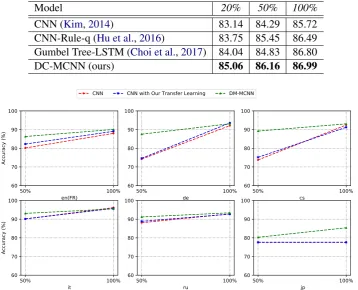
The results are given in Table4. Our dual mod-ule CNN has a sizeable lead over other methods when only using 20% of SST training set. Given that we study how to incorporate extrinsic cues into a deep neural model, we consider CNN-Rule-q (Hu et al.,2016) and Gumbel Tree-LSTM (Choi et al.,2017) as the relevant baseline methods. The CNN-Rule-q method used an iterative distillation method that exploits structured information from logical rules, which for SST is based on the word
butto determine the weights in the neural network. The Gumbel Tree-LSTM approach incorporates a Straight-Through Gumbel-Softmax into a tree-structured LSTM architecture that learns how to compose task-specific tree structures starting from plain raw text. They all require a large amount of data to pick up sufficient information during train-ing, while our method is able to efficiently capture sentiment information from our transfer learning even though the data is scarce.
For further analysis, we also artificially reduce the training set sizes to 50% of the original sizes given in Table1for our multilingual datasets. The results are plotted in Fig.2. We compare: 1) the CNN model baseline, 2) the CNN model but con-catenating our sentiment embeddings from transfer learning, and 3) our full dual module model with these sentiment embeddings. We already saw in Ta-ble3that we obtain reasonable gains over generic embeddings when using the full training sets.
In Fig.2, we additionally observe that the gains are overall much more remarkable on smaller train-ing sets. This shows that the sentiment embeddtrain-ings are most useful when they are of high quality and domain-specific training data is scarce, although a modest amount of training data is still needed for the model to be able to adapt to the target domain.
Table 4: Accuracy on SST with increasing training sizes
Model 20% 50% 100%
CNN (Kim,2014) 83.14 84.29 85.72
CNN-Rule-q (Hu et al.,2016) 83.75 85.45 86.49
Gumbel Tree-LSTM (Choi et al.,2017) 84.04 84.83 86.80
DC-MCNN (ours) 85.06 86.16 86.99
50% 100%
en(FR) 60
70 80 90 100
Accuracy (%)
50% 100%
de 60
70 80 90 100
50% 100%
cs 60
70 80 90 100
50% 100%
it 60
70 80 90 100
Accuracy (%)
CNN CNN with Our Transfer Learning DM-MCNN
50% 100%
ru 60
70 80 90 100
50% 100%
jp 60
70 80 90 100
Figure 2: Effectiveness of three embedding alternatives on 6 languages at a reduced training size (compar-ing 50% and 100%).
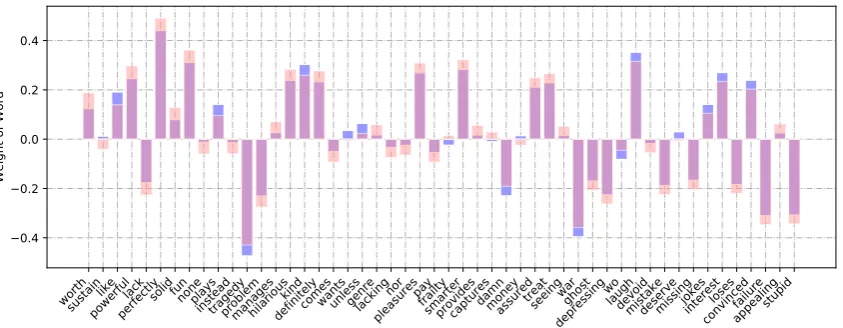
with DM-MCNNs. Although these are not as
powerful as our transfer learning embeddings, the VADER embeddings are the most easily inter-pretable here, since they are one-dimensional, and thus can be regarded as word-specific weights. The result is visualized in Fig.3. Here, the dark-shaded segments (in blue) refer to the original weights, while the light-shaded segments (in red) refer to the adjusted weights after training. The medium-shaded segments (in purple) reflect the overlap be-tween the two. Hence, whenever we observe a dark (blue) segment above a medium (purple) segment in a bar, we can infer that the fine-tuned weight for a word (e.g., for “plays” in Fig.3) was lower than the original weight of that word. Conversely, whenever we observe a light (red) segment at the top, the weight increased during training (e.g., for
hilarious). Generally, dark (blue) segments reflect decreased weight magnitudes and light (red) ones reflect increased weight magnitudes, both on the positive and on the negative side.
We consider in Fig.3the top 50 weight changes only of words that were already covered by the original VADER sentiment embeddings. Here, it is
worth noting that the weight magnitudes of positive words such as “laugh”, “appealing” and negative words such as “lack”, “missing” increase further, while words such as “damn”, “interest”, “war” see decreases in magnitude, presumably due to their ambiguity and context (e.g., “damn good”, “lost the interest”, descriptions of war movies). Hence, the figure confirms that our DM-MCNN approach is able to exploit and customize the provided sen-timent weights for the target domain. However, unlike the VADER data, our transfer learning ap-proach results in multi-dimensional sentiment em-beddings that can more easily capture multiple do-mains right from the start, thus making it possible to use them even without further fine-tuning.
4 Related Work
rep-worthsustainlike
powerfulperfectlylack solidfunnoneplaysinsteadtragedyproblemmanageshilariousdefinitelykindcomeswantsunlessgenrelackingpleasuresnor payfrailtysmarterprovidescapturesdamnmoneyassuredtreatseeingdepressingwarghost wolaugh
devoidmistakedeservemissingjokesinterestloses convincedappealingfailurestupid 0.4
0.2 0.0 0.2 0.4
[image:9.595.90.512.66.230.2]Weight of Word
Figure 3: Top 50 weight changes of words fine-tuned by the sentiment memory module of the DM-MCNN, using the one-dimensional VADER embeddings, but considering only words with non-zero values in the original VADER data. Here, the dark shade (blue) refers to the original value of word vectors, while the light shade (red) refers to their fine-tuned values after training. The medium intensity (purple) corresponds to the overlap between the original and fine-tuned word vectors.
resentations that include sentiment signals. How-ever, in their experiments, the semantic-only els mostly outperform the corresponding full mod-els with extra sentiment signals.Tang et al.(2014) showed that one can acquire sentiment informa-tion by learning from millions of training examples via distant supervision. While prior work used such signals for rule-based sentiment analysis or for feature engineering in SVMs and other shallow models, our study examines how they are best be incorporated into deep neural models, as the base-line of na¨ıvely feeding them into the model does not work sufficiently well.
Neural Architectures. In terms of architectures, deep recursive neural networks (Socher et al.,2013) were soon outperformed by deep convolutional and recurrent neural networks (˙Irsoy and Cardie, 2014;Kim,2014). Recent work has investigated more involved models, with ingredients such as Tree-LSTMs (Tai et al.,2015;Looks et al.,2017), hierarchical attention (Yang et al., 2016), user and product attention (Chen et al.,2016), aspect-specific modeling (Wang et al.,2015), and part of speech-specific transition functions (Huang et al., 2017). Large ensemble models also tend to outper-form individually trained sentiment analysis mod-els (Looks et al.,2017). The goal of our study is not necessarily to devise the most sophisticated state-of-the-art neural architecture, but to demonstrate how external sentiment cues can be incorporated such architectures. Our initial explorations relied
on a simple dual-channel convolutional neural net-work (Dong and de Melo,2018). The present work proposes a more sophisticated approach, drawing on ideas from attention mechanisms in machine translation (Bahdanau et al.,2014) as well as from memory networks (Weston et al.,2014) and iter-ative attention (Kumar et al.,2015), which have proven useful for tasks such as question answer-ing. We incorporate these ideas into a separate memory module that operates alongside the regular convolutional module.
5 Conclusions
Deep neural networks are widely used in senti-ment polarity classification, but suffer from their dependence on very large annotated training cor-pora. In this paper, we study how to incorporate extrinsic cues into the network, beyond just generic word embeddings. We have found that this is best achieved using a dual-module approach that en-courages the learning of models with favourable generalization abilities. Our experiments show that this can lead to gains across a number of different languages and domains. Our embeddings and mul-tilingual datasets are freely available fromhttp: //gerard.demelo.org/sentiment/.
Acknowledgments
References
Stefano Baccianella, Andrea Esuli, and Fabrizio Sebas-tiani. 2010. Sentiwordnet 3.0: An enhanced lexical resource for sentiment analysis and opinion mining. In LREC. European Language Resources Associa-tion.
Dzmitry Bahdanau, Kyunghyun Cho, and Yoshua Ben-gio. 2014. Neural machine translation by jointly learning to align and translate. arXiv preprint arXiv:1409.0473.
John Blitzer, Mark Dredze, Fernando Pereira, et al. 2007. Biographies, bollywood, boom-boxes and blenders: Domain adaptation for sentiment classifi-cation. InACL, volume 7, pages 440–447.
Piotr Bojanowski, Edouard Grave, Armand Joulin, and Tomas Mikolov. 2016. Enriching word vec-tors with subword information. arXiv preprint arXiv:1607.04606.
Huimin Chen, Maosong Sun, Cunchao Tu, Yankai Lin, and Zhiyuan Liu. 2016. Neural sentiment classifi-cation with user and product attention. In Proceed-ings of the 2016 Conference on Empirical Methods in Natural Language Processing, pages 1650–1659, Austin, Texas. Association for Computational Lin-guistics.
Jihun Choi, Kang Min Yoo, and Sang-goo Lee. 2017. Unsupervised learning of task-specific tree structures with tree-lstms. arXiv preprint arXiv:1707.02786.
Gerard de Melo. 2015. Wiktionary-based word embed-dings. InProceedings of MT Summit XV.
Xin Dong and Gerard de Melo. 2018. Cross-lingual propagation for deep sentiment analysis. In Proceed-ings of the 32nd AAAI Conference on Artificial Intel-ligence (AAAI 2018). AAAI Press.
William L. Hamilton, Kevin Clark, Jure Leskovec, and Dan Jurafsky. 2016. Inducing domain-specific senti-ment lexicons from unlabeled corpora. In Proceed-ings of the 2016 Conference on Empirical Methods in Natural Language Processing, pages 595–605, Austin, Texas. Association for Computational Lin-guistics.
Minqing Hu and Bing Liu. 2004. Mining and summa-rizing customer reviews. In KDD 2004: Proceed-ings of the tenth ACM SIGKDD international con-ference on Knowledge discovery and data mining, pages 168–177, New York, NY, USA. ACM.
Zhiting Hu, Xuezhe Ma, Zhengzhong Liu, Eduard Hovy, and Eric Xing. 2016. Harnessing deep neural networks with logic rules. arXiv preprint arXiv:1603.06318.
Minlie Huang, Qiao Qian, and Xiaoyan Zhu. 2017. Encoding syntactic knowledge in neural networks for sentiment classification. ACM Trans. Inf. Syst., 35(3):26:1–26:27.
C.J. Hutto and Eric Gilbert. 2014. Vader: A parsimo-nious rule-based model for sentiment analysis of so-cial media text. InProc. ICWSM-14.
Ozan ˙Irsoy and Claire Cardie. 2014. Opinion mining with deep recurrent neural networks. InProceedings of the Conference on Empirical Methods in Natural Language Processing, pages 720–728.
Nal Kalchbrenner, Edward Grefenstette, and Phil Blun-som. 2014. A convolutional neural network for mod-elling sentences.arXiv preprint arXiv:1404.2188.
Soo-Min Kim and Eduard Hovy. 2004. Determining the sentiment of opinions. InProceedings of Coling 2004, pages 1367–1373, Geneva, Switzerland. COL-ING.
Yoon Kim. 2014. Convolutional neural net-works for sentence classification. arXiv preprint arXiv:1408.5882.
Diederik Kingma and Jimmy Ba. 2014. Adam: A method for stochastic optimization. arXiv preprint arXiv:1412.6980.
Ankit Kumar, Ozan Irsoy, Jonathan Su, James Brad-bury, Robert English, Brian Pierce, Peter Ondruska, Ishaan Gulrajani, and Richard Socher. 2015. Ask me anything: Dynamic memory networks for natu-ral language processing.CoRR, abs/1506.07285.
Moshe Looks, Marcello Herreshoff, DeLesley Hutchins, and Peter Norvig. 2017. Deep learn-ing with dynamic computation graphs. CoRR, abs/1702.02181.
Andrew L Maas, Raymond E Daly, Peter T Pham, Dan Huang, Andrew Y Ng, and Christopher Potts. 2011. Learning word vectors for sentiment analysis. In
Proceedings of the 49th Annual Meeting of the Asso-ciation for Computational Linguistics: Human Lan-guage Technologies-Volume 1, pages 142–150. As-sociation for Computational Linguistics.
Julian John McAuley and Jure Leskovec. 2013. From amateurs to connoisseurs: modeling the evolution of user expertise through online reviews. In Proceed-ings of the 22nd international conference on World Wide Web, pages 897–908. ACM.
Gerard de Melo. 2017. Inducing conceptual embed-ding spaces from Wikipedia. In Proceedings of WWW 2017. ACM.
Tomas Mikolov, Kai Chen, Greg Corrado, and Jeffrey Dean. 2013. Efficient estimation of word represen-tations in vector space.CoRR, abs/1301.3781.
Jeffrey Pennington, Richard Socher, and Christopher D. Manning. 2014.Glove: Global vectors for word rep-resentation. InEmpirical Methods in Natural Lan-guage Processing (EMNLP), pages 1532–1543.
Maria Pontiki, Dimitrios Galanis, Haris Papageorgiou, Ion Androutsopoulos, Suresh Manandhar, AL Mo-hammad, Mahmoud Al-Ayyoub, Yanyan Zhao, Bing Qin, Orph´ee De Clercq, et al. 2016. Semeval-2016 task 5: Aspect based sentiment analysis. Proceed-ings of SemEval, pages 19–30.
C´ıcero Nogueira dos Santos and Ma´ıra A. de C. Gatti. 2014. Deep convolutional neural networks for senti-ment analysis of short texts. InCOLING 2014.
Richard Socher, Alex Perelygin, Jean Wu, Jason Chuang, Christopher D Manning, Andrew Ng, and Christopher Potts. 2013. Recursive deep models for semantic compositionality over a sentiment tree-bank. In Proceedings of the 2013 conference on empirical methods in natural language processing, pages 1631–1642.
Sainbayar Sukhbaatar, Arthur Szlam, Jason Weston, and Rob Fergus. 2015. End-to-end memory net-works. In C. Cortes, N. D. Lawrence, D. D. Lee, M. Sugiyama, and R. Garnett, editors,Advances in Neural Information Processing Systems 28, pages 2440–2448. Curran Associates, Inc.
Kai Sheng Tai, Richard Socher, and Christopher D. Manning. 2015. Improved semantic representations from tree-structured long short-term memory net-works.CoRR, abs/1503.00075.
Duyu Tang, Furu Wei, Nan Yang, Ming Zhou, Ting Liu, and Bing Qin. 2014. Learning sentiment-specific word embedding for twitter sentiment clas-sification. InProceedings of the 52nd Annual Meet-ing of the Association for Computational LMeet-inguistics (Volume 1: Long Papers), pages 1555–1565, Balti-more, Maryland. Association for Computational Lin-guistics.
Linlin Wang, Kang Liu, Zhu Cao, Jun Zhao, and Ger-ard de Melo. 2015. Sentiment-aspect extraction based on Restricted Boltzmann Machines. In Pro-ceedings of ACL 2015, pages 616–625.
Jason Weston, Sumit Chopra, and Antoine Bor-des. 2014. Memory networks. arXiv preprint arXiv:1410.3916.
Zichao Yang, Diyi Yang, Chris Dyer, Xiaodong He, Alex Smola, and Eduard Hovy. 2016. Hierarchical attention networks for document classification. In
Proceedings of the 2016 Conference of the North American Chapter of the Association for Computa-tional Linguistics: Human Language Technologies, pages 1480–1489, San Diego, California. Associa-tion for ComputaAssocia-tional Linguistics.