Proceedings of the 56th Annual Meeting of the Association for Computational Linguistics (Long Papers), pages 2406–2417 2406
Neural Natural Language Inference Models Enhanced with
External Knowledge
Qian Chen University of Science and
Technology of China [email protected]
Xiaodan Zhu ECE, Queen’s University [email protected]
Zhen-Hua Ling University of Science and
Technology of China [email protected]
Diana Inkpen University of Ottawa [email protected]
Si Wei iFLYTEK Research [email protected]
Abstract
Modeling natural language inference is a very challenging task. With the avail-ability of large annotated data, it has re-cently become feasible to train complex models such as neural-network-based in-ference models, which have shown to achieve the state-of-the-art performance. Although there exist relatively large anno-tated data, can machines learn all knowl-edge needed to perform natural language inference (NLI) from these data? If not, how can neural-network-based NLI mod-els benefit from external knowledge and how to build NLI models to leverage it? In this paper, we enrich the state-of-the-art neural natural language inference models with external knowledge. We demonstrate that the proposed models improve neural NLI models to achieve the state-of-the-art performance on the SNLI and MultiNLI datasets.
1 Introduction
Reasoning and inference are central to both hu-man and artificial intelligence. Natural language inference (NLI), also known as recognizing tex-tual entailment (RTE), is an important NLP prob-lem concerned with determining inferential rela-tionship (e.g., entailment, contradiction, or neu-tral) between a premisep and a hypothesish. In general, modeling informal inference in language is a very challenging and basic problem towards achieving true natural language understanding.
In the last several years, larger anno-tated datasets were made available, e.g., the SNLI (Bowman et al., 2015) and MultiNLI datasets (Williams et al., 2017), which made it feasible to train rather complicated neural-network-based models that fit a large set of parameters to better model NLI. Such models have shown to achieve the state-of-the-art per-formance (Bowman et al., 2015, 2016; Yu and Munkhdalai,2017b;Parikh et al.,2016;Sha et al., 2016;Chen et al.,2017a,b;Tay et al.,2018).
While neural networks have been shown to be very effective in modeling NLI with large train-ing data, they have often focused on end-to-end training by assuming that all inference knowledge is learnable from the provided training data. In this paper, we relax this assumption and explore whether external knowledge can further help NLI. Consider an example:
• p: A lady standing in awheatfield.
• h: A person standing in acornfield.
In this simplified example, when computers are asked to predict the relation between these two sentences and if training data do not provide the knowledge of relationship between “wheat” and “corn” (e.g., if one of the two words does not ap-pear in the training data or they are not paired in any premise-hypothesis pairs), it will be hard for computers to correctly recognize that the premise contradicts the hypothesis.
could benefit from leveraging knowledge accumu-lated by humans, particularly in a foreseeable fu-ture when machines are unable to learn it by them-selves.
In this paper we enrich neural-network-based NLI models with external knowledge in co-attention, local inference collection, and inference composition components. We show the proposed model improves the state-of-the-art NLI models to achieve better performances on the SNLI and MultiNLI datasets. The advantage of using exter-nal knowledge is more significant when the size of training data is restricted, suggesting that if more knowledge can be obtained, it may bring more benefit. In addition to attaining the state-of-the-art performance, we are also interested in under-standing how external knowledge contributes to the major components of typical neural-network-based NLI models.
2 Related Work
Early research on natural language inference and recognizing textual entailment has been performed on relatively small datasets (refer to MacCartney (2009) for a good literature survey), which in-cludes a large bulk of contributions made under the name of RTE, such as (Dagan et al., 2005; Iftene and Balahur-Dobrescu,2007), among many others.
More recently the availability of much larger annotated data, e.g., SNLI (Bowman et al., 2015) and MultiNLI (Williams et al., 2017), has made it possible to train more complex mod-els. These models mainly fall into two types of approaches: sentence-encoding-based models and models using also inter-sentence attention. Sentence-encoding-based models use Siamese ar-chitecture (Bromley et al.,1993). The parameter-tied neural networks are applied to encode both the premise and the hypothesis. Then a neural network classifier is applied to decide relationship between the two sentences. Different neural net-works have been utilized for sentence encoding, such as LSTM (Bowman et al.,2015), GRU (Ven-drov et al.,2015), CNN (Mou et al., 2016), BiL-STM and its variants (Liu et al.,2016c;Lin et al., 2017;Chen et al.,2017b;Nie and Bansal,2017), self-attention network (Shen et al., 2017, 2018), and more complicated neural networks (Bowman et al., 2016; Yu and Munkhdalai, 2017a,b; Choi et al., 2017). Sentence-encoding-based models
transform sentences into fixed-length vector rep-resentations, which may help a wide range of tasks (Conneau et al.,2017).
The second set of models use inter-sentence at-tention (Rockt¨aschel et al.,2015;Wang and Jiang, 2016; Cheng et al., 2016; Parikh et al., 2016; Chen et al., 2017a). Among them, Rockt¨aschel et al.(2015) were among the first to propose neu-ral attention-based models for NLI. Chen et al. (2017a) proposed an enhanced sequential infer-ence model (ESIM), which is one of the best mod-els so far and is used as one of our baselines in this paper.
In this paper we enrich neural-network-based NLI models with external knowledge. Unlike early work on NLI (Jijkoun and de Rijke, 2005; MacCartney et al.,2008;MacCartney, 2009) that explores external knowledge in conventional NLI models on relatively small NLI datasets, we aim to merge the advantage of powerful modeling ability of neural networks with extra external inference knowledge. We show that the proposed model improves the state-of-the-art neural NLI models to achieve better performances on the SNLI and MultiNLI datasets. The advantage of using exter-nal knowledge is more significant when the size of training data is restricted, suggesting that if more knowledge can be obtained, it may have more ben-efit. In addition to attaining the state-of-the-art performance, we are also interested in understand-ing how external knowledge affect major compo-nents of neural-network-based NLI models.
In general, external knowledge has shown to be effective in neural networks for other NLP tasks, including word embedding (Chen et al., 2015; Faruqui et al., 2015; Liu et al., 2015; Wieting et al., 2015;Mrksic et al., 2017), machine trans-lation (Shi et al.,2016;Zhang et al.,2017b), lan-guage modeling (Ahn et al., 2016), and dialogue systems (Chen et al.,2016b).
3 Neural-Network-Based NLI Models with External Knowledge
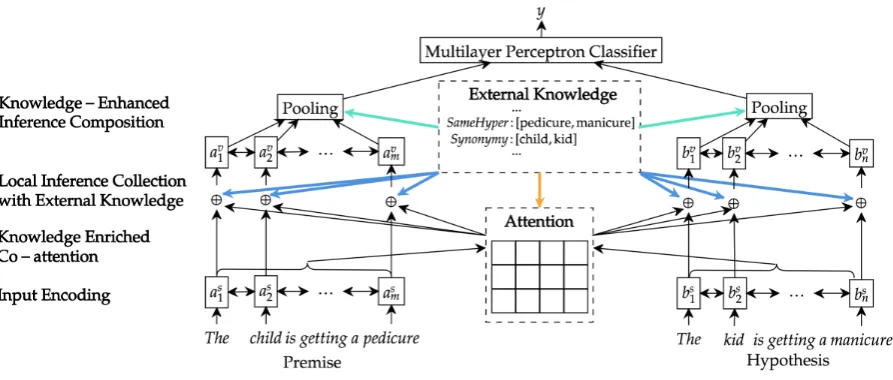
Figure1shows a high-level general view of the proposed framework. While specific NLI systems vary in their implementation, typical state-of-the-art NLI models contain the main components (or equivalents) of representing premise and hypoth-esis sentences, collecting local (e.g., lexical) in-ference information, and aggregating and compos-ing local information to make the global decision at the sentence level. We incorporate and investi-gate external knowledge accordingly in these ma-jor NLI components: computing co-attention, col-lecting local inference information, and compos-ing inference to make final decision.
3.1 External Knowledge
As discussed above, although there exist relatively large annotated data for NLI, can machines learn all inference knowledge needed to perform NLI from the data? If not, how can neural network-based NLI models benefit from external knowl-edge and how to build NLI models to leverage it?
We study the incorporation of external, inference-related knowledge in major compo-nents of neural networks for natural language inference. For example, intuitively knowledge about synonymy, antonymy, hypernymy and hyponymy between given words may help model soft-alignment between premises and hypotheses; knowledge about hypernymy and hyponymy may help capture entailment; knowledge about antonymy and co-hyponyms (words sharing the same hypernym) may benefit the modeling of contradiction.
In this section, we discuss the incorporation of basic, lexical-level semantic knowledge into neu-ral NLI components. Specifically, we consider ex-ternal lexical-level inference knowledge between word wi andwj, which is represented as a vec-torrijand is incorporated into three specific
com-ponents shown in Figure1. We will discuss the details of howrij is constructed later in the
exper-iment setup section (Section 4) but instead focus on the proposed model in this section. Note that while we study lexical-level inference knowledge in the paper, if inference knowledge about larger pieces of text pairs (e.g., inference relations be-tween phrases) are available, the proposed model can be easily extended to handle that. In this paper, we instead let the NLI models to compose lexical-level knowledge to obtain inference relations be-tween larger pieces of texts.
3.2 Encoding Premise and Hypothesis
Same as much previous work (Chen et al., 2017a,b), we encode the premise and the hypoth-esis with bidirectional LSTMs (BiLSTMs). The premise is represented asa = (a1, . . . , am) and
the hypothesis is b = (b1, . . . , bn), where m
and n are the lengths of the sentences. Then a andb are embedded into de-dimensional vectors [E(a1), . . . ,E(am)]and[E(b1), . . . ,E(bn)]using
the embedding matrixE ∈ Rde×|V|, where|V|is
the vocabulary size andEcan be initialized with the pre-trained word embedding. To represent words in its context, the premise and the hypothe-sis are fed into BiLSTM encoders (Hochreiter and Schmidhuber, 1997) to obtain context-dependent hidden statesasandbs:
asi = Encoder(E(a), i), (1) bsj = Encoder(E(b), j). (2)
whereiandjindicate thei-th word in the premise and thej-th word in the hypothesis, respectively.
3.3 Knowledge-Enriched Co-Attention
As discussed above, soft-alignment of word pairs between the premise and the hypothesis may ben-efit from knowledge-enriched co-attention mech-anism. Given the relation featuresrij ∈ Rdr be-tween the premise’si-th word and the hypothesis’s
j-th word derived from the external knowledge, the co-attention is calculated as:
eij = (asi)Tbsj +F(rij). (3)
The function F can be any non-linear or linear functions. In this paper, we useF(rij) =λ1(rij),
whereλis a hyper-parameter tuned on the devel-opment set and1is the indication function as fol-lows:
1(rij) = (
1 ifrij is not a zero vector; 0 ifrij is a zero vector.
(4)
Figure 1: A high-level view of neural-network-based NLI models enriched with external knowledge in co-attention, local inference collection, and inference composition.
Soft-alignment is determined by the co-attention matrix e ∈ Rm×n computed in
Equa-tion (3), which is used to obtain the local relevance between the premise and the hypothesis. For the hidden state of the i-th word in the premise, i.e., asi (already encoding the word itself and its con-text), the relevant semantics in the hypothesis is identified into a context vectoraci usingeij, more specifically with Equation (5).
αij =
exp(eij) Pn
k=1exp(eik)
, aci = n X
j=1
αijbsj, (5)
βij =
exp(eij) Pm
k=1exp(ekj) , bcj =
m X
i=1
βijasi, (6)
where α ∈ Rm×n and β ∈
Rm×n are the nor-malized attention weight matrices with respect to the2-axis and1-axis. The same calculation is per-formed for each word in the hypothesis, i.e., bsj, with Equation (6) to obtain the context vectorbcj.
3.4 Local Inference Collection with External Knowledge
By way of comparing the inference-related seman-tic relation between asi (individual word repre-sentation in premise) andaci (context representa-tion from hypothesis which is align to word asi), we can model local inference (i.e., word-level in-ference) between aligned word pairs. Intuitively, for example, knowledge about hypernymy or hy-ponymy may help model entailment and knowl-edge about antonymy and co-hyponyms may help model contradiction. Through comparing asi and
aci, in addition to their relation from external knowledge, we can obtain word-level inference information for each word. The same calcula-tion is performed forbsj andbcj. Thus, we collect knowledge-enriched local inference information:
ami =G([a s i;a
c i;a
s i −a
c i;a
s i ◦a
c i;
n X
j=1
αijrij]), (7)
bmj =G([bsj,bcj;bsj−bcj;bsj◦bcj; m X
i=1
βijrji]), (8)
where a heuristic matching trick with difference and element-wise product is used (Mou et al., 2016;Chen et al.,2017a). The last terms in Equa-tion (7)(8) are used to obtain word-level infer-ence information from external knowledge. Take Equation (7) as example, rij is the relation
fea-ture between the i-th word in the premise and the j-th word in the hypothesis, but we care more about semantic relation between aligned word pairs between the premise and the hypoth-esis. Thus, we use a soft-aligned version through the soft-alignment weightαij. For the i-th word in the premise, the last term in Equation (7) is a word-level inference information based on ex-ternal knowledge between the i-th word and the aligned word. The same calculation for hypoth-esis is performed in Equation (8). G is a non-linear mapping function to reduce dimensionality. Specifically, we use a 1-layer feed-forward neural network with the ReLU activation function with a shortcut connection, i.e., concatenate the hidden states after ReLU with the inputPn
j=1αijrij (or
Pm
3.5 Knowledge-Enhanced Inference Composition
In this component, we introduce knowledge-enriched inference composition. To determine the overall inference relationship between the premise and the hypothesis, we need to explore a compo-sition layer to compose the local inference vectors (amandbm) collected above:
avi = Composition(am, i), (9)
bvj = Composition(bm, j). (10)
Here, we also use BiLSTMs as building blocks for the composition layer, but the responsibility of BiLSTMs in the inference composition layer is completely different from that in the input en-coding layer. The BiLSTMs here read local in-ference vectors (am and bm) and learn to judge the types of local inference relationship and dis-tinguish crucial local inference vectors for overall sentence-level inference relationship. Intuitively, the final prediction is likely to depend on word pairs appearing in external knowledge that have some semantic relation. Our inference model con-verts the output hidden vectors of BiLSTMs to the fixed-length vector with pooling operations and puts it into the final classifier to determine the overall inference class. Particularly, in addi-tion to using mean pooling and max pooling sim-ilarly to ESIM (Chen et al., 2017a), we propose to use weighted pooling based on external knowl-edge to obtain a fixed-length vector as in Equation (11)(12).
aw= m X
i=1
exp(H(Pn
j=1αijrij)) Pm
i=1exp(H( Pn
j=1αijrij))
avi , (11)
bw= n X
j=1
exp(H(Pm
i=1βijrji)) Pn
j=1exp(H( Pm
i=1βijrji))
bvj. (12)
In our experiments, we regard the functionH as a 1-layer feed-forward neural network with ReLU activation function. We concatenate all pooling vectors, i.e., mean, max, and weighted pooling, into the fixed-length vector and then put the vector into the final multilayer perceptron (MLP) clas-sifier. The MLP has one hidden layer with tanh activation andsoftmax output layer in our exper-iments. The entire model is trained end-to-end, through minimizing the cross-entropy loss.
4 Experiment Set-Up
4.1 Representation of External Knowledge
Lexical Semantic Relations As described in Section 3.1, to incorporate external knowledge (as a knowledge vector rij) to the
state-of-the-art neural network-based NLI models, we first explore semantic relations in WordNet (Miller, 1995), motivated byMacCartney(2009). Specif-ically, the relations of lexical pairs are derived as described in(1)-(4)below. Instead of using Jiang-Conrath WordNet distance metric (Jiang and Con-rath, 1997), which does not improve the perfor-mance of our models on the development sets, we add a new feature, i.e.,co-hyponyms, which con-sistently benefit our models.
(1) Synonymy: It takes the value1if the words in the pair are synonyms in WordNet (i.e., be-long to the same synset), and0otherwise. For example, [felicitous, good] =1, [dog, wolf] =
0.
(2) Antonymy: It takes the value 1 if the words in the pair are antonyms in WordNet, and0
otherwise. For example, [wet, dry] =1.
(3) Hypernymy: It takes the value1−n/8if one word is a (direct or indirect) hypernym of the other word in WordNet, wherenis the num-ber of edges between the two words in hier-archies, and0otherwise. Note that we ignore pairs in the hierarchy which have more than 8 edges in between. For example, [dog, canid] = 0.875, [wolf, canid] = 0.875, [dog, carni-vore] =0.75, [canid, dog] =0
(4) Hyponymy: It is simply the inverse of the hy-pernymy feature. For example, [canid, dog] =0.875, [dog, canid] =0.
(5) Co-hyponyms: It takes the value1if the two words have the same hypernym but they do not belong to the same synset, and 0 other-wise. For example, [dog, wolf] =1.
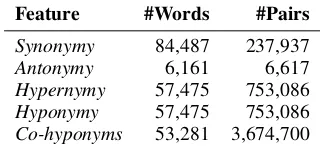
the relation feature derived from external knowl-edge, wheredr is5here. In addition, Table1 re-ports some key statistics of these features.
Feature #Words #Pairs
[image:6.595.100.262.115.190.2]Synonymy 84,487 237,937 Antonymy 6,161 6,617 Hypernymy 57,475 753,086 Hyponymy 57,475 753,086 Co-hyponyms 53,281 3,674,700
Table 1: Statistics of lexical relation features.
In addition to the above relations, we also use more relation features in WordNet, including in-stance, instance of, same instance, entailment, member meronym, member holonym, substance meronym,substance holonym,part meronym,part holonym, summing up to 15 features, but these ad-ditional features do not bring further improvement on the development dataset, as also discussed in Section 5.
Relation Embeddings In the most recent years graph embedding has been widely employed to learn representation for vertexes and their relations in a graph. In our work here, we also capture the relation between any two words in WordNet through relation embedding. Specifically, we em-ployed TransE (Bordes et al.,2013), a widely used graph embedding methods, to capture relation em-bedding between any two words. We used two typical approaches to obtaining the relation bedding. The first directly uses 18 relation em-beddings pretrained on the WN18 dataset (Bordes et al.,2013). Specifically, if a word pair has a cer-tain type relation, we take the corresponding re-lation embedding. Sometimes, if a word pair has multiple relations among the 18 types; we take an average of the relation embedding. The second ap-proach uses TransE’s word embedding (trained on WordNet) to obtain relation embedding, through the objective function used in TransE, i.e., l ≈
t−h, wherelindicates relation embedding,t in-dicates tail entity embedding, andhindicates head entity embedding.
Note that in addition to relation embedding trained on WordNet, other relational embedding resources exist; e.g., that trained on Freebase (WikiData) (Bollacker et al., 2007), but such knowledge resources are mainly about facts (e.g., relationship between Bill Gates and Microsoft) and are less for commonsense knowledge used in
general natural language inference (e.g., the color yellow potentially contradicts red).
4.2 NLI Datasets
In our experiments, we use Stanford Natural Lan-guage Inference (SNLI) dataset (Bowman et al., 2015) and Multi-Genre Natural Language Infer-ence (MultiNLI) (Williams et al., 2017) dataset, which focus on three basic relations between a premise and a potential hypothesis: the premise entails the hypothesis (entailment), they contradict each other (contradiction), or they are not related (neutral). We use the same data split as in previ-ous work (Bowman et al.,2015;Williams et al., 2017) and classification accuracy as the evaluation metric. In addition, we test our models (trained on the SNLI training set) on a new test set (Glockner et al.,2018), which assesses the lexical inference abilities of NLI systems and consists of 8,193 sam-ples. WordNet 3.0 (Miller,1995) is used to extract semantic relation features between words. The words are lemmatized using Stanford CoreNLP 3.7.0 (Manning et al.,2014). The premise and the hypothesis sentences fed into the input encoding layer are tokenized.
4.3 Training Details
For duplicability, we release our code1. All our models were strictly selected on the development set of the SNLI data and the in-domain devel-opment set of MultiNLI and were then tested on the corresponding test set. The main training de-tails are as follows: the dimension of the hid-den states of LSTMs and word embeddings are
300. The word embeddings are initialized by 300D GloVe 840B(Pennington et al., 2014), and out-of-vocabulary words among them are initial-ized randomly. All word embeddings are updated during training. Adam (Kingma and Ba, 2014) is used for optimization with an initial learning rate of0.0004. The mini-batch size is set to 32. Note that the above hyperparameter settings are same as those used in the baseline ESIM (Chen et al., 2017a) model. ESIM is a strong NLI baseline framework with the source code made available athttps://github.com/lukecq1231/nli(the ESIM core code has also been adapted to sum-marization (Chen et al., 2016a) and question-answering tasks (Zhang et al.,2017a)).
The trade-off λ for calculating
attention in Equation (3) is selected in
[0.1,0.2,0.5,1,2,5,10,20,50] based on the development set. When training TransE for WordNet, relations are represented with vectors of20dimension.
5 Experimental Results
5.1 Overall Performance
Table2shows the results of state-of-the-art models on the SNLI dataset. Among them, ESIM (Chen et al.,2017a) is one of the previous state-of-the-art systems with an 88.0% test-set accuracy. The pro-posed model, namely Knowledge-based Inference Model (KIM), which enriches ESIM with external knowledge, obtains an accuracy of 88.6%, the best single-model performance reported on the SNLI dataset. The difference between ESIM and KIM is statistically significant under the one-tailed paired
t-test at the 99% significance level. Note that the KIM model reported here uses five semantic rela-tions described in Section4. In addition to that, we also use 15 semantic relation features, which does not bring additional gains in performance. These results highlight the effectiveness of the five se-mantic relations described in Section4. To further investigate external knowledge, we add TransE re-lation embedding, and again no further improve-ment is observed on both the developimprove-ment and test sets when TransE relation embedding is used (con-catenated) with the semantic relation vectors. We consider this is due to the fact that TransE embed-ding is not specifically sensitive to inference in-formation; e.g., it does not model co-hyponyms features, and its potential benefit has already been covered by the semantic relation features used.
Table3shows the performance of models on the MultiNLI dataset. The baseline ESIM achieves 76.8% and 75.8% on in-domain and cross-domain test set, respectively. If we extend the ESIM with external knowledge, we achieve significant gains to 77.2% and 76.4% respectively. Again, the gains are consistent on SNLI and MultiNLI, and we ex-pect they would be orthogonal to other factors when external knowledge is added into other state-of-the-art models.
5.2 Ablation Results
Figure 2 displays the ablation analysis of differ-ent compondiffer-ents when using the external edge. To compare the effects of external knowl-edge under different training data scales, we
ran-Model Test
LSTM Att. (Rockt¨aschel et al.,2015) 83.5 DF-LSTMs (Liu et al.,2016a) 84.6 TC-LSTMs (Liu et al.,2016b) 85.1 Match-LSTM (Wang and Jiang,2016) 86.1 LSTMN (Cheng et al.,2016) 86.3 Decomposable Att. (Parikh et al.,2016) 86.8 NTI (Yu and Munkhdalai,2017b) 87.3 Re-read LSTM (Sha et al.,2016) 87.5 BiMPM (Wang et al.,2017) 87.5 DIIN (Gong et al.,2017) 88.0 BCN + CoVe (McCann et al.,2017) 88.1 CAFE (Tay et al.,2018) 88.5
[image:7.595.318.515.61.243.2]ESIM (Chen et al.,2017a) 88.0 KIM (This paper) 88.6
Table 2: Accuracies of models on SNLI.
Model In Cross
CBOW (Williams et al.,2017) 64.8 64.5 BiLSTM (Williams et al.,2017) 66.9 66.9 DiSAN (Shen et al.,2017) 71.0 71.4 Gated BiLSTM (Chen et al.,2017b) 73.5 73.6 SS BiLSTM (Nie and Bansal,2017) 74.6 73.6 DIIN * (Gong et al.,2017) 77.8 78.8
CAFE (Tay et al.,2018) 78.7 77.9
ESIM (Chen et al.,2017a) 76.8 75.8 KIM (This paper) 77.2 76.4
Table 3: Accuracies of models on MultiNLI. * in-dicates models using extra SNLI training set.
com-pose the three components (“A,I,C”), we obtain the best result of 72.6% (+ absolute 10.2%). When we use more training data, i.e., 4%, 20%, 100% of the training set, only “I” achieves a significant gain, but “A” or “C” does not bring any signifi-cant improvement. The results indicate that ex-ternal semantic knowledge only helps co-attention and composition when limited training data is lim-ited, but always helps in collecting local inference information. Meanwhile, for less training data,λ
is usually set to a larger value. For example, the optimalλon the development set is 20 for 0.8% training set, 2 for the 4% training set, 1 for the 20% training set and0.2for the 100% training set. Figure 3displays the results of using different ratios of external knowledge (randomly keep dif-ferent percentages of whole lexical semantic rela-tions) under different sizes of training data. Note that here we only use external knowledge in col-lecting local inference information as it always works well for different scale of the training set. Better accuracies are achieved when using more external knowledge. Especially under the condi-tion of restricted training data (0.8%), the model obtains a large gain when using more than half of external knowledge.
Figure 2: Accuracies of models of incorporat-ing external knowledge into different NLI compo-nents, under different sizes of training data (0.8%, 4%, 20%, and the entire training data).
5.3 Analysis on the (Glockner et al.,2018) Test Set
[image:8.595.334.491.69.236.2]In addition, Table4shows the results on a newly published test set (Glockner et al., 2018). Com-pared with the performance on the SNLI test
Figure 3: Accuracies of models under differ-ent sizes of external knowledge. More external knowledge corresponds to higher accuracies.
Model SNLI Glockner’s(∆)
(Parikh et al.,2016)* 84.7 51.9 (-32.8)
(Nie and Bansal,2017)* 86.0 62.2 (-23.8)
[image:8.595.309.523.300.365.2]ESIM * 87.9 65.6 (-22.3) KIM (This paper) 88.6 83.5( -5.1)
Table 4: Accuracies of models on the SNLI and (Glockner et al.,2018) test set. * indicates the re-sults taken from (Glockner et al.,2018).
set, the performance of the three baseline mod-els dropped substantially on the (Glockner et al., 2018) test set, with the differences ranging from 22.3% to 32.8% in accuracy. Instead, the proposed KIM achieves 83.5% on this test set (with only a 5.1% drop in performance), which demonstrates its better ability of utilizing lexical level inference and hence better generalizability.
Figure 5 displays the accuracy of ESIM and KIM in each replacement-word category of the (Glockner et al., 2018) test set. KIM outper-forms ESIM in 13 out of 14 categories, and only performs worse on synonyms.
5.4 Analysis by Inference Categories
[image:8.595.98.256.438.602.2]Category Instance ESIM KIM
Antonyms 1,147 70.4 86.5
Cardinals 759 75.5 93.4
Nationalities 755 35.9 73.5
Drinks 731 63.7 96.6
Antonyms WordNet 706 74.6 78.8
Colors 699 96.1 98.3
Ordinals 663 21.0 56.6
Countries 613 25.4 70.8
Rooms 595 69.4 77.6
Materials 397 89.7 98.7
Vegetables 109 31.2 79.8
Instruments 65 90.8 96.9
Planets 60 3.3 5.0
Synonyms 894 99.7 92.1
Overall 8,193 65.6 83.5
Table 5: The number of instances and accu-racy per category achieved by ESIM and KIM on the (Glockner et al.,2018) test set.
Category In-domain Cross-domain
ESIM KIM ESIM KIM
Active/Passive 93.3 93.3 100.0 100.0
Antonym 76.5 76.5 70.0 75.0
Belief 72.7 75.8 75.9 79.3
Conditional 65.2 65.2 61.5 69.2
Coreference 80.0 76.7 75.9 75.9
Long sentence 82.8 78.8 69.7 73.4
Modal 80.6 79.9 77.0 80.2
Negation 76.7 79.8 73.1 71.2 Paraphrase 84.0 72.0 86.5 89.2
Quantity/Time 66.7 66.7 56.4 59.0
Quantifier 79.2 78.4 73.6 77.1
Tense 74.5 78.4 72.2 66.7 Word overlap 89.3 85.7 83.8 81.1
Overall 77.1 77.9 76.7 77.4
Table 6: Detailed Analysis on MultiNLI.
cross-domain subset of development set. KIM out-performs or equals ESIM in 10 out of 13 cate-gories on the cross-domain setting, while only 7 out of 13 categories on in-domain setting. It indi-cates that external knowledge helps more in cross-domain setting. Especially, for antonym category in cross-domain set, KIM outperform ESIM sig-nificantly (+ absolute 5.0%) as expected, because antonym feature captured by external knowledge would help unseen cross-domain samples.
5.5 Case Study
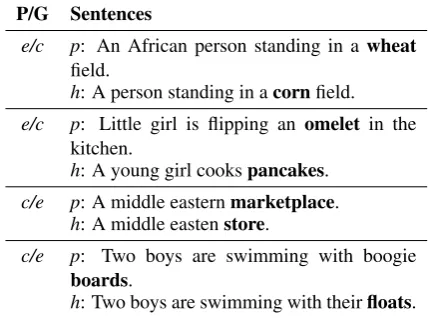
Table 7 includes some examples from the SNLI test set, where KIM successfully predicts the in-ference relation and ESIM fails. In the first
exam-P/G Sentences
e/c p: An African person standing in awheat
field.
h: A person standing in acornfield.
e/c p: Little girl is flipping an omelet in the kitchen.
h: A young girl cookspancakes.
c/e p: A middle easternmarketplace. h: A middle eastenstore.
c/e p: Two boys are swimming with boogie
boards.
[image:9.595.308.523.64.223.2]h: Two boys are swimming with theirfloats.
Table 7: Examples. Word in bold are key words in making final prediction.Pindicates a predicted label andGindicates gold-standard label. eandc denoteentailmentandcontradiction, respectively.
ple, the premise is “An African person standing in awheatfield” and the hypothesis “A person stand-ing in acornfield”. As the KIM model knows that “wheat” and “corn” are both a kind of cereal, i.e, the co-hyponyms relationship in our relation fea-tures, KIM therefore predicts the premise contra-dicts the hypothesis. However, the baseline ESIM cannot learn the relationship between “wheat” and “corn” effectively due to lack of enough samples in the training sets. With the help of external knowledge, i.e., “wheat” and “corn” having the same hypernym “cereal”, KIM predicts contradic-tion correctly.
6 Conclusions
Our neural-network-based model for natural lan-guage inference with external knowledge, namely KIM, achieves the state-of-the-art accuracies. The model is equipped with external knowledge in its main components, specifically, in calculating co-attention, collecting local inference, and compos-ing inference. We provide detailed analyses on our model and results. The proposed model of infus-ing neural networks with external knowledge may also help shed some light on tasks other than NLI.
Acknowledgments
References
Sungjin Ahn, Heeyoul Choi, Tanel P¨arnamaa, and Yoshua Bengio. 2016. A neural knowledge
lan-guage model.CoRR, abs/1608.00318.
Kurt D. Bollacker, Robert P. Cook, and Patrick Tufts. 2007. Freebase: A shared database of structured
general human knowledge. In Proceedings of the
Twenty-Second AAAI Conference on Artificial In-telligence, July 22-26, 2007, Vancouver, British Columbia, Canada, pages 1962–1963.
Antoine Bordes, Nicolas Usunier, Alberto Garc´ıa-Dur´an, Jason Weston, and Oksana Yakhnenko. 2013. Translating embeddings for modeling multi-relational data. InAdvances in Neural Information Processing Systems 26: 27th Annual Conference on Neural Information Processing Systems 2013. Pro-ceedings of a meeting held December 5-8, 2013, Lake Tahoe, Nevada, United States., pages 2787– 2795.
Samuel R. Bowman, Gabor Angeli, Christopher Potts, and Christopher D. Manning. 2015. A large an-notated corpus for learning natural language infer-ence. In Proceedings of the 2015 Conference on Empirical Methods in Natural Language Process-ing, EMNLP 2015, Lisbon, Portugal, September 17-21, 2015, pages 632–642.
Samuel R. Bowman, Jon Gauthier, Abhinav Ras-togi, Raghav Gupta, Christopher D. Manning, and Christopher Potts. 2016. A fast unified model for parsing and sentence understanding. InProceedings of the 54th Annual Meeting of the Association for Computational Linguistics, ACL 2016, August 7-12, 2016, Berlin, Germany, Volume 1: Long Papers.
Jane Bromley, Isabelle Guyon, Yann LeCun, Eduard S¨ackinger, and Roopak Shah. 1993. Signature veri-fication using a siamese time delay neural network. InAdvances in Neural Information Processing Sys-tems 6, [7th NIPS Conference, Denver, Colorado, USA, 1993], pages 737–744.
Qian Chen, Xiaodan Zhu, Zhen-Hua Ling, Si Wei, and Hui Jiang. 2016a. Distraction-based neural
net-works for modeling document. InProceedings of
the Twenty-Fifth International Joint Conference on Artificial Intelligence, IJCAI 2016, New York, NY, USA, 9-15 July 2016, pages 2754–2760.
Qian Chen, Xiaodan Zhu, Zhen-Hua Ling, Si Wei, Hui Jiang, and Diana Inkpen. 2017a. Enhanced
LSTM for natural language inference. In
Proceed-ings of the 55th Annual Meeting of the Association for Computational Linguistics, ACL 2017, Vancou-ver, Canada, July 30 - August 4, Volume 1: Long Papers, pages 1657–1668.
Qian Chen, Xiaodan Zhu, Zhen-Hua Ling, Si Wei, Hui Jiang, and Diana Inkpen. 2017b. Recurrent neural network-based sentence encoder with gated atten-tion for natural language inference. InProceedings of the 2nd Workshop on Evaluating Vector Space
Representations for NLP, RepEval@EMNLP 2017, Copenhagen, Denmark, September 8, 2017, pages 36–40.
Yun-Nung Chen, Dilek Z. Hakkani-T¨ur, G¨okhan T¨ur, Asli C¸ elikyilmaz, Jianfeng Gao, and Li Deng. 2016b. Knowledge as a teacher:
Knowledge-guided structural attention networks. CoRR,
abs/1609.03286.
Zhigang Chen, Wei Lin, Qian Chen, Xiaoping Chen, Si Wei, Hui Jiang, and Xiaodan Zhu. 2015.
Re-visiting word embedding for contrasting meaning.
In Proceedings of the 53rd Annual Meeting of the Association for Computational Linguistics and the 7th International Joint Conference on Natural Lan-guage Processing of the Asian Federation of Natural Language Processing, ACL 2015, July 26-31, 2015, Beijing, China, Volume 1: Long Papers, pages 106– 115.
Jianpeng Cheng, Li Dong, and Mirella Lapata. 2016.
Long short-term memory-networks for machine
reading. InProceedings of the 2016 Conference on
Empirical Methods in Natural Language Process-ing, EMNLP 2016, Austin, Texas, USA, November 1-4, 2016, pages 551–561.
Jihun Choi, Kang Min Yoo, and Sang-goo Lee. 2017.
Unsupervised learning of task-specific tree struc-tures with tree-lstms.CoRR, abs/1707.02786.
Alexis Conneau, Douwe Kiela, Holger Schwenk, Lo¨ıc Barrault, and Antoine Bordes. 2017. Supervised learning of universal sentence representations from natural language inference data. InProceedings of the 2017 Conference on Empirical Methods in Nat-ural Language Processing, EMNLP 2017, Copen-hagen, Denmark, September 9-11, 2017, pages 670– 680.
Ido Dagan, Oren Glickman, and Bernardo Magnini. 2005. The PASCAL recognising textual entailment challenge. InMachine Learning Challenges, Eval-uating Predictive Uncertainty, Visual Object Clas-sification and Recognizing Textual Entailment, First PASCAL Machine Learning Challenges Workshop, MLCW 2005, Southampton, UK, April 11-13, 2005, Revised Selected Papers, pages 177–190.
Manaal Faruqui, Jesse Dodge, Sujay Kumar Jauhar, Chris Dyer, Eduard H. Hovy, and Noah A. Smith. 2015. Retrofitting word vectors to semantic lexi-cons. InNAACL HLT 2015, The 2015 Conference of the North American Chapter of the Association for Computational Linguistics: Human Language Tech-nologies, Denver, Colorado, USA, May 31 - June 5, 2015, pages 1606–1615.
Yichen Gong, Heng Luo, and Jian Zhang. 2017.
Natural language inference over interaction space. CoRR, abs/1709.04348.
Sepp Hochreiter and J¨urgen Schmidhuber. 1997.
Long short-term memory. Neural Computation,
9(8):1735–1780.
Adrian Iftene and Alexandra Balahur-Dobrescu. 2007.
Proceedings of the ACL-PASCAL Workshop on Tex-tual Entailment and Paraphrasing, chapter Hypoth-esis Transformation and Semantic Variability Rules Used in Recognizing Textual Entailment. Associa-tion for ComputaAssocia-tional Linguistics.
Jay J. Jiang and David W. Conrath. 1997. Seman-tic similarity based on corpus statisSeman-tics and lexical
taxonomy. In Proceedings of the 10th Research
on Computational Linguistics International Confer-ence, ROCLING 1997, Taipei, Taiwan, August 1997, pages 19–33.
Valentin Jijkoun and Maarten de Rijke. 2005. Recog-nizing textual entailment using lexical similarity. In Proceedings of the PASCAL Challenges Workshop on Recognising Textual Entailment.
Diederik P. Kingma and Jimmy Ba. 2014. Adam:
A method for stochastic optimization. CoRR,
abs/1412.6980.
Zhouhan Lin, Minwei Feng, C´ıcero Nogueira dos San-tos, Mo Yu, Bing Xiang, Bowen Zhou, and Yoshua Bengio. 2017. A structured self-attentive sentence
embedding.CoRR, abs/1703.03130.
Pengfei Liu, Xipeng Qiu, Jifan Chen, and Xuanjing Huang. 2016a. Deep fusion lstms for text
seman-tic matching. In Proceedings of the 54th Annual
Meeting of the Association for Computational Lin-guistics, ACL 2016, August 7-12, 2016, Berlin, Ger-many, Volume 1: Long Papers.
Pengfei Liu, Xipeng Qiu, Yaqian Zhou, Jifan Chen, and Xuanjing Huang. 2016b. Modelling interaction of sentence pair with coupled-lstms. InProceedings of the 2016 Conference on Empirical Methods in Nat-ural Language Processing, EMNLP 2016, Austin, Texas, USA, November 1-4, 2016, pages 1703–1712.
Quan Liu, Hui Jiang, Si Wei, Zhen-Hua Ling, and Yu Hu. 2015. Learning semantic word embeddings
based on ordinal knowledge constraints. In
Pro-ceedings of the 53rd Annual Meeting of the Associ-ation for ComputAssoci-ational Linguistics and the 7th In-ternational Joint Conference on Natural Language Processing of the Asian Federation of Natural Lan-guage Processing, ACL 2015, July 26-31, 2015, Bei-jing, China, Volume 1: Long Papers, pages 1501– 1511.
Yang Liu, Chengjie Sun, Lei Lin, and Xiaolong Wang. 2016c. Learning natural language inference
us-ing bidirectional LSTM model and inner-attention.
CoRR, abs/1605.09090.
Bill MacCartney. 2009. Natural Language Inference. Ph.D. thesis, Stanford University.
Bill MacCartney, Michel Galley, and Christopher D. Manning. 2008. A phrase-based alignment model for natural language inference. In2008 Conference on Empirical Methods in Natural Language Pro-cessing, EMNLP 2008, Proceedings of the Confer-ence, 25-27 October 2008, Honolulu, Hawaii, USA, A meeting of SIGDAT, a Special Interest Group of the ACL, pages 802–811.
Christopher D. Manning, Mihai Surdeanu, John Bauer, Jenny Rose Finkel, Steven Bethard, and David Mc-Closky. 2014. The stanford corenlp natural language processing toolkit. InProceedings of the 52nd An-nual Meeting of the Association for Computational Linguistics, ACL 2014, June 22-27, 2014, Baltimore, MD, USA, System Demonstrations, pages 55–60.
Bryan McCann, James Bradbury, Caiming Xiong, and Richard Socher. 2017. Learned in translation:
Con-textualized word vectors. In Advances in Neural
Information Processing Systems 30: Annual Con-ference on Neural Information Processing Systems 2017, 4-9 December 2017, Long Beach, CA, USA, pages 6297–6308.
George A. Miller. 1995. Wordnet: A lexical database
for english.Commun. ACM, 38(11):39–41.
Lili Mou, Rui Men, Ge Li, Yan Xu, Lu Zhang, Rui Yan, and Zhi Jin. 2016. Natural language infer-ence by tree-based convolution and heuristic match-ing. InProceedings of the 54th Annual Meeting of the Association for Computational Linguistics, ACL 2016, August 7-12, 2016, Berlin, Germany, Volume 2: Short Papers.
Nikola Mrksic, Ivan Vulic, Diarmuid ´O S´eaghdha, Ira Leviant, Roi Reichart, Milica Gasic, Anna Korho-nen, and Steve J. Young. 2017. Semantic special-isation of distributional word vector spaces using
monolingual and cross-lingual constraints. CoRR,
abs/1706.00374.
Yixin Nie and Mohit Bansal. 2017. Shortcut-stacked sentence encoders for multi-domain infer-ence. In Proceedings of the 2nd Workshop on Evaluating Vector Space Representations for NLP, RepEval@EMNLP 2017, Copenhagen, Denmark, September 8, 2017, pages 41–45.
Ankur P. Parikh, Oscar T¨ackstr¨om, Dipanjan Das, and Jakob Uszkoreit. 2016. A decomposable attention
model for natural language inference. In
Proceed-ings of the 2016 Conference on Empirical Meth-ods in Natural Language Processing, EMNLP 2016, Austin, Texas, USA, November 1-4, 2016, pages 2249–2255.
Jeffrey Pennington, Richard Socher, and Christo-pher D. Manning. 2014. Glove: Global vectors for
word representation. In Proceedings of the 2014
2014, Doha, Qatar, A meeting of SIGDAT, a Special Interest Group of the ACL, pages 1532–1543.
Tim Rockt¨aschel, Edward Grefenstette, Karl Moritz Hermann, Tom´as Kocisk´y, and Phil Blunsom. 2015.
Reasoning about entailment with neural attention.
CoRR, abs/1509.06664.
Lei Sha, Baobao Chang, Zhifang Sui, and Sujian Li. 2016. Reading and thinking: Re-read LSTM unit
for textual entailment recognition. In COLING
2016, 26th International Conference on Computa-tional Linguistics, Proceedings of the Conference: Technical Papers, December 11-16, 2016, Osaka, Japan, pages 2870–2879.
Tao Shen, Tianyi Zhou, Guodong Long, Jing Jiang, Shirui Pan, and Chengqi Zhang. 2017. Disan: Di-rectional self-attention network for rnn/cnn-free
lan-guage understanding. CoRR, abs/1709.04696.
Tao Shen, Tianyi Zhou, Guodong Long, Jing Jiang, Sen Wang, and Chengqi Zhang. 2018. Reinforced self-attention network: a hybrid of hard and soft self-attention
for sequence modeling. CoRR, abs/1801.10296.
Chen Shi, Shujie Liu, Shuo Ren, Shi Feng, Mu Li, Ming Zhou, Xu Sun, and Houfeng Wang. 2016.
Knowledge-based semantic embedding for machine translation. InProceedings of the 54th Annual Meet-ing of the Association for Computational LMeet-inguis- Linguis-tics, ACL 2016, August 7-12, 2016, Berlin, Ger-many, Volume 1: Long Papers.
Yi Tay, Luu Anh Tuan, and Siu Cheung Hui. 2018. A compare-propagate architecture with alignment
fac-torization for natural language inference. CoRR,
abs/1801.00102.
Ivan Vendrov, Ryan Kiros, Sanja Fidler, and Raquel Urtasun. 2015. Order-embeddings of images and
language.CoRR, abs/1511.06361.
Shuohang Wang and Jing Jiang. 2016. Learning
natu-ral language inference with LSTM. InNAACL HLT
2016, The 2016 Conference of the North American Chapter of the Association for Computational Lin-guistics: Human Language Technologies, San Diego California, USA, June 12-17, 2016, pages 1442– 1451.
Zhiguo Wang, Wael Hamza, and Radu Florian. 2017.
Bilateral multi-perspective matching for natural lan-guage sentences. InProceedings of the Twenty-Sixth International Joint Conference on Artificial Intelli-gence, IJCAI 2017, Melbourne, Australia, August 19-25, 2017, pages 4144–4150.
John Wieting, Mohit Bansal, Kevin Gimpel, and Karen Livescu. 2015. From paraphrase database to
compo-sitional paraphrase model and back. TACL, 3:345–
358.
Adina Williams, Nikita Nangia, and Samuel R. Bow-man. 2017. A broad-coverage challenge corpus for
sentence understanding through inference. CoRR,
abs/1704.05426.
Hong Yu and Tsendsuren Munkhdalai. 2017a. Neural semantic encoders. InProceedings of the 15th Con-ference of the European Chapter of the Association for Computational Linguistics, EACL 2017, Valen-cia, Spain, April 3-7, 2017, Volume 1: Long Papers, pages 397–407.
Hong Yu and Tsendsuren Munkhdalai. 2017b. Neu-ral tree indexers for text understanding. In Proceed-ings of the 15th Conference of the European Chap-ter of the Association for Computational Linguistics, EACL 2017, Valencia, Spain, April 3-7, 2017, Vol-ume 1: Long Papers, pages 11–21.
Junbei Zhang, Xiaodan Zhu, Qian Chen, Lirong Dai, Si Wei, and Hui Jiang. 2017a. Ex-ploring question understanding and adaptation in
neural-network-based question answering. CoRR,
abs/arXiv:1703.04617v2.