Proceedings of the 56th Annual Meeting of the Association for Computational Linguistics (Long Papers), pages 2257–2267 Melbourne, Australia, July 15 - 20, 2018. c2018 Association for Computational Linguistics
2257
Discourse Coherence: Concurrent Explicit and Implicit Relations
Hannah Rohde1 Alexander Johnson1 Nathan Schneider2 Bonnie Webber1 1 University of Edinburgh 2 Georgetown University
{Hannah.Rohde,Bonnie.Webber}@ed.ac.uk,[email protected],[email protected]
Abstract
Theories of discourse coherence posit rela-tions between discourse segments as a key feature of coherent text. Our prior work suggests that multiple discourse relations can be simultaneously operative between two segments for reasons not predicted by the literature. Here we test how this joint presence can lead participants to endorse seemingly divergent conjunctions (e.g.,but andso) to express the link they see between two segments. These apparent divergences are not symptomatic of participant naïveté or bias, but arise reliably from the concur-rent availability of multiple relations be-tween segments – some available through explicit signals and some via inference. We believe that these new results can both in-form future progress in theoretical work on discourse coherence and lead to higher levels of performance in discourse parsing.
1 Introduction
A question that remains unresolved in work on discourse coherence is the nature and number of re-lations that can hold between clauses in a coherent text (Halliday and Hasan,1976;Stede,2012).
Our earlier work (Rohde et al., 2015, 2016) showed that, in the presence of explicit discourse adverbials, people also infer additional discourse relations that they take to hold jointly with those associated with the adverbials. For example, in:
(1) It’s too far to walk. Instead let’s take the bus.
people infer a RESULT relation in the context of the adverbialinstead, which itself signals that the bus stands in aSUBSTITUTIONrelation to walking. We showed this using crowdsourced conjunction-insertion experiments (Rohde et al.,2015,2016), in which participants were asked to insert into the gap between two discourse segments, aconjunctionthat
best expressed how they took the segments to be re-lated.Rohde et al.(2017) also asked participants to select any other conjunctions that they took to con-vey the same sense as their “best” choice. (More details of these experiments are given in Section3.) All three studies showed participants selecting conjunctions whose sense differed from that of the explicit discourse adverbial. ButRohde et al.(2015, 2016) also showed participants often selecting con-junctions that signal different coherence relations than those selected by other participants. And Ro-hde et al.(2017) showed participants often identi-fying very different conjunctions as conveying the same meaning. For example, in passage (2), with the discourse adverbialin other words, one large fraction of participants chose to insert OR, while another large fraction inserted SO. Since the two are neither synonymous nor representative of the same relation, either the participants have come up with different analyses of the passages (Section2) or something more surprising is at work.
(2) Unfortunately, nearly 75,000 acres of tropical forest are converted or deforested every day ______ in other words an area the size of Central Park disappears every 16 minutes. [SO∼OR]
Rohde et al. (2017) noted other cases where dif-ferent pairs of conjunctions (e.g., BECAUSE and BUT, BUT and OR, and BECAUSE and OR) ap-pear systematically across participants and across passages for particular adverbials, and speculated on what these odd pairings may reveal, but did not provide any empirical evidence for why this happens. Here we present such evidence from an experiment on three discourse adverbials (in other words,otherwise, andinstead).
2258 demonstrate that inference of the relation(s) be-tween segments in a passage is not always driven by the presence of such an adverbial.
2 Related Work
This is not the first work on discourse coherence to acknowledge the possibility of multiple relations holding between given discourse segments.
For example, the developers of Rhetorical Struc-ture Theory acknowledged that even experienced RST analysts may interpret a text differently in terms of the relations they take to hold (Mann and Thompson,1988, p. 265). But while RST allows for multiplealternative analysesof a text in terms of discourse relations, in practice, researchers work-ing in the RST framework standardly produce a single analysis of a text, with a single relational labeling, selecting the analysis that is “most plau-sible in terms of the perceived goals of the writer” (Mann et al.,1989, pp. 34–35). If that single an-alysis is later mapped into a different structure to support further processing – e.g., a binary branch-ing tree structure – the mappbranch-ing does not change the chosen relational labeling.
Multiple relations may additionally hold in theo-ries of discourse coherence that posit multiple lev-elsof text analysis. For example, followingGrosz and Sidner(1986),Moore and Pollack(1992) char-acterized text as having both aninformational struc-ture(relating information conveyed by discourse segments) and anintentional structure(relating the functions of those segments with respect to what the speaker is trying to accomplish through the text). The kinds of relations at the two levels are different, as can be seen in the following example from (Moore and Pollack,1992, p. 540):
(3) a. George Bush supports big business. b. He’s sure to veto House Bill 1711.
At the level of intentions, (3a) aims to provide EVI-DENCEfor the claim in (3b), while at an informa-tional level, (3a) serves as theCAUSEof the situa-tion in (3b). RST would force annotators to choose only the analysis that best reflected the perceived goals of the writer.
Additionally, multiple relations can hold where there aredistinct explicit signalsfor distinct dis-course relations holding between a pair of segments (Cuenca and Marin,2009;Fraser,2013), as in:
(4) It’s too far to walk. So instead let’s take the bus.
where the conjunctionsosignals aRESULTrelation and the adverbialinsteadsignals that taking the bus stands in anSUBSTITUTIONrelation to walking.
Finally, a fourth way in which the previous lit-erature has taken multiple discourse relations to hold is when a single phrase or lexico-syntactic constructionjointly signalsmultiple discourse re-lations as holding over a text – for example,since as a subordinating conjunction may, in particular contexts, signal both aTEMPORALrelation and a CAUSALrelation, rather than just one or the other (Miltsakaki et al.,2005).
We are aware of only two resources that allow more than one discourse relation to be annotated between two segments – the Penn Discourse Tree-Bank (PDTB;Prasad et al.,2008,2014) and, more recently, the BECauSE Corpus 2.0 (Dunietz et al., 2017). The PDTB allows multiple discourse re-lations of the third and fourth types noted above. It also allows them to be annotated if there is no explicit connective between a pair of segments but annotators see more than one sense relation as link-ing them, as in the followlink-ing variant of (4):
(5) It’s too far to walk. Let’s take the bus.
Here aRESULTrelation can be associated with an implicit token ofsobetween the clauses, while a SUBSTITUTIONrelation can be associated with an implicit token ofinstead. The above are the main cases in which PDTB annotates multiple relations. Relevant to this paper, the PDTB does not anno-tate implicit conjunction relations where there is already an explicit discourse adverbial. Thus the PDTB would either ignore the implicitRESULT re-lation for (1) or (incorrectly) annotateinsteadin (1) as conveying bothSUBSTITUTIONandRESULT.
Moreover, while the PDTB has been used in training many (but not all) discourse parsers (Marcu, 2000;Lin et al., 2014; Feng and Hirst, 2012;Xue et al., 2015, 2016; Ji and Eisenstein, 2014), discourse parsing has for the most part ig-nored its annotations of multiple concurrent rela-tions between clauses, except in the case of distinct explicit connectives expressing distinct relations. Instead, they have arbitrarily taken just a single re-lation to hold, even though the rere-lations are simply recorded in ana prioricanonical order. This prac-tice is problematic because, for example, there may well be a difference in the properties of segments where two relations are jointly seen to hold, ver-sus those segments in which only one or the other holds. This can result in unwanted noise in the data and lower the reliability of whatever is induced.
con-2259 currently between discourse segments, the work reported here explains how, in the context of mul-tiple relations, participants can take very different conjunctions to be conveying the same relation, and what can change participants’ selection of a con-junction to mark the relation they infer alongside that conveyed by an explicit discourse adverbial.
3 Methodology
A locally crowdsourced conjunction-insertion task provided a proxy for labelling relations between adjacent discourse segments within a passage.
Our materials consisted of passages containing an explicit discourse adverbial, preceded by a gap, which effectively separated the passage into two segments. The passages consisted of 16 with in other words, 16 withinstead, 16 withafter all, and 48 withotherwise. Participants were asked to read each passage and choose the conjunction(s) that best expressed how the two segments link together. The presentation of conjunction choices varied in order for each participant, but always consisted of AND, BECAUSE, BUT, OR, SO, NONE. While the task admittedly encourages participants to se-lect one (or more) conjunctions, our prior work has shown that participants are very willing to use NONE if no conjunction is appropriate. We there-fore take their insertion of a conjunction as their en-dorsement of the relation signaled by that conjunc-tion. To further control data quality, we included 6 catch trials with an expected correct conjunction like “To be ______ not to be”.
Three of the explicit discourse adverbials that we chose are anaphoric: in other words, other-wise, and instead (Webber et al., 2000). Unlike conjunctions such as AND, BECAUSE, BUT, OR and SO, they are not constrained by structure as to what they establish discourse relations with. So a conjunction-insertion task can be used to assess links between the segments (see alsoScholman and Demberg 2017). Our three anaphoric adverbials share a core meaning of ‘otherness’ via their lexical semantics and flexibility in the relations they can participate in, making them a fruitful set to com-pare. The fourth adverbial,after all, allows us to test a hypothesis that the inferred connection be-tween clauses is not driven by the adverbial alone. These particular adverbials were selected be-cause they had yielded unexpected combinations of conjunction insertions in our prior work (e.g., OR/SO with in other words). This is in
con-trast to adverbials like therefore and neverthe-less, for which participants’ conjunction combi-nations could be attributed to variation in the speci-ficity of the conjunctions (SO/AND fortherefore, BUT/AND fornevertheless). For our selection of a set of conjunctions to use as proxies for relation labels, we included all the coordinating conjunc-tions in English, as well as the subordinating con-junction BECAUSE asEXPLANATIONrelations are frequent.
All participants (N=28) were monolingual na-tive English speakers who were selected following a pre-test to measure their ability to consistently insert conjunctions that captured the underlying co-herence relations in a series of passages. All gave informed consent. They each received £50 for their time. Each participant saw one of two randomly ordered lists. Passages were presented in batches of 34, one batch per day for three days.
The materials were simplified variants of natu-rally occurring passages. Some were also manipu-lated systematically, in ways aimed at altering the availability of different coherence relations. Pas-sages are available via the “dataset” link on the paper in the ACL anthology, and predictions about them are laid out in Sections4.1–4.4.
4 Datasets
4.1 In other wordsDataset
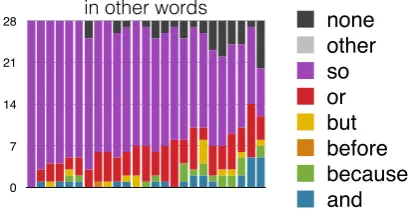
Rohde et al. (2016) report an OR∼SO response split forin other wordswhen participants could in-sert only their top choice of conjunction. Figure1 shows SO dominating participants’ choice in all cases, but OR showing up among their choices in all but one passage (leftmost vertical bar). Addi-tionally, several passages elicited BUT as the top choice of some participants.
0 7 14 21 28
and because before but or so other none
instead in other words
0 7 14 21 28
and because before but or so other none
0 7 14 21 28
and because before but or so other none
otherwise
[image:3.595.313.519.613.719.2]1
2260 Thein other wordspassages of the current ex-periment tested two linked hypotheses: The first is that OR∼SO response splits arise from two com-ponents of the lexical semantics of the adverbial itself: its sense of an evoked alternative and its sense of a consequence via restatement, whereby the truth of the second segment holds because it provides a reformulated restatement of the first seg-ment’s content. For passage (2), this corresponds to the deforestation of 75,000 acres of tropical forest entailing the disappearance of an area the size of Central Park every 16 minutes.
The second hypothesis is that the prevalence of and substitutability between SO and OR in (2) de-pends on the immediately adjacency of the two seg-ments. This was suggested by participant choices of BUT (cf. Figure1), as well as the observation that in other words does not always license OR via its lexical semantics and SO via entailment, as shown in (6), where BUT has become more avail-able. Note that none of the relations conveyed by these conjunctions (CONTRAST orCONCESSION for BUT,DISJUNCTIONfor OR,CONSEQUENCE for SO) are already conveyed by the adverbial itself, which forin other words) would beRESTATEMENT. (6) Unfortunately, nearly 75,000 acres of tropical forest are
converted or deforested every day.I don’t know where I heard that______ in other words an area the size of Central Park disappears every 16 minutes.
We tested these hypotheses by creating mini-mal pairs of 16 passages containingin other words. The pairs varied in the presence/absence of a meta-linguistic comment intervening between the origi-nal description and its reformulation, as in (7)–(8). (7) Typically, a cast-iron wood-burning stove is 60 percent
efficient ______ in other words 40 percent of the wood ends up as ash, smoke or lost heat.
(8) Typically, a cast-iron wood-burning stove is 60 percent efficient. How this is measured is unclear______ in other words 40 percent of the wood ends up as ash, smoke or lost heat.
For each passage, participants identified their preferred conjunction and then any others that they took to convey the same sense. Half the partici-pants saw a given passage with no intervening meta-linguistic comment, half with.
If our hypotheses are confirmed, it will show that manipulating the immediately preceding seg-ment can shift participants’ preference from rela-tions associated with OR and SO (ALTERNATIVE andCONSEQUENCE) to relations ofCONTRASTor CONCESSION. This would then be evidence that adjacency affects what coherence relations partici-pants take to be available.
0 7 14 21 28
and because before but or so other none instead
in other words
0 7 14 21 28
and because before but or so other none
0 7 14 21 28
and because before but or so other none otherwise
[image:4.595.315.520.80.183.2]1
Figure 2:Stacked bar chart for participants’ (N=28) conjunc-tion inserconjunc-tions inotherwisepassages (Rohde et al.,2016)
4.2 OtherwiseDataset
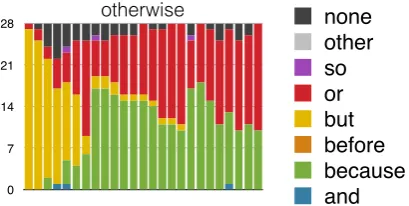
Rohde et al.(2016) report surprising response splits amongst BECAUSE∼BUT∼OR forotherwisein their conjunction-insertion data (Figure2). Given thatotherwisehas several different functions (de-scribed below), we hypothesize that different re-sponse splits arise from the lexical semantics of otherwise, combined with inference as to the func-tion of theotherwiseclause in a given passage.
One function ofotherwiseis in ARGUMENTA-TION. Here, anotherwiseclause provides a reason for a given claim, as in (9). Another function is in ENUMERATION, when the speaker first gives some preferred or more salient options, the otherwise clause introduces other alternative options, as in (10). A third use is in expressing anEXCEPTIONto a generalization. Here, the main clause expresses a generalization, whileotherwiseclause specifies an exception (disjunctive alternative) to it, as in (11).
(9) Proper placement of the testing device is an important issue ______ otherwise the test results will be inaccu-rate.
(10) A baked potato, plonked on a side plate with sour cream flecked with chives, is the perfect accompani-ment ______ otherwise you could serve a green salad and some good country bread.
(11) Mr. Lurie and Mr. Jarmusch actually catch a shark, a thrashing 10-footer ______ otherwise the action is light.
Results presented in (Rohde et al., 2017) for passages like (9) showed participant judgments of OR and BECAUSE, but not BUT. Passages like (10) yielded pairings of OR and BUT, but not BECAUSE. Lastly, passages like (11) yielded re-sponse splits between BUT and the less specific AND (Knott,1996).
2261 ENUMERATION. Thus we probe both participant choices of connectives and (via paraphrase) the use ofotherwisethat they take to hold.
We chose 16 passages for each use ofotherwise, based on our own category judgments. For each passage, we asked participants to select the con-junction that best expressed how its two segments were related, and then any other connectives that they took to express the same thing.
A paraphrase task was then used as further ev-idence for the relation participants inferred in the otherwisepassages. After completing a given ses-sion’s batch of passages, participants were asked to select which of three options they took to be a valid paraphrase of the passage. Each use of other-wisewas assigned a distinct paraphrase to link the left-hand and right-hand segments (LHS, RHS).
• ARGUMENTATION: “A reason forhLHSi is
hRHSi.”
• EXCEPTION: “GenerallyhRHSi. An excep-tion is whenhLHSi.”
• ENUMERATION: “There’s more than one good option forhgoali. They are:hLHSi,hRHSi.”
We also allowed participants to choose a second paraphrase if they thought it appropriate.
4.3 InsteadDataset
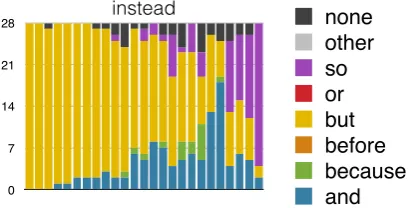
Rohde et al. (2016) report a range of participant choices in conjunction-insertion passages involv-ing instead (Figure3). For passages on the left of the figure, participants uniformly chose BUT, while the passage on the far right yielded a strong preference for SO. Elsewhere, some chose BUT and some chose SO. (For the current experiment, we ignore the fact that AND can contingently sub-stitute for either BUT or SO as a connective in text (Knott,1996), focussing only on passages where participants explicitly choose BUT and/or SO.)
Rohde et al.(2017) report even more surpris-ing participant responses to passages such as (12), where some participants selected both BUT and SO as equally expressing how the segments in the passage were related.
(12) There may not be a flight scheduled to Loja today ______ instead we can go to Cuenca. [BUT∼SO]
Neither the inter-participant split between BUT and SO in (Rohde et al., 2016) nor the intra-participant split between them (Rohde et al.,2017) can be explained in terms ofinstead itself, since
0 7 14 21 28
and because before but or so other none instead
in other words
0 7 14 21 28
and because before but or so other none
0 7 14 21 28
and because before but or so other none otherwise
[image:5.595.315.521.78.182.2]1
Figure 3:Stacked bar chart for participants’ (N=28) conjunc-tion inserconjunc-tions ininsteadpassages (Rohde et al.,2016)
insteadsimply conveys that what follows is an al-ternative to an unrealised situation in the context (Prasad et al.,2008;Webber,2013). The current experiment tests the hypothesis that this BUT∼SO split is a consequence of inference from properties of the segments themselves.
To test this hypothesis, we created 16 mini-mal pairs of passages containing instead, one of which emphasized the information structural par-allelism between the clauses, as in (13a), and an-other variant (13b) that de-emphasized that par-allelism in favor of a causal link implied by a downward-entailing construction such as too X (Webber,2013). For each passage, half the partici-pants saw the parallelism variant in the conjunction-insertion task, while half saw the causal variant.
(13) a. There was no flight scheduled to Loja yesterday ______ instead there were several to Cuenca.
b. There were too few flights scheduled to Loja yester-day ______ instead we went to Cuenca.
4.4 After allDataset
In (Rohde et al., 2017), we reported a BECAUSE∼BUT response split for passages containingafter all. We speculated that this may be because a passage such as (14) below presents an argument in which the second segment serves as a REASON (hence, BECAUSE) for the first segment, but also serves to CONTRAST with it (hence, BUT).
(14) Yes, I suppose there’s a certain element of danger in it ______ (after all) there’s a certain amount of danger in living, whatever you do.
We hypothesize that the BECAUSE∼BUT split cannot be a consequence of the adverbialafter all, which the Cambridge Dictionary indicates is “used to add information that shows that what you have just said is true”.1 IfREASONand/orCONTRAST
1https://dictionary.cambridge.org/us/dictionary/
2262
A B C D E F G H I J K L M N O P
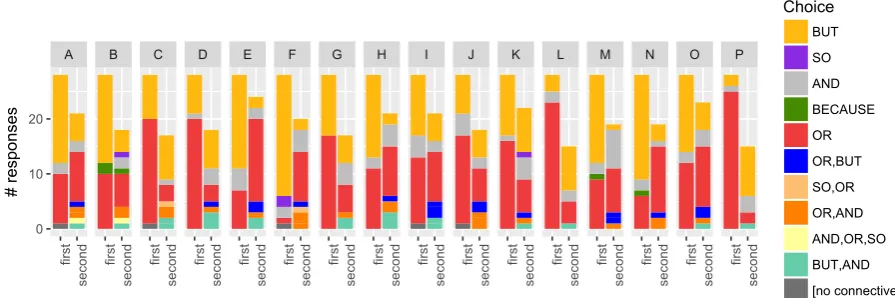
[image:6.595.75.521.76.186.2]no _i nt erve ni ng w ith _i nt erve ni ng no _i nt erve ni ng w ith _i nt erve ni ng no _i nt erve ni ng w ith _i nt erve ni ng no _i nt erve ni ng w ith _i nt erve ni ng no _i nt erve ni ng w ith _i nt erve ni ng no _i nt erve ni ng w ith _i nt erve ni ng no _i nt erve ni ng w ith _i nt erve ni ng no _i nt erve ni ng w ith _i nt erve ni ng no _i nt erve ni ng w ith _i nt erve ni ng no _i nt erve ni ng w ith _i nt erve ni ng no _i nt erve ni ng w ith _i nt erve ni ng no _i nt erve ni ng w ith _i nt erve ni ng no _i nt erve ni ng w ith _i nt erve ni ng no _i nt erve ni ng w ith _i nt erve ni ng no _i nt erve ni ng w ith _i nt erve ni ng no _i nt erve ni ng w ith _i nt erve ni ng 0 5 10 # re sp on se s Choice BUT SO AND BECAUSE OR [no connective]
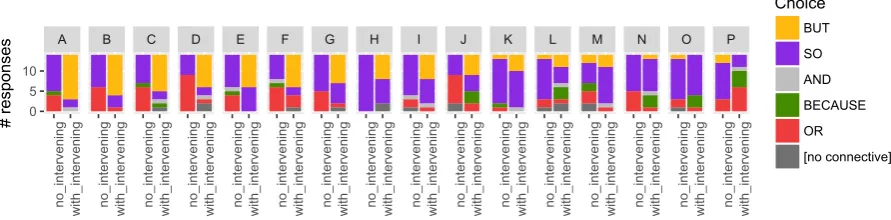
Figure 4:Distribution of participants’ first choice of conjunction for passages within other words. Each participant saw only one variant. Each vertical bar represents a passage with the responses from each participant, color-coded by conjunction.
are being conveyed, it can’t be a consequence of after all. As such, this response split must depend on the reasoning that supports the inference of co-herence between the two segments, separate from the adverbial itself.
We test the hypothesis that the response split is independent of the presence or absence ofafter all. Starting with 16 passages that originally contained after all, we created a variant of each passage with-out the adverbial. The conjunction insertion task was the same as with the other datasets.
5 Results
5.1 In other words: Inference and adjacency
Section 4.1lays out the joint hypotheses that in-ferred relations in passages with in other words reflect two components of the lexical semantics of the adverbial (leading to the OR∼SO split) and that the presence of intervening material beforein other words reduces the availability of those relations, favoring BUT instead.
Figure 4 shows the predicted pattern: The no-intervening-content condition primarily yields OR/SO responses (with variation across passages on the OR-vs.-SO preference) with a relative in-crease in BUT responses in the intervening-content condition.2 Passage B corresponds to the pair of examples (2)/(6), and passage C reflects (7)/(8).
For the analysis here and in Section5.3, a rele-vant first-choice conjunction was chosen and the binary outcome of its insertion was modeled with a mixed-effect logistic regression. Here, the insertion of OR indeed varied with the presence/absence of intervening material (β =−1.569,p <0.005).
We posit that increases in BUT associated with the intervening content indicate either an interrup-tion of the meta-linguistic tangent or an inteninterrup-tion to signal a contrast with the negative affect of the
2For Passage P in Figure4, participants may have linked
thein other wordsclause to the intervening material itself.
tangent itself (e.g., “I don’t know where. . . ”, “frus-trating way of putting it”, “how this is measured is unclear”). We speculate that the presence of BE-CAUSE in passages with intervening content may arise when that content implies that the situation is somehow surprising, which in turn merits ex-planation (e.g., “it’s an UNUSUAL role for her”, “their ability to actually work sensitively is perhaps QUESTIONABLE”, “it’s STRANGE to think of a planet being born”). These hypotheses will them-selves need to be tested.
5.2 Otherwise: Inference from semantic features of segments
2263
A B C D E F G H I J K L M N O P
first
se
co
nd first
se
co
nd first
se
co
nd first
se
co
nd first
se
co
nd first
se
co
nd first
se
co
nd first
se
co
nd first
se
co
nd first
se
co
nd first
se
co
nd first
se
co
nd first
se
co
nd first
se
co
nd first
se
co
nd first
se
co
nd
0 10 20
#
re
sp
on
se
s
Choice BUT
SO
AND
BECAUSE
OR
OR,BUT
OR,SO
OR,AND
OR,BECAUSE
AND,OR,BUT
AND,OR,SO
AND,OR,SO,BUT
[image:7.595.76.524.106.272.2][no connective]
Figure 5:Distribution of first and second choice conjunctions forARGUMENTATIONotherwise. Labels such as “OR,BUT” are for multiple second choices. Each vertical bar represents a passage with the responses from each participant, color-coded by conjunction. Enlarged B/W versions of Figures 4–8 are available via the “notes” link on the paper in the ACL anthology.
A B C D E F G H I J K L M N O P
first
se
co
nd first
se
co
nd first
se
co
nd first
se
co
nd first
se
co
nd first
se
co
nd first
se
co
nd first
se
co
nd first
se
co
nd first
se
co
nd first
se
co
nd first
se
co
nd first
se
co
nd first
se
co
nd first
se
co
nd first
se
co
nd
0 10 20
#
re
sp
on
se
s
Choice BUT
SO
AND
BECAUSE
OR
OR,AND
[image:7.595.73.525.377.478.2][no connective]
Figure 6:Distribution of first and second choice conjunctions forEXCEPTIONotherwise. The label “OR,AND” in the legend implies both as second choices.
A B C D E F G H I J K L M N O P
first
se
co
nd first
se
co
nd first
se
co
nd first
se
co
nd first
se
co
nd first
se
co
nd first
se
co
nd first
se
co
nd first
se
co
nd first
se
co
nd first
se
co
nd first
se
co
nd first
se
co
nd first
se
co
nd first
se
co
nd first
se
co
nd
0 10 20
#
re
sp
on
se
s
Choice BUT
SO
AND
BECAUSE
OR
OR,BUT
SO,OR
OR,AND
AND,OR,SO
BUT,AND
[no connective]
[image:7.595.70.518.567.716.2]2264
A B C D E F G H I J K L M N O
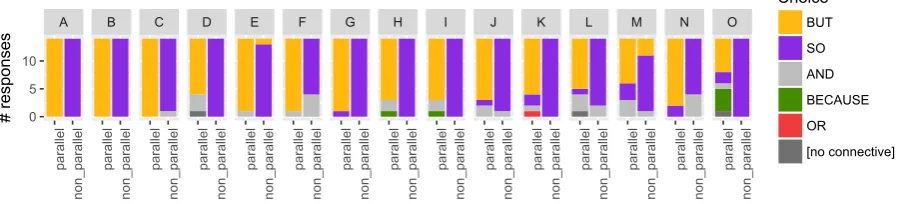
[image:8.595.75.525.79.181.2]pa ra lle l no n_ pa ra lle l pa ra lle l no n_ pa ra lle l pa ra lle l no n_ pa ra lle l pa ra lle l no n_ pa ra lle l pa ra lle l no n_ pa ra lle l pa ra lle l no n_ pa ra lle l pa ra lle l no n_ pa ra lle l pa ra lle l no n_ pa ra lle l pa ra lle l no n_ pa ra lle l pa ra lle l no n_ pa ra lle l pa ra lle l no n_ pa ra lle l pa ra lle l no n_ pa ra lle l pa ra lle l no n_ pa ra lle l pa ra lle l no n_ pa ra lle l pa ra lle l no n_ pa ra lle l 0 5 10 # re sp on se s Choice BUT SO AND BECAUSE OR [no connective]
Figure 8:Insteadpassages, pairing a parallel variant and a causal variant. Each column shows the distribution of participants’ first choice in the conjunction-insertion task. Each participant saw only one variant.
participants’ top choice, with OR or BECAUSE chosen as equivalent (shown in the columns la-belled “second”). ForEXCEPTION(Figure6), BUT is consistently the participants’ top choice.
There are a few deviations from this near uni-form endorsement of BUT for EXCEPTION (Fig-ure 6, passages L–P). Any hypotheses, however, would require further experimentation to test. For example, in passage M (see (15)) and P (see (16)), participants rarely identified any conjunction as conveying the same sense as BUT. However, when their top choice was BECAUSE, they also selected OR as conveying the same sense. As noted above, BECAUSE and OR predominate with otherwise used inARGUMENTATION. This raises the question of why passages M and P lead some participants to inferARGUMENTATIONand other participants, eitherEXCEPTIONorENUMERATION.
(15) Democrats insist that the poor should be the priority, and that tax relief should be directed at them _____ otherwise they lack a cogent vision of the needs of a new economy.
(16) He said that the proposed bill would give states more flexibility in deciding whether they wanted to use the Federal money for outright grants to municipalities or to set up loan programs _____ otherwise it left last fall’s Congressional legislation unchanged.
Finally, though the pattern forENUMERATION (Figure7) is harder to see, combinations of BUT, OR and AND predominate as participants’ top choices, with a few tokens of BECAUSE and SO, but too few to analyse as anything but noise.
The above results reflect researcher-assigned use labels. However, the confusion matrix in Table1 shows that on the whole, participants agree with
that assignment. The column labelled Multiple is for cases where participants offered two para-phrases. ForARGUMENTATION, at least one para-phrase always corresponded toEXCEPTION, while forENUMERATION, it did so for most of these to-kens (9/14). We comment on this below.
While there was less agreement when partici-pants offered multiple paraphrases for researcher-assigned EXCEPTION, there may be too few to-kens here to draw any kind of conclusion. In any case, the results forARGUMENTATION and ENU-MERATIONagree both across participants (in what paraphrase they choose when they don’t choose the researcher-assigned label) and within partici-pants (in what pairs of paraphrases they gave for the original passage).
The above results support our hypothesis that variability in participants’ choice of conjunctions follows from both the lexical semantics of other-wiseand the relation that participants infer between the segments in the passage.
5.3 Instead: Inference from a single manipulated property
On aggregate, participants responded very differ-ently to the parallel and causal variants ofinstead passages (cf. Section4.3). Figure8shows that in all cases, the parallel variant yielded more BUT re-sponses, whereas the non-parallel (causal) variant yielded significantly more SO responses (main ef-fect of (non-)parallelism: β=−7.0008,p<0.001).3
Some of these results are very strong. For exam-ple, Passage A (17) drew all BUT responses for the
3
We analyzed only 15 passages forinsteadandafter all, due to a presentation error of the 16th for these adverbials.
Participant
Researcher ARGUMENTATION ENUMERATION EXCEPTION Multiple
ARGUMENTATION 401 (91.5%) 4 25 18
ENUMERATION 23 364 (81.4%) 46 14
EXCEPTION 21 29 393 (87.7%) 5
2265
A B C D E F G H I J K L M N O
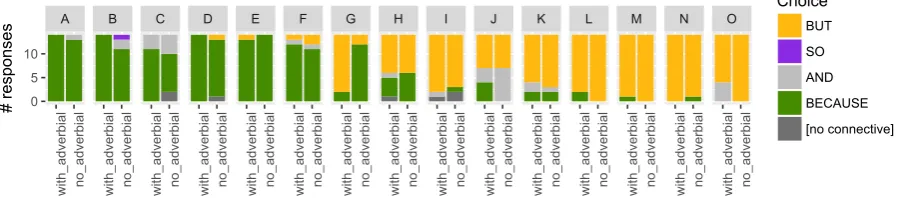
[image:9.595.74.524.77.176.2]w ith _a dve rb ia l no _a dve rb ia l w ith _a dve rb ia l no _a dve rb ia l w ith _a dve rb ia l no _a dve rb ia l w ith _a dve rb ia l no _a dve rb ia l w ith _a dve rb ia l no _a dve rb ia l w ith _a dve rb ia l no _a dve rb ia l w ith _a dve rb ia l no _a dve rb ia l w ith _a dve rb ia l no _a dve rb ia l w ith _a dve rb ia l no _a dve rb ia l w ith _a dve rb ia l no _a dve rb ia l w ith _a dve rb ia l no _a dve rb ia l w ith _a dve rb ia l no _a dve rb ia l w ith _a dve rb ia l no _a dve rb ia l w ith _a dve rb ia l no _a dve rb ia l w ith _a dve rb ia l no _a dve rb ia l 0 5 10 # re sp on se s Choice BUT SO AND BECAUSE [no connective]
Figure 9:Distribution of first choice in conjunction selection task for passages withafter all
parallel variant in (17a) and all SO responses for the causal variant in (17b), as did Passage B. In a few cases, however, the parallel variant drew vari-able responses, even while its causal variant drew strong SO responses. This is true of Passage O, with parallel and causal variants in (18a–b).
(17) a. They could have been playing football in the village green _____ instead they played in the street.
b. They didn’t like playing football in the village green _____ instead they played in the street.
(18) a. Smugglers nowadays don’t use overland passages _____ instead they use the seas to transport their goods.
b. Smugglers’ overland passages nowadays are too visible _____ instead they use the seas to transport their goods.
One possible explanation is that participants var-ied in the role they assigned to the positive claim in the second segment of (18a) – either as a reason for the negative claim in the first segment (BECAUSE), as a contrast with that claim (BUT), or as its result (SO). Although manipulating the segment to en-hance either parallelism or causality can change participant responses, it is clear that parallelism alone doesn’t guarantee contrast.
5.4 After all: Adverb adds little to inference
Figure9shows participant choice of conjunction when after all is present and when it is absent. Their choice is largely the same for passages A–F and K–N, with and without the adverbial. As for passage O, since AND can contingently substitute for BUT (Knott,1996), the response pattern can be considered the same as well. A by-passage cor-relation between the rate of BUT and BECAUSE responses across the two conditions confirms this similarity (R2=.70, F(1,13)=30.98,p<0.001). The outlier is passage G:
(19) There was a testy moment driving over the George Wash-ington Bridge when the toll-taker charged him $24 for his truck and trailer _____ after all it was New York.
Withafter all, the majority of participants chose BUT as best expressing how the two segments are connected, while without it, the majority chose BE-CAUSE. Whatever explanation we gave here would be pure speculation. We trust that the fact that the other 14 passages demonstrate the predicted effect provides sufficient evidence that splits in partici-pant responses are not simply a result of the pres-ence of a discourse adverbial.
6 Conclusion
While our previous work showed that multiple dis-course relations can hold between two segments – relations at the same semantic level,
simultane-ously available to a reader – we provided no evi-dence as to what influences the particular relations that are taken to be available. Our current experi-ments have provided some such evidence. Specif-ically, we have shown that participant responses to systematically manipulated passages involving discourse adverbials can be explained in terms of both the lexical semantics of discourse adverbials and properties of the passages that contain them. As the conjunctions chosen by participants con-vey senses that differ from those of the discourse adverbials, we also provided evidence for the simul-taneous availability of multiple coherence relations that arise from both explicit signals and inference. We hope the reader is now convinced that, in both psycholinguistic research on discourse coherence and computational work on discourse parsing, one needs to identify and examine evidence for coher-ence involving more than one discourse relation.
Acknowledgments
2266 References
M.J. Cuenca and M.J. Marin. 2009. Co-occurrence of discourse markers in Catalan and Spanish oral narra-tive.Journal of Pragmatics, 41(5):899–914. Jesse Dunietz, Lori Levin, and Jaime Carbonell. 2017.
The BECauSE Corpus 2.0: Annotating causality and overlapping relations. InProceedings of the 11th Linguistic Annotation Workshop, pages 95–104, Va-lencia, Spain.
Vanessa Wei Feng and Graeme Hirst. 2012. Text-level discourse parsing with rich linguistic features. In Proceedings of the 50th Annual Meeting of the Asso-ciation for Computational Linguistics, pages 60–68, Jeju Island, Korea.
Bruce Fraser. 2013. Combinations of contrastive dis-course markers in English. International Review of Pragmatics, 5:318–340.
Barbara Grosz and Candace Sidner. 1986. Attention, intention and the structure of discourse. Computa-tional Linguistics, 12(3):175–204.
Michael Halliday and Ruqaiya Hasan. 1976. Cohesion in English. Longman.
Yangfeng Ji and Jacob Eisenstein. 2014. Representa-tion learning for text-level discourse parsing. In Pro-ceedings of the 52nd Annual Meeting of the Associa-tion for ComputaAssocia-tional Linguistics, volume 1, pages 13–24, Baltimore, Maryland.
Alistair Knott. 1996. A Data-driven Methodology for Motivating a Set of Coherence Relations. Ph.D. dis-sertation, Department of Artificial Intelligence, Uni-versity of Edinburgh.
Ziheng Lin, Hwee Tou Ng, and Min-Yen Kan. 2014.A PDTB-styled end-to-end discourse parser. Natural Language Engineering, pages 151–184.
William C. Mann, Christian M. I. M. Matthiessen, and Sandra A. Thompson. 1989. Rhetorical structure theory and text analysis. Technical Report ISI/RR-89-242, USC-ISI, Marina del Rey CA.
William C. Mann and Sandra A. Thompson. 1988. Rhetorical Structure Theory: Toward a functional theory of text organization.Text, 8(3):243–281. Daniel Marcu. 2000. The theory and practice of
dis-course parsing and summarization. MIT Press. Eleni Miltsakaki, Nikhil Dinesh, Rashmi Prasad,
Ar-avind Joshi, and Bonnie Webber. 2005. Experi-ments on sense annotation and sense disambigua-tion of discourse connectives. InProceedings of the Fourth Workshop on Treebanks and Linguistic Theo-ries (TLT’05), Barcelona, Spain.
Johanna Moore and Martha Pollack. 1992. A problem for RST: The need for multi-level discouse analysis. Computational Linguistics, 18(4):537–544.
Rashmi Prasad, Nikhil Dinesh, Alan Lee, Eleni Milt-sakaki, Livio Robaldo, Aravind Joshi, and Bon-nie Webber. 2008. The Penn Discourse TreeBank 2.0. InProceedings of the 6th International Confer-ence on Language Resources and Evaluation, pages 2961–2968, Marrakech, Morocco.
Rashmi Prasad, Bonnie Webber, and Aravind Joshi. 2014. Reflections on the Penn Discourse TreeBank, comparable corpora and complementary annotation. Computational Linguistics, 40(4):921–950.
Hannah Rohde, Anna Dickinson, Chris Clark, Annie Louis, and Bonnie Webber. 2015. Recovering dis-course relations: Varying influence of disdis-course ad-verbials. In Proceedings of the First Workshop on Linking Computational Models of Lexical, Senten-tial and Discourse-level Semantics, pages 22–31, Lisbon, Portugal.
Hannah Rohde, Anna Dickinson, Nathan Schneider, Christopher Clark, Annie Louis, and Bonnie Web-ber. 2016. Filling in the blanks in understand-ing discourse adverbials: Consistency, conflict, and context-dependence in a crowdsourced elicitation task. InProceedings of the Tenth Linguistic Anno-tation Workshop (LAW-X), pages 49–58, Berlin, Ger-many.
Hannah Rohde, Anna Dickinson, Nathan Schneider, Annie Louis, and Bonnie Webber. 2017. Explor-ing substitutability through discourse adverbials and multiple judgments. In Proceedings of the 12th International Conference on Computational Seman-tics (IWCS), Montpellier, France.
Merel Scholman and Vera Demberg. 2017. Crowd-sourcing discourse interpretations: On the influence of context and the reliability of a connective inser-tion task. InProceedings of the 11th Linguistic An-notation Workshop, pages 24–33, Valencia, Spain. Manfred Stede. 2012. Discourse Processing. Morgan
& Claypool Publishers.
Bonnie Webber. 2013. What excludes an alternative in coherence relations? InProceedings of the 10th International Conference on Computational Seman-tics, Potsdam, Germany.
Bonnie Webber, Aravind Joshi, and Alistair Knott. 2000. The anaphoric nature of certain discourse con-nectives. InMaking Sense: From Lexeme to Dis-course, Groningen, The Netherlands.
Nianwen Xue, Hwee Tou Ng, Sameer Pradhan, Rashmi Prasad, Christopher Bryant, and Attapol T. Ruther-ford. 2015. The CoNLL-2015 Shared Task on Shallow Discourse Parsing. InProceedings of the Nineteenth Conference on Computational Language Learning: Shared Task, pages 1–16, Beijing, China. Nianwen Xue, Hwee Tou Ng, Sameer Pradhan,
2267