Stochastic Approximation Method for Fixed Point
Problems
Ya. I. Alber1, C. E. Chidume2, Jinlu Li3
1Department of Mathematics, The Technion-Israel Institute of Technology, Haifa, Israel 2The Abdus Salam International Centre for Theoretical Physics, Trieste, Italy 3Department of Mathematical Sciences, Shawnee State University, Portsmouth, USA
Email: [email protected], [email protected]
Received August 28, 2012; revised November 28, 2012; accepted December 5, 2012
ABSTRACT
We study iterative processes of stochastic approximation for finding fixed points of weakly contractive and nonexpan- sive operators in Hilbert spaces under the condition that operators are given with random errors. We prove mean square convergence and convergence almost sure (a.s.) of iterative approximations and establish both asymptotic and nonasymptotic estimates of the convergence rate in degenerate and non-degenerate cases. Previously the stochastic ap- proximation algorithms were studied mainly for optimization problems.
Keywords: Hilbert Spaces; Stochastic Approximation Algorithm; Weakly Contractive Operators; Nonexpansive
Operators; Fixed Points; Convergence in Mean Square; Convergence Almost Sure (a.s.); Nonasymptotic Estimates of Convergence Rate
1. Introduction
In this paper the following problem is solved: To find a fixed point x of the operator in other
words, to find a solution
:
T GH, xG of the equation
,
xTx (1.1)
where T is a Lipschitz continuous mapping, H is a
Hilbert space, is a closed convex subset. We suppose that
GH
x exists, i.e., the fixed point set of
is nonempty. Note in different particular cases of the Equation (1.1), for example, when T G the
solution existence and solution uniqueness can be proved under some additional assumptions.
N
: G,
T
We separately consider two classes of mappings T: the
class of weakly contractive maps and more general class of nonexpansive ones. Let us recall their definitions.
Definition 1.1. A mapping is said to be
weakly contractive of class t on a closed convex subset if there exists a continuous and increas- ing function
:
T GH
C
GH
t defined on IR such that is po- sitive on IR
0 , 0 0,limt
t ,
and for all
, ,
.x yG Tx Ty x y xy (1.2)
Remark 1.2. It follows from (1.2) that
tDefinition 1.3. A mapping is said to be
nonexpansive on the closed convex subset if for all
:
T GH
GH
,
x yG
.
Tx Ty xy
It is obvious that the class of weakly contractive maps is contained in the class of nonexpansive maps because the right-hand side of (1.2) is estimated as
0 x y xy x y , (1.3) and it contains the class of strongly contractive maps because
t 1 q
t with 0 q 1 gives us.
Tx Ty q xy (1.4)
We study the following algorithm of stochastic appro- ximation:
1 , 1, 2, , 1
n G n n n n ,
x Pr x S x n x G (1.5)
where PrG is the metric projection operator from H
onto G and deterministic step-parameters n satisfy the
standard conditions:
2
1 1
and .
n
n n
n
(1.6)t
and in real problems an argument of the function t
tdoesn’t necessary approaches to obeying the con- dition T G: H (see the example in Remark 3.4).
The factor n n in (1.5) is an infinite-dimensional vector of random observations of the clearance operator
S x
F I T at random points xnG
, ,given for all on the same probability space
1
n
.A P
,
n n n n
S x (1.7)
where n xnTxn and n is a sequence of indepen-
dent random vectors with the conditions
21 1
0 and , 0 .
n n
E E C C (1.8)
Here is a symbol of the mathematical expectation. In order to calculate conditional mathematical expecta- tions of different random variables we define the
E
- subalgebra An:
x x1, , ,2 xn
on
, ,A P
. And then
n n
means n function with the following property: for anyE A A-measurabl
n BA
e
d d
n n n
B B
P E A P .
We also assume in the sequel that n is An-mea-
surable for all n1.
Let us recall the mean square convergence and almost sure (a.s.) convergence.
We say that the sequence
n of random variables
n
converges in mean square to if exists and
2
lim n 0.
nE
The sequence n converges to almost surely or
with probability 1 if
lim n
1.n
P
Almost sure convergence and convergence in mean square imply convergence in the sense of probability: The sequence
n of random variables n
con-verges in the sense of probability to if for all
0
lim n 0.
nP
So, we consider iterative processes of stochastic approximation in the form (1.5) for finding fixed points of weakly contractive (Definition 1.1) and nonexpansive (Definition 1.3) mappings in Hilbert spaces under the conditions (1.8). We prove mean square convergence and convergence almost sure of iterative approximations and establish both asymptotic and nonasymptotic estimates of the convergence rate. Perhaps, we present here the first results of this sort for fixed point problems. Formerly the stochastic approximation methods were studied mainly to find minimal and maximal points in optimization problems (see, for example, [1-6] and references within).
2. Auxiliary Recurrent Inequalities
Lemma 2.1. [3,4] Let
k , k and
k
1 1 , 1
k k k k k
, 2, (2.1)
Assume that
1 k
k
and Then1
. k k
kis bounded and converges to some limit.
Lemma 2.2. [3,4] Let
k , k , k and
k be sequences of nonnegative real numbers satisfying the recurrent inequality.
1 1 ,
k k k k k k k
1, 2, , (2.2)
where
1 1
,
k k
k k
and either1
k k
orlim k 0.
k k
(2.3)
Assume that
tIR
is continuous and increasing func- tion defined on such that is positive on
IR 0 ,
0 0. Then limkk 0. There existsan infinite subsequence
kl ,l1,2,, such that1 0
1
1 l ,
l l
l
k
k k
k k k
C
where 0
1
1 k .
k
C
In the following two lemmas we want to present non- asymptotic estimates for the whole sequence k,k1.
For this the stronger requirements are made of para- meters k and function in the recurrent in-
equality.
t
Suppose that
t such that
k k, F t
and
t are antiderivatives from
t and
1 ,
t
re-
spectively, with arbitrary constants (without loss of generality, one can put
C
0
C ), i.e.
d ,
d
t .F t t t t
t
Observe that F t
has the following properties:i) F t
t ;ii) F t
is strictly increasing on
1,
and
F t as t ;
iii) The function
be se- quences of nonnegative real numbers satisfying the re- current inequality.
t F
g t t
F t F t
is decreasing;
iv) G t
lnF t
as t .Introduce the following denotations:
1) 1
z and 1
z are the inverse functions to
t and
t , respectively;2)
0 1
0 1
1 , 2, 1
1
c s
v s s s c
s
fixed control parameter;
3)
,
1
2
u s C C a F s F ,
0 0
1
0, c 1;
C a
c
4) w s v r
,
1
v r
a F s
F
2 ,
2 r ;
5)
1
2
1
Q c c a F F , where
0
c is an arbitrary fixed number;
We present now the based condition (P): The graphs
of the scalar functions and with any fixed are intersected on the interval
v s w s v r
,
2,
r
2,
not more than at two points s1 and s2 (we do not con- sider contact points as intersection ones excepting s2
if any).
For example, the graphs of the functions v s
and
,w s v r
calculated for
s b,b 0, 0 1 s ,
,
and
t t, 1 satisfy the condition (P).Lemma 2.3. [3,4] Assume that 1) the property (P) is carried out for the function
2
u s v
, 2
and2) as
,
w s v
v s ; u s v
, 2
v s
s ; 3) the control ameter.
(2.4)
Then for the sequence
par c0 is chosen such that
, 2
u s v v s ass 2
k generated by the in- eq, (2.5)
it follows: uality
1 , 1, 2,
k k k k k k
limkk 0 and for all
. (2.6)
Lemma 2.4. [3,4] Assume that 1) the proper ca
1
k
,
, 1
,k u k C C v
max
Q
2
ty (P) is rried out for all the function w s v
, 2
r
and v s
;2) u s v
, 2
v s
as s . he seq
k
generated by the inequali Then for tty (2.5) limkkuence0.dition,
a) if Q
In ad
1 v 2
uch that u s
and the control parameter is chosen s
(2.7)
b) in all remaining cases
0
c
, 2v v s as s2, then for
all 2k
;k v k
,
,
1
u k C C
max , 2 ,
1 ,
k Q v
k s
(2.8)
, ,k v k k s
(2.9)
where is a unique root of the equation
,
u s C v s (2.10)
on the interval
s
2,
. g The followin relemmas deal with another sort of current inequalities:
Lemma 2.5. [7,8] Let
k , k , k and
k real numbers satisfyingbe sequences of non-negative the recurrence inequality.
1
k k k k k,k 1, 2,
. (2.11) Assume that
1 1
and .
k k
k k
Then:
e exists an infinite subsequence
i) Ther
k k
such that
1
1 ,
k k
j j
(2.12)
and, consequently, limkk 0; 0
ii) if limkk and there exists 0 such that
1
k k k
(2.13)
for all k1, then limkk 0.
] Let
Lemma 2.6. [7,8
k , k , k and
kreal numbers satisfying be sequences of non-negative the recurrence inequality (2.11). Assume that
1
k k
and (2.3) is satisfied. Then there exists an infinite sub- sequence
k
k such that limkk 0.3. Mean Square Convergence of Stochastic
Approximations
eorem 3.1. Assume
Th that T G: H is a weakly ss C ,
contractive mapping of the cla 1
is a convex function with respect to t2 and2
1 .
E x x Then the sequence
xn
generated by (1.5)-(1.7) converges in mean square to a unique fixed point x of T. There exists an infinite subsequence
nl ,l1, 2,, such that2 1
0 1
1 1
, 2
l l l
n n n
n n
E x x C C
(3.1)
where
2
1
the inequality
and some positive constant
(3.2) 0
C
satisfies
2
0 1
1 8 n .
n
C
Remark 3.2. exists in view condition in (1.6
no on
0
1C
).
of the second
Proof. First of all, we te that the method (1.5)-(1.7)
guarantees inclusi xn G for all n1. Since the
metric projection
operator PrG is nonexpansive in a
Hilbert space and xG exists, we can write
2 1
2
n
x x
2
1 2
2 1
2 ,
2 ,
2 , .
G n n n n n G
n n n n n
n n n n
n n n n n
Pr x x Tx Pr x
x x x x
x x x x
x x x x
(3.3)
Let us evaluate the first scalar product in (3.3). We have
2 2 2
1
,
n n n
x Tx x x
,
,
n n n
n n n
n n n
n n n n
n n n
x x Tx Tx x x x x Tx Tx x x x x Tx Tx x x
x x x x x x x x
x x x x x x
(3.4)
We remember that
2
1 .
(3.4) yield
Then the in- equalities (3.3) and
2 2
1
n n
x x x x x
2
2 2
2
2 , .
n n
n n n n n n
x x x
(3.5)
Applying the conditional expectation with respect to
n
A to the both sides of (3.5) we obtain
2 1
n n
E x x A
2 2
2 2
2
2 , .
n n n
n n n n n n n n
x x x x
E x x A E A
(3.6)
It is easy to see that
2 2
n n
2
2 2
2 2
2 2 .
n
n n n n
n n n
E A
E A E A
E A
(3.7)
Since is weakly contractive and therefore non- expansive, one gets
T
2 2
4 .
n n n
x Tx x x
Taking into account (3.7), the inequali mated as follows:
ty (3.9) is esti-
2
2 2
2
2 , 2 .
n n
n n
n n n n n n n
E x x A
x x x
E x x A E A
(3.8)
1
2 2
2
1 8n xn
Now the unconditional expectation implies
2 1
2 2
2
2 2
1 8 2
2 , 2
n
n n n n
n n n n n
E x x
E x x E x x
E x x E
(3.9)
Next we need the Jensen inequality for a convex fun- ction
xn x 2
:
2
2n n
E x x E x x
(see [9,10]). This allows us to rewrite (3.9) in the form
2 1
n
E x x
2 2
2 2 2
1 8
2 2
n n
n n n n
E x x
E x x E
(3.10)
because of
n, n
0E x x .
Denoting n E xn x 2
we have
2
21 1 8 2 2 1 ,
n n n n n C n
(3.11)
ew of Definition 1.1,
where in vi
0 0 is a continuous
ng function with . Due to (6), from Lemma 2.2 it follows
and increasi
2
lim n 0
n E x x
and the estimate (3.1) holds too. The theorem is p
□
of we it is un ample wa
roved.
Remark 3.3. If a fixed point akly contractive mapping T G: H exists, then ique [11].
Remark 3.4. The following ex s presented in
[11]: Let Txsin ,x
0,1t
G and It has been show
: .
3 1 sin sin
8
x y x y xy
for all 0 x y 1. Then
3
4
21
1 , 1 and 1 .
8 t 8t
8
que fixe
Definition 3.5. Let a nonexpansive mapping
:
T GH have a uni d point x. d c in
T is ve on the close onvex subset if there exists continuous and creasing func- said to be weakly sub-contracti
GH
tion
t defined on IR such that is positive on
0IR ,
0 0,tlim
t , such that for allxG.
2
,
x Tx x x xx . (3.12)
Theorem 3.6. Assume that a mapping T G: H is weakly sub-contractive and the function
t in (3.12) is convex on IR Then the results of Theorem 3.1 holds for the sequence
xn g erated by (1.5 (1.7).Th u ) can
en
e second .6
assume n t less than linear growth )
ineq ality in (1 be omitted if we
o of
“on in-finity” and put n0
Assume
as
Theorem 3.7. tha ing is
weakly sub-contractive and the function is convex
n
t a mapp T G: H
t
in (3.12) on IR Suppose that instead e conditions1
lim n 0 and n .
n
(3.13) of (1.6) th
n
hold. In addition, let n 0.5 and
lim 4 .
14)
Then the sequence
n(3.
x generated by (1.5), (1.7) and
(3.13) converges in mean square to x. There exists an
infinite subsequence
nl ,l1, 2,, such that2 1 3
1
1 .
2 2
l l
n
E x x
l
n n
n n
C
where
2 2
1 1
,
2 8 ,
4 .
C
C
3.15)
Proof. Consider the inequality ( 11) in the for
,
n
2
3 1 1 2
2 1
2 8 max ,
C C x x C
C
(
m
2 21 2 2 1 8
n n n n C n n
where n E xn x 2 .
Observe that it is derived by making use of (3.4) and the nonexpansivity property of
We shall show that .
T n are bounded for all
1, 2,
.n I Indeed, since
oncl is a us function, ude that
convex in- creasing continuo we c
1
is nondecreasing and since (3.14) holds,
the inequality
C14 has a solutionwhere is the unique root of the scalar equ0
,
(3.16)
ation
C14. Together with this, (3.4) and(3.14) are co-ordinated by the parameter 0.5. Only one alternative can happen for each nI:
er eith
2 21: 2 n n 2 1 n 8 n n 0
H C
or
2 21 2 n n 2
2: n 8 n n 0.
H C
Den te o I1
nI H1is true
and
2 2is true
I nI H . It is clear that I1I2I. From
the hypothesis H1, it arises
n C1 4 n,
for all nI1. From the hypothesis and then n
2,
H we have: n1n for all nI2. Consider all
1)
the possible cases:
2 .
I Then n for all nI.
2) I1 . Then n1 for all nI.
3) Let I1
1, 2,,N0
and I2
N01,N02,
.Then n for n1, 2, , N0. By (3.16), 2
n C
0 1 2.
N C
It is obvious that for 0 2, 0 3, .
N N Therefore, nC2 for all nI.
4) Let I2
1, 2, , N0
and I1
N01,N02,
.Then n1 for n1, 2,,N0. and n for
0 1,N0 2,
N Thus, n fo I.
5) Let 1
r all n
I and I2 be unbounded sets. Consider an
arbitrary interval
1, s 1
2,s s 1
I n n I
where 1 I s1
.
, , 1,3,5,
s s
n n It is easy to be sure that
s
n
and nC2 for all nIs.
nded a
6) The other situations of bou nd unbounded sets 1
I and I2
e th
are covered by ms 1)-5). Consequently
v e result: ll
the ite ,
we ha final n max
1,C2
for a .nI
Thus, we obtain the inequality
21 2 3 ,
n n n n C n
(3.17)
where is defined by (3.15). Now Lemma 2.2 with n (2.3) implies the re
Rema . For a nction
3
C
ditio
the con sult. □
is convex and concave at the same time we suppose
2 c 4 .
Remark 3.9. If G is bounded or more generally
xn difis bounded, t e inequality (3.17) (with some ly follows from (3.16).
4. Estimates of the Mean Square
ble to gi
hen th ferent constant C3) immediate
Convergence Rate
Using Lemmas 2.3 and 2.4 we are a ve two general theorems on the nonasymptotic estimates of the mean square convergence rate for sequence
xn gene-rat ti
(1.7)
re
ed by the stochas c approximation algorithm (1.5)- .
Again we introduce denotations 1)-5) from Section 2 induced now by the current inequality (3.11):
1) 1
z
and 1
z
are the invers
t and
t , respectively;2)
1
v s C c s
e functions to
1
is
,
2
12C s1 ,c
1 0 1 0
a fixed control parameter;
3)
1
2 2 2
, 2 0,
u s C C a F s F
C 0 1 1
c a
c
0
4)
,
1
2
,w s v r v r a F s F
; 2s,r
5) 1
1 x a F 2 F 1 .
ndition (P).
orem 4.1. Assume that all the conditions o Th are fulfiled and
i) the cond on (P) holds for the functions
and as
2
Q x
Introduce also the basic co
The f
eorem 3.1
iti
, 2
, 2
w s v u s v v s
;ii) u s v
, 2
v s
s ;iii) c01 is chosen such that u s v
, 2
v s
asen the sequence 2.
Th
s
xn generated by (1. )-(1.7)co oint
5 nverges in average to a unique fixed p x of
an
T
d for all n1
0 , 2 ,
n
E x x C u n C
, 2v
2 max .
C Q
(4.1)
orem 4.2. Assu hat a he conditions of
Th m 3.1
i) th con s
2
The me t ll t
eore are fulfiled and
e dition (P) holds for the function v s
and w s v z
,
with any fixed z
2,
;ii) u s v
, 2
v s
as s ;iii) If and is chosen such that then the sequence
generated by (1.5)-(1.7) converges in average to a unique fixed point
2Qv
v s
as0 1
c
2,
, 2
u s v s
xnx of T and for all n1
2
0 ;
n
Ex x C v n
iv) In all the remainin
(4.2)
g cases, (4.1) holds for 1 n s and (4.2) for ns, where s is a unique
of the eq
root uation u s C
, 2
v s
on the interval
2,
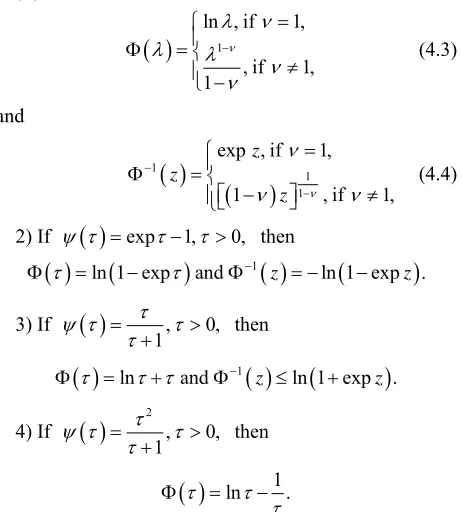
. uLet s provide the examples of functions
and
[image:6.595.310.541.238.494.2] sui heorem and 4.2 (see [12,13]). 1) Below llaries 6 we use the functions
table for T s 4.1 in Coro 4.3-4.
with 1. For them
1ln , if 1,
, if 1, 1
(4.3)
and
1 , if 1,
if 1,
z
1 (4.4)
1 exp
1 ,
z
z
2) If
exp1, 0, then
ln 1 exp
and 1
ln 1 exp .
z z
, 01
3) If ,
then
ln and 1
ln 1 exp .
z z
4)
2
, 0
1
If ,
then
ln 1.
In this example we are unable to define 1
z te it numin an l form, therefore sugg lcula e- rically by computer.
We next present very important corollaries from The- or .1 and 4.2, where th ptions automatically guarantee accomplishment of the condition (P) (see [4]).
The functions
alitica est to ca
ems 4 eir assum
.3. Ass
coincide with the point 1) a .
Corollary 4 ume that is a strongly
co ive mapping, that is satisfied with
.
bove
:
T GH
ntract ,(1.4) is
0 q 1 Let in (1.5) n ,b 0. n
b Then
1
11 1
ln
ln , , e ,q z 1 ,
t b t z q q
q
F
2 0 1 1
2 1abq c C
v s
1
1 2 1
1
1 .
2
abq
b s s
Q x x
I. Suppose that 1
b q
1 and 1
0 1
. 1
bq Then bq c 2 lim
nEx
1) If and
0
nx and
2Qv 0 1
1 , 2 bq c bq
we have for all
1 n
2 ; nE x x v n
(4.5)
2) In all the remain cases
2
, ,
ma 2 , 1
n
E x x u n C
C Q n
.6) and
x ,v s,
(4
2
, ,
n
x n s
(4.7)
e
E x v s
wher s is a unique root of the equation
on the interval II. Suppose that
,
u s C v s
2,
.1
2q 1
1 1
b q
and 1
0 1 1. 1 bq c bq
Then lim n 2 0
n E x x
r all n1.
and the estimate (4.6)
holds fo
Corollary 4.4. Assume that is a strongly
active mapping, that is, in (1.4) is satisfied with
. Let in (1.5)
:
T GH
contr
0 q 1 n b ,b 0,0 1
n
. Then
1 1 0 1 1 1 1 1 1 1 ln 1 , 1 2 2 22 1 .
1
b
q b
c C
v s C
b abq s ab Suppose that 1 1 , ,
F t t
q 1 1 1 ,
z z q
2
, exp ,
1
u s C C
q 1 exp
Q x x
1 , 1 s 0 . 1 bq c bq
Then
2
lim n 0
n E x x
and
1) If Qv
2 and 0 1 1 , 2 bq c bq we have for all
1 n
2 ; nE x x v n (4.8)
2) In all the remain cases the estimates (4.6) and (4.7) hold.
Corollary 4.5. Assume that is a weakly
contractive mapping of the class , that is, in Theorem 3.1
:
T GH
t 2 1, 1
C t
. Let in (1.5)
, 0
n
b b n
. Then
1 1 1 1 1 1 12 2 1 1
1 1
ln , , 1 ,
1
1 1 ,
2
1 1
F t b t z z
C
x x x
1
, lns
u s C C ab
ln 2 .
Q x ab
If is chosen from the condition
01
c 1 1 0 1 1 2 2 c C C ab b ,
then lim 2 0
n E x x
n
and for all n> 1
2
1
C c1 0
1 , ,
2
x , 2 .
n C Q C b ma C n
E x x u
(4.9)
Corollary 4.6. Assume that is a weakly
contractive mapping of the class , that is, in Theorem 3.1
:
T GH
t 2 1, 1
C t
. Let in (1.5)
, 0,0 1
n b
b n
. Then
1 11 1 1
1 0 1
1
1 1 1 1 21 ,
u s b s
1 1
2 2 1 1
1 1
, , 1 ,
1 1 2 1 2 , 1 1 , 1 1 1 1 2 1 b
F t t z z
c C
v s C
b s
C C C a
Q x x x x ab
1 .
I. Suppose that
1) If Qv
2 and c01 is chosen from the con-dition
1
1 0 1
2 2
,
c C
ab b
1
2C
then lim n 2 0
n E x x
and for all n1
2
.
n
E x x v n
(4.10) 2) In all the remain cases the estimates (4.6) and (4.7) hold.
II. Suppose that
1 .
1
If c01 is chosen from the condition 1
1 0 1
1
2
2 ,
c C
C ab
b
then lim 2
nE xn x 0
and for all n1
2
2
, , max , .
n
E x x u n C C Q v
(4.11)
In addition to the examples presented in this section, roduce the function
we p s
and
which have 0 as a tangency gree multiplicity and given logarithmic estimates of the con- vergence rate.point of the infinite de
We define the function
by the following way: 1
exp
f
f
, 0,
where f
is differentiable and decreasing function,and
, 0limf
,where
0
0 lim , 0,1, 2,
l l
l
l 0denote the derivative degrees o the function f
,
. It is easy to see that
expf
and
1 z f 1 ln z .
In particular,
i)
1,
2exp 1 .f
We ha
ve
1 exp
and
1 z 1 .
We have to
ln z
verify that
is convex. In fact, it is true because
2
2
d 2 1 1
2 exp 0, 0.
d
Beside this, it is easy to see that
, at least, on the interval
0,1k these
. In the next eave to readers to chec properties.
examples we l
ii)
1 , 1,
exp 1 1.s s
s
f s
We have
exp 1s
and
1
1 ln s
z
z .
iii)
exp 1 ,
exp 1 exp 1 s1s s
f s
We have
exp exp 1s
and
1
1 ln ln s.
z z
5. Almost Su
Approximations for Nonexpansive
ngs
Consider next the almost surely convergence of sto- chastic approximations. First of all, we need th sto- chastic analogy of Lemma 2.5:
re Convergence of Stochastic
Mappi
e
Lemma 5.1. Let
k be sequences of no -negative real numbers andn
k be sequence of random Ak-measurable variables, a.s. nonnegative for all Assume that
k
1.
k
1 1
an .
k k
k k
d
and there exists c0 such that for all If lim k 0
k
1
k
1 a.s.,
k E k An c k
(5.1)
then lim k 0
k a.s.
The proof can be provided by the scheme of non-
[14] as ap ase of Hilbert spaces (the concepts of stochastic case (see Proposition 2 in [8]) or as it was done in [5].
We need also the following lemma from plied to our c
modulus of convexity B
of Banach spaces B orHilbert spaces H can be found in [15] and [16]). Lemma 5.2. If F I T with a nonexpansive mapping T G: H, then for all x y, D T
,
21
1
, ,
2
H
Fx Fy
Fx Fy x y R
R
2 2
1
1 2 .
R xy Tx Ty xy
If x R and y R with x y, D T
, then 1 2
R R and
,
1 2 .4
H
Fx Fy
Fx Fy x y L R
R
eorem 5.3 that a mapping is
no
Th . Assume T G: H
nexpansive and its fixed point set N is nonempty. If
(1.8) holds and En An C0, then the sequence
xn generated by (1.5)-(1.7) weakly almost surely converges to some xN.Proof. Let xN. We next use Lemma 5.2 and the
estimate (see [17], p. 49)
2 8H
to get
2 21
1 ,
2 32
H .
x Tx x Tx x Tx x x R
R
is case the inequality (3.3) implies In th
2 1
2 2
2 2 1
2 , 2 .
n
n n n n
n n n n n
x x
1 2
8 n x x 32 x Tx
x x
Similarly to (3.10), we have
(5.2)
2 1
2
n n
E x x A
2 2
1 8n xn Txn An
2 2
2nE n,xn x An 2nE n An .
2 n n
x Ex
(5.3)
Denote n E xn x 2
and n E xnTxn 2
and apply the unconditional expectation to both sides of (5.3). Then
2 1 n
2
1 1 8 2 2 .
n n n n n C
(5.4)
It follows from this that
1 1 8 2 1 .
n n n C n
2 2
Since and due to Lemma 2.1, we con- clude that
2 1n
n is bounded. Consequently,
xn is bounded a. ollows from the theory of coquasimartingales (see [5,18]).
We now need Lemma 5.1. It is not difficult to see that
s. that f nvergent
2
1 1
.
n n nE xn Txn
(5.5)The last gives us
2 1
a.s.
n xn Txn
Next we evaluate the following difference:
2 2
1 1
1 1
n n n n
x Tx x Tx
1 1
n n n
n n n n
x Tx xn Tx
x Tx x Tx
It is easy to see that
n n
x Tx is bounded a.
si
s. Indeed, nce xn C1 a.s., ther
ch that 2
0
C
e exists a constant su
2
2 a. .
n n n
x Tx x x C s
Therefore
1 1 2 2 a.s.
n n n n
x Tx x Tx C
It is obviously that
1 1
1 1 2 1
Pr
2 2 .
n n n n
n n n n n n
n n n n G n
n n n n n
x Tx x Tx
x
2 PrG n
x Tx Tx x x
x Tx x
x Tx
Thus,
x
2 2
1 1
2
2 2
2 2 0
4 4
4 a.s..
n n n n n
n n n n
n
E x Tx A x Tx
C C E A
C C C
By Lemma 5.1, xnTxn 0 a.s. as n .
Since
xn is bounded a.s., there is a subsequence
xnk weakly convergent to some point x. Sinis convex a
ce closed, consequently, weak osed,
G
we
nd ly cl
assert that xG.
T
It is known that a nexpansi ng weakly demiclosed, there ore,
no f
ve
mappi is xN
quence a.s. Weak almost surely convergence of whole se
xnCoro
is e standard way [8]. □ Assume that
co of the class If
shown
llary 5.
by th
4. T G: H is a weakly ntractive mapping C t.
1
,
n
2 1
n
and En An C0, then the sequence
xn generated by (1.5)-(1.7) strongly almost surely erges to unique fixed pointconv x of
We have from (3.4)
.
T Proof.
2
.
n n n n
Since
xn is bounded a.s. and xnTxn 0 a.s. as we conclude that
,
n
xnx 2
0 a.s.The proof follows due to the properties of the function
.
□
s clear that all rema still va sel
case, e
t
Remark 5.5. It i the results in
lid for f-mappings T G: G. However, in this unlike any deterministic situation, th algorithm
(1.5)-(1.7) must use the projection operator PrG be-
cause the vec or vnxnnS xn n not always belongs to
G. If T xn nTxnnG for all n1 and
0n1, then (1.5) can be replaced by
1
, 1, 2,1 1
n n n n n n , .
x x T x n x G
S
[1] M. T. “Stochastic Approximation,” Cambridge Unive ss, Cambridge, 196
[2]
[3] “Nonasymptotic Estimates of the Convergence Rate of Stochastic Iterative Algori-thms,” Automation and Remote Control, Vol.
pp. 32-41.
[4] l Nonasymptoti
timate te of Iterative Stoc Algori nal Mathematics an
REFERENCE
Wasan,rsity Pre 9.
M. B. Nevelson and R. Z. Hasminsky, “Stochastic Ap- proximation and Recursive Estimation,” AMS Providence, Rhode Island, 1973.
Ya. Alber and S. Shilman,
42, 1981, Ya. Alber and S. Shilman, “Genera c Es- s of the Convergence Ra hastic thms,” USSR Computatio d Ma- thematical Physics, Vol. 25, No. 2, 1985, pp. 13-20. doi:10.1016/0041-5553(85)90099-0
[5] K. Barty, J.-S. Roy and C. Strugarek, “Hilbert-Valued Perturbed Subgradient Algorithms,” Mathematics of Op- eration Research, Vol. 32, No. 3, 2007, pp. 551-562. doi:10.1287/moor.1070.0253
[6] X. Chen and H. White, “Asymptotic Properties of Some Projection-Based Robbins-Monro Procedures in a Hilbert Space,” Studies in Nonlinear Dynamics & Econometrics
/1558-3708.1000 Vol. 6, No. 1, 2002, pp. 1-53. doi:10.2202
[7] Ya. I. Alber and A. N. Iusem, “Extension of Subgradient Techniques for Nonsmooth Optimization in Banach Spaces,” Set-Valued Analysis, Vol. 9, No. 4, 2001, pp. 315-335. doi:10.1023/A:1012665832688
[8] Ya. Alber, A. Iusem and M. Solodov, “On the Projection Subgradient Method for Nonsmooth Convex Optimiza- tion in a Hilbert Space,” Mathematical Programming, Vol. 81, No. 1, 1998, pp. 23-35.
doi:10.1007/BF01584842
[9] A. P. Dempster, N. M. Laird and D. B. Rubin, “Maximal Likelihood from Incomplete Data via the EM Algorithm,” Journal of the Royal Statistical Society, Vol. 39, No. 1, 1977, pp. 185-197.
[10] W. Rudin, “Real and Complex Analysis,” McGraw-Hill,
98, 1997, pp. 7-
mimartingales,” De Gruyter, Berlin, 1982. New York, 1978.
[11] Ya. I. Alber and S. Guerre-Delabriere, “Principle of Weakly Contractive Maps in Hilbert Spaces,” Operator Theory, Advances and Applications, Vol.
22.
[12] Ya. I. Alber, “Recurrence Relations and Variational Ine- qualities,” Soviet Mathematics Doklady, Vol. 27, 1983, pp. 511-517.
[13] Ya. Alber, S. Guerre-Delabriere and L. Zelenko, “The Principle of Weakly Contractive Maps in Metric Spaces,” Communications on Applied Nonlinear Analysis, Vol. 5, No. 1, 1998, pp. 45-68.
[14] Ya. I. Alber, “New Results in Fixed Point Theory,” Pre- print, Haifa Technion, 2000.
[15] J. Diestel, “The Geometry of Banach Spaces,” Lecture Notes in Mathematics, No. 485, Springer, Berlin, 1975. [16] T. Figiel, “On the Moduli of Convexity and Smoothness,”
Studia Mathematica, Vol. 56, No. 2, 1976, pp. 121-155. [17] Ya. Alber and I. Ryazantseva, “Nonlinear Ill-Posed Prob-
lems of Monotone Type,” Springer, Berlin, 2006. [18] M. Métivier, “Se