Changes in management function of
control
Misun, Juraj
University of Economics, Faculty of Business Management,
Department of Management
2017
Online at
https://mpra.ub.uni-muenchen.de/83720/
Misun, J. (2017). Changes in management function of control. In International Conference Socio-Economic Perspectives in the Age of XXI Century Globalization Proceedings Book (pp. 204-217). Tirana: University of Tirana, Faculty of Economy, Department of Economics.
Harvard
Misun, J. (2017). Changes in management function of control. In: International Conference Socio-Economic Perspectives in the Age of XXI Century Globalization. Tirana: University of Tirana, Faculty of Economy, Department of Economics, pp.204-217.
ISO 690
MISUN, JURAJ, 2017, Changes in management function of control. In : International Conference Socio-Economic Perspectives in the Age of XXI Century Globalization. Tirana : University of Tirana, Faculty of Economy, Department of Economics. 2017. p. 204-217.
Chicago
Misun, Juraj. 2017. "Changes In Management Function Of Control". In International Conference Socio-Economic Perspectives In The Age Of XXI Century Globalization, 204-217. Tirana: University of Tirana, Faculty of Economy, Department of Economics.
Author
First name: Juraj Family name: Misun
Paper
Paper title: Changes in management function of control
Pages: 204-217
Conference
Conference title: International Conference Socio-Economic Perspectives In The Age Of XXI Century Globalization
Proceedings title: International Conference Socio-Economic Perspectives In The Age Of XXI Century Globalization Proceedings Book
Publisher: University of Tirana, Faculty of Economy, Department of Economics
City: Tirana
Country: Republic of Albania
204
Changes in management function of control
Juraj MIŠÚN1, Assoc. Professor
Abstract
Controlling is a constantly ongoing managerial process of designing standards, measuring
performance, comparing the performance with standards, and implementing corrective
actions to ensure effective and efficient running of the organization's activities. Controlling
represents one of the basic functions in management in Anglo-American understanding. The
original term has been changed from control to controlling, as control is (like a plan in
planning) only a small part of long-term activity.
The term controlling, however, is also used in German literature, where it represents what
Anglo-American literature refers as management (or managerial) accounting. As the Central
and Eastern European literature is heavily influenced by German literature, in English-written
papers published in Europe confusions often happen.
Based on results of our questionnaire survey in 331 companies operating in Slovakia, which
collected data at the turn of 2016 and 2017, we analyze the changes in management function
of controlling and compare them with the findings in literature. We analyze the research
results according to the different characteristics of the research sample, such as the size of the
company by number of employees, the economic result, the respondent's position in the
organizational structure of the company, or the respondent's attitude if he/she is an object or
subject of control. Taking into account the quantitative and qualitative results obtained, we
also present specific changes in the control of our businesses.
Keywords: organizational control, management functions, changes
1
University of Economics in Bratislava, Faculty of Business Management, Department of Management, email:
205
I. Introduction
The term “control” is probably one of the worst defined in English language. The reason is it
has many meanings. For example Rathe (1960) created a list of 57 different variations of
differences, which ranged from prohibiting to manipulating. There are two major themes in
these variations; a) control as domination – the person who controls has the power to enforce
his will and; b) control as regulation – the person detects a deviation between the plan and the
reality and forces this person to act. (Emmanuel et al., 2013) While control is a one-time act,
controlling is a constantly ongoing managerial process of designing standards, measuring
performance, comparing the performance with standards, and implementing corrective
actions to ensure effective and efficient running of the organization's activities.
In the context of this paper, controlling is one of the five sequential functions of management
(other are planning, organizing, staffing and leading), which's importance has significantly
risen during the last economic crisis. In addition to sequential functions, management theory
also distinguishes parallel functions, including analyzing, decision making, and
implementing.
During our research in this field, we discovered large differences among theories in the
Western and Eastern parts of the world. While Western (capitalist) countries emphasize
self-control and informal self-control, Eastern (post-communist) place largely importance on formal
control.
Another important aspect in the area is the use of the term “controlling”. The term is
prominently used in both the Anglo-American and German literature. Central and Eastern
European theory is in the studied area strongly influenced by the German literature. The term
controlling was used by German business economics at first, but in the course of time it came
into collision with Anglo-American literature as it began to be used in management theory.
In Slovakia and other Eastern European countries (generally known as Eastern bloc),
controlling has also a dark side of its history, thanks to the communistic regime. This can
result to negative views from persons who remember controls by the regime. Due to the
negative role of controlling in this period, many managers still have a poor perception of this
206
II. Theoretical background
Any meaningful human activity needs a certain degree of control if it is to achieve what it
intended. Frequent verification can ensure that redirecting to the right course prevents the loss
of resources and efforts. (Boddy, 2008)
One of the first definitions of managerial function of controlling was written by Fayol in
1949, when he stated: “control of an undertaking consists of seeing that everything is being
carried out in accordance with the plan which has been adopted, the orders which have been
given, and the principles which have been laid down. Its object is to point out mistakes in
order that they may be rectified and prevented from recurring.” Anthony later (1965) defined
controlling as the process through which managers ensure that resources are procured and
used efficiently and effectively to meet the goals of the organization. Among the Slovak
authors, Kracmar et al. (2013) define controlling as a specific, multi-step activity, starting
with setting objectives and criteria, identifying the situation and comparing it with the desired
status, ending with remedying shortcomings, and providing information for correcting plans
and supporting decision makers.
II.1 Management function of controlling
Controlling is a fundamental aspect of an organization that has been largely neglected by
scientists for several decades. Despite the fundamental nature of this phenomenon, its
importance and some significant progress, this scientific area is still neglected. Specifically,
controlling is poorly captured in its constructs, determinants, and effects. (Sitkin et al., 2010)
It should be clear that, with its primary characteristics, which are feedback and corrective
action, controlling is an essential and integral part of the role of management. Without
control, there can be no management. (Eilon, 1971)
Another reason for controlling being the least scientifically researched function is its status as
the last step of the management process. Based on the study of numerous domestic and
foreign literature, we can say that much more attention is paid to the other sequential
functions. From parallel managerial functions, the decision-making function enjoys also more
attention. In 1977, for example, Ouchi pointed out that the functions of organizing and
207 Controlling plays an important role in management of a company; however its role is often
hidden from the sight of others. Organizational structure visualizes the scheme of
organization. Unfortunately, there is nothing to help us visualize the organization's control
system. (Flamholtz, 1996)
Efficiency and effectiveness are very important terms in controlling. Through them managers
are trying to achieve their goals. Effectiveness is interested in achieving goals; that means the
action is effective to the extent if the intended was achieved. Efficiency is interested in
achieving the result with minimal use of resources. (Emmanuel et al., 1990)
II.2 Controlling and “controlling”
Controlling as a term is used both in Anglo-American literature as well as in German
literature. Both theories have their spheres of influence. While in the Anglo-American
literature, controlling means the management function, in the German literature (and some
Eastern European) it acquires the meaning of managerial accounting of Anglo-American
literature. It is very likely that in the future, both theories will approach to each other,
because: a) the growing Americanization of society will play a big role and; b) English is
becoming more common in Central and Eastern Europe.
However, it is very interesting to see how much attention is paid to managerial accounting
and how the managerial function of controlling continues to be neglected. We see the reason
in simpler applications. Although at first glance the application of different formulas, ratios,
or conversions may seem challenging, management accounting is hardly likely to pose
controlling when evaluating qualitative indicators. In this respect, it will probably be very
difficult to replace controlling in a digitizing world. In addition, managerial accounting does
not have decision-making power, but should serve as a help in deciding of a manager who
assesses an object complexly by considering qualitative parameters.
The purpose of both managerial accounting and financial accounting is to provide useful
information for the decision-maker. They do this by collecting, processing and reporting
information for decision-makers. In general, a large portion of managerial accounting
involves obtaining cost information for decision-making in planning and control. (Wild and
208
II.3 Western and Eastern approach to controlling
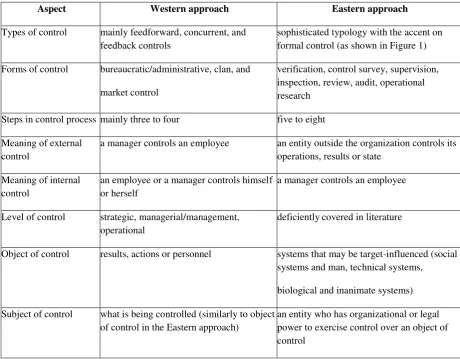
Although the current management theory may appear globally identical, there are large
differences in the controlling function. Major differences we discovered during our research
[image:7.595.71.532.211.570.2]of the managerial function of controlling are listed in table 1.
Table 1. Major differences between the Western and Eastern approach to control
Aspect Western approach Eastern approach
Types of control mainly feedforward, concurrent, and feedback controls
sophisticated typology with the accent on formal control (as shown in Figure 1)
Forms of control bureaucratic/administrative, clan, and
market control
verification, control survey, supervision, inspection, review, audit, operational research
Steps in control process mainly three to four five to eight
Meaning of external control
a manager controls an employee an entity outside the organization controls its operations, results or state
Meaning of internal control
an employee or a manager controls himself or herself
a manager controls an employee
Level of control strategic, managerial/management, operational
deficientlycovered in literature
Object of control results, actions or personnel systems that may be target-influenced (social systems and man, technical systems,
biological and inanimate systems)
Subject of control what is being controlled (similarly to object of control in the Eastern approach)
an entity who has organizational or legal power to exercise control over an object of control
Source: own work based on a large number of Western and Eastern literature.
III. Methodology
The presented research results in this paper are coming from a questionnaire survey, which
collected data at the turn of 2016 and 2017. Questionnaire's emphasis was on new trends in
controlling and attitudes of managers to controlling when they are in the role of the subject
and object of control. We received 395 completed questionnaires, of which 376 were further
processed for the purposes of attitudes research. Our sample does not represent statistical
209 respondents from the same company were allowed for the purpose of attitude research,
further selection is needed for the purposes of this paper. We chose the highest-ranked
manager in the hierarchy for whom we expect the best knowledge of our subject, so
subsequently, 331 questionnaires were left for further processing.
Our research sample has the following characteristics (n = 331):
- size of company (employees in 2015): 115 microenterprises, 90 small, 56
medium-large, 70 large companies;
- management level of the respondent: 120 top-management, 52 middle, 116 lower
management level, 43 informed employees1 ;
- most frequently represented sections according to the SK-NACE classification: 69
industrial production, 66 wholesale and retail trade and repair of motor vehicles and
motorcycles, 46 professional scientific and technical activities, 25 information and
communication, 21 accommodation and catering services;
- higher territorial unit of Slovakia: 174 Bratislava (capital city and surrounding
districts), 33 Trnava, 4 Nitra, 3 Trenčín, 3 Žilina, 17 Banská Bystrica, Prešov, 8 Košice;
- legal form: 222 private limited liability companies, 66 joint-stock companies, 30
self-employed individuals, 5 branches of foreign enterprises, 4 cooperatives, 4 other
forms;
- economic result in 2015: 254 profit, 52 loss, 20 balanced economic result, 3
companies founded in 2016, 2 n/a;
- sales in 15: 164 ≤ M Euro, 43 M≤1 M Euro, 6 1 M≤5 M Euro, 5 ≥5 M Euro,
14 n/a.
Besides various other questions, we also asked the respondentswhether they noticed in their
company changes in controlling over the past year (the period before the questionnaire is
completed was meant/not the previous calendar year). We also asked the respondents for a
short justification.
All 331 respondents answered this question, 103 did not state a justification. Out of these 103
unclarified answers, only four answered the question positive. An interesting fact was that 75
1
210 respondents who replied that their business had no change in controlling justified their
response. Based on this data we are able to make a quantitative and qualitative analysis of
changes in controlling.
Justifications (in various questions) helped us to resolve questionnaires from inadequately
competent respondents. We used standard scientific methods in evaluating and interpreting
the results of our questionnaire surveys.
Potential limitations of our research come from the fact that our respondents are at different
places in organizational structures of different companies. This may cause them not to notice
changes in controlling, which could have been implemented in another part of the
organization.
Another limitation may arise from the question itself, as a small change in controlling can be
considered negligible for a large business, but in a small business can be perceived as a key
one.
IV. Discussion
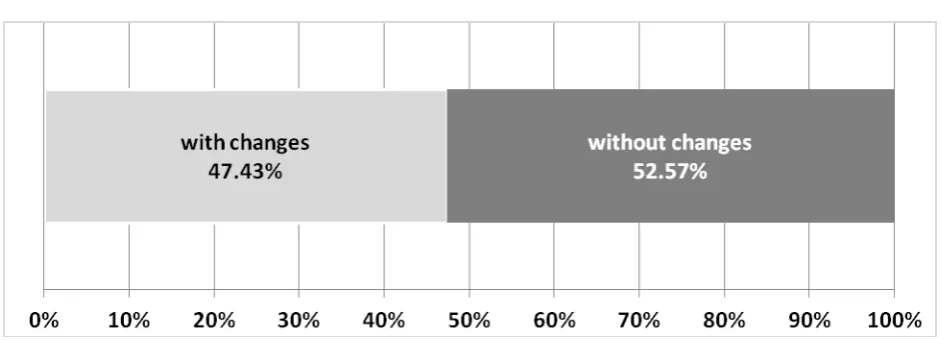
First, we would like present the overall results for the question. Out of the whole sample 157
respondents stated, in their company was some kind of change in controlling. A negative
[image:9.595.71.543.515.685.2]answer was recorded in 174 companies.
Figure 1 Changes in management function of controlling in Slovak companies (in %)
211 These results are interesting for us in light of the fact that the Slovak Republic is currently in
the economic phase of expansion and employers are starting to feel a lack of workforce. This
creates, on the one hand, pressure on wage growth, but it also has a direct impact on the
management function of controlling. At the time of expansion and in the absence of potential
staff, the permitted deviations in performance increase and controlling is not so strict when
implementing corrective action.
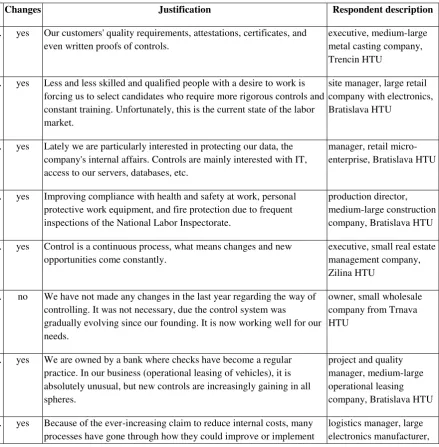
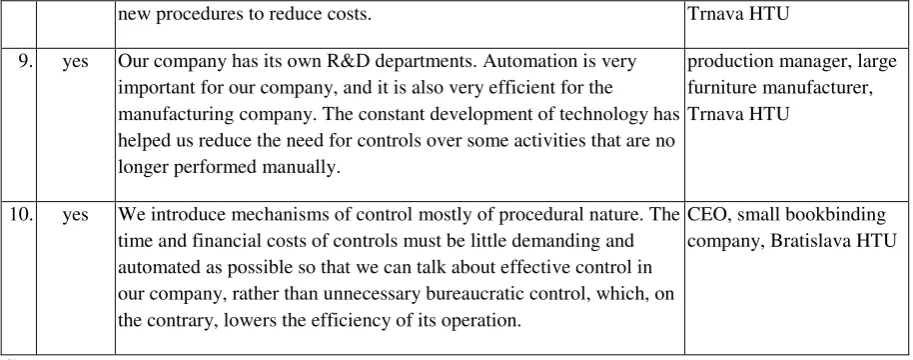
To confirm the validity of our findings, ten examples of qualitative responses from our
[image:10.595.85.525.293.741.2]respondents (including their characteristics) are listed in table 2.
Table 2 Changes in controlling of selected companies in Slovak republic
Changes Justification Respondent description
1. yes Our customers' quality requirements, attestations, certificates, and even written proofs of controls.
executive, medium-large metal casting company, Trencin HTU
2. yes Less and less skilled and qualified people with a desire to work is forcing us to select candidates who require more rigorous controls and constant training. Unfortunately, this is the current state of the labor market.
site manager, large retail company with electronics, Bratislava HTU
3. yes Lately we are particularly interested in protecting our data, the company's internal affairs. Controls are mainly interested with IT, access to our servers, databases, etc.
manager, retail micro-enterprise, Bratislava HTU
4. yes Improving compliance with health and safety at work, personal protective work equipment, and fire protection due to frequent inspections of the National Labor Inspectorate.
production director, medium-large construction company, Bratislava HTU
5. yes Control is a continuous process, what means changes and new opportunities come constantly.
executive, small real estate management company, Zilina HTU
6. no We have not made any changes in the last year regarding the way of controlling. It was not necessary, due the control system was
gradually evolving since our founding. It is now working well for our needs.
owner, small wholesale company from Trnava HTU
7. yes We are owned by a bank where checks have become a regular practice. In our business (operational leasing of vehicles), it is absolutely unusual, but new controls are increasingly gaining in all spheres.
project and quality manager, medium-large operational leasing company, Bratislava HTU
8. yes Because of the ever-increasing claim to reduce internal costs, many processes have gone through how they could improve or implement
212
new procedures to reduce costs. Trnava HTU
9. yes Our company has its own R&D departments. Automation is very important for our company, and it is also very efficient for the manufacturing company. The constant development of technology has helped us reduce the need for controls over some activities that are no longer performed manually.
production manager, large furniture manufacturer, Trnava HTU
10. yes We introduce mechanisms of control mostly of procedural nature. The time and financial costs of controls must be little demanding and automated as possible so that we can talk about effective control in our company, rather than unnecessary bureaucratic control, which, on the contrary, lowers the efficiency of its operation.
CEO, small bookbinding company, Bratislava HTU
Source: own work, HTU – higher territorial unit of Slovak republic
Let us now analyze these overall results according to selected characteristics of the research
sample. First, we look closer to the results according to the size of the companies (number of
[image:11.595.70.527.81.261.2]employees in 2015) in figure 2.
Figure 2 Changes in controlling according to the size of company (in %)
Source: own work.
As can be seen in the results, the share of positive responses increases with the growing
business size. Small exceptions are large enterprises (40 with changes/30 without), but this
can be due to statistical variation. The reason for the high share in medium-large companies
(34/22) is mainly due to customer requirements and their adaptation to larger competition. On
the other hand, micro-enterprises (43/72) benefit from a small number of employees and their
213 Given the limitations of our paper, we present the other quantitative results according to other
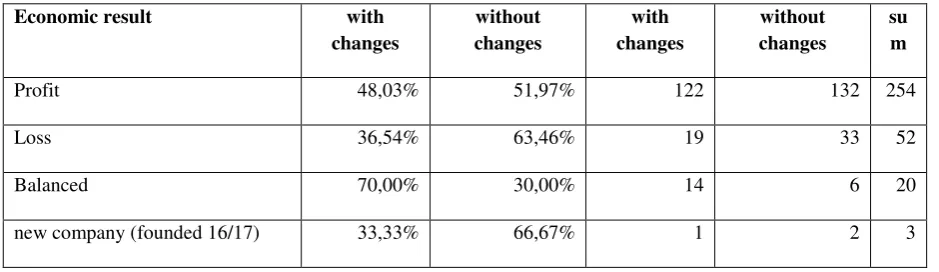
characteristics of our research sample in table 3.
With many characteristics of respondents and their businesses, we see interesting results.
Already in the first characteristic, it is obvious that profitable businesses have made changes
rather than those that have recorded a loss in 2015. Controlling has, in general, a very
positive impact on the economic outcome of an enterprise, but some research limitations may
be due to profits optimizing, which was more likely to be possible in Slovakia in 2015.
Respondent's management level is less interesting in the case of controlling changes, as the
implementation of changes is rather at enterprise level than at a specific manager level.
Certain trends can be found here rather in the question of who is responsible for executing
controlling (subject of control) and who is exposed to it (object of control).
Then again, we found a very rare match with the subject of control when an exact half of
respondents with a positive attitude to exercising controlling experienced a change and the
other half did not. Negative responses show a too small number to make any conclusions.
In the case of the object of controlling, we also cannot express more clear conclusions as the
results show no pronounced trend.
In the case of the last characteristic, however, this trend is obvious. The increasing perceived
importance of controlling is also accompied with increases of the number of positive
responses to the question of changes in controlling. Except for the second and third levels of
importance, we see an increasing number of positive responses. The limitation here may be
the mean value that is often used by respondents who do not want to consider an issue
[image:12.595.65.535.624.760.2]further.
Table 3 Changes in controlling according to other characteristics of the research sample
Economic result with
changes
without changes
with changes
without changes
su m
Profit 48,03% 51,97% 122 132 254
Loss 36,54% 63,46% 19 33 52
Balanced 70,00% 30,00% 14 6 20
214
n/a 50,00% 50,00% 1 1 2
Respondent's management level with
changes without changes with changes without changes su m
Top 42,50% 57,50% 51 69 120
Middle 59,62% 40,38% 31 21 52
Lower 45,69% 54,31% 53 63 116
Informed 51,16% 48,84% 22 21 43
Attitude to controlling when
respondent is a subject of control with changes without changes with changes without changes su m
Positive 50,00% 50,00% 126 126 252
Neutral 38,16% 61,84% 29 47 76
Negative 66,67% 33,33% 2 1 3
Attitude to controlling when
respondent is an object of control with changes without changes with changes without changes su m
Positive 46,75% 53,25% 79 90 169
Neutral 49,23% 50,77% 64 66 130
Negative 43,75% 56,25% 14 18 32
Perception of importance
of controlling in company
with changes without changes with changes without changes su m
absolutely unimportant (1 point) 0,00% 100,00% 0 1 1
little important (2) 41,67% 58,33% 5 7 12
present (3) 34,88% 65,12% 15 28 43
important (4) 42,86% 57,14% 57 76 133
very important (5) 56,34% 43,66% 80 62 142
215
V. Conclusion
Controlling is a very important management function, but it has been neglected by scientists
for many decades. However, it is this function, which can together with its Siamese twin
planning, contribute to the efficient and effective operation an company. The reason for the
neglect in theory we see above all in its position as the last step of the management cycle, but
also in the great interest in managerial accounting. For managerial accounting, the term
controlling is still used in some countries. This causes confusions both in theory and practice,
but we can see slowly the first examples when meanings are not mistaken.
It will be interesting to follow the approach of Western and Eastern theory. While foreign
investors in Central and Eastern Europe implement elements of Western theory, many entities
in the Western world discover the advantages of a strong bureaucratic controlling from the
Eastern world.
Due to our results, we can see that in practice controlling is in motion. Changes are
implemented and move from the largest businesses to medium and later to smaller ones. Our
next research will concentrate on the statistical analysis of data obtained, as well as an
in-depth analysis of qualitative responses.
Since the question regarding the changes in controlling was very broad, we asked additional
questions about the changes in concrete. In particular, we wanted to find out if new
controlling tools, methods or procedures were introduced in the respondent company in the
previous year. From our sample 120 respondents (36,25%) answered positively, 210
(63,44%) negatively and one respondent (0,30%) did not respond this question.
Other associate questions related to the intensity of controlling: a) that the respondent must
spend on controlling the subordinates; b) he is exposed from other control subjects. However,
these results are discussed in more detail in our second paper titled Changing intensity of
216
Literature
1. ANTHONY, R. N. 1965. Planning and Control Systems: Framework for Analysis.
Boston: Graduate School of Business Administration, Harvard University. 180 pp. ISBN
978-0-8758-4047-5.
2. BODDY, D. 2008. Management: an introduction. 4th ed. Harlow (UK): Pearson
Education Limited. 728 pp. ISBN 978-0-273-71106-3.
3. EILON, S. 1971. Management Control. Studies in Management. London: Macmillan
Education. 217 pp. ISBN 978-1-349-01281-7.
4. EMMANUEL, C. R. – OTLEY, D. T. – MERCHANT, K. 1990. Accounting for
Management Control. Second Edition. London: Springer-Science+Business Media. 518
pp. ISBN 978-0-412-37480-7.
5. EMMANUEL, C. R. – OTLEY, D. T. – MERCHANT, K. A. 2013. Accounting for
Management Control. Second Edition. London: Springer-Science+Business Media. 518
pp. ISBN 978-0-412-37480-7.
6. FAYOL, H. 1949. General and Industrial Management. London: Pitman. 110 pp.
7. FLAMHOLTZ, E. G. 1996. Effective management control: Theory and Practice. London:
Kuwer Academic Publishers. 174 pp. ISBN 978-1-4612-8586-1.
8. KRÁČMAR, J. et al. 13. Kontrolovanie. Bratislava: KARTPRINT, 2013. 193 pp.
ISBN 978-80-89553-17-4.
9. OUCHI, W. G. 1977. The relationship between organizational structure and
organizational control. Administrative science quarterly. ISSN 0001-8392, 1977, vol. 22,
no. 1, pp. 95-113.
10.RATHE, A. W. 1960. Management Controls in Business. pp. 28-60. In Malcolm, D. G. –
Rowe, A. J. Management Control Systems. New York: Wiley. 375 pp.
11.SITKIN, S. B. – CARDINAL, L. B. – BIJLSMA-FRANKEMA, K. M. 2010.
Organizational Control. Cambridge (UK): Cambridge University Press. 541 pp. ISBN
978-0-521-51744-7.
12.WILD, J. J. – SHAW, K. W. 2010. Managerial Accounting. 2010 Edition. New York:
217
Acknowledgments: This paper is a part of the research project “Trends of internal control in
business entities in the light of new challenges” (no. 1/ 135/17) funded by the Scientific