Proceedings of the 57th Annual Meeting of the Association for Computational Linguistics, pages 3731–3741 3731
Dialogue Natural Language Inference
Sean Welleck New York University [email protected]
Jason Weston Facebook AI Research
New York University
Arthur Szlam Facebook AI Research
Kyunghyun Cho New York University Facebook AI Research CIFAR Azrieli Global Scholar
Abstract
Consistency is a long standing issue faced by dialogue models. In this paper, we frame the consistency of dialogue agents as natural lan-guage inference (NLI) and create a new natu-ral language inference dataset called Dialogue NLI. We propose a method which demon-strates that a model trained on Dialogue NLI can be used to improve the consistency of a dialogue model, and evaluate the method with human evaluation and with automatic metrics on a suite of evaluation sets designed to mea-sure a dialogue model’s consistency.
1 Introduction
A long standing issue faced by dialogue models is consistency (Li et al.,2016;Vinyals et al.,2015; Zhang et al., 2018). An example from (Vinyals et al.,2015) shows a two-round dialogue in which their neural sequence model first responds towhat is your job? withi’m a lawyer, then responds to what do you do?withi’m a doctor. Even when in-consistencies are relatively rare and semantically plausible, they are jarring, and because semantic plausibility is not enough to root them out, pre-venting them is challenging.
One approach to increasing the consistency of a chit-chat dialogue model was proposed in (Zhang et al.,2018), where the dialogue agent was given a set of personal facts describing its character (a persona) and produces utterances that reflect the persona. The intended outcome is that the agent produces utterances consistent with its given per-sona. However, these models still face the consis-tency issue, as shown in Figure1.
Separately, the framework of Natural Language Inference (NLI) (Bowman et al., 2015; Dagan et al., 2006;Maccartney and Manning, 2009) in-volves learning a mapping between a sentence pair and an entailment category. It is hypothesized that
the NLI task is a proxy for general goals in natu-ral language processing, such as language under-standing (Bowman et al., 2015; Williams et al., 2018). Thus, the NLI task has been used for learning general sentence representations (Con-neau et al., 2017) and for evaluating NLP mod-els (Poliak et al.,2018a;Wang et al.,2018), with the expectation that such models will be useful in downstream tasks.
Despite this expectation, leveraging an NLI model for a downstream task remains an under-explored research direction. An NLI model may improve downstream task performance if prop-erly used, while downstream tasks may yield new datasets or identify issues with existing NLI mod-els, thus expanding the NLI research domain.
In this paper, we reduce the problem of consis-tency in dialogue to natural language inference. We first create a dataset, Dialogue NLI,1 which contains sentence pairs labeled as entailment, neu-tral, or contradiction.
Then, we demonstrate that NLI can be used to improve the consistency of dialogue models using a simple method where utterances are re-ranked using a NLI model trained on Dialogue NLI. The method results in fewer persona contradictions on three evaluation sets. The evaluation sets can be used independently to automatically evaluate a di-alogue model’s persona consistency, reducing the need for human evaluation. We discuss several fu-ture research directions involving this approach.
2 Dialogue Consistency and Natural Language Inference
First, we review the dialogue generation and nat-ural language inference problems as well as the notions of consistency used throughout.
1The dataset is available atwellecks.github.io/
Figure 1: Persona-based dialogue with a Key-Value Memory Network trained on Persona-Chat (Zhang et al.,
2018).
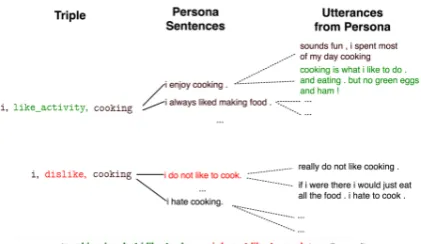
Figure 2: Relating triples, persona sentences, and utter-ances to derive annotated sentence pairs. Shown here is a “relation swap” contradiction.
Dialogue Generation Dialogue generation can be framed asnext utterance prediction, in which an utterance (a sequence of tokens representing a sentence) ut+1 is predicted given a conversa-tion prefix u≤t. A sequence of utterances is in-terpreted as a dialogue between agents. For in-stance, an alternating two-agent dialogue which starts with agentAand ends with agentBis writ-ten asuA1, uB2, uA3, uB4, ..., uBT.
Persona-Based Dialogue In persona-based di-alogue, each agent is associated with a persona,
PAandPB. An utterance is now predicted using
the conversation prefix u≤t and the agents own persona, e.g. PAfor agentA. It is assumed that an agent’s utterances are conditionally dependent on its persona, which can be interpreted as the ut-terances being representative of, or reflecting, the persona.
A typical approach for representing the persona is to use a set of sentencesP ={p1, ..., pm}.
Consistency Aconsistency error, or contradic-tion, occurs when an agent produces an utterance that contradicts one of their previous utterances. Similarly, apersona consistency error, or persona contradiction, occurs when an agent produces an utterance that contradicts a subset of its persona.
A contradiction may be a clear logical contra-diction, e.g. I have a dog vs. I do not have a dog, but in general is less clearly defined. As a result, in addition to logical contradictions, we in-terpret a consistency error as being two utterances not likely to be said by the same persona. For in-stance, “i’m looking forward to going to the bas-ketball game this weekend!” vs. “i don’t like at-tending sporting events”, as well as “i’m a lawyer” vs. “i’m a doctor” would be viewed here as
con-tradictions, although they are not strict logical in-consistencies.
Similarly, a persona consistency error is inter-preted here as an utterance which is not likely to be said given a persona described by a given set of persona sentences, in addition to logical contra-dictions.
Natural Language Inference Natural Lan-guage Inference (NLI) assumes a dataset
D = {(s1, s2)i, yi}Ni=1 which associates an input pair (s1, s2) to one of three classes
y ∈ {entailment,neutral,contradiction}. Each input item sj comes from an input space Sj,
which in typical NLI tasks is the space of natural language sentences, i.e. sj is a sequence of words
(w1, ..., wK) where each word wk is from a vocabularyV.
The input(s1, s2)are referred to as thepremise andhypothesis, respectively, and each label is in-terpreted as meaning the premise entails the hy-pothesis, the premise is neutral with respect to the hypothesis, or the premisecontradictsthe hy-pothesis. The problem is to learn a function
fNLI(s1, s2) → {E, N, C} which generalizes to new input pairs.
Reducing Dialogue Consistency to NLI Iden-tifying utterances which contradict previous utter-ances or an agent’s persona can be reduced to nat-ural language inference by assuming that contra-dictions are contained in a sentence pair. That is, given a personaPA = {pA1, ..., pAm}for agent
A and a length-T dialogue uA1, uB2, ...uAT−1, uBT, it is assumed that a dialogue contradiction for agent A is contained in an utterance pair(uA
i , uAj),
and a persona contradiction is contained in a pair
[image:2.595.76.285.68.183.2]and neutral interactions, defined in Section3, are contained in sentence pairs. We do not consider re-lationships which require more than two sentences to express.
Under this assumption, we can use a natural lan-guage inference modelfNLI to identify entailing, neutral, or contradicting utterances.
Section 3 proposes a dialogue-derived dataset for trainingfNLI, and Section4proposes a method
which incorporatesfNLIwith a dialogue model for next utterance prediction.
3 Dialogue NLI Dataset
The Dialogue NLI dataset consists of sentence pairs labeled as entailment (E), neutral (N), or con-tradiction (C).
Sentences Sentences originate from a two-agent persona-based dialogue dataset. A dialogue be-tween agentsA andB consists of a sequence of utterancesuA1, uB2, uA3, uB4, ..., uBT, and each agent has a persona represented by a set of persona sen-tences{pA
1, ..., pAmA}and{p B
1, ..., pBmB}. The
Di-alogue NLI dataset consists of(ui, pj)and(pi, pj)
pairs2from the Persona-Chat dataset (Zhang et al., 2018)3.
3.1 Triple Generation
In order to determine labels for our dataset, we require human annotation of the utterances and persona sentences in PersonaChat, as the orig-inal dataset does not contain this information. We perform such annotation by first associat-ing a human-labeled triple (e1, r, e2) with each persona sentence, and a subset of all the utter-ances, detailed in 3.2. Each triple contains the main fact conveyed by a persona sentence, such as(i, have pet, dog)for the persona sen-tenceI have a pet dog, or a fact mentioned in an utterance, such asNo, but my dog sometimes does. Persona sentences and utterances are grouped by their triple (e.g. see Figure2), and pairs(u, p)
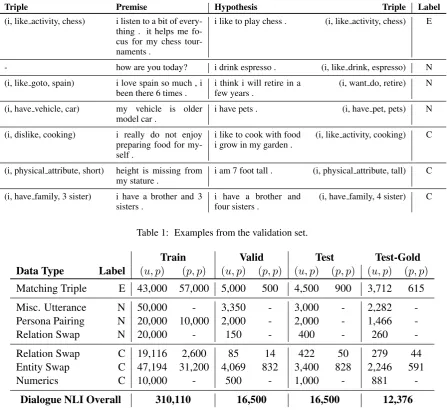
and (p, p) are defined as entailment, neutral, or contradiction based on their triple according to the criteria below. For examples and summary, we re-fer readers to Tables1–2.
2 We also release additional(u
i, uj) pairs, but experi-ments in this paper are not based on them.
3The dataset collection process is applicable to other
persona-based dialogue datasets such as (Mazar´e et al.,
2018).
Entailment Each unique pair of sentences that share the same triple are labeled as entailment.
Neutral Neutral pairs are obtained with three different methods.
First, a miscellaneous utteranceis a(u, p)pair of whichuis not associated with any triple. This includes greetings (how are you today?) and sentences unrelated to a persona sentence (the weather is ok today), so such utterances are as-sumed to be neutral with respect to persona sen-tences.
The second method,persona pairing, takes ad-vantage of the fact that each ground-truth persona is typically neither redundant nor contradictory. A persona sentence pair(p, p0)is first selected from a persona ifpandp0 do not share the same triple. Then each sentence associated with the same triple aspis paired with each sentence associated with the same triple asp0.
Lastly, we specifyrelation swaps(r, r0)for cer-tain relations (see Appendix A.2) whose triples are assumed to represent independent facts, such ashave vehicleandhave pet. A sentence pair, whose first sentence is associated with a triple(·, r,·)and whose second sentence has triple
(·, r0,·), is labeled as neutral. See Table 1for an example.
Contradiction We obtain contradictions using three methods. See Figure2for an example.
First, the relation swap method is used by specifying contradicting relation pairs (r, r0) (see Appendix A.2), such as
(like activity,dislike), then pairing each sentence associated with the triple(e1, r, e2) with each sentence associated with(e1, r0, e2).
Similarly, an entity swap consists of specify-ing relations, e.g.,physical attribute, that would yield a contradiction when the value of e2 is changed to a different valuee02, e.g.,short→ tall (see AppendixA.3). Sentences associated with(e1, r, e2) are then paired with sentences as-sociated with(e1, r, e02).
Triple Premise Hypothesis Triple Label
(i, like activity, chess) i listen to a bit of every-thing . it helps me fo-cus for my chess tour-naments .
i like to play chess . (i, like activity, chess) E
- how are you today? i drink espresso . (i, like drink, espresso) N
(i, like goto, spain) i love spain so much , i been there 6 times .
i think i will retire in a few years .
(i, want do, retire) N
(i, have vehicle, car) my vehicle is older model car .
i have pets . (i, have pet, pets) N
(i, dislike, cooking) i really do not enjoy preparing food for my-self .
i like to cook with food i grow in my garden .
(i, like activity, cooking) C
(i, physical attribute, short) height is missing from my stature .
i am 7 foot tall . (i, physical attribute, tall) C
(i, have family, 3 sister) i have a brother and 3 sisters .
i have a brother and four sisters .
[image:4.595.76.524.61.471.2](i, have family, 4 sister) C
Table 1: Examples from the validation set.
Train Valid Test Test-Gold
Data Type Label (u, p) (p, p) (u, p) (p, p) (u, p) (p, p) (u, p) (p, p)
Matching Triple E 43,000 57,000 5,000 500 4,500 900 3,712 615
Misc. Utterance N 50,000 - 3,350 - 3,000 - 2,282 -Persona Pairing N 20,000 10,000 2,000 - 2,000 - 1,466 -Relation Swap N 20,000 - 150 - 400 - 260
-Relation Swap C 19,116 2,600 85 14 422 50 279 44 Entity Swap C 47,194 31,200 4,069 832 3,400 828 2,246 591
Numerics C 10,000 - 500 - 1,000 - 881
-Dialogue NLI Overall 310,110 16,500 16,500 12,376
Table 2: Dialogue NLI Dataset Properties. (u, p)and(p, p)refer to (utterance, persona sentence) and (persona sentence, persona sentence) pairs, respectively. Numerics consist of(u, u) (u, p)and(p, p)pairs.
3.2 Triple Annotation
Each persona sentence is annotated with a triple (e1, r, e2) using Amazon Mechanical Turk task. We first define a schema consisting of
hcategoryihrelationihcategoryi rules, such as
hpersonihave pethanimali, where the relation comes from a fixed set of relation typesR, listed in AppendixA.1. Given a sentence, the annotator selects a relation r from a drop-down populated with the values inR. The annotator then selects the categories and values of the entitiese1ande2 using drop-downs that are populated based on the schema rules. An optional drop-down contains nu-meric values for annotating entity quantities (e.g., 3 brothers). If selected, the numeric value is con-catenated to the front of the entity value. The an-notator can alternatively input an out-of-schema
entity value in a text-box. Using this method, each of the 10,832 persona sentences is annotated with a triple (e1, r, e2), where r ∈ R, e1 ∈ E1, and
e2∈ E2. HereE1is the set of all annotatede1from the drop-downs or the text-box, andE2is similarly defined.
Finally, utterances are associated with a triple as follows. Letpbe a persona sentence with triple
(e1, r, e2). We start with all utterances,U, from agents that havep in their persona. An utterance
u∈U is then associated with the triple(e1, r, e2) and persona sentencepwhene2is a sub-string of
u, or word similarity4 sim(u, p) ≥ τ is suitably large.
4We use cosine similarity between the mean of TF-IDF
3.3 Statistics
Table2summarizes the dataset and its underlying data types. The label, triple, and data type are sup-plied as annotations for each sentence pair. We additionally create a gold-standard test set (Test Gold) by crowdsourcing three label annotations for each example in the test set. We keep each test example for which two or more annotators agreed with its dataset label. All sentences in Di-alogue NLI were generated by humans during the crowdsourced dialogue collection process of the Persona-Chat dataset (Zhang et al.,2018). The re-sulting sentence pairs are thus drawn from a natu-ral dialogue domain that differs from existing NLI datasets, which are either drawn from different do-mains such as image captions or created using syn-thetic templates (Bowman et al., 2015;Demszky et al.,2018;Khot et al.,2018;Marelli et al.,2014; Poliak et al.,2018b;Wang et al., 2018;Williams et al.,2018).
4 Consistent Dialogue Agents via Natural Language Inference
We now present a method which demonstrates that natural language inference can be used to improve the consistency of dialogue agents. Candidate ut-terances are re-ranked based on whether the candi-date is predicted to contradict a persona sentence. If the NLI model predicts that a candidate contra-dicts a persona sentence, the candidate’s score is penalized, with the penalty weighted by the NLI model’s confidence5scaled by a constant.
Specifically, assume a dialogue model
fdialogue(P, u≤t, U) → (s1, s2, ..., s|U|) and a Dialogue NLI model fNLI(u, p) → {E, N, C}. Given a persona P = {p1, ..., pm}, previous
utterances u≤t, and a set of candidate next-utterancesU, the dialogue model outputs a ranked list of scores s1, s2, ..., s|U| corresponding to
next-utterance candidatesu1, u2, ..., u|U|.
The NLI model is then run on each(ui, pj)pair, predicting a label yi,j ∈ {E, N, C} with
confi-denceci,j. A contradiction score is computed for
each candidate as:
scontradicti =
0, ifyi,j6=C∀pj ∈P
max
j:yi,j=C
ci,j, otherwise.
That is, if the candidate ui does not
contra-dict any persona sentencepj according to the NLI
5
In our experiments, the softmax output corresponding to the contradiction class from Dialogue NLI.
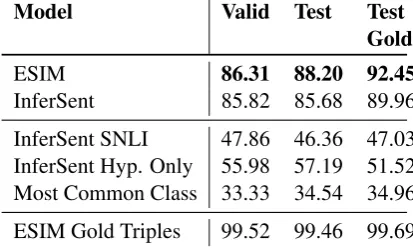
Model Valid Test Test
Gold
ESIM 86.31 88.20 92.45
InferSent 85.82 85.68 89.96
InferSent SNLI 47.86 46.36 47.03 InferSent Hyp. Only 55.98 57.19 51.52 Most Common Class 33.33 34.54 34.96
ESIM Gold Triples 99.52 99.46 99.69
Table 3: Dialogue NLI Results
model, scontradict
i is zero. Ifui contradicts one or
more persona sentences, scontradicti is the highest confidence,ci,j, out of the contradicting(ui, pj).6
New candidate scores are then computed as
sre-ranki =si−λ(s1−sk)scontradicti (1)
and the candidates are sorted according tosre-rank. Hyper-parametersλandkcontrol the NLI model’s influence in re-ranking. For example, if the top candidate has a contradiction score of 1.0, then withλ= 1, it will be moved to thek’th position in the ranking.λ= 0corresponds to no re-ranking.
5 Experiments
5.1 Experiment 1: NLI
Models Many recently proposed NLI models can be categorized into sentence encoding based methods of the form fMLP(genc(s1), genc(s2)), and attention-based methods of the form
fMLP(gattn(s1, s2)) (Lan and Xu, 2018). We thus choose and train representative models of each type which have achieved competitive performance on existing NLI benchmark datasets. For the sentence encoding method, we use In-ferSent (Conneau et al., 2017), which encodes a sentence using a bidirectional LSTM followed by max-pooling over the output states. As the representative attention-based method we use the enhanced sequential inference model (ESIM, (Chen et al.,2017)), which computes an attention score for each word pair.
We also report results from a model trained and evaluated using the hypothesis sentence only (In-ferSent Hyp. Only) (Gururangan et al.,2018; Po-liak et al.,2018c), a model trained on the existing SNLI dataset (Bowman et al.,2015) but evaluated
6Future work could consider filtering previous-utterance
[image:5.595.314.521.63.188.2]Data Type Example Pred. Actual
Matching Triple
(p, p)
i am a hopeless bookworm.
Neutral Entail when i have some spare time i read.
Matching Triple
(u, p)
i am from italy. i love the early mornings.
Neutral Entail i like getting up bright and early.
Misc. Utterance i do not understand football or baseball. Contradict Neutral i am employed as an engineer.
Persona Pairing i lift weights every chance i get. Entail Neutral i work in a warehouse driving a forklift.
Relation Swap
(p, p)
canines make me shake with fear.
Entail Contradict i love dogs but hate cats.
Relation Swap
(u, p)
i am heavy into fitness although i am rather large.
Entail Contradict i do not like exercise or physical activity.
Entity Swap
(p, p)
hawaii is where i reside.
Neutral Contradict i do not drive because i live in new york.
Entity Swap
(u, p)
tell me it was vegan food please , that is all i eat.
Neutral Contradict i eat ham.
[image:6.595.117.480.58.302.2]Numerics i have two part time jobs. Neutral Contradict i have 7 part time jobs.
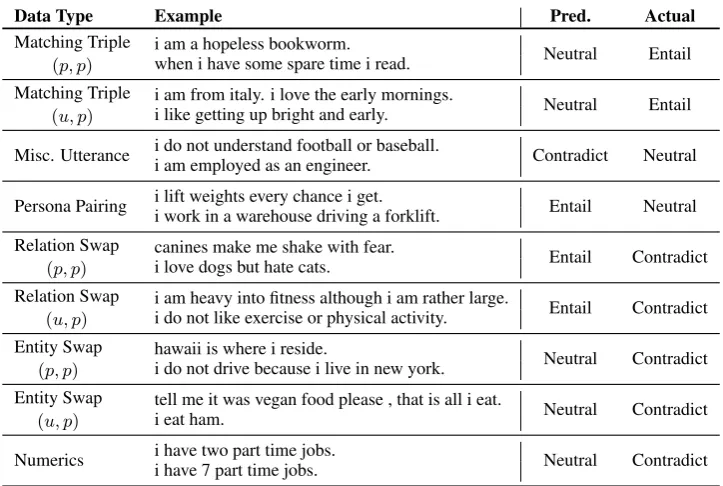
Table 4: Example ESIM mispredictions by data type on Test Gold.
Data Type N Accuracy
Matching Triple(p, p) 615 83.58 Matching Triple(u, p) 3,712 91.25 Misc. Utterance 2,282 96.85 Persona Pairing 1,466 94.48 Relation Swap(p, p) 44 79.55 Relation Swap(u, p) 539 80.71 Entity Swap(p, p) 591 93.40 Entity Swap(u, p) 2,246 92.43
[image:6.595.118.480.59.302.2]Numerics 881 96.25
Table 5: ESIM Accuracy by data type on Test Gold.
on Dialogue NLI (InferSent SNLI), and a model which returns the most common class from the Di-alogue NLI training set (Most Common Class).
Results Table 3 shows the performance of the two NLI models and three baselines on the Dia-logue NLI validation and test sets. The test perfor-mance of ESIM (88.2%) and InferSent (85.68%) is similar to the performance reported on the ex-isting SNLI dataset (88.0% (Chen et al., 2017) and 85.5% (Conneau et al., 2017), respectively), while the results on the Dialogue NLI gold test set (92.45%, 89.96%) are higher. As in Table3, how-ever, an InferSent model trained on SNLI performs poorly when evaluated on the proposed Dialogue NLI (47.03%). This is likely due to a mismatch in sentence distributions between SNLI, which is
derived from image captions, and Dialogue NLI, whose sentences more closely resemble down-stream dialogue applications. The hypothesis-only performance (51.52%) is lower than the hypothesis-only baseline for SNLI (69.00% (Po-liak et al.,2018c)), and shows that using informa-tion from both the utterance and persona sentence is necessary to achieve good performance on Dia-logue NLI.
ESIM’s reasonably strong performance on Dia-logue NLI suggests that the model may be useful in a downstream task - a claim which we verify in Experiment 5.1. However, there is also room for improvement. In particular, we report the per-formance of a model which takes the ground-truth triples as input instead of sentences. As shown in the last row of Table 3, each sentence’s un-derlying triple contains sufficient information to achieve near-perfect accuracy (99.69%). We also show ESIM’s accuracy by data type on Test Gold in Table5, along with example mispredictions in Table4. The accuracies and examples suggest that the NLI model could be improved further.
5.2 Experiment 2: Consistency in Dialogue
This experiment evaluates the effect of the re-ranking method from Section 4 on the dialogue model’s persona consistency.
[image:6.595.83.284.350.493.2]Haves Likes Attributes
Orig. Rerank Orig. Rerank Orig. Rerank
Hits@1↑ 30.2 37.3 16.9 18.7 35.2 36.4
Contradict@1↓ 32.5 8.96 17.6 4.1 8.0 5.7
[image:7.595.136.465.61.136.2]Entail@1↑ 55.2 74.6 77.9 90.6 87.5 88.6
Table 6: Effect of NLI re-ranking on persona consistency in dialogue. The reported metrics are percentages computed over each validation set.
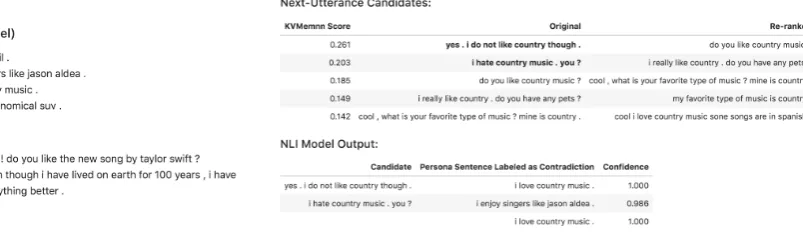
Figure 3: Example from the Likes Evaluation Set, showing dialogue model candidates, NLI model predictions, and reranked candidates using the method proposed in Section4.
model and the Dialogue NLI model.
For the dialogue model we train a key-value memory network (Zhang et al., 2018) on the Persona-Chat dataset, which uses persona sen-tences and the conversation prefix as context. This model achieved the best performance on Persona-Chat in (Zhang et al., 2018). We train the model using ParlAI (Miller et al., 2017) on thepersonachat:self original
task, using the hyper-parameters given for the
KVMemnnAgent in the ConvAI2 competition. For the NLI model we use the ESIM model trained on Dialogue NLI, based on the results of Experi-ment5.
To study the effect of re-ranking on persona consistency, we form evaluation sets which con-tain next-utterances which are likely to yield per-sona contradiction or entailment, as follows.
Evaluation Sets Each example is formed
by first finding a next-utterance ut+1 in the Persona-Chat validation set which has an associated triple (e1, r, e2) of interest, e.g.
(i,like music,country). If a sentence in the agent’s profilePhas triple(e1, r, e2), we form the validation example (P, u≤t, ut+1). Figure 3 shows an example.
Each example is associated with candidatesU, consisting of the ground-truth utteranceut+1, 10 entailment candidates with the same triple asut+1,
10 contradicting candidates with a different triple than that ofut+1, and 10 random candidates. The
dialogue model must avoid ranking a contradicting candidate highly.
Specifically, suppose the ground-truth next-utteranceut+1 is associated with triple(e1, r, e2), e.g.,(i,have pet,dog). Entailment candidates are utterances u from the validation or training sets such thatuis associated with triple(e1, r, e2). Since by construction a sentence in the profile also has triple(e1, r, e2), these candidates entail a pro-file sentence. A contradicting candidate is an ut-terance associated with a specified contradicting triple(e01, r0, e20), e.g.,(i,not have,dog).
We construct three evaluation sets, Haves,
Likes, andAttributesusing this process.
Metrics We introduce variants of the ranking metric Hits@k, called Contradict@k and En-tail@k. Contradict@kmeasures the proportion of top-k candidates returned by the model which contradict candidates, averaged over examples. This measures the propensity of a model to highly rank contradictions. Contradiction@1 is the pro-portion of consistency errors made by the model. For this metric lower values are better, in contrast to Hits@k.
[image:7.595.115.517.188.305.2]Entail-Overall Score↑ % Consistent↑ % Contradiction↓
Raw Calibrated Raw Calibrated Raw Calibrated
[image:8.595.103.498.62.121.2]KV-Mem 2.11±1.12 2.21±0.26 0.24 0.27±0.07 0.23 0.25±0.08 KV-Mem + NLI 2.34±1.21 2.38±0.26 0.28 0.35±0.08 0.19 0.16±0.06
Table 7: Human evaluation results (mean±standard deviation).
ment candidates share the same underlying triple as the ground-truth next utterance, so this metric rewards highly ranked candidates that convey sim-ilar meaning and logic to the ground-truth utter-ance. Thus it can be interpreted as a more permis-sive version of Hits@k.
Results Table6shows re-ranking results on the three evaluation sets (λ = 1.0, k = 10). The NLI re-ranking improves all three metrics on all the evaluation sets. Overall dialogue performance improves, as measured by Hits@1. The NLI re-ranking substantially reduces the number of con-tradicting utterances predicted by the model, and increases the number of utterances which entail a profile sentence, as seen in the Contradict@1 and Entail@1 scores.
Figure3shows an example dialogue with candi-dates, contradictions predicted by the NLI model, and the corresponding re-ranked candidates.
5.3 Experiment 3: Human Evaluation
This experiment evaluates the effect of the pro-posed NLI re-ranking method on a dialogue model’s consistency, where consistency is judged by human annotators in an interactive persona-based dialogue setting.
Experiment Setup We use ParlAI (Miller et al., 2017) which integrates with Amazon Mechanical Turk for human evaluation. A human annotator is paired with a model, and each is randomly as-signed a persona from 1,155 persona sets. The hu-man and model are then asked to make a conver-sation of at least either five or six turns (randomly decided). After the conversation, the annotator as-signs three scores to the conversation, described below. Each annotator is allowed to participate in at most ten conversations per model, and we col-lect 100 conversations per model. Two models are evaluated: the same key-value memory network used in Experiment 5.1 without re-ranking ( KV-Mem), and with re-ranking (KV-Mem + NLI).
Scoring and Calibration Following a conversa-tion, an annotator is shown the conversation and the model’s persona, and assigns three scores: an overall score of how well the model represented its persona ({1,2,3,4,5}), a marking of each model utterance that was consistent with the model’s per-sona ({0,1}), and a marking of each model utter-ance that contradicted a previous utterutter-ance or the model’s persona ({0,1}).
We use Bayesian calibration to adjust for anno-tator bias, following (Kulikov et al.,2018). We as-sume a model with observed scoresSij and latent variables Mi for the unobserved score of model i and Bj for the bias of annotator j. We then
estimate the posterior mean and variance for the unobserved scores given the observed scores. We use Pyro (Bingham et al.,2018) and the no-u-turn sampler (Hoffman and Gelman,2014) for poste-rior inference. See AppendixCfor details.
Results Table7shows the human evaluation re-sults. The natural language inference re-ranking improves all the metrics, notably the fine-grained consistency score (0.27 vs. 0.35) and contradic-tion score (0.25 vs. 0.16). The results are consis-tent with the conclusions from the automatic eval-uation in Experiment5.1.
6 Conclusion
References
Eli Bingham, Jonathan P Chen, Martin Jankowiak, Fritz Obermeyer, Neeraj Pradhan, Theofanis Kar-aletsos, Rohit Singh, Paul Szerlip, Paul Horsfall, and Noah D Goodman. 2018. Pyro: Deep Uni-versal Probabilistic Programming. arXiv preprint arXiv:1810.09538.
Samuel R Bowman, Gabor Angeli, Christopher Potts, Christopher D Manning, and Stanford Linguistics. 2015. A large annotated corpus for learning natu-ral language inference. InProceedings of the 2015 Conference on Empirical Methods in Natural Lan-guage Processing, pages 632–642. Association for Computational Linguistics.
Qian Chen, Xiaodan Zhu, Zhenhua Ling, Si Wei, Hui Jiang, and Diana Inkpen. 2017. Enhanced LSTM for Natural Language Inference. InProceedings of the 55th Annual Meeting of the Association for Compu-tational Linguistics (Volume 1: Long Papers), pages 1657–1668. Association for Computational Linguis-tics.
Alexis Conneau, Douwe Kiela, Holger Schwenk, Loc Loc Barrault, and Antoine Bordes. 2017. Super-vised Learning of Universal Sentence Representa-tions from Natural Language Inference Data. In Proceedings of the 2017 Conference on Empirical Methods in Natural Language Processing, pages 670–680, Copenhagen, Denmark. Association for Computational Linguistics.
Ido Dagan, Oren Glickman, and Bernardo Magnini. 2006. The PASCAL Recognising Textual Entail-ment Challenge. pages 177–190. Springer, Berlin, Heidelberg.
Dorottya Demszky, Kelvin Guu, and Percy Liang. 2018. Transforming Question Answering Datasets Into Natural Language Inference Datasets. arXiv preprint arXiv:1809.02922.
Suchin Gururangan, Swabha Swayamdipta, Omer Levy, Roy Schwartz, Samuel R Bowman, and Noah A Smith. 2018. Annotation Artifacts in Natu-ral Language Inference Data. InProceedings of the 2018 Conference of the North American Chapter of the Association for Computational Linguistics: Hu-man Language Technologies, Volume 2 (Short Pa-pers), pages 107–112, New Orleans, Louisiana. As-sociation for Computational Linguistics.
Matthew D. Hoffman and Andrew Gelman. 2014. The no-u-turn sampler: Adaptively setting path lengths in hamiltonian monte carlo. J. Mach. Learn. Res., 15(1):1593–1623.
Tushar Khot, Ashish Sabharwal, and Peter Clark. 2018. SCITAIL: A Textual Entailment Dataset from Sci-ence Question Answering. InAAAI.
Diederik P Kingma and Jimmy Lei Ba. 2014. Adam: A Method For Stochastic Optimization. arXiv preprint arXiv:1412.6980.
Ilya Kulikov, Alexander H Miller, Kyunghyun Cho, and Jason Weston. 2018. Importance of a Search Strategy in Neural Dialogue Modelling. arXiv preprint:1811.00907.
Wuwei Lan and Wei Xu. 2018. Neural Network Mod-els for Paraphrase Identification, Semantic Textual Similarity, Natural Language Inference, and Ques-tion Answering. In Proceedings of the 27th Inter-national Conference on Computational Linguistics, pages 3890–3902, Santa Fe, New Mexico, USA. As-sociation for Computational Linguistics.
Jiwei Li, Michel Galley, Chris Brockett, Georgios P Spithourakis, Jianfeng Gao, and Bill Dolan. 2016. A Persona-Based Neural Conversation Model. In Pro-ceedings of the 54th Annual Meeting of the Associa-tion for ComputaAssocia-tional Linguistics (Volume 1: Long Papers), pages 994–1003, Berlin, Germany. Associ-ation for ComputAssoci-ational Linguistics.
Bill Maccartney and Christopher D Manning. 2009.
An extended model of natural logic. Technical re-port.
M Marelli, S Menini, M Baroni, L Bentivogli, R Bernardi, and R Zamparelli. 2014. A SICK cure for the evaluation of compositional distributional se-mantic models. InProceedings of the Ninth Interna-tional Conference on Language Resources and Eval-uation (LREC-2014), Reykjavik, Iceland. European Language Resources Association (ELRA).
Pierre-Emmanuel Mazar´e, Samuel Humeau, Martin Raison, and Antoine Bordes. 2018. Training Mil-lions of Personalized Dialogue Agents. In Proceed-ings of the 2018 Conference on Empirical Methods in Natural Language Processing, Brussels, Belgium. Association for Computational Linguistics.
Alexander H Miller, Will Feng, Adam Fisch, Jiasen Lu, Dhruv Batra, Antoine Bordes, Devi Parikh, and Ja-son Weston. 2017. ParlAI: A Dialog Research Soft-ware Platform.arXiv preprint:1705.06476.
Jeffrey Pennington, Richard Socher, and Christopher D Manning. 2014. GloVe: Global Vectors for Word Representation. InEmpirical Methods in Natural Language Processing (EMNLP), pages 1532–1543.
Adam Poliak, Yonatan Belinkov, James Glass, and Benjamin Van Durme. 2018a. On the Evaluation of Semantic Phenomena in Neural Machine Trans-lation Using Natural Language Inference. In Pro-ceedings of the 2018 Conference of the North Amer-ican Chapter of the Association for Computational Linguistics: Human Language Technologies, Vol-ume 2 (Short Papers), pages 513–523, New Orleans, Louisiana. Association for Computational Linguis-tics.
Representation Evaluation. In Proceedings of the 2018 Conference on Empirical Methods in Natural Language Processing, pages 67–81. Association for Computational Linguistics.
Adam Poliak, Jason Naradowsky, Aparajita Haldar, Rachel Rudinger, and Benjamin Van Durme. 2018c.
Hypothesis Only Baselines in Natural Language In-ference. InThe Seventh Joint Conference on Lexical and Computational Semantics (*SEM).
Oriol Vinyals, Google Quoc, and V Le. 2015. A Neu-ral Conversational Model. InICML Deep Learning Workshop.
Alex Wang, Amanpreet Singh, Julian Michael, Felix Hill, Omer Levy, and Samuel R Bowman. 2018.
GLUE: A Multi-Task Benchmark and Analysis Plat-form for Natural Language Understanding. arXiv preprint arXiv:1804.07461.
Adina Williams, Nikita Nangia, and Samuel R Bow-man. 2018. A Broad-Coverage Challenge Corpus for Sentence Understanding through Inference. In Proceedings of the 2018 Conference of the North American Chapter of the Association for Computa-tional Linguistics: Human Language Technologies, Volume 1 (Long Papers), pages 1112–1122, New Orleans, Louisiana. Association for Computational Linguistics.
Saizheng Zhang, Emily Dinan, Jack Urbanek, Arthur Szlam, Douwe Kiela, and Jason Weston. 2018. Per-sonalizing Dialogue Agents: I have a dog, do you have pets too? In Proceedings of the 56th An-nual Meeting of the Association for Computational Linguistics (Volume 1: Long Papers), pages 2204– 2213, Melbourne, Australia. Association for Com-putational Linguistics.
A Dataset Details
A.1 Schema
Relation Types :
place origin, live in citystatecountry, live in general, nationality, em-ployed by company, employed by general, has profession, previous profession, job status, teach, school status, has degree, attend school, like general, like food, like drink, like animal, like movie, like music, like read, like sports, like watching, like activity, like goto, dislike, has hobby, has ability, member of, want do, want job, want, favorite food, favorite color, fa-vorite book, favorite movie, favorite music, favorite music artist, favorite activity, fa-vorite drink, favorite show, favorite place, favorite hobby, favorite season, favorite animal, favorite sport, favorite, own, have, have pet, have sibling, have children, have family,
have vehicle, physical attribute, misc attribute, has age, marital status, gender, other.
Additional triples with a not have relation were extracted using a dependency tree pattern.
Entity Categories : ability, activity, animal, color, citystate, country, company, cuisine, degree type, drink, family, food, gender, gen-eral location, job status, language, marital, media genres, media other, movie title, mu-sic artist, mumu-sic genre, mumu-sic instrument, noun, number, organization, person, person attribute, person label, personality trait, profession, read author, read genre, read title, read other, school name, school status, school type, season, sport type, subject, time, vehicle, location, other.
A.2 Relation Swaps
Relation swaps for contradictions include
(have *, not have),
(own, not have),
(has hobby, not have),
(like *, dislike),
(favorite *, dislike).
Neutral relation swaps include (have x, have y), e.g. have pet, have sibling. Additional(have * A, not have B)swaps were defined for entities A which are a super-type of B, namely (A,B) pairs ({pet, animal}, {dog, cat}), ({sibling},{brother, sister}), ({child, kid},
{son, daughter}), ({vehicle}, {car, truck}); this includes sentence pairs such as “i have a sibling”, “i do not have a sister”. Similarly, (not have B, have * A) swaps were defined using the (A, B) pairs above.
A.3 Entity Swaps
For contradictions, swapping entities for the fol-lowing relation types was assumed to yield a con-tradiction:
attend school, employed by company, employed by general, favorite animal, fa-vorite book, favorite color, favorite drink, favorite food, favorite hobby, favorite movie, favorite music, favorite music artist, fa-vorite place, favorite season, favorite show, favorite sport, gender, has profession, job status, live in citystatecountry, marital status, na-tionality, place origin, previous profession, school status, want job.
Additionally, for physical attribute,
en-tity swap was done using all WordNet antonym pairs in the personality trait and person attribute entity categories, as well as the swaps ({blonde},
{brunette}), ({large}, {tiny}), ({carnivore, om-nivore}, {vegan, vegetarian}), ({depressed},
{happy, cheerful}), ({clean},{dirty}) where each entity in the left set is swapped with each entity in the right set.
B Experiment Details
Experiment 1 The InferSent model used the Adam (Kingma and Lei Ba,2014) optimizer with learning rate 0.001, and otherwise used the hyper-parameters from the open source implementation7. The ESIM model used a 1-layer bidirectional LSTM with hidden dimension 1024 and Adam op-timizer with learning rate 0.0001, with the remain-ing hyper-parameters set to those used by the In-ferSent model.
C Score Calibration
1-5 star rating LetMi ∼ N(µi,12) be the un-observed, underlying quality of thei-th approach, whereµi ∼ U(1,5). Let Aj ∼ N(0,12) be the
unobserved annotator bias, indicating whether the
j-th annotator is more or less generous. We ob-serve a score given by the j-th annotator to the
i-th approach, and this score follows a normal dis-tribution with its mean given by the sum of the underlying model score and annoator bias, i.e.,
Sij ∼ N(Mi+Aj,12). We observe some of these scores, and given these scores, the goal is to infer
E[Mi]andV[Mi]for alli.
Utterance-pair selection Each annotator is asked to label each utterance-pair as consistent and/or contradictory with respect to the personas. In this case, the unobserved, underlying model score is modelled as a pre-sigmoid normal vari-able, i.e.,Mi ∼ N(0,12), and the annotator bias as a usual normal variable, i.e., Aj ∼ N(0,12),
similarly to the 1-5 star rating case above. We however also introduce a turn biasTk ∼ N(0,12)
to incorporate the potential degradation of a neu-ral dialogue model as the conversation lengthens. An observed score for each utterance pair then fol-lows a Bernoulli distribution with its mean given as the sigmoid of the sum of these three latent vari-ables, i.e.,Sijk∼ B(sigmoid(Mi+Aj+Tk)). The
7https://github.com/facebookresearch/InferSent
goal of inference is to compute E[sigmoid(Mi)]