233
Adversarial Attack on Sentiment Classification
Alicia Yi-Ting Tsai
Tobey Yang
Erica Chen
hanyu [email protected]
Abstract
In this paper, we propose a white-box attack algorithm called “Global Search” method and compare it with a simple mis-spelling noise and a more sophisticated and common white-box attack approach called “Greedy Search”. The attack meth-ods are evaluated on the Convolutional Neural Network (CNN) sentiment classi-fier trained on the IMDB movie review dataset. The attack success rate is used to evaluate the effectiveness of the attack methods and the perplexity of the sen-tences is used to measure the degree of dis-tortion of the generated adversarial exam-ples. The experiment results show that the proposed “Global Search” method gener-ates more powerful adversarial examples with less distortion or less modification to the source text.
1 Introduction
In the past few decades, machine learning and deep learning techniques have been successful in several applications. However, these techniques developed so far are proven to be vulnerable given some manipulated inputs, which are called ad-versarial examples, that human can easily distin-guish but algorithms can not (Szegedy et al.,2014;
Goodfellow et al.,2015).
Current research have shown successful results in producing adversarial images that cause the al-gorithms to completely fail in computer vision (Kurakin et al., 2016). Studies of adversarial ex-amples in the applications of natural language pro-cessing such as sentiment analysis, fake news de-tection and machine translation remain relatively low. Nonetheless, it is an emerging field that is worth exploring and has increased attention
re-cently due to the success of adversarial learning in images. When generating an adversarial example, if the adversary does not have knowledge of the classifier or the training data, we call this a black-box setting. On the other hand, if the adversary has full knowledge of the classifier and the train-ing data, we call this a white-box setttrain-ing.
In a black-box setting,Belinkov and Bisk intro-duces a simple attack method by randomly replac-ing characters with their nearby key on the key-board, which is similar to keyboard typos, to at-tack a machine translation system (Belinkov and Bisk, 2017). Similar idea can be found in the work of Hosseini et al., the authors generate ad-versaries that deceive Google Perspective API by misspelling the abusive words or adding punctua-tion to the letters (Hosseini et al.,2017). Another work from Alzantot et al. attempts to generate semantically and syntactically similar adversarial examples by word replacement (Alzantot et al.,
2018). They develop an genetic algorithm that uses population-based gradient-free optimization, inspired by the process of natural selection. In the black-box setting, the adversary tries different per-turbations and evaluates the quality of perturba-tions by querying the model to get the classifica-tion result or the output score. The adversary con-tinues to altered the sentence until the model fails or until score reduces significantly.
In the white-box setting, the adversary has ac-cess to the model and thus is capable of gen-erating more sophisticated adversarial examples.
giv-ing the adversary important information to find the classifier’s weak points. Because white-box adver-sary has access to the gradients of the model, the adversary does not have to query the output score from the classifier every time. Using the gradients as a surrogate loss, the white-box adversary can efficiently find the best changes that maximize the surrogate loss simply by backpropagation.
Other white-box adversary includes word-level substitution.Kuleshov et al.try to replace 10-30% of words in the source text by solving an optimiza-tion problem that maximizes a surrogate loss sub-ject using a greedy approach, which is similar to the “Greedy Search” baseline used in the exper-iment. A similar idea can be found in Samanta and Mehtawhere the authors apply different rules (insertion, replacement and deletion of words) to generate adversarial examples. Liang et al. later combine the strategies above and try to avoid in-troducing excessive modification or insertion to the original source text.
In this paper, we consider the task of white-box attack where the adversary has full knowledge of the model under attack. We propose a ”Global Search” attack method that mitigates some of the problems faced in the commonly used greedy ap-proach. A very simple misspelling noise baseline is also reported to show the effectiveness of the 2 white-box attack methods in the experiment.
2 Attack Method
2.1 Misspelling Noise
We first consider a very simple case by swap-ping two characters in a word (eg. perfect → pefrect), which is similar to keyboard typos or misspelling. To maintain the readability of source text, the noise is only applied to word of length longer than 3 and 50% of the words in the source text are randomly swapped.
2.2 Greedy Search Approach
We follow a similar greedy optimization strategy in (Kuleshov et al., 2018) for constructing adver-sarial examples for sentiment classification. At each iteration, the algorithm considers k nearest neighbors of each word in the word embedding space. It then picks the one among thekneighbors that has the greatest impact on the prediction re-sult. Consider a sentiment classifierf, the greedy approach forms the adversarial example by replac-ing the original wordwwith the candidatesw0. If
the label is positive, then the final sigmoid layer of the model should output a valueσgreater than 0.5. The algorithm then replaces the original word
wwith each candidatew0 among thekneighbors and see if the sigmoid value of the adversary x0
is less thanσ, indicating that replacingwwithw0
can contribute to flipping the prediction result to negative. The candidatew0that results in the max-imum difference is then chosen to be the final re-placement, i.e. smallest σ0 for positive class (1) and the largestσ0for the negative class (0).
arg min
w0 fsigmoid(x
0 )
s.t.fsigmoid(x0)< fsigmoid(x) if positive class
arg max
w0 fsigmoid(x
0)
s.t.fsigmoid(x0)> fsigmoid(x) if negative class
Algorithm 1 summarizes the “Greedy Search” approach. Although the objective of the algorithm is to fool the sentiment classifier, the grammar, se-mantic and sentiment should not be altered. Thus, some constraints are imposed in order to maintain the similarity between the original source text and the adversarial example.
Algorithm 1 Generate adversarial example via greedy search
1: σ←fsigmoid(x)
2: Initializex0 ←x,count ←0
3: forwinx0do
4: candidates ← k nearest neighbors of w
within distancedand have the same POS tag asw
5: Σ← ∅
6: forw0incandidates do
7: x¯←replacewwithw0 8: σ0←fsigmoid(¯x)
9: Σ←Σappendσ0
10: ifpositive andmin Σ< σthen
11: x0 ←argminx¯Σ 12: count ←count +1
13: else ifnegative andmax Σ> σthen
14: x0 ←argmaxx¯Σ 15: count ←count +1 16: σ ←fsigmoid(x0)
17: ifpositive andσ <0.5then returnx0
18: ifnegative andσ >0.5then returnx0
Word Choice. When picking the word can-didates in each iteration, we consider the top k
nearest neighbors in the word embedding space. The nearest neighbors in GloVE word embedding space usually appear in the same context as the original word. Thus, by picking nearest neighbors in GloVE vectors, we can ensure semantic simi-larity after word replacement. Although word em-bedding helps to find words that are used in sim-ilar context, it does not guarantee that the part of speech (POS) will remain the same after replace-ment. Therefore, we examine the part of speech of the original word and ensure the selected candi-dates have the same part of speech as the original word.
Hyper-parameters. There are 3 hyper-parameters, k, d, and r, used in Algorithm 1 to maintain the semantic similarity of the sentences. The first parameterkis used to decide how many nearest neighbors should be considered in the first place. When k is too small, there might not be enough candidates to successfully form an adver-sarial example. d represents the maximum dis-tance allowed between the candidate words and the original word in the word embedding space. When dis large, the meaning of the altered sen-tence is generally farther from the original one. When d gets too small, the chance of generat-ing a successful attack decreases. The last hyper-parameter,r, stands for the percentage of replace-ment allowed in the sentence. When the threshold
ris too low, the chance of generating a successful adversarial example decreases. Similarly, whenr
is too large, too many words will be replaced and thus the generated sentence will be very dissimilar to the original one.
2.3 Global Search Approach
The greedy approach proposed above does not guarantee to produce the optimal results and is sometimes time consuming because the algorithm needs to search the candidate words for every it-eration. To mitigate the problem, we propose to search for the candidates globally by computing a small perturbation,δ.
To learn the perturbation, δ, we define an ob-jective functionJ(δ). The objective function tries to maximize the difference between the sigmoid value of the original inputxand that of perturbed input x +δ. Furthermore, we add two regular-ization terms in the objective function. The first
regularization penalizes large perturbations and is controlled via the hyperparametersλ1. The second regularization penalizes large distance between original word embedding and perturbed word em-bedding and is controlled by the hyperparameters
λ2. The two regularization terms are added to help keep the semantic of chosen words.
J(δ) =(fsigmoid(Ex)−fsigmoid(Ex+δ))2
+λ1· kδk2
+λ2· k(Ex−(Ex+δ))k2
The attack algorithm is described in Algorithm
2. We first initialize the perturbation δ to be 0. Here, the original input embedding is denoated asEx and the perturbed embedding is denoted as Ex0 = Ex +δ. For each iteration, the algorithm
computes the gradient,∇δ, of the objective func-tion J(δ) with respect to the perturbation δ, and update the perturbationδvia backpropagation. We then form a perturbed embedding Ex0. The per-turbed embedding Ex0 is a matrix and each row ofEx0 is the perturbed word embedding for each word, denoted as e, in the source text. The per-turbed embeddingeusually does not have a actual word that can be mapped back to. Thus, we find the candidate words w0 in the embedding space that is the closest to the perturbed word embed-dingeand record the w0 in the candidate listke.
The candidate words for replacement are recorded in another listW0. After computing the perturbed embedding, and record the candidate words, the algorithm checks if the current perturbed embed-dingEx0 flips the prediction result. The algorithm continues to compute newEx0 and record the can-didate words if the previous Ex0 fails to fool the model, otherwise, the algorithm returns the candi-date words and the perturbation.
Next, we can use the generated candidate words list and the perturbation to generate the adversar-ial example. The algorithm is described in algo-rithm3. The algorithm sorts the magnitude of the perturbation and replaces words in the positions that have higher perturbation magnitude. A higher perturbation magnitude indicates that the classifier is more sensitive to changes of the original word. Here, we have a hyperparameterdthat controls the threshold for word distance. If the last candidate
w0nin the candidate words list is too far away from the original word, then the algorithm rejects the candidatewn0 and move to the previous candidate
Algorithm 2Global Search Attack Function
1: y←Round(fsigmoid(x))
2: Initializeδ ←0,success = False
3: Ex←input embedding
4: W0←Ø
5: foreinEx0 do
6: ke←Ø .Empty candidate list 7: W0 ←W0 appendke
8: whilenotsuccess do
9: ∇δ←viaback-propagation
10: δ ←δ−· ∇δ
11: Ex0 ←Ex+δ .perturbed embedding
12: foreinE0xdo
13: ke ←keappendargminw0ke−Ew0k2
14: yˆ←Round(fsigmoid(Ex0))
15: W0 ←W0∪ {ke}
16: ifyˆ6=ythen
17: returnW0, δ
the percentage of changes allowed as the described earlier.
Algorithm 3 Global Search Generate Adversary Function
1: y←Round(fsigmoid(x))
2: positions←reversed(argsortkδk2) 3: Initializesuccess = False
4: foriinpositionsdo
5: w←i-th word in the source textx 6: candidates ←Wi0
7: candidates ←reversed(candidates)
8: forw0incandidates do
9: ifkew−ew0k2 < dthen
10: E0i←ew0 .replace embedding
11: break
12: x0i←w0 .replace word
13: yˆ←Round(fsigmoid(Ex0))
14: ifyˆ6=ythen
15: success = True
16: returnx0 17: if leni(x) > rthen
18: returnNone
3 Experiment
3.1 Dataset
We use a dataset of 25,000 informal movie re-views from the Internet Movie Database (IMDB) (Maas et al., 2011) and randomly select 80% of the dataset to include in the training set, and 20%
in the testing set1.
3.1.1 CNN Sentiment Classifier
In this experiment, we used the convolutional neu-ral network classifier (Kim, 2014) as the target model to be attacked. We replicated the archi-tecture of the CNN model from Kim work. In the CNN model, an embedding of a fixed dictio-nary and size serves as the very first layer. Con-volutional layers with filter widths of 3, 4, 5 and 100 are added with a max-over-time pooling layer and a fully connected layer with dropout rate of 0.5. We trained the model with 20,000 reviews and tested it with another 5,000 reviews with batch size of 64, reaching testing accuracy of 0.9. The result is summarized in Table1.
3.2 Evaluation
3.2.1 Success Rate
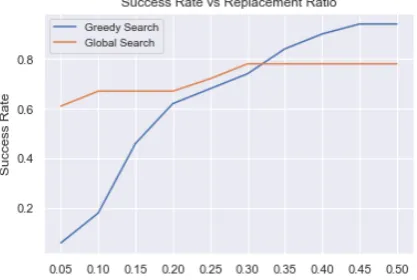
The end goal of the attack algorithms is to trick the model to make wrong prediction by manip-ulating the input. To access the effectiveness of the attack models, we select 500 examples that are correctly classified from the test set, so that the accuracy of the classifiers does not affect the evaluation. We then input these source text into the attack algorithms to generate adversarial ex-amples. The adversarial examples are then fed into the CNN classifier to get the final prediction. The success rate of the attack algorithm is defined as the percentage of wrong prediction by the CNN classifier. Higher success rate means that the at-tack algorithm can generate more powerful adver-saries that can cause the CNN classifier to mis-behave. The experiment result in Table 2 shows that Global Search approach has 72% success rate while Greedy Search approach has 65%. Com-pared with the Global Search method, it gener-ally requires higher percentage of words replace-ment for Greedy Search to successfully generate an adversary. Because of the greedy nature, the algorithm replaces words as long as changing the words can help confuse the classifier; hence, the algorithm can replace sub-optimal words in a ear-lier position that do not contribute the most to the end goal. Another limitation of the Greedy Search approach is that word replacements tend to locate in a close area of the sentence, especially in an ear-lier position. This greatly reduce the readability of
Accuracy Training Testing
CNN 0.99 0.90
Table 1: Sentiment Classifier Result
the sentences and can destroy the semantic mean-ing of the source text.
3.2.2 Hyper-parameters Choice
As mentioned above, there are 3 hyper-parameters in the greedy approach, which arek, the number of candidates to be considered;d, the maximum dis-tance allowed between the original word and the candidate; r, the ratio of word changes allowed with respect to the length of the sentence. The global search algorithm also includes the hyper-parameters d and r. In our experiment of the greedy approach, k is set to 20. This parameter does not affect much since the maximum word dis-tance allowed and the limitation of picking words with the same part-of-speech tag help to main-tain similarity. The parameter is used to reduce the run-time complexity of the algorithm by lim-iting the number of candidates. As ford, we run the algorithm for a few different values, we de-cide to set d to 20 to reach a high success rate while not picking words too far from the origi-nal one. There exists a trade-off between simi-larity and success rate in choosing the value for
d. While allowing words farther from the original word, the success rate increases but similarity de-creases as a penalty. The thresholdrcontrols how many words are allowed to change in a sentence; it is also shared by the two approaches. In greedy approach,rshould be at least set to 0.2 to achieve a good result. When r is set to 0.1, the success rate is merely 0.18; whenris 0.2, the success rate increases to 0.65. So we decide to set the thresh-oldr to 0.2 for greedy approach in the following experiment. On the other hand, the global search algorithm can reach a pretty good result when r
is set to 0.1. In our experiment, we found that global search algorithm is more effective than the greedy approach since the global search algorithm looks for the word that contributes most to classi-fication result while greedy algorithm swap words with any degree of contribution.
3.2.3 Perplexity
[image:5.595.311.520.194.334.2]In order to evaluate the adversarial examples gen-erated from our models, we decide to measure the perplexity, which is widely used in assessing
[image:5.595.311.519.514.661.2]Figure 1: Success Rate vs Replacement Ratio
Misspelling Noise Greedy Search Global Search
[image:6.595.75.283.136.280.2]6% 65% 72%
[image:6.595.310.519.136.266.2]Table 2: Success rate of attacking methods
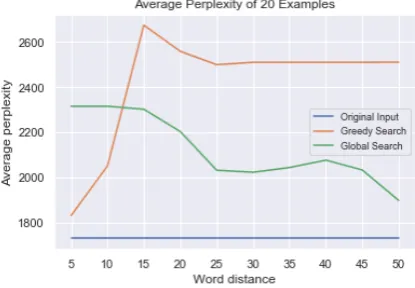
Figure 3: Average Perplexity vs Word Distance
language models, of 20 examples with different hyper-parameters. As Figure 3 shows, the per-plexity increases as the word distance increases in the greedy approach, meaning that the gener-ated examples are less likely to occur in the cor-pus. However, in the global search approach, it is the opposite. It might be that the number of change decreases while allowing larger word dis-tance. We also calculate the perplexity with differ-ent values of proportion of changes. The perplex-ity increases as the proportion of changes allowed in both attacking models. See result in Figure4. When comparing the perplexity of the two attack-ing models, the global search approach generally does better than the greedy one. Since the greedy algorithm usually requires more changes than the global search approach even though we have set the threshold for the replacement rate.
3.2.4 Human Evaluation
We conduct a survey and propose two criteria to measure the performance of the adversarial exam-ples from three attack methods. The first criteria is the sentiment classification accuracy of the adver-sarial examples which is predicted by human, and the second is the similarity between the adversar-ial examples and the original sentence.
Human Prediction Accuracy. Unlike adver-sarial examples in the context of image classifi-cation, natural language perturbation is generally perceptible since words are deleted, added, or
re-Figure 4: Average Perplexity vs Replacement Ra-tio
placed. Thus, we need to redefine imperceptibility in the context of natural language. Since we are crafting adversarial example to fool the sentiment classifier, we define it as imperceptible if human can still correctly classify without being fooled by the perturbation. Therefore, we ask some volun-teers to evaluate adversarial examples and look at the percentage of responses that match the original classification.
Sentence Similarity. In addition to classifica-tion accuracy, we also care about how similar the generated adversaries examples are to the original unaltered sentences. we ask volunteers to rate the similarity, from 1 to 5, which means less similar to very similar between the adversarial sentence and original sentence.
We choose two sentences which originally clas-sified as positive comment and negative comment, and then flipped to opposite sentiment result af-ter applying three attack methods. Afaf-ter asking 15 volunteers and analyzing the survey data, we found that the adversarial example from Global Search is most similar to the original sentence, with an average similarity of 4.4, while the exam-ple from Greedy Search is less similar, with the score of 2.9.
Search adversarial examples, human could still classify sentiment correctly. However, greedy search only has 0.30 accuracy because it alter too many words to fool the sentiment classifier. In this survey, some of the volunteers feel that the adver-sarial sentences from Greedy Search are hard to read and can not tell the sentiment of the sene-tence.
Examples of adversarial text generated
Original reviews:as long as you go into this movie knowing that it ’s terrible : bad acting , bad ” effects , ” bad story , bad ... everything , then you ’ll love it . this is one of my favorite ” goof on ” movies ; watch it as a comedy and have a dozen good laughs !
Global Search: as long as you go into this movie knowing that it ’s terrible : worse act-ing , bad ” effects , ” bad story , bad ... ev-erything , then you ’ll love it . this is one of my favorite ” goof on ” movies ; watch it as a comedy and have a dozen good laughsyes
Greedy Search:as long as youleaveinto this blockbuster telling whetherit ’shorrendous: bad acting , bad ” effects , ” bad story , bad ... everything , then you ’ll love it . this is one of my favorite ” goof on ” movies ; watch it as ...
Misspelling Noise:as lnog as you go into this mvoie knowing that it’s terirble : bad atcing , bad ” effects , ” bad sotry , bad ... everything , then you ’ll lvoe it . this is one of my favorite ” goof on ” movies ; watch it as a comedy and hvae a dzoen good laguhs !
4 Conclusion and Future Work
In this experiment, we generalize the concept of adversarial examples to the context of sentiment classification in natural language. We prove that some machine learning algorithms are vulnerable to adversarial examples. Some works have been done using the greedy approach and have proved the method to be effective; however, the global search algorithm is proved to be much more pow-erful than the greedy approach. The global search
method requires less change to the original sen-tence and maintain a higher level of similarity in terms of both human evaluation and perplexity measure.
Both of the greedy and global search algorithms are operating in a white-box scenario; they are not as powerful as the black-box algorithms. The black-box character swapping algorithm could be further applied to CNN model with character-level embedding. Other word-level attacking models operating in black-box scenarios can be a way to improve the limitation of white-box models.
By far, we developed some successful strategies to attack the sentiment classifiers. Further stud-ies can be done to strengthen the classifiers. By training the classifiers with generated adversarial examples, we hope to help defend the classifier against adversarial attack and improve the model accuracy.
References
Moustafa Alzantot, Yash Sharma, Ahmed Elgohary, Bo-Jhang Ho, Mani Srivastava, and Kai-Wei Chang. 2018. Generating natural language adversarial ex-amples.
Yonatan Belinkov and Yonatan Bisk. 2017. Synthetic and natural noise both break neural machine transla-tion.CoRR, abs/1711.02173.
Javid Ebrahimi, Anyi Rao, Daniel Lowd, and Dejing Dou. 2017. Hotflip: White-box adversarial
exam-ples for NLP. CoRR, abs/1712.06751.
Ian Goodfellow, Jonathon Shlens, and Christian Szegedy. 2015. Explaining and harnessing adversar-ial examples. InInternational Conference on Learn-ing Representations.
Hossein Hosseini, Sreeram Kannan, Baosen Zhang, and Radha Poovendran. 2017. Deceiving google’s perspective API built for detecting toxic comments. CoRR, abs/1702.08138.
Yoon Kim. 2014. Convolutional neural networks for sentence classification. InProceedings of the 2014 Conference on Empirical Methods in Natural Lan-guage Processing (EMNLP).
Volodymyr Kuleshov, Shantanu Thakoor, Tingfung Lau, and Stefano Ermon. 2018. Adversarial exam-ples for natural language classification problems.
Misspelling Noise Greedy Search Global Search
Semantic Similarity (Scale: 1-5) 3.8 2.9 4.4
Human Prediction Accuracy 0.70 0.30 0.83
Table 3: Human Evaluation Survey Results
Bin Liang, Hongcheng Li, Miaoqiang Su, Pan Bian, Xirong Li, and Wenchang Shi. 2018. Deep text clas-sification can be fooled.Proceedings of the Twenty-Seventh International Joint Conference on Artificial Intelligence.
Andrew L. Maas, Raymond E. Daly, Peter T. Pham, Dan Huang, Andrew Y. Ng, and Christopher Potts. 2011. Learning word vectors for sentiment analy-sis. InProceedings of the 49th Annual Meeting of the Association for Computational Linguistics: Hu-man Language Technologies, pages 142–150, Port-land, Oregon, USA. Association for Computational Linguistics.
S. Samanta and S. Mehta. 2017.Towards Crafting Text Adversarial Samples.ArXiv e-prints.
Christian Szegedy, Wojciech Zaremba, Ilya Sutskever, Joan Bruna, Dumitru Erhan, Ian Goodfellow, and Rob Fergus. 2014. Intriguing properties of neural
networks. InInternational Conference on Learning