http://www.scirp.org/journal/jhrss ISSN Online: 2328-4870
ISSN Print: 2328-4862
DOI: 10.4236/jhrss.2017.53015 Sep. 22, 2017 156 Journal of Human Resource and Sustainability Studies
The Effects of Burnout on Task Performance
and Turnover Intention of New Generation of
Skilled Workers
Gege Pan
School of Business Administration, South China University of Technology, Guangzhou, China
Abstract
Based on the matching questionnaire data of 223 employees on the car assem-bly line and 45 of their direct supervisors, this paper discusses the influence of new generation burnout on task performance and turnover intention and the mediating role of career commitment and the moderating effect of innovation orientation. The results reveal that burnout of young skilled employees has direct negative effect on their task performance. Career commitment of young people plays the partial mediation role in the positive relationship between burnout and turnover intention, while innovation orientation plays the nega-tive moderation in the relationship between occupational commitment and turnover intention. Management implications of the study are to reduce bur-nout can effectively improve job performance. At the same time, enhancing the employees’ occupational commitment and innovative work values can ef-fectively reduce the young employees’ turnover intention.
Keywords
Burnout, Task Performance, Turnover Intention, Career Commitment, Innovation Orientation
1. Introduction
In the face of fierce competition, burnout is common among new generation of employees. It is reported that 77.1% of young employees have felt burnout, they lose enthusiasm for work and work attitude is negative, irritable, and hopeless about the future.
In practice and academic research, most researchers pay attention to burnout of knowledge workers and professionals, but lack attention to burnout of skilled How to cite this paper: Pan, G.G. (2017)
The Effects of Burnout on Task Perfor-mance and Turnover Intention of New Generation of Skilled Workers. Journal of Human Resource and Sustainability Stu-dies, 5, 156-166.
https://doi.org/10.4236/jhrss.2017.53015
Received: August 10, 2017 Accepted: September 19, 2017 Published: September 22, 2017
Copyright © 2017 by author and Scientific Research Publishing Inc. This work is licensed under the Creative Commons Attribution International License (CC BY 4.0).
DOI: 10.4236/jhrss.2017.53015 157 Journal of Human Resource and Sustainability Studies workers. Burnout can’t be ignored as it will cause negative effects, high turnover rate, low work performance. This issue is particularly important in the context of China’s manufacturing transformation and upgrading. 2016, China issued the “China made 2025” goal of the project guide, and further stressed the “innova-tion driven” to accelerate the transforma“innova-tion and upgrading of manufacturing. The transformation and upgrading of the manufacturing industry can’t be sepa-rated from the input and innovation of the new generation of skilled workers. At present, the front-line technical workers are in short supply; they have high technical specificity, once left the job, or even leave the profession, which will se-riously affect the competitiveness and performance of manufacturing enterpris-es. Therefore, to reduce turnover and improve performance caused by burnout has become an important issue in human resource management.
At present, most researches on burnout at home and abroad focus on the measurement of burnout and the influencing factors, and reduce the negative impact of burnout through reducing burnout. However, the modern manufac-turing industry is demanding increasing pressure, and workers are prone to burnout. Therefore, besides the intervention of burnout, we should further de-velop and perfect the study of the negative effects of burnout, that is, the influ-ence of burnout on turnover intention and performance.
In recent years, the research of the new generation of employees, many scho-lars believe that the career commitment of the employees determines their work attitude and behavior, so the career commitment is associated with job perfor-mance and turnover intention, if the career commitment and work values is similar, it can stimulate the employee’s behavior.
2. Theory and Hypotheses
2.1. Burnout, Task Performance, Turnover Intention
Burnout is a long-term reaction that an individual can’t cope with the job stress effectively. Burnout and burnout of individuals feel tired, lose passion, lack of motivation, make individual inattention, listless and other symptoms, which se-riously affects the individual’s behavior [1]. Study of the domestic and foreign scholars show that individuals, who feel anxious, tired, unable to concentrate, and unable to control their work will make mistakes in their work and lead to lower performance [2]. So the first hypothesis is put forward:
Hypothesis 1a. Burnout is negatively associated with task performance. Mobley (1997) believes that turnover intention is the intention of an individu-al to leave the organization after a certain period of time in a particular organi-zation [3]. Turnover intention is more predictive of turnover behavior. Previous studies have shown that the burnout one who feel unhappy with job and have a lot of trouble at work and bad relationship with colleagues can lead to higher absenteeism rates and a greater likelihood of leaving the post [4]. So we propose a second hypothesis:
DOI: 10.4236/jhrss.2017.53015 158 Journal of Human Resource and Sustainability Studies 2.2. Career Commitment as a Mediator
Career commitment has become an important variable in the field of organiza-tional behavior, occupaorganiza-tional psychology and other fields to study the careers of the new generation of employees.
Scholars summarize the theory of career commitment structure for the three categories: one-dimensional attitude theory (emphasis on career emotion), mo-tivation theory (emphasis on the motive of behavior) and three-dimensional at-titude theory (affective, normative and continuous commitment). Our study re-cognizes Blau single-dimensional attitude theory, that career commitment is an emotional attitude of the employee to his/her career.
Lee and Ashforth (1991) found that burnout reduced career commitment [5], while Chinese scholars argued that career commitment was significantly nega-tively correlated with burnout, i.e., the higher the individual’s job commitment and the lower burnout. The difference between these findings is that the causal relationship is different, but they indicate that there is a relationship between burnout and career commitment. In general, the higher the burnout, the more likely to hate the current occupation, so we think that the high burnout individ-uals, the more will shake their professional pursuit, resulting in lower career commitment, thereby reducing the work of the input; and low burnout of the individual will be more and more his/her career choice, and become more fo-cused on professional activities, more input in the work, also they will use a pos-itive and optimistic way to solve problems in the work, so the higher task per-formance. Therefore, we assume that:
Hypothesis 2a. Career commitment mediates the negative effect of burnout on task performance.
Domestic and foreign scholars generally believe that the relationship between career commitment and turnover intention is negatively correlated, that is, the decline in professional commitment will lead to increased turnover intention. The study found that career-related attitudes would have a certain impact on the loss of business people. Some scholar pointed out that when employees are will-ing to leave their jobs, they will judge and weigh their own inputs and gains in their work, analyze the various losses that will be borne from the organization, including emotional loss [6]. Thus, turnover intention will be influenced by ca-reer commitment. A caca-reer loving employee helps reduce turnover intention, i.e., an individual commitment to a career that will increase his desire to remain in the organization. Therefore, this paper assumes:
Hypothesis 2b. Career commitment mediates the positive effect of burnout on turnover intention.
2.3. Innovation Orientation as a Moderator
innova-DOI: 10.4236/jhrss.2017.53015 159 Journal of Human Resource and Sustainability Studies tion orientation employees love challenges, new things and new knowledge and they have a strong ability to accept, like creative work, want to work with inno-vative concept. Previous research also pointed out that employees have clear in-dividual job preferences, and their job preferences will lead to their active or negative behavior in the workplace. As individuals’ career commitments reflect their love and identity of their work, individuals with higher career commit-ments, if they have a strong sense of innovation, will take the initiative to carry out the work and prefer to try creative ways of working, which may enhance their task performance; at the same time, with a strong professional pursuit of individual, once he/she have the innovative work values, will cherish the oppor-tunities offered by the enterprise and looking forward to more job skills, thereby reducing their willingness to leave. On the other hand, workers who tend to work with lower innovation orientation, even if they have a certain career pur-suance, may be more willing to work step by step, and their task performance improvements will be constrained; and under innovative work pressure, there is no sense of innovation and enthusiasm employees will reduce their degree of liking for their careers, thereby deepening their willingness to leave.
In sum, we propose:
Hypothesis 3a. Innovation orientation moderates the relationship between career commitment and task performance. The higher innovation orientation, the more negative the relationship.
Hypothesis 3b. Innovation orientation moderates the relationship between career commitment and turnover intention. The higher innovation orientation, the less negative the relationship.
3. Methods
3.1. Sample and Procedure
Data for the study were collected from a car manufacturing company in China. We selected 223 employees on the car assembly line and 45 of their direct super-visors to participate in the study. To avoid problems with common method bias, we collected data using two separate questionnaires: one for the employees and the other for their supervisors, who assessed employee task performance and turnover intention. Subordinates and supervisors completed their surveys at separate locations. In the process of questionnaire collection, we put the super-visor with the employee number, matching, questionnaire to set as a unit. After excluding incomplete dyads (i.e., data from either member of the subordi-nate-supervisor dyad were missing), we got 223 sets of paired data, yielding an effective response rate of 99.11%. Employees’ average age was 25.12; 100.00% were male; the average organizational tenure was 3.05 years; and 96.4% had re-ceived a high school education or above.
3.2. Measures
ac-DOI: 10.4236/jhrss.2017.53015 160 Journal of Human Resource and Sustainability Studies count the issue of a questionnaire in China, so we use the widely accepted Chi-nese translation scale to measure. Unless otherwise noted, the response scale for all items ranged from 1 (“strongly disagree”) to 5 (“strongly agree”).
Burnout. Burnout was measured according to the MBI-GS developed by Maslach and Schaufeli (1996) who believe that emotional exhaustion is the core of burnout, so in this study, burnout is measured only by the dimension of emo-tional exhaustion, including 5 items. Cronbach’s a was 0.94.
Career commitment. Career commitment was measured according to an 8- item questionnaire developed by Blau (1985) [7]. In the questionnaire, the first, third, seventh of items are reverse scoring problems, the higher the total score, the higher the commitment. Cronbach’s a was 0.93.
Task Performance. Task Performance was measured according to a 4-item questionnaire development by Farh (1999) [8], which includes items such as “He/She can finish the work delivered by his/her superior on time” and “ His/ Her performance is always up to his superiors”. Supervisors reported on these items, so the data collected in this way exclude the staff in charge and are more objective and impartial. Cronbach’s a was 0.90.
Turnover Intention. Turnover Intention was measured using a 3-item in-strument developed by Cammann (1983) [9], which includes items such as “I often want to quit the job”, “I’ll probably get a new job next year” and “I began looking for something else”. Cronbach’s a was 0.89.
Innovation Orientation. Innovation Orientation was measured using a 4-item instrument developed by Hou and Li (2014) [10], which includes items such as “Creative work idea”, “challenging work”. Cronbach’s a was 0.88.
Control variables. Because demographic variables may influence employees’ job attitudes and performance (van der Vegt & Bunderson, 2005), we controlled for participants’ age (in years), highest educational attainment (“1” = below high school, “2” = high school, “3” = college, “4” = undergraduate or above), and or-ganizational tenure (in years).
4. Results
4.1. Descriptive Statistics, Validity, and Reliability
Table 1 provides descriptive statistics for all variables analyzed in this study. We began by observing the factor structure of the focal variables and thus conducted a confirmatory factor analysis (CFA) using AMOS 21 software with maximum- likelihood estimation procedures. The expected five-factor solution (burnout, task performance, turnover intention, career commitment and innovation) displayed adequate fit with the data (χ2 = 402.03, CFI = 0.96, RMR = 0.05, RMSEA = 0.06).
The contents in brackets represent the reliability of each variable.
4.2. Hypothesis Testing
DOI: 10.4236/jhrss.2017.53015 161 Journal of Human Resource and Sustainability Studies
Table 1. Means, standard deviations, and correlationsa.
Variable Mean s.d. 1 2 3 4 5 6 7 8
1) Age 25.12 2.22 −
2) Education 2.96 0.26 0.10 −
3) Organizational tenure 3.05 1.35 0.64** 0.21** −
4) Burnout 3.09 1.07 −0.02 0.09 −0.04 (0.94)
5) Career commitment 3.05 0.97 0.08 −0.00 0.05 −0.58** (0.93)
6) Innovation Orientation 3.84 0.69 −0.03 0.11 0.01 −0.02 0.05 (0.88)
7) Task Performance 3.69 0.93 0.16* 0.01 0.24** −0.26** 0.16* −0.04 (0.90)
8) Turnover Intention 2.73 1.01 0.04 0.06 0.04 0.68** −0.61** 0.04 −0.17* (0.89)
[image:6.595.60.541.288.708.2]an = 223; *p < 0.05; **p < 0.01.
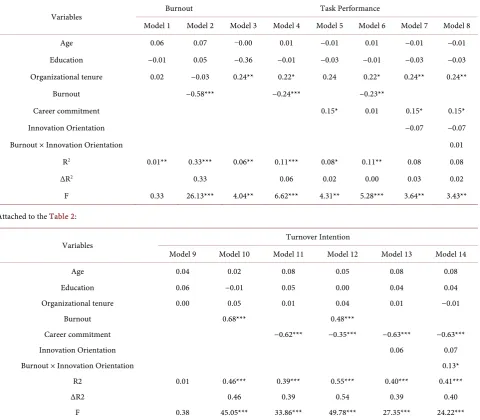
Table 2. Regression analysis of task performance and turnover intention as the dependent variable.
Variables Burnout Task Performance
Model 1 Model 2 Model 3 Model 4 Model 5 Model 6 Model 7 Model 8
Age 0.06 0.07 −0.00 0.01 −0.01 0.01 −0.01 −0.01
Education −0.01 0.05 −0.36 −0.01 −0.03 −0.01 −0.03 −0.03
Organizational tenure 0.02 −0.03 0.24** 0.22* 0.24 0.22* 0.24** 0.24**
Burnout −0.58*** −0.24*** −0.23**
Career commitment 0.15* 0.01 0.15* 0.15*
Innovation Orientation −0.07 −0.07
Burnout × Innovation Orientation 0.01
R2 0.01** 0.33*** 0.06** 0.11*** 0.08* 0.11** 0.08 0.08
ΔR2 0.33 0.06 0.02 0.00 0.03 0.02
F 0.33 26.13*** 4.04** 6.62*** 4.31** 5.28*** 3.64** 3.43**
Attached to the Table 2:
Variables Turnover Intention
Model 9 Model 10 Model 11 Model 12 Model 13 Model 14
Age 0.04 0.02 0.08 0.05 0.08 0.08
Education 0.06 −0.01 0.05 0.00 0.04 0.04
Organizational tenure 0.00 0.05 0.01 0.04 0.01 −0.01
Burnout 0.68*** 0.48***
Career commitment −0.62*** −0.35*** −0.63*** −0.63***
Innovation Orientation 0.06 0.07
Burnout × Innovation Orientation 0.13*
R2 0.01 0.46*** 0.39*** 0.55*** 0.40*** 0.41***
ΔR2 0.46 0.39 0.54 0.39 0.40
F 0.38 45.05*** 33.86*** 49.78*** 27.35*** 24.22***
DOI: 10.4236/jhrss.2017.53015 162 Journal of Human Resource and Sustainability Studies variables are used as a first step to enter the model (sample sex for all men, in the data display, and is a constant) prediction variables into model.
Hypothesis 1a and Hypothesis 1b testing. After controlling for the relevant variables. We can conclude that burnout has a significant negative impact on job performance (beta = −0.24, p < 0.001) from model 4, so hypothesis 1a is sup-ported. Model 10 shows that burnout has a significant positive impact on turno-ver intention (beta = 0.68, p < 0.001), hypothesis 1b is supported.
In this study, the mediation effect test was conducted according to the Baron and Kenny (1981) [11] as well as the mediation effect test according to the med-iation effect test procedure proposed by Wen Zhonglin et al. (2004). By model 4, burnout has a significant negative impact on job performance (beta = −0.24, p < 0.001); the model 2 shows that burnout has a significant negative impact on ca-reer commitment (beta = −0.58; p < 0.001); but by the model 6 shows that when working together to do regression performance on burnout and career commit-ment, career commitment coefficient is not significant, in order to further test the hypothesis of 2a, this paper uses Hayes (2013) [12] design of the SPSS plug-in for Bootstrap mediator test. Select the Bootstrap 5000 samples, using the method of error correction, select the 95% confidence interval, the results show: the test results intermediary contains 0 (LLCI = −0.0888, ULCI = 0.0794), shows that the mediating effect of career commitment is not significant, so that hypo-thesis 2a is not supported.
Significant effects of burnout on model 2 career commitment (beta = −0.58; p < 0.001) and model 12 career commitment has a significant impact on turnover intention (beta = −0.35, p < 0.001) provides some support for the hypothesis 2b, in order to further test the hypothesis 2b, still using Hayes design of the SPSS plug-in for Bootstrap intermediary variable test. Select the Bootstrap 5000 sam-ples, using the method of error correction, select the 95% confidence interval, the results show: the test results intermediary does not contain 0 (LLCI = 0.0957, ULCI = 0.2764), shows that the mediating effect of career commitment signifi-cantly, and the mediating effect of size 0.1809. At the same time, in the control of intermediary variable career commitment, burnout variables still had signifi-cant effects on turnover intention (p < 0.001, LLCI = 0.3465, ULCI = 0.5574), showed that career commitment partially mediated the relationship of burnout and turnover intention, so that hypothesis 2b support.
The model 5 shows that the career commitment has a positive effect on job performance (beta = 0.15, p < 0.05), when the career commitment and innova-tion orientainnova-tion into the regression equainnova-tion, career commitment has a positive impact on job performance (beta = 0.15, p < 0.05) (model 7), the center of the career commitment and innovation oriented interaction with the regression eq-uation, the interaction coefficient is not significant (model 8), therefore, hypo-thesis 3a is not supported.
DOI: 10.4236/jhrss.2017.53015 163 Journal of Human Resource and Sustainability Studies
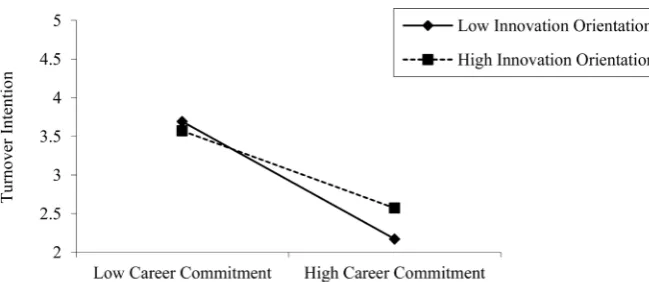
Figure 1. Moderating effect of innovation on the career commitment-turnover intention
relationship.
turnover intention still has a negative effect (beta = −0.63, p < 0.001) (model 13). For the regulation of test of innovation oriented career commitment and turno-ver intention between, this study will career commitment and innovation center of the interaction term into the regression equation (model 14), the results showed significant interaction coefficient (beta = 0.13, p < 0.05), therefore, as-sume that 3b support (Figure 1).
5. Conclusions and Discussions
On the base of theoretical review, this study explored the intermediate mechan-ism of burnout affecting job performance and turnover intention, and tested the relevant hypotheses through empirical analysis.
5.1. Theoretical Contributions
Burnout has a direct negative impact on job performance. The higher the bur-nout, the lower the job performance, while the reverse is the opposite. This con-clusion is consistent with the previous research results of knowledge workers and executives, which shows that this conclusion can be extended to different groups of enterprises. Burnout also has a direct impact on turnover rates. The higher the burnout, the more likely it is to lead the workers away from work. This study extends the applicable population and expands the theoretical scope.
Previous studies found burnout negatively affecting career commitment. This study extends the conclusion that career commitment plays an intermediary role in the effect of burnout and turnover intention, burnout influences turnover in-tention by reducing employee's career commitment. In the burnout and turno-ver intention research, a number of studies have found that organizational commitment plays an intermediary role; the study found that the career com-mitment also plays a similar role to further validate the effect on individual atti-tudes and behavior in the workplace, career commitment and organizational commitment play a role.
inten-DOI: 10.4236/jhrss.2017.53015 164 Journal of Human Resource and Sustainability Studies tion. The higher the innovation orientation is, the weaker the negative correla-tion between career commitment and turnover intencorrela-tion is. On the contrary, the negative correlation between job commitment and turnover intention is stronger among the workers with lower innovation orientation. Innovation oriented workers are receptive to new things and new knowledge, willing to do innovative work, and are willing to stay on the job even though they are less committed and loyal to their profession.
These findings enrich the role of intermediate variables between burnout and job performance and turnover intention. At the same time, found that the data does not support the hypothesis that H2a and H3a, namely the career commit-ment plays an intermediary role is not established in the burnout influence on work performance, regulation of innovation orientation between career com-mitment and job performance is not established. To this end, the following ex-planations are given: First, when workers are tired of their work, they usually do not reduce their commitment to their work and wait for their confirmation of a reduction in their commitment to work, thereby reducing the effectiveness of their work. In fact, in the high pressure competition, individuals feel listless and produce negative mental and physiological reaction, which is direct, which leads to lower work performance directly. Secondly, the high career commitment of individuals with innovation oriented enterprises, will remain in the challenging work, and to work with their own innovative ideas, they will spend a lot of time studying, innovation, even ignoring the routine work, into a very difficult task.
5.2. Practical Implications
The results show that job burnout has a negative impact on job commitment, job performance and turnover intention of skilled workers. Job burnout caused technical workers to lower their professional commitment, and fewer and fewer workers willing to do the job improved their turnover intention, which was one of the reasons for the shortage of skilled workers and labor shortage. In the face of the transformation and upgrading of China’s manufacturing industry, it is necessary to pay attention to the problem of job burnout among skilled workers. The results of the technical workers of human resource development and cul-tivate some enlightenment, put forward three suggestions: first, in the face of job burnout, job performance of workers with low, enterprise human resources management is the key to reduce the job burnout through adjustment work, in-crease the work to create a relaxed recreational activities a pleasant working at-mosphere, to help workers relieve job burnout and improve job performance.
DOI: 10.4236/jhrss.2017.53015 165 Journal of Human Resource and Sustainability Studies also to meet the reality of enterprise development, the demand for talents, for long-term development of enterprises to provide a strong support and protec-tion of talent.
Finally, because of its innovative work values of workers, career commitment negative effect on turnover intention is weaker, the human resources department in addition to the innovative values in the recruitment of workers, but also through a variety of measures to create innovative work values, such as the strengthening of staff training, carry out competition activities and lectures, set up to improve the group, let it continue to learn knowledge, thus strengthening the cultivation of innovative consciousness or workers. Therefore, workers who are innovative and value oriented will choose to continue to work and study in the enterprise, thus reducing turnover intention.
5.3. Limitations and Suggestions for Future Research
Although there are some conclusions about management theory and practice in this study, there are still some shortcomings. The future research on job burnout and performance and turnover intention can be considered from the following aspects. First of all, the sample size of this study is relatively small, and the future research can collect more samples of data, and further test the relationship be-tween these variables. Secondly, the sample of the study comes from the technic-al workers in the production workshop of the automobile assembly enterprise, and whether the conclusion of the study can be inferred to other workers or knowledge workers depends on future research. Finally, this study adopted a cross-sectional study design, in the strict sense, this only shows that the rela-tionship between variables, cannot fully explain the causal relarela-tionship between job burnout and job performance and turnover intention, so future research can use longitudinal research methods to explore the test method such as the causal relationship between variables, improve the Study on persuasion force.
References
[1] Embriaco, N., Azoulay, E., Barrau, K., et al. (2007) High Level of Burnout in Inten-sivists: Prevalence and Associated Factors. American Journal of Respiratory & Crit-ical Care Medicine, 175, 686-692. https://doi.org/10.1164/rccm.200608-1184OC
[2] Vagas, V. (2005) Five-Factor Model of Personality, Burnout and Performance in Child Protective Service Work. Ph.D. Thesis. Alliant International University Cali-fornia School of Organizational Studies, San Diego.
[3] Mobley, W.H. (1977) Intermediate Linkages in the Relationship between Job Satis-faction and Employee Turnover. Journal of Applied Psychology, 62, 237-240.
https://doi.org/10.1037/0021-9010.62.2.237
[4] Firth, H. and Britton, P. (1989) “Burnout”, Absence and Turnover amongst British nursing Staff. Journal of Occupational and Organizational Psychology, 62, 55-59.
https://doi.org/10.1111/j.2044-8325.1989.tb00477.x
DOI: 10.4236/jhrss.2017.53015 166 Journal of Human Resource and Sustainability Studies
[6] Piert, M., Zittel, T., Jahn, M., Stahlschmidt, A. and Becker, G.A. (2003) Increased Sensitivity in Detection of a Porcine High-Turnover Osteopenia after Total Ga-strectomy by Dynamic 18f-Fluoride Ion Pet and Quantitative. Journal of Nuclear Medicine Official Publication Society of Nuclear Medicine, 44, 117-124.
[7] Blau, G.J. (1985) The Measurement and Prediction of Career Commitment. Journal of Occupational and Organizational Psychology, 58, 277-288.
https://doi.org/10.1111/j.2044-8325.1985.tb00201.x
[8] Farh, J.L. and Cheng, B.S. (1999) An Investigation of Modesty Bias in Self-Ratings of Work Performance among Taiwan Workers. Chinese Journal of Psychology, 39, 103-118.
[9] Cammann, C., Fishman, M. and Klesh, J.R. (1983) Assessing the Attitudes and Per-ceptions of Organizational Members. S Seashore Assessing Organizational Change, Wiley, New York.
[10] Li, Y.P. and Hou, X.F. (2012) The New Generation of Employees’ Work Value and Its Influence on the Behavior Mechanism of. Economic Management, 5, 77-86. [11] Baron, R.M. and Kenny, D.A. (1981) The Moderator-Mediator Variable Distinction
in Social Psychological Research: Conceptual, Strategic, and Statistical Considera-tions/ Lead Pollution Causes and Control. Journal of Personality and Social Psy-chology, 51, 1173-1182. https://doi.org/10.1037/0022-3514.51.6.1173
[12] Hayes, A.F. (2013) Introduction to Mediation, Moderation, and Conditional Process Analysis: A Regression-Based Approach. Journal of Educational Measurement, 51, 335-337.
Submit or recommend next manuscript to SCIRP and we will provide best service for you:
Accepting pre-submission inquiries through Email, Facebook, LinkedIn, Twitter, etc. A wide selection of journals (inclusive of 9 subjects, more than 200 journals)
Providing 24-hour high-quality service User-friendly online submission system Fair and swift peer-review system
Efficient typesetting and proofreading procedure
Display of the result of downloads and visits, as well as the number of cited articles Maximum dissemination of your research work
Submit your manuscript at: http://papersubmission.scirp.org/