Proceedings of the 55th Annual Meeting of the Association for Computational Linguistics, pages 571–581 Vancouver, Canada, July 30 - August 4, 2017. c2017 Association for Computational Linguistics Proceedings of the 55th Annual Meeting of the Association for Computational Linguistics, pages 571–581
Vancouver, Canada, July 30 - August 4, 2017. c2017 Association for Computational Linguistics
Improved Neural Relation Detection for Knowledge Base Question
Answering
Mo Yu† Wenpeng Yin? Kazi Saidul Hasan‡ Cicero dos Santos†
Bing Xiang‡ Bowen Zhou†
†AI Foundations, IBM Research, USA
?Center for Information and Language Processing, LMU Munich
‡IBM Watson, USA
{yum,kshasan,cicerons,bingxia,zhou}@us.ibm.com, [email protected]
Abstract
Relation detection is a core component of many NLP applications including Knowl-edge Base Question Answering (KBQA). In this paper, we propose a hierarchi-cal recurrent neural network enhanced by residual learning which detects KB re-lations given an input question. Our method uses deep residual bidirectional LSTMs to compare questions and rela-tion names via different levels of abstrac-tion. Additionally, we propose a sim-ple KBQA system that integrates entity linking and our proposed relation detec-tor to make the two components enhance each other. Our experimental results show that our approach not only achieves out-standing relation detection performance, but more importantly, it helps our KBQA system achieve state-of-the-art accuracy for both single-relation (SimpleQuestions) and multi-relation (WebQSP) QA bench-marks.
1 Introduction
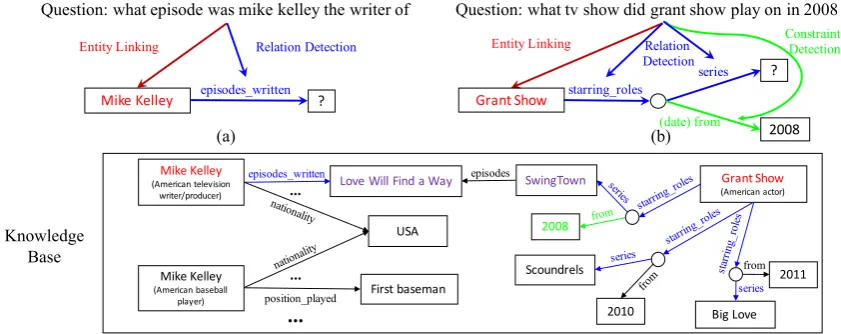
Knowledge Base Question Answering (KBQA) systems answer questions by obtaining informa-tion from KB tuples (Berant et al., 2013; Yao et al., 2014; Bordes et al., 2015; Bast and Haussmann, 2015; Yih et al., 2015; Xu et al., 2016). For an input question, these systems typically generate a KB query, which can be executed to retrieve the answers from a KB. Figure 1 illustrates the process used to parse two sample questions in a KBQA system: (a) a single-relation question, which can be answered with a single<head-entity, relation, tail-entity>KB tuple (Fader et al., 2013; Yih et al., 2014; Bordes et al., 2015); and (b) a more complex case, where some constraints need to be handled
for multiple entities in the question. The KBQA system in the figure performs two key tasks: (1) entity linking, which links n-grams in questions to KB entities, and (2) relation detection, which identifies the KB relation(s) a question refers to.
The main focus of this work is to improve the relation detectionsubtask and further explore how it can contribute to the KBQA system. Although general relation detection1methods are well stud-ied in the NLP community, such studies usually do not take the end task of KBQA into considera-tion. As a result, there is a significant gap between general relation detection studies and KB-specific relation detection. First, in most general relation detection tasks, the number of target relations is limited, normally smaller than 100. In contrast, in KBQA even a small KB, like Freebase2M (Bor-des et al., 2015), contains more than 6,000 relation types. Second, relation detection for KBQA often becomes a zero-shot learning task, since some test instances may have unseen relations in the training data. For example, the SimpleQuestions (Bordes et al., 2015) data set has 14% of the golden test relations not observed in golden training tuples. Third, as shown in Figure 1(b), for some KBQA tasks like WebQuestions (Berant et al., 2013), we need to predict a chain of relations instead of a single relation. This increases the number of tar-get relation types and the sizes of candidate rela-tion pools, further increasing the difficulty of KB relation detection. Owing to these reasons, KB re-lation detection is significantly more challenging compared to general relation detection tasks.
This paper improves KB relation detection to cope with the problems mentioned above. First, in order to deal with the unseen relations, we propose to break the relation names into word sequences for question-relation matching. Second, noticing
1In the information extraction field such tasks are usually
Question: what episode was mike kelley the writer of
Knowledge Base
Mike Kelley
(American television writer/producer)
Mike Kelley (American baseball
player)
…
Entity LinkingLove Will Find a Way
USA
…
First baseman
…
episodes_written
position_played
Relation Detection
(a) (b)
Question: what tv show did grant show play on in 2008
Mike Kelley episodes_written ?
Entity Linking Relation Detection
Grant Show
?
starring_roles
series
(date) from 2008
Constraint Detection
Grant Show
(American actor) SwingTown
Big Love episodes
Scoundrels
series 2011 from
2010
[image:2.595.86.507.67.234.2]2008
Figure 1:KBQA examples and its three key components. (a) A single relation example. We first identify the topic entity with
entity linkingand then detect the relation asked by the question withrelation detection(from all relations connecting the topic entity). Based on the detected entity and relation, we form a query to search the KB for the correct answer “Love Will Find a Way”. (b) A more complex question containing two entities. By using “Grant Show” as the topic entity, we could detect a chain of relations “starring roles-series” pointing to the answer. An additionalconstraint detectiontakes the other entity “2008” as a constraint, to filter the correct answer “SwingTown” from all candidates found by the topic entity and relation.
that original relation names can sometimes help to match longer question contexts, we propose to build both relation-level and word-level rela-tion representarela-tions. Third, we use deep bidirec-tional LSTMs (BiLSTMs) to learn different levels of question representations in order to match the different levels of relation information. Finally, we propose a residual learning method for sequence matching, which makes the model training easier and results in more abstract (deeper) question rep-resentations, thus improves hierarchical matching. In order to assess how the proposed improved relation detection could benefit the KBQA end task, we also propose a simple KBQA implemen-tation composed of two-step relation detection. Given an input question and a set of candidate enti-ties retrieved by an entity linker based on the ques-tion, our proposed relation detection model plays a key role in the KBQA process: (1) Re-ranking the entity candidates according to whether they con-nect to high confident relations detected from the raw question textby the relation detection model. This step is important to deal with the ambigui-ties normally present in entity linking results. (2) Finding the core relation (chains) for each topic entity2 selection from a much smaller candidate entity set after re-ranking. The above steps are followed by an optional constraint detection step, when the question cannot be answered by single relations (e.g., multiple entities in the question). Finally the highest scored query from the above
2Following Yih et al. (2015), heretopic entityrefers to
the root of the (directed) query tree; andcore-chainis the directed path of relation from root to the answer node.
steps is used to query the KB for answers.
Our main contributions include: (i) An im-proved relation detection model by hierarchical matching between questions and relations with residual learning; (ii) We demonstrate that the im-proved relation detector enables our simple KBQA system to achieve state-of-the-art results on both single-relation and multi-relation KBQA tasks.
2 Related Work
Relation Extraction Relation extraction (RE) is
TAC-KBP2015 has 74 relations although it considers open-domain Wikipedia relations. All are much fewer than thousands of relations in KBQA. As a result, few work in this field focuses on dealing with large number of relations or unseen relations. Yu et al. (2016) proposed to use relation embed-dings in a low-rank tensor method. However their relation embeddings are still trained in supervised way and the number of relations is not large in the experiments.
Relation Detection in KBQA Systems
Rela-tion detecRela-tion for KBQA also starts with feature-rich approaches (Yao and Van Durme, 2014; Bast and Haussmann, 2015) towards usages of deep networks (Yih et al., 2015; Xu et al., 2016; Dai et al., 2016) and attention models (Yin et al., 2016; Golub and He, 2016). Many of the above re-lation detection research could naturally support large relation vocabulary and open relation sets (especially for QA with OpenIE KB like ParaLex (Fader et al., 2013)), in order to fit the goal of open-domain question answering.
Different KBQA data sets have different levels of requirement about the above open-domain ca-pacity. For example, most of the gold test relations in WebQuestions can be observed during train-ing, thus some prior work on this task adopted the close domain assumption like in the general RE re-search. While for data sets like SimpleQuestions and ParaLex, the capacity to support large relation sets and unseen relations becomes more necessary. To the end, there are two main solutions: (1) use pre-trained relation embeddings (e.g. from TransE (Bordes et al., 2013)), like (Dai et al., 2016); (2) factorize the relation names to sequences and for-mulate relation detection as a sequence
match-ing and rankmatch-ing task. Such factorization works
because that the relation names usually comprise meaningful word sequences. For example, Yin et al. (2016) split relations to word sequences for single-relation detection. Liang et al. (2016) also achieve good performance on WebQSP with word-level relation representation in an end-to-end neu-ral programmer model. Yih et al. (2015) use char-acter tri-grams as inputs on both question and rela-tion sides. Golub and He (2016) propose a gener-ative framework for single-relation KBQA which predicts relation with a character-level sequence-to-sequence model.
Another difference between relation detection in KBQA and general RE is that general RE
re-search assumes that the two argument entities are both available. Thus it usually benefits from features (Nguyen and Grishman, 2014; Gormley et al., 2015) or attention mechanisms (Wang et al., 2016) based on the entity information (e.g. entity types or entity embeddings). For relation detec-tion in KBQA, such informadetec-tion is mostly missing because: (1) one question usually contains single argument (the topic entity) and (2) one KB entity could have multiple types (type vocabulary size larger than 1,500). This makes KB entity typing itself a difficult problem so no previous used en-tity information in the relation detection model.3
3 Background: Different Granularity in KB Relations
Previous research (Yih et al., 2015; Yin et al., 2016) formulates KB relation detection as a se-quence matching problem. However, while the questions are natural word sequences, how to rep-resent relations as sequences remains a challeng-ing problem. Here we give an overview of two types of relation sequence representations com-monly used in previous work.
(1) Relation Name as a Single Token(
relation-level). In this case, each relation name is treated as a unique token. The problem with this ap-proach is that it suffers from the low relation cov-erage due to limited amount of training data, thus cannot generalize well to large number of open-domain relations. For example, in Figure 1, when treating relation names as single tokens, it will be difficult to match the questions to relation names “episodes written” and “starring roles” if these names do not appear in training data – their rela-tion embeddingshrs will be random vectors thus are not comparable to question embeddingshqs.
(2) Relation as Word Sequence(word-level). In
this case, the relation is treated as a sequence of words from the tokenized relation name. It has better generalization, but suffers from the lack of global information from the original relation names. For example in Figure 1(b), when doing only word-level matching, it is difficult to rank the target relation “starring roles” higher compared to the incorrect relation “plays produced”. This is because the incorrect relation contains word “plays”, which is more similar to the question
3Such entity information has been used in KBQA systems
Relation Token what tv episodes wereQuestion 1<e>the writer of what episode was written byQuestion 2 <e> relation-level episodes written tv episodes were<e>the writer of episode was written by<e>
[image:4.595.83.511.61.115.2]word-level episodeswritten the writer oftv episodes episodewritten
Table 1: An example of KB relation (episodes written) with two types of relation tokens (relation names and words), and two questions asking this relation. The topic entity is replaced with token<e>which could give the position information to the deep networks. The italics show the evidence phrase for each relation token in the question.
(containing word “play”) in the embedding space. On the other hand, if the target relation co-occurs with questions related to “tv appearance” in train-ing, by treating the whole relation as a token (i.e. relation id), we could better learn the correspon-dence between this token and phrases like “tv show” and “play on”.
The two types of relation representation con-tain different levels of abstraction. As shown in Table 1, the word-level focuses more on lo-cal information (words and short phrases), and the relation-level focus more on global informa-tion (long phrases and skip-grams) but suffer from data sparsity. Since both these levels of granu-larity have their own pros and cons, we propose a hierarchical matching approach for KB relation detection: for a candidate relation, our approach matches the input question to both word-level and relation-level representations to get the final rank-ing score. Section 4 gives the details of our pro-posed approach.
4 Improved KB Relation Detection
This section describes our hierarchical sequence matching with residual learning approach for rela-tion detecrela-tion. In order to match the quesrela-tion to different aspects of a relation (with different ab-straction levels), we deal with three problems as follows on learning question/relation representa-tions.
4.1 Relation Representations from Different Granularity
We provide our model with both types of re-lation representation: word-level and rere-lation- relation-level. Therefore, the input relation becomesr = {rword1 ,· · · , rMword1 } [ {r1rel,· · ·, rrelM2}, where the first M1 tokens are words (e.g. {episode,
writ-ten}), and the lastM2 tokens are relation names, e.g.,{episode written}or{starring roles, series} (when the target is a chain like in Figure 1(b)). We transform each token above to its word
embed-ding then use two BiLSTMs (with shared parame-ters) to get their hidden representations [Bword
1:M1 : Brel1:M2] (each row vector i is the
concatena-tion between forward/backward representaconcatena-tions at i). We initialize the relation sequence LSTMs with the final state representations of the word se-quence, as a back-off for unseen relations. We ap-plyonemax-pooling on these two sets of vectors and get the final relation representationhr.
4.2 Different Abstractions of Questions Representations
From Table 1, we can see that different parts of a relation could match different contexts of question texts. Usually relation names could match longer phrases in the question and relation words could match short phrases. Yet different words might match phrases of different lengths.
As a result, we hope the question representa-tions could also comprise vectors that summa-rize various lengths of phrase information (differ-ent levels of abstraction), in order to match rela-tion representarela-tions of different granularity. We deal with this problem by applying deep BiL-STMs on questions. The first-layer of BiLSTM works on the word embeddings of question words q={q1,· · ·, qN}and gets hidden representations
(1) 1:N = [
(1) 1 ;· · · ;
(1)
N ]. The second-layer
BiL-STM works on (1)
1:N to get the second set of
hid-den representations (2)
1:N. Since the second
BiL-STM starts with the hidden vectors from the first layer, intuitively it could learn more general and abstract information compared to the first layer.
…
… …
max-pooling
max-pooling Question
Representation RepresentationRelation (cosine similarity)
Shortcut connections
Point-wise summation
Bi-LSTM 2
Bi-LSTM 1 !"#
!"$
Relation-Level Word-Level
what tv show did <e> … starring_role series starring role series
%&' %()
… .
… .
... …
...
[image:5.595.121.479.61.267.2]Question Relation
Figure 2: The proposed Hierarchical Residual BiLSTM (HR-BiLSTM) model for relation detection. Note that without the dotted arrows of shortcut connections between two layers, the model will only compute the similarity between the second-layer of questions representations and the relation, thus is not doing hierarchical matching.
4.3 Hierarchical Matching between Relation and Question
Now we have question contexts of different lengths encoded in (1)1:N and (2)1:N. Unlike the standard usage of deep BiLSTMs that employs the representations in the final layer for prediction, here we expect that two layers of question repre-sentations can be complementary to each other and both should be compared to the relation represen-tation space (Hierarchical Matching). This is im-portant for our task since each relation token can correspond to phrases of different lengths, mainly because of syntactic variations. For example in Ta-ble 1, the relation wordwrittencould be matched to either the same single word in the question or a much longer phrasebe the writer of.
We could perform the above hierarchical match-ing by computmatch-ing the similarity between each layer of and hr separately and doing the
(weighted) sum between the two scores. How-ever this does not give significant improvement (see Table 2). Our analysis in Section 6.2 shows that this naive method suffers from the training difficulty, evidenced by that the converged train-ing loss of this model is much higher than that of a single-layer baseline model. This is mainly because (1) Deep BiLSTMs do not guarantee that the two-levels of question hidden representations are comparable, the training usually falls to local optima where one layer has good matching scores and the other always has weight close to 0. (2)
The training of deeper architectures itself is more difficult.
To overcome the above difficulties, we adopt the idea from Residual Networks (He et al., 2016) for hierarchical matching by adding shortcut connec-tions between two BiLSTM layers. We proposed two ways of such Hierarchical Residual Match-ing: (1) Connecting each i(1) and i(2), resulting in a 0
i =
(1)
i +
(2)
i for each positioni. Then the
final question representation hq becomes a max-pooling over all i0s, 1iN. (2) Applying
max-pooling on (1) 1:N and
(2)
1:N to geth
(1)
maxandh(2)max,
respectively, then settinghq =h(1)
max+h(2)max.
Fi-nally we compute the matching score ofrgivenq assrel(r;q) =cos(hr,hq).
Intuitively, the proposed method should benefit from hierarchical training since the second layer is fitting the residues from the first layer of matching, so the two layers of representations are more likely to be complementary to each other. This also en-sures the vector spaces of two layers are compara-ble and makes the second-layer training easier.
During training we adopt a ranking loss to max-imizing the margin between the gold relation r+ and other relationsr in the candidate poolR.
Remark: Another way of hierarchical matching consists in relying on attention mechanism, e.g. (Parikh et al., 2016), to find the correspondence between different levels of representations. This performs below the HR-BiLSTM (see Table 2).
5 KBQA Enhanced by Relation Detection
This section describes our KBQA pipeline system. We make minimal efforts beyond the training of the relation detection model, making the whole system easy to build.
Following previous work (Yih et al., 2015; Xu et al., 2016), our KBQA system takes an existing entity linker to produce the top-K linked entities, ELK(q), for a questionq(“initial entity linking”).
Then we generate the KB queries forq following the four steps illustrated in Algorithm 1.
Algorithm 1:KBQA with two-step relation detection
Input : Questionq, Knowledge BaseKB, the initial
top-Kentity candidatesELK(q)
Output: Top query tuple(ˆe,r,ˆ{(c, rc)})
1 Entity Re-Ranking(first-step relation detection): Use theraw question textas input for a relation detector to score all relations in the KB that are associated to the entities inELK(q); use the relation scores to re-rank ELK(q)and generate a shorter listEL0K0(q)
containing the top-K0entity candidates (Section 5.1)
2 Relation Detection: Detect relation(s) using the
reformatted question textin which the topic entity is replaced by a special token<e>(Section 5.2) 3 Query Generation: Combine the scores from step 1
and 2, and select the top pair(ˆe,rˆ)(Section 5.3) 4 Constraint Detection(optional): Compute similarity
betweenqand any neighbor entitycof the entities alongˆr(connecting by a relationrc) , add the high
scoringcandrcto the query (Section 5.4).
Compared to previous approaches, the main dif-ference is that we have an additional entity re-ranking step after the initial entity linking. We have this step because we have observed that entity linking sometimes becomes a bottleneck in KBQA systems. For example, on SimpleQuestions the best reported linker could only get 72.7% top-1 accuracy on identifying topic entities. This is usu-ally due to the ambiguities of entity names, e.g. in Fig 1(a), there areTV writer andbaseball player “Mike Kelley”, which is impossible to distinguish with only entity name matching.
Having observed that different entity candidates usually connect to different relations, here we pro-pose to help entity disambiguation in theinitial en-tity linkingwith relations detected in questions.
Sections 5.1 and 5.2 elaborate how our relation detection help to re-rank entities in the initial tity linking, and then those re-ranked entities en-able more accurate relation detection. The KBQA end task, as a result, benefits from this process.
5.1 Entity Re-Ranking
In this step, we use theraw question textas input for a relation detector to score all relations in the KB with connections to at least one of the entity candidates inELK(q). We call this steprelation
detection on entity set since it does not work on a single topic entity as the usual settings. We use the HR-BiLSTM as described in Sec. 4. For each question q, after generating a score srel(r;q) for
each relation using HR-BiLSTM, we use the top l best scoring relations (Rlq) to re-rank the origi-nal entity candidates. Concretely, for each entity eand its associated relationsRe, given the
origi-nal entity linker scoreslinker, and the score of the
most confident relationr2Rl
q\Re, we sum these
two scores to re-rank the entities: srerank(e;q) =↵·slinker(e;q)
+(1 ↵)· max
r2Rl q\Re
srel(r;q).
Finally, we select topK0< Kentities according to scoresrerankto form the re-ranked listEL0K0(q).
We use the same example in Fig 1(a) to illustrate the idea. Given the input question in the exam-ple, a relation detector is very likely to assign high scores to relations such as “episodes written”, “author of” and “profession”. Then, according to the connections of entity candidates in KB, we find that the TV writer “Mike Kelley” will be scored higher than the baseball player “Mike Kelley”, because the former has the relations “episodes written” and “profession”. This method can be viewed as exploiting entity-relation collo-cation for entity linking.
5.2 Relation Detection
In this step, for each candidate entity e 2 EL0K(q), we use the question text as the input to a relation detector to score all the relationsr 2 Re
that are associated to the entityein the KB.4 Be-cause we have a single topic entity input in this step, we do the following question reformatting: we replace the the candidatee’s entity mention in
4Note that the number of entities and the number of
q with a token “<e>”. This helps the model bet-ter distinguish the relative position of each word compared to the entity. We use the HR-BiLSTM model to predict the score of each relationr2Re:
srel(r;e, q).
5.3 Query Generation
Finally, the system outputs the<entity, relation (or core-chain)>pair(ˆe,rˆ)according to:
s(ˆe,ˆr;q) = max
e2EL0K0(q),r2Re
( ·srerank(e;q)
+(1 )·srel(r;e, q)), where is a hyperparameter to be tuned.
5.4 Constraint Detection
Similar to (Yih et al., 2015), we adopt an ad-ditional constraint detection step based on text matching. Our method can be viewed as entity-linking on a KB sub-graph. It contains two steps:
(1) Sub-graph generation: given the top scored
query generated by the previous 3 steps5, for each nodev(answer node or the CVT node like in Fig-ure 1(b)), we collect all the nodescconnecting to v(with relationrc) with any relation, and generate
a sub-graph associated to the original query. (2)
Entity-linking on sub-graph nodes: we compute
a matching score between eachn-gram in the input question (without overlapping the topic entity) and entity name of c(except for the node in the orig-inal query) by taking into account the maximum overlapping sequence of characters between them (see Appendix A for details and B for special rules dealing with date/answer type constraints). If the matching score is larger than a threshold✓(tuned on training set), we will add the constraint entityc (andrc) to the query by attaching it to the
corre-sponding nodevon the core-chain.
6 Experiments
6.1 Task Introduction & Settings
We use the SimpleQuestions (Bordes et al., 2015) and WebQSP (Yih et al., 2016) datasets. Each question in these datasets is labeled with the gold semantic parse. Hence we can directly evaluate relation detection performance independently as well as evaluate on the KBQA end task.
5Starting with the top-1 query suffers more from error
propagation. However we still achieve state-of-the-art on We-bQSP in Sec.6, showing the advantage of our relation detec-tion model. We leave in future work beam-search and feature extraction on beam for final answer re-ranking like in previ-ous research.
SimpleQuestions (SQ): It is a single-relation
KBQA task. The KB we use consists of a Freebase subset with 2M entities (FB2M) (Bordes et al., 2015), in order to compare with previous research. Yin et al. (2016) also evaluated their relation ex-tractor on this data set and released their proposed question-relation pairs, so we run our relation de-tection model on their data set. For the KBQA evaluation, we also start with their entity linking results6. Therefore, our results can be compared with their reported results on both tasks.
WebQSP (WQ): A multi-relation KBQA task.
We use the entire Freebase KB for evaluation purposes. Following Yih et al. (2016), we use S-MART (Yang and Chang, 2015) entity-linking outputs.7 In order to evaluate the relation detec-tion models, we create a new reladetec-tion detecdetec-tion task from the WebQSP data set.8 For each ques-tion and its labeled semantic parse: (1) we first select the topic entity from the parse; and then (2) select all the relations and relation chains (length 2) connected to the topic entity, and set the core-chain labeled in the parse as the positive label and all the others as the negative examples.
We tune the following hyper-parameters on de-velopment sets: (1) the size of hidden states for LSTMs ({50, 100, 200, 400})9; (2) learning rate ({0.1, 0.5, 1.0, 2.0}); (3) whether the shortcut connections are between hidden states or between max-pooling results (see Section 4.3); and (4) the number of training epochs.
For both the relation detection experiments and the second-step relation detection in KBQA, we have entity replacement first (see Section 5.2 and Figure 1). All word vectors are initialized with 300-dpretrained word embeddings (Mikolov et al., 2013). The embeddings of relation names are randomly initialized, since existing pre-trained relation embeddings (e.g. TransE) usually support limited sets of relation names. We leave the usage of pre-trained relation embeddings to future work.
6.2 Relation Detection Results
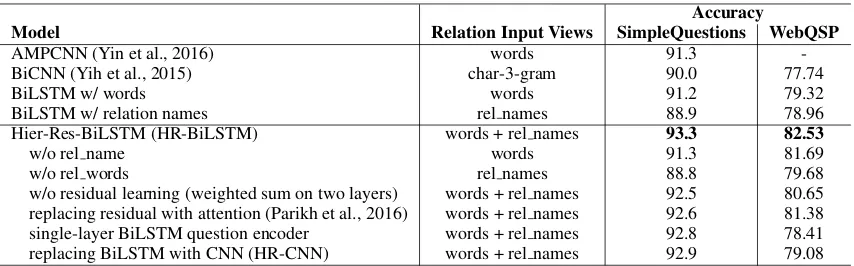
Table 2 shows the results on two relation detec-tion tasks. The AMPCNN result is from (Yin et al., 2016), which yielded state-of-the-art scores by outperforming several attention-based
meth-6The two resources have been downloaded fromhttps:
//github.com/Gorov/SimpleQuestions-EntityLinking
7https://github.com/scottyih/STAGG 8The dataset is available athttps://github.com/Gorov/
SimpleQuestions-EntityLinking.
Accuracy
Model Relation Input Views SimpleQuestions WebQSP
AMPCNN (Yin et al., 2016) words 91.3
-BiCNN (Yih et al., 2015) char-3-gram 90.0 77.74
BiLSTM w/ words words 91.2 79.32
BiLSTM w/ relation names rel names 88.9 78.96
Hier-Res-BiLSTM (HR-BiLSTM) words + rel names 93.3 82.53
w/o rel name words 91.3 81.69
w/o rel words rel names 88.8 79.68
[image:8.595.85.512.61.194.2]w/o residual learning (weighted sum on two layers) words + rel names 92.5 80.65 replacing residual with attention (Parikh et al., 2016) words + rel names 92.6 81.38 single-layer BiLSTM question encoder words + rel names 92.8 78.41 replacing BiLSTM with CNN (HR-CNN) words + rel names 92.9 79.08 Table 2: Accuracy on the SimpleQuestions and WebQSP relation detection tasks (test sets). The top shows performance of baselines. On the bottom we give the results of our proposed model together with the ablation tests.
ods. We re-implemented the BiCNN model from (Yih et al., 2015), where both questions and rela-tions are represented with the word hash trick on character tri-grams. The baseline BiLSTM with relation word sequence appears to be the best base-line on WebQSP and is close to the previous best result of AMPCNN on SimpleQuestions. Our pro-posed HR-BiLSTM outperformed the best base-lines on both tasks by margins of 2-3% (p<0.001 and 0.01 compared to the best baselineBiLSTM w/ wordson SQ and WQ respectively).
Note that using only relation names instead of words results in a weaker baseline BiLSTM model. The model yields a significant per-formance drop on SimpleQuestions (91.2% to 88.9%). However, the drop is much smaller on WebQSP, and it suggests that unseen relations have a much bigger impact on SimpleQuestions.
Ablation Test: The bottom of Table 2 shows
ab-lation results of the proposed HR-BiLSTM. First, hierarchical matching between questions and both relation names and relation words yields improve-ment on both datasets, especially for SimpleQues-tions (93.3% vs. 91.2/88.8%). Second, residual learning helps hierarchical matching compared to weighted-sum and attention-based baselines (see Section 4.3). For the attention-based baseline, we tried the model from (Parikh et al., 2016) and its one-way variations, where the one-way model gives better results10. Note that residual learn-ing significantly helps on WebQSP (80.65% to
10We also tried to apply the same attention method on deep
BiLSTM with residual connections, but it does not lead to better results compared to HR-BiLSTM. We hypothesize that the idea of hierarchical matching with attention mechanism may work better for long sequences, and the new advanced attention mechanisms (Wang and Jiang, 2016; Wang et al., 2017) might help hierarchical matching. We leave the above directions to future work.
82.53%), while it does not help as much on Sim-pleQuestions. On SimpleQuestions, even remov-ing the deep layers only causes a small drop in per-formance. WebQSP benefits more from residual and deeper architecture, possibly because in this dataset it is more important to handle larger scope of context matching.
Finally, on WebQSP, replacing BiLSTM with CNN in our hierarchical matching framework re-sults in a large performance drop. Yet on Sim-pleQuestions the gap is much smaller. We believe this is because the LSTM relation encoder can bet-ter learn the composition of chains of relations in WebQSP, as it is better at dealing with longer de-pendencies.
Analysis Next, we present empirical evidences,
which show why our HR-BiLSTM model achieves the best scores. We use WebQSP for the analy-sis purposes. First, we have the hypotheanaly-sis that training of the weighted-sum model usually falls to local optima, since deep BiLSTMs do not guar-antee that the two-levels of question hidden rep-resentations are comparable. This is evidenced by that during training one layer usually gets a weight close to 0 thus is ignored. For exam-ple, one run gives us weights of -75.39/0.14 for the two layers (we take exponential for the final weighted sum). It also gives much lower train-ing accuracy (91.94%) compared to HR-BiLSTM (95.67%), suffering from training difficulty.
single-layer BiLSTM. Under our setting the two-layer model captures the single-two-layer model as a special case (so it could potentially better fit the training data), this result suggests that the deep BiLSTM without shortcut connections might suf-fers more from training difficulty.
Finally, we hypothesize that HR-BiLSTM is more than combination of two BiLSTMs with residual connections, because it encourages the hierarchical architecture to learn different levels of abstraction. To verify this, we replace the deep BiLSTM question encoder with two single-layer BiLSTMs (both on words) with shortcut connec-tions between their hidden states. This decreases test accuracy to 76.11%. It gives similar training accuracy compared to HR-BiLSTM, indicating a more serious over-fitting problem. This proves that the residual and deep structures both con-tribute to the good performance of HR-BiLSTM.
6.3 KBQA End-Task Results
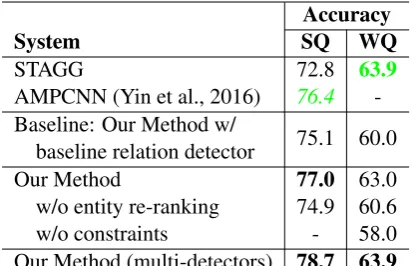
Table 3 compares our system with two published baselines (1) STAGG (Yih et al., 2015), the state-of-the-art on WebQSP11 and (2) AMPCNN (Yin et al., 2016), the state-of-the-art on SimpleQues-tions. Since these two baselines are specially de-signed/tuned for one particular dataset, they do not generalize well when applied to the other dataset. In order to highlight the effect of different rela-tion detecrela-tion models on the KBQA end-task, we also implemented another baseline that uses our KBQA system but replaces HR-BiLSTM with our implementation of AMPCNN (for SimpleQues-tions) or the char-3-gram BiCNN (for WebQSP) relation detectors (second block in Table 3).
Compared to thebaseline relation detector(3rd row of results), our method, which includes an im-proved relation detector (HR-BiLSTM), improves the KBQA end task by 2-3% (4th row). Note that in contrast to previous KBQA systems, our sys-tem does not use joint-inference or feature-based re-ranking step, nevertheless it still achieves better or comparable results to the state-of-the-art.
The third block of the table details two ablation tests for the proposed components in our KBQA systems: (1) Removing the entity re-ranking step significantly decreases the scores. Since the re-ranking step relies on the relation detection mod-els, this shows that our HR-BiLSTM model con-tributes to the good performance in multiple ways.
11The STAGG score on SQ is from (Bao et al., 2016).
Accuracy
System SQ WQ
STAGG 72.8 63.9
AMPCNN (Yin et al., 2016) 76.4
-Baseline: Our Method w/
75.1 60.0 baseline relation detector
Our Method 77.0 63.0
w/o entity re-ranking 74.9 60.6
w/o constraints - 58.0
[image:9.595.312.522.62.195.2]Our Method (multi-detectors) 78.7 63.9
Table 3: KBQA results on SimpleQuestions (SQ) and WebQSP (WQ) test sets. The numbers in
greencolor are directly comparable to our results since we start with the same entity linking results.
Appendix C gives the detailed performance of the re-ranking step. (2) In contrast to the conclusion in (Yih et al., 2015), constraint detection is crucial for our system12. This is probably because our joint performance on topic entity and core-chain detection is more accurate (77.5% top-1 accuracy), leaving a huge potential (77.5% vs. 58.0%) for the constraint detection module to improve.
Finally, like STAGG, which uses multiple rela-tion detectors (see Yih et al. (2015) for the three models used), we also try to use the top-3 rela-tion detectors from Secrela-tion 6.2. As shown on the last row of Table 3, this gives a significant perfor-mance boost, resulting in a new state-of-the-art re-sult on SimpleQuestions and a rere-sult comparable to the state-of-the-art on WebQSP.
7 Conclusion
KB relation detection is a key step in KBQA and is significantly different from general relation ex-traction tasks. We propose a novel KB relation detection model, HR-BiLSTM, that performs hier-archical matching between questions and KB rela-tions. Our model outperforms the previous meth-ods on KB relation detection tasks and allows our KBQA system to achieve state-of-the-arts. For fu-ture work, we will investigate the integration of our HR-BiLSTM into end-to-end systems. For ex-ample, our model could be integrated into the de-coder in (Liang et al., 2016), to provide better se-quence prediction. We will also investigate new emerging datasets like GraphQuestions (Su et al., 2016) and ComplexQuestions (Bao et al., 2016) to handle more characteristics of general QA.
12Note that another reason is that we are evaluating on
References
Junwei Bao, Nan Duan, Zhao Yan, Ming Zhou, and Tiejun Zhao. 2016. Constraint-based question
an-swering with knowledge graph. In Proceedings of
COLING 2016, the 26th International Conference on Computational Linguistics: Technical Papers. The COLING 2016 Organizing Committee, Osaka, Japan, pages 2503–2514.
Hannah Bast and Elmar Haussmann. 2015. More
ac-curate question answering on freebase. In
Proceed-ings of the 24th ACM International on Conference on Information and Knowledge Management. ACM, pages 1431–1440.
Jonathan Berant, Andrew Chou, Roy Frostig, and Percy Liang. 2013. Semantic parsing on Freebase from
question-answer pairs. In Proceedings of the 2013
Conference on Empirical Methods in Natural Lan-guage Processing. Association for Computational Linguistics, Seattle, Washington, USA, pages 1533– 1544.
Antoine Bordes, Nicolas Usunier, Sumit Chopra, and Jason Weston. 2015. Large-scale simple question
answering with memory networks. arXiv preprint
arXiv:1506.02075.
Antoine Bordes, Nicolas Usunier, Alberto Garcia-Duran, Jason Weston, and Oksana Yakhnenko. 2013. Translating embeddings for modeling
multi-relational data. InAdvances in Neural Information
Processing Systems. pages 2787–2795.
Zihang Dai, Lei Li, and Wei Xu. 2016. Cfo: Condi-tional focused neural question answering with
large-scale knowledge bases. InProceedings of the 54th
Annual Meeting of the Association for Computa-tional Linguistics (Volume 1: Long Papers). Asso-ciation for Computational Linguistics, Berlin, Ger-many, pages 800–810.
Cicero dos Santos, Bing Xiang, and Bowen Zhou. 2015. Classifying relations by ranking with
con-volutional neural networks. InProceedings of the
53rd Annual Meeting of the Association for Compu-tational Linguistics and the 7th International Joint Conference on Natural Language Processing (Vol-ume 1: Long Papers). Association for Computa-tional Linguistics, Beijing, China, pages 626–634. Anthony Fader, Luke S Zettlemoyer, and Oren Etzioni.
2013. Paraphrase-driven learning for open question
answering. InACL (1). Citeseer, pages 1608–1618.
David Golub and Xiaodong He. 2016. Character-level
question answering with attention. arXiv preprint
arXiv:1604.00727.
Matthew R. Gormley, Mo Yu, and Mark Dredze. 2015. Improved relation extraction with feature-rich
com-positional embedding models. In Proceedings of
the 2015 Conference on Empirical Methods in Nat-ural Language Processing. Association for Compu-tational Linguistics, Lisbon, Portugal, pages 1774– 1784.
Kaiming He, Xiangyu Zhang, Shaoqing Ren, and Jian Sun. 2016. Deep residual learning for image
recog-nition. In Proceedings of the IEEE Conference
on Computer Vision and Pattern Recognition. pages 770–778.
Chen Liang, Jonathan Berant, Quoc Le, Kenneth D Forbus, and Ni Lao. 2016. Neural symbolic ma-chines: Learning semantic parsers on freebase with
weak supervision.arXiv preprint arXiv:1611.00020
.
Tomas Mikolov, Ilya Sutskever, Kai Chen, Greg S Cor-rado, and Jeff Dean. 2013. Distributed representa-tions of words and phrases and their
compositional-ity. InAdvances in neural information processing
systems. pages 3111–3119.
Thien Huu Nguyen and Ralph Grishman. 2014. Em-ploying word representations and regularization for
domain adaptation of relation extraction. In
Pro-ceedings of the 52nd Annual Meeting of the Associa-tion for ComputaAssocia-tional Linguistics (Volume 2: Short Papers). Association for Computational Linguistics, Baltimore, Maryland, pages 68–74.
Ankur Parikh, Oscar T¨ackstr¨om, Dipanjan Das, and Jakob Uszkoreit. 2016. A decomposable attention
model for natural language inference. In
Proceed-ings of the 2016 Conference on Empirical Meth-ods in Natural Language Processing. Association for Computational Linguistics, Austin, Texas, pages 2249–2255.
Bryan Rink and Sanda Harabagiu. 2010. Utd: Clas-sifying semantic relations by combining lexical and
semantic resources. InProceedings of the 5th
Inter-national Workshop on Semantic Evaluation. Associ-ation for ComputAssoci-ational Linguistics, Uppsala, Swe-den, pages 256–259.
Yu Su, Huan Sun, Brian Sadler, Mudhakar Sri-vatsa, Izzeddin Gur, Zenghui Yan, and Xifeng Yan. 2016. On generating characteristic-rich question
sets for qa evaluation. In Proceedings of the
2016 Conference on Empirical Methods in Natu-ral Language Processing. Association for Compu-tational Linguistics, Austin, Texas, pages 562–572. https://aclweb.org/anthology/D16-1054.
Ang Sun, Ralph Grishman, and Satoshi Sekine. 2011. Semi-supervised relation extraction with large-scale
word clustering. InProceedings of the 49th Annual
Meeting of the Association for Computational Lin-guistics: Human Language Technologies. Associa-tion for ComputaAssocia-tional Linguistics, Portland, Ore-gon, USA, pages 521–529.
Ngoc Thang Vu, Heike Adel, Pankaj Gupta, and Hin-rich Sch¨utze. 2016. Combining recurrent and con-volutional neural networks for relation
classifica-tion. In Proceedings of the 2016 Conference of
Linlin Wang, Zhu Cao, Gerard de Melo, and Zhiyuan Liu. 2016. Relation classification via multi-level
at-tention cnns. In Proceedings of the 54th Annual
Meeting of the Association for Computational Lin-guistics (Volume 1: Long Papers). Association for Computational Linguistics, Berlin, Germany, pages 1298–1307.
Shuohang Wang and Jing Jiang. 2016. Learning
natural language inference with lstm. In
Pro-ceedings of the 2016 Conference of the North American Chapter of the Association for Com-putational Linguistics: Human Language Tech-nologies. Association for Computational Linguis-tics, San Diego, California, pages 1442–1451. http://www.aclweb.org/anthology/N16-1170.
Zhiguo Wang, Wael Hamza, and Radu Florian. 2017. Bilateral multi-perspective matching for natural
lan-guage sentences. arXiv preprint arXiv:1702.03814
.
Kun Xu, Siva Reddy, Yansong Feng, Songfang Huang, and Dongyan Zhao. 2016. Question answering on freebase via relation extraction and textual evidence. InProceedings of the 54th Annual Meeting of the As-sociation for Computational Linguistics (Volume 1: Long Papers). Association for Computational Lin-guistics, Berlin, Germany, pages 2326–2336.
Yi Yang and Ming-Wei Chang. 2015. S-mart: Novel tree-based structured learning algorithms applied to
tweet entity linking. InProceedings of the 53rd
An-nual Meeting of the Association for Computational Linguistics and the 7th International Joint Confer-ence on Natural Language Processing (Volume 1: Long Papers). Association for Computational Lin-guistics, Beijing, China, pages 504–513.
Xuchen Yao, Jonathan Berant, and Benjamin
Van Durme. 2014. Freebase qa: Information
extraction or semantic parsing? ACL 2014page 82.
Xuchen Yao and Benjamin Van Durme. 2014. Infor-mation extraction over structured data: Question
an-swering with freebase. InACL (1). Citeseer, pages
956–966.
Wen-tau Yih, Ming-Wei Chang, Xiaodong He, and Jianfeng Gao. 2015. Semantic parsing via staged query graph generation: Question answering with
knowledge base. InAssociation for Computational
Linguistics (ACL).
Wen-tau Yih, Xiaodong He, and Christopher Meek. 2014. Semantic parsing for single-relation
ques-tion answering. In Proceedings of the 52nd
An-nual Meeting of the Association for Computational Linguistics (Volume 2: Short Papers). Association for Computational Linguistics, Baltimore, Mary-land, pages 643–648.
Wen-tau Yih, Matthew Richardson, Chris Meek, Ming-Wei Chang, and Jina Suh. 2016. The value of se-mantic parse labeling for knowledge base question
answering. InProceedings of the 54th Annual
Meet-ing of the Association for Computational LMeet-inguistics (Volume 2: Short Papers). Association for Computa-tional Linguistics, Berlin, Germany, pages 201–206.
Wenpeng Yin, Mo Yu, Bing Xiang, Bowen Zhou, and Hinrich Sch¨utze. 2016. Simple question answering
by attentive convolutional neural network. In
Pro-ceedings of COLING 2016, the 26th International Conference on Computational Linguistics: Techni-cal Papers. The COLING 2016 Organizing Commit-tee, Osaka, Japan, pages 1746–1756.
Mo Yu, Mark Dredze, Raman Arora, and Matthew R. Gormley. 2016. Embedding lexical features via
low-rank tensors. InProceedings of the 2016 Conference
of the North American Chapter of the Association for Computational Linguistics: Human Language Technologies. Association for Computational Lin-guistics, San Diego, California, pages 1019–1029. http://www.aclweb.org/anthology/N16-1117.
Daojian Zeng, Kang Liu, Siwei Lai, Guangyou Zhou, and Jun Zhao. 2014. Relation classification via
con-volutional deep neural network. In Proceedings of
COLING 2014, the 25th International Conference on Computational Linguistics: Technical Papers. Dublin City University and Association for Com-putational Linguistics, Dublin, Ireland, pages 2335– 2344.
GuoDong Zhou, Jian Su, Jie Zhang, and Min Zhang. 2005. Exploring various knowledge in relation
ex-traction. InAssociation for Computational
Linguis-tics. pages 427–434.
Peng Zhou, Wei Shi, Jun Tian, Zhenyu Qi, Bingchen Li, Hongwei Hao, and Bo Xu. 2016. Attention-based bidirectional long short-term memory
net-works for relation classification. InProceedings of