Toward Future Scenario Generation: Extracting Event Causality
Exploiting Semantic Relation, Context, and Association Features
Chikara Hashimoto∗ Kentaro Torisawa† Julien Kloetzer‡ Motoki Sano§ Istv´an Varga¶ Jong-Hoon Ohk Yutaka Kidawara∗∗
∗ † ‡ § k ∗∗National Institute of Information and Communications Technology, Kyoto, 619-0289, Japan ¶NEC Knowledge Discovery Research Laboratories, Nara, 630-0101, Japan
{∗ch, †torisawa, ‡julien, §msano, krovellia, ∗∗kidawara}@nict.go.jp
Abstract
We propose a supervised method of extracting event causalities like conduct
slash-and-burn agriculture→exacerbate desertification from the web using
se-mantic relation (between nouns), context,
and association features. Experiments
show that our method outperforms base-lines that are based on state-of-the-art
methods. We also propose methods of
generating future scenarios like conduct
slash-and-burn agriculture→exacerbate desertification→increase Asian dust (from China)→asthma gets worse. Experi-ments show that we can generate 50,000
scenarios with 68% precision. We also
generated a scenario deforestation
con-tinues→global warming worsens→sea temperatures rise→vibrio parahaemolyti-cus fouls (water), which is written in no
document in our input web corpus crawled in 2007. But the vibrio risk due to global warming was observed in Baker-Austin et al. (2013). Thus, we “predicted” the future event sequence in a sense.
1 Introduction
The world can be seen as a network of causal-ity where people, organizations, and other kinds of entities causally depend on each other. This network is so huge and complex that it is almost impossible for humans to exhaustively predict the consequences of a given event. Indeed, after the Great East Japan Earthquake in 2011, few ex-pected that it would lead to an enormous trade deficit in Japan due to a sharp increase in en-ergy imports. For effective decision making that carefully considers any form of future risks and chances, we need a system that helps humans do
scenario planning (Schwartz, 1991), which is a
decision-making scheme that examines possible
future events and assesses their potential chances and risks. Our ultimate goal is to develop a system that supports scenario planning through generat-ing possible future events usgenerat-ing big data, which would contain what Donald Rumsfeld called
“un-known un“un-knowns”1(Torisawa et al., 2010).
To this end, we propose a supervised method of extracting such event causality as conduct
slash-and-burn agriculture→exacerbate desertifi-cation and use its output to generate future sce-narios (scesce-narios), which are chains of
causal-ity that have been or might be observed in this world like conduct slash-and-burn
agricul-ture→exacerbate desertification→increase Asian dust (from China)→asthma gets worse. Note that,
in this paper, A→B denotes that A causes B, which
means that “if A happens, the probability of B
in-creases.” Our notion of causality should be
inter-preted probabilistically rather than logically. Our method extracts event causality based on three assumptions that are embodied as features of our classifier. First, we assume that two nouns (e.g. slash-and-burn agriculture and
desertifica-tion) that take some specific binary semantic
rela-tions (e.g. A CAUSES B) tend to constitute event
causality if combined with two predicates (e.g.
conduct and exacerbate). Note that semantic
re-lations are not restricted to those directly relevant
to causality like ACAUSESB but can be those that
might seem irrelevant to causality like A IS AN
INGREDIENT FOR B (e.g. plutonium and atomic
bomb as in plutonium is stolen→atomic bomb is made). Our underlying intuition is the observation
that event causality tends to hold between two en-tities linked by semantic relations which roughly entail that one entity strongly affects the other. Such semantic relations can be expressed by
(oth-erwise unintuitive) patterns like A IS AN INGRE
-DIENT FORB. As such, semantic relations like the
MATERIALrelation can also be useful. (See
Sec-1http://youtu.be/GiPe1OiKQuk
tion 3.2.1 for a more intuitive explanation.) Our second assumption is that there are gram-matical contexts in which event causality is more
likely to appear. We implement what we
sider likely contexts for event causality as
con-text features. For example, a likely context of
event causality (underlined) would be: CO2 levels
rose, so climatic anomalies were observed, while
an unlikely context would be: It remains uncertain
whether if the recession is bottomed the declining birth rate is halted. Useful context information
in-cludes the mood of the sentences (e.g., the uncer-tainty mood expressed by uncertain above), which is represented by lexical features (Section 3.2.2).
The last assumption embodied in our associa-tion features is that each word of the cause phrase must have a strong association (i.e., PMI, for ex-ample) with that of the effect phrase as
slash-and-burn agriculture and desertification in the above
example, as in Do et al. (2011).
Our method exploits these features on top of our base features such as nouns and predicates. Exper-iments using 600 million web pages (Akamine et al., 2010) show that our method outperforms base-lines based on state-of-the-art methods (Do et al., 2011; Hashimoto et al., 2012) by more than 19% of average precision.
We require that event causality be
self-contained, i.e., intelligible as causality without the
sentences from which it was extracted. For
ex-ample, omit toothbrushing→get a cavity is
self-contained, but omit toothbrushing→get a
girl-friend is not since this is not intelligible without a
context: He omitted toothbrushing every day and
got a girlfriend who was a dental assistant of den-tal clinic he went to for his cavity. This is
im-portant since future scenarios, which are gener-ated by chaining event causality as described be-low, must be self-contained, unlike Hashimoto et al. (2012). To make event causality self-contained, we wrote guidelines for manually annotating
train-ing/development/test data. Annotators regarded
as event causality only phrase pairs that were interpretable as event causality without contexts (i.e., self-contained). From the training data, our method seemed to successfully learn what self-contained event causality is.
Our scenario generation method generates sce-narios by chaining extracted event causality;
gen-erating A→B→C from A→B and B→C. The
chal-lenge is that many acceptable scenarios are over-looked if we require the joint part of the chain (B
above) to be an exact match. To increase the num-ber of acceptable scenarios, our method identifies compatibility w.r.t causality between two phrases by a recently proposed semantic polarity,
exci-tation (Hashimoto et al., 2012), which properly
relaxes the chaining condition (Section 3.1 de-scribes it). For example, our method can iden-tify the compatibility between sea temperatures
are high and sea temperatures rise to chain global warming worsens→sea temperatures are high
and sea temperatures rise→vibrio
parahaemolyti-cus2 fouls (water). Accordingly, we generated
a scenario deforestation continues→global
warm-ing worsens→sea temperatures rise→vibrio para-haemolyticus fouls (water), which is written in
no document in our input web corpus that was crawled in 2007, but the vibrio risk due to global warming has actually been observed in the Baltic sea and reported in Baker-Austin et al. (2013). In a sense, we “predicted” the event sequence re-ported in 2013 by documents written in 2007. Our experiments also show that we generated 50,000 scenarios with 68% precision, which include
con-duct terrorist operations→terrorist bombing oc-curs→cause fatalities and injuries→cause eco-nomic losses and the above “slash-and-burn agri-culture” scenario (Section 5.2). Neither is written
in any document in our input corpus.
In this paper, our target language is Japanese. However, we believe that our ideas and methods are applicable to many languages. Examples are translated into English for ease of explanation. Supplementary notes of this paper are available at http://khn.nict.go.jp/analysis/ member/ch/acl2014-sup.pdf.
2 Related Work
For event causality extraction, clues used by previous methods can roughly be categorized as lexico-syntactic patterns (Abe et al., 2008; Radinsky et al., 2012), words in context (Oh et al., 2013), associations among words (Torisawa, 2006; Riaz and Girju, 2010; Do et al., 2011), and predicate semantics (Hashimoto et al., 2012). Be-sides features similar to those described above, we
propose semantic relation features3 that include
those that are not obviously related to causality. We show that such thorough exploitation of new and existing features leads to high performance.
2A bacterium in the sea causing food-poisoning. 3
Other clues include shared arguments (Torisawa, 2006; Chambers and Jurafsky, 2008; Chambers and Jurafsky, 2009), which we ignore since we tar-get event causality about two distinct entities.
To the best of our knowledge, future scenario
generation is a new task, although previous works
have addressed similar tasks (Radinsky et al., 2012; Radinsky and Horvitz, 2013). Neither in-volves chaining and restricts themselves to only one event causality step. Besides, the events they predict must be those for which similar events have previously been observed, and their method only applies to news domain.
Some of the scenarios we generated are written on no page in our input web corpus. Similarly, Tsuchida et al. (2011) generated semantic knowl-edge like causality that is written in no sentence. However, their method cannot combine more than two pieces of knowledge unlike ours, and their tar-get knowledge consists of nouns, but ours consists of verb phrases, which are more informative.
Tanaka et al. (2013)’s web information analy-sis system provides a what-happens-if QA service, which is based on our scenario generation method.
3 Event Causality Extraction Method
This section describes our event causality extrac-tion method. Secextrac-tion 3.1 describes how to extract event causality candidates, and Section 3.2 details our features. Section 3.3 shows how to rank event causality candidates.
3.1 Event Causality Candidate Extraction
We extract the event causality between two events represented by two phrases from single sentences
that are dependency parsed.4 We obtained
sen-tences from 600 million web pages. Each phrase in the event causality must consist of a predicate with an argument position (template, hereafter) like conduct X and a noun like slash-and-burn
agriculture that completes X. We also require the
predicate of the cause phrase to syntactically de-pend on the effect phrase in the sentence from which the event causality was extracted; we guar-antee this by verifying the dependencies of the original sentence. In Japanese, since the tempo-ral order between events is usually determined by precedence in a sentence, we require the cause phrase to precede the effect phrase. For context
4
We used a Japanese dependency parser called J.DepP (Yoshinaga and Kitsuregawa, 2009), available athttp:// www.tkl.iis.u-tokyo.ac.jp/∼ynaga/jdepp/.
feature extraction, the event causality candidates are accompanied by the original sentences from which they were extracted.
Excitation We only keep the event causality candidates each phrase of which consists of
exci-tation templates, which have been shown to be
ef-fective for causality extraction (Hashimoto et al., 2012) and other semantic NLP tasks (Oh et al., 2013; Varga et al., 2013; Kloetzer et al., 2013a). Excitation is a semantic property of templates that classifies them into excitatory, inhibitory, and
neu-tral. Excitatory templates such as cause X entail
that the function, effect, purpose or role of their ar-gument’s referent is activated, enhanced, or man-ifested, while inhibitory templates such as lower
X entail that it is deactivated or suppressed.
Neu-tral ones like proportional to X belong to neither of them. We collectively call both excitatory and inhibitory templates excitation templates. We ac-quired 43,697 excitation templates by Hashimoto et al.’s method and the manual annotation of
exci-tation template candidates.5 We applied the
exci-tation filter to all 272,025,401 event causality can-didates from the web and 132,528,706 remained.
After applying additional filters (see Section A in the supplementary notes) including those based on a stop-word list and a causal connective list to remove unlikely event causality candidates that are not removed by the above filter, we finally ac-quired 2,451,254 event causality candidates.
3.2 Features for Event Causality Classifier
3.2.1 Semantic Relation Features
We hypothesize that two nouns with some particu-lar semantic relations are more likely to constitute event causality. Below we describe the semantic relations that we believe are likely to constitute event causality.
CAUSATIONis the causal relation between two entities and is expressed by binary patterns like
A CAUSES B. Deforestation and global warming
might complete the A and B slots. We manually collected 748 binary patterns for this relation. (See Section B in the supplementary notes for examples of our binary patterns.)
MATERIAL is the relation between a material
and a product made of it (e.g. plutonium and
5Hashimoto et al.’s method constructs a network of
atomic bomb) and can be expressed by AIS MADE OF B. Its relation to event causality might seem
unclear, but a material can be seen as a “cause”
of a product. Indeed materials can participate
in event causality with the help of such template pairs as A is stolen→B is made as in plutonium is stolen→atomic bomb is made. We manually
col-lected 187 binary patterns for this relation. NECESSITY’s patterns include A IS NECES
-SARY FORB, which can be filled with verbal apti-tude and ability to think. Noun pairs with this
rela-tion can constitute event causality when combined
with template pairs like improve A→cultivate B.
We collected 257 patterns for this relation.
USE is the relation between means (or
instru-ments) and the purpose for using them. AIS USED
FOR B is a pattern of the relation, which can be
filled with e-mailer and exchanges of e-mail
mes-sages. Note that means can be seen as “causing”
or “realizing” the purpose of using the means in this relation, and actually event causality can be obtained by incorporating noun pairs of this
rela-tion into template pairs like activate A→conduct
B. 2,178 patterns were collected for this relation.
PREVENTION is the relation expressed by
pat-terns like APREVENTSB, which can be filled with
toothbrushing and periodontal disease. This
rela-tion is, so to speak, “negative CAUSATION” since
the entity denoted by the noun completing the A slot makes the entity denoted by the B noun NOT realized. Such noun pairs mean event causality by substituting them into template pairs like omit
A→get B. The number of patterns is 490.
The experiments in Section 5.1.1 show that not
only CAUSATION and PREVENTION (“negative
CAUSATION”) but the other relations are also ef-fective for event causality extraction.
In addition, we invented the EXCITATION
rela-tion that is expressed by binary patterns made of excitatory and inhibitory templates (Section 3.1).
For instance, we make binary patterns ARISES B
and A LOWERSB from excitatory template rise X
and inhibitory template lower X respectively. The EXCITATION relation roughly means that A
acti-vates B (excitatory) or suppresses it (inhibitory). We simply add an additional argument position to each template in the 43,697 excitation templates to make binary patterns. We restricted the argument positions (represented by Japanese postpositions) of the A slot to either ha (topic marker), ga (nomi-native), or de (instrumental) and those of the B slot to either ha, ga, de, wo (accusative), or ni (dative),
SR1: Binary pattern of our semantic relations that
co-occurs with two nouns of an event causality candi-date in our web corpus.
SR2: Semantic relation types (e.g CAUSATIONand EN
-TAILMENT) of the binary pattern of SR1. EXCITA
-TIONis divided into six sub types based on the ex-citation polarity of the binary patterns, the argument positions, and the existence of causative markers. A CAUSATIONpattern, BBYA, constitutes an indepen-dent relation called the BYrelation.
Table 1: Semantic relation features.
and obtained 55,881 patterns.
Moreover, for broader coverage, we acquired binary patterns that entail or are entailed by one of the patterns of the above six semantic relations. Those patterns were acquired from our web cor-pus by Kloetzer et al. (2013b)’s method, which ac-quired 185 million entailment pairs with 80% pre-cision from our web corpus and was used for con-tradiction acquisition (Kloetzer et al., 2013a). We acquired 335,837 patterns by this method. They are class-dependent patterns, which have seman-tic class restrictions on arguments. The semanseman-tic classes were obtained from our web corpus based on Kazama and Torisawa (2008). See De Saeger et al. (2009), De Saeger et al. (2011) and Kloet-zer et al. (2013a) for more on our patterns. They
collectively constitute the ENTAILMENTrelation.
Table 1 shows our semantic relation features. To use them, we first make a database that records which noun pairs co-occur with each binary pat-tern. Then we check a noun pair (the nouns of the cause and effect phrases) for each event causality candidate, and give the candidate all the patterns in the database that co-occur with the noun pair.
3.2.2 Context Features
We believe that contexts exist where event causal-ity candidates are more likely to appear, as de-scribed in Section 1. We developed features that capture the characteristics of likely contexts for Japanese event causality (See Section C in the sup-plementary notes). In a nutshell, they represent a connective (C1 and C2 in Section C), the distance between the elements of event causality candidate (C3 and C4), words in context (C5 to C8), the ex-istence of adnominal modifier (9 to C10), and the existence of additional arguments of cause and ef-fect predicates (C13 to C20), among others.
3.2.3 Association Features
deser-AC1: The CEA value, the sum of AC2, AC3, and AC4. AC2: Do et al.’s Spp. This is the association measure
between predicates, which is the product of AC5, AC6 and AC7 below. They are calculated from the 132,528,706 event causality candidates in Section 3.1. We omit Do et al.’sDist, which is a constant since we set our window size to one.
AC3: Do et al.’sSpa. This is the association measure be-tween arguments and predicates, which is the sum of AC8 and AC9. They are calculated from the 132,528,706 event causality candidates.
AC4: Do et al.’sSaa, which is PMI between arguments. We obtained it in the same way as Filter 5 in the sup-plementary notes.
AC5: PMI between predicates. AC6 / AC7: Do et al.’smax/IDF.
AC8: PMI between a cause noun and an effect predicate. AC9: PMI between a cause predicate and an effect noun.
Table 2: CEA-based association features.
tification in conduct slash-and-burn agricul-ture→exacerbate desertification for instance and
consist of CEA-, Wikipedia-, definition-, and web-based features. CEA-web-based features are web-based on the Cause Effect Association (CEA) measure
of Do et al. (2011). It consists of association
measures like PMI between arguments (nouns), between arguments and predicates, and between
predicates (Table 2). Do et al. used it (along
with discourse relations) to extract event causality.
Wikipedia-based features are the co-occurrence
counts and the PMI values between cause and ef-fect nouns calculated using Wikipedia (as of 2013-Sep-19). We also checked whether an Wikipedia article whose title is a cause (effect) noun con-tains its effect (cause) noun, as detailed in Section D.1 in the supplementary notes. Definition-based
features, as detailed in Section D.2 in the
sup-plementary notes, resemble the Wikipedia-based features except that the information source is the definition sentences automatically acquired from our 600 million web pages using the method of
Hashimoto et al. (2011). Web-based features
provide association measures between nouns us-ing various window sizes in the 600 million web pages. See Section D.3 for detail. Web-based as-sociation measures were obtained from the same database as AC4 in Table 2.
3.2.4 Base Features
Base features represent the basic properties of event causality like nouns, templates, and their ex-citation polarities (See Section E in the
supple-mentary notes). For B3 and B4, 500 semantic
classes were obtained from our web corpus using
the method of Kazama and Torisawa (2008).
3.3 Event Causality Scoring
Using the above features, a classifier6 classifies each event causality candidate into causality and
non-causality. An event causality candidate is
given a causality scoreCScore, which is the SVM
score (distance from the hyperplane) that is nor-malized to [0,1] by the sigmoid function 1+1e−x. Each event causality candidate may be given mul-tiple original sentences, since a phrase pair can ap-pear in multiple sentences, in which case it is given more than one SVM score. For such candidates, we give the largest score and keep only one origi-nal sentence that corresponds to the largest score.7 Original sentences are also used for scenario gen-eration, as described below.
4 Future Scenario Generation Method
Our future scenario generation method creates scenarios by chaining event causalities. A naive approach chains two phrase pairs by exact match-ing. However, this approach would overlook many acceptable scenarios as discussed in Section 1. For
example, global warming worsens→sea
tempera-tures are high and sea temperatempera-tures rise→vibrio parahaemolyticus fouls (water) can be chained to
constitute an acceptable scenario, but the joint part is not the same string. Note that the two phrases are not simply paraphrases; temperatures may be rising but remain cold, or they may be decreasing even though they remain high.
What characterizes two phrases that can be the joint part of acceptable scenarios? Although we have no definite answer yet, we name it the
causal-compatibility of two phrases and provide its
pre-liminary characterization based on the excitation polarity. Remember that excitatory templates like
cause X entail that X’s function or effect is
acti-vated, but inhibitory templates like lower X entail that it is suppressed (Section 3.1). Two phrases are causally-compatible if they mention the same entity (typically described by a noun) that is pred-icated by the templates of the same excitation
po-larity. Indeed, both X rise and X are high are
ex-citatory and hence sea temperatures are high and
sea temperatures rise are causally-compatible.8
6We used SVMlightwith the polynominal kernel (d= 2),
available athttp://svmlight.joachims.org.
7Future work will exploit other original sentences, as
sug-gested by an anonymous reviewer.
8
Scenarios (scs) generated by chaining
causally-compatible phrase pairs are scored byScore(sc),
which embodies our assumption that an acceptable scenario consists of plausible event causality pairs:
Score(sc) = Y
cs∈CAUS(sc)
CScore(cs)
where CAUS(sc) is a set of event causality
pairs that constitutes sc and cs is a member of
CAUS(sc). CScore(cs), which is cs’s score, was described in Section 3.3.
Our method optionally applies the following two filters to scenarios for better precision: An
original sentence filter removes a scenario if two
event causality pairs that are chained in it are ex-tracted from original sentences between which no word overlap exists other than words constituting causality pairs. In this case, the two event causal-ity pairs tend to be about different topics and con-stitute an incoherent scenario. A common
argu-ment filter removes a scenario if a joint part
con-sists of two templates that share no argument in
ourhargument, templateidatabase, which is
com-piled from the syntactic dependency data between arguments and templates extracted from our web corpus. Such a scenario tends to be incoherent too.
5 Experiments
5.1 Event Causality Extraction
Next we describe our experiments on event causal-ity extraction and show (a) that most of our fea-tures are effective and (b) that our method outper-forms the baselines based on state-of-the-art meth-ods (Do et al., 2011; Hashimoto et al., 2012). Our method achieved 70% precision at 13% recall; we can extract about 69,700 event causality pairs with 70% precision, as described below.
For the test data, we randomly sampled 23,650
examples of hevent causality candidate,
origi-nal sentencei among which 3,645 were positive
from 2,451,254 event causality candidates ex-tracted from our web corpus (Section 3.1). For the development data, we identically collected 11,711 examples among which 1,898 were posi-tive. These datasets were annotated by three anno-tators (not the authors), who annotated the event causality candidates without looking at the origi-nal sentences. The fiorigi-nal label was determined by majority vote. The training data were created by the annotators through our preliminary experi-ments and consists of 112,110 among which 9,657
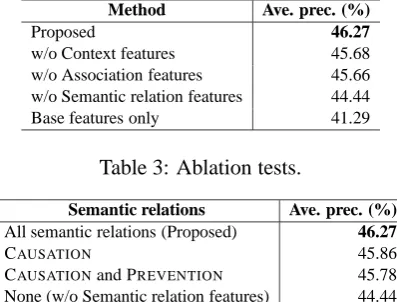
Method Ave. prec. (%)
Proposed 46.27
[image:6.595.316.515.63.214.2]w/o Context features 45.68 w/o Association features 45.66 w/o Semantic relation features 44.44 Base features only 41.29
Table 3: Ablation tests.
Semantic relations Ave. prec. (%)
All semantic relations (Proposed) 46.27
CAUSATION 45.86
CAUSATIONand PREVENTION 45.78 None (w/o Semantic relation features) 44.44
Table 4: Ablation tests on semantic relations.
were positive. The Kappa (Fleiss, 1971) of their judgments was 0.67 (substantial agreement (Lan-dis and Koch, 1977)). These three datasets have no overlap in terms of phrase pairs. About nine man-months were required to prepare the data.
Our evaluation is based on average precision;9
we believe that it is important to rank the plausible event causality candidates higher.
5.1.1 Ablation Tests
We evaluated the features of our method by ab-lation tests. Table 3 shows the results of remov-ing the semantic relation, the context, and the as-sociation features from our method. All the fea-ture types are effective and contribute to the per-formance gain that was about 5% higher than the
Base features only. Proposed achieved 70%
pre-cision at 13% recall. We then estimated that, with the precision rate, we can extract 69,700 event causality pairs from the 2,451,254 event causality candidates, among which the estimated number of positive examples is 377,794.
Next we examined whether the semantic rela-tions that do not seem directly relevant to causality
like MATERIAL are effective. Table 4 shows that
the performance degraded (46.27→45.86) when
we only used the CAUSATIONbinary patterns and
their entailing and entailed patterns compared to
Proposed. Even when adding the PREVENTION
(“negative CAUSATION”) patterns and their entail-ing and entailed patterns, the performance was still slightly worse than Proposed. The performance was even worse when using no semantic relation (“None” in Table 4). Consequently we conclude that not only semantic relations directly relevant
9
Method Ave. prec. (%)
w/o Wikipedia-based features 46.52
Proposed 46.27
[image:7.595.92.273.62.128.2]w/o definition-based features 46.21 w/o Web-based features 46.15 w/o CEA-based features 45.80
Table 5: Ablation tests on association features.
Method Ave. prec. (%)
Proposed 46.27
[image:7.595.324.495.67.186.2]Proposed-CEA 45.80 CEAsup 21.77 CEAuns 16.57
Table 6: Average precision of our proposed meth-ods and baselines using CEA.
to causality like CAUSATION but also those that
seem to lack direct relevance to causality like MA
-TERIALare somewhat effective.
Finally, Table 5 shows the performance drop by removing the Wikipedia-, definition-, web-,
and CEA-based features. The CEA-based
fea-tures were the most effective, while the Wikipedia-based ones slightly degraded the performance.
5.1.2 Comparison to Baseline Methods
We compared our method and two baselines based
on Do et al. (2011): CEAuns is an unsupervised
method that uses CEA to rank event causality
can-didates, and CEAsup is a supervised method
us-ing SVM and the CEA features, whose rankus-ing is based on the SVM scores. The baselines are not complete implementations of Do et al.’s method which uses discourse relations identified based on Lin et al. (2010) and exploits them with CEA within an ILP framework. Nonetheless, we believe that this comparison is informative since CEA can be seen as the main component; they achieved a F1 of 41.7% for extracting causal event relations, but with only CEA they still achieved 38.6%.
Table 6 shows the average precision of the com-pared methods. Proposed is our proposed method.
Proposed-CEA is Proposed without the
CEA-features and shows their contribution. Proposed is the best and the CEA features slightly contribute to the performance, as Proposed-CEA indicates.
We observed that CEAsupand CEAunsperformed
poorly and tended to favor event causality candi-dates whose phrase pairs were highly relevant to each other but described the contrasts of events rather than event causality (e.g. build a slow
mus-cle and build a fast musmus-cle) probably because their
0 0.2 0.4 0.6 0.8 1
0 0.2 0.4 0.6 0.8 1
Pre
ci
si
o
n
Recall
Figure 1: Precision-recall curves of proposed
methods and baselines using CEA.
Method Ave. prec. (%)
Proposed 49.64
Csuns 30.38 Cssup 27.49
Table 7: Average precision of our proposed
method and baselines usingCs.
main components are PMI values. Figure 1 shows their precision-recall curves.
Next we compared our method with the base-lines based on Hashimoto et al. (2012). They de-veloped an automatic excitation template acqui-sition method that assigns each template an
ex-citation value in range [−1,1] that is positive if the template is excitatory and negative if it is in-hibitory. They ranked event causality candidates byCs(p1, p2) = |s1| × |s2|, wherep1 andp2 are the two phrases of event causality candidates, and |s1|and |s2|are the absolute excitation values of p1’s and p2’s templates. The baselines are as
fol-lows: Csuns is an unsupervised method that uses
Csfor ranking, and Cssupis a supervised method
using SVM withCsas the only feature that uses
SVM scores for ranking. Note that some event causality candidates were not given excitation val-ues for their templates, since some templates were acquired by manual annotation without Hashimoto et al.’s method. To favor the baselines for fairness, the event causality candidates of the development and test data were restricted to those with excita-tion values. Since Cssupperformed slightly better when using all of the training data in our prelimi-nary experiments, we used all of it.
Table 7 shows the average precision of the com-pared methods. Proposed is our method. Its av-erage precision is different from that in Table 6 due to the difference in test data described above.
[image:7.595.121.243.164.220.2]0 0.2 0.4 0.6 0.8 1
0 0.2 0.4 0.6 0.8 1
Pre
ci
si
o
n
[image:8.595.312.523.63.117.2]Recall
Figure 2: Precision-recall curves of proposed
methods and baselines usingCs.
phrase pairs described two events that often hap-pen in parallel but are not event causality (e.g.
re-duce the intake of energy and increase the energy consumption) in the highly ranked event causality
candidates of Csuns and Cssup. Figure 2 shows
their precision-recall curves.
Hashimoto et al. (2012) extracted 500,000 event causalities with about 70% precision. However, as described in Section 1, our event causality crite-ria are different; since they regarded phrase pairs that were not self-contained as event causality (their annotators checked the original sentences of phrase pairs to see if they were event causality), their judgments tended to be more lenient than ours, which explains the performance difference.
In preliminary experiments, since our proposed
method’s performance degraded whenCswas
in-corporated, we did not use it in our method.
5.2 Future Scenario Generation
To show that our future scenario generation meth-ods can generate many acceptable scenarios with reasonable precision, we experimentally
com-pared four methods: Proposed, our scenario
generation method without the two filters,
Pro-posed+Orig, our method with the original
sen-tence filter, Proposed+Orig+Comm, our method with the original sentence and common argument filters, and Exact, a method that chains event causality by exact matching.
Beginning events As the beginning event of a scenario, we extracted nouns that describe social problems (social problem nouns, e.g.
deforesta-tion) from Wikipedia to focus our evaluation on
the ability to generate scenarios about them, which is a realistic use-case of scenario generation. We extracted 557 social problem nouns and used the cause phrases of the event causality candidates that
Two-step Three-step
Exact 1,000 (44.10) 1,000 (23.50)
Proposed 2,000 (32.25) 2,000 (12.55)
Proposed+Orig 995 (36.28) 602 (17.28)
[image:8.595.97.258.66.182.2]Proposed+Orig+Comm 708 (38.70) 339 (17.99)
Table 8: Number of scenario samples and their precision (%) in parentheses.
consisted of one of the social problem nouns as the scenario’s beginning event.
Event causality We applied our event causality extraction method to 2,451,254 candidates (Sec-tion 3.1) and culled the top 1,200,000 phrase pairs from them (See Section F in the supplementary notes for examples). Some phrase pairs have the same noun pairs and the same template
polar-ity pairs (e.g. omit toothbrushing→get a cavity
and neglect toothbrushing→have a cavity, where
omit X and neglect X are inhibitory and get X and have X are excitatory). We removed such phrase
pairs except those with the highest CScore, and
960,561 phrase pairs remained, from which we generated two- or three-step scenarios that con-sisted of two or three phrase pairs.
Evaluation samples The numbers of two- and three-step scenarios generated by Proposed were 217,836 and 5,288,352, while those of Exact were 22,910 and 72,746. We sampled 2,000 from
Pro-posed’s two- and three-step scenarios and 1,000
from those of Exact. We applied the filters to the sampled scenarios of Proposed, and the results were regarded as the sample scenarios of
Pro-posed+Orig and ProPro-posed+Orig+Comm. Table
Two-step Three-step
Exact 2,085 1,237
Proposed 5,773 0
Proposed+Orig 4,107 0
[image:9.595.88.280.63.117.2]Proposed+Orig+Comm 3,293 21,153
Table 9: Estimated number of acceptable scenar-ios with a 70% precision rate.
0 0.2 0.4 0.6 0.8 1
0 10000 20000 30000 40000 50000 60000 70000
Pre
ci
si
o
n
Estimated number of acceptable scenarios
Figure 3: Precision-scenario curves (2-step).
scenario judgment requires careful consideration about various possible futures for which individ-ual annotators tend to draw different conclusions.
Result 1 Table 9 shows the estimated number of acceptable scenarios generated with 70% pre-cision. The estimated number is calculated as the product of the recall at 70% precision and the number of acceptable scenarios in all the gener-ated scenarios, which is estimgener-ated by the anno-tated samples. Figures 3 and 4 show the
precision-scenario curves for the two- and three-step
narios, which illustrate how many acceptable sce-narios can be generated with what precision. The curve is drawn in the same way as the precision-recall curve except that the X-axis indicates the
estimated number of acceptable scenarios. At
70% precision, all of the proposed methods out-performed Exact in the two-step setting, and
Pro-posed+Orig+Comm outperformed Exact in the
three-step setting.
Result 2 To evaluate the top-ranked scenarios of Proposed+Orig+Comm in the three-step set-ting with more samples, the annotators labeled 500 samples from the top 50,000 of its output. 341 (68.20%) were acceptable, and the estimated num-ber of acceptable scenarios at a precision rate of 70% and 80% are 26,700 and 5,200 (See Section H in the supplementary notes). The “terrorist
oper-ations” scenario and the “slash-and-burn agricul-ture” scenario in Section 1 were ranked 16,386th
0 0.2 0.4 0.6 0.8 1
0 100000 200000 300000 400000 500000 600000 700000
Pre
ci
si
o
n
Estimated number of acceptable scenarios
[image:9.595.325.503.65.187.2]
Figure 4: Precision-scenario curves (3-step).
and 21,968th. Next we examined how many of the top 50,000 scenarios were acceptable and
non-trivial, i.e., found in no page in our input web
cor-pus, using the 341 acceptable samples. A scenario was regarded as non-trivial if its nouns co-occur in no page of the corpus. 22 among the 341 samples were non-trivial. Accordingly, we estimate that we can generate 2,200 (50,000500×22) acceptable and non-trivial scenarios from the top 50,000. (See Section G in the supplementary notes for exam-ples of the generated scenarios.)
Discussion Scenario deforestation contin-ues→global warming worsens→sea temperatures rise→vibrio parahaemolyticus fouls (water)
was generated by Proposed+Orig+Comm. It
is written in no page in our input web corpus,
which was crawled in 2007.10 But we did find
a paper Baker-Austin et al. (2013) that observed the emerging vibrio risk in the Baltic sea due to global warming. In a sense, we “predicted” an event observed in 2013 from documents written in 2007, although the scenario was ranked as low as 240,738th.
6 Conclusion
We proposed a supervised method for event causality extraction that exploits semantic rela-tion, context, and association features. We also proposed methods for our new task, future sce-nario generation. The methods chain event
causal-ity by causal-compatibilcausal-ity. We generated
non-trivial scenarios with reasonable precision, and “predicted” future events from web documents. Increasing their rank is future work.
10
[image:9.595.91.266.173.294.2]References
Shuya Abe, Kentaro Inui, and Yuji Matsumoto. 2008. Two-phrased event relation acquisition: Coupling the relation-oriented and argument-oriented ap-proaches. In Proceedings of the 22nd International Conference on Computational Linguistics (COLING 2008), pages 1–8.
Susumu Akamine, Daisuke Kawahara, Yoshikiyo Kato, Tetsuji Nakagawa, Yutaka I. Leon-Suematsu, Takuya Kawada, Kentaro Inui, Sadao Kurohashi, and Yutaka Kidawara. 2010. Organizing informa-tion on the web to support user judgments on in-formation credibility. In Proceedings of 2010 4th International Universal Communication Symposium Proceedings (IUCS 2010), pages 122–129.
Craig Baker-Austin, Joaquin A. Trinanes, Nick G. H. Taylor, Rachel Hartnell, Anja Siitonen, and Jaime Martinez-Urtaza. 2013. Emerging vibrio risk at high latitudes in response to ocean warming. Nature Climate Change, 3:73–77.
Nathanael Chambers and Dan Jurafsky. 2008. Unsu-pervised learning of narrative event chains. In Pro-ceedings of the 48th Annual Meeting of the Asso-ciation of Computational Linguistics: Human Lan-guage Technologies (ACL-08: HLT), pages 789– 797.
Nathanael Chambers and Dan Jurafsky. 2009. Unsu-pervised learning of narrative schemas and their par-ticipants. In Proceedings of the 47th Annual Meet-ing of the ACL and the 4th IJCNLP of the AFNLP (ACL-IJCNLP 2009), pages 602–610.
Stijn De Saeger, Kentaro Torisawa, Jun’ichi Kazama, Kow Kuroda, and Masaki Murata. 2009. Large scale relation acquisition using class dependent pat-terns. In Proceedings of the IEEE International Conference on Data Mining (ICDM 2009), pages 764–769.
Stijn De Saeger, Kentaro Torisawa, Masaaki Tsuchida, Jun’ichi Kazama, Chikara Hashimoto, Ichiro Ya-mada, Jong-Hoon Oh, Istv´an Varga, and Yulan Yan. 2011. Relation acquisition using word classes and partial patterns. In Proceedings of the Conference on Empirical Methods in Natural Language Pro-cessing (EMNLP 2011), pages 825–835.
Quang Xuan Do, Yee Seng Chan, and Dan Roth. 2011. Minimally supervised event causality identification. In Proceedings of the 2011 Conference on Empirical Methods in Natural Language Processing (EMNLP 2011), pages 294–303.
Joseph L. Fleiss. 1971. Measuring nominal scale agreement among many raters. Psychological Bul-letin, 76(5):378–382.
Chikara Hashimoto, Kentaro Torisawa, Kow Kuroda, Masaki Murata, and Jun’ichi Kazama. 2009. Large-scale verb entailment acquisition from the web. In
Proceedings of EMNLP 2009: Conference on Em-pirical Methods in Natural Language Processing, pages 1172–1181.
Chikara Hashimoto, Kentaro Torisawa, Stijn
De Saeger, Jun’ichi Kazama, and Sadao Kuro-hashi. 2011. Extracting paraphrases from definition sentences on the web. In Proceedings of the 49th Annual Meeting of the Association for Computa-tional Linguistics: Human Language Technologies, pages 1087–1097.
Chikara Hashimoto, Kentaro Torisawa, Stijn De Saeger, Jong-Hoon Oh, and Jun’ichi Kazama. 2012. Excitatory or inhibitory: A new semantic orienta-tion extracts contradicorienta-tion and causality from the web. In Proceedings of EMNLP-CoNLL 2012: Con-ference on Empirical Methods in Natural Language Processing and Natural Language Learning, pages 619–630.
Jun’ichi Kazama and Kentaro Torisawa. 2008. Induc-ing gazetteers for named entity recognition by large-scale clustering of dependency relations. In Pro-ceedings of the 46th Annual Meeting of the Associ-ation for ComputAssoci-ational Linguistics: Human Lan-guage Technologies (ACL-08: HLT), pages 407– 415.
Julien Kloetzer, Stijn De Saeger, Kentaro Torisawa, Chikara Hashimoto, Jong-Hoon Oh, and Kiyonori Ohtake. 2013a. Two-stage method for large-scale acquisition of contradiction pattern pairs using en-tailment. In Proceedings of the Conference on Em-pirical Methods in Natural Language Processing (EMNLP 2013), pages 693–703.
Julien Kloetzer, Kentaro Torisawa, Stijn De Saeger, Motoki Sano, Chikara Hashimoto, and Jun Gotoh. 2013b. Large-scale acquisition of entailment pattern pairs. In Information Processing Society of Japan (IPSJ) Kansai-Branch Convention 2013.
J. Richard Landis and Gary G. Koch. 1977. The mea-surement of observer agreement for categorical data. Biometrics, 33(1):159–174.
Ziheng Lin, Hwee Tou Ng, and Min-Yen Kan. 2010. A pdtb-styled end-to-end discourse parser. Technical report, School of Computing, National University of Singapore.
Chris Manning and Hinrich Sch ¨utze. 1999. Foun-dations of Statistical Natural Language Processing. MIT Press.
Kira Radinsky and Eric Horvitz. 2013. Mining the web to predict future events. In Proceedings of Sixth ACM International Conference on Web Search and Data Mining (WSDM 2013), pages 255–264.
Kira Radinsky, Sagie Davidovich, and Shaul
Markovitch. 2012. Learning causality for news events prediction. In Proceedings of International World Wide Web Conference 2012 (WWW 2012), pages 909–918.
Mehwish Riaz and Roxana Girju. 2010. Another look at causality: Discovering scenario-specific contin-gency relationships with no supervision. In 2010 IEEE Fourth International Conference on Semantic Computing, pages 361–368.
Peter Schwartz. 1991. The Art of the Long View. Dou-bleday.
Hiroya Takamura, Takashi Inui, and Manabu Okumura. 2005. Extracting semantic orientation of words us-ing spin model. In Proceedus-ings of the 43rd Annual Meeting of the Association for Computational Lin-guistics (ACL 2005), pages 133–140.
Shohei Tanaka, Naoaki Okazaki, and Mitsuru Ishizuka. 2012. Acquiring and generalizing causal inference rules from deverbal noun constructions. In Proceed-ings of 24th International Conference on Compu-tational Linguistics (COLING 2012), pages 1209– 1218.
Masahiro Tanaka, Stijn De Saeger, Kiyonori Ohtake, Chikara Hashimoto, Makoto Hijiya, Hideaki Fujii, and Kentaro Torisawa. 2013. WISDOM2013: A large-scale web information analysis system. In Companion Volume of the Proceedings of the 6th In-ternational Joint Conference on Natural Language Processing (IJCNLP 2013) (Demo Track), pages 45–48.
Kentaro Torisawa, Stijn de Saeger, Jun’ichi Kazama, Asuka Sumida, Daisuke Noguchi, Yasunari Kak-izawa, Masaki Murata, Kow Kuroda, and Ichiro Ya-mada. 2010. Organizing the web’s information ex-plosion to discover unknown unknowns. New Gen-eration Computing (Special Issue on Information Explosion), 28(3):217–236.
Kentaro Torisawa. 2006. Acquiring inference rules with temporal constraints by using japanese coordi-nated sentences and noun-verb co-occurrences. In Proceedings of the Human Language Technology Conference of the North American Chapter of the ACL (HLT-NAACL2006), pages 57–64.
Masaaki Tsuchida, Kentaro Torisawa, Stijn De Saeger, Jong Hoon Oh, Jun’ichi Kazama, Chikara Hashimoto, and Hayato Ohwada. 2011. Toward finding semantic relations not written in a single sen-tence: An inference method using auto-discovered rules. In Proceedings of the 5th International Joint Conference on Natural Language Processing (IJC-NLP 2011), pages 902–910.
Istv´an Varga, Motoki Sano, Kentaro Torisawa, Chikara Hashimoto, Kiyonori Ohtake, Takao Kawai, Jong-Hoon Oh, and Stijn De Saeger. 2013. Aid is out there: Looking for help from tweets during a large scale disaster. In Proceedings of the 51st Annual Meeting of the Association for Computational Lin-guistics (ACL 2013), pages 1619–1629.