Generalized Character-Level Spelling Error Correction
Noura Farra, Nadi Tomeh†, Alla Rozovskaya, Nizar Habash
Center for Computational Learning Systems, Columbia University
{noura,alla,habash}@ccls.columbia.edu
†LIPN, Université Paris 13, Sorbonne Paris Cité
Abstract
We present a generalized discrimina-tive model for spelling error correction which targets character-level transforma-tions. While operating at the charac-ter level, the model makes use of word-level and contextual information. In con-trast to previous work, the proposed ap-proach learns to correct a variety of er-ror types without guidance of manually-selected constraints or language-specific features. We apply the model to cor-rect errors in Egyptian Arabic dialect text, achieving 65% reduction in word error rate over the input baseline, and improv-ing over the earlier state-of-the-art system.
1 Introduction
Spelling error correction is a longstanding Natural Language Processing (NLP) problem, and it has recently become especially relevant because of the many potential applications to the large amount of informal and unedited text generated online, including web forums, tweets, blogs, and email. Misspellings in such text can lead to increased sparsity and errors, posing a challenge for many NLP applications such as text summarization, sen-timent analysis and machine translation.
In this work, we present GSEC, a Generalized character-level Spelling Error Correction model, which uses supervised learning to map input char-acters into output charchar-acters in context. The ap-proach has the following characteristics:
Character-level Corrections are learned at the character-level1 using a supervised sequence
la-beling approach.
Generalized The input space consists of all characters, and a single classifier is used to learn 1We use the term ‘character’ strictly in the alphabetic
sense, not the logographic sense (as in the Chinese script).
common error patterns over all the training data, without guidance of specific rules.
Context-sensitiveThe model looks beyond the context of the current word, when making a deci-sion at the character-level.
Discriminative The model provides the free-dom of adding a number of different features, which may or may not be language-specific.
Language-Independent In this work, we in-tegrate only language-independent features, and therefore do not consider morphological or lin-guistic features. However, we apply the model to correct errors in Egyptian Arabic dialect text, following a conventional orthography standard, CODA (Habash et al., 2012).
Using the described approach, we demonstrate a word-error-rate (WER) reduction of 65% over a do-nothing input baseline, and we improve over a state-of-the-art system (Eskander et al., 2013) which relies heavily on language-specific and manually-selected constraints. We present a de-tailed analysis of mistakes and demonstrate that the proposed model indeed learns to correct a wider variety of errors.
2 Related Work
Most earlier work on automatic error correction addressed spelling errors in English and built mod-els of correct usage on native English data (Ku-kich, 1992; Golding and Roth, 1999; Carlson and Fette, 2007; Banko and Brill, 2001). Ara-bic spelling correction has also received consider-able interest (Ben Othmane Zribi and Ben Ahmed, 2003; Haddad and Yaseen, 2007; Hassan et al., 2008; Shaalan et al., 2010; Alkanhal et al., 2012; Eskander et al., 2013; Zaghouani et al., 2014).
Supervised spelling correction approaches trained on paired examples of errors and their cor-rections have recently been applied for non-native English correction (van Delden et al., 2004; Li et al., 2012; Gamon, 2010; Dahlmeier and Ng, 2012;
Rozovskaya and Roth, 2011). Discriminative models have been proposed at the word-level for error correction (Duan et al., 2012) and for error detection (Habash and Roth, 2011).
In addition, there has been growing work on lex-ical normalization of social media data, a some-what related problem to that considered in this pa-per (Han and Baldwin, 2011; Han et al., 2013; Subramaniam et al., 2009; Ling et al., 2013).
The work of Eskander et al. (2013) is the most relevant to the present study: it presents a character-edit classification model (CEC) using the same dataset we use in this paper.2
Eskan-der et al. (2013) analyzed the data to identify the seven most common types of errors. They devel-oped seven classifiers and applied them to the data in succession. This makes the approach tailored to the specific data set in use and limited to a specific set of errors. In this work, a single model is con-sidered for all types of errors. The model consid-ers every character in the input text for a possible spelling error, as opposed to looking only at cer-tain input characters and contexts in which they appear. Moreover, in contrast to Eskander et al. (2013), it looks beyond the boundary of the cur-rent word.
3 TheGSECApproach
3.1 Modeling Spelling Correction at the Character Level
We recast the problem of spelling correction into a sequence labeling problem, where for each input character, we predict an action label describing how to transform it to obtain the correct charac-ter. The proposed model therefore transforms a given input sentence e = e1, . . . , en of n
char-acters that possibly include errors, to a corrected sentencecofmcharacters, where corrected char-acters are produced by one of the following four actions applied to each input characterei:
• ok:ei is passed without transformation. • substitute−with(c): ei is substituted with
a charactercwhereccould be any character encountered in the training data.
• delete:ei is deleted.
• insert(c): A character c is inserted before ei. To address errors occurring at the end 2Eskander et al. (2013) also considered a slower, more
expensive, and more language-specific method using a mor-phological tagger (Habash et al., 2013) that outperformed the CEC model; however, we do not compare to it in this paper.
Input Action Label
k substitute-with(c)
o ok
r insert(r)
e ok
c ok
t ok
[image:2.595.362.470.61.143.2]d delete
Table 1: Character-level spelling error correction process on the input wordkorectd, with the reference wordcorrect
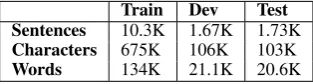
Train Dev Test Sentences 10.3K 1.67K 1.73K Characters 675K 106K 103K Words 134K 21.1K 20.6K
Table 2:ARZ Egyptian dialect corpus statistics
of the sentence, we assume the presence of a dummy sentence-finalstopcharacter. We use a multi-class SVM classifier to predict the action labels for each input character ei ∈ e. A
decoding process is then applied to transform the input characters accordingly to produce the cor-rected sentence. Note that we consider the space character as a character like any other, which gives us the ability to correct word merge errors with space character insertion actions and word split er-rors with space character deletion actions. Table 1 shows an example of the spelling correction pro-cess.
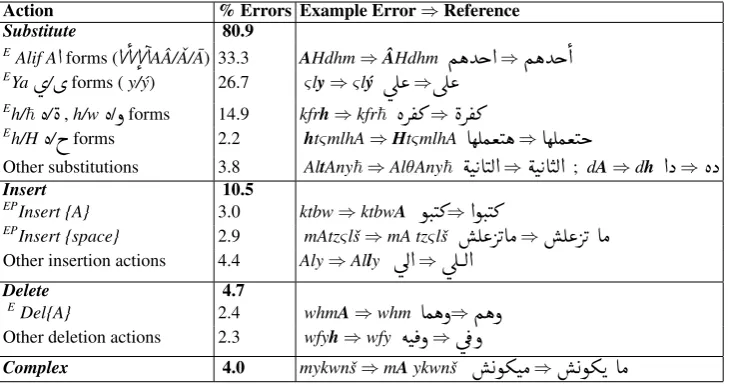
In this paper, we only model single-edit actions and ignore cases where a character requires mul-tiple edits (henceforth,complex actions), such as multiple insertions or a combination of insertions and substitutions. This choice was motivated by the need to reduce the number of output labels, as many infrequent labels are generated by complex actions. An error analysis of the training data, de-scribed in detail in section 3.2, showed that com-plex errors are relatively infrequent (4% of data). We plan to address these errors in future work.
Finally, in order to generate the training data in the described form, we require a parallel cor-pus of erroneous and corrected reference text (de-scribed below), which we align at the character level. We use the alignment toolSclite (Fiscus, 1998), which is part of the SCTK Toolkit.
3.2 Description of Data
[image:2.595.338.495.190.232.2]Action % Errors Example Error⇒Reference
Substitute 80.9
EAlif A
@
forms (@
/@
/@
/@
AÂ/ ˇA/ ¯A) 33.3 AHdhm⇒ÂHdhmÑëYg@
⇒ÑëYg@
EYaø
/ø
forms (y/ý) 26.7 ςly⇒ςlýúΫ
⇒úΫ
Eh/~
è
/è
,h/wè
/ð
forms 14.9 kfrh⇒kfr~èQ ®»
⇒èQ ®»
Eh/H
è
/h
forms 2.2 htςmlhA⇒HtςmlhAAêÊÒªJë
⇒AêÊÒªJk
Other substitutions 3.8 AltAny~⇒AlθAny~
éJ KAJË@
⇒éJ KAJË@
; dA⇒dh@X
⇒èX
Insert 10.5
EPInsert {A} 3.0 ktbw⇒ktbwA
ñJ.J»
⇒@ñJ.J»
EPInsert {space} 2.9 mAtzςlš⇒mA tzςlš
Ê« QKAÓ
⇒Ê« QK AÓ
Other insertion actions 4.4 Aly⇒Ally
úÍ@
⇒úÎË@
Delete 4.7
EDel{A} 2.4 whmA⇒whm
AÒëð
⇒Ñëð
Other deletion actions 2.3 wfyh⇒wfy
éJ ¯ð
⇒ú ¯ð
[image:3.595.118.484.62.255.2]Complex 4.0 mykwnš⇒mAykwnš
ñºJÓ
⇒ ñºK AÓ
Table 3: Character-level distribution of correction labels. We model all types of transformations exceptcomplexactions, and rareInsertlabels with counts below a tuned threshold. TheDeletelabel is a single label that comprises all deletion actions. Labels modeled by Eskander et al. (2013) are marked withE, andEP for cases modeled partially, for example, theInsert{A}
would only be applied at certain positions such as the end of the word.
spellings of the same word. The CODA orthogra-phy was proposed by Habash et al. (2012) in an attempt to standardize dialectal writing, and we use it as a reference of correct text for spelling correction following the previous work by Eskan-der et al. (2013). We use the same corpus (la-beled "ARZ") and experimental setup splits used by them. The ARZ corpus was developed by the Linguistic Data Consortium (Maamouri et al., 2012a-e). See Table 2 for corpus statistics. Error Distribution Table 3 presents the distri-bution of correction action labels that correspond to spelling errors in the training data together with examples of these errors.3 We group the
ac-tions into:Substitute,Insert,Delete, andComplex, and also list common transformations within each group. We further distinguish between the phe-nomena modeled by our system and by Eskander et al. (2013). At least 10% of all generated action labels are not handled by Eskander et al. (2013). 3.3 Features
Each input character is represented by a feature vector. We include a set of basic features inspired by Eskander et al. (2013) in their CEC system and additional features for further improvement. Basic features We use a set of nine basic fea-tures: the given character, the preceding and fol-lowing two characters, and the first two and last 3Arabic transliteration is presented in the
Habash-Soudi-Buckwalter scheme (Habash et al., 2007). For more informa-tion on Arabic orthography in NLP, see (Habash, 2010).
two characters in the word. These are the same features used by CEC, except that CEC does not include characters beyond the word boundary, while we consider space characters as well as char-acters from the previous and next words.
Ngram features We extract sequences of char-acters corresponding to the current character and the following and previous two, three, or four characters. We refer to these sequences as bi-grams, tribi-grams, or 4-bi-grams, respectively. These are an extension of the basic features and allow the model to look beyond the context of the cur-rent word.
3.4 Maximum Likelihood Estimate (MLE) We implemented another approach for error cor-rection based on a word-level maximum likeli-hood model. The MLE method uses a unigram model which replaces each input word with its most likely correct word based on counts from the training data. The intuition behind MLE is that it can easily correct frequent errors; however, it is quite dependent on the training data.
4 Experiments 4.1 Model Evaluation
This step removes redundant repetitions of charac-ters in sequence, e.g.,
QJJJ»
ktyyyyyr‘veeeeery’. The same speech effect handling was applied by Eskander et al. (2013).For classification, we used the SVM implemen-tation in YamCha (Kudo and Matsumoto, 2001), and trained with different variations of the fea-tures described above. Default parameters were selected for training (c=1, quadratic kernel, and context window of +/- 2).
In all results listed below, the baseline corre-sponds to the do-nothing baseline of the input text. Metrics Three evaluation metrics are used. The word-error-rateWERmetric is computed by sum-ming the total number of word-level substitution errors, insertion errors, and deletion errors in the output, and dividing by the number of words in the reference. The correct-rateCorrmetric is com-puted by dividing the number of correct output words by the total number of words in the refer-ence. These two metrics are produced by Sclite (Fiscus, 1998), using automatic alignment. Fi-nally, the accuracyAcc metric, used by Eskander et al. (2013), is a simple string matching metric which enforces a word alignment that pairs words in the reference to those of the output. It is cal-culated by dividing the number of correct output words by the number of words in theinput. This metric assumes no split errors in the data (a word incorrectly split into two words), which is the case in the data we are working with.
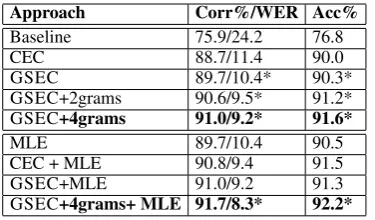
Character-level Model Evaluation The per-formance of the generalized spelling correction model (GSEC) on the dev data is presented in the first half of Table 4. The results of the Eskan-der et al. (2013) CEC system are also presented for the purpose of comparison. We can see that using a single classifier, the generalized model is able to outperform CEC, which relies on a cascade of classifiers (p = 0.03 for the basic model and
p <0.0001for the best model, GSEC+4grams).4 Model Combination Evaluation Here we present results on combining GSEC with the MLE component (GSEC+MLE). We combine the two models in cascade: the MLE component is applied to the output of GSEC. To train the MLE model, we use the word pairs obtained from the original training data, rather than from the output of GSEC. We found that this configuration allows 4Significance results are obtained using McNemar’s test.
Approach Corr%/WER Acc%
Baseline 75.9/24.2 76.8
CEC 88.7/11.4 90.0
GSEC 89.7/10.4* 90.3*
GSEC+2grams 90.6/9.5* 91.2* GSEC+4grams 91.0/9.2* 91.6*
MLE 89.7/10.4 90.5
CEC + MLE 90.8/9.4 91.5
GSEC+MLE 91.0/9.2 91.3
[image:4.595.324.512.61.171.2]GSEC+4grams+ MLE 91.7/8.3* 92.2*
Table 4: Model Evaluation. GSEC represents the gener-alized level model. CEC represents the character-level-edit classification model of Eskander et al. (2013). Rows marked with an asterisk (*) are statistically signifi-cant compared to CEC (for the first half of the table) or CEC+MLE (for the second half of the table), withp <0.05.
us to include a larger sample of word pair errors for learning, because our model corrects many errors, leaving fewer example pairs to train an MLE post-processor. The results are shown in the second half of Table 4.
We first observe that MLE improves the per-formance of both CEC and GSEC. In fact, CEC+MLE and GSEC+MLE perform similarly (p = 0.36, not statistically significant). When adding features that go beyond the word bound-ary, we achieve an improvement over MLE, GSEC+MLE, and CEC+MLE, all of which are mostly restricted within the boundary of the word. The best GSEC model outperforms CEC+MLE (p < 0.0001), achieving aWER of 8.3%, corre-sponding to 65% reduction compared to the base-line. It is worth noting that adding the MLE com-ponent allows Eskander’s CEC to recover various types of errors that were not modeled previously. However, the contribution of MLE is limited to words that are in the training data. On the other hand, because GSEC is trained on character trans-formations, it is likely to generalize better to words unseen in the training data.
Results on Test Data Table 5 presents the re-sults of our best model (GSEC+4grams), and best
model+MLE. The latter achieves a 92.1% Acc
score. TheAccscore reported by Eskander et al. (2013) for CEC+MLE is 91.3% . The two results are statistically significant (p < 0.0001) with re-spect to CEC and CEC+MLE rere-spectively.
Approach Corr%/WER Acc%
Baseline 74.5/25.5 75.5
[image:4.595.329.502.695.741.2]GSEC+4grams 90.9/9.1 91.5 GSEC+4grams+ MLE 91.8/8.3 92.1
4.2 Error Analysis
To gain a better understanding of the performance of the models on different types of errors and their interaction with the MLE component, we separate the words in the dev data into: (1) words seen in the training data, or in-vocabulary words(IV), and (2) out-of-vocabulary (OOV) words not seen in the training data. Because the MLE model maps every input word to its most likely gold word seen in the training data, we expect the MLE compo-nent to recover a large portion of errors in the IV category (but not all, since an input word can have multiple correct readings depending on the con-text). On the other hand, the recovery of errors in OOV words indicates how well the character-level model is doing independently of the MLE compo-nent. Table 6 presents the performance, using the Accmetric, on each of these types of words. Here our best model (GSEC+4grams) is considered.
#Inp Words Baseline CEC+MLEGSEC+MLE OOV3,289 (17.2%) 70.7 76.5 80.5
IV 15,832 (82.8%) 78.6 94.6 94.6 Total19,121 (100%) 77.2 91.5 92.2
Table 6: Accuracy of character-level models shown sepa-rately on out-of-vocabulary and in-vocabulary words.
When considering words seen in the training data, CEC and GSEC have the same performance. However, when considering OOV words, GSEC performs significantly better (p < 0.0001), veri-fying our hypothesis that a generalized model re-duces dependency on training data. The data is heavily skewed towards IV words (83%), which explains the generally high performance of MLE.
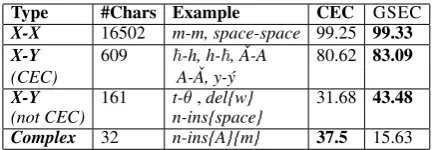
[image:5.595.308.526.61.136.2]We performed a manual error analysis on a sam-ple of 50 word errors from the IV set and found that all of the errors came from gold annotation er-rors and inconsistencies, either in the dev or train. We then divided the character transformations in the OOV words into four groups: (1) characters that were unchanged by the gold (X-X transforma-tions), (2) character transformations modeled by CEC (X-Y CEC), (3) character transformations not modeled by CEC, and which include all phenom-ena that were only partially modeled by CEC (X-Y not CEC), and (4) complex errors. The character-level accuracy on each of these groups is shown in Table 7.
Both CEC and GSEC do much better on the second group of character transformations (that is, X-Y CEC) than on the third group (X-Y not CEC). This is not surprising because the former
Type #Chars Example CEC GSEC
X-X 16502 m-m, space-space 99.25 99.33
X-Y 609 ~-h, h-~, ˇA-A 80.62 83.09
(CEC) A- ˇA, y-ý
X-Y 161 t-θ,del{w} 31.68 43.48
(not CEC) n-ins{space}
Complex 32 n-ins{A}{m} 37.5 15.63
Table 7: Character-level accuracy on different transforma-tion types for out-of-vocabulary words. For complex trans-formations, the accuracy represents the complex category recognition rate, and not the actual correction accuracy.
transformations correspond to phenomena that are most common in the training data. For GSEC, they are learned automatically, while for CEC they are selected and modeled explicitly. Despite this fact, GSEC generalizes better to OOV words. As for the third group, both CEC and GSEC per-form more poorly, but GSEC corrects more errors (43.48% vs. 31.68% accuracy). Finally, CEC is better at recognizing complex errors, which, al-though are not modeled explicitly by CEC, can sometimes be corrected as a result of applying multiple classifiers in cascade. Dealing with com-plex errors, though there are few of them in this dataset, is an important direction for future work, and for generalizing to other datasets, e.g., (Za-ghouani et al., 2014).
5 Conclusions
We showed that a generalized character-level spelling error correction model can improve spelling error correction on Egyptian Arabic data. This model learns common spelling error patterns automatically, without guidance of manually se-lected or language-specific constraints. We also demonstrate that the model outperforms existing methods, especially on out-of-vocabulary words.
In the future, we plan to extend the model to use word-level language models to select between top character predictions in the output. We also plan to apply the model to different datasets and differ-ent languages. Finally, we plan to experimdiffer-ent with more features that can also be tailored to specific languages by using morphological and linguistic information, which was not explored in this paper.
Acknowledgments
References
Mohamed I. Alkanhal, Mohammed A. Al-Badrashiny, Mansour M. Alghamdi, and Abdulaziz O. Al-Qabbany. 2012. Automatic Stochastic Arabic Spelling Correction With Emphasis on Space Inser-tions and DeleInser-tions. IEEE Transactions on Audio, Speech & Language Processing, 20:2111–2122. Michele Banko and Eric Brill. 2001. Scaling to very
very large corpora for natural language disambigua-tion. InProceedings of 39th Annual Meeting of the Association for Computational Linguistics, pages 26–33, Toulouse, France, July.
Chiraz Ben Othmane Zribi and Mohammed Ben Ahmed. 2003. Efficient Automatic Correction of Misspelled Arabic Words Based on Contextual Information. In Proceedings of the Knowledge-Based Intelligent Information and Engineering Sys-tems Conference, Oxford, UK.
Andrew Carlson and Ian Fette. 2007. Memory-based context-sensitive spelling correction at web scale. In
Proceedings of the IEEE International Conference on Machine Learning and Applications (ICMLA). Daniel Dahlmeier and Hwee Tou Ng. 2012. A
beam-search decoder for grammatical error correction. In
Proceedings of the 2012 Joint Conference on Empir-ical Methods in Natural Language Processing and Computational Natural Language Learning, pages 568–578.
Huizhong Duan, Yanen Li, ChengXiang Zhai, and Dan Roth. 2012. A discriminative model for query spelling correction with latent structural svm. In Proceedings of the 2012 Joint Conference on Empirical Methods in Natural Language Process-ing and Computational Natural Language LearnProcess-ing, EMNLP-CoNLL ’12, pages 1511–1521, Strouds-burg, PA, USA. Association for Computational Lin-guistics.
Ramy Eskander, Nizar Habash, Owen Rambow, and Nadi Tomeh. 2013. Processing spontaneous orthog-raphy. In The Conference of the North American Chapter of the Association for Computational Lin-guistics: Human Language Technologies, NAACL HLT ’13.
Jon Fiscus. 1998. Sclite scoring package ver-sion 1.5. US National Institute of Standard Technology (NIST), URL http://www. itl. nist. gov/iaui/894.01/tools.
Michael Gamon. 2010. Using mostly native data to correct errors in learners’ writing. InHuman Lan-guage Technologies: The 2010 Annual Conference of the North American Chapter of the Association for Computational Linguistics, pages 163–171, Los Angeles, California, June.
Andrew R. Golding and Dan Roth. 1999. A Winnow based approach to context-sensitive spelling correc-tion. Machine Learning, 34(1-3):107–130.
Nizar Habash and Ryan M. Roth. 2011. Using deep morphology to improve automatic error detection in arabic handwriting recognition. InProceedings of
the 49th Annual Meeting of the Association for Com-putational Linguistics: Human Language Technolo-gies - Volume 1, HLT ’11, pages 875–884, Strouds-burg, PA, USA. Association for Computational Lin-guistics.
Nizar Habash, Abdelhadi Soudi, and Tim Buckwalter. 2007. On Arabic Transliteration. In A. van den Bosch and A. Soudi, editors, Arabic Computa-tional Morphology: Knowledge-based and Empiri-cal Methods. Springer.
Nizar Habash, Mona Diab, and Owen Rambow. 2012. Conventional orthography for dialectal Ara-bic. In Nicoletta Calzolari (Conference Chair), Khalid Choukri, Thierry Declerck, Mehmet U˘gur Do˘gan, Bente Maegaard, Joseph Mariani, Jan Odijk, and Stelios Piperidis, editors, Proceedings of the Eight International Conference on Language Resources and Evaluation (LREC’12), Istanbul, Turkey, may. European Language Resources Asso-ciation (ELRA).
Nizar Habash, Ryan Roth, Owen Rambow, Ramy Es-kander, and Nadi Tomeh. 2013. Morphological Analysis and Disambiguation for Dialectal Arabic. InProceedings of the 2013 Conference of the North American Chapter of the Association for Computa-tional Linguistics: Human Language Technologies (NAACL-HLT), Atlanta, GA.
Nizar Habash. 2010. Introduction to Arabic Natural Language Processing. Morgan & Claypool Publish-ers.
Bassam Haddad and Mustafa Yaseen. 2007. Detection and Correction of Non-Words in Arabic: A Hybrid Approach. International Journal of Computer Pro-cessing Of Languages (IJCPOL).
Bo Han and Timothy Baldwin. 2011. Lexical normali-sation of short text messages: Makn sens a# twitter. In Proceedings of the 49th Annual Meeting of the Association for Computational Linguistics: Human Language Technologies-Volume 1, pages 368–378. Association for Computational Linguistics.
Bo Han, Paul Cook, and Timothy Baldwin. 2013. Lexical normalization for social media text. ACM Transactions on Intelligent Systems and Technology (TIST), 4(1):5.
Ahmed Hassan, Sara Noeman, and Hany Hassan. 2008. Language Independent Text Correction us-ing Finite State Automata. InProceedings of the In-ternational Joint Conference on Natural Language Processing (IJCNLP 2008).
Taku Kudo and Yuji Matsumoto. 2001. Chunking with support vector machines. In Proceedings of the second meeting of the North American Chap-ter of the Association for Computational Linguistics on Language technologies, NAACL ’01, pages 1– 8, Stroudsburg, PA, USA. Association for Computa-tional Linguistics.
Yanen Li, Huizhong Duan, and ChengXiang Zhai. 2012. A generalized hidden markov model with dis-criminative training for query spelling correction. In
Proceedings of the 35th international ACM SIGIR conference on Research and development in infor-mation retrieval, SIGIR ’12, pages 611–620, New York, NY, USA. ACM.
Wang Ling, Chris Dyer, Alan W Black, and Isabel Trancoso. 2013. Paraphrasing 4 microblog normal-ization. In Proceedings of the 2013 Conference on Empirical Methods in Natural Language Process-ing, pages 73–84, Seattle, Washington, USA, Octo-ber. Association for Computational Linguistics. Mohamed Maamouri, Ann Bies, Seth Kulick, Sondos
Krouna, Dalila Tabassi, and Michael Ciul. 2012a. Egyptian Arabic Treebank DF Part 1 V2.0. LDC catalog number LDC2012E93.
Mohamed Maamouri, Ann Bies, Seth Kulick, Sondos Krouna, Dalila Tabassi, and Michael Ciul. 2012b. Egyptian Arabic Treebank DF Part 2 V2.0. LDC catalog number LDC2012E98.
Mohamed Maamouri, Ann Bies, Seth Kulick, Sondos Krouna, Dalila Tabassi, and Michael Ciul. 2012c. Egyptian Arabic Treebank DF Part 3 V2.0. LDC catalog number LDC2012E89.
Mohamed Maamouri, Ann Bies, Seth Kulick, Sondos Krouna, Dalila Tabassi, and Michael Ciul. 2012d. Egyptian Arabic Treebank DF Part 4 V2.0. LDC catalog number LDC2012E99.
Mohamed Maamouri, Ann Bies, Seth Kulick, Sondos Krouna, Dalila Tabassi, and Michael Ciul. 2012e. Egyptian Arabic Treebank DF Part 5 V2.0. LDC catalog number LDC2012E107.
Alla Rozovskaya and Dan Roth. 2011. Algorithm se-lection and model adaptation for esl correction tasks. InProc. of the Annual Meeting of the Association of Computational Linguistics (ACL), Portland, Oregon, 6. Association for Computational Linguistics. Khaled Shaalan, Rana Aref, and Aly Fahmy. 2010. An
approach for analyzing and correcting spelling er-rors for non-native Arabic learners. Proceedings of Informatics and Systems (INFOS).
L Venkata Subramaniam, Shourya Roy, Tanveer A Faruquie, and Sumit Negi. 2009. A survey of types of text noise and techniques to handle noisy text. InProceedings of The Third Workshop on Analytics for Noisy Unstructured Text Data, pages 115–122. ACM.
Sebastian van Delden, David B. Bracewell, and Fer-nando Gomez. 2004. Supervised and unsupervised automatic spelling correction algorithms. In Infor-mation Reuse and Integration, 2004. Proceedings of the 2004 IEEE International Conference on, pages 530–535.