Influence of Silicon Additions on the Microstructure and Mechanical
Properties of Cu
47Ti
34Zr
11Ni
8Bulk Metallic Glass Forming Alloys
Y. F. Sun
1;2;*, C. H. Shek
3and S. K. Guan
21
Department of Adaptive Machine System, Graduate School of Engineering, Osaka University, Suita 565-0871, Japan
2Research Center for Materials, School of Materials Science and Engineering,
Zhengzhou University, Zhengzhou 450002, P.R China
3Department of Physics and Materials Science, City University of Hong Kong,
83 Tat Chee Avenue, Kowloon Tong, Hong Kong, P.R China
A group of (Cu47Ti34Zr11Ni8)100xSix(x¼0;1;2;3) bulk metallic glass forming alloys with diameter of 3 mm were prepared by
water-cooled copper mould cast. Microstructural investigations reveal that with increasing Si content the precipitated phases exhibit quite different morphologies, which varies from earthworm-like phase for alloys withx¼1to small-sized dendrite phase for alloys withx¼2, and finally to developed dendritic phase for alloys withx¼3. Room temperature compression tests reveal that a transformation from shear fracture to distensile fracture mechanism occurs for the samples with Si content over a critical value. For the alloys withx¼0and 1, fracture occurs in a shear mode with very high ultimate fracture strength. In contrast, the alloys withx¼2and 3 seem to fracture by a distensile mode with ultimate fracture strength greatly decreased. The fracture behavior of the as-cast alloys were investigated and discussed.
[doi:10.2320/matertrans.MF200611]
(Received November 8, 2006; Accepted January 25, 2007; Published May 25, 2007)
Keywords: Bulk metallic glass, Shear fracture, Shear bands, Mechanical properties
1. Introduction
Since the first emergence of the bulk metallic glass (BMG) synthesized by Chen in 1974,1) BMGs has been considered to be natural candidates for structural applica-tions due to their excellent mechanical properties such as high strength (2 GPa) and elastic limit (2%). In recent years a lot of bulk metallic glass forming alloys has been fabricated successfully. These alloys include La, Pd, Zr, Mg, and Cu-based alloy families, which can be obtained through casting methods at low cooling rates of 1–100 K/s.2–5) However, up to now very few BMGs are found to exhibit significant plasticity combined with high yield strength at room temperature.6,7)Nearly all of the BMGs developed so far display very limited global plasticity of less than 2% in compression and nearly zero in tension tests. The intrinsic feature of brittleness greatly prohibits the commercial application of BMGs. Although the mechanical behavior of metallic glasses has been widely studied, the real nature of the deformation mechanisms in these amorphous alloys still remains unclear. It is usually believed that the deformation of BMG materials always concentrates in the highly localized shear bands which are approximately parallel to the maximum stress plane. While the highly localized shear bands are assumed to form by the build-up of free volume, and even a very small change of the free volume could induce a dramatic variation in the shear flow behavior.8,9)Recently, several attempts were devoted to the synthesis of BMG matrix composites by introducing a second crystalline phase into the glass matrix.10–12) How-ever, the plasticities of the composites have not been improved significantly, but sometimes even displays a lower strength and zero plasticity due to the increase in the volume
fraction of brittle intermetallic compounds. For example, long time isothermally annealing the amorphous ZrCuAlNi-Ti alloy will result in the precipitation of nanocrystals with the volume fraction of 68 vol.% and considerably decreased the fractures stress to about 1350 MPa, comparing with 1650 MPa of the fully amorphous counterpart.13)In order to further improve the plasticity of BMGs, ductile dendritic phase reinforced Zr- or Ti-based BMG matrix composites prepared via an in-situ processing method seem to be the most promising. Such materials possess both high strength and remarkably improved ductility prior to failure.14,15)With the development of diverse kinds of BMG composites, the complex fracture phenomena in these materials have been considered and discussed in detail. A distensile mode, rather than a shear mode, was proposed to describe the fracture features in the BMG composites.16)
Cu47Ti34Zr11Ni8 BMG was first developed by Lin and
Johnson several years ago. It exhibits combinations of low cost of constitutes, high glass-forming ability, good mechanical properties and is suggested to be suitable as new engineering material.17) Further studies revealed that substitution of small amount of Ti constitutes with a fifth alloying element, i.e. Si, or Sn, can improve the glass forming ability and form larger sized quinary alloys with homoge-neous amorphous structure.18,19)However, Cahnet al.found that 1 at% Si element introduced into Cu47Ti34Zr11Ni8
BMG with diameter of 2 mm could favor the formation of nanocrystals and greatly improve the plasticity of the material.20,21)
In this paper, the influence of Si elements on the micro-structure evolution and mechanical properties of (Cu47
-Ti34Zr11Ni8)100xSix(x¼0;1;2;3) alloys with diameter of 3 mm were investigated. It reveals that slight changes of Si content will result in remarkable changes in microstructure and mechanical properties. The fracture behavior in relation
*Corresponding author, E-mail: [email protected]
to the microstructural evolutions of the materials were investigated and discussed.
2. Experimental Procedure
A group of (Cu47Ti34Zr11Ni8)100xSix(x¼0;1;2;3) mas-ter alloys were prepared by arc-melting 99.9% pure elements in a Ti-gettered argon atmosphere. From these master alloys cylindrical rods with 3 mm in diameter and 70 mm in length were produced by suction casting into a water-cooled copper mould. The phase constitution of the as-cast cylindrical samples was identified by X-ray diffraction (XRD) using a Philips PW1700 diffractometer with Cu Kradiation. The thermal stability was examined by differential scanning calorimetry (DSC) in a flowing argon atmosphere with a heating rate of 20 K/min. Scanning electron microscopy (SEM) investigations and energy dispersive X-ray spec-troscopy (EDX) microanalysis were performed using a Jeol 5200 SEM equipped with Oxford energy dispersive X-ray spectrometer. Room temperature uniaxial compression tests were conducted under quasistatic loading (strain rate of1
104) with an Instron 5567 device. The samples with an
aspect ratio of 2:1 were prepared for the compression test.
3. Experimental Results
The XRD patterns of the as-cast (Cu47Ti34Zr11
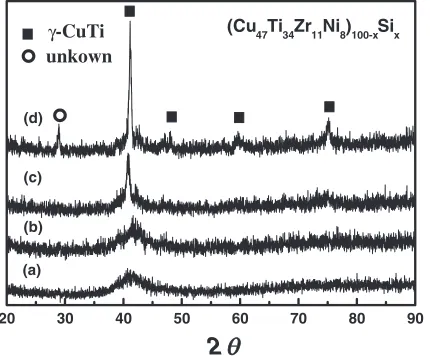
-Ni8)100xSix(x¼0;1;2;3) alloys are shown in Fig. 1. For the Si-free and 1 at% Si containing sample, the patterns only display a broad hump with no visible crystalline diffraction peaks, which is the characteristic of an amorphous phase. While for the samples with x¼2 and 3, sharp crystalline diffraction peaks can be observed and the intensity of the crystalline diffraction peak become stronger with increasing Si additions. Comparing with the phase constitution of the similar alloys system in Ref. 20), the main diffraction peaks can be identified to be-TiCu intermetallic compound. This reveals that crystalline phase with higher volume fraction might precipitate from the alloy melts with increasing Si additions during the solidification process.
The typical DSC traces of the as-cast alloys recorded upon heating are displayed in Fig. 2. For the samples with x¼0
and 1, the curves exhibit an endothermic heat effect characteristic of a glass transition (Tg) and a distinct supercooled liquid region (Tx) before crystallization. While for the samples withx¼2and 3, the glass transitions are not easy to be distinguished. The samples also show different exothermic peaks, characteristic of stepwise transformations from the supercooled liquid state to the equilibrium crystal-line phases with different Si contents. The DSC curves of the samples withx¼0and 1 are quite similar and exhibit four exothermic events. While for the samples containing higher Si contents, the crystallization behavior are quite different and the primary crystallization temperature (Tx) moves to higher temperature. The differences of the thermal stabilities with different Si additions are supposed to be due to the composition changes of the amorphous phase in the alloys.
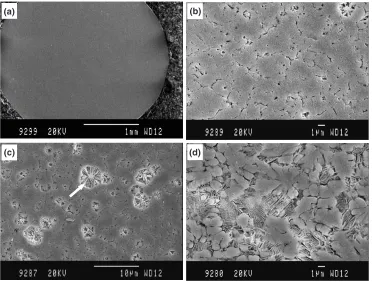
Figure 3 shows the cross-sectional SEM images of the as-cast (Cu47Ti34Zr11Ni8)100xSixalloy rods. For the alloy with
x¼0 shown in Fig. 3(a), no crystalline phase can be observed and the sample exhibits a homogeneous amorphous structure. For the alloys withx¼1, no crystalline phase can be observed at the outermost area of the sample. At the central area of the sample, Figure 3(b) clearly reveals a duplex microstructure consisting of a uniform distribution of earthworm-like crystalline phase with 1–2mmin length in the glass matrix, even though the X-ray pattern gives no clear indications for crystalline phases. The accurate identification of the chemical composition of the earthworm-like phase is difficult since they are very small in width and are embedded in a complex multi-component glassy matrix. From the SEM image of the as-cast alloys with x¼2 shown in Fig. 3(c), dispersion of dendritic phase indicated by a white arrow can be observed in the glass matrix, as well as the earthworm-like phase. According to the XRD pattern combined with EDS determination, the dendritic phase was confirmed to be -CuTi intermetallic compound with a composition of Cu36Ti43Zr7Ni10Si4. For the alloys with x¼3, the SEM
image shown in Fig. 3(d) exhibits more developed dendritic -CuTi phase spreading across the whole sample. The dendritic structure has primary dendrite axes with length of 10–15mmand a radius of about 1–2mm. The earthworm-like
20 30 40 50 60 70 80 90
unkown
γ-CuTi (Cu47Ti34Zr11Ni8)100-xSix
(d)
(c)
(b)
(a)
2
θ
Fig. 1 XRD patterns of the as-cast (Cu47Ti34Zr11Ni8)100xSixalloys (a)
x¼0; (b)x¼1; (c)x¼2and (d)x¼3.
600 650 700 750 800 850 900 950
Tg X=0
X=1
X=2
X=3
(Cu47Ti34Zr11Ni8)100-xSix
Temperature (T/K)
Exothermic (a.u.)
[image:2.595.320.533.73.238.2] [image:2.595.63.278.74.252.2]phase can no longer be found, but eutectic structure exists in the inter-dendritic regions. EDS analysis reveals that the developed dendritic phase has a composition of Cu36Ti43
-Zr6Ni9Si6, which has a relatively more Si concentration
comparing with the dendritic phase in Fig. 3(c).
Figure 4 shows the stress-strain curves of the as-cast (Cu47Ti34Zr11Ni8)100xSixalloys measured under quasistatic loading. In each case, the sample was tested to failure. It reveals that the monolithic Cu47Ti34Zr11Ni8BMG exhibits a
yield strength of 2280 MPa and the alloys withx¼1exhibits yielding with a higher ultimate strength of 2320 MPa, comparing with that of the monolithic BMG. While the yield strengths for samples withx¼2and 3 were 1680 MPa and 1300 MPa respectively, which is remarkably lower than
that of the former two samples. The stress-strain curve of the alloys withx¼3also presents several zigzags before failure. The fracture surfaces of the compression test specimens were examined in order to understand the fracture behavior dependence on the crystallized volume fraction. It was found that the alloys withx¼0and 1 fractured along the maximum shear plane, which is inclined about 45to the direction of the compression loading. While more complex fracture phenom-enon occurs for the alloys withx¼2 and 3. Fractography observations of fractured samples containing different Si contents are shown in Fig. 5. For the sample with x¼0
shown in Fig. 5(a), the typical compressive shear fracture surface exhibits only a vein-like structure with a rather uniform arrangement, indicating a pure shear fracture mode. This vein-like structure is widely believed to be attributed to local softening by melting of some regions of the alloy within the shear band, induced by the high elastic energy release upon instantaneous fracture. Figure 5(b) shows the fracture surface of the samples with x¼1. The propagation of the fracture starts with a few vein patterns, and terminates in to a zone where micro-cracks and micro-voids have formed. The observed fracture surface reveals that during compressive loading micro-cracks join together to form continuous cracks, finally leading to fracture. Figure 5(c) shows the profile of the alloys withx¼2 after fracture. The fractured surface greatly deviate from the maximum stress plane and splits into multiple small planes, indicating a fracture mode rather different with the shear fracture of monolithic BMG. At higher magnification shown in Fig. 5(d), most of the area of the fracture surface exhibits brittle features with a set of ridges running nominally parallel to the direction of crack propagation. The deformation is supposed to be localized
(a) (b)
(c) (d)
Fig. 3 SEM images showing the microstructure of the as-cast (Cu47Ti34Zr11Ni8)100xSix alloys (a)x¼0; (b)x¼1; (c)x¼2and
(d)x¼3.
400 600 800 1000 1200 1400 1600 1800 2000 2200 2400
(d) (c) (b) (a)
ε =1%
Stress
(
σ
/MPa
)
Strain (%)
[image:3.595.113.485.72.354.2] [image:3.595.63.277.406.565.2]between the ridges to form a deformation band and present a band space in range of about 10mm. The formation of the deformation bands and the multiple fracture planes indicate the inhomogeneous deformation in different areas occurs.22) Figure 5(e) shows the profile of the alloys with x¼3after fracture, multiple fracture planes can also been observed. Further observations at higher magnification shown in Fig. 5(f) reveal that broken dendrites can be clearly found on the fracture surface and no vein pattern can be observed.
4. Discussions
The above descriptions reveal that slight variations of Si content can greatly change the microstructure of the Cu47Ti34Zr11Ni8bulk glass forming alloys and consequently
determines the mechanical properties of the materials. In general, bulk amorphous alloys fail due to the formation of shear bands, with vein-like structure often spreading over the whole fracture surface and extending along a uniform direction. For all kinds of monolithic BMGs, their compres-sive fracture surfaces almost show the same feature. When crystalline phase with small volume fraction presents in the glass matrix,e.g.the present alloy with 1 at% Si, the fracture
plane still extend along the direction of about 45inclined to the loading axis, i.e. the direction of the maximum shear stress. However, the vein-like structure could not spread unobstructedly across the whole surface but terminate or branch near the crystalline phase, which acts as a pin during the deformation to prevent the shear band moving through. It is well-known that the uniform arrangement of the veins exactly corresponds to the stable propagation of the shear bands. Therefore, the destroyed vein-like structure indicates the interaction between the shear bands and the precipitated crystalline phase. The further propagation of the shear bands requires larger stress to move through the precipitations and thus, result in the increasing of the ultimate fracture strength. As a result of this plastic mismatch between the matrix and the crystalline phases, cracking around the latter occurs.
As for the samples containing more than 1 at% Si, the alloys exhibit quite different fracture phenomena. The samples fracture into multiple pieces and seem to follow a distensile mode, exhibiting basically brittle fracture features. The ultimate fracture strength of the high Si-containing alloys are rather lower than that of the alloys with no more than 1 at% Si. Since the ability of a region to undergo loading depends on the amount of amorphous phase, the remarkable
(a)
Micro-voids
Micro-cracks
Vein pattern
(b)
(c) (d)
(e)
Dendritic phase
(f)
Fig. 5 SEM images showing the fractured morphology of the as-cast (Cu47Ti34Zr11Ni8)100xSixalloys (a)x¼0; (b)x¼1; (c, d)x¼2
[image:4.595.111.484.70.468.2]decreased ultimate fracture strength of the samples contain-ing 2 at% and 3 at% Si are supposed to be due to the increasing volume fracture of the crystalline phase. Simulta-neously, the presence of large amount of crystals will lead to the inhomogeneous stress distribution in the matrix and the degree of stress concentration will increase with increasing compressive loading. Although the morphologies of the densely distributed-CuTi dendritic phase in the present case are quite similar to that of the-Ti dendrite in Ti-based or Zr-based BMG matrix composites, the-CuTi dendritic phases are typically brittle in nature and hence cannot accommodate plastic strains. When the stress concentration increases to a critical value, the -CuTi phase is easily to be broken and will bring detrimental effect to the mechanical properties of the materials. As a result, the sample cannot bear much load and will break or split into pieces rather than fracture in a shear mode. However, the-CuTi phase might not distribute so uniformly due to the cooling rate difference between the areas near and far from the center of the sample. Therefore, the brittle crystals will exhibit different critical stress value to break, which will lead to the breaking or splitting of the different parts of the materials into pieces by a successive way, but not simultaneously. The fracture behavior can also be confirmed by the formation of zigzags on the stress-strain curves shown in Fig. 4(d).
5. Conclusion
The microstructure, mechanical properties and fracture features of as-cast (Cu47Ti34Zr11Ni8)100xSix (x¼1;2;3) alloys with diameter of 3 mm were investigated. The following conclusions can be made:
(1) The microstructure of the as-cast alloys varies greatly due to different Si additions. For alloys withx¼1, only micron-sized earthworm-like crystals were found at the central area of the sample. For alloys with x¼2, dendritic -TiCu intermetallic compounds were found embedded in the glass matrix, together with the earthworm-like crystals. For alloys withx¼3, devel-oped -TiCu dendrite was the dominate phase and spread unobstructedly through the whole sample. (2) Among the four alloys, those withx¼0and 1 fracture
with high ultimate fracture strength in a shear fracture mode with fracture plane inclined about 45 to the loading direction. While the fractures of the alloys with
x¼2 and 3 occur in a distensile fracture mode with
multiple fracture planes and rather low fracture strength. The different fracture mechanisms are strong-ly dependent on the microstructural difference of the materials.
Acknowledgement:
This work was supported by National Natural Science Foundation of China (Grant number: 50601023, 50571092) and City University of Hong Kong Strategic Research Grant (Project number: 7001529, 7001773).
REFERENCES
1) H. S. Chen: Acta. Metall22(1974) 1505–15116. 2) A. Inoue: Acta. Mater.48(2000) 279-30.
3) A. Inoue, T. Zhang and T. Masumoto: Mater. Trans. JIM36(1995) 391. 4) W. H. Wang, C. Dong and C. H. Shek: Mater. Sci. Eng. R44(2004)
45–89.
5) Z. F. Zhang, J. Eckert and L. Schultz: Acta. Mater.51(2003) 1167– 1179.
6) J. Schroers and W. L. Johnson: Phys. Rew. Lett.93(2004) 255506. 7) J. Das, M. B. Tang, K. B. Kim, R. Theissmann, F. Baier, W. H. Wang
and J. Eckert: Phys. Rew. Lett.94(2005) 205501.
8) B. P. Kanungo, S. C. Glade, P. Asoka-Kumar and K. M. Flores: Intermetallics12(2004) 1073–1080.
9) A. Concustell, G. Alcala, S. Mato, T. G. Woodcock, A. Gebert, J. Eckert and M. D. Baro: Intermetallics13(2005) 1214–1219. 10) C. Fan, R. T. Ott and T. C. Hufnagel: Appl. Phys. Lett.81(2002) 1020–
1022.
11) L. Q. Xing, Y. Li, K. T. Ramesh, J. Li and T. C. Hufnagel: Phys. Rew. B64(2001) R180201.
12) H. Choi-Yim, R. Busch, U. Ko¨ster and W. L. Johnson: Acta. Mater.47
(1999) 2455–2462.
13) A. Leonhard, L. Q. Xing, M. Heilmaier, A. Gebert, J. Eckert and L. Schultz: NanoStruct. Mater.10(1998) 805–817.
14) G. He, J. Eckert, W. Lo¨ser and L. Schultz: Nature. Mater.2(2003) 33– 38.
15) C. C. Hays, C. P. Kim and W. L. Johnson: Phys. Rev. Lett.84(2000) 2901–2904.
16) Z. F. Zhang, G. He and J. Eckert: Phil. Mag.85(2005) 897–915. 17) X. H. Lin and W. L. Johnson: J. Appl. Phys.78(1995) 6514–6519. 18) H. Choi-Yim, R. Busch and W. L. Johnson: J. Appl. Phys.83(1998)
7993–7997.
19) E. S. Park, H. K. Lim, W. T. Kim and D. H. Kim: J. Non-Cryst. Solids
298(2002) 15–22.
20) M. Calin, M. Stoica, J. Eckert, A. R. Yavari and L. Schultz: Mater. Sci. Eng. A392(2005) 169–178.
21) M. Calin, J. Eckert and L. Schultz: Scripta. Mater.48(2003) 653–658. 22) G. He, W. Lo¨ser, J. Eckert and L. Schultz: Mater. Sci. Eng. A352