Munich Personal RePEc Archive
Functional generalized autoregressive
conditional heteroskedasticity
Aue, Alexander and Horvath, Lajos and Pellatt, Daniel
University of California Davis, University of Utah, University of
Utah
20 August 2015
Online at
https://mpra.ub.uni-muenchen.de/67702/
Functional generalized autoregressive conditional heteroskedasticity
∗Alexander Aue† Lajos Horv´ath‡ Daniel F. Pellatt‡
September 12, 2015
Abstract
Heteroskedasticity is a common feature of financial time series and is commonly addressed in the
model building process through the use of ARCH and GARCH processes. More recently multivariate
variants of these processes have been in the focus of research with attention given to methods seeking an
efficient and economic estimation of a large number of model parameters. Due to the need for estimation of
many parameters, however, these models may not be suitable for modeling now prevalent high-frequency
volatility data. One potentially useful way to bypass these issues is to take a functional approach. In
this paper, theory is developed for a new functional version of the generalized autoregressive
condition-ally heteroskedastic process, termed fGARCH. The main results are concerned with the structure of the
fGARCH(1,1) process, providing criteria for the existence of a strictly stationary solutions both in the
space of square-integrable and continuous functions. An estimation procedure is introduced and its
consis-tency verified. A small empirical study highlights potential applications to intraday volatility estimation.
Keywords:Econometrics; Financial time series; Functional data; GARCH processes; Stationary solutions
MSC 2010:Primary: 62M10, Secondary: 62P20, 91B84
1
Introduction
Modeling volatility is one of the prime objectives of financial time series analysis. Research in the area
has increased rapidly since the seminal contributions by Engle (1982), who introduced the autoregressive
conditional heteroskedastic, ARCH, model, and Bollerslev (1986), who introduced the generalized ARCH,
GARCH, model to deal with non-constant and randomly changing volatilities for univariate time series.
Methodology based on these processes and their modifications have become major theoretical and applied
tools to analyze stock returns, exchange rates and more. The book Francq and Zako¨ıan (2010) provides an
excellent introduction to volatility processes and their applications. The interested reader may find detailed
∗This research was partially supported by NSF grants DMS 1209226, DMS 1305858 and DMS 1407530
†Department of Statistics, University of California, Davis, CA 95616, USA, email:[email protected]
‡
Department of Mathematics, University of Utah, Salt Lake City, UT 84112, USA, emails: [email protected],
accounts on theoretical properties such as conditions for the existence of stationary solutions and finiteness of
moments as well as methodology for the estimation of model parameters.
With ever more data being collected in today’s financial sector, there has come a need to address new
phenomena observed when dealing with high-frequency, intra-day observations. While multivariate volatility
processes such as the ones of Engle (2002) and Engle and Kroner (1995) might be used to model
high-frequency returns, these models are typically associated with the difficult task of estimating a large number
of parameters (see Chapter 11 of Francq and Zako¨ıan, 2010). Surveys of multivariate GARCH models and
related volatility processes may be found in Bauwens et al. (2006) and Silvennoinen and Ter¨asvirta (2009).
To alleviate the numerical burden of the parameter estimation, the variance targeting method of Engle and
Mezrich (1996) can be used, which was recently extended to cover multivariate GARCH models by Francq
et al. (2011, 2015). These methods, however, may still fail to produce satisfactory results in a high-frequency
setting.
Modeling data as a collection of functions was popularized through the work of Ramsay and Silvermann
(2005). While this approach has now started to become relevant for the analysis of high-frequency volatility
data, much of the research in the area has so far been devoted to homoskedastic functional time series. The
books by Bosq (2010) and Horv´ath and Kokoszka (2012) provide an account of the state-of-the-art research on
dependent sequences of random functions, including functional autoregressive processes. More recently,
pre-diction of functional time series was considered in Aue et al. (2015), while estimation in dependent functional
linear models was discussed in Aue et al. (2014).
A first step to introduce a functional heteroskedastic framework in the tradition of Engle (1982) was
un-dertaken in H¨ormann et al. (2013). These authors found conditions for the existence of functional ARCH(1)
processes, for which the conditional variance depends on the whole (intra-day) path of the previous
obser-vation. In the spirit of Bollerslev (1986), this paper introduces a functional model in which the conditional
volatility function of the present observation is given as a functional linear combination of the (intra-day)
paths of both the past squared observation and its volatility function. The following definition is central.
Definition 1.1. A sequence of random functions(yi:i∈Z)is called a functional GARCH process of orders
(1,1), abbreviated by fGARCH(1,1), if it satisfies the equations
yi =σiεi, (1.1)
σ2i =δ+αy2i−1+βσi2−1, (1.2)
where δ is a nonnegative function and the integral operators α and β and map nonnegative functions to nonnegative functions, which is in short notation referred to as
Further, the innovations
(εi:i∈Z) are independent and identically distributed processes. (1.4)
Additional assumptions will be introduced were needed. Note that the integral operators α andβ are, for
t ∈ [0,1], defined by (αx)(t) = R
α(t, s)x(s)ds and(βx)(t) = R
β(t, s)x(s)ds, wherex is an arbitrary element ofL2[0,1]andR
is used to meanR1
0. The integral kernel functionsα(s, t)andβ(s, t)are elements
of the Hilbert spaceL2[0,1]2and consequently bounded.
The model given by (1.1) and (1.2) exhibits two time variables. The first is labeled by the integer i
and will in the present context often refer to trading day i, even though other time units are possible. The second time variable is labeled by the real-valuedtwhich, without loss of generality, takes values in the unit interval[0,1]. Witht, intra-day trading time is parameterized. From this set-up, it should become clear that a modeling of intra-day seasonality may be accommodated by the fGARCH model. Doing this in a functional
framework, may lead to efficiency gains over a multivariate modeling approach if the underlying process is
sufficiently smooth. Similar to the univariate case argued in Bollerslev (1986), (1.2) should lead to a more
flexible modeling of the functional volatility lag structure compared to the fARCH(1) process of H¨ormann
et al. (2013). The focus is here on the first-order (1,1) case. Even in the univariate case, this is the most
widely used GARCH process, used as default in the financial industry because it tends to work well (see,
for example, the overview article by Zivot, 2009). Similar arguments should also apply in the more complex
functional world.
The paper proceeds as follows. Theoretical properties of the fGARCH(1,1) process defined via (1.1)
and (1.2) are discussed in Section 2. This section contains the main contributions of this work, establishing
conditions for the existence of the functional stochastic difference equations (1.1) and (1.2). Since one may
view the functionsyiandσi2both as members of the space of square-integrable and continuous functions, two
different theorems are stated to cover both cases. The results on the structure of the fGARCH(1,1) process
are accompanied by additional results on the estimation of quantities appearing in (1.2). These are given
in Section 3. Empirical aspects are highlighted in Section 4. Proofs of the theoretical results are given in
Section 5.
2
Structure
This section discusses properties of the fGARCH(1,1) process, in particular notions of unique, strictly
sta-tionary solutions to the defining equations (1.1) and (1.2). Two different settings are of interest: solutions
inL2 = L2[0,1], the space of square integrable functions on [0,1], and inC[0,1], the space of continuous
kernel
γ0(s, t) =α(s, t)ε20(s) +β(t, s).
By assumption,γ0(s, t) is an element ofL2[0,1]2 with probability one and, following Riesz and Sz.–Nagy
(1990, p. 148), gives rise to the random integral operatorγ0defined through(γx)(t) =Rγ0(s, t)x(s)ds. Note
thatγ0 ≥0(it maps nonnegative functions to nonnegative functions) and denote its (random) Hilbert–Schmidt
norm by
kγ0kS =
Z Z
γ02(s, t)dtds 1/2
.
In the L2 case and for the fGARCH(1,1), the Hilbert–Schmidt norm kγ
0kS will play the role of the usual
top Lyapunov exponent when characterizing the existence of stationary solutions to random difference
equa-tions (see, for example, Boucherol and Picard, 1992). One may also observe the similarity to the univariate
GARCH(1,1) case discussed in Nelson (1990).
Theorem 2.1. Assume that(1.3)and(1.4)hold, thatδ ∈L2, and thatε0 ∈L2with probability one.
(i) If
−∞ ≤E[logkγ0kS]<0, (2.1)
then(1.1)and(1.2)have a unique, strictly stationary and nonanticipative solution inL2. (ii) If there isν >0such that
E[kγ0kνS]<1, (2.2)
then(1.1)and(1.2)have a unique, strictly stationary and nonanticipative solution inL2andE[kσ2
0kν2]<∞.
The proof of Theorem 2.1 is given in Section 5. If (yi:i∈ Z)is an fARCH(1) process, thenγ0(s, t) =
α(s, t)ε2
0(s). The condition for the existence of a strictly stationary solution for the fARCH(1) equations in
L2 used in H¨ormann et al. (2013) can be rewritten asE[kγ0kαS] < 1. It can then be seen readily from an application of Jensen’s inequality that this condition implies (2.1).
Corollary 2.1. The following statements are consequences of Theorem 2.1.
(i) There is a functionalgsuch that
σi2=g(εi−1, εi−2, . . .), i∈Z, (2.3)
and therefore(σ2
i :i∈Z)and(yi:i∈Z)are Bernoulli shifts.
(ii) The representation(2.3)implies the ergodicity of(σ2i:i∈Z)and(yi:i∈Z). (iii) Both(σ2
i:i∈Z)and(yi:i∈Z)are weakly dependent processes.
(iv) Forℓ∈Nandi, j ∈Z, letε(ℓ)
i,j be independent copies ofε0and define
If (2.2)is satisfied, then there is a constant0< ρ <1such that
E
kσi2−σi,ℓ2 kν2
=O(ρℓ). (2.4)
Statement (iv) of the corollary says that, for everyℓ, the sequence(σ2
i:i∈Z)can be approximated with
theℓ–dependent sequence(σi,ℓ2 :i∈Z)under a geometric rate. Consequently, if (2.2) holds with someν ≥2, then the partial sum process(N−1/2P⌊N x⌋
i=1 {σi2 −E[σi2]}) satisfies the functional central limit theorem in
the space of square integrable processes; see Berkes et al. (2012) and Jirak (2013) for recent theoretical
contributions in this area.
If smoother trajectories are required of the fGARCH(1,1) and its volatility process, one may view(yi:i∈
Z) and(σ2
i: i ∈ Z) as functional sequences inC[0,1]. To give the analog of Theorem 2.1 for continuous
functions, letγ¯0 =R γ0(·, s)dsand observe thatγ¯ ∈C[0,1]. The next theorem shows that the role ofkγ0kS
for square integrable functions is assumed bykγ¯kC= supt|γ¯(t)|for continuous functions.
Theorem 2.2. Assume that(1.3)and(1.4)hold, thatδ ∈C[0,1], and thatε0∈C[0,1]with probability one.
(i) If
−∞ ≤E[logkγ¯0kC]<0, (2.5)
then(1.1)and(1.2)have a unique, strictly stationary and nonanticipative solution inC[0,1].
(ii) If there isν >0such that
E[kγ¯kνC]<1, (2.6)
then(1.1)and(1.2)have a unique, strictly stationary nonanticipative solution inC[0,1]andE[kσ2
0kνC]<∞. Corollary 2.2. As in Corollary 2.1, the sequences(yi:i∈Z)and(σi:i∈Z)are weakly dependent. Under
condition(2.6)there is a constant0< ρ <1such that
E
kσi2−σi,ℓ2 kνC
=O(ρℓ),
whereσ2i,ℓis defined in Corollary 2.1.
The proofs of Theorem 2.2 and Corollary 2.2 are given in Section 5. The next section covers an estimation
procedure for the fGARCH(1,1) process. Empirical examples are part of Section 4.
3
Estimation
The goal of this section is to obtain an estimate of the volatility equation (1.2), that is, of the functionδand the operatorsαandβin (1.2). Since the objects involved in the estimation procedure are infinite-dimensional, an
αandβin the following way. It is assumed thatδcan be represented as a linear combination of the functions
inΦM, that is,
δ =
M
X
m=1
dmϕm. (3.1)
It is further assumed that the integral kernelsα(s, t)andβ(s, t)are elements of the span ofΦM×ΦM, so that
α(t, s) =
M
X
m,m′=1
am,m′ϕm(t)ϕm′(s) and β(t, s) =
M
X
m,m′=1
bm,m′ϕm(t)ϕm′(s). (3.2)
With these requirements in place, the problem of estimatingδ,αandβfrom a functional sampley1, y2, . . . , yn
reduces to estimating the set of real-valued parameters{dm, am,m′, bm,m′:m, m′ = 1, . . . , M}. To this end, project firsty21, . . . , yn2andσ12, . . . , σ2nontoΦM and define theM-dimensional vectorsyi= (yi,1, . . . , yi,M)⊤
ands2i = (si,1, . . . , si,M)T through their entriesyi,m = hyi2, ϕmiandsi,m =hσ2i, ϕmi, whereh·,·idenotes
the inner product inL2and⊤stands for the transpose of vectors and matrices. Using (1.2) it follows that
s2i =d+Ay2i−1+Bs2i−1, (3.3)
whered= (d1, . . . , dM)⊤withdm=hδ, ϕmiandAandBareM×M matrices whose(m, m′)th entries are
given byam,m′ andbm,m′. With this multivariate formulation of the volatility equation, iterating (3.3) yields
s2i =
∞
X
ℓ=1
Bℓ−1d+
∞
X
ℓ=1
Bℓ−1Ay2i−ℓ, (3.4)
whereB0 =I, theM×M identity matrix. Note that (3.4) provides a representation for the projections of the unobservable volatilities in terms of the observations. Define the generic equation
˜s2i = ˜s2i(θ) =
∞
X
ℓ=1
Bℓ−1d+
∞
X
ℓ=1
Bℓ−1Ay2i−ℓ, (3.5)
whereθ = (d⊤,A⊤,B⊤)⊤ ∈Θ⊂RM×2M2. It is clear thats2
i = ˜s2i(θ), whereθ= (d⊤,A⊤,B⊤)⊤is the
true parameter of the fGARCH(1,1) process(yi:i∈Z). Since this can always be achieved by an appropriate
scaling, it is assumed without loss of continuity that
E[ε2i(t)] = 1 for allt∈[0,1]. (3.6)
IfFi = σ(εℓ: ℓ ≤ i) denotes theσ-algebra generated by the all innovations up toi, then (3.6) implies that
E[y2
i|Fi] = s2i−1 and hence the least square estimator ofθ is given as the smallest value of the criterion
functionPn
i=1{yi2−s˜2i(θ)}⊤{yi2−˜s2i(θ)}. Since only observey1, . . . ynare observed, the actual parameter
estimator is based on a truncated version of (3.5), namely on
ˆs2i = ˆs2i(θ) =
n
X
ℓ=1
Bℓ−1d+
i−1
X
ℓ=1
This leads to the least squares estimator
ˆ
θn=argmin
Sn(θ) = n
X
i=2
{y2i −ˆs2i(θ)}⊤{y2i −ˆs2i(θ)}:θ∈Θ
,
withˆθn = (ˆd⊤n,Aˆn⊤,Bˆ⊤n)⊤. The main result of this section is the strong consistency ofˆθn. Some guarantees to ensure the identifiability ofθare needed and collected next. Letk · kdenote the Euclidean norm of vectors and matrices.
Assumption 3.1. It is assumed that
(A1)y21 is not measurable with respect toF0;
(A2)Ais nonsingular andkBk<1;
(A3)Θis a compact set andθis in the interior ofΘ; and
(A4) there are0< c1andc2<1such thatc1 ≤ |det(A)|andkBk ≤c2for allθ= (d⊤,A⊤,B⊤)⊤∈Θ.
Part (A1) of Assumption 3.1 means haty21cannot be predicted almost surely from its past. Parts (A3) and (A4) on the parameter spaceΘcontain standard regularity conditions.
Theorem 3.1. Assume that(1.1)–(1.4)and(2.2)hold withν = 1, thatE[|ε0k22]<∞and(3.6)is satisfied.
Thenˆθnis strongly consistent forθunder Assumption 3.1, that is,
ˆ
θn→θ a.s.
asn→ ∞.
The proof of Theorem 3.1 is given in Section 5. Typical choices for the orthonormal class of functions
ΦM include the common Fourier andB-spline bases, but other choices such as wavelets may be entertained
as well. If the finite-dimensionality condition (3.2) is not satisfied, thenδ,αandβcan typically still be well approximated by finite-dimensional functions assuming thatMis sufficiently large. While for theoretical con-siderationsM should grow with the sample size, it is worthwhile noting that in practice often a small choice ofM (less than, say,5) will already work reasonably well. This aspect was investigated in the simulations reported in Aue et al. (2015) and is also reported elsewhere in the functional data literature (see Horv´ath and
Kokoszka, 2012).
A different route for utilizing the estimation procedure that leads to a small class ΦM is to follow the
idea of functional principal components analysis (see Horv´ath and Kokoszka, 2012). For example, it can be
proposed to use the eigenfunctions of the covariance kernel
as a basis, so that a few large eigenvalues and their corresponding eigenfunctions capture the most important
directions of randomness iny21, . . . , yn2and hence in the unobservable volatilitiesσ12, . . . , σn2. SinceD(t, s)is unknown, the estimation is based on the empirical covariance kernel
ˆ
Dn(t, s) =
1
n
n
X
i=1
yi2(t)−y¯n(2)(t) y2i(s)−y¯(2)n (s) , (3.7)
wherey¯n(2) = 1nPni=1yi2. The spectral decomposition ofDˆ(t, s)gives rise to the ordered empirical
eigen-values λˆ1 ≥ . . . ≥ λˆn and the corresponding empirical eigenfunctions ϕˆ1, . . . ,ϕˆn. Therefore, ΦM may
be replaced with the class of estimated eigenfunctionsΦˆM ={ϕˆ1, . . . ,ϕˆM}, with appropriately chosenM.
The following result shows that consistency can be established also for the functional principal components
approach to estimating the fGARCH(1,1) process.
Corollary 3.1. IfR E[y04(t)]dt < ∞, then the result of Theorem 3.1 is retained if the random classΦˆM is used in place of a deterministic classΦM.
The proof of Corollary 3.1 is given in Section 5.
4
Empirical results
4.1 Simulations
In order to investigate the performance of the least squares procedure in finite samples, functional data was
generated from the fGARCH(1,1) process(yi:i∈Z)whose volatility function (1.2) is specified through the
constant intercept functionδgiven by
δ(t) =.01, t∈[0,1], (4.1)
and the operatorsαandβdefined through their kernel functions
α(t, s) =β(t, s) = 12t(1−t)s(1−s), t, s∈[0,1]. (4.2)
The innovations(εi:i∈Z)appearing in (1.1) and (1.2) functions are defined as
εi(t) =
√
log 2 2200t Bi
2400t log 2
, t∈[0,1], (4.3)
where (Bi: i ∈ Z) are independent and identically distributed standard Brownian motions. Lengthy but
elementary calculations show that (2.1) holds in case of (4.1)–(4.3) and therefore (yi:i ∈ Z) constitutes a
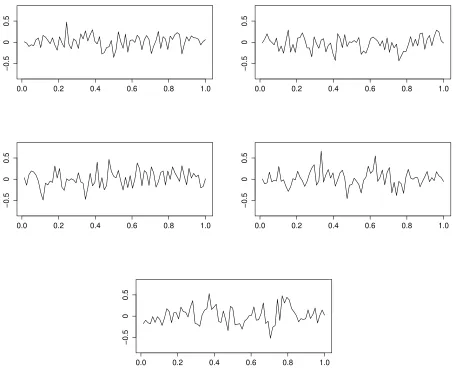
strictly stationary process. The recursion in (1.2) was initialized with σ12 = δ and the first 1000 simulated curves were discarded as burn-in values since to get close to the stationary solution. Figure 4.1 displays the
Figure 4.1: Five consecutive fGARCH(1,1) observations (read row-wise starting from the top-left) generated from model (4.1)–(4.3).
−0.5
0
0.5
0.0 0.2 0.4 0.6 0.8 1.0
−0.5
0
0.5
0.0 0.2 0.4 0.6 0.8 1.0
−0.5
0
0.5
0.0 0.2 0.4 0.6 0.8 1.0
−0.5
0
0.5
0.0 0.2 0.4 0.6 0.8 1.0
−0.5
0
0.5
0.0 0.2 0.4 0.6 0.8 1.0
Random samples of size n = 300, 600 and1200 were obtained from the data generating process in equations (4.1)–(4.3). Note that in this settingα(t, s) =β(t, s) =.4ϕ1(t)ϕ1(s)with the normalized function
ϕ1given by
ϕ1(t) =
√
30t(1−t), t∈[0,1].
Equation (3.2) shows then that the operator-related parameters to estimate are a11 = b11 = .4. Note that
the intercept function δ ≡ 0.01 is not in the span of ϕ1 and therefore does not satisfy (3.1), so that the
corresponding least squares estimate becomes a proxy ford1 =hδ, ϕ1i=√30/600≈.009. The estimation
procedure was run1000times withM = 1yielding the outcomes reported in Table 4.1.
asymp-totically consistent estimators forαandβin theL2-sense, then
˜
δn= ¯y(2)n −(ˆα+ ˆβ)¯y(2)n
is an asymptotically consistent estimator forδ, wherey¯n(2) = n1 Pni=1yi2. In the present simulation setting,
there was little difference betweenδˆ= ˆd1ϕand˜δ, so only results for the first choice are presented here.
Table 4.1: Estimatesdˆ1,ˆa11andˆb11withM = 1andϕ1(t) =
√
30t(1−t)in model (4.1)–(4.3) for different sample sizesn. The row labeled by∞shows the population values.
n dˆ1 aˆ11 ˆb11
300 0.013 0.420 0.306 600 0.011 0.412 0.344 1200 0.010 0.408 0.369
∞ 0.009 0.400 0.400
To illustrate the estimation method using estimated functional principal components, whose large-sample
behavior is given in Corollary 3.1,n= 1000functional observations were generated from the fGARCH(1,1) model (4.1)–(4.3). The largest eigenvalue ofDˆ1,000, the empirical covariance kernel defined in (3.7), explains
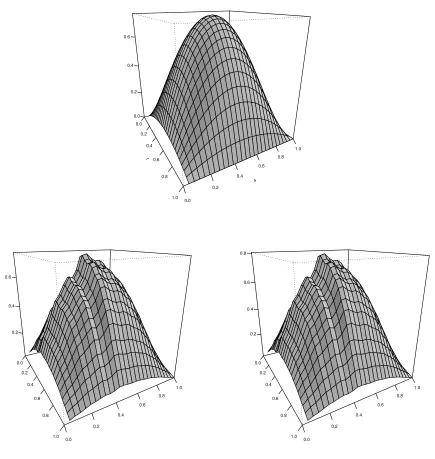
about 70% of the variability in the squared functionsyi2, while the second-largest eigenvalue only accounts for 4%. First, the estimation procedure was applied using only the first empirical eigenfunction ϕˆ1. The
resulting estimated kernels αˆ1000(t, s) and βˆ1000(t, s) are shown in Figure 4.2 along with the population
kernelsα(t, s) = β(t, s)given in (4.3). The experiment was then repeated using two or more eigenfunction but no qualitative improvement in the shape of the estimatorsα1000(t, s)andβ1000(t, s)was found. As before,
ˆ
d1000estimates the sum of the first coefficients of the expansion ofδin the empirical eigenbasisϕˆ1,ϕˆ2, . . .
4.2 Application
The data example considered in this subsection is on intra-day log-returns of an exchange-traded fund (ETF),
namely the popular SPDR S&P 500 EDF (SPY) designed to track the S&P 500 index. Let thenpi(t)denote
the value of the SPY ETF on dayi at time t. Following Cyree et al. (2004) one can set up the intra-day log-returns
yi(t) = logpi(t)−logpi(t−h),
wherehis a time window typically corresponding to 1, 5, or 15 minutes. In the following, onlyh = 5and therefore 5-minute log-returns are considered. This is done for convenience because the price of the SPY ETF
is recorded in five-minute resolution, for example, at the website https://quantquote.com, and the
5-minute log-return process(yi)becomes easily computable. Since the SPY trades from 9:30am to 4:00pm,
Figure 4.2: Plots of α(t, s) = β(t, s) of (4.2) (top panel) and corresponding estimates αˆ1000(t, s) and ˆ
β1000(t, s)(lower panel) based on the data generating process (4.1)–(4.3).
t 0.0
0.2
0.4
0.6
0.8
1.0
s
0.0 0.2
0.4 0.6
0.8 1.0 0.0
0.2 0.4 0.6
0.0
0.2
0.4
0.6
0.8
1.0 0.0
0.2 0.4
0.6 0.8
1.0 0.2
0.4 0.6
0.0
0.2
0.4
0.6
0.8
1.0 0.0
0.2 0.4
0.6 0.8
1.0 0.2
0.4 0.6 0.8
application of any multivariate ARCH or GARCH model impractical and a functional alternative is suggested
in the following. Note that the volatility of the log-returns on dayiat timetis then represented by
σi2(t) = Var(yi(t)|Fi−1),
whereFi−1 denotes the the available information until the end of dayi−1. Figure 4.3 shows the graphs of
the 5-minute log-returns of the SPY data for five consecutive trading days in July 2006.
Figure 4.3: Plots of 5-minute log-returns of the SPY ETF from July 21 and 24–27, 2006 (read row-wise starting from the top-left).
−0.002
0.001
0.0 0.2 0.4 0.6 0.8 1.0
−0.002
0.001
0.0 0.2 0.4 0.6 0.8 1.0
−0.002
0.001
0.0 0.2 0.4 0.6 0.8 1.0
−0.002
0.001
0.0 0.2 0.4 0.6 0.8 1.0
−0.002
0.001
0.0 0.2 0.4 0.6 0.8 1.0
2006. SPY is not traded on weekends and bank holidays. There were eight half trading days during this four
year span and due to possibly different market behavior these eight curves were excluded from the analysis,
resulting in the fitting of an fGARCH(1,1) process to n = 999functional observations. The least squares estimation procedure was carried out usingΦM consisting of the empirical eigenfunctions associated with
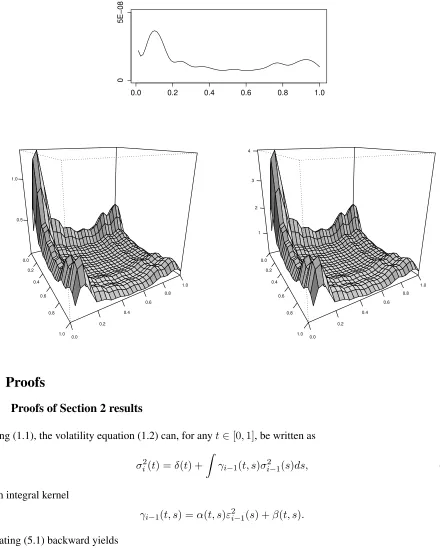
theM largest eigenvalues of the covariance operatorDˆ999. Figure 4.4 shows the estimates for the intercept
functionδand integral kernels corresponding to the operatorsαandβfor the caseM = 1. As in the simulated data example, increasing the number of eigenfunctions used, did not qualitatively improve the estimators. It
Figure 4.4: Estimates for intercept functionδ(top), and kernelsα(t, s)(bottom left) andβ(t, s)(bottom right) based on the SPY ETF data.
0.0 0.2 0.4 0.6 0.8 1.0
0
5E−08
0.0
0.2
0.4
0.6
0.8
1.0 0.0
0.2 0.4
0.6 0.8
1.0 0.5
1.0
0.0
0.2
0.4
0.6
0.8
1.0 0.0
0.2 0.4
0.6 0.8
1.0 1
2 3 4
5
Proofs
5.1 Proofs of Section 2 results
Using (1.1), the volatility equation (1.2) can, for anyt∈[0,1], be written as
σi2(t) =δ(t) +
Z
γi−1(t, s)σ2i−1(s)ds, (5.1)
with integral kernel
γi−1(t, s) =α(t, s)ε2i−1(s) +β(t, s).
Iterating (5.1) backward yields
σi2(t) =δ(t) +
Z
γi−1(t, s1)
δ(s1) +
Z
γi−2(s1, s2)σi2−2(s2)ds2
ds1
=δ(t) +
Z
γi−1(t, s1)δ(s1)ds1+
Z Z
=δ(t) +
Z
γi−1(t, s1)δ(s1)ds1+
Z Z
γi−1(t, s1)γi−2(s1, s2)δ(s2)ds2ds1
+
Z Z Z
γi−1(t, s1)γi−2(s1, s2)γi−3(s2, s3)σi2−3(s3)ds3ds2ds1,
and so on. Fori ∈Z, letΓi,0denote the identity operator and, fori∈Zandk ∈N, let the random integral
operatorsΓi,k be defined by the equation
(Γi,kx)(t) =
Z
· · ·
Z
γi−1(t, s1)γi−2(s1, s2)· · ·γi−k(sk−1, sk)x(sk)dsk· · ·ds2ds1.
Then, it follows that, for anym∈N,
σi2 =
m−1
X
k=0
Γi,kδ+ Γi,mσ2i−m. (5.2)
It can be seen from the definition ofΓi,k that
Γi,k = Γi,1◦Γi−1,1◦ · · · ◦Γi−k+1,1, (5.3)
where◦denotes the composition of operators. The foregoing identifies
σ2i =
∞
X
k=0
Γi,kδ, (5.4)
as candidate for the nonanticipative solution of (1.1) and (1.2). It remains to be shown that the sum on the
right-hand side of equation (5.4) is well defined with probability one. This will be verified in the following.
Proof of Theorem 2.1. (i) Consider the convergence of the sum in (5.4) inL2, the space of square integrable
functions on[0,1]. Since
(Γi,1x)(t) =
Z
γi−1(t, s)x(s)ds
defines an integral operator inL2, it follows from Riesz and Sz.–Nagy (1990, p. 148) that
kΓi,1kN ≤ kγi−1k2, (5.5)
wherek · kN denotes the operator norm onL2. Using representation (5.3) and inequality (5.5) leads to
kΓi,kkN ≤
k
Y
ℓ=1
kγi−ℓk2. (5.6)
(The usual arrangement Q
i∈∅ = 1 applies here and in the following.) Since kγℓk2 are independent and
identically distributed random variables, the strong law of large numbers implies that
1
k
k
X
ℓ=1
Hence, in view of (2.1),
P ∞
X
k=0
(Γi,kδ)(t)∈L2[0,1]
= 1.
It is easy to see that that the infinite sum on the right side of (5.4) satisfies (5.1) and hence (1.1) and (1.2).
To prove the uniqueness of the solution to (1.1) and (1.2) assume thatσ¯i2is another such solution. Using the backward recursions as in (5.2) shows that, for allm∈N,
¯
σi2 =
m−1
X
k=0
Γi,kδ+ Γi,mσ¯2i−m. (5.8)
Hence, for allm∈N,
¯
σi2−
∞
X
k=0 Γi,kδ
2 ≤ ∞ X
k=m
Γi,kδ
2 +
Γi,mσ¯i2−m
2. (5.9)
Assumption (2.1) implies for the first norm on the right-hand side of the latter equation that, asm→ ∞,
∞ X
k=m
Γi,kδ
2 ≤ ∞ X
k=m
kΓi,kkNkδk2→0 a.s.
Similarly,
Γi,mσ¯i2−m
2≤ kΓi,mkNkσ¯ 2
i−mk2 →P 0,
which follows since kΓi,mkN → 0 a.s. and, due to the weak stationarity of (¯σi: i ∈ Z), the sequence (k¯σ2
i−mk2:i∈Z)is bounded in probability. Therefore
P ¯
σi−
∞
X
k=0 Γi,kδ
2 = 0
= 1,
which proves the first part of the theorem.
(ii) Note that
kσ20k2≤
∞
X
k=0
kΓi,kδk2≤ kδk2
∞
X
k=0
kΓi,kkN ≤ kδk2
∞ X k=0 k Y ℓ=1
kγi−ℓk2.
Consequently Minkowski’s inequality (cf. Hardy et al., 1959, pp. 24–26) implies that, forν ≥1,
E[kσ2
0kν2]
1/ν
≤ kδk2
∞ X k=0 E k Y ℓ=1
kγi−ℓk2
ν1/ν
≤ kδk2
∞
X
k=0
(E[kγ0kν
2])k/ν
and, for0< ν ≤1,
E[kσ02kν2]≤ kδkν2
∞
X
k=0
(E[kγ0kν2])k
Proof of Corollary 2.1. (i) The Bernoulli shift representation in (2.3) is an immediate consequence of (5.4).
(ii) Ergodicity is implied by the work of Stout (1974).
(iv) Forj ∈N, let
γi,ℓ,i−ℓ−j(t, s) =α(t, s)ε2i,ℓ,i−ℓ−j(s) +β(t, s).
and, fork≥ℓ, let the operatorsΓi,ℓ,kbe defined through
(Γi,ℓ,kx)(t) =
Z
· · ·
Z
γi−1(t, s1)γi−2(s1, s2)· · ·γi−ℓ−1(sℓ−2, sℓ−1)
×γi,ℓ,i−ℓ(sℓ−1, sℓ)γi,ℓ,i−k(sk−1, sk)x(sk)dskdsk−1· · ·ds1.
Setting
σi,ℓ2 =
ℓ−1
X
k=0
Γi,kδ+
∞
X
k=ℓ
Γi,ℓ,kδ,
it can be seen that
Ekσi2−σ2
i,ℓkν2
≤2νE
∞ X
k=ℓ
Γi,kδ
ν 2
+ 2νE
∞ X
k=ℓ
Γi,ℓ,kδ
ν 2 .
It follows from the proof of Theorem 2.1 that
E ∞ X
k=ℓ
Γi,kδ
ν 2 ≤
kδkν2 ∞
X
k=ℓ
{E[kγ0kν2]}k/ν
ν
, if ν≥1,
kδkν2
∞
X
k=ℓ
{E[kγ0kν2]}k, if 0< ν ≤1.
Observing that E ∞ X
k=ℓ
Γi,kδ
ν 2 =E ∞ X
k=ℓ
Γi,ℓ,kδ
ν 2
and thatE[kγ0kν2]<1by assumption, the proof of (2.4) is complete.
Proof of Theorem 2.2. (i) Recall relations (5.2)–(5.4). It follows from the definition ofΓi,k that
kΓi,kδkC≤ kδkC
k
Y
ℓ=1
k¯γi−ℓkC
withγ¯j(t) =Rγj(t, s)ds. Hence
∞ X k=0 Γi,kδ
C ≤ k
δkC
∞ X k=0 k Y ℓ=1
k¯γi−ℓkC.
The strong law of large numbers yields that
1
k
k
X
ℓ=1
implying immediately that, under assumption (2.5)
P ∞
X
k=0
Γi,kδ∈C[0,1]
= 1.
Thus the existence of a solution to (1.1) and (1.2) is proven. Assume that(¯σ2i:i∈Z)is an other solution to (1.1) and (1.2) inC[0,1]. Since (5.8) holds, if follows as in (5.9) that, for allm∈N,
¯
σi−
∞
X
k=0 Γi,kδ
C ≤ ∞ X
k=m
Γi,kδ
C
+
Γi,mσ¯i2−m C.
If (2.5) is satisfied, then, asm→ ∞,
∞ X
k=m
Γi,k
C ≤ k
δkC
∞
X
k=m
kΓi,kkC→0 a.s.,
using that(1/m) logkΓi,mkC → E[logkγ¯0kC] < 0with probability one. By the assumed weak stationarity
of the function series(¯σi:i ∈ Z), the univariate sequence(kσ¯i2−mkC:i ∈ Z)is bounded in probability and
therefore
Γi,mσ¯i2−m
C ≤ kΓi,mkCkσ¯i2−mkC
P
→0.
Consequently, P ¯
σi−
∞
X
k=0 Γi,kδ
C = 0
= 1,
and the uniqueness of the solution to (1.1) and (1.2) is established.
(ii) The proof is similar to the proof of part (ii) of Theorem 2.1.
Proof of Corollary 2.2. The proof follows along the line of arguments used to establish Remark 2.1 and the
details are thus omitted.
5.2 Proofs of Section 3 results
Proof of Theorem 3.1. First observe that, by (1.1),hyi2, ϕmi = hσi2ε2i, ϕmi =hσi2, ϕmi+hσi2(ε2i −1), ϕmi.
Due to the independence ofεiandσi, yi−ℓ, ℓ∈N, (3.6) and the stationarity of(yi:i∈Z)imply that
E[(y2i −˜s2i)⊤(y2i −˜s2i)] =
M
X
m=1
Ehσ02(ε20−1), ϕmi2+M(θ), (5.10)
where
M(θ) =E[{s02−˜s20(θ)}⊤{s20−˜s20(θ)}], θ∈Θ.
SinceM(θ) ≥0,M(θ) = 0and the first term on the right-hand side of (5.10) is constant as a function ofθ, it suffices to show that
Assume now that (5.11) does not hold, so that there isθ∗ 6=θ,θ∗ ∈Θsuch thatM(θ∗) = 0. But this means
thats20 = ˜s20(θ∗)with probability one. Using (3.4) and (3.5), it can be concluded that ∞
X
ℓ=1
Bℓ−1d+
∞
X
ℓ=1
Bℓ−1Ay2−ℓ=
∞
X
ℓ=1
Bℓ∗−1d∗+ ∞
X
ℓ=1
Bℓ∗−1A∗y−2ℓ, (5.12)
withθ∗ = (d∗,A∗,B∗). Ifℓ∗ is the smallest integer such thatBℓ
∗−1
A6=Bℓ∗∗−1A∗, then
(Bℓ∗−1A−B∗ℓ∗−1A∗)y−2ℓ∗ =
∞
X
ℓ=1
Bℓ−1d−
∞
X
ℓ=1
Bℓ∗−1d∗+ ∞
X
ℓ=ℓ∗+1
(Bℓ−1A−B∗ℓ−1A∗)y2−ℓ
and thereforey2−ℓ∗is measurable with respect toF−ℓ∗−1 which contradicts part (A1) of Assumption 3.1 due to stationarity. HenceBℓA =Bℓ∗A∗ for allℓ≥ 0resulting inA =A∗ and consequentlyP∞ℓ=1Bℓ−1A =
P∞
ℓ=1Bℓ∗−1A, in turn implying that(I−B)−1A= (I−B∗)−1A. ThusB=B∗. SinceA=A∗andB=B∗,
(5.12) shows thatP∞
ℓ=1Bℓ−1d =
P∞
ℓ=1Bℓ−1d∗ and hence (I−B)−1d = (I−B)−1d∗, completing the
proof ofd=d∗. By contradiction, (5.11) is established.
The ergodic theorem (cf. Breiman, 1968) yields that, for allθ∈Θ,
1
n
n
X
i=2
(y2i −˜s2i−1(θ))⊤(y2i −˜s2i−1(θ))→
M
X
m=1
E
hσ02(ε20−1), ϕmi2+M(θ) a.s.
asn→ ∞. Observing that the derivatives of˜s20have a uniformly bounded expected value onθ∈Θ, standard arguments (see, for example, the proof of the uniform law of large numbers in Ferguson, 1996) show that
sup
θ∈Θ
1 n n X i=2
{yi2−˜s2i−1(θ)}⊤{yi2−˜s2i−1(θ)} −
M X
m=1
Ehσ02(ε20−1), ϕmi2+M(θ)
→
0 a.s.
Using (3.5) and the assumption thatkBk ≤ρ <1onΘgives
sup
θ∈Θ
1 n n X i=2
{yi2−˜s2i−1(θ)}⊤{yi2−˜s2i−1(θ)} − 1
n
n
X
i=2
{yi2−ˆs2i−1(θ)}⊤{y2i −ˆs2i−1(θ)}
→ 0 a.s. Thus, sup
θ∈Θ
1 n n X i=2
{y2i −ˆs2i−1(θ)}⊤{y2i −ˆs2i−1(θ)} −
M X
m=1
Ehσ02(ε20−1), ϕmi2+M(θ)
→
0 a.s. (5.13)
The results in (5.11) and (5.13) imply the consistency in Theorem 3.1 via standard arguments.
Proof of Corollary 3.1. The approximability established in Corollary 2.1 implies that kDˆN −Dk → 0 in
probability and therefore
max
1≤m≤Mkϕˆm−
ˆ
ζmϕmk→P 0, (n→ ∞),
where the ζˆm’s are random signs, assuming that λ1 > · · · > λM > λM+1 are the eigenvalues of D in
decreasing order (see Horv´ath and Kokoszka, 2012). Hence the consistency of Theorem 3.1 remains true
References
[1] Aue, A., Dubart Nourinho, D. and H¨ormann, S. (2015). On the prediction of stationary functional time
series.Journal of the American Statistical Association110, 378–392.
[2] Aue, A., H¨ormann, S., Horv´ath, L., and Huˇskov´a, M. (2014). Dependent functional linear models with
applications to monitoring structural change.Statistica Sinica24, 1043–1073.
[3] Bauwens, I., Laurent, S. and Rombouts, J.V.K. (2006). Multivariate GARCH models: a survey.Journal
of Applied Econometrics21(2006), 79–109.
[4] Berkes, I., Horv´ath, L. and Rice, G. (2013). Weak invariance principles for sums of dependent random
functions.Stochastic Processes and Their Applications123, 385–403.
[5] Bollerslev, T. (1986). Generalized autoregressive conditional heteroskedasticity. Journal of
Economet-rics31, 307–327.
[6] Bosq, D. (2010).Linear Processes in Function Spaces.Springer-Verlag, New York.
[7] Bougerol, P. and Picard, N. (1992). Stationarity of GARCH processes and of some nonnegative time
series.Journal of Econometrics52, 115–127.
[8] Breiman, L. (1968).Probability.Addison Wesley.
[9] Cyree, K.K., Griffiths, M.D. and Winters, D.B. (2004). An empirical examination of intraday volatility
in euro-dollar rates.The Quarterly Review of Economics and Finance44, 44–57.
[10] Engle, R.F. (1982). Autoregressive conditional heteroskedasticity with estimates of the variance of
United Kingdom inflation.Econometrica50, 987–1007.
[11] Engle, R.F. (2002). Dynamic conditional correlation: a simple class of multivariate GARCH models.
Journal of Business of Economic Statistics20, 339–350.
[12] Engle, R.F. and Kroner, K. (1995). Multivariate simultaneous generalized ARCH.Econometric Theory
11, 122–150.
[13] Engle, R.F. and Mezrich, J. (1996). GARCH for groups.Risk9, 36–40.
[14] Ferguson, T. (1996).A Course in Large Sample Theory.Chapman and Hall.
[16] Francq, C., Horv´ath, L. and Zako¨ıan, J.-M. (2011). Merits and drawbacks of variance Targeting in
GARCH models.Journal of Financial Econometrics9, 619–656.
[17] Francq, C., Horv´ath, L. and Zakoian, J.-M. (2015+). Variance targeting estimation of multivariate
GARCH models.Journal of Financial Econometrics, in press.
[18] Hardy, G.H., Littlewood, J.E. and P´olya, G. (1959).Inequalities (2nd ed.).Cambridge University Press,
Cambridge, U.K.
[19] H¨ormann, S., Horv´ath, L. and Reeder, R. (2013). A functional version of the ARCH model.Econometric
Theory29, 267–288.
[20] Horv´ath, L. and Kokoszka, P. (2012),Inference for Functional Data with Applications.Springer-Verlag,
New York.
[21] Jirak, M. (2013). On weak invariance principles for sums of dependent random functionals.Statistics &
Probability Letters83, 2291–2296.
[22] Nelson, D.B. (1990). Stationarity and persistence in the GARCH(1,1) model. Econometric Theory6,
318–334.
[23] Ramsay, J.O. and Silvermann, B.W. (2005).Functional Data Analysis (2nd ed.).Springer-Verlag, New
York.
[24] Riesz, F. and Sz.–Nagy, B. (1990).Functional Analysis.Dover, New York.
[25] Silvennoinen, A. and Ter¨asvirta, T. (2009). Multivariate GARCH models. In: Handbook of Financial
Time Series (Eds: T.G. Anderson et al.), pp. 201–229. Springer-Verlag, New York.
[26] Stout, W.F. (1974).Almost Sure Convergence.Academic Press, New York.
[27] Zivot, E. (2009). Practical issues in the analysis of univariate GARCH models. In: Handbook of