Arguments and Modifiers from the Learner’s Perspective
Leon Bergen
MIT
Brain and Cognitive Science [email protected]
Edward Gibson
MIT
Brain and Cognitive Science [email protected]
Timothy J. O’Donnell
MIT
Brain and Cognitive Science [email protected]
Abstract
We present a model for inducing sen-tential argument structure, which distin-guishes arguments from optional modi-fiers. We use this model to study whether representing an argument/modifier distinc-tion helps in learning argument structure, and whether a linguistically-natural argu-ment/modifier distinction can be induced from distributional data alone. Our results provide evidence for both hypotheses.
1 Introduction
A fundamental challenge facing the language learner is to determine the content and structure of the stored units in the lexicon. This problem is made more difficult by the fact that many lexical
units haveargument structure. Consider the verb
put. The sentence, John put the socks is
incom-plete; when hearing such an utterance, a speaker of English will expect a location to also be
speci-fied: John put the socks in the drawer. Facts such
as these can be captured if the lexical entry forput
also specifies that the verb has three required ar-guments: (i) who is doing the putting (ii) what is being put (iii) and the destination of the putting.
The problem of acquiring argument structure is further complicated by the fact that not all phrases in a sentence fill an argument role. Instead, many aremodifiers. Consider the sentenceJohn put the socks in the drawer at 5 o’clock. The phrase at 5 o’clockoccurs here with the verb put, but it is not an argument. Removing this phrase does not
change the core structure of the PUTTING event,
nor is the sentence incomplete without this phrase. The distinction between arguments and mod-ifiers has a long history in traditional grammar and is leveraged in many modern theories of syn-tax (Haegeman, 1994; Steedman, 2001; Sag et al., 2003). Despite the ubiquity of the
distinc-S
NP
John
VP
V
put NP
the socks PP
in the drawer PP
at 5 o’clock S
NP
John
VP
V
put NP
the socks PP
[image:1.595.310.524.202.270.2]in the drawer
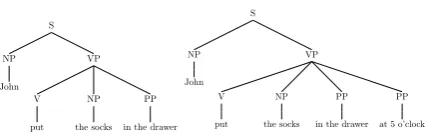
Figure 1: The VP’s in these sentences only share structure if we separate arguments from modifiers.
tion in syntax, however, there is a lack of consen-sus on the necessary and sufficient conditions for argumenthood (Sch¨utze, 1995; Sch¨utze and Gib-son, 1999). It remains unclear whether the argu-ment/modifier distinction is purely semantic or is also represented in syntax, whether it is binary or graded, and what effects argument/modifierhood have on the distribution of linguistic forms.
In this work, we take a new approach to these problems. We propose that the argument/modifier distinction is inferred on a phrase–by–phrase basis using probabilistic inference. Crucially, allowing the learner to separate the core argument structure of phrases from peripheral modifier content in-creases the generalizability of argument construc-tions. For example, the two sentences in Figure 1 intuitively share the same argument structures, but this overlap can only be identified if the preposi-tional phrase, “at 5 o’clock,” is treated as a modi-fier. Thus representing the argument/modifier dis-tinction can help the learner find useful argument structures which generalize robustly.
Although, like the majority of theorists, we agree that the argument/adjunct distinction is fun-damentally semantic, in this work we focus on its distributional correlates. Does the optionality of modifier phrases help the learner acquire lexical items with the right argument structure?
2 Approach
We adopt an approach where the lexicon consists of an inventory of stored tree fragments. These
tree fragments encode the necessary phrase types (i.e., arguments) that must be present in a struc-ture before it is complete. In this system,
sen-tences are generated by recursive substitution of
tree fragments at the frontier argument nodes of other tree fragments. This approach extends work on learning probabilistic Tree–Substitution Gram-mars (TSGs) (Post and Gildea, 2009; Cohn et al.,
2010; O’Donnell, 2011; O’Donnell et al., 2011).1
To model modification, we introduce a second
structure–building operation, adjunction. While
substitution must be licensed by the existence of an argument node, adjunction can insert con-stituents into well–formed trees. Many syntactic theories have made use of an adjunction operation to model modification. Here, we adopt the variant
known assister–adjunction(Rambow et al., 1995;
Chiang and Bikel, 2002) which can insert a con-stituent as the sister to any node in an existing tree. In order to derive the complete tree for a
sen-tence, starting from anSroot node, we recursively
sample arguments and modifiers as follows.2 For
every nonterminal node on the frontier of our derivation, we sample an elementary tree from our lexicon to substitute into this node. As already noted, these elementary trees represent the ment structure of our tree. Then, for each argu-ment nonterminal on the tree’s interior, we sister– adjoin one or more modifier nodes, which them-selves are built by the same recursive process.
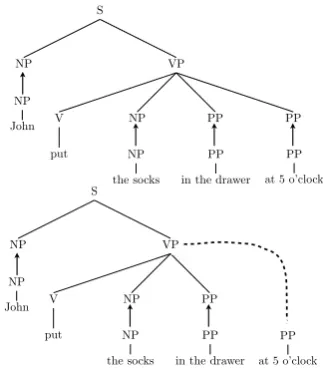
Figure 2 illustrates two derivations of the same tree, one in standard TSG without sister– adjunction, and one in our model. In the TSG derivation, at top, an elementary tree with four ar-guments – including the intuitively optional tem-poral PP – is used as the backbone for the deriva-tion. The four phrases filling these arguments are then substituted into the elementary tree, as indicated by arrows. In the bottom derivation, which uses sister–adjunction, an elementary tree with only three arguments is used as the back-bone. While the right-most temporal PP needed to be an argument of the elementary tree in the TSG derivation, the bottom derivation uses sister– adjunction to insert this PP as a child of the VP. Sister–adjunction therefore allows us to use an
ar-1Note that we depart from many discussions of argument
structure in that we do not require that every stored fragment has a head word. In effect, we allow completely abstract phrasal constructions to also have argument structures.
2Our generative model is related to the generative model
for Tree–Adjoining Grammars proposed in (Chiang, 2000)
S
NP
John
VP
V
put
NP
the socks PP
in the drawer PP
at 5 o’clock NP
John
NP the socks
PP in the drawer
PP at 5 o’clock S
NP
John
VP
V
put
NP
the socks PP
in the drawer PP
at 5 o’clock NP
John
NP the socks
PP at 5 o’clock PP
[image:2.595.337.499.60.246.2]in the drawer
Figure 2: The first part of the figure shows how to derive the tree in TSG, while the second part shows how to use sister-adjunction to derive the same tree in our model.
gument structure that matches the true argument structure of the verb “put.”
This figure illustrates how derivations in our model can have a greater degree of generalizabil-ity than those in a standard TSG. Sister–adjunction will be used to derive children which are not part of the core argument structure, meaning that a greater variety of structures can be derived by a combination of common argument structures and sister-adjoined modifiers. Importantly, this makes the learning problem for our model less sparse than for TSGs; our model can derive the trees in a corpus using fewer types of elementary trees than a TSG. As a result, the distribution over these ele-mentary trees is easier to estimate.
To understand what role modifiers play during learning, we will develop a learning model that can induce the lexicon and modifier contexts used by our generative model.
3 Model
For each nonterminalc, we define:
Gc|ac, bc, PE ∼PYP(ac, bc, PE(·|c)) (1)
e|c, Gc∼Gc, (2)
where PE(·|c) is a context free distribution over
elementary trees rooted atc, andeis an elementary
tree.
The context-free distribution over elementary
treesPE(e|c)is defined by:
PE(e|c) =
Y
i∈I(e)
(1−sci)
Y
f∈F(e)
scf
Y
c0→α∈e
Pc0(α|c0),
(3)
whereI(e)is the set of internal nodes ine,F(e)is
the set of frontier nodes,ciis the nonterminal
cat-egory associated with nodei, andscis the
proba-bility that we stop expanding at a nodec. For this
paper, the parametersscare set to 0.5.
In addition to defining a distribution over ele-mentary trees, we also define a distribution which governs modification via sister–adjunction. To sample a modifier, we first decide whether or not
to sister–adjoin into locationlin a tree. Following
this step, we sample a modifier category (e.g., a
PP) conditioned on the locationl’scontext: its
par-ent and left siblings. Because contexts are sparse, we use a backoff scheme based on hierarchical Dirichlet processes similar to the ngram backoff schemes defined in (Teh, 2006; Goldwater et al.,
2006). Letc be a nonterminal node in a tree
de-rived by substitution into argument positions. The
node c will have n ≥ 1 children derived by
ar-gument substitution: d0, ..., dn. In order to sister–
adjoin between two of these childrendi, di+1, we
recursively sample nonterminalssi,1, ..., si,k until
we hit a STOP symbol:
Pa(si,1, ..., si,k, ST OP|C0) (4)
= k
Y
j=1
Pa(si,j|Cj)·(1−PCj(ST OP))
·PCk+1(ST OP)
whereCj =d1, s1,1, ..., di, si,1, ..., si,j−1, cis the context for the j’th modifier between these chil-dren. The distribution over sister–adjoined non-terminals is defined using a hierarchical Dirichlet process to implement backoff in a prefix tree over
contexts. We define the distributionG(ql, ..., q1)
over sister–adjoined nonterminals si,j given the
contextql, ..., q1 by:
G(ql, ..., q1)∼DP(α, G(ql−1, ..., q1)). (5)
The distribution Gat the root of the hierarchy is
not conditioned on any prior context. We defineG
by:
G∼DP(α,Multinomial(m)) (6)
wheremis a vector with entries for each
nonter-minal, and where we samplem∼Dir(1,...,1).
To perform inference, we developed a local Gibbs sampler which generalizes the one proposed by (Cohn et al., 2010).
4 Results
We evaluate our model in two ways. First,
we examine whether representing the argu-ment/modifier distinction increases the ability of the model to learn highly generalizable elemen-tary trees that can be used as argument structures across a variety of sentences. Second, we ask whether our model is able to induce the correct argument/modifier distinction according to a lin-guistic gold–standard. We trained our model on sections 2–21 of the WSJ part of the Penn Tree-bank (Marcus et al., 1999). The model was trained on the trees in this corpus, without any further an-notations for substitution or modification.
To address the first question, we compared the structure of the grammar learned by our model to a grammar learned by a version of our model with-out sister–adjunction (i.e., a TSG similar to the one used in Cohn et al.). Our model should find more common structure among the trees in the in-put corpus, and therefore it should learn a set of el-ementary trees which are more complex and more widely shared across sentences. We evaluated this hypothesis by analyzing the average complexity of the most probable elementary trees learned by these models. As Table 1 shows, our model dis-covers elementary trees that have greater depth and more nodes than those found by the TSG. In addition, our model accounts for a larger portion of the corpus with fewer rules: the top 50, 100, and 200 most common elementary trees in our model’s lexicon account for a greater portion of the corpus than the corresponding sets in the TSG.
S
NP
Most of those who left stock funds ADVP
simply
VP
VP
VBD
switched
PP
into money market funds ADVP
simply
PP
into money market funds VBD
switched NP
[image:4.595.309.523.61.94.2]Most of those who left stock funds
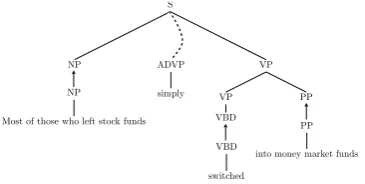
Figure 3: Part of a derivation found by our model.
Model Rank Avg tree
depth Avg treesize #Tokens
Modifier 50 1.59 3.42 97282
TSG 50 1.38 2.98 88023
Modifier 100 1.84 3.98 134205
TSG 100 1.58 3.38 116404
Modifier 200 1.97 4.27 170524
[image:4.595.90.273.62.154.2]TSG 200 1.77 3.84 146040
Table 1: This table shows the average depth and node count for elementary trees in our model and the TSG. The results are shown for the 50, 100, and 200 most frequent types of elementary trees.
node in the elementary tree; this wider elementary tree is much less common in the corpus.
We next examined whether our model learned to correctly identify modifiers in the corpus. Un-fortunately, marking for argument/modifiers in the Penn Treebank is incomplete, and is limited to certain adverbials, e.g. locative and temporal PP’s. To supplement this markup, we made use of the corpus of (Kaeshammer and Demberg, 2012). This corpus adds annotations indicating, for each node in the Penn Treebank, whether that node is a modifier. This corpus was compiled by com-bining information from Propbank (Palmer et al., 2005) with a set of heuristics, as well as the NP-branching structures proposed in (Vadas and Cur-ran, 2007). It is important to note that this corpus can only serve as a rough benchmark for evalua-tion of our model, as the heuristics used in its de-velopment did not always follow the correct lin-guistic analysis; the corpus was originally con-structed for an alternative application in compu-tational linguistics, for which non–linguistically– natural analyses were sometimes convenient. Our model was trained on this corpus, after it had been stripped of argument/modifier annotations.
We compare our model’s performance to a ran-dom baseline. Our model constrains every non-terminal to have at least one argument child, and our Gibbs sampler initializes argument/modifier choices randomly subject to this constraint. We
Model Precision Recall #Guessed #Correct Random 0.27 0.19 298394 82702 Modifier 0.62 0.15 108382 67516
Table 2: This table shows precision and recall in identifying modifier nodes in the corpus.
therefore calculated the probability that a node that was randomly initialized as a modifier was in fact a modifier, i.e. the precision of random ini-tialization. Next, we looked at the precision of our model following training. Table 2 shows that among nodes that were labeled as modifiers, 0.27
were labeled correctly before training and 0.62
were labeled correctly after. This table also shows the recall performance for our model decreased by 0.04. Some of this decrease is due to limitations of the gold standard; for example, our model learns to classify infinitives and auxiliary verbs as argu-ments — consistent with standard linguistic anal-yses — whereas the gold standard classifies these as modifiers. Future work will investigate how the metric used for evaluation can be improved.
5 Summary
We have investigated the role of the argu-ment/modifier distinction in learning. We first looked at whether introducing this distinction helps in generalizing from an input corpus. Our model, which represents modification using sister–adjunction, learns a richer lexicon than a model without modification, and its lexicon pro-vides a more compact representation of the in-put corpus. We next looked at whether the tra-ditional linguistic classification of arguments and modifiers can be induced from distributional in-formation. Without supervision from the correct labelings of modifiers, our model learned to iden-tify modifiers more accurately than chance. This suggests that although the argument/modifier dis-tinction is traditionally drawn without reference to distributional properties, the distributional corre-lates of this distinction are sufficient to partially reconstruct it from a corpus. Taken together, these results suggest that representing the difference be-tween arguments and modifiers may make it easier to acquire a language’s argument structure.
Acknowledgments
References
David Chiang and Daniel Bikel. 2002. Recovering latent information in treebanks. InProceedings of COLING 2002.
David Chiang. 2000. Staistical parsing with an automatically–extracted tree adjoining grammar. In
Proceedings of the 38th Annual Meeting of the Asso-ciation for Computational Linguistics. Association for Computational Linguistics.
Trevor Cohn, Phil Blunsom, and Sharon Goldwater. 2010. Inducing tree–substitution grammars. Jour-nal of Machine Learning Research, 11:3053–3096.
Sharon Goldwater, Thomas L. Griffiths, and Mark Johnson. 2006. Interpolating between types and to-kens by estimating power–law generators. In Ad-vances in Neural Information Processing Systems 18, Cambridge, Ma. MIT Press.
Liliane Haegeman. 1994. Government & Binding The-ory. Blackwell.
Mirian Kaeshammer and Vera Demberg. 2012. Ger-man and English treebanks and lexica for tree– adjoining grammars. InProceedings of the Interna-tional Conference on Language Resources and Eval-uation (LREC 2012).
Mitchell P. Marcus, Beatrice Santorini, Mary Ann Marcinkiewicz, and Ann Taylor. 1999. Treebank– 3. Technical report, Linguistic Data Consortium, Philadelphia.
Timothy J. O’Donnell, Jesse Snedeker, Joshua B. Tenenbaum, and Noah D. Goodman. 2011. Pro-ductivity and reuse in language. InProceedings of the 33rd Annual Conference of the Cognitive Science Society.
Timothy J. O’Donnell. 2011. Productivity and Reuse in Language. Ph.D. thesis, Harvard University.
Martha Palmer, P. Kingsbury, and Daniel Gildea. 2005. The proposition bank. Computational Linguistics, 31(1):71–106.
Matt Post and Daniel Gildea. 2009. Bayesian learning of a tree substitution grammar. InProceedings of the Joint Conference of the 47th Annual Meeting of the ACL and the 4th International Joint Conference on Natural Language Processing of the AFNLP.
Owen Rambow, K. Vijay-Shanker, and David Weir. 1995. D–tree grammars. In Proceedings of the 33rd annual meeting of the Association for Compu-tational Linguistics. Association for Computational Linguistics.
Ivan A. Sag, Thomas Wasow, and Emily M. Bender. 2003. Syntactic Theory: A Formal Introduction. CSLI, Stanford, CA, 2 edition.
Carson T Sch¨utze and Edward Gibson. 1999. Ar-gumenthood and english prepositional phrase at-tachment. Journal of Memory and Language, 40(3):409–431.
Carson T. Sch¨utze. 1995. PP attachment and argu-menthood. Technical report, Papers on language processing and acquisition, MIT working papers in linguistics, Cambridge, Ma.
Mark Steedman. 2001. The syntactic process. The MIT press.
Yee Whye Teh. 2006. A Bayesian interpretation of in-terpolated Kneser-Ney. Technical Report TRA2/06, National University of Singapore, School of Com-puting.